Charles Villet Monash South Africa Centre for Extra
- Slides: 36
Charles Villet (Monash South Africa) Centre for Extra Mural Studies, UCT 12 August 2017 Whiteness in Post-Apartheid South Africa: Still braaivleis, rugby, sunny skies and Chevrolet?
Charles Villet Faculty of Social and Health Sciences at Monash South Africa Lecturer in Philosophy Research interests: Work of Fanon and Foucault Postcolonialism Politics of Recognition Whiteness Studies Contact details: Email: charles. villet@monash. edu Phone: 011 950 4073 2
My doctoral project Problem of mutual recognition in post-Apartheid SA with focus on white identity Two theses: 1. Persistence of master-slave relation in SA 2. South Africa (and whiteness) as heterotopia Number of important ideas: Hegel: The master-slave dialectic Fanon: Misrecognition and the problem of violence Foucault: The space and experience of the heterotopia 3
Thesis 1: Persistence of the master-slave relation in daily life in SA Growing divide between rich and poor leads to new forms of mastery and slavery. Master-slave dialectic was present in the colonial context. Violence and racism was central to the dialectic. This continues into the postcolonial context as a historical continuity. Violence and racism still present. However: Also a socio-economic element. Result: More intricate experience of mastery & slavery. 4
Thesis 2: South Africa as an instance of the Foucaultian heterotopia Points to intricate experience of mastery & slavery Master and slave have fundamentally incommensurate experiences of everyday reality within the same place and space Dual experience of space: In a way, white and black but also rich and poor inhabit two different countries Experience of the same place is vastly different for white and black but also rich and poor Experience of radical otherness in everyday life 5
Master and slave: The problem of misrecognition Misrecognition: Simply put, not giving recognition to the other’s identity & freedom (Charles Taylor) Five characteristics: 1. Infliction of harm 2. A form of oppression 3. Provides the other with a false, distorted & reduced identity 4. Lack of due respect 5. Leads to self-hatred Examples of misrecognised groups: Women, blacks, aboriginal people (in Canada and the US) 6
An account of misrecognition: Hegel’s master & slave Phenomenology of Spirit / Mind (1807) Confrontation between two persons Demand for recognition from the other Life-and-death struggle follows The one that submits becomes the slave ▪ Recognized as an object to be exploited by the master for his labour ▪ Slave learns self-respect through his work 7
Hegel’s master & slave Paradox of the relation: Master: Remains dependent on the slave to be recognized as master Slave: Educates himself towards independence ▪ World around him is the result of his own handiwork (labour) Two outcomes: Perpetuation of relation by way of conflict ▪ Violence makes mutual recognition impossible Mediation through labour with the aim of mutual recognition ▪ Relation disappears Hegel’s account seems naïve in light of colonialism… 8
Fanon: Master & slave in the colonial context Black Skin, White Masks (1952) White master: Colonist, settler Black slave: Natives, indigenous or aboriginal people (First Peoples) Hegel’s model relevant, but inadequate within colonial context Hegel: Labour (work) sets the slave free Fanon: Not so in the colonies… 9
Fanon on colonial recognition No reciprocity: White master does not recognise himself in the slave Slave mirrors everything that is bad about humanity to the master Slave is seen as being inhuman Machine-animal-man: A thing that performs labour Self-recognition of white master only through seeing the other as being inhuman 10
Fanon on colonial recognition �Colonial recognition: 1. Slave is an instrument against which the master measures his own superiority 2. Slave enables master to realize his subjective security 3. Slave helps master in defining himself and the world 4. Slave is denied his individuality and liberty (freedom) 11
Fanon on colonial recognition How does the slave react to all of this: He wants to be like the master He wants to be the centre of attention How does the slave do this? Through violent means… Only way by which the slave can gain recognition from the master 12
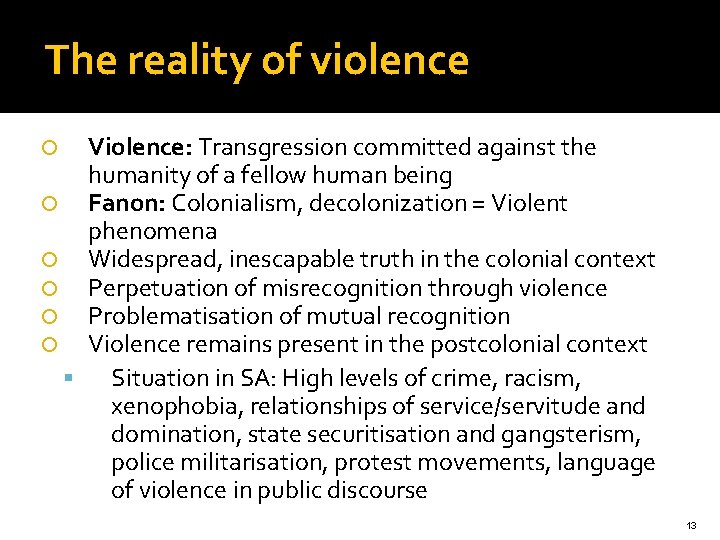
The reality of violence Violence: Transgression committed against the humanity of a fellow human being Fanon: Colonialism, decolonization = Violent phenomena Widespread, inescapable truth in the colonial context Perpetuation of misrecognition through violence Problematisation of mutual recognition Violence remains present in the postcolonial context Situation in SA: High levels of crime, racism, xenophobia, relationships of service/servitude and domination, state securitisation and gangsterism, police militarisation, protest movements, language of violence in public discourse 13
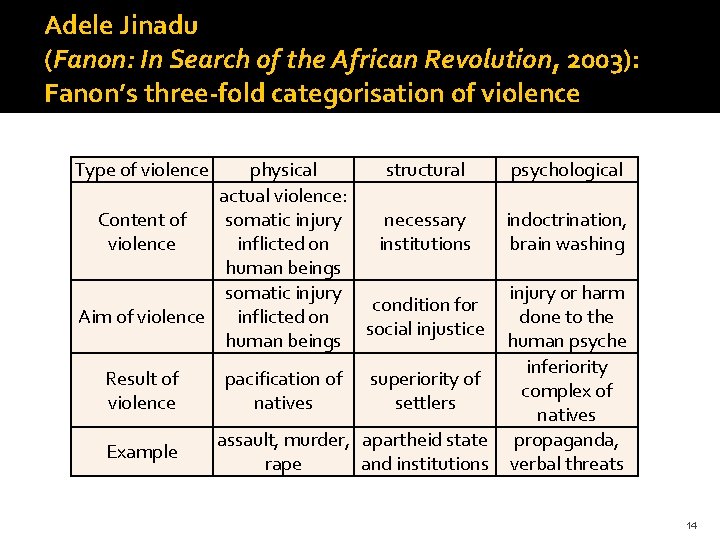
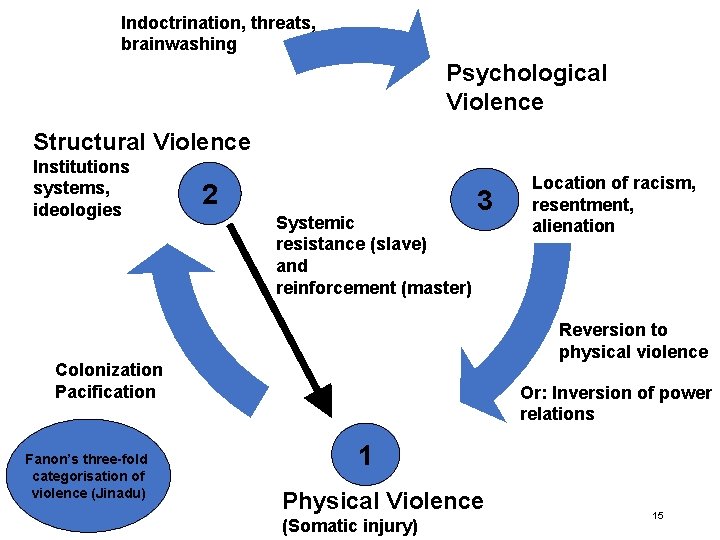
Adele Jinadu (Fanon: In Search of the African Revolution, 2003): Fanon’s three-fold categorisation of violence Type of violence physical structural actual violence: Content of somatic injury necessary violence inflicted on institutions human beings somatic injury condition for Aim of violence inflicted on social injustice human beings Result of violence Example psychological indoctrination, brain washing injury or harm done to the human psyche inferiority pacification of superiority of complex of natives settlers natives assault, murder, apartheid state propaganda, rape and institutions verbal threats 14
Indoctrination, threats, brainwashing Psychological Violence Structural Violence Institutions systems, ideologies 2 Systemic resistance (slave) and reinforcement (master) 3 Reversion to physical violence Colonization Pacification Fanon’s three-fold categorisation of violence (Jinadu) Location of racism, resentment, alienation Or: Inversion of power relations 1 Physical Violence (Somatic injury) 15
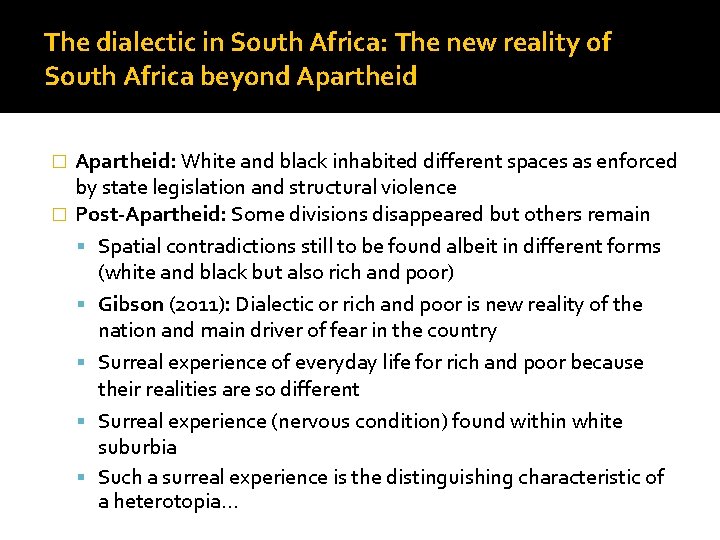
The dialectic in South Africa: The new reality of South Africa beyond Apartheid: White and black inhabited different spaces as enforced by state legislation and structural violence � Post-Apartheid: Some divisions disappeared but others remain Spatial contradictions still to be found albeit in different forms (white and black but also rich and poor) Gibson (2011): Dialectic or rich and poor is new reality of the nation and main driver of fear in the country Surreal experience of everyday life for rich and poor because their realities are so different Surreal experience (nervous condition) found within white suburbia Such a surreal experience is the distinguishing characteristic of a heterotopia… � 16
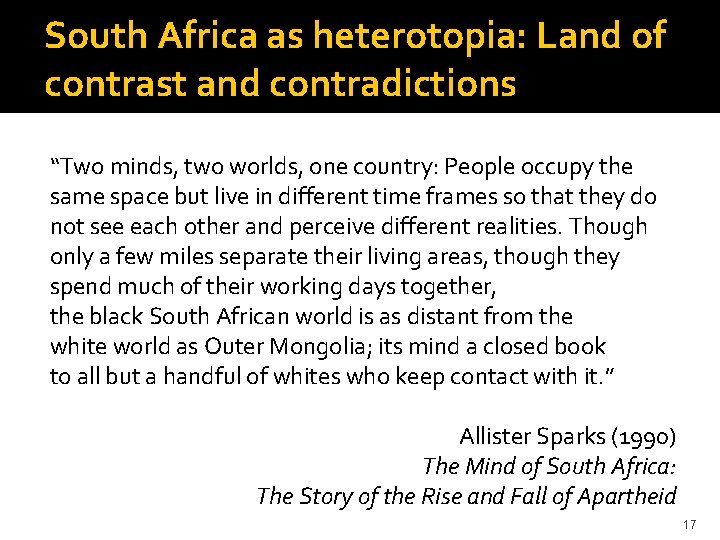
South Africa as heterotopia: Land of contrast and contradictions “Two minds, two worlds, one country: People occupy the same space but live in different time frames so that they do not see each other and perceive different realities. Though only a few miles separate their living areas, though they spend much of their working days together, the black South African world is as distant from the white world as Outer Mongolia; its mind a closed book to all but a handful of whites who keep contact with it. ” Allister Sparks (1990) The Mind of South Africa: The Story of the Rise and Fall of Apartheid 17
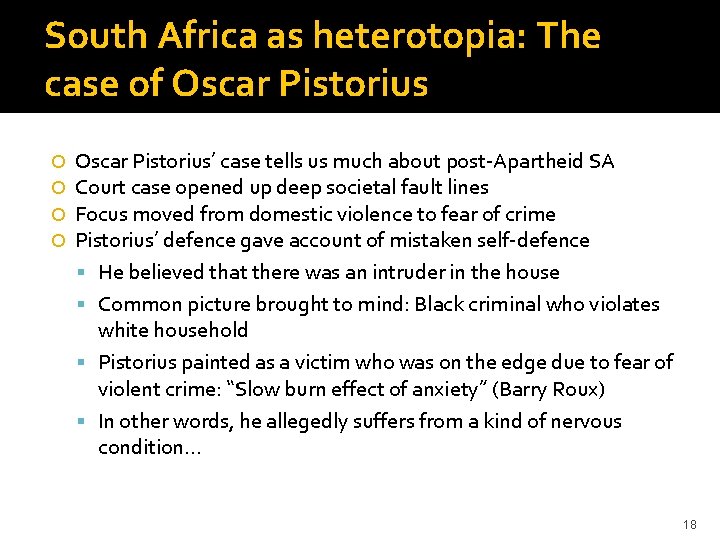
South Africa as heterotopia: The case of Oscar Pistorius Oscar Pistorius’ case tells us much about post-Apartheid SA Court case opened up deep societal fault lines Focus moved from domestic violence to fear of crime Pistorius’ defence gave account of mistaken self-defence He believed that there was an intruder in the house Common picture brought to mind: Black criminal who violates white household Pistorius painted as a victim who was on the edge due to fear of violent crime: “Slow burn effect of anxiety” (Barry Roux) In other words, he allegedly suffers from a kind of nervous condition… 18
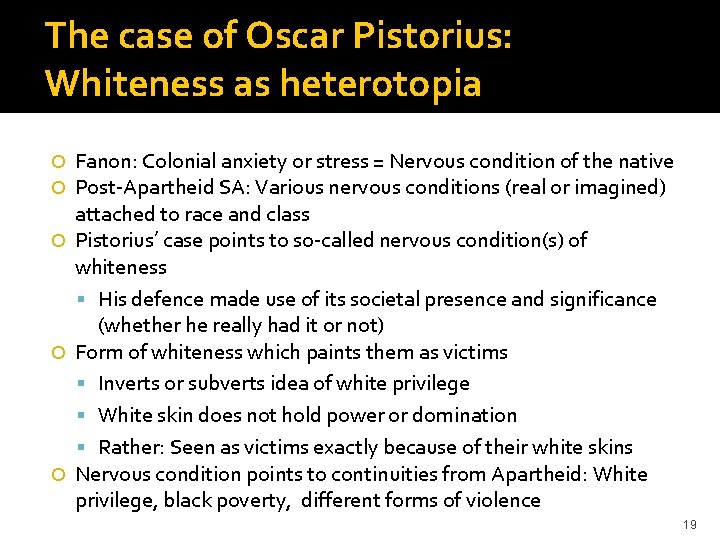
The case of Oscar Pistorius: Whiteness as heterotopia Fanon: Colonial anxiety or stress = Nervous condition of the native Post-Apartheid SA: Various nervous conditions (real or imagined) attached to race and class Pistorius’ case points to so-called nervous condition(s) of whiteness His defence made use of its societal presence and significance (whether he really had it or not) Form of whiteness which paints them as victims Inverts or subverts idea of white privilege White skin does not hold power or domination Rather: Seen as victims exactly because of their white skins Nervous condition points to continuities from Apartheid: White privilege, black poverty, different forms of violence 19
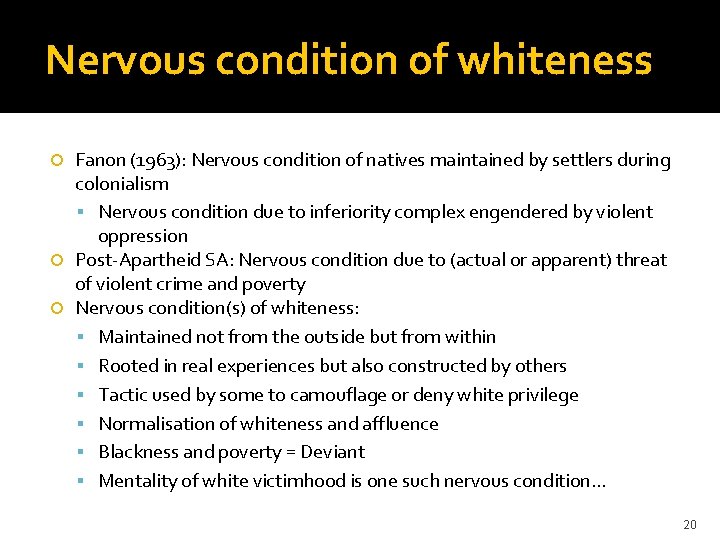
Nervous condition of whiteness Fanon (1963): Nervous condition of natives maintained by settlers during colonialism Nervous condition due to inferiority complex engendered by violent oppression Post-Apartheid SA: Nervous condition due to (actual or apparent) threat of violent crime and poverty Nervous condition(s) of whiteness: Maintained not from the outside but from within Rooted in real experiences but also constructed by others Tactic used by some to camouflage or deny white privilege Normalisation of whiteness and affluence Blackness and poverty = Deviant Mentality of white victimhood is one such nervous condition… 20
Mentality of white victimhood Apartheid fear of black violence remains Internalisation of farm murders and white poverty by white middle class to paint themselves as victims of the system Supremacist hyperbole = White genocide: Dangerous idea Breivik (Norway in 2011) and Roof (Charleston, S. C. in 2015): Invoked South African situation in their manifestos as “proof” that whites will become a persecuted minority in face of a Muslim (in Europe) or black (in US) onslaught Criminality attached to blackness or non-whiteness Notion of white persecution and annihilation 21
Whiteness as heterotopia Crisis of white identity in post-Apartheid SA Krog (2007): Afrikaners found themselves in a nervous condition during Apartheid Explore this nervous condition in white suburbia Make use of the Foucaultian idea of the heterotopia A kind of heuristic conceptual tool with which to understand the context of white suburbia and this nervous condition Whiteness as heterotopia is context of this nervous condition Siege mentality: The suburbs have become the laager ▪ Apartheid: Violence in townships, black homelands and Border War ▪ Post-Apartheid: White suburbia as site of violence 22
What is a heterotopia? 23 Foucault: Of Other Spaces (1984) 1. Space where the normal and accepted logic and rules of society are allowed to be suspended and things are done that are disallowed or unacceptable in “decent society” (OS: 24). ▪ Brothels, retirement homes, hospitals, theatres, cinemas, schools, prisons ▪ A useful definition for the colonial context 2. Designated space within or outside of society that functions as a kind of mirror to the state of affairs within society, be it as a mirror of perfection or imperfection (OS: 27). ▪ Religious colonies, prisons, psychiatric hospitals, schools, monuments, libraries, museums, zoological gardens ▪ A useful definition for the postcolonial context 23
Why use the idea of the heterotopia? � Could help to explain and understand nervous condition(s) �Show that there are real and constructed experiences � Demonstrates how the postcolonial context reveals a deviation from the original idea of the heterotopia � Foucault’s heterotopia: Narrow definition �Specific physical places �Pockets within or outside of society �Space where normalising processes are either not applicable or where they are actually dominant 24
Creolisation of the heterotopia Postcolonial deviation from Foucault’s original idea: � Racial experience as a kind of heterotopia � Daily experience of contradictions within this country � People’s experience of the same place could be so vast that one could say that they are living in different countries � Broader or extended idea of the heterotopia: � Multiple spatial experiences of the same place by different people � Morally problematic space = Nervous conditions � Could be ordinary but simply because of a normalisation of a compromised reality � Space where different forms of normalisation processes are (again) either absent or actually dominant � Thus: Heterotopia shows how normalisation works in a society… � 25
Normalisation in South Africa Foucault shows how identities can be inscribed from the inside and outside Fanon: Black body essentialised from the outside by white ideas and reactions SA heterotopia: Inscription of abnormality onto the black poor Due to normalisation of whiteness and affluence Abnormal = criminality, deviance, madness Objectification as reaction to the face of poverty Leads to “nervous conditions” for white and black as well as rich and poor Whites: Internal inscription of victimhood 26
Heterotopia in South Africa Heterotopia is about contradictions between social spaces (private and public) Connection and contact between radically different social spaces Simultaneous presence of utopia and dystopia (e. g. Rainbow Nation or Zim as worst case scenario) Complex struggle for recognition due to experience of radical otherness in everyday life Nature and dynamics of nervous condition of white victimhood becomes clearer through the prism of the heterotopia Provides a psychosocial analysis of the condition, which was what Fanon’s work also produced 27
The nervous condition of whiteness as heterotopia Aspects of the condition in this place: Place of crisis and deviance Existential insecurity and angst Home as space of safety and anxiety Multiple functions of public space Restricted accessibility to space Heterotopian mirror of contradistinctions 28
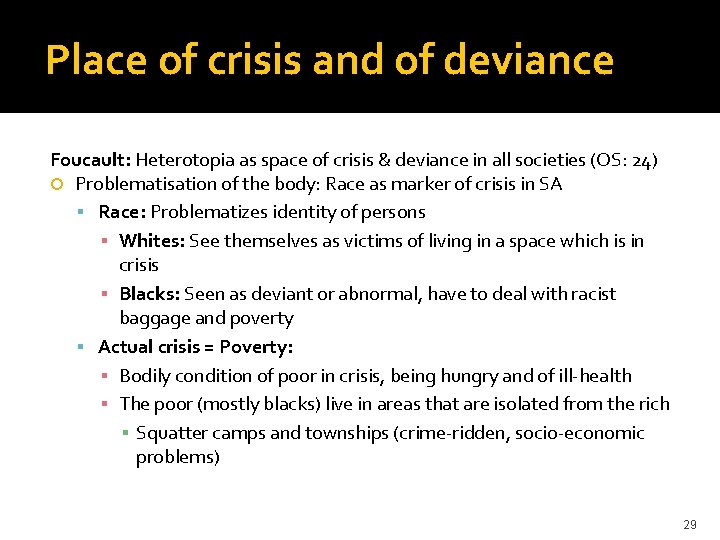
Place of crisis and of deviance Foucault: Heterotopia as space of crisis & deviance in all societies (OS: 24) Problematisation of the body: Race as marker of crisis in SA Race: Problematizes identity of persons ▪ Whites: See themselves as victims of living in a space which is in crisis ▪ Blacks: Seen as deviant or abnormal, have to deal with racist baggage and poverty Actual crisis = Poverty: ▪ Bodily condition of poor in crisis, being hungry and of ill-health ▪ The poor (mostly blacks) live in areas that are isolated from the rich ▪ Squatter camps and townships (crime-ridden, socio-economic problems) 29
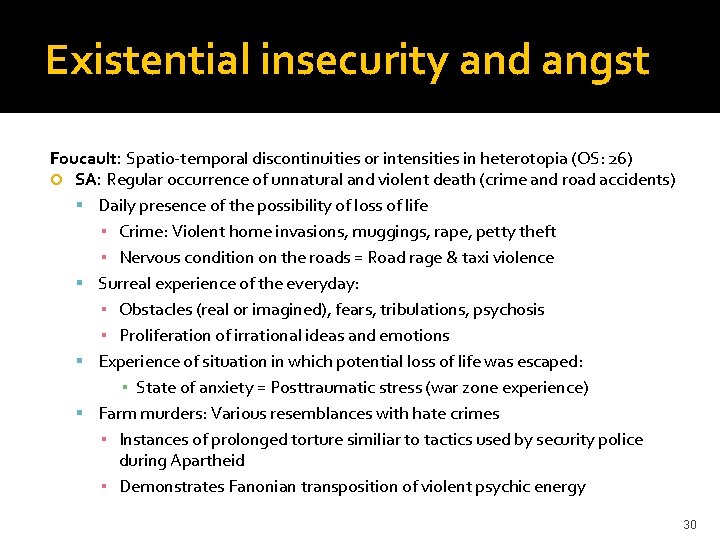
Existential insecurity and angst Foucault: Spatio-temporal discontinuities or intensities in heterotopia (OS: 26) SA: Regular occurrence of unnatural and violent death (crime and road accidents) Daily presence of the possibility of loss of life ▪ Crime: Violent home invasions, muggings, rape, petty theft ▪ Nervous condition on the roads = Road rage & taxi violence Surreal experience of the everyday: ▪ Obstacles (real or imagined), fears, tribulations, psychosis ▪ Proliferation of irrational ideas and emotions Experience of situation in which potential loss of life was escaped: ▪ State of anxiety = Posttraumatic stress (war zone experience) Farm murders: Various resemblances with hate crimes ▪ Instances of prolonged torture similiar to tactics used by security police during Apartheid ▪ Demonstrates Fanonian transposition of violent psychic energy 30
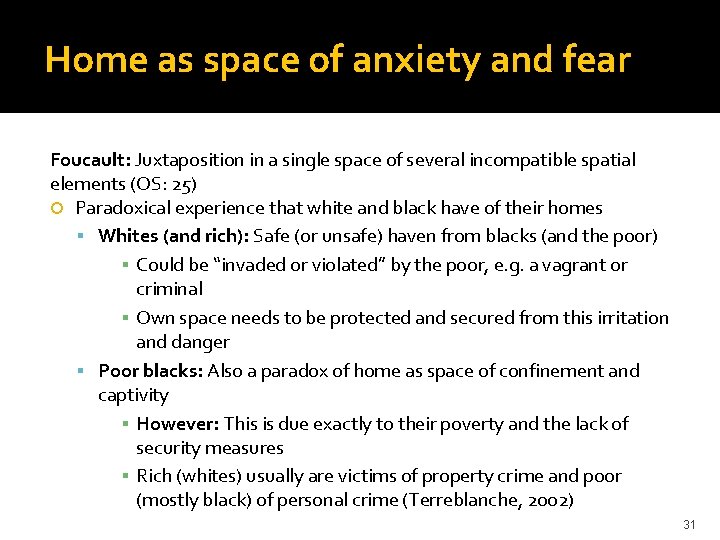
Home as space of anxiety and fear Foucault: Juxtaposition in a single space of several incompatible spatial elements (OS: 25) Paradoxical experience that white and black have of their homes Whites (and rich): Safe (or unsafe) haven from blacks (and the poor) ▪ Could be “invaded or violated” by the poor, e. g. a vagrant or criminal ▪ Own space needs to be protected and secured from this irritation and danger Poor blacks: Also a paradox of home as space of confinement and captivity ▪ However: This is due exactly to their poverty and the lack of security measures ▪ Rich (whites) usually are victims of property crime and poor (mostly black) of personal crime (Terreblanche, 2002) 31
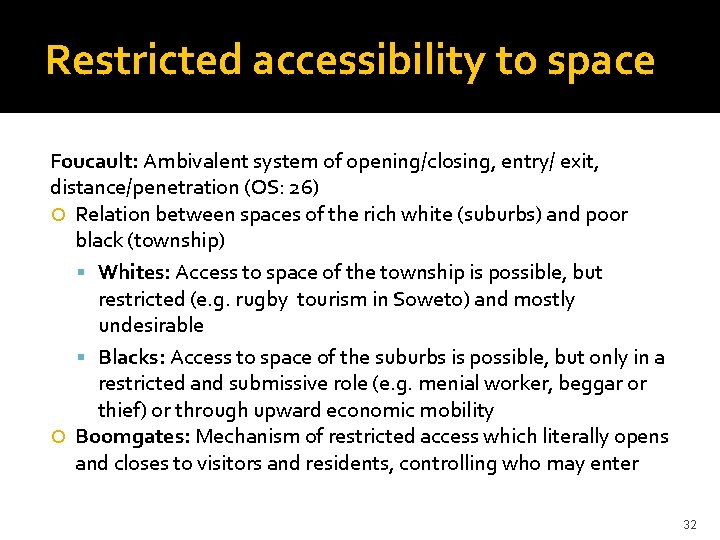
Restricted accessibility to space Foucault: Ambivalent system of opening/closing, entry/ exit, distance/penetration (OS: 26) Relation between spaces of the rich white (suburbs) and poor black (township) Whites: Access to space of the township is possible, but restricted (e. g. rugby tourism in Soweto) and mostly undesirable Blacks: Access to space of the suburbs is possible, but only in a restricted and submissive role (e. g. menial worker, beggar or thief) or through upward economic mobility Boomgates: Mechanism of restricted access which literally opens and closes to visitors and residents, controlling who may enter 32
Multiple functions of public space Foucault: Multiple functions and operations of space within the same society (OS: 25) Public space within SA has different functions for different people, depending on their race and economic status Function has also changed over time in the transition from Apartheid Public (or political) space give whites a different idea of themselves now Idea of whiteness has changed because of the mirror that society provides ▪ Apartheid heterotopia: Whites saw few blacks and even fewer beggars (due to pass laws and official segregation) ▪ Social problems were hidden from view then, now it is regularly seen 33
Heterotopian mirror of contradistinctions Foucault: Heterotopia has specific function in relation to other spaces as illusion or compensation (OS: 26) Whiteness is both invisible and visible: Invisible: Measure of state of society and an ideal to strive for Visible: Mirror of SA society reflects blackness to whites although in varying degrees “While one’s whiteness might still constitute the unacknowledged norm, as the invisibility thesis claims, that one is white rather than black is always present to oneself and others, barring an impressive feat of self-deception. ” (Vice, 2010) Mirror exposes whiteness as problem but this remains invisible: ▪ Blackness is viewed as the root of societal problems ▪ Whiteness seen as antidote to society’s problems 34
Concluding thoughts Heterotopia pertinent to a post-Apartheid understanding of Fanonian nervous conditions Shows that whiteness itself is a heterotopia of sorts Demonstrates a form of solastalgia (Albrecht, 2005): Change in people’s environment leads them to perceive themselves a victims E. g. Trump’s “Make America Great Again” Whites live in a reality that is perfect relative to the existential chaos of the reality of many blacks Whites think blackness is the problem but their own identity is greatly problematized Reality interrupted by the face of the poor black that they find at most traffic lights and street corners 35
Concluding thoughts Contra-realities: Existential tension between the “different countries” inhabited by white & black Euro-African fabric of society (Comaroff, 2012) Crisis of European Man (Gordon, 1995) also the crisis of African Man Objectification of blacks according to constructed truths (criminality, deviance, abnormality) Actual experiences (trauma) but also constructed truths at the root of the mentality of white victimhood Main factor behind vilification of the black other, in other words the intruder in Pistorius’ house… 36