Chapter 6 The Definite Integral Copyright 2014 2010
- Slides: 15
Chapter 6 The Definite Integral Copyright © 2014, 2010, 2007 Pearson Education, Inc.
Chapter Outline • Antidifferentiation • The Definite Integral and Net Change of a Function • The Definite Integral and Area under a Graph • Areas in the xy-Plane • Applications of the Definite Integral Copyright © 2014, 2010, 2007 Pearson Education, Inc.
Section 6. 1 Antidifferentiation Copyright © 2014, 2010, 2007 Pearson Education, Inc.
Section Outline • Antidifferentiation • Finding Antiderivatives • Theorems of Antidifferentiation • The Indefinite Integral • Rules of Integration • Antiderivatives in Application Copyright © 2014, 2010, 2007 Pearson Education, Inc.
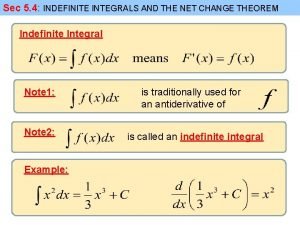
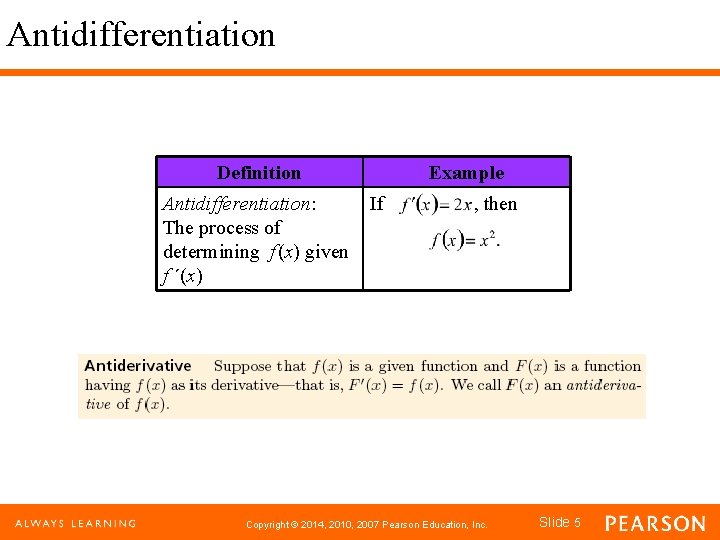
Antidifferentiation Definition Antidifferentiation: The process of determining f (x) given f ΄(x) Example If , then Copyright © 2014, 2010, 2007 Pearson Education, Inc. Slide 5
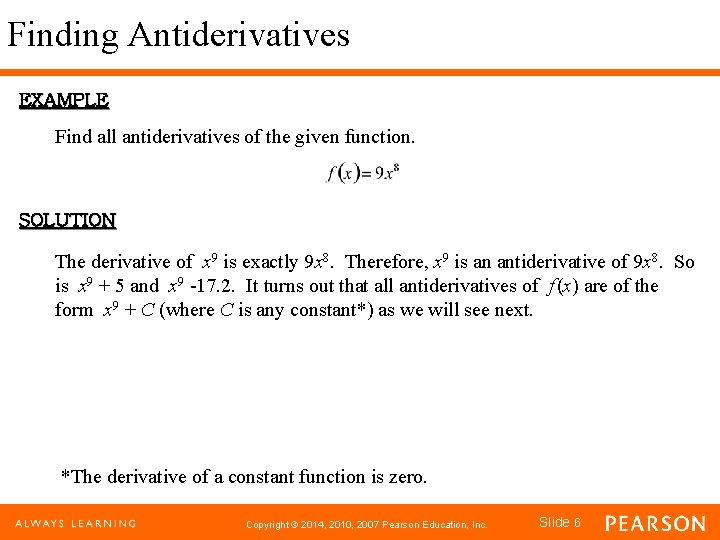
Finding Antiderivatives EXAMPLE Find all antiderivatives of the given function. SOLUTION The derivative of x 9 is exactly 9 x 8. Therefore, x 9 is an antiderivative of 9 x 8. So is x 9 + 5 and x 9 -17. 2. It turns out that all antiderivatives of f (x) are of the form x 9 + C (where C is any constant*) as we will see next. *The derivative of a constant function is zero. Copyright © 2014, 2010, 2007 Pearson Education, Inc. Slide 6
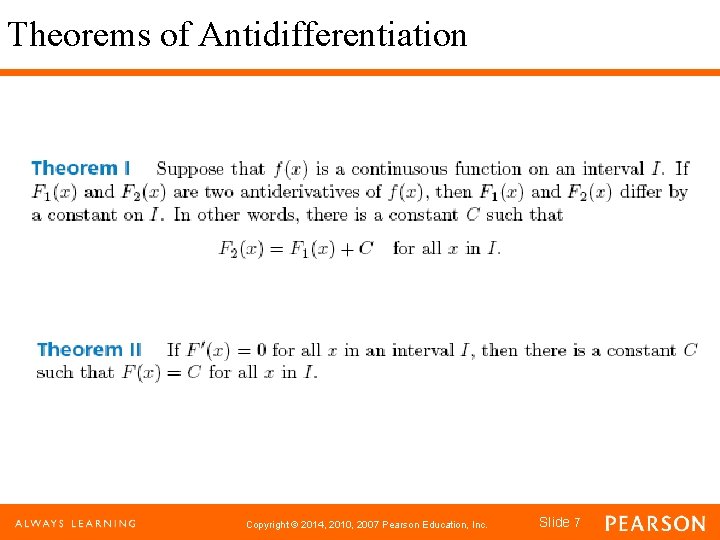
Theorems of Antidifferentiation Copyright © 2014, 2010, 2007 Pearson Education, Inc. Slide 7
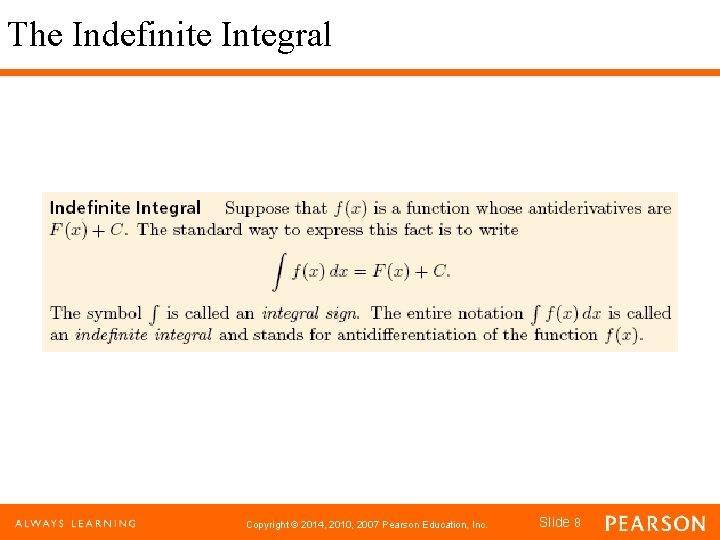
The Indefinite Integral Copyright © 2014, 2010, 2007 Pearson Education, Inc. Slide 8
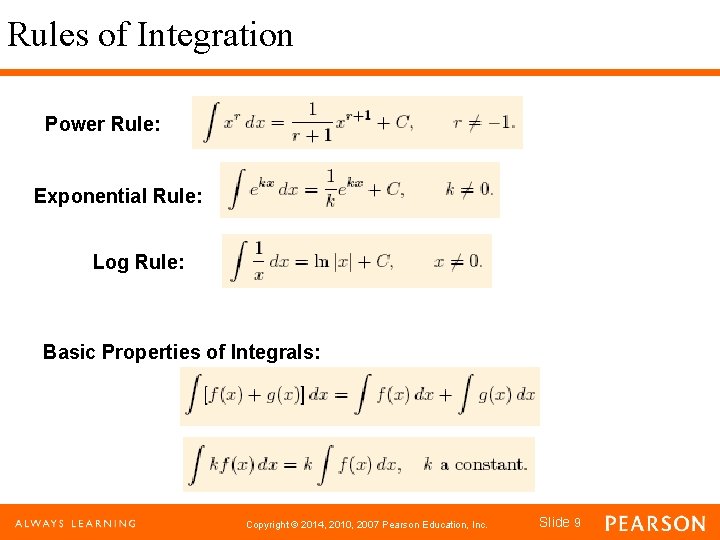
Rules of Integration Power Rule: Exponential Rule: Log Rule: Basic Properties of Integrals: Copyright © 2014, 2010, 2007 Pearson Education, Inc. Slide 9
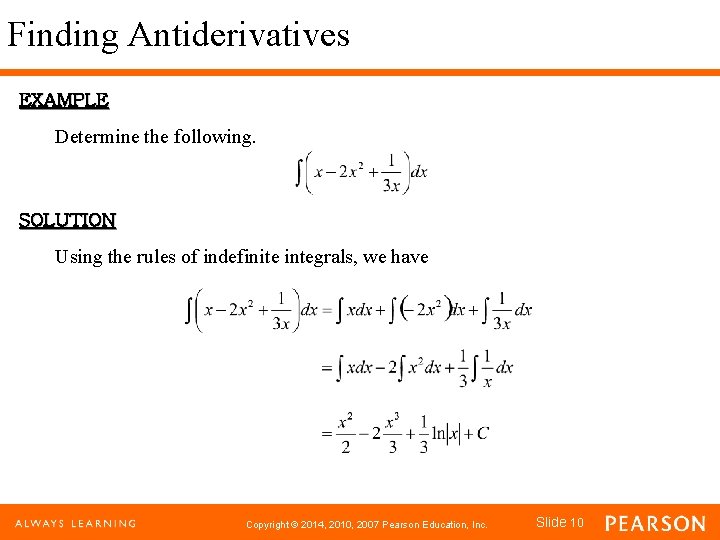
Finding Antiderivatives EXAMPLE Determine the following. SOLUTION Using the rules of indefinite integrals, we have Copyright © 2014, 2010, 2007 Pearson Education, Inc. Slide 10
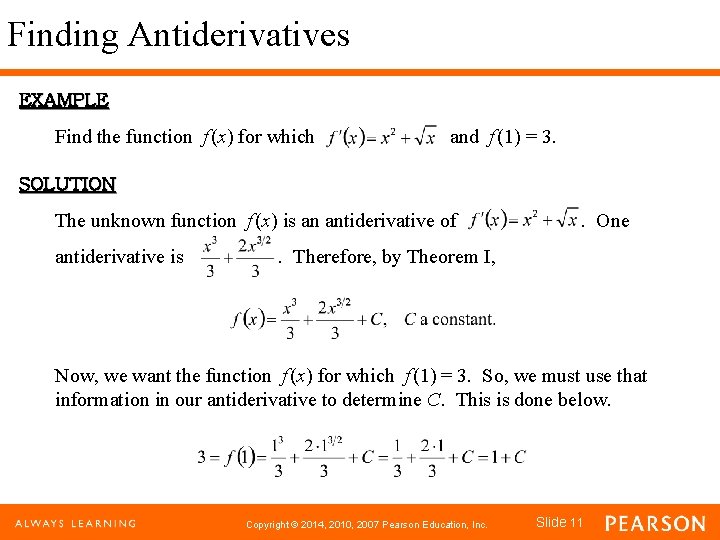
Finding Antiderivatives EXAMPLE Find the function f (x) for which and f (1) = 3. SOLUTION The unknown function f (x) is an antiderivative of antiderivative is . One . Therefore, by Theorem I, Now, we want the function f (x) for which f (1) = 3. So, we must use that information in our antiderivative to determine C. This is done below. Copyright © 2014, 2010, 2007 Pearson Education, Inc. Slide 11
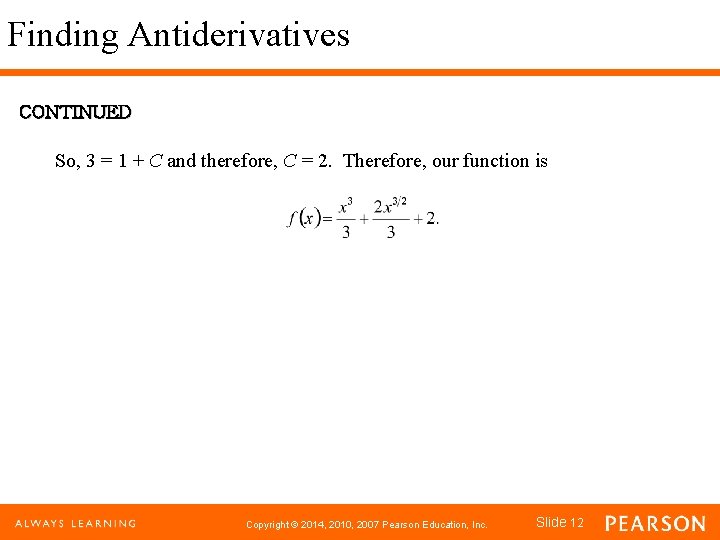
Finding Antiderivatives CONTINUED So, 3 = 1 + C and therefore, C = 2. Therefore, our function is Copyright © 2014, 2010, 2007 Pearson Education, Inc. Slide 12
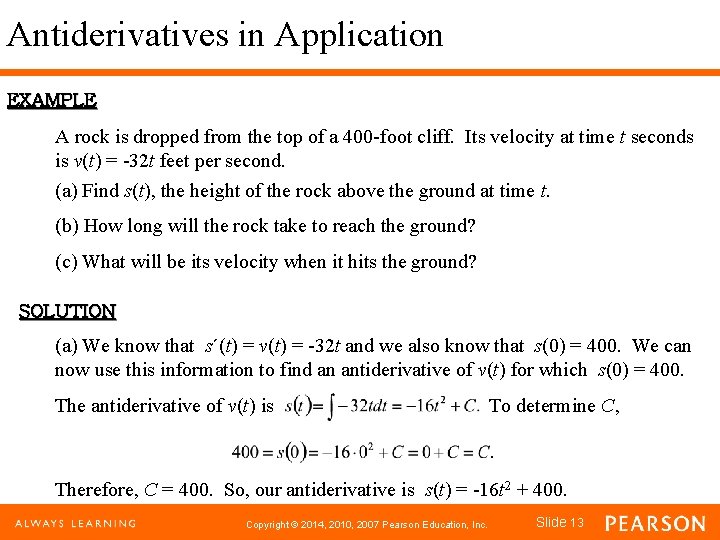
Antiderivatives in Application EXAMPLE A rock is dropped from the top of a 400 -foot cliff. Its velocity at time t seconds is v(t) = -32 t feet per second. (a) Find s(t), the height of the rock above the ground at time t. (b) How long will the rock take to reach the ground? (c) What will be its velocity when it hits the ground? SOLUTION (a) We know that s΄(t) = v(t) = -32 t and we also know that s(0) = 400. We can now use this information to find an antiderivative of v(t) for which s(0) = 400. The antiderivative of v(t) is To determine C, Therefore, C = 400. So, our antiderivative is s(t) = -16 t 2 + 400. Copyright © 2014, 2010, 2007 Pearson Education, Inc. Slide 13
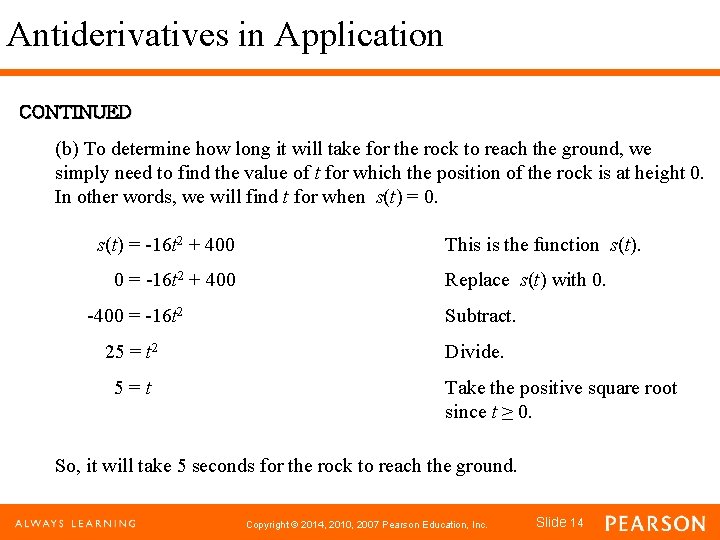
Antiderivatives in Application CONTINUED (b) To determine how long it will take for the rock to reach the ground, we simply need to find the value of t for which the position of the rock is at height 0. In other words, we will find t for when s(t) = 0. s(t) = -16 t 2 + 400 0 = -16 t 2 + 400 -400 = -16 t 2 25 = t 2 5=t This is the function s(t). Replace s(t) with 0. Subtract. Divide. Take the positive square root since t ≥ 0. So, it will take 5 seconds for the rock to reach the ground. Copyright © 2014, 2010, 2007 Pearson Education, Inc. Slide 14
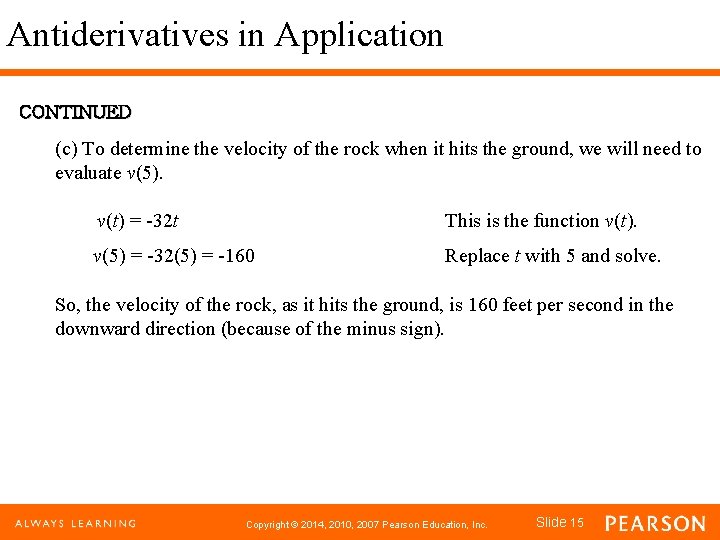
Antiderivatives in Application CONTINUED (c) To determine the velocity of the rock when it hits the ground, we will need to evaluate v(5). v(t) = -32 t This is the function v(t). v(5) = -32(5) = -160 Replace t with 5 and solve. So, the velocity of the rock, as it hits the ground, is 160 feet per second in the downward direction (because of the minus sign). Copyright © 2014, 2010, 2007 Pearson Education, Inc. Slide 15