Chapter 5 Anxiety Disorders PANIC DISORDER Description with

- Slides: 30
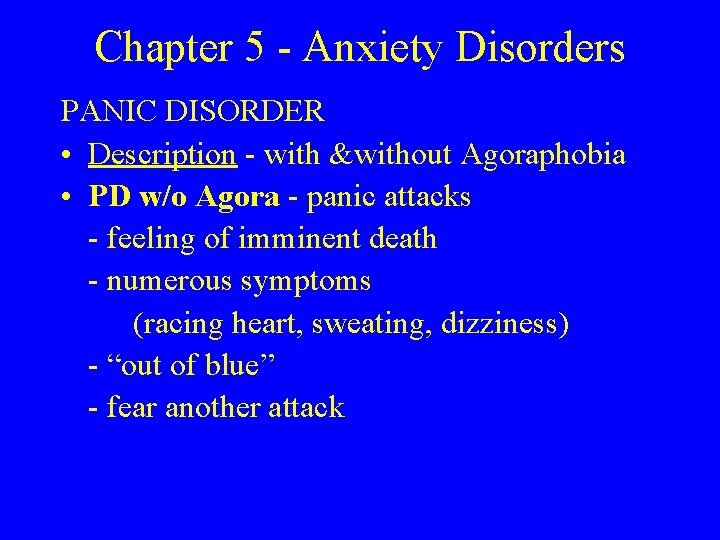
Chapter 5 - Anxiety Disorders PANIC DISORDER • Description - with &without Agoraphobia • PD w/o Agora - panic attacks - feeling of imminent death - numerous symptoms (racing heart, sweating, dizziness) - “out of blue” - fear another attack
• PD w/Agora - avoid certain situations - embarrassment, lack of help - Rare - More in women Tx implications? involve spouse, decrease aid
Possible Causes • Psychodynamic: - anxiety from sexual/aggressive impulses leaking • Cognitive: - Hypersensitive to internal states - Misinterpret symptoms - Perceive danger
Behavioral: Classical conditioning • Panic attack (US) -> fear (UR) • Associate place (CS) with panic attack • Public place (CS) -> fear (CR) (embarrassment, lack of assistance) Agoraphobia = stimulus generalization (all places like 1 st place)
Biological • genetic sensitivity – overactive BAS • hyperventilation causes symptoms
Panic Treatment Psychodynamic • Uncover conflict Cognitive • Breathing retraining & relaxation • Self-statements & reappraisal of fears Biological • Mild tranquilizers (Xanax)
Behavioral • Systematic desensitization • Barlow: gradual exposure to panic symptoms until fear decreases
Phobias Description • Fear specific object or situation • No threat or threat is exaggerated • Common fears, but heightened • Phobia = impairs your life
Specific Phobias • fear of specific situation/object • animal, nature (childhood) • blood-injection-injury • ~11%
Social Phobia • fear of being judged/embarrassed in social situations • 3 -13%
Agoraphobia • fear situations/public places • something bad might happen • fear panic but no actual attacks • avoid situation
Possible Causes Psychodynamic • Projection of own impulses onto object • Avoid object to reduce anxiety & keep impulse out of awareness Cognitive • Catastrophize
Behavioral: Mowrer’s 2 -Factor Theory • 1 st = fear is classically conditioned • 2 nd = fear maintained by operant conditioning - avoid situation = avoid punishment (negative reinforcement)
• Preparedness - biologically prepared to fear certain stimuli harmful to ancestors - harder to unlearn these phobias
Treatment • Best is behavioral (esp. specific phobia) - Exposure to feared situation/object - Learn that it is not so frightening - Extinguish link of CS -> CR - Imaginal vs. in vivo exposure - Gradual (systematic) or flooding - Relax vs. not during exposure
Obsessive-Compulsive Disorder (OCD) Description • Anxiety if do not perform certain actions Anxiety from certain thoughts • Actions are pointless, often embarrassing
• Obsessions - meaningless, troublesome thoughts that cannot stop • Compulsions - meaningless acts person feels forced to repeat
Possible Causes Psychodynamic • Obsessions = unconscious impulses • Compulsions = behaviors that keep impulses unconscious Cognitive • Irrational beliefs: perfectionism & seeking approval of others
Behavioral • Obsessions -> anxiety compulsions reduce anxiety • Modeling
Treatment • Systematic desensitization + response prevention - Expose to thoughts and prevent behavior - Tolerate thoughts until anxiety decreases • Medication — SSRIs
Post-Traumatic Stress Disorder (PTSD) Description • Extreme anxiety related to specific trauma • Trauma is “outside the normal range of human experience”
Symptoms • Intrusive thoughts: reliving event • Avoid reminders • Emotional numbness • Hypervigilance • Dissociation - detachment from self & surroundings
1. Acute Stress Disorder - lasts a few weeks 2. Post-Traumatic Stress Disorder >1 month
Possible Causes Cognitive • Appraising threat as extremely traumatic Biological • Sympathetic NS
Behavioral • Classical conditioning - environment becomes conditioned stimuli for PTSD response • Stimulus generalization - cues that resemble original situation trigger PTSD
Treatment • Systematic Desensitization - progressive exposure, imaginal or in vivo • Flooding - imagine worst-case scene - multiple times until anxiety decreases • Disagreement about flooding for trauma
Generalized Anxiety Disorder (GAD) Description • continual anxiety over everything • “catch-all” vs. true disorder
Possible Causes Cognitive • General tendency to catastrophize, perceive threat Behavioral • Worrying modeled/reinforced
Biological Genetic predisposition + decreased GABA • GABA = inhibits firing • Less GABA=more firing
Treatment Behavioral • Relaxation exercises (deep breathing, progressive muscle) Cognitive • Discover & retrain automatic thoughts Biological • Medications to stimulate GABA