
Mental Health NursingNUR 413 Lecture 8 Anxiety Disorders
- Slides: 13
Mental Health Nursing-NUR 413 Lecture 8 Anxiety Disorders
Outline § What is Anxiety? § What are the different types of anxiety disorders? § What are the causes? § What are the treatments?
Anxiety Disorders § Anxiety is a feeling of apprehension or fear. The source of this uneasiness is not always known or recognized. § Anxiety disorders are a group of psychiatric conditions that involve excessive anxiety. § Anxiety may be differentiated from fear in that the former is an emotional process, whereas fear is cognitive. § More common in women than men § Also occurs in children
Anxiety Disorders (cont. ) § Anxiety disorders most common type of all psychiatric illnesses § Anxiety provides the motivation for achievement, a necessary force for survival. § May be considered abnormal if § Anxiety is out of proportion to the situation that is creating it § Anxiety interferes with social, occupational, or other important areas of functioning
Types of Anxiety Disorders § Generalized anxiety disorder § Panic Disorder § Obsessive-Compulsive Disorder § Post-Traumatic Stress Disorder § Social Phobias § Specific Phobias
Generalized anxiety disorder § Feelings of constant apprehension and a general tendency to be worried about any areas of life (for example, health, work, and finances). § This constant worry affects daily functioning and can cause physical symptoms.
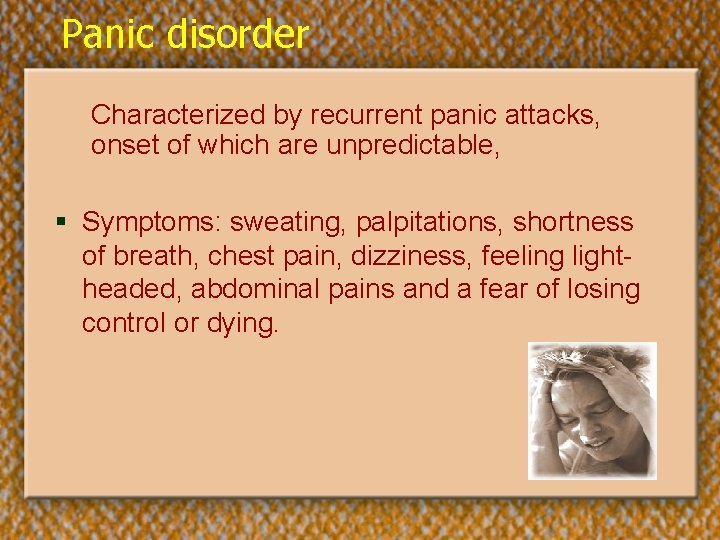
Panic disorder Characterized by recurrent panic attacks, onset of which are unpredictable, § Symptoms: sweating, palpitations, shortness of breath, chest pain, dizziness, feeling lightheaded, abdominal pains and a fear of losing control or dying.
Obsessive-Compulsive Disorder (OCD) § Recurrent obsessions (thoughts) or compulsions (actions) that are severe enough to be time-consuming or to cause marked distress or significant impairment Examples: § Cleaning. Repeatedly washing their hands, showering, or constantly cleaning their home § Checking. Individuals may check several or even hundreds of times to make sure that doors are locked
Post-Traumatic Stress Disorder § A reaction to a serious traumatic event (such as a car accident, natural disaster, physical abuse or sexual abuse) in which the person was extremely afraid or seriously injured.
Social Phobias § Excessive fear of situations in which the person might do something embarrassing or be evaluated negatively by others § Examples: Ø public speaking Ø attending and participating in class Ø meeting new people Ø eating, drinking, or writing in public Ø using public bathrooms Ø shopping
Specific Phobias § Marked, persistent, and excessive or unreasonable fear when in the presence of, or when anticipating, an encounter with a specific object or situation § Examples: Ø Animal type. ex: fear of spiders Ø Natural environment type. ex: fear of water Ø Blood injection, injury type. ex: fear of blood
Causes of anxiety disorders § Caused by a combination of biological, psychological and social factors. § May develop as a result of a major stressor such as the death of a loved one, divorce and loss of a job § There also appears to be a major genetic component
Treatment Modalities § § Individual psychotherapy Cognitive therapy Group/family therapy Psychopharmacology § Antidepressants § Anxiolytics § Antihypertensive § Others