Chapter 4 Quiz Define terms 1 2 3
- Slides: 26
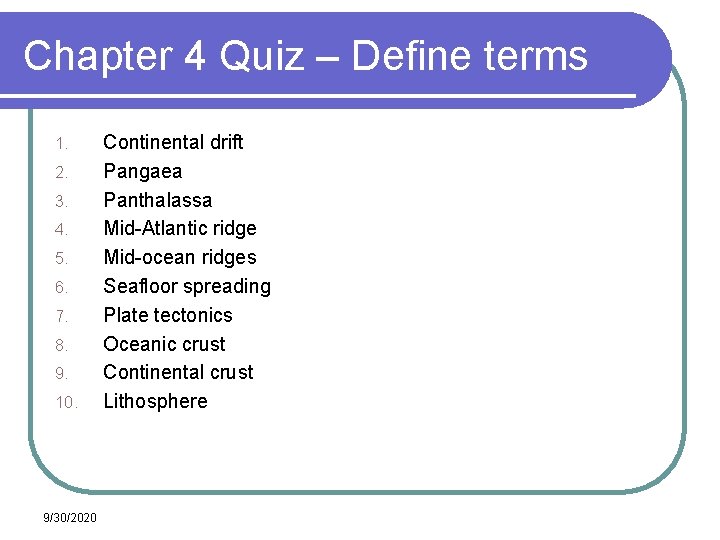
Chapter 4 Quiz – Define terms 1. 2. 3. 4. 5. 6. 7. 8. 9. 10. 9/30/2020 Continental drift Pangaea Panthalassa Mid-Atlantic ridge Mid-ocean ridges Seafloor spreading Plate tectonics Oceanic crust Continental crust Lithosphere
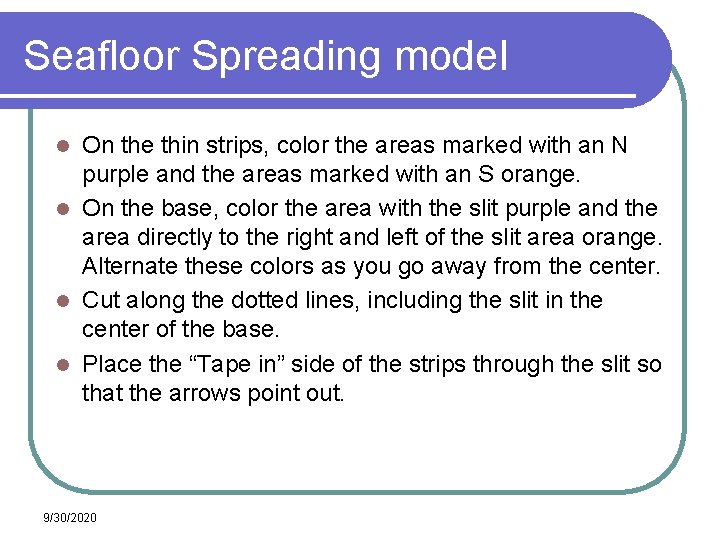
Seafloor Spreading model On the thin strips, color the areas marked with an N purple and the areas marked with an S orange. l On the base, color the area with the slit purple and the area directly to the right and left of the slit area orange. Alternate these colors as you go away from the center. l Cut along the dotted lines, including the slit in the center of the base. l Place the “Tape in” side of the strips through the slit so that the arrows point out. l 9/30/2020
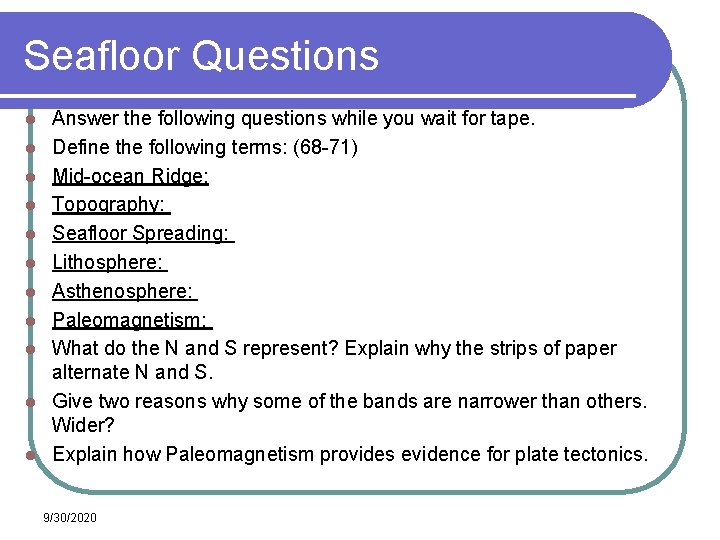
Seafloor Questions l l l Answer the following questions while you wait for tape. Define the following terms: (68 -71) Mid-ocean Ridge: Topography: Seafloor Spreading: Lithosphere: Asthenosphere: Paleomagnetism: What do the N and S represent? Explain why the strips of paper alternate N and S. Give two reasons why some of the bands are narrower than others. Wider? Explain how Paleomagnetism provides evidence for plate tectonics. 9/30/2020
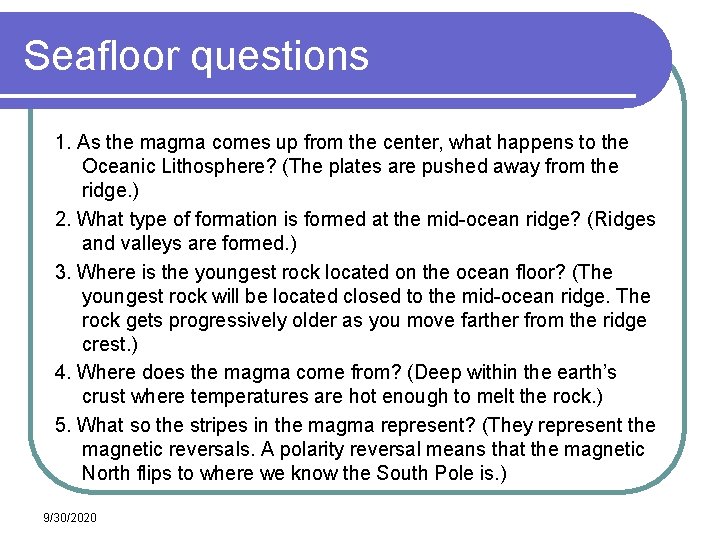
Seafloor questions 1. As the magma comes up from the center, what happens to the Oceanic Lithosphere? (The plates are pushed away from the ridge. ) 2. What type of formation is formed at the mid-ocean ridge? (Ridges and valleys are formed. ) 3. Where is the youngest rock located on the ocean floor? (The youngest rock will be located closed to the mid-ocean ridge. The rock gets progressively older as you move farther from the ridge crest. ) 4. Where does the magma come from? (Deep within the earth’s crust where temperatures are hot enough to melt the rock. ) 5. What so the stripes in the magma represent? (They represent the magnetic reversals. A polarity reversal means that the magnetic North flips to where we know the South Pole is. ) 9/30/2020
l 4. Where does the magma come from? (Deep within the earth’s crust where l temperatures are hot enough to melt the rock. ) l 5. What so the stripes in the magma represent? (They represent the magnetic l reversals. A polarity reversal means that the magnetic North flips to where we l know the South Pole is. ) 9/30/2020
Essential Question I will be able to write a summary of plate tectonics. l Warm up l Explain how paleomagnetism proves seafloor spreading l Exit Task l What is a microplate terrane l Homework l Study for chapter 4 test l Extra credit due Friday pages 78 -79 l 9/30/2020
Chapter 4 Vocabulary – define and give one fact 1. 2. 3. 4. 5. 6. 7. 8. 9. 10. 11. 12. 9/30/2020 Continental drift Pangaea Panthalassa Mid-Atlantic ridge Mid-ocean ridges Seafloor spreading Plate tectonics Oceanic crust Continental crust Lithosphere Divergent boundary Rift valley 13. 14. 15. 16. 17. 18. 19. 20. 21. 22. Asthenosphere Convergent boundary Subduction zone Ocean Trench Island arc Transformation boundary Convection current Theory of Micro plate terranes
Chapter 4 Standards Plate tectonics operating over geologic time has changed the patterns of land, sea, and mountains on Earth's surface. As the basis for understanding this concept: l l l 9/30/2020 Students know features of the ocean floor (magnetic patterns, age, and sea-floor topography) provide evidence of plate tectonics. Students know the principal structures that form at the three different kinds of plate boundaries.
4. 1 notes objectives l Explain Wegener’s hypothesis of continental drift l List evidence for Wegener’s hypothesis of continental drift l Describe seafloor spreading 9/30/2020
Explain Wegener’s hypothesis of Continental Drift 9/30/2020
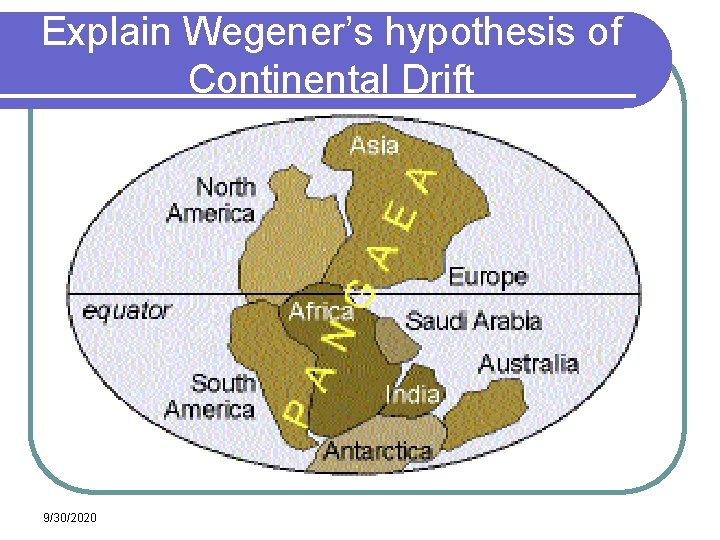
Explain Wegener’s hypothesis of Continental Drift l Continental Drift – Hypothesis by Alfred Wegener in 1912 that states continents had moved l Introduced the concept of Pangaea - Which means all land l Panthalassa – Which means all sea l Provided the first evidence of continental drift l 9/30/2020
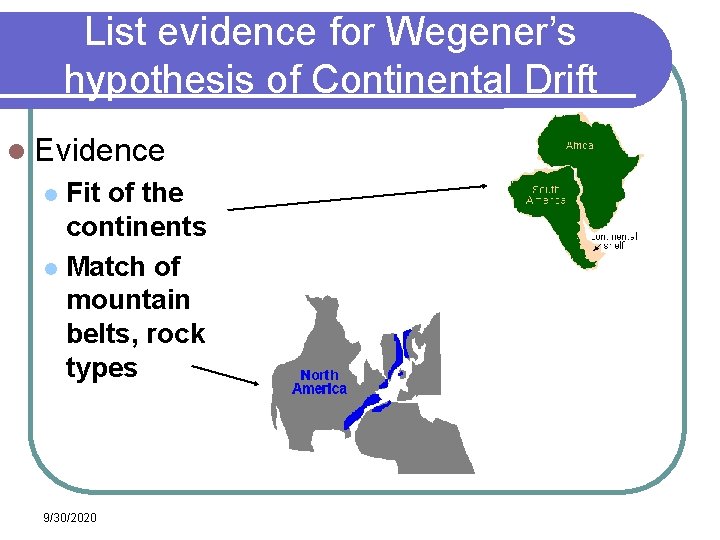
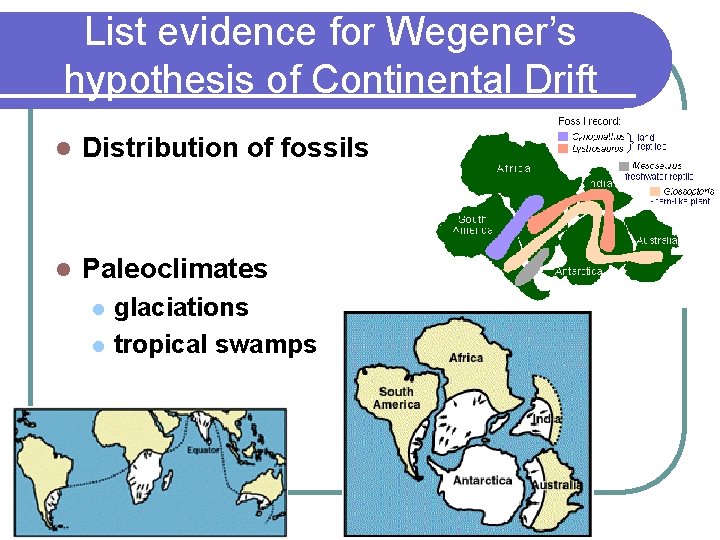
List evidence for Wegener’s hypothesis of Continental Drift l Evidence Fit of the continents l Match of mountain belts, rock types l 9/30/2020
List evidence for Wegener’s hypothesis of Continental Drift l Distribution of fossils l Paleoclimates l l 9/30/2020 glaciations tropical swamps
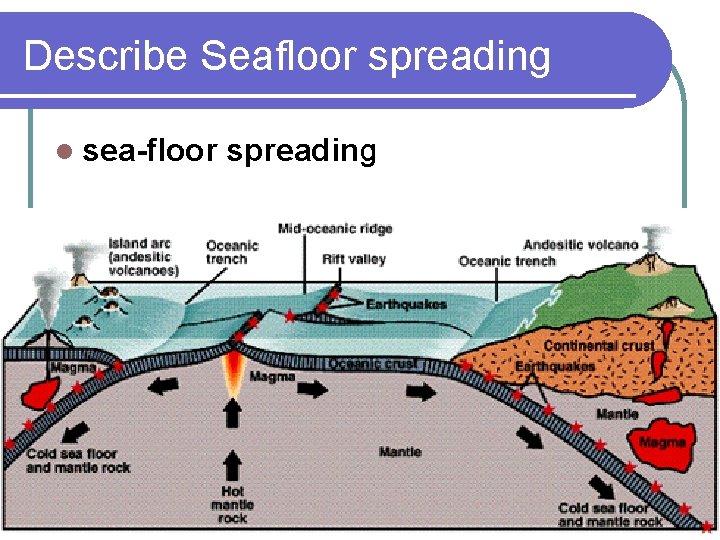
Describe Seafloor spreading l sea-floor 9/30/2020 spreading
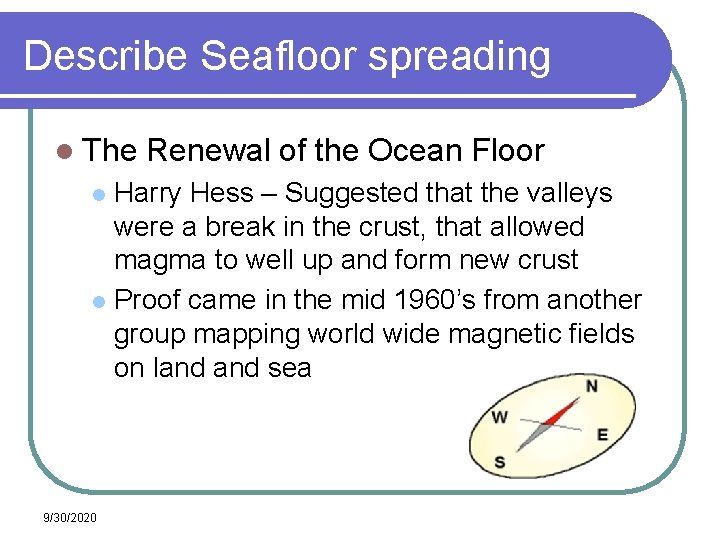
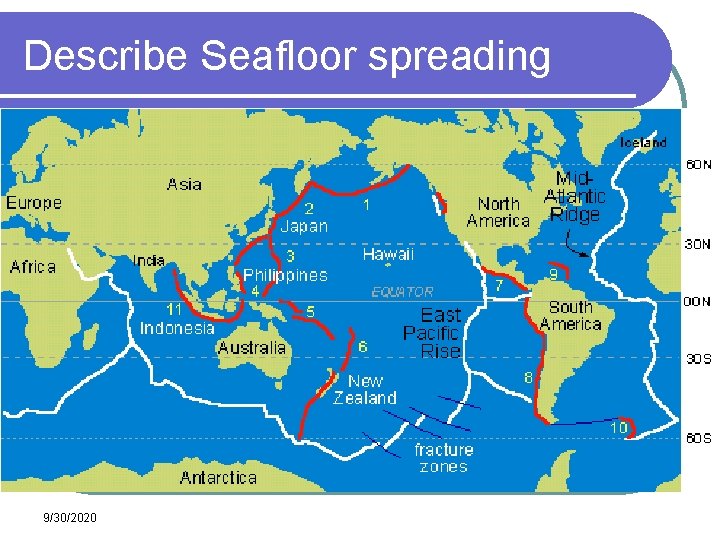
Describe Seafloor spreading l The Renewal of the Ocean Floor Harry Hess – Suggested that the valleys were a break in the crust, that allowed magma to well up and form new crust l Proof came in the mid 1960’s from another group mapping world wide magnetic fields on land sea l 9/30/2020
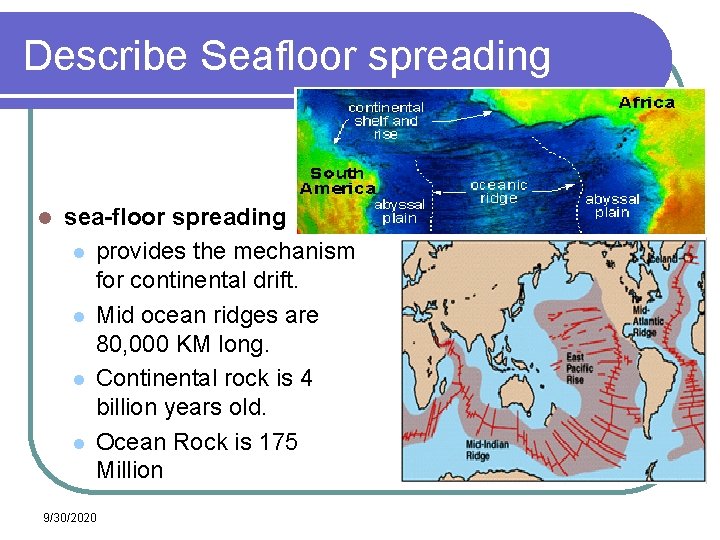
Describe Seafloor spreading l sea-floor spreading l provides the mechanism for continental drift. l Mid ocean ridges are 80, 000 KM long. l Continental rock is 4 billion years old. l Ocean Rock is 175 Million 9/30/2020
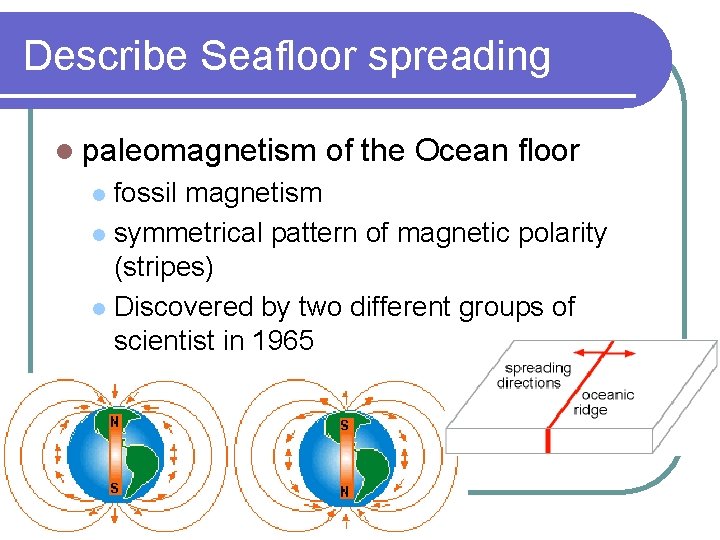
Describe Seafloor spreading l paleomagnetism of the Ocean floor fossil magnetism l symmetrical pattern of magnetic polarity (stripes) l Discovered by two different groups of scientist in 1965 l 9/30/2020
Describe Seafloor spreading 9/30/2020
4. 2 notes objectives l Summarize theory of Plate Tectonics l Compare the characteristic geologic activities that occur along the three types of plate boundaries l Explain the possible role of convection currents l Summarize theory of Micro-plate terranes 9/30/2020
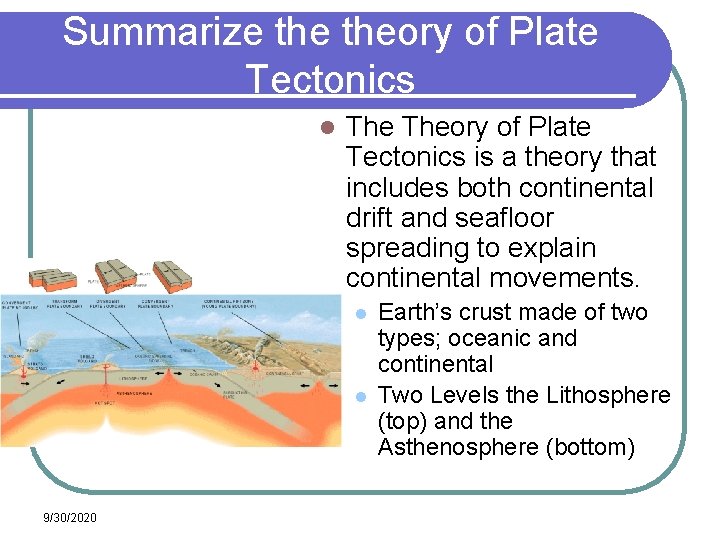
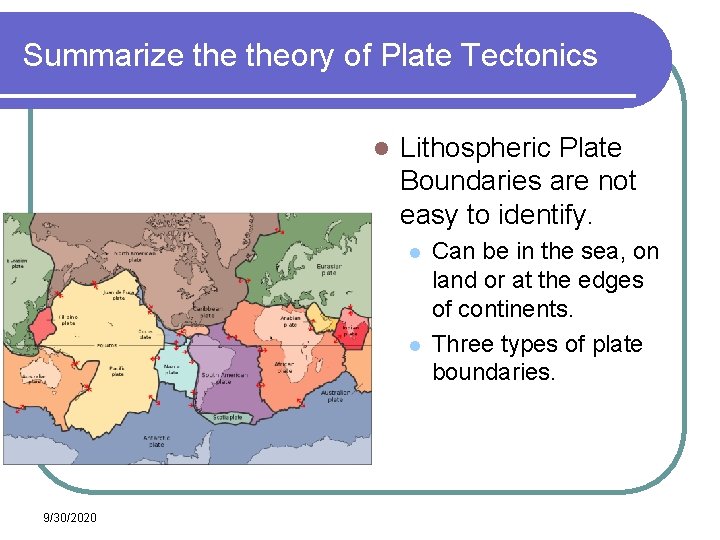
Summarize theory of Plate Tectonics l Theory of Plate Tectonics is a theory that includes both continental drift and seafloor spreading to explain continental movements. l l 9/30/2020 Earth’s crust made of two types; oceanic and continental Two Levels the Lithosphere (top) and the Asthenosphere (bottom)
Summarize theory of Plate Tectonics l Lithospheric Plate Boundaries are not easy to identify. l l 9/30/2020 Can be in the sea, on land or at the edges of continents. Three types of plate boundaries.
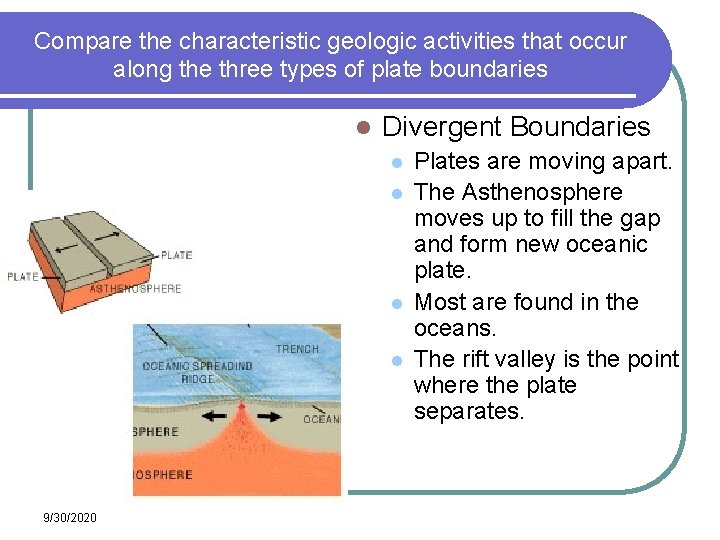
Compare the characteristic geologic activities that occur along the three types of plate boundaries l Divergent Boundaries l l 9/30/2020 Plates are moving apart. The Asthenosphere moves up to fill the gap and form new oceanic plate. Most are found in the oceans. The rift valley is the point where the plate separates.
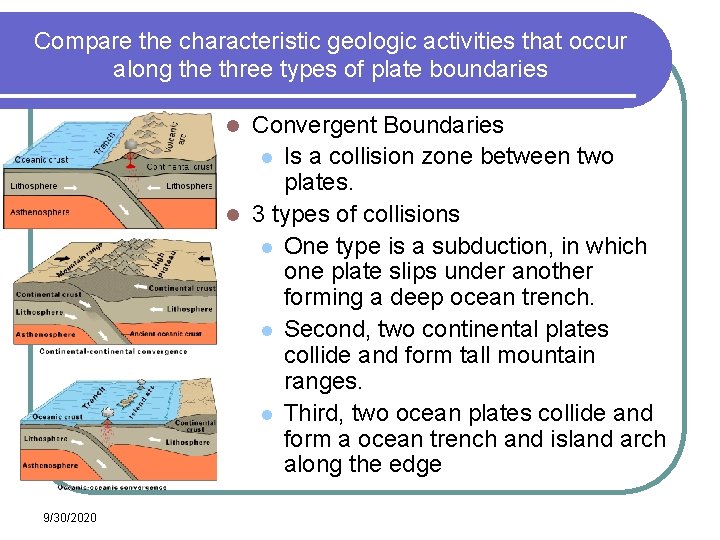
Compare the characteristic geologic activities that occur along the three types of plate boundaries Convergent Boundaries l Is a collision zone between two plates. l 3 types of collisions l One type is a subduction, in which one plate slips under another forming a deep ocean trench. l Second, two continental plates collide and form tall mountain ranges. l Third, two ocean plates collide and form a ocean trench and island arch along the edge l 9/30/2020
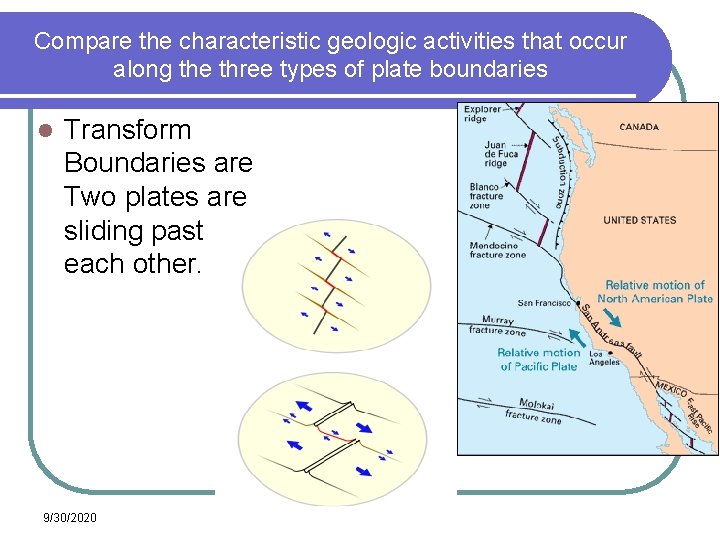
Compare the characteristic geologic activities that occur along the three types of plate boundaries l Transform Boundaries are Two plates are sliding past each other. 9/30/2020
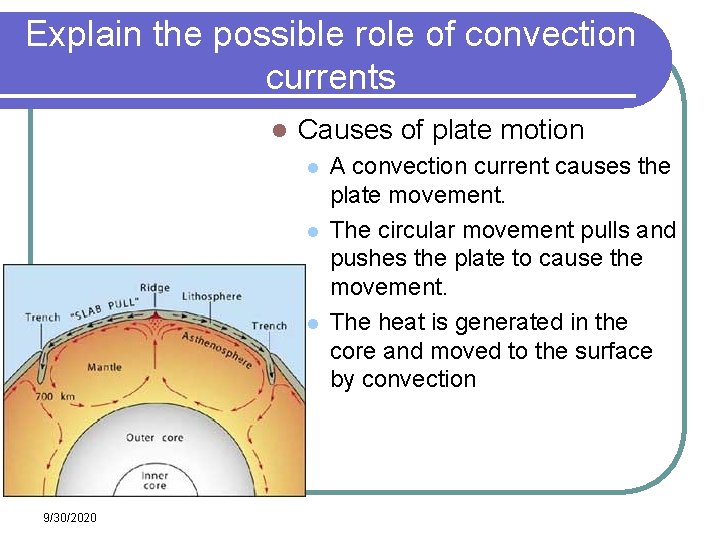
Explain the possible role of convection currents l Causes of plate motion l l l 9/30/2020 A convection current causes the plate movement. The circular movement pulls and pushes the plate to cause the movement. The heat is generated in the core and moved to the surface by convection
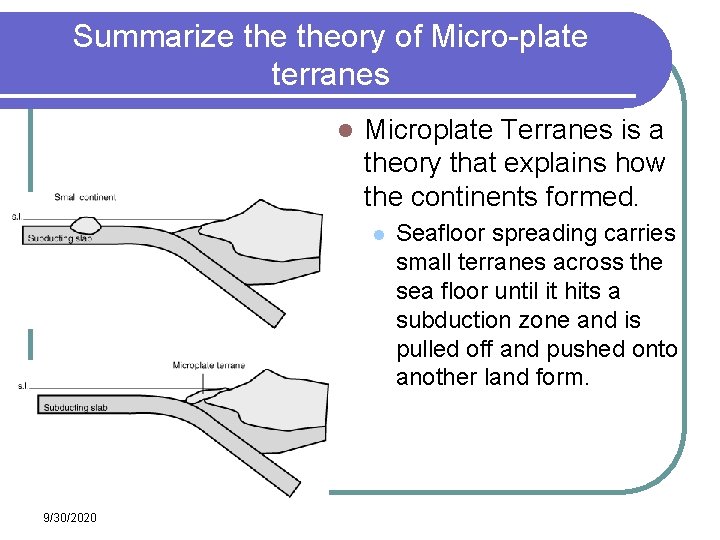
Summarize theory of Micro-plate terranes l Microplate Terranes is a theory that explains how the continents formed. l 9/30/2020 Seafloor spreading carries small terranes across the sea floor until it hits a subduction zone and is pulled off and pushed onto another land form.