
Chapter 1 Objectives Define accounting terms related to
Chapter 1 Objectives • Define accounting terms related to starting a service business organized as a proprietorship and to changes that affect the accounting equation • Identify accounting concepts and practices related to starting a service business organized as a proprietorship and to changes that affect the accounting equation • Classify accounts as assets, liabilities, or owner’s equity and demonstrate their relationships in the accounting equation • Analyze how transactions affect accounts in an accounting equation CENTURY 21 ACCOUNTING © 2009 South-Western, Cengage Learning
2 TERMS TO KNOW n n n n accounting system accounting records financial statements service business proprietorship asset page 9 n n n equities liability owner’s equity accounting equation ethics business ethics CENTURY 21 ACCOUNTING © 2009 South-Western, Cengage Learning LESSON 1 -1
LESSON 1 -1 What is Accounting? • It is the planning, recording, analyzing and interpreting financial information • It is the language of business CENTURY 21 ACCOUNTING © 2009 South-Western, Cengage Learning
4 What is Accounting • Accounting System—a planned process for providing financial information that will be useful to management • Accounting Records—organized summaries of a business’s financial activities • Financial Statements—financial reports that summarize the financial condition and operation of a business CENTURY 21 ACCOUNTING © 2009 South-Western, Cengage Learning LESSON 1 -1
The Business—Tech. Know Consulting 5 • Service Business—a business that performs an activity for a fee • Proprietorship—a business owned by one person; also called a sole proprietorship • Accounting Concept—Business Entity is when a business’s financial information is recorded and reported separately from the owner’s personal financial information CENTURY 21 ACCOUNTING © 2009 South-Western, Cengage Learning LESSON 1 -1
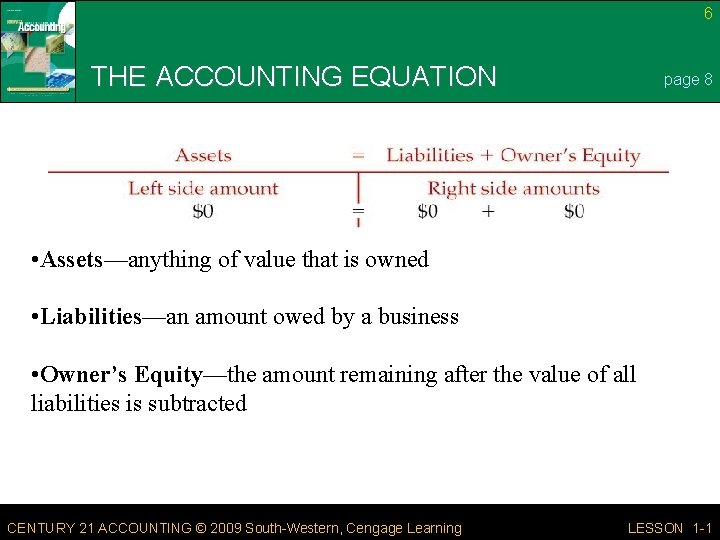
6 THE ACCOUNTING EQUATION page 8 • Assets—anything of value that is owned • Liabilities—an amount owed by a business • Owner’s Equity—the amount remaining after the value of all liabilities is subtracted CENTURY 21 ACCOUNTING © 2009 South-Western, Cengage Learning LESSON 1 -1
7 Equities and Ethics • Equities—financial rights to the assets of a business • A business has two types of equities 1. Equity to those to whom money is owed 2. Equity of the owner • Ethics—the principles of right and wrong that guide an individual in making decisions • Business Ethics—the use of ethics in making business decisions CENTURY 21 ACCOUNTING © 2009 South-Western, Cengage Learning LESSON 1 -1
Lesson 1 -1 Let’s do Work Together 1 -1 and On Your Own 1 -1 on textbook page 9 CENTURY 21 ACCOUNTING © 2009 South-Western, Cengage Learning LESSON 1 -1
LESSON 1 -2: How Business Activities Change the Accounting Equation • Both sides of an equation must always equal • The words “Received cash” in a transaction statement always mean cash increases; “Paid cash” in a transaction statement always means cash decreases • It is important to establish the habit of: 1) reading the transaction 2) identifying the accounts 3) classifying the accounts CENTURY 21 ACCOUNTING © 2009 South-Western, Cengage Learning
10 Definitions n Transaction—a business activity that changes assets, liabilities, or owner’s equity n Account—a record summarizing all the information pertaining to a single item in the accounting equation n Account title—the name given to an account n Account balance—the amount in an account n Capital—the account used to summarize the owner’s equity in a business CENTURY 21 ACCOUNTING © 2009 South-Western, Cengage Learning LESSON 1 -2
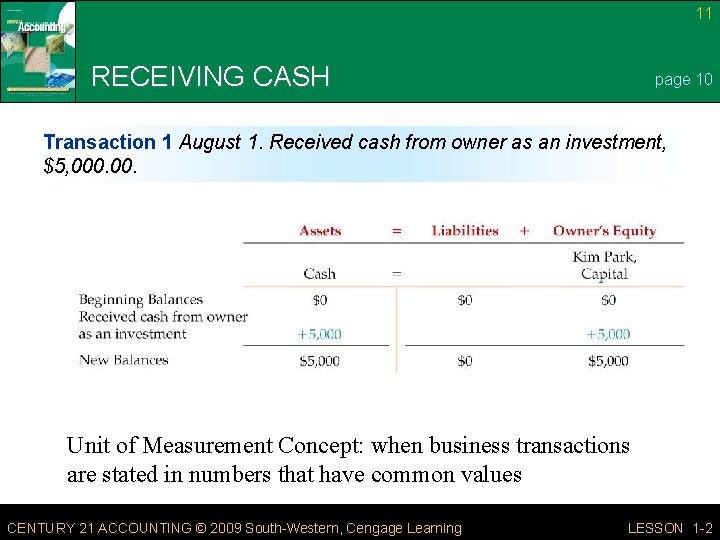
11 RECEIVING CASH page 10 Transaction 1 August 1. Received cash from owner as an investment, $5, 000. Unit of Measurement Concept: when business transactions are stated in numbers that have common values CENTURY 21 ACCOUNTING © 2009 South-Western, Cengage Learning LESSON 1 -2
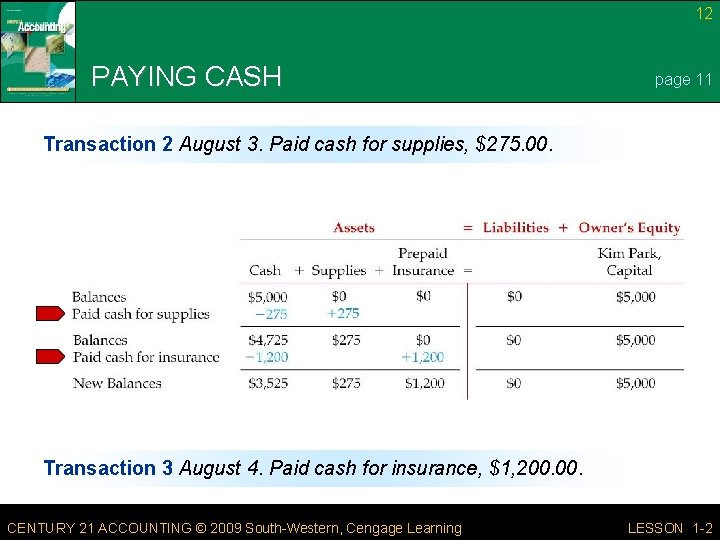
12 PAYING CASH page 11 Transaction 2 August 3. Paid cash for supplies, $275. 00. Transaction 3 August 4. Paid cash for insurance, $1, 200. CENTURY 21 ACCOUNTING © 2009 South-Western, Cengage Learning LESSON 1 -2
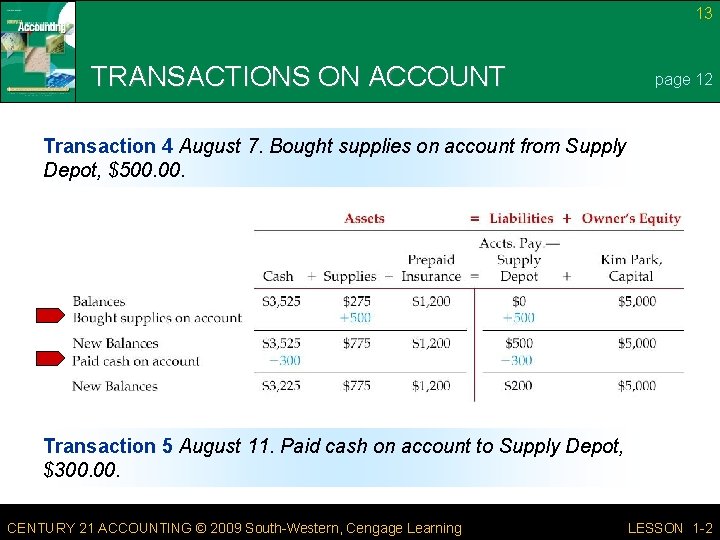
13 TRANSACTIONS ON ACCOUNT page 12 Transaction 4 August 7. Bought supplies on account from Supply Depot, $500. Transaction 5 August 11. Paid cash on account to Supply Depot, $300. CENTURY 21 ACCOUNTING © 2009 South-Western, Cengage Learning LESSON 1 -2
Lesson 1 -2 Let’s do Work Together 1 -2 and On Your Own 1 -2 on textbook page 13 CENTURY 21 ACCOUNTING © 2009 South-Western, Cengage Learning
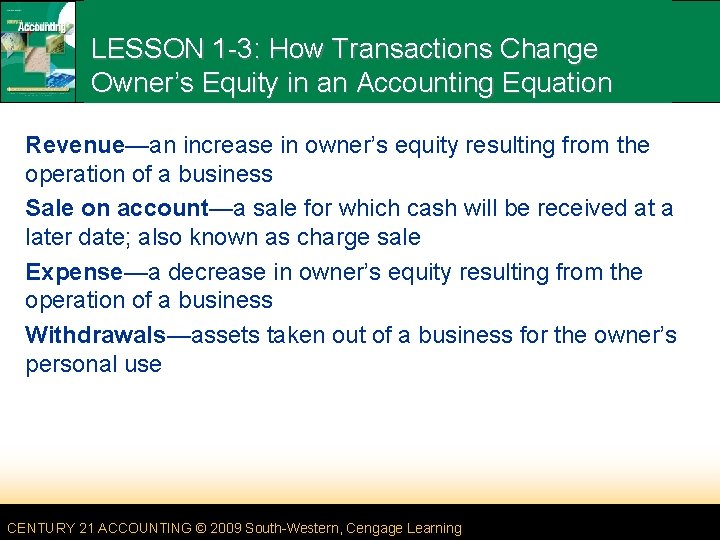
LESSON 1 -3: How Transactions Change Owner’s Equity in an Accounting Equation Revenue—an increase in owner’s equity resulting from the operation of a business Sale on account—a sale for which cash will be received at a later date; also known as charge sale Expense—a decrease in owner’s equity resulting from the operation of a business Withdrawals—assets taken out of a business for the owner’s personal use CENTURY 21 ACCOUNTING © 2009 South-Western, Cengage Learning
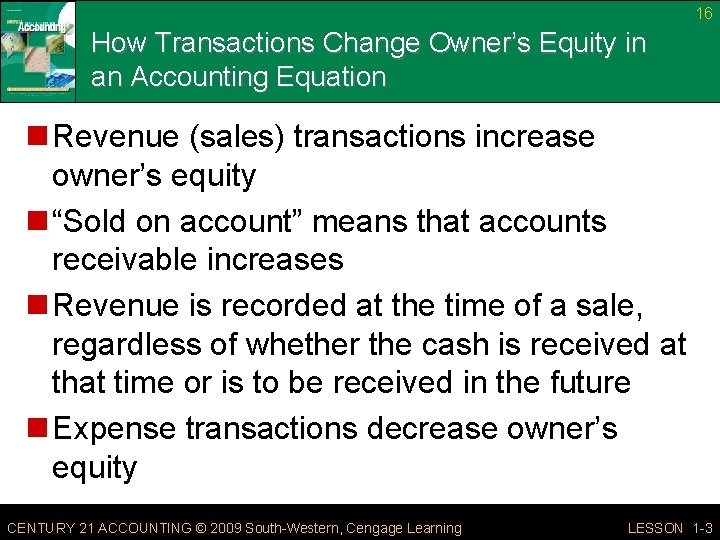
16 How Transactions Change Owner’s Equity in an Accounting Equation n Revenue (sales) transactions increase owner’s equity n “Sold on account” means that accounts receivable increases n Revenue is recorded at the time of a sale, regardless of whether the cash is received at that time or is to be received in the future n Expense transactions decrease owner’s equity CENTURY 21 ACCOUNTING © 2009 South-Western, Cengage Learning LESSON 1 -3
How Transactions Change Owner’s Equity in an Accounting Equation • When cash is received on account, the capital account is not affected. The sale was recorded previously and the capital account was increased at the time of the sale. When payment is received, only cash and accounts receivable are affected. • Withdrawals by the owner also decrease owner’s equity. CENTURY 21 ACCOUNTING © 2009 South-Western, Cengage Learning
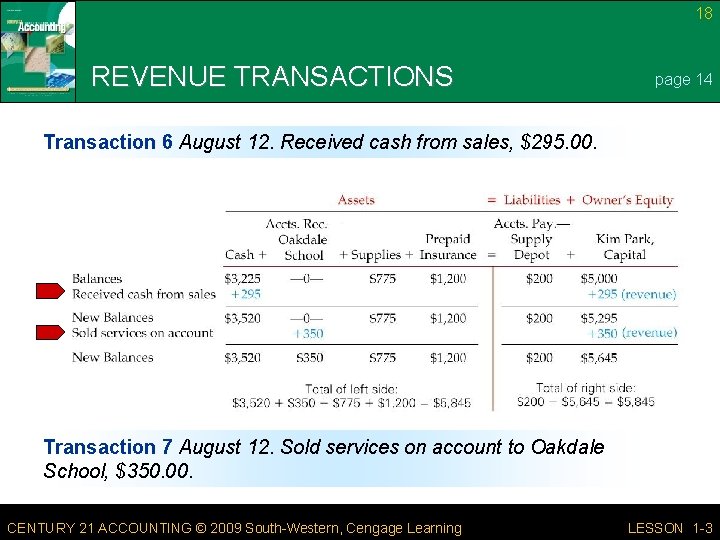
18 REVENUE TRANSACTIONS page 14 Transaction 6 August 12. Received cash from sales, $295. 00. Transaction 7 August 12. Sold services on account to Oakdale School, $350. 00. CENTURY 21 ACCOUNTING © 2009 South-Western, Cengage Learning LESSON 1 -3
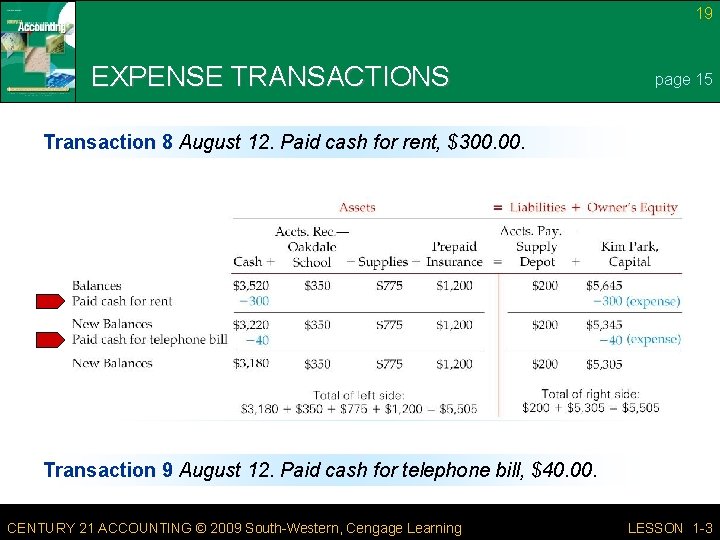
19 EXPENSE TRANSACTIONS page 15 Transaction 8 August 12. Paid cash for rent, $300. Transaction 9 August 12. Paid cash for telephone bill, $40. 00. CENTURY 21 ACCOUNTING © 2009 South-Western, Cengage Learning LESSON 1 -3
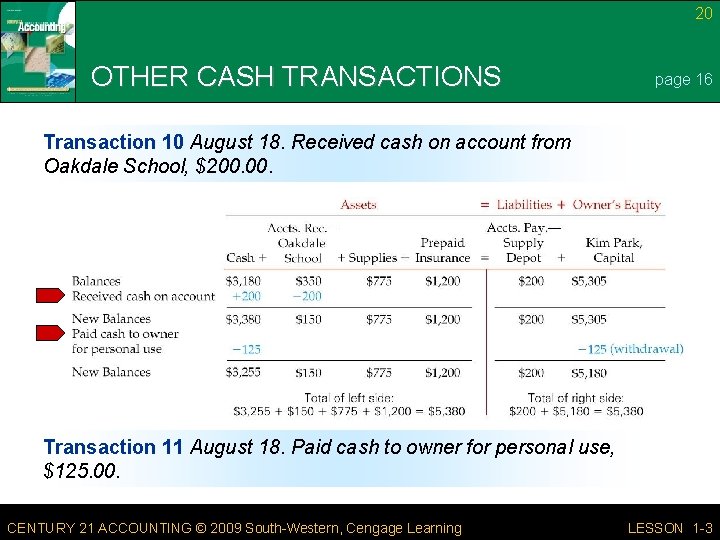
20 OTHER CASH TRANSACTIONS page 16 Transaction 10 August 18. Received cash on account from Oakdale School, $200. Transaction 11 August 18. Paid cash to owner for personal use, $125. 00. CENTURY 21 ACCOUNTING © 2009 South-Western, Cengage Learning LESSON 1 -3
21 Lesson 1 -3 Let’s do Work Together 1 -3 and On Your Own 1 -3 on textbook page 17 CENTURY 21 ACCOUNTING © 2009 South-Western, Cengage Learning LESSON 1 -1
22 Chapter Assignments n n n Chapter 1 Study Guide 1 -1 Application Problem 1 -2 Application Problem 1 -3 Application Problem 1 -4 Mastery Problem 1 -5 Challenge Problem CENTURY 21 ACCOUNTING © 2009 South-Western, Cengage Learning LESSON 1 -1
- Slides: 22