Chapter 18 Classification 18 1 Finding Order in

- Slides: 55
Chapter 18 Classification
18 -1 Finding Order in Diversity Why Classify? – To make it easier to identify unknown organisms – To show relationships among organisms – To organize information about different types of organisms Biologists use a classification system to name organisms and group them in a logical manner Taxonomy = the science of naming and classifying species
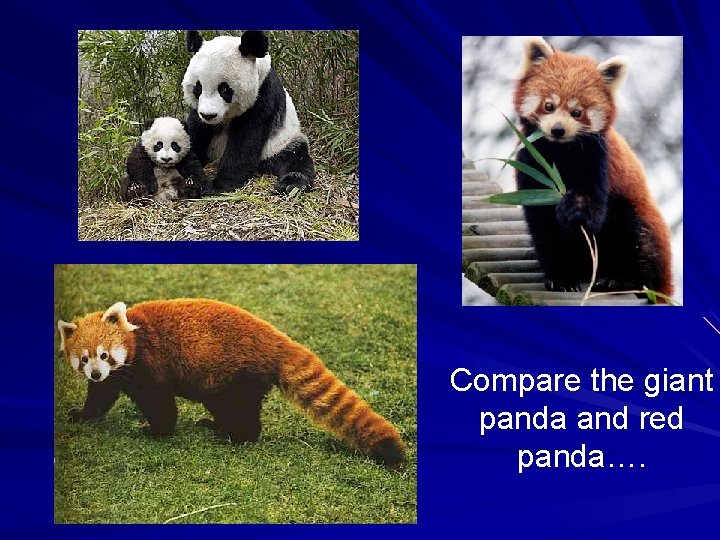
18 -1 Finding Order in Diversity Given the common names red panda and giant panda, how similar would you expect the two organisms to be?
Compare the giant panda and red panda….
18 -1 Finding Order in Diversity Assigning Scientific Names – Using common names can be confusing Ex: buzzard = hawk UK / vulture in US Ex: different common names such as mountain lion, puma, cougar or panther describe the same species of animal Felis concolor – First attempts at naming organisms relied on descriptions of physical appearance/Names were often very long and became impractical to use
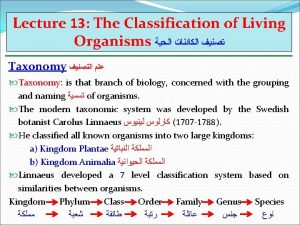
18 -1 Finding Order in Diversity Binomial Nomenclature – Developed by Carolus Linnaeus(1759) – Uses two words to describe an organism, the genus name and the species name Ex: Dianthus caryophyllus = carnation Ex: Ursus arctos = grizzly bear – Names are the same (Latin) in all languages! – Names are always in italics, genus name is always capitalized, the species name is always lower case
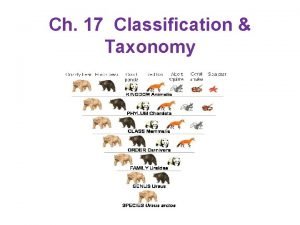
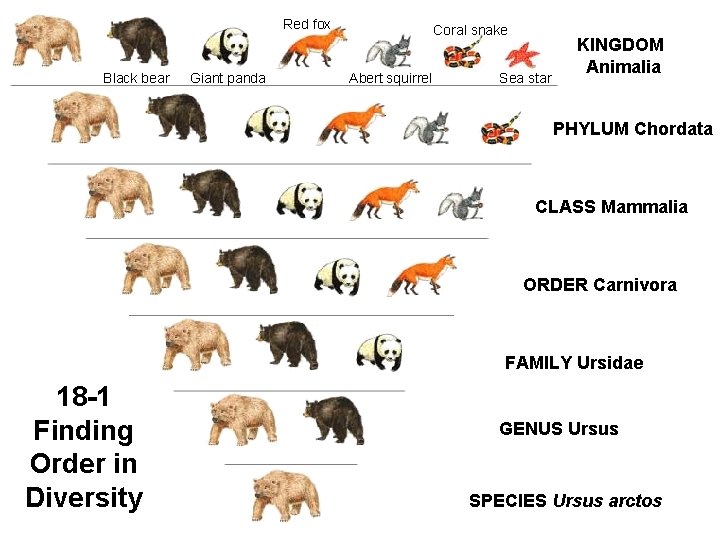
18 -1 Finding Order in Diversity Linnaeus’s System of Classification – A hierarchical system of classification which included seven levels – Each level is referred to as a taxon – Organisms with the most in common were grouped together as a species – Species = a group of similar organisms which can interbreed freely and produce fertile offspring
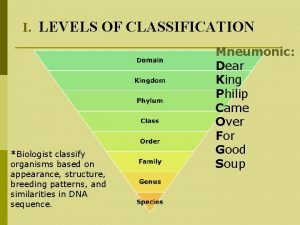
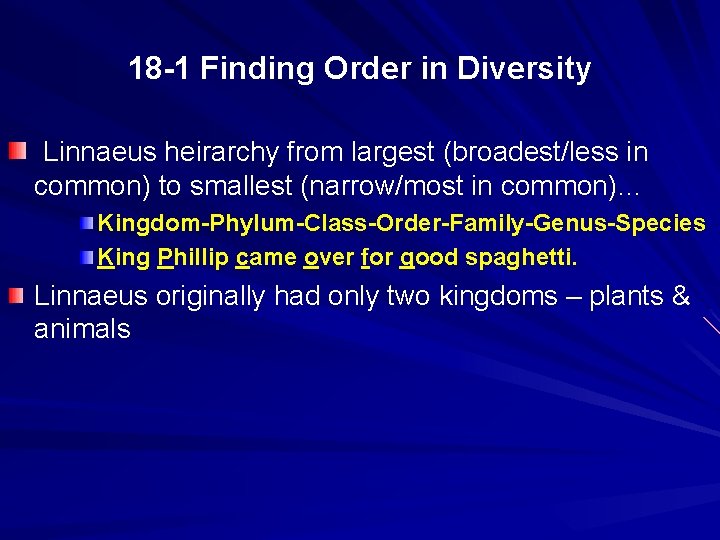
18 -1 Finding Order in Diversity Linnaeus heirarchy from largest (broadest/less in common) to smallest (narrow/most in common)… Kingdom-Phylum-Class-Order-Family-Genus-Species King Phillip came over for good spaghetti. Linnaeus originally had only two kingdoms – plants & animals
18 -1 Finding Order in Diversity Linnaeus’s System of Classification – Species that share several characteristics are grouped into a genus, several genera that share some characteristics are grouped into the same family, several families that share some common characteristics are grouped in the same order, etc. – Only a few common characteristics are shared at the kingdom level / Think about what characteristics organisms in the kingdom Animalia have in common / In what ways are you similar to a sponge or a fruit fly?
Red fox Black bear Giant panda Coral snake Abert squirrel Sea star KINGDOM Animalia PHYLUM Chordata CLASS Mammalia ORDER Carnivora FAMILY Ursidae 18 -1 Finding Order in Diversity GENUS Ursus SPECIES Ursus arctos
18 -2 Modern Evolutionary Classification Groupings above the level of species are “invented” by researchers who decide how to distinguish one genus, phylum, or family from another. Which similarities are most important when grouping organisms? – Physical similarities? – Evolutionary relationships? – Note that some organisms that look similar due to convergent evolution may not be closely related at all
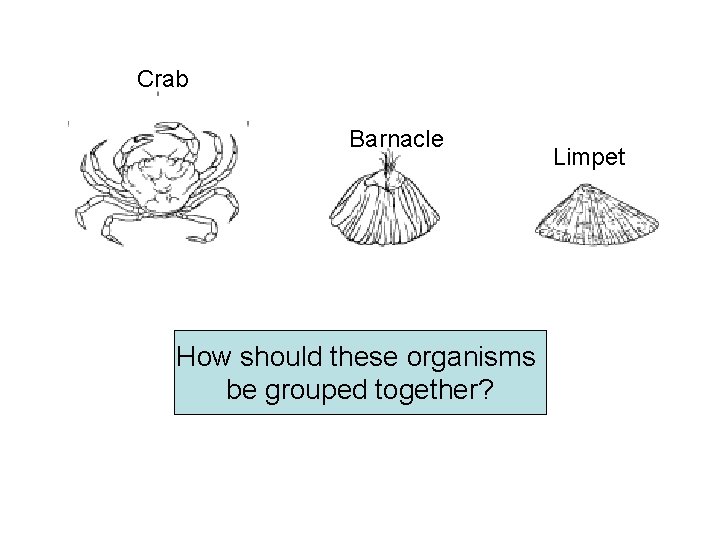
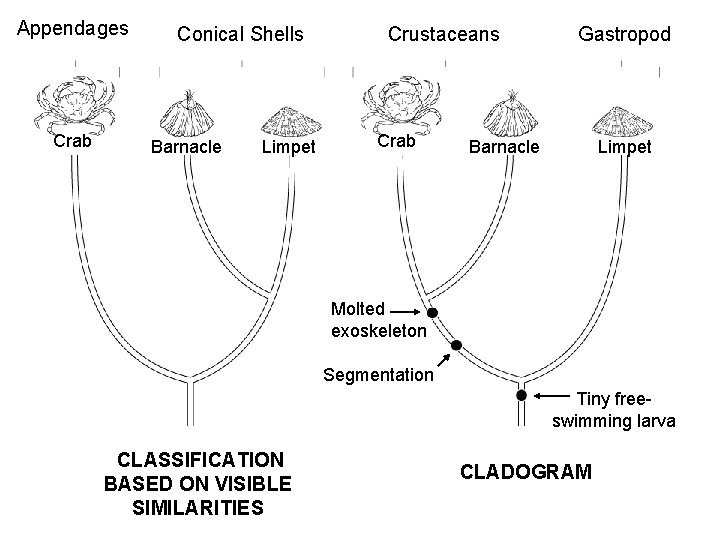
Crab Barnacle How should these organisms be grouped together? CLASSIFICATION BASED ON VISIBLE SIMILARITIES Limpet
18 -2 Modern Evolutionary Classification Organisms can be classified based on – structure - function – biochemistry- behavior – nutrition - embryonic development – cellular and molecular (RNA/DNA) makeup – evolutionary histories – ecological interactions
18 -2 Modern Evolutionary Classification – The strategy of grouping organisms together based on their evolutionary history Biologists now group organisms into categories that represent lines of evolutionary descent, not just physical similarities
18 -2 Modern Evolutionary Classification Phylogeny = the study of evolutionary relationships among organisms Basic principles are as follows: – All members of a genus share a common ancestor / All members of a family share a common ancestor, etc – The higher the level of the taxon, the farther back in time is the common ancestor of all the organisms in the taxon
18 -2 Modern Evolutionary Classification As mentioned earlier, organisms that appear very similar may not share a recent common ancestor Ex: barnacles and limpets porpoises & fish
Appendages Crab Conical Shells Barnacle Limpet Crustaceans Crab Gastropod Barnacle Limpet Molted exoskeleton Segmentation Tiny freeswimming larva CLASSIFICATION BASED ON VISIBLE SIMILARITIES CLADOGRAM
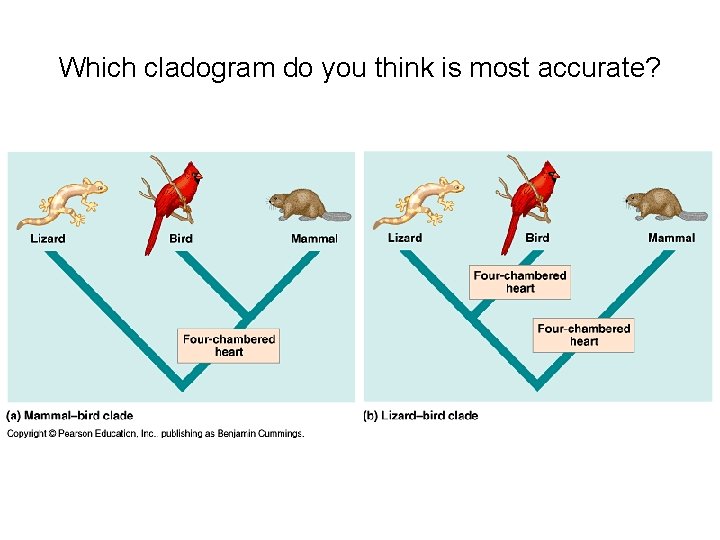
Which cladogram do you think is most accurate?
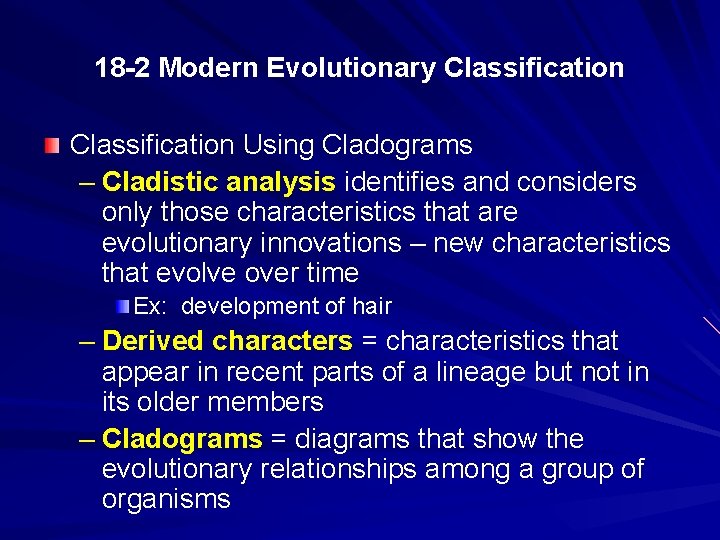
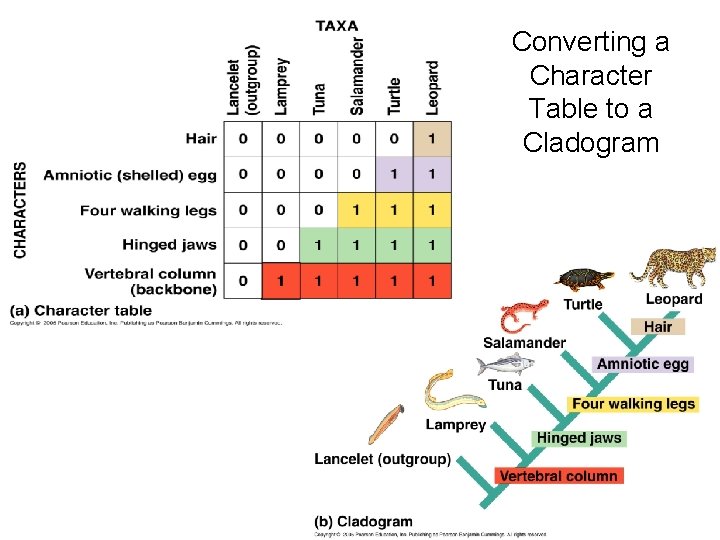
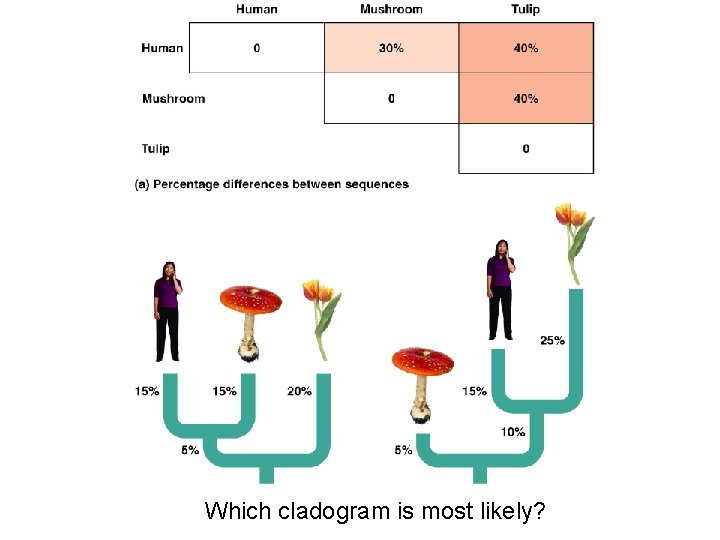
18 -2 Modern Evolutionary Classification Using Cladograms – Cladistic analysis identifies and considers only those characteristics that are evolutionary innovations – new characteristics that evolve over time Ex: development of hair – Derived characters = characteristics that appear in recent parts of a lineage but not in its older members – Cladograms = diagrams that show the evolutionary relationships among a group of organisms
Converting a Character Table to a Cladogram
Which cladogram is most likely?
18 -2 Modern Evolutionary Classification Making a cladogram – Queue i-text Quick Lab p. 453
18 -2 Modern Evolutionary Classification Similarities in DNA and RNA – The genes of many organisms show important similarities at the molecular level – Similarities in DNA can be used to determine classification and evolutionary relationships
18 -2 Modern Evolutionary Classification Similarities in DNA and RNA – The more similar the DNA sequences of two species, the more recently they shared a common ancestor, and the more closely they are related in evolutionary terms Ex: chimpanzees determined to be more similar to humans than to gorillas Vultures vs storks p. 454
18 -2 Modern Evolutionary Classification Molecular Clocks – Uses DNA comparisons to estimate the length of time that two species have been evolving independently – Relies on differences in DNA sequences due to mutations in different genes – Queue i-text for picture p. 456?
18 -3 Kingdoms & Domains The Tree of Life Evolves Taxonomic classifications are the result of interpretations of data and are subject to change – New evidence may become available to lead to a change in categories – Taxonomists can differ in how they interpret evidence
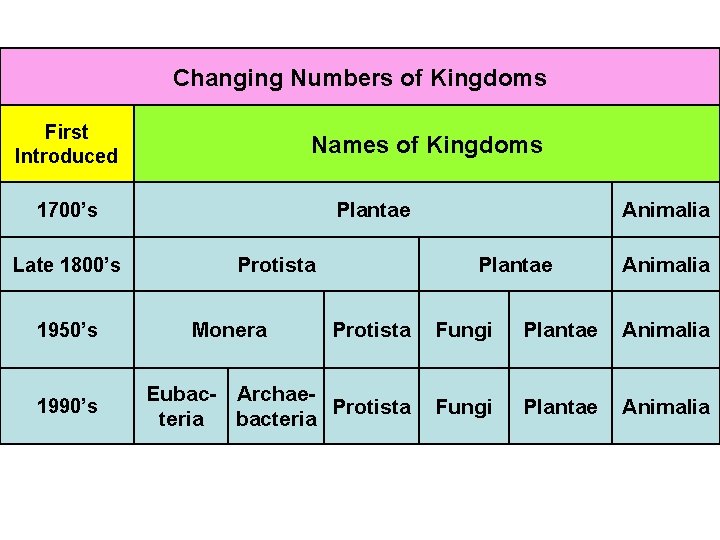
Changing Numbers of Kingdoms First Introduced Names of Kingdoms Plantae 1700’s Late 1800’s 1950’s 1990’s Protista Monera Animalia Plantae Animalia Protista Fungi Plantae Animalia Eubac- Archae. Protista teria bacteria Fungi Plantae Animalia
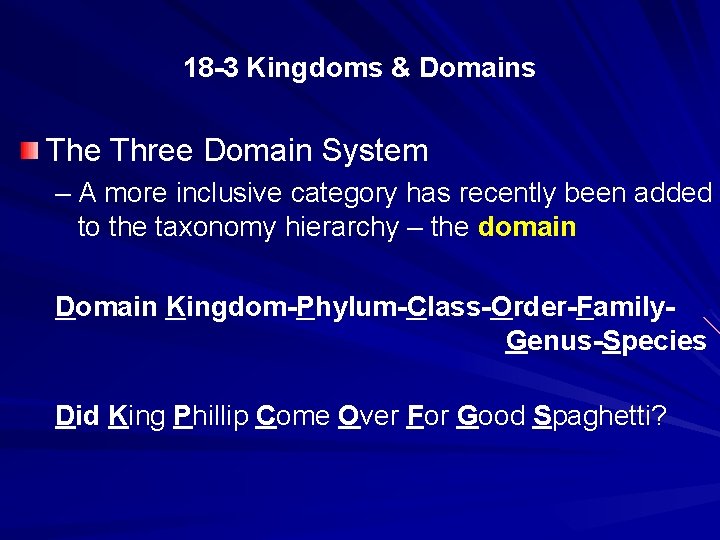
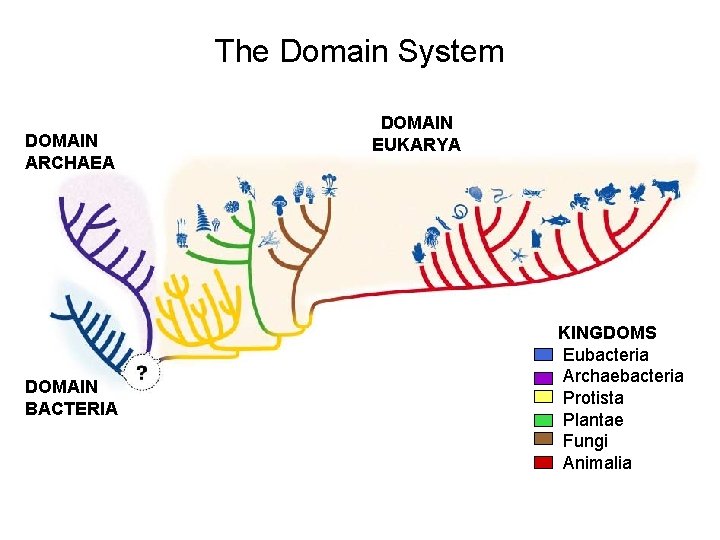
18 -3 Kingdoms & Domains The Three Domain System – A more inclusive category has recently been added to the taxonomy hierarchy – the domain Domain Kingdom-Phylum-Class-Order-Family. Genus-Species Did King Phillip Come Over For Good Spaghetti?
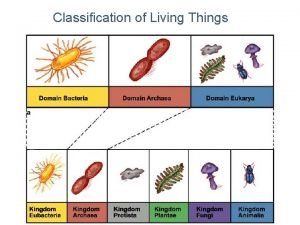
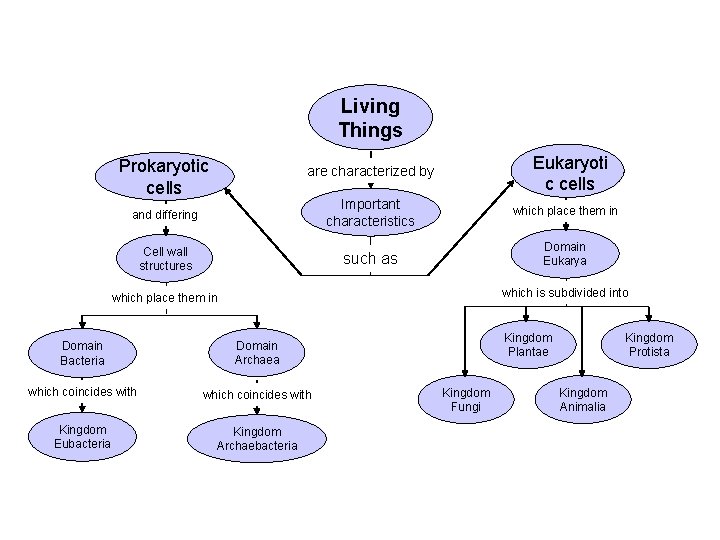
18 -3 Kingdoms & Domains Three domains have been designated – Domain Bacteria – Domain Archaea – Domain Eukarya
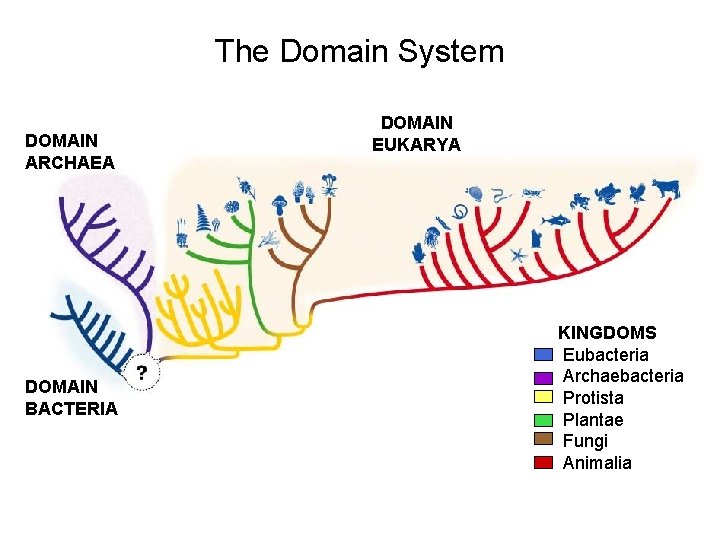
The Domain System DOMAIN ARCHAEA DOMAIN BACTERIA DOMAIN EUKARYA KINGDOMS Eubacteria Archaebacteria Protista Plantae Fungi Animalia
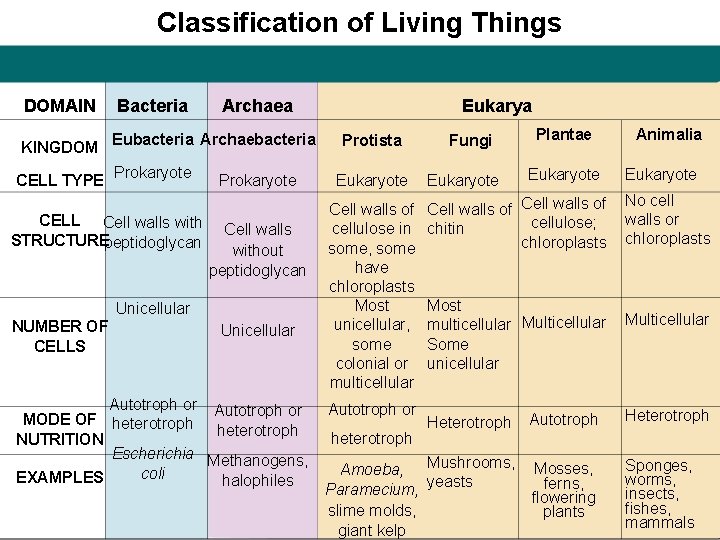
Classification of Living Things DOMAIN Bacteria KINGDOM Eubacteria Archaebacteria CELL TYPE Prokaryote CELL Cell walls with STRUCTUREpeptidoglycan Prokaryote Cell walls without peptidoglycan Unicellular NUMBER OF CELLS Eukarya Archaea Unicellular Autotroph or MODE OF heterotroph NUTRITION Escherichia Methanogens, coli EXAMPLES halophiles Protista Eukaryote Cell walls of cellulose in some, some have chloroplasts Most unicellular, some colonial or multicellular Autotroph or Fungi Eukaryote Plantae Eukaryote Cell walls of cellulose; chitin chloroplasts Most multicellular Multicellular Some unicellular Animalia Eukaryote No cell walls or chloroplasts Multicellular Heterotroph Autotroph Heterotroph Amoeba, Mushrooms, yeasts Paramecium, slime molds, giant kelp Mosses, ferns, flowering plants Sponges, worms, insects, fishes, mammals heterotroph
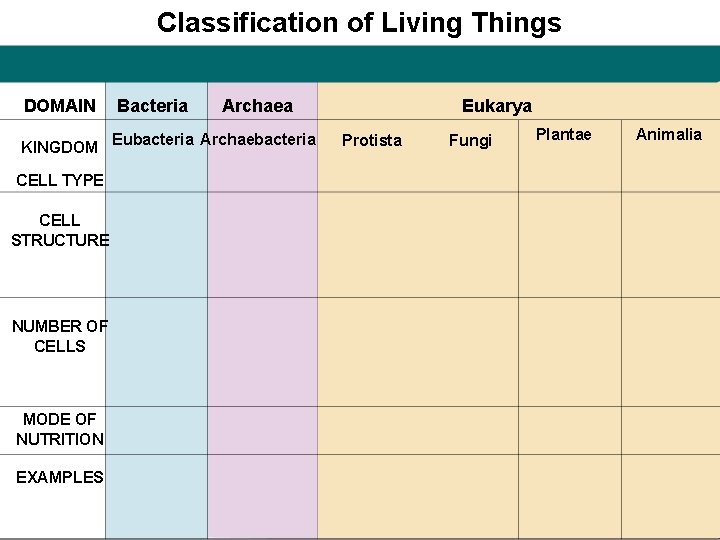
Classification of Living Things DOMAIN Bacteria Archaea KINGDOM Eubacteria Archaebacteria CELL TYPE CELL STRUCTURE NUMBER OF CELLS MODE OF NUTRITION EXAMPLES Eukarya Protista Fungi Plantae Animalia
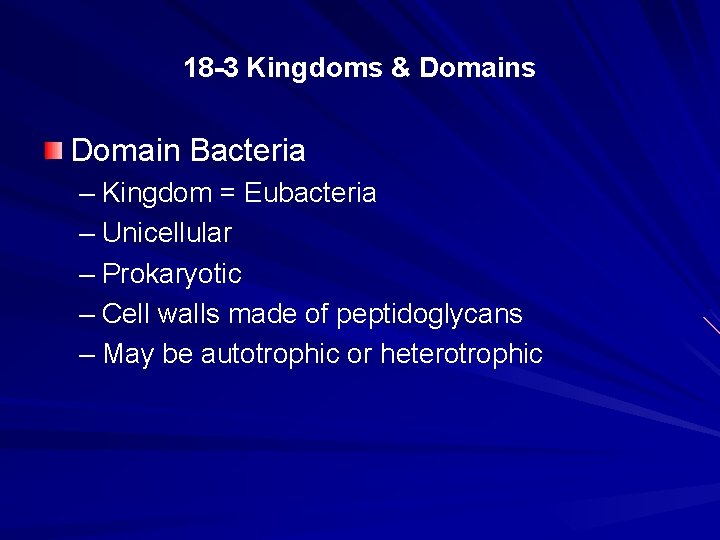
18 -3 Kingdoms & Domains Domain Bacteria – Kingdom = Eubacteria – Unicellular – Prokaryotic – Cell walls made of peptidoglycans – May be autotrophic or heterotrophic
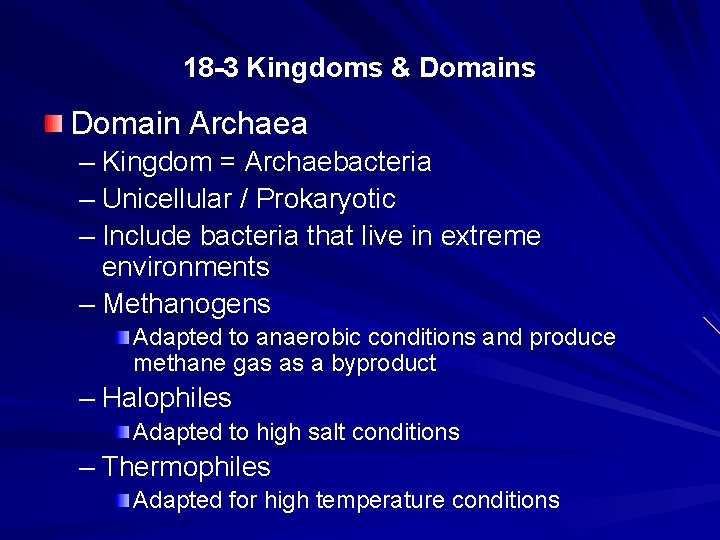
18 -3 Kingdoms & Domains Domain Archaea – Kingdom = Archaebacteria – Unicellular / Prokaryotic – Include bacteria that live in extreme environments – Methanogens Adapted to anaerobic conditions and produce methane gas as a byproduct – Halophiles Adapted to high salt conditions – Thermophiles Adapted for high temperature conditions
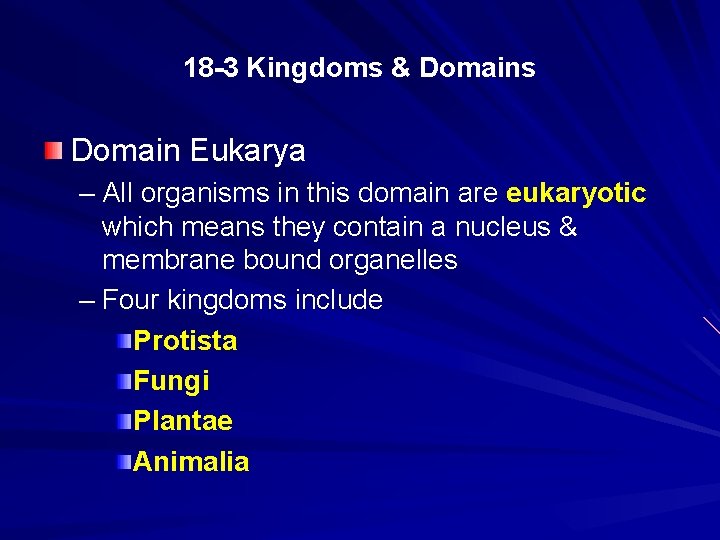
18 -3 Kingdoms & Domains Domain Eukarya – All organisms in this domain are eukaryotic which means they contain a nucleus & membrane bound organelles – Four kingdoms include Protista Fungi Plantae Animalia
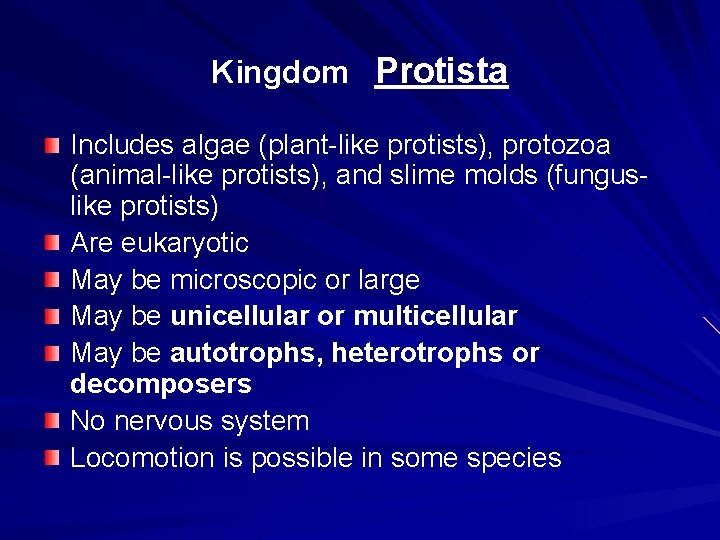
Kingdom Protista Includes algae (plant-like protists), protozoa (animal-like protists), and slime molds (funguslike protists) Are eukaryotic May be microscopic or large May be unicellular or multicellular May be autotrophs, heterotrophs or decomposers No nervous system Locomotion is possible in some species
Kingdom Fungi Develop directly from spores Heterotrophs that absorb small molecules from their surroundings through their outer walls Most are decomposers Most are multicellular (except yeast which are unicellular) Reproduction may be sexual or asexual Most are haploid rather than diploid No nervous system/no locomotion Cell walls usually contain chitin
Kingdom Plantae Autotrophic/produce their own food via photosynthesis Multicellular and eukaryotic Contain chloroplasts Have cellulose in cell walls No locomotion/no nervous system
Kingdom Animalia Eukaryotic Heterotrophic/ do not produce their own food Multicellular with organs and organ systems Very diverse in form Most reproduce sexually Most have nervous systems that aid in locomotion Contains both vertebrates and invertebrates
The Origin of Diversity Did all of today’s species evolve from one ancestral species?
The Domain System DOMAIN ARCHAEA DOMAIN BACTERIA DOMAIN EUKARYA KINGDOMS Eubacteria Archaebacteria Protista Plantae Fungi Animalia
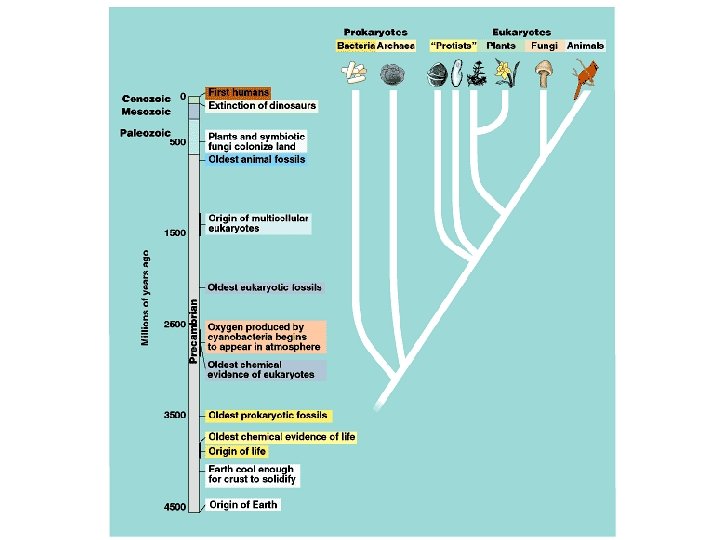
The Origin of Diversity Fossils indicate that many forms evolved from a few ancestral forms See a common pattern – One group fades out, another group increases in number and diversity – Ex: reptiles decrease, mammals and birds increase
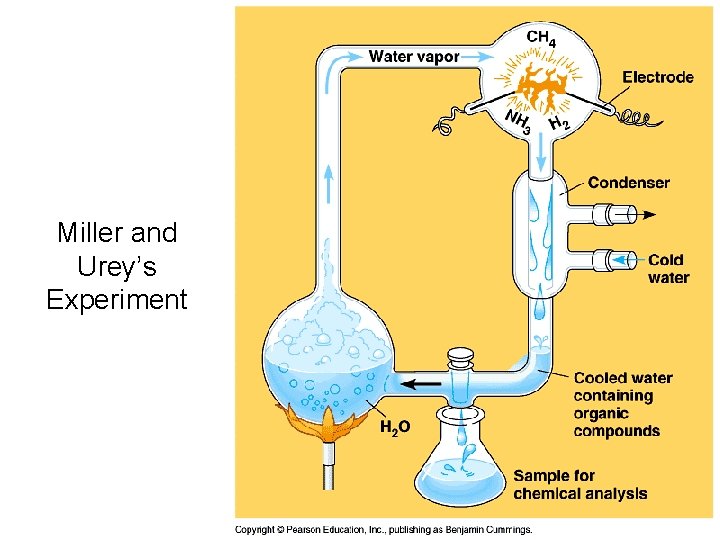
Earth’s Early History Earth – may have evolved from condensed gases and dust – may be 4. 6 billion years old – early atmosphere very hot / composed of volcanic gases such as methane (CH 4), carbon dioxide (CO 2), ammonia (NH 3), hydrogen (H 2), and water vapor (H 2 O) / free oxygen (O 2) was absent
Earth’s Early History – energy from heat and lightening may have allowed combinations of gases to form new molecules such as amino acids, etc. – 1952 Miller and Urey simulate early atmospheric conditions in the laboratory and generate amino acids
Miller and Urey’s Experiment
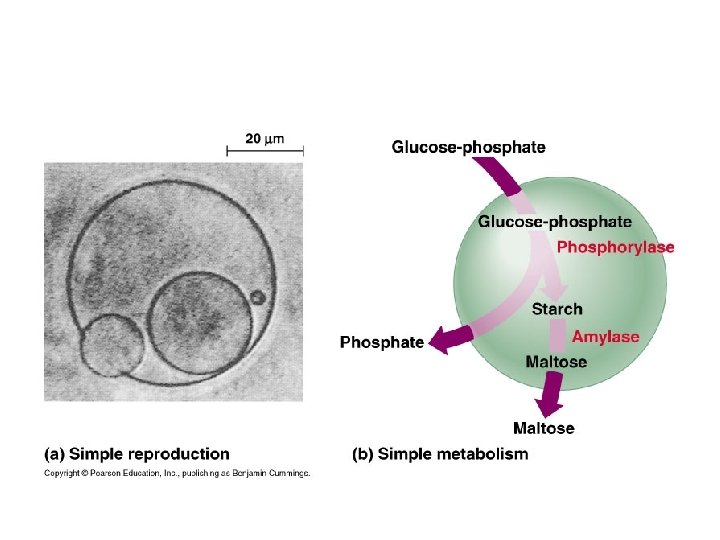
The First Cells Q: How did we get from complex organic molecules to living organisms? A: No one knows for sure Essential characteristics of life: – Self-maintenance (maintain organization and order) – Self-replication (reproduce themselves)
The First Cells, cont’d Thought that the first living things were heterotrophs Oldest microfossils are ~ 3 billion years old First photosynthetic organisms may have been part autotroph/part heterotroph Earliest photosynthetic organisms probably did not produce free oxygen as a by-product
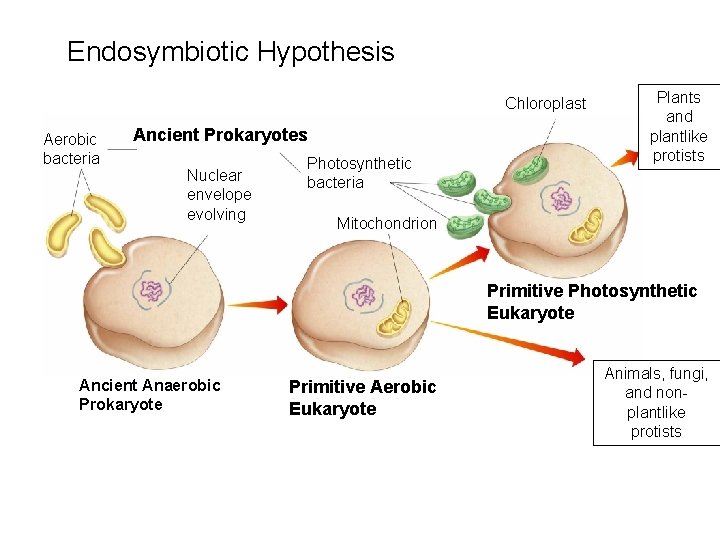
The First Cells, cont’d Anaerobic (without oxygen) – Anaerobes use light energy to synthesize organic compounds utilizing H 2 S instead of H 2 O Aerobic (requires oxygen) Eventually photosynthesis evolved as we know it today Prokaryotes vs Eukaryotes – Theory that mitochondria and chloroplasts found in eukaryotes originated as free-living prokaryotes that were taken up by larger anaerobic prokaryotes
Endosymbiotic Hypothesis Chloroplast Aerobic bacteria Ancient Prokaryotes Nuclear envelope evolving Photosynthetic bacteria Plants and plantlike protists Mitochondrion Primitive Photosynthetic Eukaryote Ancient Anaerobic Prokaryote Primitive Aerobic Eukaryote Animals, fungi, and nonplantlike protists
The First Cells, cont’d Photosynthetic organisms that produced oxygen (O 2) as a by-product led to significant changes in the Earth’s atmosphere Free O 2 reacted to form ozone (O 3) which prevents many of the sun’s UV rays from reaching Earth as a by-product led to significant changes in the Earth’s atmosphere Is our atmosphere still evolving?
Organization of Matter When does a collection of matter become living? atoms → molecules → macromolecules → compound molecules → organelles → cells → (tissues → organs → systems →) organisms → populations → communities → ecosystems → biosphere Do we classify viruses as living or nonliving things?
Living Things Prokaryotic cells Eukaryoti c cells are characterized by and differing Cell wall structures Important characteristics which place them in such as Domain Eukarya which is subdivided into which place them in Domain Bacteria Domain Archaea which coincides with Kingdom Eubacteria Kingdom Archaebacteria Kingdom Plantae Kingdom Fungi Kingdom Protista Kingdom Animalia