Chapter 11 General Issues in Psychotherapy Overview p

- Slides: 18
Chapter 11 General Issues in Psychotherapy
Overview p p p This is the first chapter in the section on psychotherapy Psychotherapy is the most common professional activity of clinical psychologists Upcoming chapters will focus on specific approaches; this chapter focuses on general psychotherapy issues
Does Psychotherapy Work? p p p Through the mid-1900 s, most answers to this question came in subjective, non-empirical forms (few empirical studies) Hans Eysenck (1952) concluded that therapy was of little benefit His finding has since been overturned, but his study inspired decades of research on therapy outcome
Who, When, and How Should Researchers Ask? p Who? n Tripartite (“three party”) model - Hans Strupp Client n Therapist n Third parties (society, family, insurance company, others) n n Ratings by any of these three parties can be informative, but also biased
Who, When, and How Should Researchers Ask? (cont. ) p When? n n Immediately after therapy? Follow-up? n n After months? Years? Before therapy ends? n At certain points, or at every session?
Who, When, and How Should Researchers Ask? (cont. ) p How? n n Questionnaires? Interviews? n n p What questions should be asked? Behavioral observation? Who, when, and how researchers ask about psychotherapy can influence results
Efficacy vs. Effectiveness p Efficacy—the extent to which psychotherapy works “in the lab” n n In controlled outcome studies Therapists’ methods are controlled or manualized Clients are selected for diagnostic criteria Better internal validity than external validity
Efficacy vs. Effectiveness (cont. ) p Effectiveness—the extent to which psychotherapy works “in the real world” n n n Greater variability in therapists’ methods Greater variability in clients’ issues and diagnoses Better external validity than internal validity
Efficacy vs. Effectiveness (cont. ) p Results of efficacy studies n n Overall result: psychotherapy works Hundreds of meta-analyses and thousands of individual studies support this finding Average person receiving therapy is better off than 80% of comparable others who don’t Benefits last and exceed placebo effect
Efficacy vs. Effectiveness (cont. ) p Results of effectiveness studies n n Not as many studies as efficacy studies, but similar results: psychotherapy works Consumer Reports study is example of a large scale effectiveness study Therapy had positive effects n Results lasted over time n Some methodological concerns n n n Sampling bias No control group
Alternate Ways to Measure Psychotherapy Outcome p Neurobiological effects of therapy n n p Via f. MRI, PET neuroimaging, etc. Therapy changes the brain Medical cost offset n n Indirect measure of therapy outcome Successful therapy reduces later medical costs
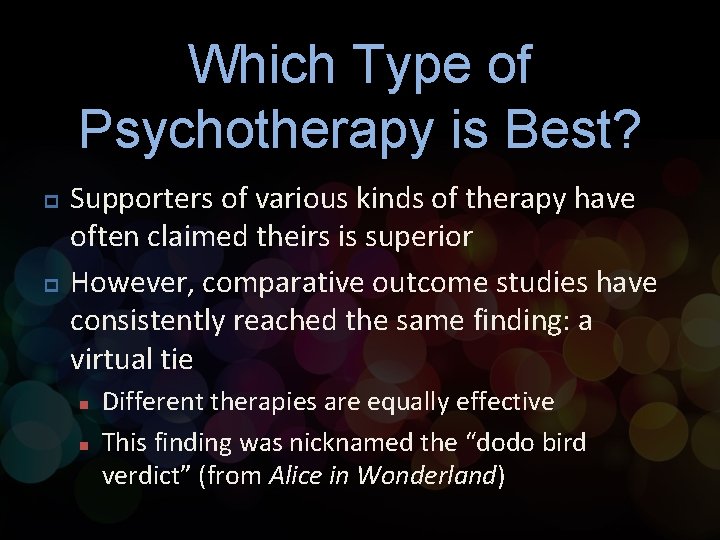
Which Type of Psychotherapy is Best? p p Supporters of various kinds of therapy have often claimed theirs is superior However, comparative outcome studies have consistently reached the same finding: a virtual tie n n Different therapies are equally effective This finding was nicknamed the “dodo bird verdict” (from Alice in Wonderland)
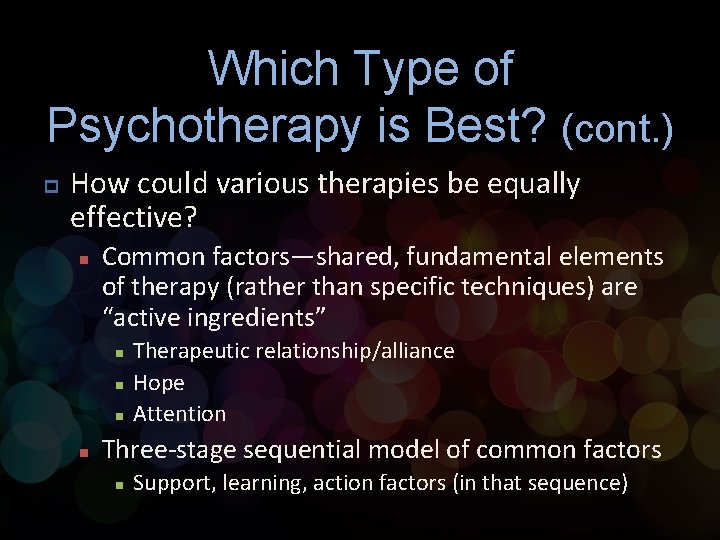
Which Type of Psychotherapy is Best? (cont. ) p How could various therapies be equally effective? n Common factors—shared, fundamental elements of therapy (rather than specific techniques) are “active ingredients” n n Therapeutic relationship/alliance Hope Attention Three-stage sequential model of common factors n Support, learning, action factors (in that sequence)
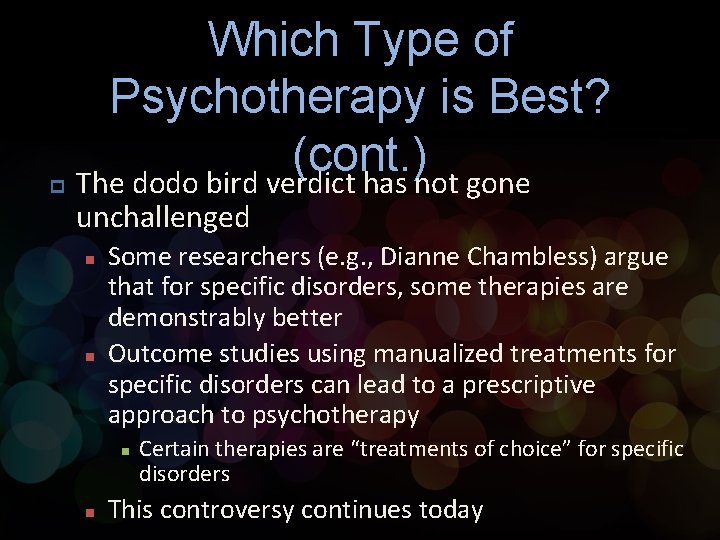
p Which Type of Psychotherapy is Best? (cont. ) The dodo bird verdict has not gone unchallenged n n Some researchers (e. g. , Dianne Chambless) argue that for specific disorders, some therapies are demonstrably better Outcome studies using manualized treatments for specific disorders can lead to a prescriptive approach to psychotherapy n n Certain therapies are “treatments of choice” for specific disorders This controversy continues today
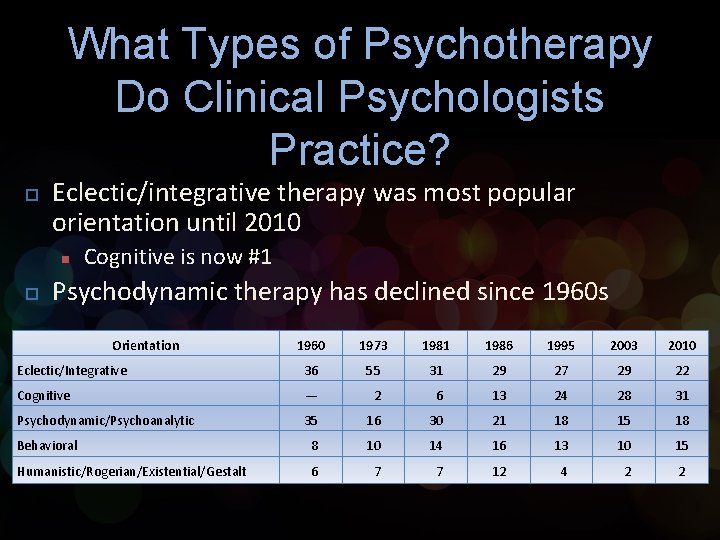
What Types of Psychotherapy Do Clinical Psychologists Practice? p Eclectic/integrative therapy was most popular orientation until 2010 n p Cognitive is now #1 Psychodynamic therapy has declined since 1960 s Orientation 1960 1973 1981 1986 1995 2003 2010 Eclectic/Integrative 36 55 31 29 27 29 22 Cognitive — 2 6 13 24 28 31 Psychodynamic/Psychoanalytic 35 16 30 21 18 15 18 Behavioral 8 10 14 16 13 10 15 Humanistic/Rogerian/Existential/Gestalt 6 7 7 12 4 2 2
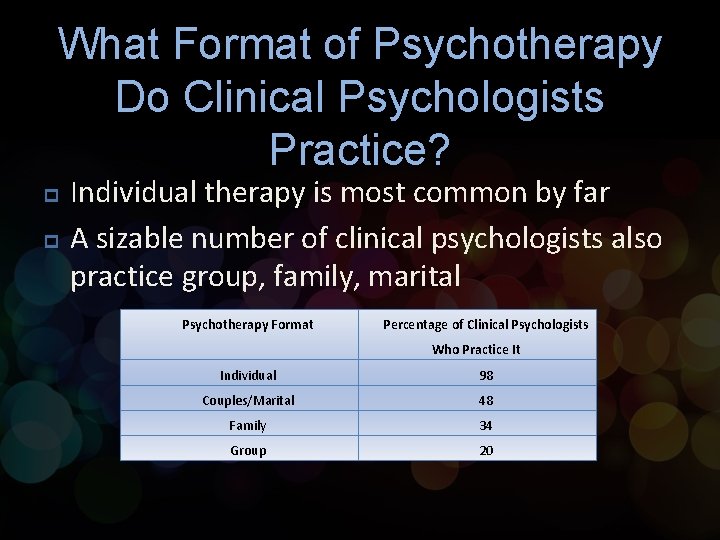
What Format of Psychotherapy Do Clinical Psychologists Practice? p p Individual therapy is most common by far A sizable number of clinical psychologists also practice group, family, marital Psychotherapy Format Percentage of Clinical Psychologists Who Practice It Individual 98 Couples/Marital 48 Family 34 Group 20
The Future of Psychotherapy p Experts expect the future of psychology to include a rise in n n Cognitive and behavioral therapy Culturally sensitive therapy Eclectic/integrative therapy Evidence-based therapy
Eclectic and Integrative Approaches p p p Both involve multiple approaches Eclectic therapy involves selecting the best treatment for a given client based on empirical data from studies of the treatment of similar clients Integrative therapy involves blending approaches in order to create a new hybrid