
Hamid zolfaghari Ms cognitive psychology What is ppt



- Slides: 26
Hamid zolfaghari Ms. cognitive psychology
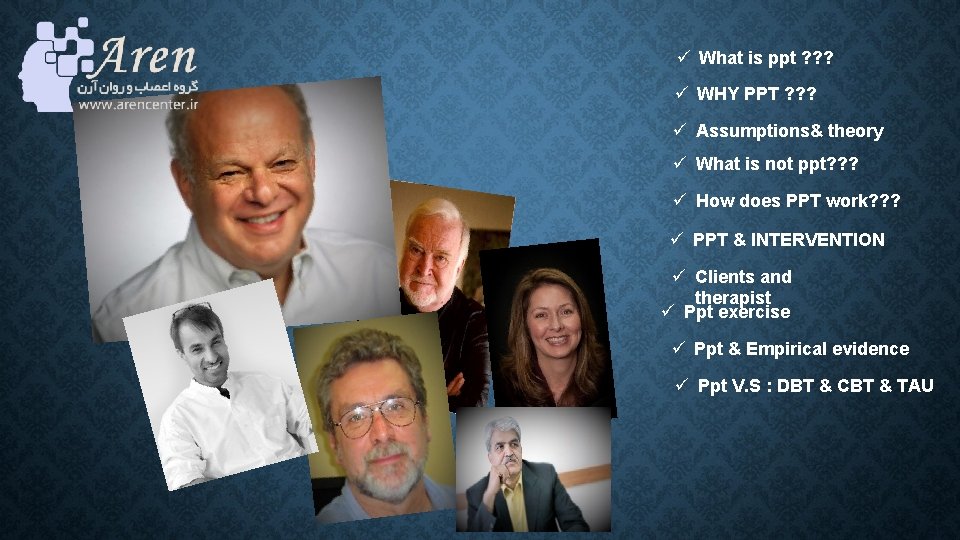
ü What is ppt ? ? ? ü WHY PPT ? ? ? ü Assumptions& theory ü What is not ppt? ? ? ü How does PPT work? ? ? ü PPT & INTERVENTION ü Clients and therapist ü Ppt exercise ü Ppt & Empirical evidence ü Ppt V. S : DBT & CBT & TAU
WHAT IS PPT ? ? ? Positive psychotherapy (PPT) is a therapeutic approach based on a premise, articulated and empirically explored by Chris Peterson, who emphasized that psychology ought to be concerned with strength as with weakness; as interested in building the best things in life as in repairing the worst; and as concerned with making lives of normal people fulfilling as with healing pathology (Peterson, 2006 a). PPT integrates symptoms with strengths, resources with risks, weaknesses with values, and hopes with regrets in order to understand inherent complexities of human experiences in a balanced way.
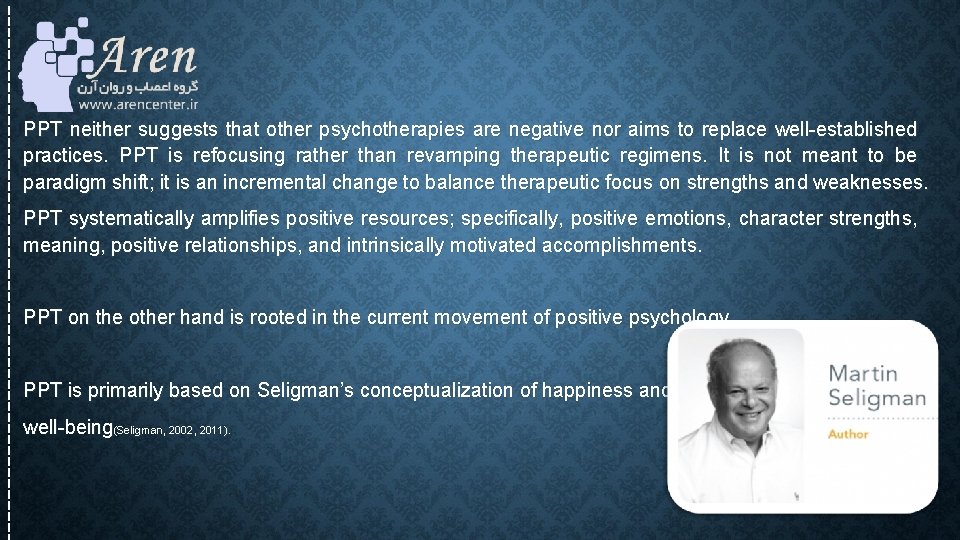
PPT neither suggests that other psychotherapies are negative nor aims to replace well-established practices. PPT is refocusing rather than revamping therapeutic regimens. It is not meant to be paradigm shift; it is an incremental change to balance therapeutic focus on strengths and weaknesses. PPT systematically amplifies positive resources; specifically, positive emotions, character strengths, meaning, positive relationships, and intrinsically motivated accomplishments. PPT on the other hand is rooted in the current movement of positive psychology. PPT is primarily based on Seligman’s conceptualization of happiness and well-being(Seligman, 2002, 2011).
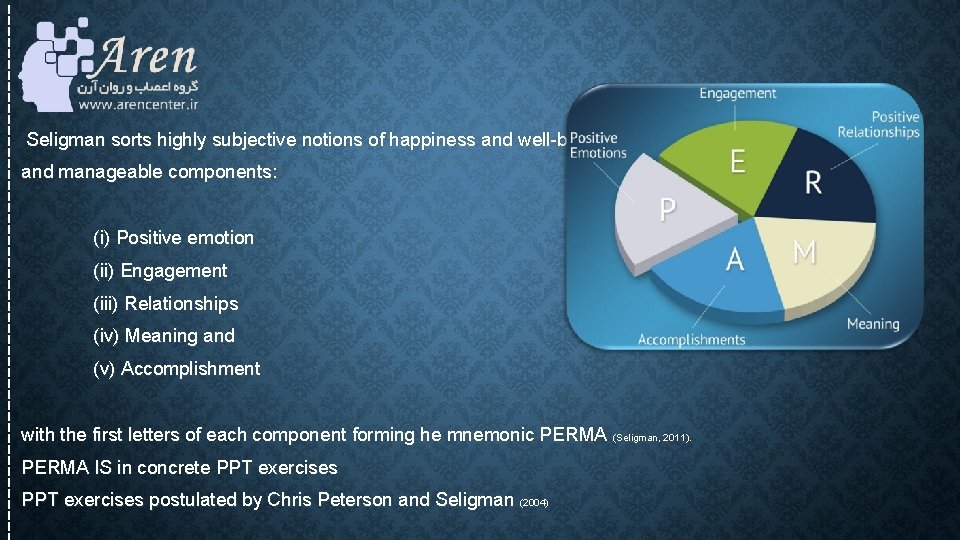
Seligman sorts highly subjective notions of happiness and well-being into five scientifically measurable and manageable components: (i) Positive emotion (ii) Engagement (iii) Relationships (iv) Meaning and (v) Accomplishment with the first letters of each component forming he mnemonic PERMA (Seligman, 2011). PERMA IS in concrete PPT exercises postulated by Chris Peterson and Seligman (2004)
PPT is based on three assumptions (Rashid & Seligman, 2013): 1)clients inherently desire growth: Psychopathology engenders when the growth is thwarted. 2)fulfillment : positive resources such as strengths are authentic and as real as symptoms and disorders. These are not defenses, Pollyannaish illusions or clinical by-products of symptom relief that lie at the clinical peripheries without needing attention. 3)happiness instead of just seeking to avoid misery, worry and anxiety: effective therapeutic relationships can be formed through the discussion and manifestation of positive resources, not only thorough lengthy analysis of weaknesses and deficits.
WHY PPT ? ? ? 1) The human mind defaults towards negativity . negatives, because of their apparent greater informational value, typically receive more attention and form more complex cognitive representations. So, Negative impressions are harder to undo 2) clinical psychology and psychotherapy have traditionally been about deficits . Psychotherapy can also be about optimization . Peterson’s seminal work on character strengths offers psychotherapy a tremendous opportunity to expand its scope, making it more inclusive and balanced. 3) the use of psychotherapy declined from 15. 9 to 10. 5% from 1998 to 2008, whereas during the same period, the use of psychotropic medications increased from 44. 1 to 57. 4% (Olfson & Marcus, 2010). individuals, who could benefit more from psychotherapy, avoid it due to the stigma of being labeled with a psychiatric diagnosis (Corrigan, 2004).
4) Psychotherapy is not only about untwisting distorted thinking or restoring troubled relationships; it is also about learning to use one’s strengths, skills, talents, and abilities to face challenges. 5) the effectiveness of psychotherapy is primarily assessed by symptom remittance, while variables such as quality of life or personal recovery are not commonly considered as part recovery : include hope, a meaningful and fulfilling life, a positive sense of identity, and taking responsibility for one’s own wellbeing (Slade, 2010).
ASSUMPTIONS & THEORY PPT has three assumptions about the nature, cause, course, and treatment of specific behavioral patterns: 1) psychopathology results when clients’ inherent capacities for growth, fulfillment, and wellbeing are thwarted by psychological and sociocultural factors. Well-being do not reside entirely inside clients, derive from interaction between clients and their environment. When this interaction becomes dysfunctional, clients’ growth is thwarted . Evidence shows that strengths can play a key role in growth even in dire life circumstances (Seery, Holman, & Silver, 2010).
2) PPT considers positive emotions and strengths as real as symptoms and disorders, and they are valued in their own right. honesty, co-operation, gratitude, and kindness are as real as deception, competition, grudge, greed, andworry. The absence of mental illness does not necessarily mean the presence of well-being 3)effective therapeutic relationships can be formed through the discussion of positive personal characteristics and experiences. 4)Not all clients need or will benefit from deep analysis and discussions of their troubles. It is not that troubles are not worth discussing, but powerful therapeutic bonds can also be built by deeply discussing positive emotions and experiences (Burton & King, 2004).
WHAT IS NOT PPT? ? ? PPT is not a panacea and will not be appropriate for all clients in all situations. Clinical judgment is needed to determine the suitability of PPT for individual clients. PPT is not prescriptive. Rather, it is describe that scientific evidence indicates that certain benefits accrue when individuals attend to the positive aspects of their experience. PPT, does not deny negative emotions, nor does it encourage clients to search for positives all too quickly through rose-colored glasses. It is a scientific endeavor to encourage clients to explore their intact resources and learn contextual, nuanced and calibrated use of these resources to overcome their challenges in increments but never at the cost of denying, dismissing or avoiding negatives.
HOW DOES PPT WORK? ? ? PPT applied to treat symptoms of depression, anxiety, psychosis, borderline personality disorder, and to support smoking cessation. PPT protocol can be adapted to be incorporated in other treatment approaches.
1)the therapist empathically listens to clients’ concerns to build and maintain a trusting therapeutic relationship 2)the therapist searches for opportunities to help clients identify and own their strengths. 3)Exploring and amplifying : Throughout PPT, negatives are balanced with positives: Pain associated with trauma is empathetically attended, but potential for growth from trauma is also explored, whenever appropriate 4)Recall of positive memories plays an important role in mood regulation (Joormann, Dkane, & Gotlib, 2006). 5)change brought by positive interventions could be moderated by level of symptom severity, individual personality variables
PPT & INTERVENTION Positive interventions typically are one or more positive psychology exercises. positive interventions would be Seligman et al. (2005), Vella-Brodrick, Park, and Peterson (2009), Mongrain and Anselmo-Mathews (2012) and Schueller & Parks (2012). Positive Psychotherapy Inventory (PPTI), which can be used to assess specific active ingredients of PPT including positive emotions, engagement, meaning, and relationships, has been devised and validated (Bertisch et al. , 2014; Guney, 2011; Rashid, 2008). PPT interventions, especially focusing on signature strengths, are very effective with many patients. These interventions are particularly useful in establishing a strong therapeutic alliance in the initial session or sessions.
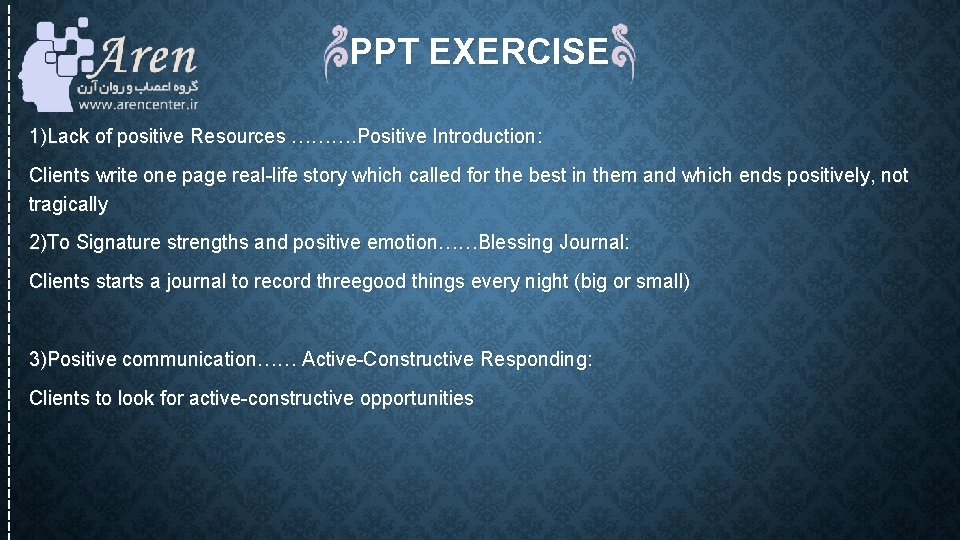
PPT EXERCISE 1)Lack of positive Resources ………. Positive Introduction: Clients write one page real-life story which called for the best in them and which ends positively, not tragically 2)To Signature strengths and positive emotion……Blessing Journal: Clients starts a journal to record threegood things every night (big or small) 3)Positive communication…… Active-Constructive Responding: Clients to look for active-constructive opportunities
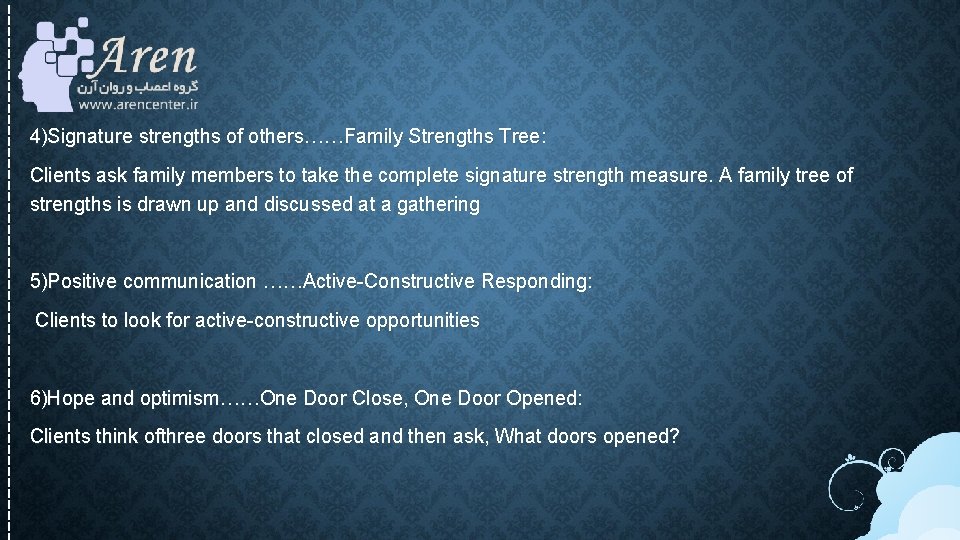
4)Signature strengths of others……Family Strengths Tree: Clients ask family members to take the complete signature strength measure. A family tree of strengths is drawn up and discussed at a gathering 5)Positive communication ……Active-Constructive Responding: Clients to look for active-constructive opportunities 6)Hope and optimism……One Door Close, One Door Opened: Clients think ofthree doors that closed and then ask, What doors opened?
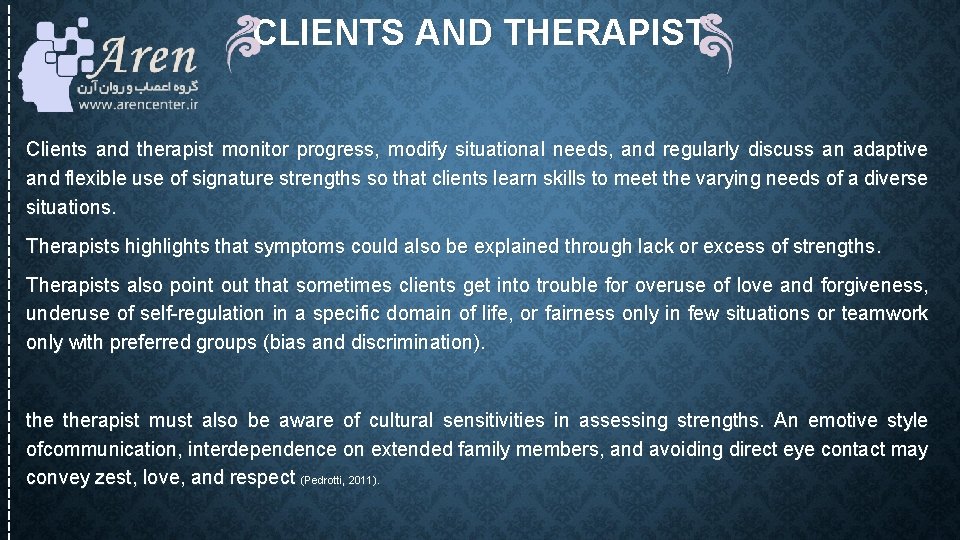
CLIENTS AND THERAPIST Clients and therapist monitor progress, modify situational needs, and regularly discuss an adaptive and flexible use of signature strengths so that clients learn skills to meet the varying needs of a diverse situations. Therapists highlights that symptoms could also be explained through lack or excess of strengths. Therapists also point out that sometimes clients get into trouble for overuse of love and forgiveness, underuse of self-regulation in a specific domain of life, or fairness only in few situations or teamwork only with preferred groups (bias and discrimination). therapist must also be aware of cultural sensitivities in assessing strengths. An emotive style ofcommunication, interdependence on extended family members, and avoiding direct eye contact may convey zest, love, and respect (Pedrotti, 2011).
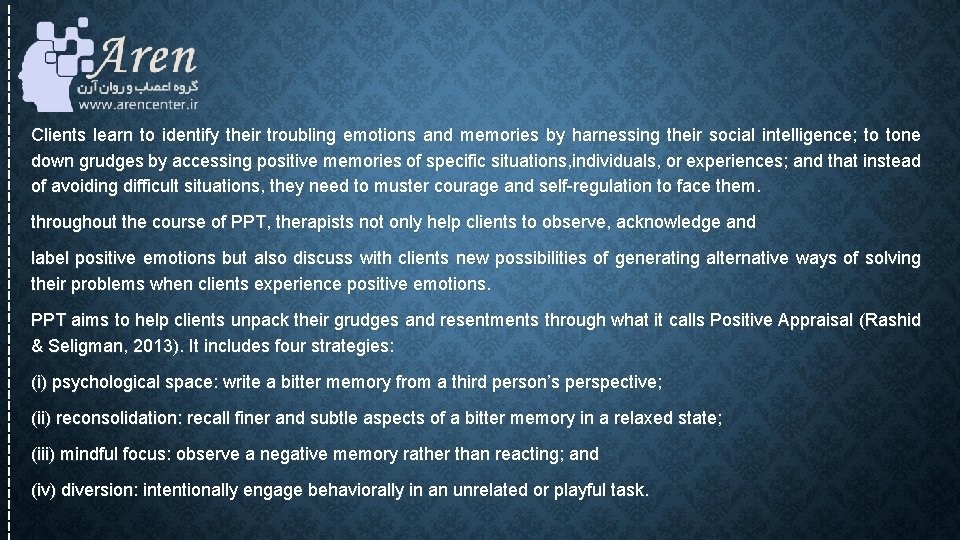
Clients learn to identify their troubling emotions and memories by harnessing their social intelligence; to tone down grudges by accessing positive memories of specific situations, individuals, or experiences; and that instead of avoiding difficult situations, they need to muster courage and self-regulation to face them. throughout the course of PPT, therapists not only help clients to observe, acknowledge and label positive emotions but also discuss with clients new possibilities of generating alternative ways of solving their problems when clients experience positive emotions. PPT aims to help clients unpack their grudges and resentments through what it calls Positive Appraisal (Rashid & Seligman, 2013). It includes four strategies: (i) psychological space: write a bitter memory from a third person’s perspective; (ii) reconsolidation: recall finer and subtle aspects of a bitter memory in a relaxed state; (iii) mindful focus: observe a negative memory rather than reacting; and (iv) diversion: intentionally engage behaviorally in an unrelated or playful task
PPT & EMPIRICAL EVIDENCE Kashdan, Julian, Merritt, and Uswatte (2006) in a diary study with the Vietnam War veterans diagnosed with Post-traumatic Stress Disorder (PTSD), found that gratitude related to more daily self-esteem and positive affect, above the effects of symptomatology. through PPT exercises such as Satisficing versus Maximizing (Schwartz, Ward et al. , 2002) and Savoring (Bryant & Veroff, (Schwartz, Ward et (Bryant & Veroff, 2006) clients learn to slow down and enjoy experiences they would normally hurry through (e. g. eating a meal). according to Fredrickson’s positivity ratio (2009), Depressed individuals seeking therapy experience lower than one positive for every one negative (Schwartz et al. , 2002).
In a 6 -group, random-assignment Seligman, Steen, Park, and Peterson (2005) found that of 5 purported happiness interventions and 1 plausible control exercise, three exercises (using signature strengths in a new way, three good things & gratitude visit) increased happiness and decreased depressive symptoms. These findings independently replicated with somewhat similar results (Giannopoulos & Vella-Brodrick, 2011; Mongrain & Anselmo-Matthews, 2012). Two meta-analyses of positive interventions have been published. The first meta-analysis of 51 positive interventions including both clinical and non-clinical samples, conducted by Sin and Lyubomirsky (2009), found that positive interventions are effective, with moderate effect sizes in significantly decreasing symptoms of depression (mean r = 0. 31) and enhancing well-being (mean r = 0. 29).
PPT V. S : DBT & CBT & TAU Clients sought counseling services at a large urban university for symptoms of severe depression. PPT took place over up to 14 sessions, mostly weekly, to individual clients in 12– 14 sessions. It The TAU (Treatment as Usual) received an integrative and eclectic approach administered by licensed psychologists, two licensed social workers, and two graduate-level interns. Overall, results indicated that PPT did better than two active treatments, with large effect size. PPT is compared with DBT. Participants are identified after completing SCID and multiple measures of psychiatric distress and emotional dysregulation. Results of the first phase show that both PPT (n = 6) and DBT (n = 10) worked equally well on most measure, . However, due to small sample size, these results are highly preliminary.
Asgharipoor and colleagues compared PPT with CBT. Eighteen outpatients diagnosed met the inclusion criteria, which included having major depressive disorder as identified by SCID (Beck, Steer, & Brown, 1996; a Persian validated version), Subjective Units of Distress Scale (SUDS), Oxford Happiness Scale, and Subjective Wellbeing Scale. The PPT (n = 9) and CBT (n = 9) were offered in 12 two houres sessions at a community counseling center in Mashhad, Iran. Results showed that the two treatments did not differ in reducing symptoms of depression, but PPT was found more effective in increasing happiness.