Chapter 10 Review 1 Which represents a polyploid


- Slides: 34
Chapter 10 Review
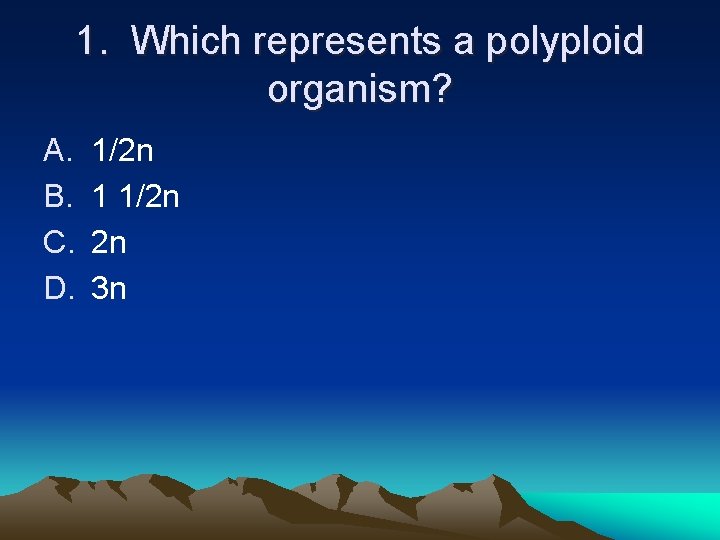
1. Which represents a polyploid organism? A. B. C. D. 1/2 n 1 1/2 n 2 n 3 n
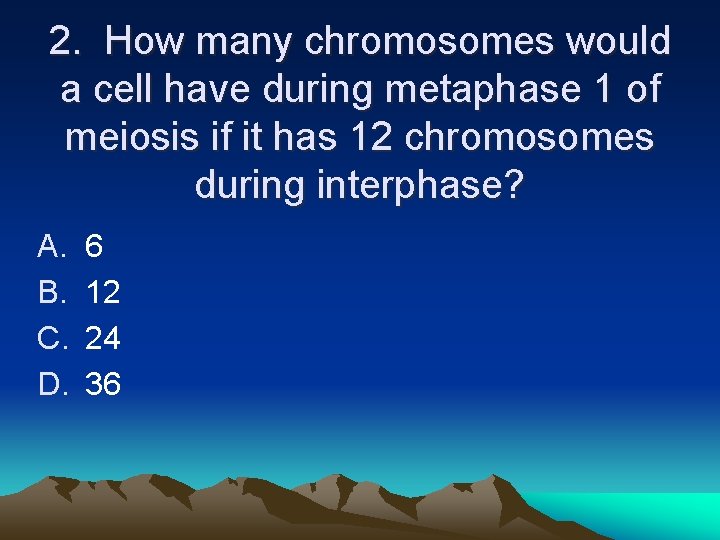
2. How many chromosomes would a cell have during metaphase 1 of meiosis if it has 12 chromosomes during interphase? A. B. C. D. 6 12 24 36
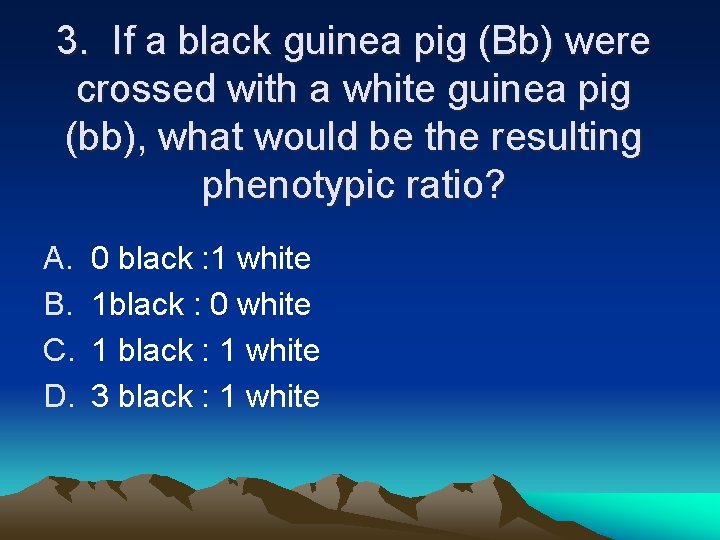
3. If a black guinea pig (Bb) were crossed with a white guinea pig (bb), what would be the resulting phenotypic ratio? A. B. C. D. 0 black : 1 white 1 black : 0 white 1 black : 1 white 3 black : 1 white
4. Which is not a characteristic of homologous chromosomes? A. Homologous chromosomes have the same length. B. Homologous chromosomes have the same centromere position. C. Homologous chromosomes have the exact same type of allele at the same location. D. Homologous chromosomes pair up during meiosis I.
5. In garden peas, purple flowers (P) are dominant to white flowers (p), and tall plants (T) are dominant to short plants (t). If a purple tall plant (Pp. Tt) is crossed with a white short plant (pptt), what is the resulting phenotypic ratio? A. 1: 1: 1: 1 C. 9: 3: 3: 1 B. 3 purple tall: 3 purple short D. All purple tall
6. Which does not contribute to genetic variation? A. B. C. D. Chromosome number Crossing over Meiosis Random mating
7. Which concept is considered an exception to Mendel’s law of independent assortment? A. B. C. D. Crossing over Gene linkage Polyploidy Law of segregation
8. For the housefly with six pairs of chromosomes, how many possible combinations of gametes can be produced by the random linking up of pairs in meiosis? A. B. C. D. 32 48 64 120
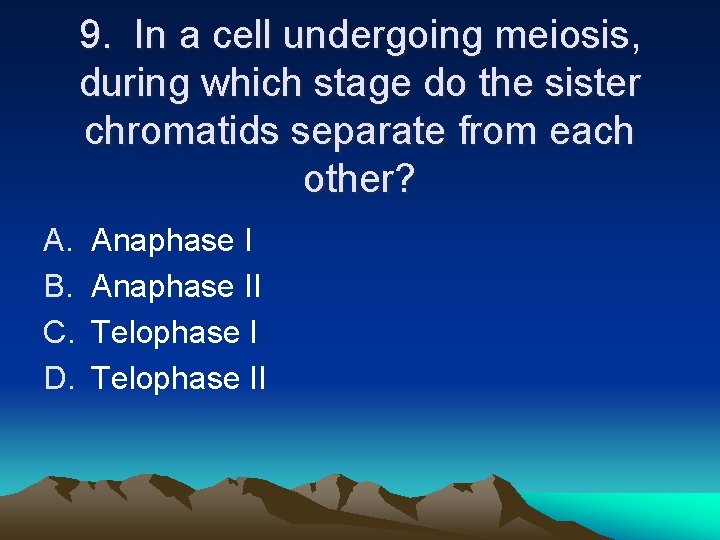
9. In a cell undergoing meiosis, during which stage do the sister chromatids separate from each other? A. B. C. D. Anaphase II Telophase II
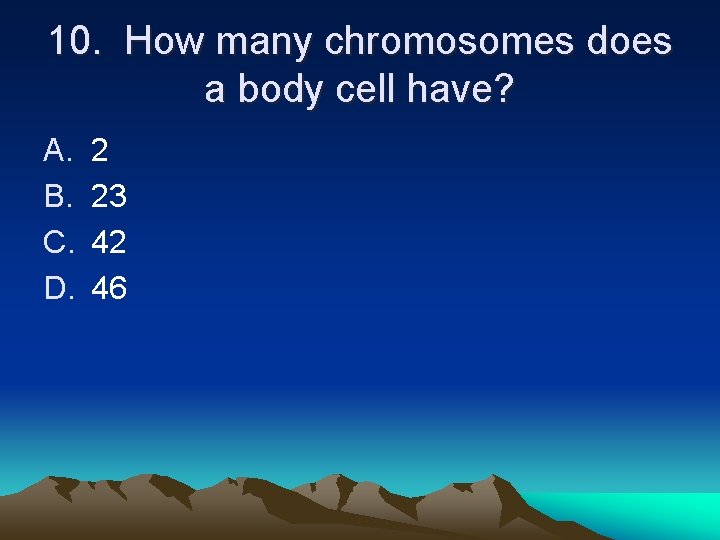
10. How many chromosomes does a body cell have? A. B. C. D. 2 23 42 46
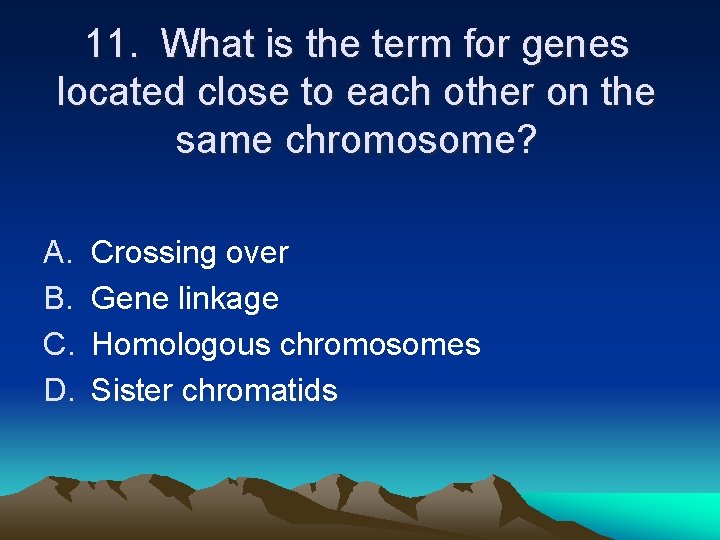
11. What is the term for genes located close to each other on the same chromosome? A. B. C. D. Crossing over Gene linkage Homologous chromosomes Sister chromatids
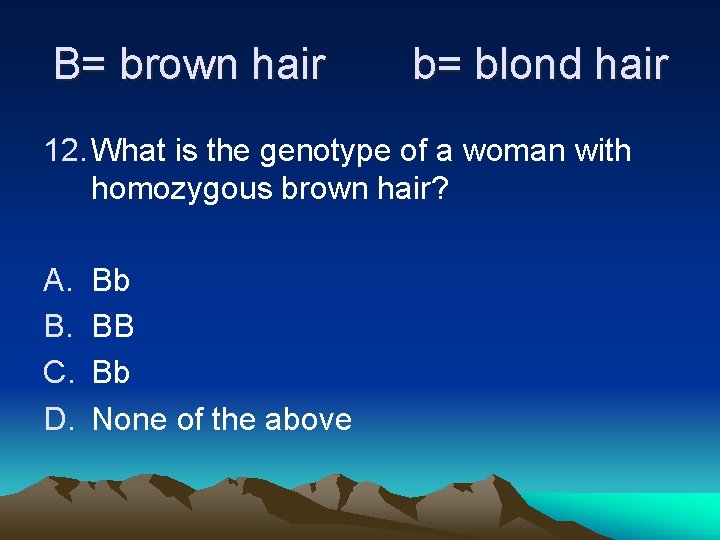
B= brown hair b= blond hair 12. What is the genotype of a woman with homozygous brown hair? A. B. C. D. Bb BB Bb None of the above
B= brown hair b= blond hair 13. What is the phenotype of a woman that is bb? A. B. C. D. Brown hair Homozygous recessive Blond hair Homozygous dominant
14. What law states that alleles must separate upon being passed on? A. B. C. D. Mendel’s monohybrid cross Law of Independent Assortment Law of Segregation Mendel’s dihybrid cross
15. Passing on the dominant allele for hair color and the recessive allele for eye color is an example of the… A. B. C. D. Mendel’s monohybrid cross Law of Independent Assortment Law of Segregation Mendel’s dihybrid cross
16. What process does not increase genetic variation? A. B. C. D. Meiosis Crossing over Mitosis Random fusion of sperm/egg
17. An organism that has a different form of a trait from each parent is called a A. B. C. D. Homozygote Purebred Hybrid fluke
18. If the diploid number of a fruitfly is 26, what is the haploid number? A. B. C. D. 26 0 22 13
For the remainder questions, list either A for Mitosis, or B for Meiosis: 19. Crossing over occurs. A. Mitosis B. Meiosis
20. 2 diploid cells are formed A. Mitosis B. Meiosis
21. Occurs in gametes A. Mitosis B. Meiosis
22. Associated with asexual reproduction. A. Mitosis B. Meiosis
23. Associated with growth A. Mitosis B. Meiosis
24. Could occur in bone cells A. Mitosis B. Meiosis
25. Daughter cells are not identical to parent cells A. Mitosis B. Meiosis
26. 1 division occurs A. Mitosis B. Meiosis
27. Chromosome number is ½ the original A. Mitosis B. Meiosis
28. 4 daughter cells are formed A. Mitosis B. Meiosis
29. Involved in repair of cells A. Mitosis B. Meiosis
30. Involved in formed new and diverse organism A. Mitosis B. Meiosis
31. A white mouse whose parents are both white produces only brown offspring when mated with a brown mouse. The white mouse is most probably A. Homozygous recessive B. Heterozygous C. Homozygous dominant D. haploid
32. A dog’s phenotype can be determined by A. Looking at the dog’s parents B. Examining the dog’s chromosomes C. Mating the dog and examining its offspring D. Looking at the dog
33. Crossing over results in a A. Female genotype B. Male genotype C. Genetic recombination D. Phenotype replication