Chapter 10 Expenses College students are diverse and


- Slides: 32
Chapter 10
§ Expenses § College students are diverse and may be in different stages of their lives. § Some students may have just graduated from high school, while other may be older and have families. While these differences will have an impact on financial responsibilities, there are certain financial obligations most college students have to pay for. § Some are more expensive, like tuition, while others are less pricey but still important, like books and food. § The following slide describes basic expenses associated with college.
§ Tuition: This includes the price for attending an institution. Students pay relatively more or less for this based on where they’re going to school and how many credits they’re taking. § Room and board: These are essentially “food and shelter” costs. Many college students live in a dorm and eat their meals on campus. Students who live off campus will have to pay for comparable things, like renting an apartment and buying their own groceries. § Books and supplies: These include books for classes and supplies like notebooks, writing utensils, and calculators. Textbooks are often very expensive, so many students try to find used textbooks for sale. § Personal needs: Regardless of where students live, they typically need money for things like laundry, cell phones, computers, and going out with friends. This expense can vary a lot depending on personal preferences. For instance, some students may prefer to make their own meals while others may prioritize eating out. § Transportation: Students who commute by car or need to drive to off-campus activities will need to consider the price of car insurance, maintenance, and gas. Students who attend college in more urban areas may also have public-transportation expenses. § What types of expenses do you think you might face as a college student? The following video will help you review the types of college expenses and examine particular costs that are common for both four-year and two-year institutions.
§ Video Link
§ Objectives § Identify sources of major and minor expenses in your life § Identify sources of income in your life § Set financial goals and priorities for yourself § Directions § Identify two larger college expenses and two smaller college expenses that you are responsible for. For example, tuition might be a large college expense while notebooks and folders might be smaller ones. § Describe any sources of income you currently have to cover these expenses. § Explain three financial goals you have for covering your college expenses. For example, you might want to consider work study or taking out another loan. § Follow your instructor’s guidelines for submitting assignments.
§ Paying for college is a big challenge, but the following financial resources can help: § Jobs: Full-time students may find part-time work on or off campus, while part-time students may work during the day and then take evening classes. Students can also talk to their guidance counselor and financial resource department about work-study opportunities, which allow students to receive money for completing work related to their studies. § Free Application for Federal Student Aid (FAFSA): This free application, available here, requires students to answer questions regarding their background and personal finances in order to find out how much financial assistance they might qualify for. The financial assistance comes in the form of government loans, grants, work study, or scholarships. Financial aid will be discussed in greater detail later in this module. § Loans: Students can apply for federal loans or personal loans through banks. Loans accrue interest and eventually need to be paid back. § Grants and scholarships: Students can apply for grants and scholarships through their institutions, local businesses, or online organizations. Scholarships may be awarded on the basis of merit (grades, achievements, volunteer work, etc. ), financial need (economic status), or some other set of criteria (achievements and ethnic background, for instance). Unlike loans, grants and scholarships don’t need to be paid back.
§ Setting financial goals for yourself is one of the best ways to track and manage your expenses. The following strategies can help: § Create SMART goals: SMART stands for specific, measurable, attainable, realistic, and timely. These kinds of goals are more manageable and can help you reach your final target more easily. For example, instead of setting a broad, vague goal of “paying for college, ” you might set a goal of paying off your two college loans five years after you graduate. This more specific, measurable goal can help you keep track of your progress and whether you need to make changes to reach it.
§ Monitor your spending: Try keeping track of what you spend money on during a one -month period. This can help you see where your money goes and where you may be able to save. § Create a budget: Based on what you discovered after monitoring your spending, create a monthly budget you can stick to. While some expenses, such as food and transportation, are necessary, you may find that you can save money on both by riding a bike (instead of driving) to school and eating out in restaurants less.
§ Consider working: Some students have full-time jobs while attending college, whereas others may not have a lot of time to work if they’re taking a full academic load. Depending on your circumstances, it’s worth looking into employment opportunities both on and off campus. Even if you feel like only a couple hours of work per week are possible, it could help you pay for something like books so you have one less thing to worry about when you graduate.
§ Choose loans wisely: Many college students need some sort of financial support through loans. While loans are a good way to pay for tuition up front if you don’t have the money, remember that they accrue interest until you pay them off. That means that you will end up paying back more—in some cases, thousands of dollars more—than you initially borrowed. Make sure you investigate and apply for as many scholarships and grants as you can (since they won’t need to be repaid), and shop around for the loans with the lowest interest rates and best repayment plans. Check with the financial aid office on your college campus—they can provide additional help.
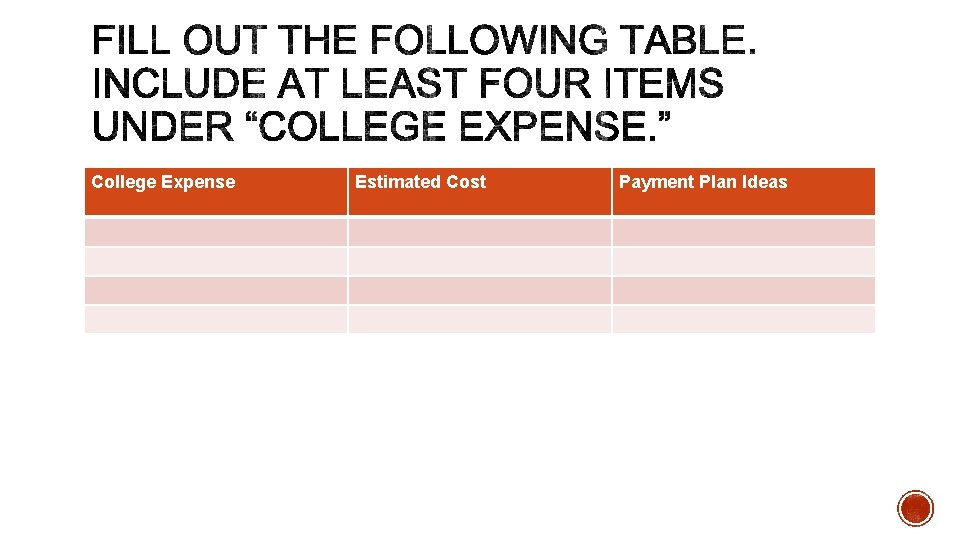
§ Determine the costs of attending the school of your choice § Identify the potential sources of financial assistance available, including subsidized and unsubsidized loans, grants, scholarships, and work study § Directions § Identify the college expenses you will need to cover. § Research the college you attend and identify any additional costs that may be unique to that institution. § Review resources that may help you pay for college in the “Financial Resources” section. § Fill out table on the next slide…
College Expense Estimated Cost Payment Plan Ideas
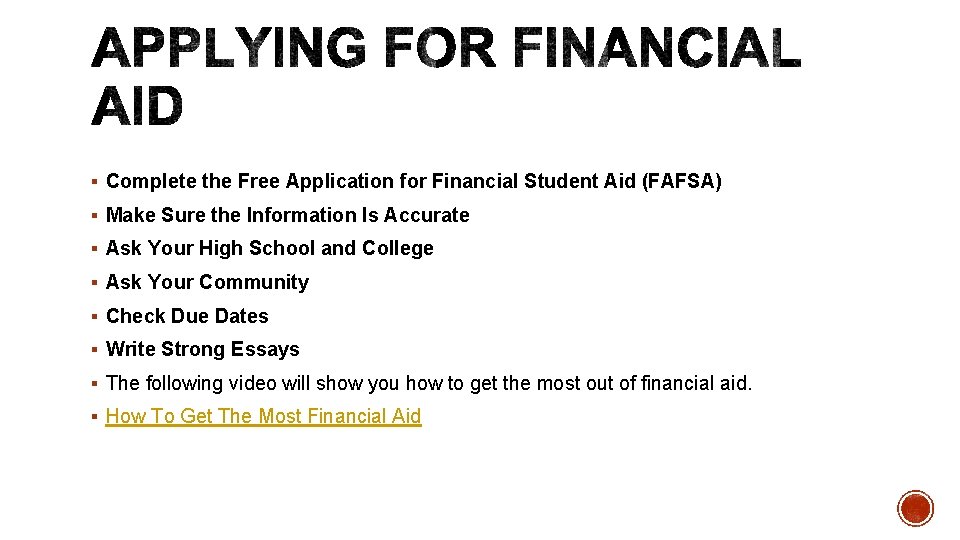
§ Complete the Free Application for Financial Student Aid (FAFSA) § Make Sure the Information Is Accurate § Ask Your High School and College § Ask Your Community § Check Due Dates § Write Strong Essays § The following video will show you how to get the most out of financial aid. § How To Get The Most Financial Aid
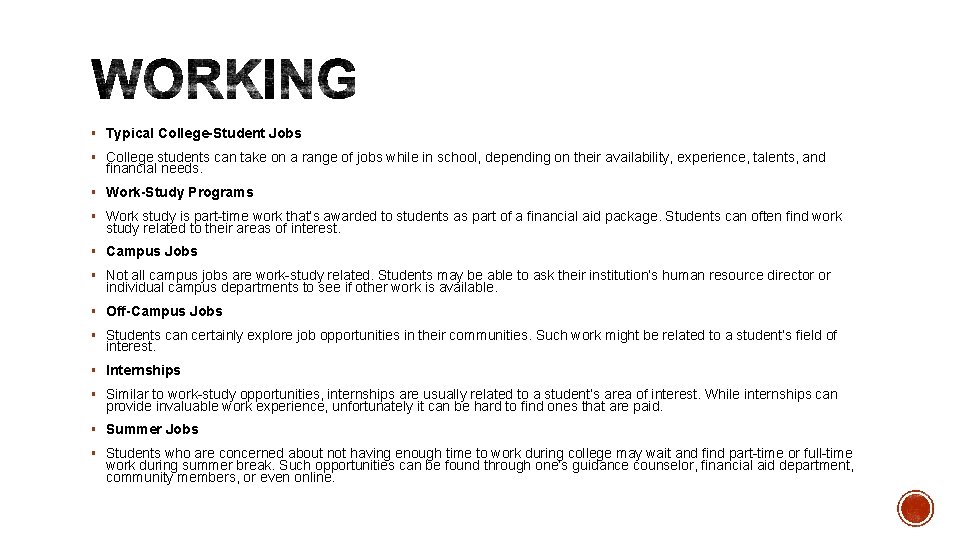
§ Typical College-Student Jobs § College students can take on a range of jobs while in school, depending on their availability, experience, talents, and financial needs. § Work-Study Programs § Work study is part-time work that’s awarded to students as part of a financial aid package. Students can often find work study related to their areas of interest. § Campus Jobs § Not all campus jobs are work-study related. Students may be able to ask their institution’s human resource director or individual campus departments to see if other work is available. § Off-Campus Jobs § Students can certainly explore job opportunities in their communities. Such work might be related to a student’s field of interest. § Internships § Similar to work-study opportunities, internships are usually related to a student’s area of interest. While internships can provide invaluable work experience, unfortunately it can be hard to find ones that are paid. § Summer Jobs § Students who are concerned about not having enough time to work during college may wait and find part-time or full-time work during summer break. Such opportunities can be found through one’s guidance counselor, financial aid department, community members, or even online.
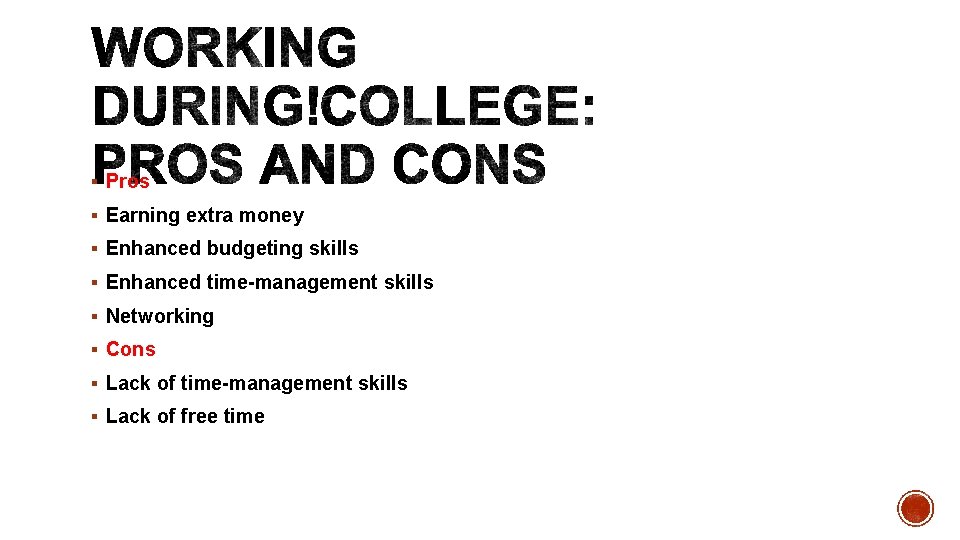
§ Pros § Earning extra money § Enhanced budgeting skills § Enhanced time-management skills § Networking § Cons § Lack of time-management skills § Lack of free time
§ The following video shares one student’s experience with the pros and cons of working her way through college. § Students Working Through College - Video
§ We’ve identified some categories of work that are typically available to college students, but what about the actual process of finding a suitable job? Students have a number of employment resources available to them on campus, online, and in the community: § Career centers: Most colleges have a career center where students can learn about job opportunities both on and off campus. Refer to San Jac’s Career Services site for more information. Career Services Link § Career fairs: Many colleges organize on-campus career fairs—companies are invited to set up booths and share information with students about potential job and career opportunities. § Online job search: Web sites such as Careerbuilder, Snagajob, and even Craigslist post job listings for positions ranging from seasonal retail work to freelance writing opportunities. § Community businesses and places of worship: Don’t overlook community bulletin boards in places like neighborhood coffee shops and grocery stores—someone always seems to need a dog walker, house sitter, or nanny.
§ You may be surprised to find that you can change your spending habits, gain better control § § over your finances, and wind up with money in the bank. Below are some common hazards you can avoid and tips to get you started: New spending responsibilities: Save extra money you have left at the end of the month, look for coupons, and look for sales. Using credit cards: Owning and using a credit card can be an effective way to build a credit history. However, if you don’t pay them off in full every month, they accrue interest. Neglecting to pursue scholarships: Many college students are either unaware of scholarships they qualify for or they just don’t follow through and apply. Take advantage of the financial aid office. Recreational activities: College students may find themselves with hours of free time. To fill that time, they may want to go to places like restaurants, movies, and shopping centers. Activities such as these can add up fast and cost more money than cooking your own meal at your home or watching a movie on Netflix.
§ Analyzing your spending habits (as you just did) is the first step. Next, you can try the following: § Create a detailed budget: Budgets will enable you to treat yourself while avoiding overspending. § Cut down on meal costs: Looking for deals and using coupons at grocery stores will save more money than eating out. § Save on transportation: Cut down on the cost of gas (or get rid of your car altogether) by walking to class, riding a bike, or using public transportation. § Look for discounts and used items: As long as a textbook isn’t outdated, you can often purchase used or discounted copies online or from other students. § Apply for scholarships and minimize loans: Scholarships don’t have to be repaid, and they don’t rack up interest.
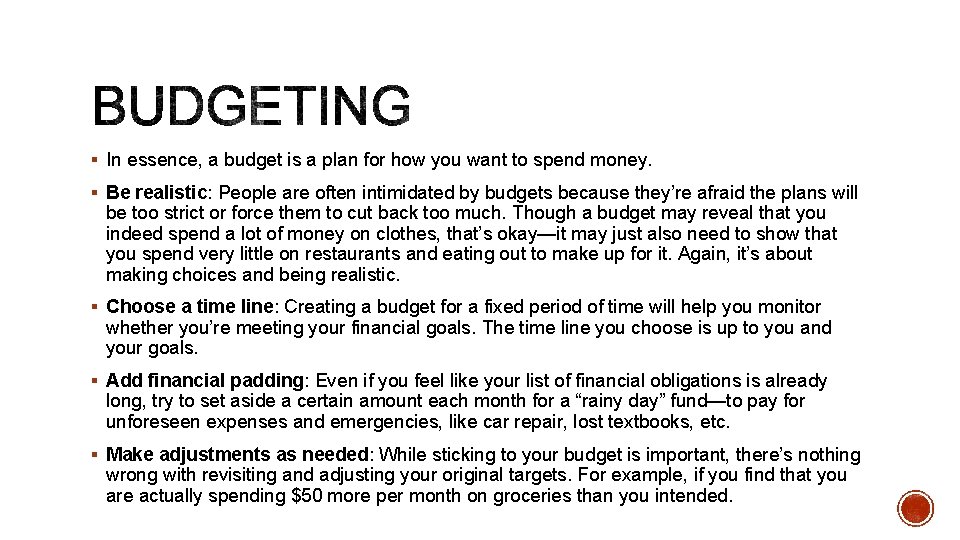
§ In essence, a budget is a plan for how you want to spend money. § Be realistic: People are often intimidated by budgets because they’re afraid the plans will be too strict or force them to cut back too much. Though a budget may reveal that you indeed spend a lot of money on clothes, that’s okay—it may just also need to show that you spend very little on restaurants and eating out to make up for it. Again, it’s about making choices and being realistic. § Choose a time line: Creating a budget for a fixed period of time will help you monitor whether you’re meeting your financial goals. The time line you choose is up to you and your goals. § Add financial padding: Even if you feel like your list of financial obligations is already long, try to set aside a certain amount each month for a “rainy day” fund—to pay for unforeseen expenses and emergencies, like car repair, lost textbooks, etc. § Make adjustments as needed: While sticking to your budget is important, there’s nothing wrong with revisiting and adjusting your original targets. For example, if you find that you are actually spending $50 more per month on groceries than you intended.
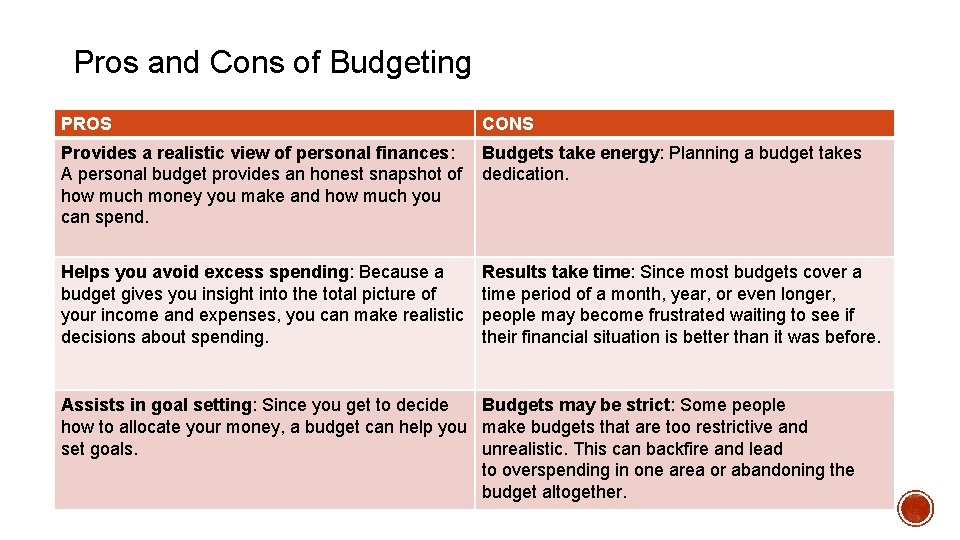
Pros and Cons of Budgeting PROS CONS Provides a realistic view of personal finances: Budgets take energy: Planning a budget takes A personal budget provides an honest snapshot of dedication. how much money you make and how much you can spend. Helps you avoid excess spending: Because a budget gives you insight into the total picture of your income and expenses, you can make realistic decisions about spending. Results take time: Since most budgets cover a time period of a month, year, or even longer, people may become frustrated waiting to see if their financial situation is better than it was before. Assists in goal setting: Since you get to decide Budgets may be strict: Some people how to allocate your money, a budget can help you make budgets that are too restrictive and set goals. unrealistic. This can backfire and lead to overspending in one area or abandoning the budget altogether.
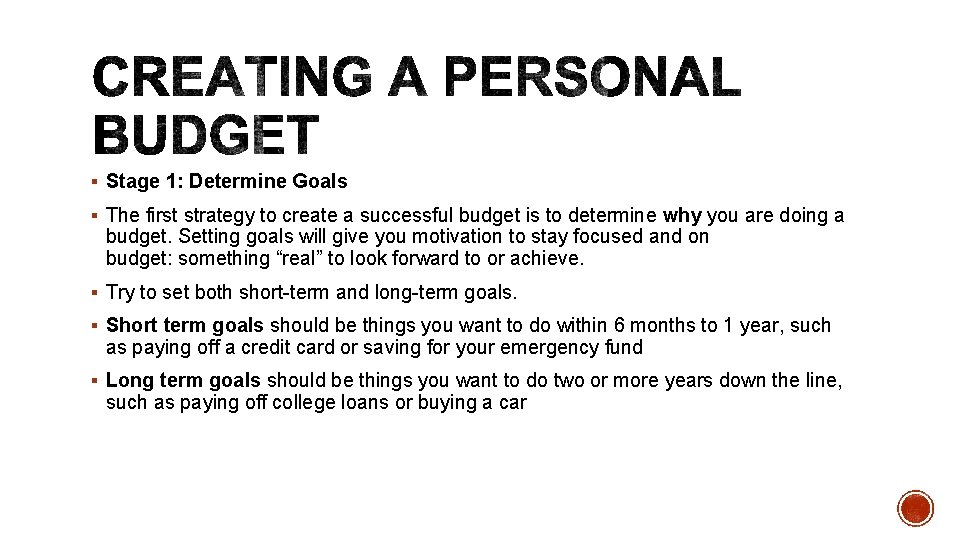
§ Stage 1: Determine Goals § The first strategy to create a successful budget is to determine why you are doing a budget. Setting goals will give you motivation to stay focused and on budget: something “real” to look forward to or achieve. § Try to set both short-term and long-term goals. § Short term goals should be things you want to do within 6 months to 1 year, such as paying off a credit card or saving for your emergency fund § Long term goals should be things you want to do two or more years down the line, such as paying off college loans or buying a car
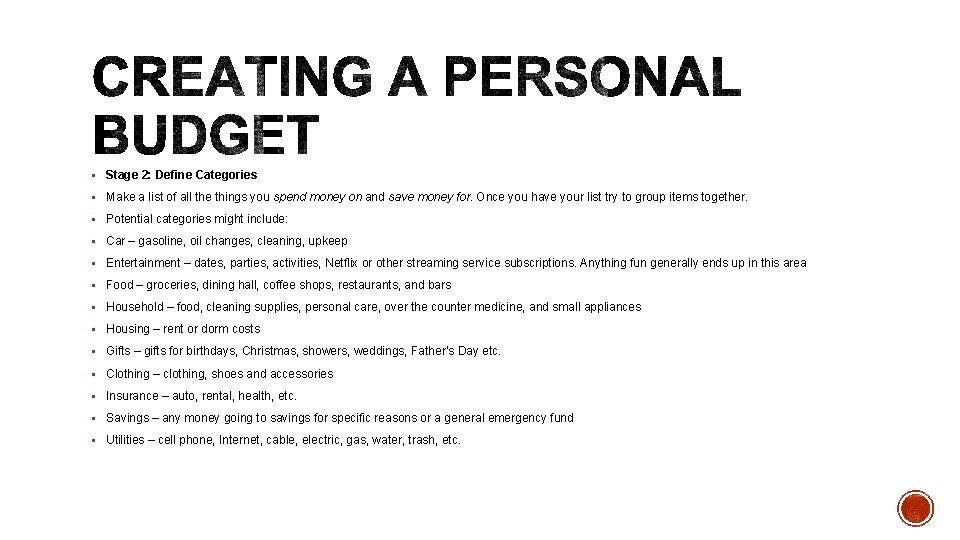
§ Stage 2: Define Categories § Make a list of all the things you spend money on and save money for. Once you have your list try to group items together. § Potential categories might include: § Car – gasoline, oil changes, cleaning, upkeep § Entertainment – dates, parties, activities, Netflix or other streaming service subscriptions. Anything fun generally ends up in this area § Food – groceries, dining hall, coffee shops, restaurants, and bars § Household – food, cleaning supplies, personal care, over the counter medicine, and small appliances § Housing – rent or dorm costs § Gifts – gifts for birthdays, Christmas, showers, weddings, Father’s Day etc. § Clothing – clothing, shoes and accessories § Insurance – auto, rental, health, etc. § Savings – any money going to savings for specific reasons or a general emergency fund § Utilities – cell phone, Internet, cable, electric, gas, water, trash, etc.
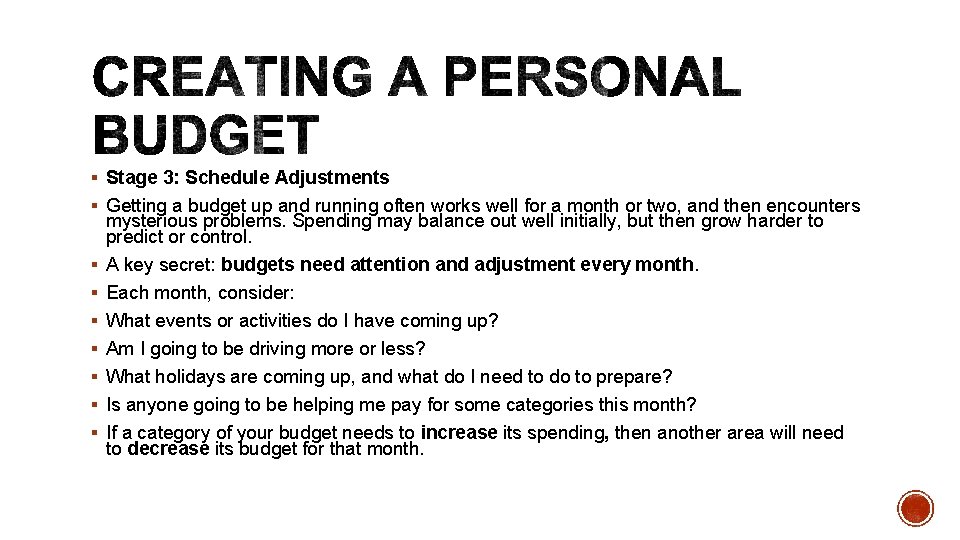
§ Stage 3: Schedule Adjustments § Getting a budget up and running often works well for a month or two, and then encounters § § § § mysterious problems. Spending may balance out well initially, but then grow harder to predict or control. A key secret: budgets need attention and adjustment every month. Each month, consider: What events or activities do I have coming up? Am I going to be driving more or less? What holidays are coming up, and what do I need to do to prepare? Is anyone going to be helping me pay for some categories this month? If a category of your budget needs to increase its spending, then another area will need to decrease its budget for that month.
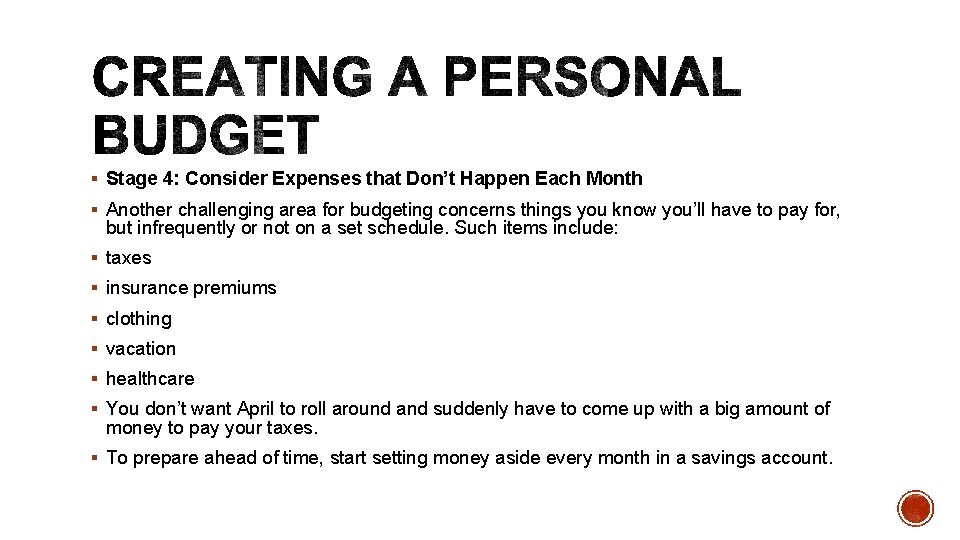
§ Stage 4: Consider Expenses that Don’t Happen Each Month § Another challenging area for budgeting concerns things you know you’ll have to pay for, but infrequently or not on a set schedule. Such items include: § taxes § insurance premiums § clothing § vacation § healthcare § You don’t want April to roll around and suddenly have to come up with a big amount of money to pay your taxes. § To prepare ahead of time, start setting money aside every month in a savings account.
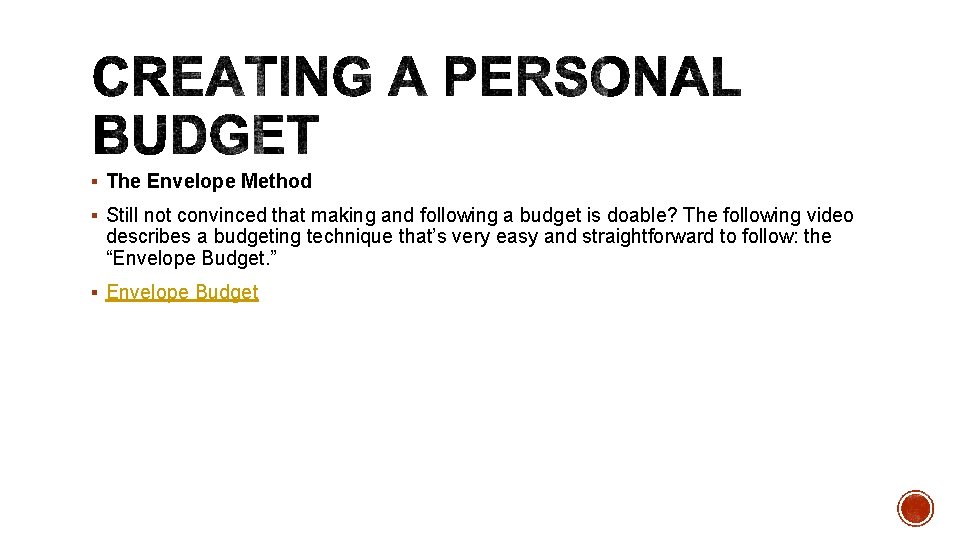
§ The Envelope Method § Still not convinced that making and following a budget is doable? The following video describes a budgeting technique that’s very easy and straightforward to follow: the “Envelope Budget. ” § Envelope Budget
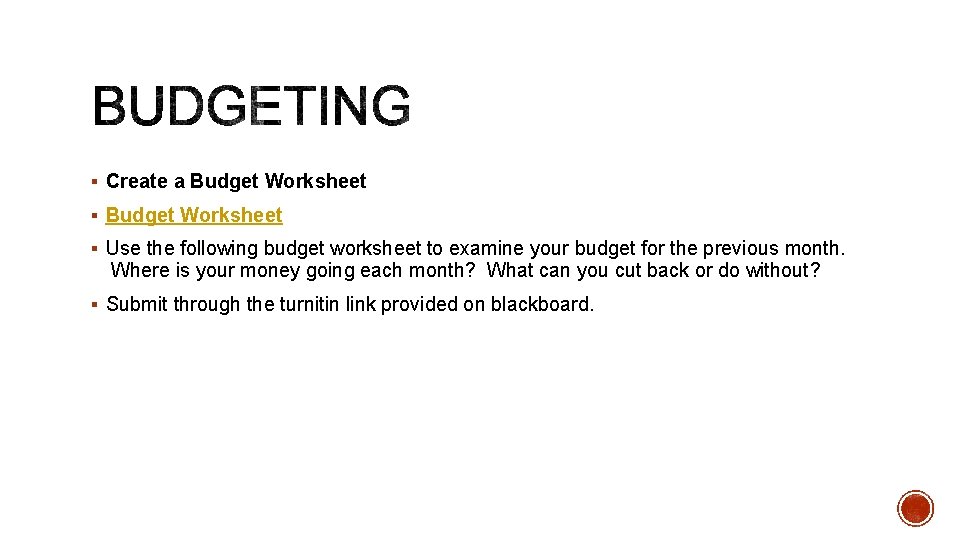
§ Create a Budget Worksheet § Use the following budget worksheet to examine your budget for the previous month. Where is your money going each month? What can you cut back or do without? § Submit through the turnitin link provided on blackboard.
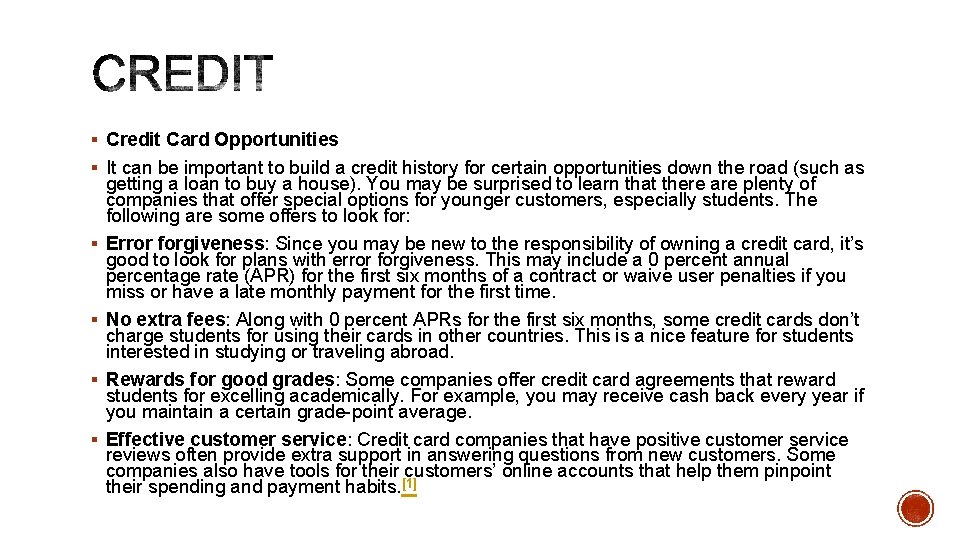
§ Credit Card Opportunities § It can be important to build a credit history for certain opportunities down the road (such as § § getting a loan to buy a house). You may be surprised to learn that there are plenty of companies that offer special options for younger customers, especially students. The following are some offers to look for: Error forgiveness: Since you may be new to the responsibility of owning a credit card, it’s good to look for plans with error forgiveness. This may include a 0 percent annual percentage rate (APR) for the first six months of a contract or waive user penalties if you miss or have a late monthly payment for the first time. No extra fees: Along with 0 percent APRs for the first six months, some credit cards don’t charge students for using their cards in other countries. This is a nice feature for students interested in studying or traveling abroad. Rewards for good grades: Some companies offer credit card agreements that reward students for excelling academically. For example, you may receive cash back every year if you maintain a certain grade-point average. Effective customer service: Credit card companies that have positive customer service reviews often provide extra support in answering questions from new customers. Some companies also have tools for their customers’ online accounts that help them pinpoint their spending and payment habits. [1]
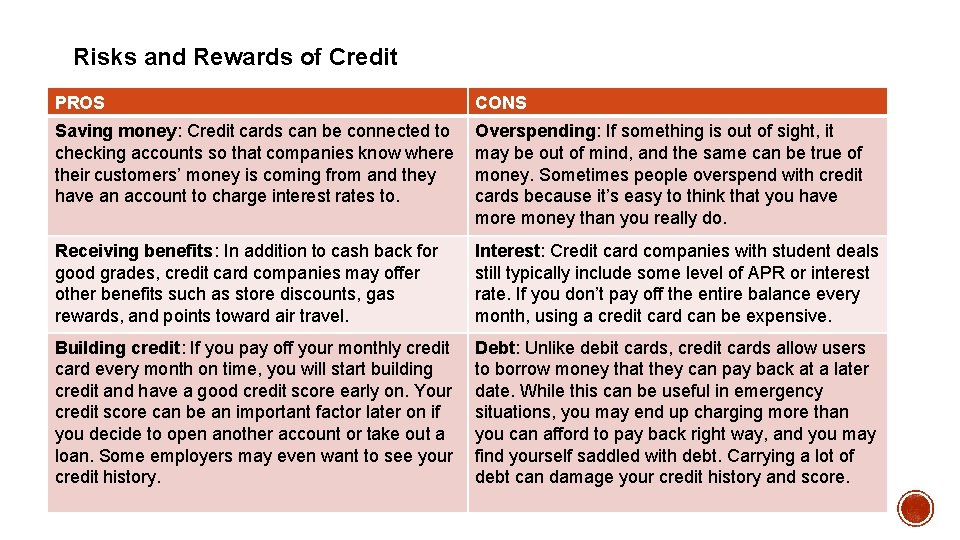
Risks and Rewards of Credit PROS CONS Saving money: Credit cards can be connected to checking accounts so that companies know where their customers’ money is coming from and they have an account to charge interest rates to. Overspending: If something is out of sight, it may be out of mind, and the same can be true of money. Sometimes people overspend with credit cards because it’s easy to think that you have more money than you really do. Receiving benefits: In addition to cash back for good grades, credit card companies may offer other benefits such as store discounts, gas rewards, and points toward air travel. Interest: Credit card companies with student deals still typically include some level of APR or interest rate. If you don’t pay off the entire balance every month, using a credit card can be expensive. Building credit: If you pay off your monthly credit card every month on time, you will start building credit and have a good credit score early on. Your credit score can be an important factor later on if you decide to open another account or take out a loan. Some employers may even want to see your credit history. Debt: Unlike debit cards, credit cards allow users to borrow money that they can pay back at a later date. While this can be useful in emergency situations, you may end up charging more than you can afford to pay back right way, and you may find yourself saddled with debt. Carrying a lot of debt can damage your credit history and score.
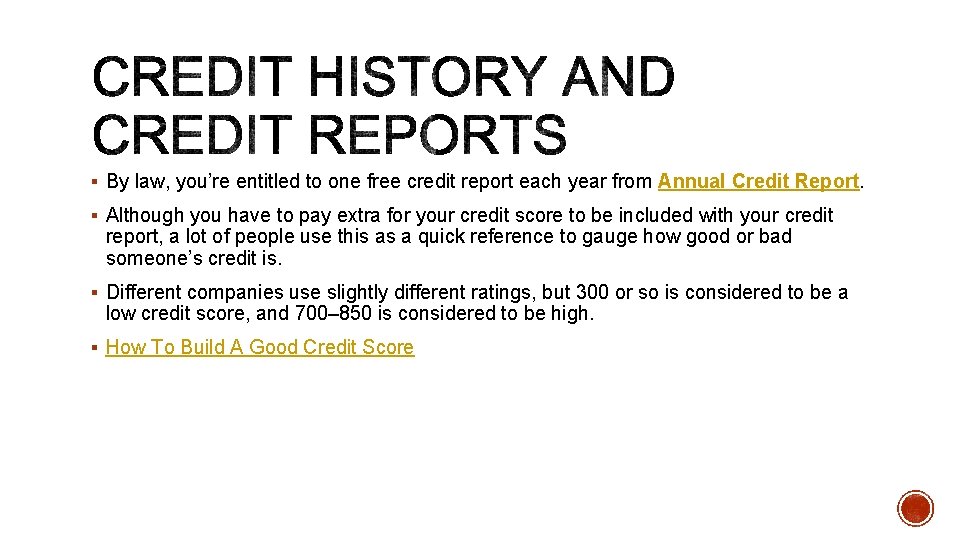
§ By law, you’re entitled to one free credit report each year from Annual Credit Report. § Although you have to pay extra for your credit score to be included with your credit report, a lot of people use this as a quick reference to gauge how good or bad someone’s credit is. § Different companies use slightly different ratings, but 300 or so is considered to be a low credit score, and 700– 850 is considered to be high. § How To Build A Good Credit Score
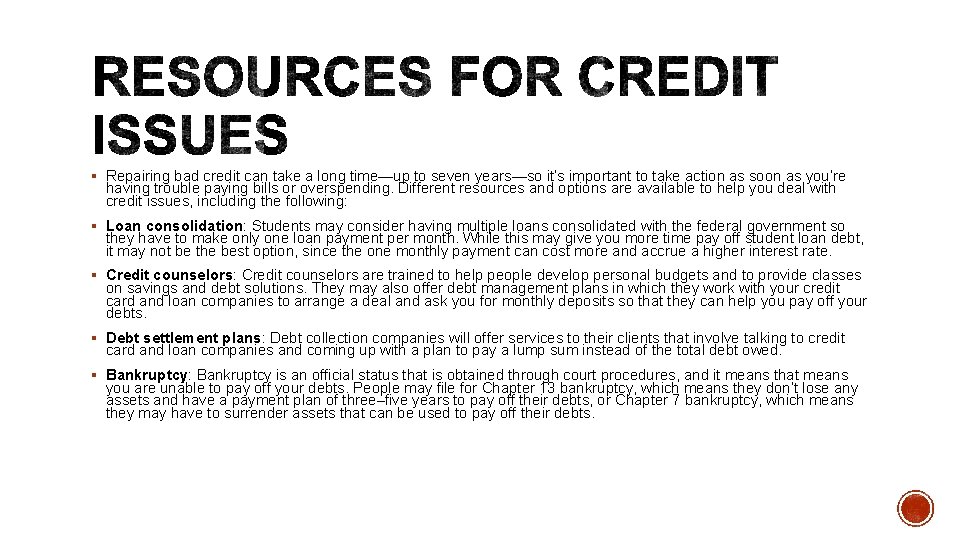
§ Repairing bad credit can take a long time—up to seven years—so it’s important to take action as soon as you’re having trouble paying bills or overspending. Different resources and options are available to help you deal with credit issues, including the following: § Loan consolidation: Students may consider having multiple loans consolidated with the federal government so they have to make only one loan payment per month. While this may give you more time pay off student loan debt, it may not be the best option, since the one monthly payment can cost more and accrue a higher interest rate. § Credit counselors: Credit counselors are trained to help people develop personal budgets and to provide classes on savings and debt solutions. They may also offer debt management plans in which they work with your credit card and loan companies to arrange a deal and ask you for monthly deposits so that they can help you pay off your debts. § Debt settlement plans: Debt collection companies will offer services to their clients that involve talking to credit card and loan companies and coming up with a plan to pay a lump sum instead of the total debt owed. § Bankruptcy: Bankruptcy is an official status that is obtained through court procedures, and it means that means you are unable to pay off your debts. People may file for Chapter 13 bankruptcy, which means they don’t lose any assets and have a payment plan of three–five years to pay off their debts, or Chapter 7 bankruptcy, which means they may have to surrender assets that can be used to pay off their debts.
§ How To Avoid Credit Card Debt