Chapter 10 Coordination in a Supply Chain Learning

- Slides: 32
Chapter 10 Coordination in a Supply Chain
Learning Objectives 10. 1 Describe supply chain coordination and the bullwhip effect, and their impact on supply chain performance. 10. 2 Identify obstacles to coordination in a supply chain. 10. 3 Discuss managerial levers that help achieve coordination in a supply chain. 10. 4 Understand some practical approaches to improve coordination in a supply chain.
Lack of Supply Chain Coordination and Its Impact on Performance • • • Supply chain coordination – all stages of the chain take actions that are aligned and increase total supply chain surplus Requires that each stage share information and take into account the effects of its actions on the other stages Lack of coordination results when: n Objectives of different stages conflict n Information moving between stages is delayed or distorted
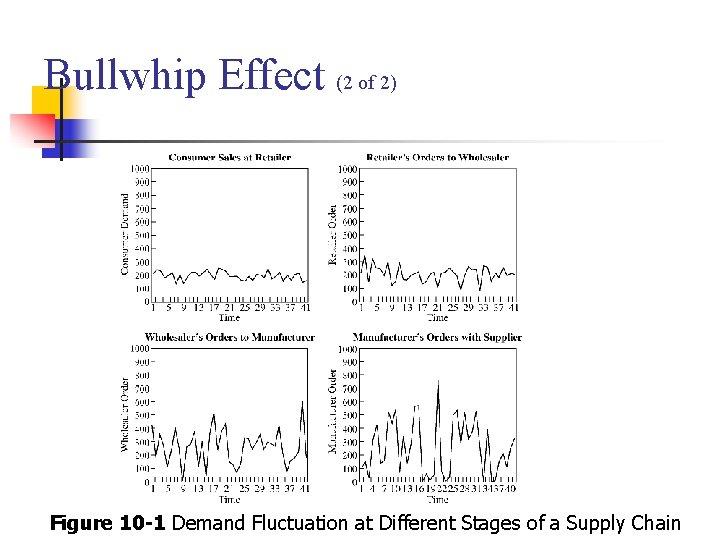
Bullwhip Effect (1 of 2) • • • Fluctuations in orders increase as they move up the supply chain from retailers to wholesalers to manufacturers to suppliers Distorts demand information within the supply chain Results from a loss of supply chain coordination
Bullwhip Effect (2 of 2) Figure 10 -1 Demand Fluctuation at Different Stages of a Supply Chain
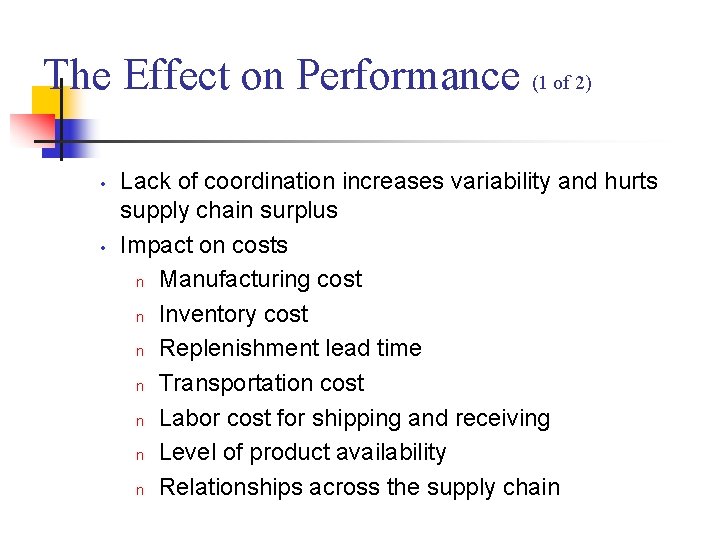
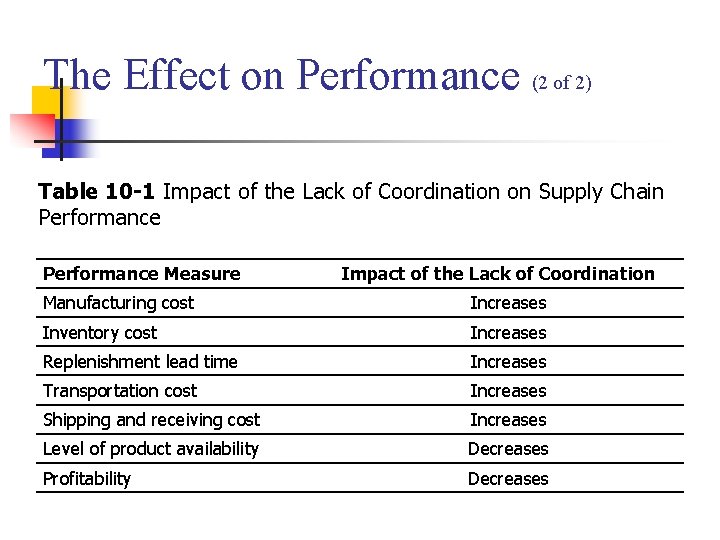
The Effect on Performance (1 of 2) • • Lack of coordination increases variability and hurts supply chain surplus Impact on costs n Manufacturing cost n Inventory cost n Replenishment lead time n Transportation cost n Labor cost for shipping and receiving n Level of product availability n Relationships across the supply chain
The Effect on Performance (2 of 2) Table 10 -1 Impact of the Lack of Coordination on Supply Chain Performance Measure Impact of the Lack of Coordination Manufacturing cost Increases Inventory cost Increases Replenishment lead time Increases Transportation cost Increases Shipping and receiving cost Increases Level of product availability Decreases Profitability Decreases
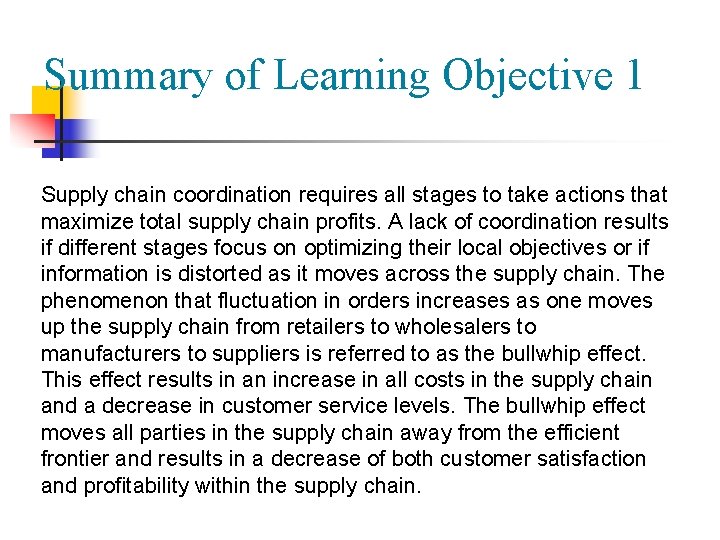
Summary of Learning Objective 1 Supply chain coordination requires all stages to take actions that maximize total supply chain profits. A lack of coordination results if different stages focus on optimizing their local objectives or if information is distorted as it moves across the supply chain. The phenomenon that fluctuation in orders increases as one moves up the supply chain from retailers to wholesalers to manufacturers to suppliers is referred to as the bullwhip effect. This effect results in an increase in all costs in the supply chain and a decrease in customer service levels. The bullwhip effect moves all parties in the supply chain away from the efficient frontier and results in a decrease of both customer satisfaction and profitability within the supply chain.
Obstacles to Coordination in a Supply Chain • • • Incentive Obstacles Information Processing Obstacles Operational Obstacles Pricing Obstacles Behavioral Obstacles
Incentive Obstacles • Occur when incentives offered to different stages or participants in a supply chain lead to actions that increase variability and reduce total supply chain profits n Local optimization within functions or stages of a supply chain n Sales force incentives
Information Processing Obstacles • When demand information is distorted as it moves between different stages of the supply chain, leading to increased variability in orders within the supply chain n Forecasting based on orders and not customer demand n Lack of information sharing
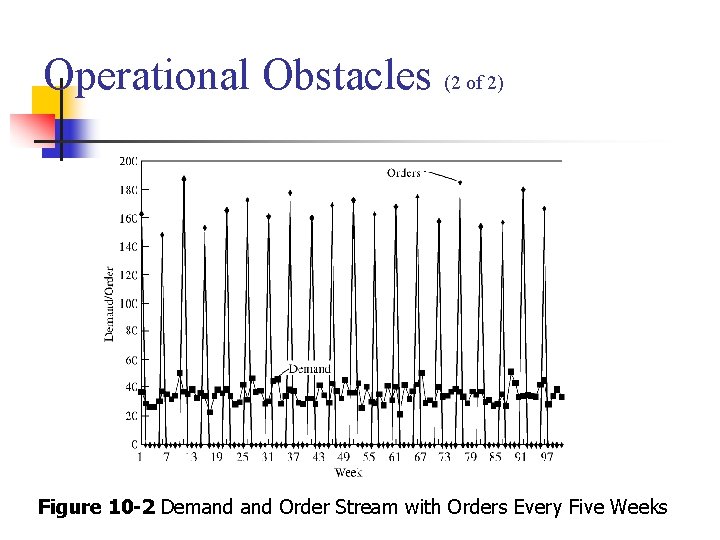
Operational Obstacles (1 of 2) • Occur when placing and filling orders lead to an increase in variability n Ordering in large lots n Large replenishment lead times n Rationing and shortage gaming
Operational Obstacles (2 of 2) Figure 10 -2 Demand Order Stream with Orders Every Five Weeks
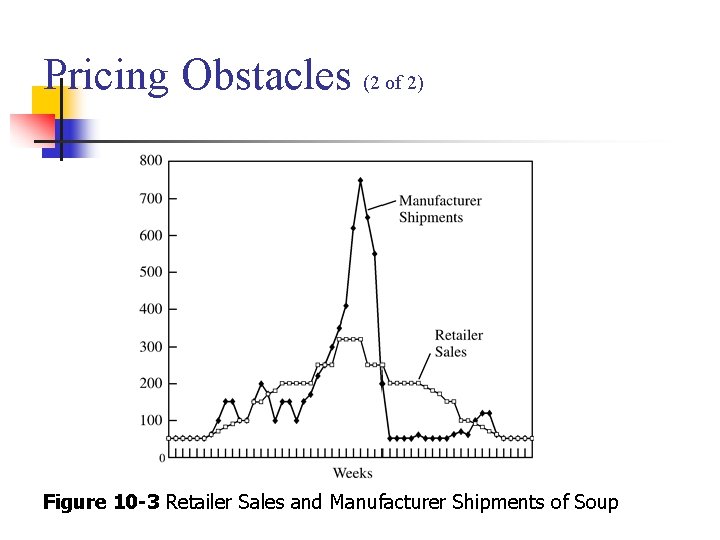
Pricing Obstacles (1 of 2) • When pricing policies for a product lead to an increase in variability of orders placed n Lot-size based quantity decisions n Price fluctuations
Pricing Obstacles (2 of 2) Figure 10 -3 Retailer Sales and Manufacturer Shipments of Soup
Behavioral Obstacles (1 of 2) n Problems in learning within organizations that contribute to information distortion 1. Each stage of the supply chain views its actions locally and is unable to see the impact of its actions on other stages 2. Different stages of the supply chain react to the current local situation rather than trying to identify the root causes 3. Different stages of the supply chain blame one another for the fluctuations
Behavioral Obstacles (2 of 2) 4. 5. No stage of the supply chain learns from its actions over time A lack of trust among supply chain partners causes them to be opportunistic at the expense of overall supply chain performance
Summary of Learning Objective 2 A key obstacle to coordination in the supply chain is misaligned incentives that result in different stages optimizing local objectives instead of total supply chain profits. Other obstacles include lack of information sharing, operational inefficiencies leading to large replenishment lead times and large lots, sales force incentives that encourage forward buying, rationing schemes that encourage inflation of orders, promotions that encourage forward buying, and a lack of trust that makes any effort toward coordination difficult.
Managerial Levers to Achieve Coordination • • • Aligning goals and incentives Improving information accuracy Improving operational performance Designing pricing strategies to stabilize orders Building strategic partnerships and trust
Aligning Goals and Incentives • Align goals and incentives so that every participant in supply chain activities works to maximize total supply chain profits n Align goals across the supply chain n Align incentives across functions n Pricing for coordination n Alter sales force incentives from sell-in (to the retailer) to sell-through (by the retailer)
Improving Information Visibility and Accuracy • • • Sharing customer demand data Implementing collaborative forecasting and planning Designing single-stage control of replenishment n Continuous replenishment programs (CRP) n Vendor managed inventory (VMI)
Improving Operations to Synchronize Supply and Demand • • • Reducing replenishment lead time Reducing lot sizes Rationing based on past sales and sharing information to limit gaming
Designing Pricing Strategies to Stabilize Orders • Encouraging retailers to order in smaller lots and reduce forward buying n Moving from lot size-based to volume-based quantity discounts n Stabilizing pricing
Building Strategic Partnerships and Trust • • Easier to use levers to achieve coordination if trust and strategic partnerships are built n Sharing accurate information n Lower transaction costs between stages All parties must believe that the benefits of improved coordination are being shared equally
Improving Coordination in Practice 1. 2. 3. Get top management commitment for coordination Devote resources to coordination Focus on communication with other stages
Summary of Learning Objective 3 Managers can improve coordination in the supply chain by aligning goals and incentives across different functions and stages of the supply chain. Other actions that managers can take to improve coordination include sharing of sales information and collaborative forecasting and planning, implementation of singlepoint control of replenishment, improving operations to reduce lead times and lot sizes, EDLP and other pricing strategies that limit forward buying, and the building of trust and strategic partnerships within the supply chain. Top management commitment, the devotion of resources to coordination, and a focus on communication across the supply chain are important requirements for coordination to improve in practice.
Improve Supply Chain Coordination (1 of 2) • Continuous replenishment and vendor-managed inventories n A single point of replenishment n CRP – wholesaler or manufacturer replenishes based on POS data n VMI – manufacturer or supplier is responsible for all decisions regarding inventory n Substitutes
Some Practical Approaches to Improve Supply Chain Coordination (2 of 2) • Collaborative planning, forecasting, and replenishment (CPFR) • Sellers and buyers in a supply chain may collaborate along any or all of the following 1. 2. 3. 4. Strategy and planning Demand supply management Execution Analysis
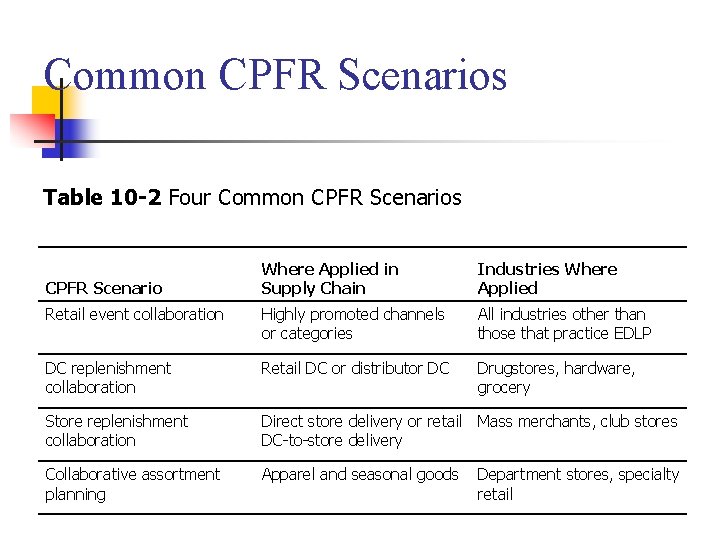
Common CPFR Scenarios Table 10 -2 Four Common CPFR Scenarios Where Applied in Supply Chain Industries Where Applied Retail event collaboration Highly promoted channels or categories All industries other than those that practice EDLP DC replenishment collaboration Retail DC or distributor DC Drugstores, hardware, grocery Store replenishment collaboration Direct store delivery or retail Mass merchants, club stores DC-to-store delivery Collaborative assortment planning Apparel and seasonal goods CPFR Scenario Department stores, specialty retail
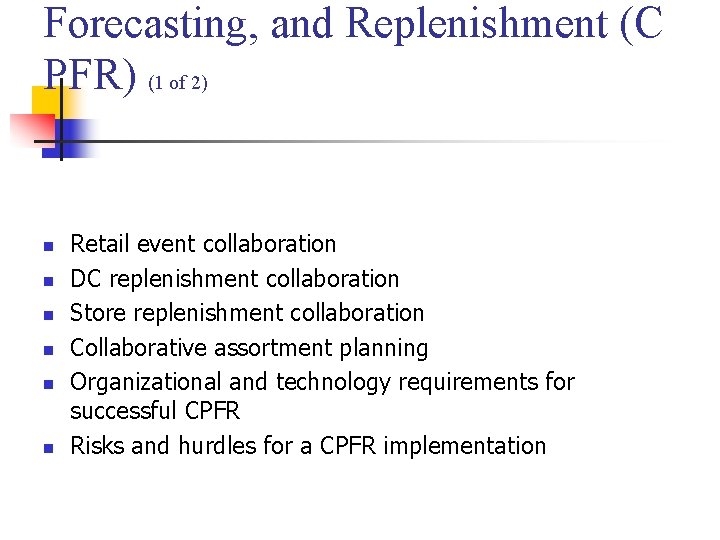
Forecasting, and Replenishment (C PFR) (1 of 2) n n n Retail event collaboration DC replenishment collaboration Store replenishment collaboration Collaborative assortment planning Organizational and technology requirements for successful CPFR Risks and hurdles for a CPFR implementation
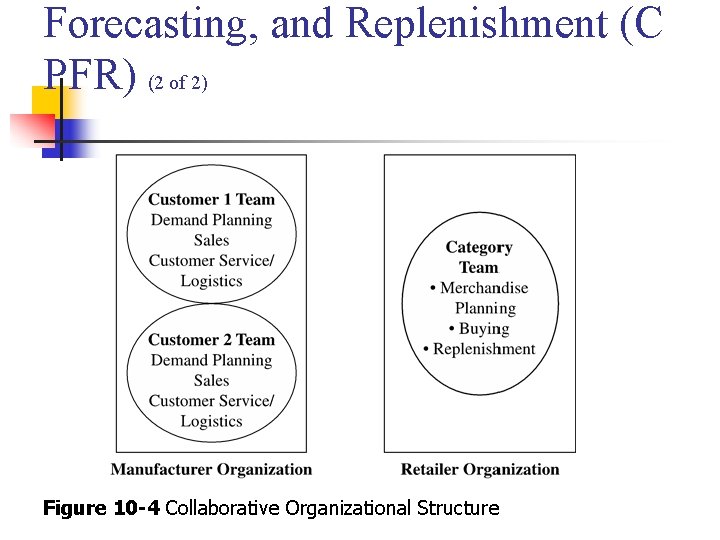
Forecasting, and Replenishment (C PFR) (2 of 2) Figure 10 -4 Collaborative Organizational Structure
Summary of Learning Objective 4 VMI and CPFR are two practical approaches to improve coordination in the supply chain. Under VMI, the supplier is responsible for managing product inventories at the retailer while ensuring an agreed upon level of service. Under CPFR, supply chain members manage forecasting, planning, and replenishment in a collaborative manner. Partners may set CPF R relationships to collaborate on store events, DC replenishment, store replenishment, or assortment planning. DC replenishment collaboration is often the easiest to implement because it requires aggregate-level data. Store replenishment collaboration requires a higher level of investment in technology and data sharing to be successful.