Care Homes and End of Life Sophie Meredith
- Slides: 20
Care Homes and End of Life Sophie Meredith and Nicole Beeching
Pathways 4 Life • 7 Dementia Cafés; providing people with vital advice about the condition and an opportunity to socialise. Run on a monthly basis alongside a weekly dementia café held at Walsall Manor Hospital. • Dementia Advisor Service; acting as a first point of call for people with dementia and their carers. • Dementia Support Workers; at Walsall Manor Hospital. • Dementia Diagnosis Support Worker; working alongside the memory clinic to provide support, advice and guidance. • Dementia Support Worker: Hard to Reach; working within the community to engage and support people with dementia from hard to reach communities. • A monthly Mind Matters café’ to support older people and families living with mental health conditions and depression. • Dementia Support Workers: Care Homes and End of Life; to offer advice and support to care home staff working across Walsall. • Personal Assistant Dementia Support Workers, providing guidance to people for the first 12 weeks following a diagnosis of Dementia; • Dementia Friendly Communities; working alongside the Alzheimer's Society to help make Walsall become a Dementia Friendly Community
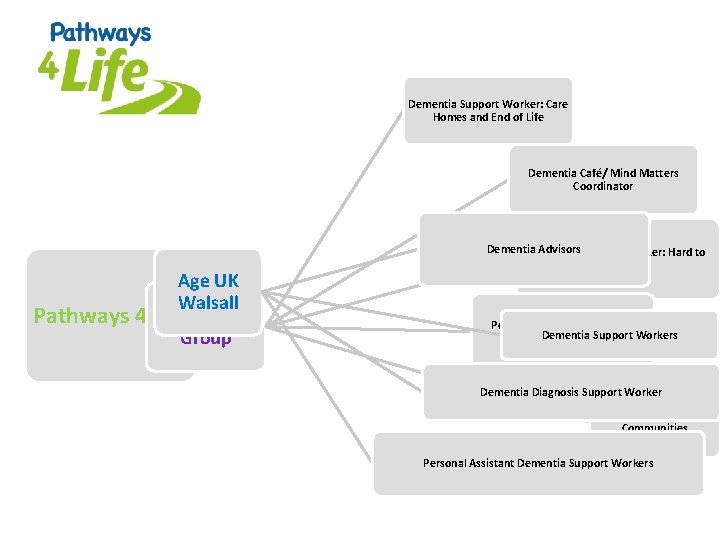
Dementia Support Worker: Care Homes and End of Life Dementia Café/ Mind Matters Coordinator Age UK Walsall Pathways 4 Life. Accord Group Dementia Advisors Support Worker: Hard to Reach Personal Assistant Dementia Support Workers Dementia Diagnosis Support Worker Dementia Friendly Communities Personal Assistant Dementia Support Workers
St Giles Hospice • Established in 1983 • 1 site in Walsall, 1 site in Whittington • Registered charity providing high-quality medical and nursing care for local people living with cancer and other serious illnesses • St Giles has over 400 staff, over 1, 500 volunteers and 31 charity shops, with over £ 9 million spent on providing care every year
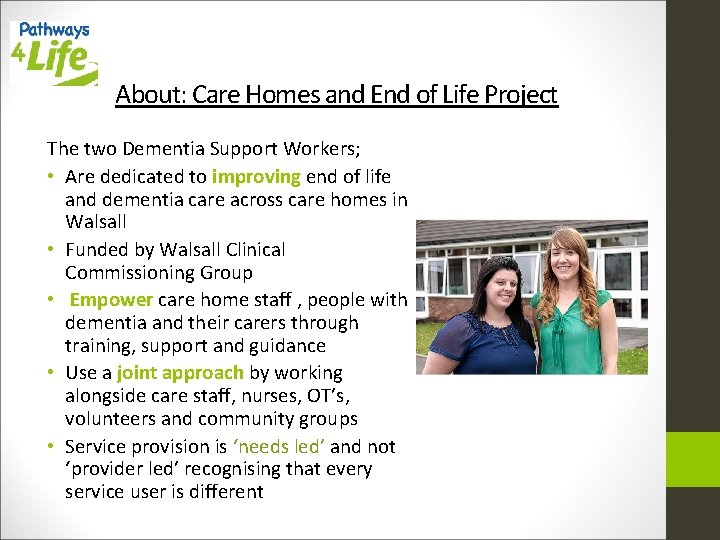
About: Care Homes and End of Life Project The two Dementia Support Workers; • Are dedicated to improving end of life and dementia care across care homes in Walsall • Funded by Walsall Clinical Commissioning Group • Empower care home staff , people with dementia and their carers through training, support and guidance • Use a joint approach by working alongside care staff, nurses, OT’s, volunteers and community groups • Service provision is ‘needs led’ and not ‘provider led’ recognising that every service user is different
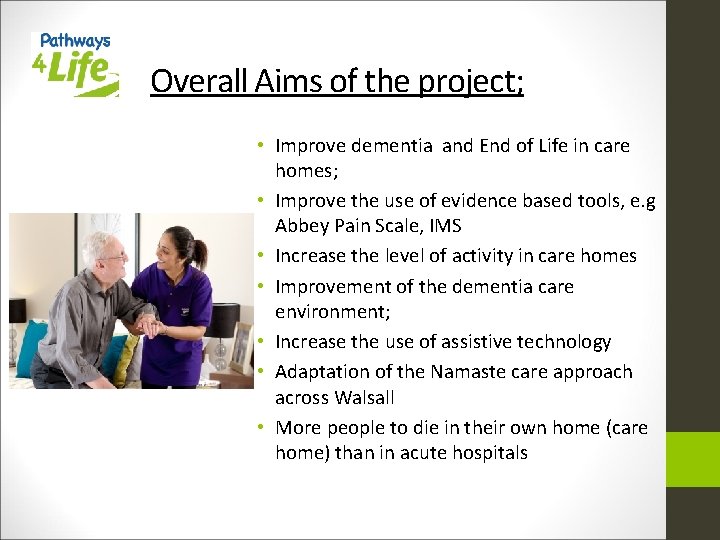
Overall Aims of the project; • Improve dementia and End of Life in care homes; • Improve the use of evidence based tools, e. g Abbey Pain Scale, IMS • Increase the level of activity in care homes • Improvement of the dementia care environment; • Increase the use of assistive technology • Adaptation of the Namaste care approach across Walsall • More people to die in their own home (care home) than in acute hospitals
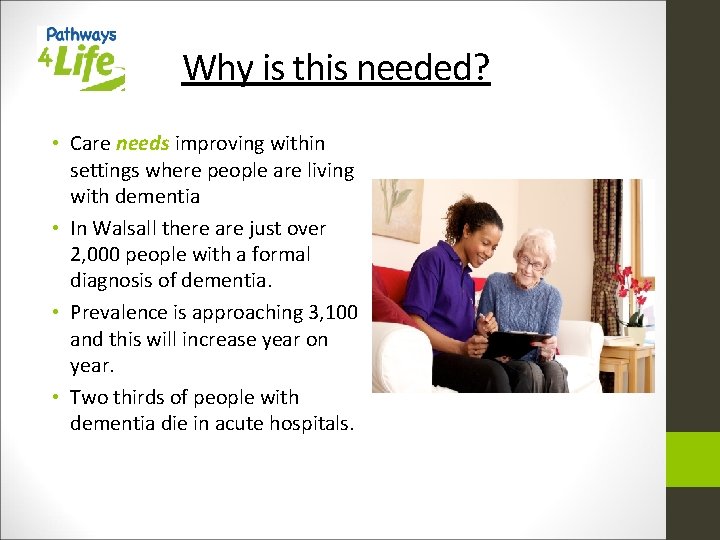
Why is this needed? • Care needs improving within settings where people are living with dementia • In Walsall there are just over 2, 000 people with a formal diagnosis of dementia. • Prevalence is approaching 3, 100 and this will increase year on year. • Two thirds of people with dementia die in acute hospitals.
Objectives • Formulate an improvement plan for homes using Care Fit for VIPs • Prompt the use of the “This is Me”/Life Story work • Prompt the use of Wellbeing Action Plans and Individual Management Strategies where behavioural issues are identified to better understand the cause • Make suggestions to improve the environment • Prompt good hydration and nutrition and the use of nutritional screening tools • Prompt socialisation, activity and meaningful engagement • Support care homes in adopting the Namaste care approach • Provide information in the appropriate format for staff, residents/service users and carers
Case Study 1 - Beryl • Beryl has a diagnosis of mixed dementia • She has limited communication with others • Only 1 word is ever used- “Birmingham” • Lack of confidence to socialise with others within the care home • Appears to be very frustrated anxious within herself
Challenges • Staff had a lack of understanding of the importance of activities, in particular music • Staff members having a lack of confidence to deliver activities • Lack of confidence in identifying ways in which they can communicate with Beryl • Lack of understanding of Beryl’s dementia • Staff didn’t full understand residents interests/ past history / likes/dislikes • Risk adverse
What we did… • DSW’s spent time with staff to help support with understanding Life Story work and the benefits this can bring • Each staff member was set a ‘task’, to identify one piece of important information about a person - from this information they were to provide a meaningful activity • With Beryl, staff identified she loves music • DSW provided a wide variety of activities around music, i. e music quiz, use musical instruments • They also offered Beryl an i-Pod… MAGIC!!!
Following the introduction of an I Pod: • Initially played ‘Le Fabuleux Destin d Amelie Poulain’ soundtrack for approximately 30 minutes • Beryl is now communicating more, asking others: “Can you hear this? ” “Listen to this with me” ‘this is fantastic’ – whilst clapping her hands and tapping her feet • Beryl is now making friends within the care home for the first time since moving in • Beryl is now ‘smiling’
Case Study 2 • ‘Traditional’ nursing home setting • Task driven culture • Lack of meaningful engagement for residents living with advanced dementia • Activity co-ordinators and senior members of staff feeling demotivated, as a result of feeling the residents they care for “are not living, but, are just existing” • Limited family/friends input, resulting in lack of support when fundraising for residents comfort fund etc. • Several staff feel uncomfortable acknowledging end of life
Challenges • Time constraints • Staff’s lack of confidence • Task driven culture • Fear of discussing end of life • Limited understanding of people living with dementia • Risk adverse
What we did… • Delivered development sessions to staff to help them gain a better understanding of meaningful engagement for people living with advanced stages dementia • Supported staff to implement new paperwork that allows them to spend more 1 -2 -1 time with residents, resulting in a less task driven environment • Signposted staff to local services within Walsall that provide assistive technology to support residents • Supported staff to implement the Namaste Care Approach, with incredible results!
The Power of the Namaste Care Approach • During one Namaste session with a gentleman, a very moving moment occurred… • Staff used his Wife’s old perfume, which he had not smelt for many years. • The gentleman cannot communicate verbally, but, staff explained that during the Namaste engagement, they witnessed a “tear fall down his cheek and a smile stretch across his face. ”
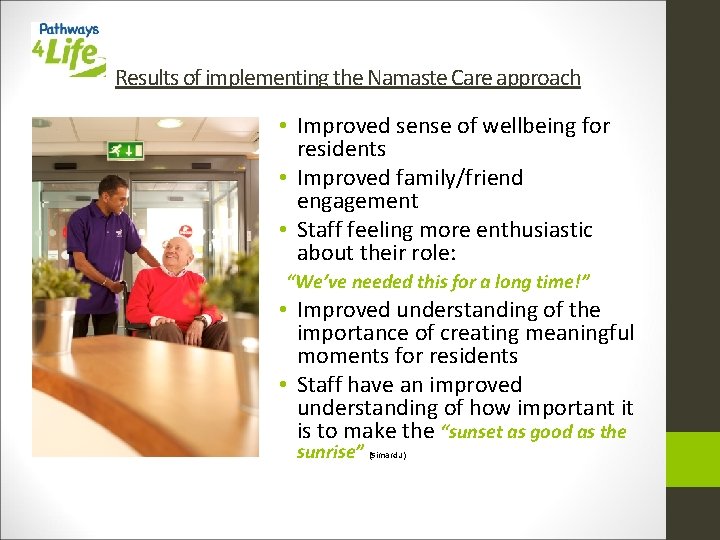
Results of implementing the Namaste Care approach • Improved sense of wellbeing for residents • Improved family/friend engagement • Staff feeling more enthusiastic about their role: “We’ve needed this for a long time!” • Improved understanding of the importance of creating meaningful moments for residents • Staff have an improved understanding of how important it is to make the “sunset as good as the sunrise” (Simard. J)
Contact Details Sophie Meredith Dementia Support Worker: Care Homes and End of Life Sophie. meredith@accordgroup. org. uk 07795 151401 Nicole Beeching Head of Service Development, Accord Group Nicole. beeching@accordgroup. org. uk Joanne Jinks Dementia Support Worker: Care Homes and End of Life Joanne. jinks@stgileshospice. com
References • http: //cms. walsall. gov. uk/strategic_business_plan_2013_to_2016_joint_co mmissioning_unit. pdf (2015) • http: //namastecare. com/ • End of Life Namaste Care: Program for People Living With Dementia, Professor Joyce Simard
Any questions? Thank you for listening