
Chapter 55 EndofLife Care Copyright 2017 Elsevier Inc
- Slides: 24
Chapter 55 End-of-Life Care Copyright © 2017, Elsevier, Inc. All rights reserved.
End-of-Life Care End-of-life care describes the support and care given during the time surrounding death. Death may be sudden or expected. Ø Some people gradually fail. Ø End-of-life care may involve days, weeks, or months. Ø According to the National Institute on Aging, most people die in hospitals or nursing centers. Ø Hospice care is becoming a common option. You must understand the dying process. Ø Then you can approach the dying person with caring, kindness, and respect. Copyright © 2017, Elsevier, Inc. All rights reserved. 2
Terminal Illness Terminal illness is an illness or injury from which the person will not likely recover. Many illnesses and diseases have no cure. Ø The body cannot function after some injuries. Ø Recovery is not expected. Ø The disease or injury ends in death. Ø Doctors cannot predict the time of death. Hope and the will to live strongly influence living and dying. Copyright © 2017, Elsevier, Inc. All rights reserved. 3
Terminal Illness (Cont. ) Persons with terminal illnesses can choose palliative care or hospice care. Ø Palliative care—focuses on relief of symptoms. The illness is also treated. • Care is for a long-term illness that will cause death. • Settings include hospitals, nursing centers, and the person’s home. Ø Hospice care—focuses on the physical, emotional, social, and spiritual needs of dying persons and their families. Hospice care is not concerned with cure or life-saving measures. • Often, the person has less than 6 months to live. • Hospitals, nursing centers, and home care agencies offer hospice care, or a hospice may be a separate agency. Copyright © 2017, Elsevier, Inc. All rights reserved. 4
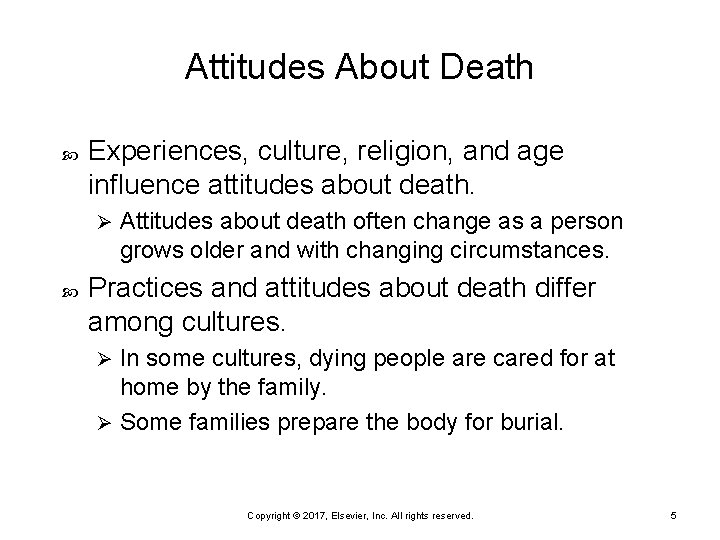
Attitudes About Death Experiences, culture, religion, and age influence attitudes about death. Ø Attitudes about death often change as a person grows older and with changing circumstances. Practices and attitudes about death differ among cultures. In some cultures, dying people are cared for at home by the family. Ø Some families prepare the body for burial. Ø Copyright © 2017, Elsevier, Inc. All rights reserved. 5
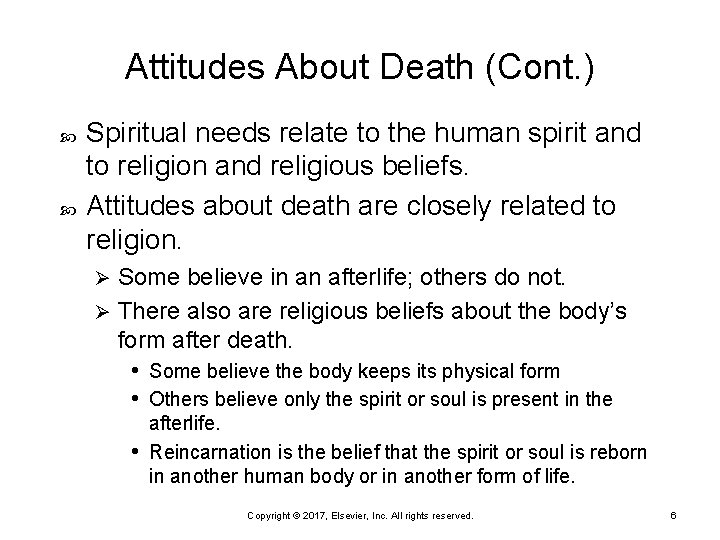
Attitudes About Death (Cont. ) Spiritual needs relate to the human spirit and to religion and religious beliefs. Attitudes about death are closely related to religion. Some believe in an afterlife; others do not. Ø There also are religious beliefs about the body’s form after death. • Some believe the body keeps its physical form • Others believe only the spirit or soul is present in the Ø afterlife. • Reincarnation is the belief that the spirit or soul is reborn in another human body or in another form of life. Copyright © 2017, Elsevier, Inc. All rights reserved. 6
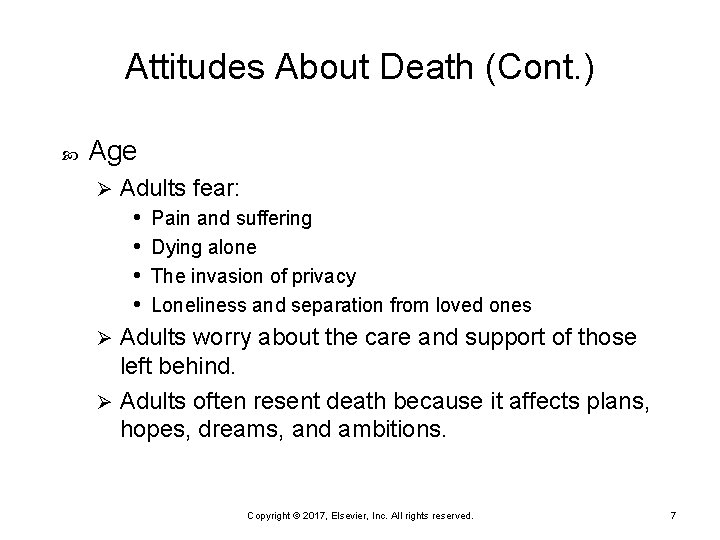
Attitudes About Death (Cont. ) Age Adults fear: • Pain and suffering • Dying alone • The invasion of privacy • Loneliness and separation from loved ones Ø Adults worry about the care and support of those left behind. Ø Adults often resent death because it affects plans, hopes, dreams, and ambitions. Ø Copyright © 2017, Elsevier, Inc. All rights reserved. 7
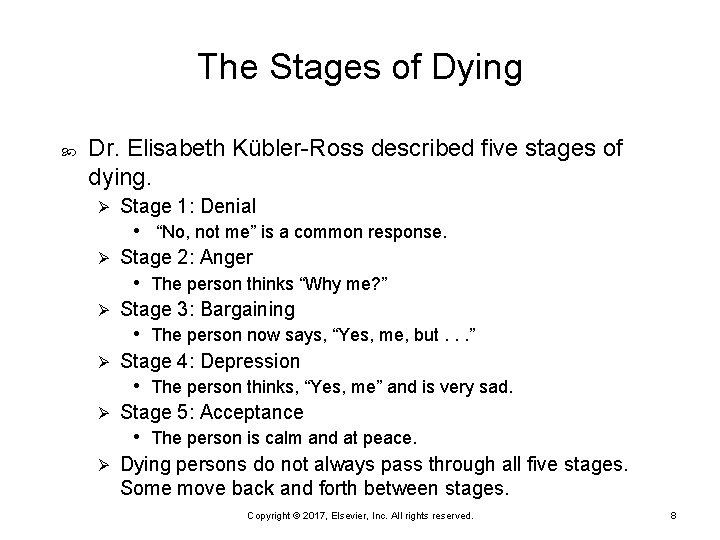
The Stages of Dying Dr. Elisabeth Kübler-Ross described five stages of dying. Ø Stage 1: Denial • “No, not me” is a common response. Ø Stage 2: Anger • The person thinks “Why me? ” Ø Stage 3: Bargaining • The person now says, “Yes, me, but. . . ” Ø Stage 4: Depression • The person thinks, “Yes, me” and is very sad. Ø Stage 5: Acceptance • The person is calm and at peace. Ø Dying persons do not always pass through all five stages. Some move back and forth between stages. Copyright © 2017, Elsevier, Inc. All rights reserved. 8
Comfort Needs Comfort involves physical, mental and emotional, and spiritual needs. Comfort goals are to: Prevent or relieve suffering to the extent possible Ø Respect and follow end-of-life wishes Ø You need to listen and use touch. Some people may want to see a spiritual leader. Some want to take part in religious practices. Ø Provide privacy during prayer and spiritual moments. Ø Be courteous to the spiritual leader. Ø Handle religious objects with care and respect. Ø Copyright © 2017, Elsevier, Inc. All rights reserved. 9
Comfort Needs (Cont. ) Physical needs Dying may take a few minutes, hours, days, or weeks. Ø To the extent possible, independence is allowed. • As the person weakens, basic needs are met. Ø Every effort is made to promote physical and psychological comfort. Ø The person is allowed to die in peace and with dignity. Ø Copyright © 2017, Elsevier, Inc. All rights reserved. 10
Comfort Needs (Cont. ) Ø Pain • Some dying person do not have pain. Others may have severe pain. Pain management is important. • The following promote comfort: Good skin care Personal and oral hygiene Back massages Good alignment Frequent position changes Supportive devices Copyright © 2017, Elsevier, Inc. All rights reserved. 11
Comfort Needs (Cont. ) Ø Breathing problems • Shortness of breath and difficulty breathing (dyspnea) are common end-of-life problems. Semi-Fowler’s position and oxygen are helpful. • Noisy breathing—called the death rattle—is common as death nears. This is due to mucus collecting in the airway. These may help: the side-lying position; suctioning by the nurse; and drugs to reduce the amount of mucus. Copyright © 2017, Elsevier, Inc. All rights reserved. 12
Comfort Needs (Cont. ) Ø Vision, hearing, and speech • Vision blurs and gradually fails. Secretions may collect in the eye corners. Good eye care is needed. • Hearing is one of the last functions lost. Always assume that the person can hear. • Speech becomes harder. It may be hard to understand the person. Sometimes, the person cannot speak. Copyright © 2017, Elsevier, Inc. All rights reserved. 13
Comfort Needs (Cont. ) Ø Mouth, nose, and skin • Oral hygiene promotes comfort. Oral hygiene is needed if mucus collects in the mouth and the person cannot swallow. • Crusting and irritation of the nostrils can occur. Nasal secretions, an oxygen canula, and a naso-gastric tube are common causes. • Circulation fails and body temperature rises as death nears. The skin is cool, pale, and mottled (blotchy). Perspiration increases. Skin care, bathing, and preventing pressure ulcers are necessary. Copyright © 2017, Elsevier, Inc. All rights reserved. 14
Comfort Needs (Cont. ) Ø Nutrition • Nausea, vomiting, and loss of appetite are common at the end of life. • As death nears, loss of appetite is common. Ø The person may choose not to eat or drink. Elimination • Urinary and fecal incontinence may occur. • Constipation and urinary retention are common. Enemas and catheters may be needed. Copyright © 2017, Elsevier, Inc. All rights reserved. 15
Comfort Needs (Cont. ) Ø The person’s room: • Provide a comfortable and pleasant room. • Remove unnecessary equipment. • The person and family arrange the room as they wish. This helps meet love, belonging, and esteem needs. The room should reflect the person’s choices. Copyright © 2017, Elsevier, Inc. All rights reserved. 16
Comfort Needs (Cont. ) Ø Mental and emotional needs are very personal. • Some persons are anxious or depressed. • Others have specific fears and concerns. Examples include: Severe pain When and how death will occur What will happen to loved ones Dying alone Copyright © 2017, Elsevier, Inc. All rights reserved. 17
The Family This is a hard time for the family. Ø Family members usually can stay as long as they wish. Respect the right to privacy. Ø Show you care by being available, courteous, and considerate. However, do not neglect care because the family is present. The family goes through stages like the dying person. They need support, understanding, courtesy, and respect. Ø A spiritual leader may provide comfort. Ø Copyright © 2017, Elsevier, Inc. All rights reserved. 18
Legal Issues Consent is needed for any treatment. When able, the person makes care decisions. Ø Some people make end-of-life wishes known. Ø The Patient Self-Determination Act and OBRA give persons the right to: Accept or refuse treatment Ø Make advance directives Ø An advance directive is a document stating a person’s wishes about health care when that person cannot make his or her own decisions. Copyright © 2017, Elsevier, Inc. All rights reserved. 19
Legal Issues (Cont. ) A living will is a document about measures that support or maintain life when death is likely. Ø A living will may instruct doctors: • Not to start measures that prolong dying • To remove measures that prolong dying Durable power of attorney for health care gives the power to make health care decisions to another person (Health Care Proxy). After consulting with the person and family, doctors often write “Do Not Resuscitate” (DNR) or “No Code” orders for terminally ill persons. Ø This means that the person will not be resuscitated. Copyright © 2017, Elsevier, Inc. All rights reserved. 20
Signs of Death In the weeks before death, the following may occur: Ø Ø Ø Restlessness and agitation Shortness of breath Depression Anxiety Drowsiness Confusion Constipation or incontinence Nausea Loss of appetite Healing problems Swelling in the hands, feet, or other body areas Pauses in breathing Copyright © 2017, Elsevier, Inc. All rights reserved. 21
Signs of Death (Cont. ) As death nears, the following signs may occur fast or slowly: Ø Ø Ø The signs of death include no pulse, no respirations, and no blood pressure. Ø Movement, muscle tone, and sensation are lost. Peristalsis and other gastrointestinal functions slow down. Body temperature rises. Circulation fails. The respiratory system fails. Pain decreases as the person loses consciousness. The pupils are fixed and dilated. A doctor determines that death has occurred. Copyright © 2017, Elsevier, Inc. All rights reserved. 22
Care of the Body After Death Care of the body after death is called postmortem care. A nurse gives post-mortem care. Ø You may be asked to assist. Post-mortem care begins when the doctor pronounces the person dead. Post-mortem care is done to maintain a good appearance of the body. Copyright © 2017, Elsevier, Inc. All rights reserved. 23
Care of the Body After Death (Cont. ) The right to privacy and the right to be treated with dignity and respect apply after death. Within 2 to 4 hours after death, rigor mortis (the stiffness or rigidity of skeletal muscles that occurs after death) develops. Ø The body is positioned in normal alignment before rigor mortis sets in. When an autopsy is done, post-mortem care is not done. An autopsy is the examination of the body after death. Ø Follow agency procedures for an autopsy. Ø Copyright © 2017, Elsevier, Inc. All rights reserved. 24