Cardia Touch Control Systems Stuart O Schecter MD
- Slides: 11
Cardia. Touch Control Systems Stuart O. Schecter, MD, FACC, FASE, CCDS owner / inventor
Cardia. Touch Control Systems Disclosure: owner / inventor
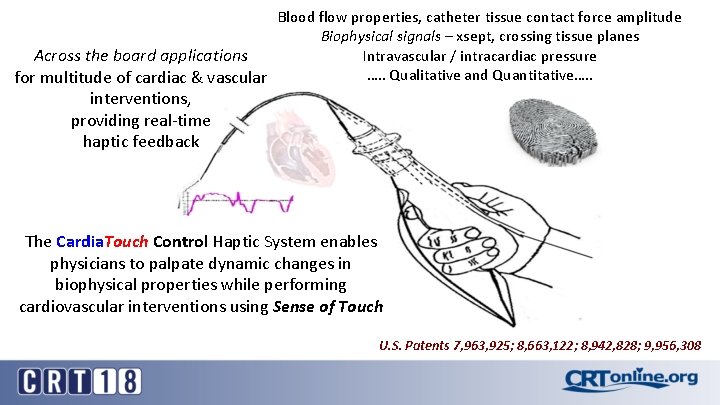
Blood flow properties, catheter tissue contact force amplitude Biophysical signals – xsept, crossing tissue planes Intravascular / intracardiac pressure Across the board applications …. . Qualitative and Quantitative…. . for multitude of cardiac & vascular interventions, providing real-time haptic feedback The Cardia. Touch Control Haptic System enables physicians to palpate dynamic changes in biophysical properties while performing cardiovascular interventions using Sense of Touch U. S. Patents 7, 963, 925; 8, 663, 122; 8, 942, 828; 9, 956, 308
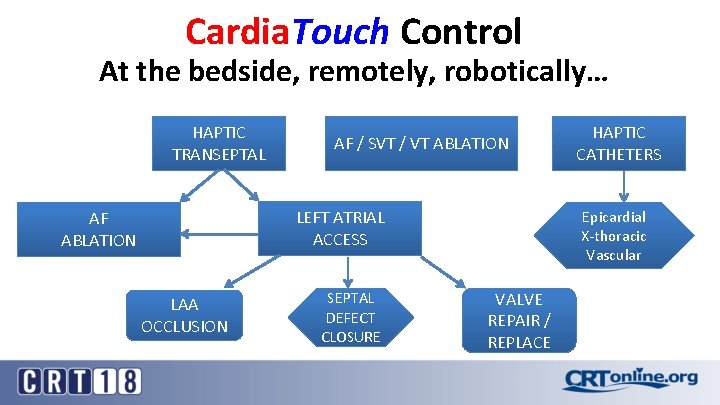
Cardia. Touch Control At the bedside, remotely, robotically… Haptic System – Multiple Clinical Applications HAPTIC TRANSEPTAL AF / SVT / VT ABLATION LEFT ATRIAL ACCESS AF ABLATION LAA OCCLUSION SEPTAL DEFECT CLOSURE HAPTIC CATHETERS Epicardial X-thoracic Vascular VALVE REPAIR / REPLACE
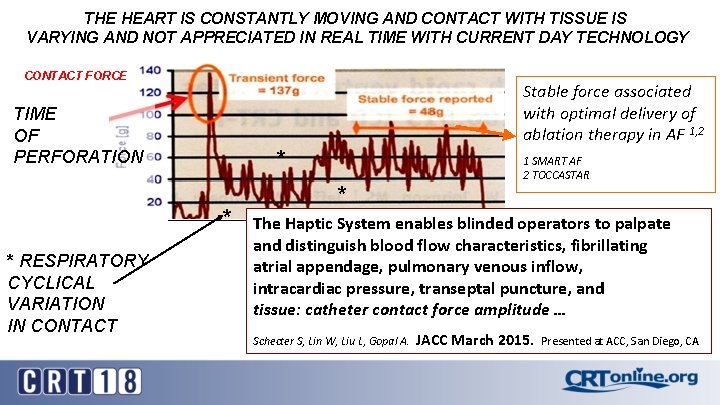
THE HEART IS CONSTANTLY MOVING AND CONTACT WITH TISSUE IS VARYING AND NOT APPRECIATED IN REAL TIME WITH CURRENT DAY TECHNOLOGY CONTACT FORCE Stable force associated with optimal delivery of ablation therapy in AF 1, 2 TIME OF PERFORATION * * * RESPIRATORY CYCLICAL VARIATION IN CONTACT * 1 SMART AF 2 TOCCASTAR The Haptic System enables blinded. TIME operators to palpate and distinguish blood flow characteristics, fibrillating atrial appendage, pulmonary venous inflow, intracardiac pressure, transeptal puncture, and tissue: catheter contact force amplitude … Schecter S, Lin W, Liu L, Gopal A. JACC March 2015. Presented at ACC, San Diego, CA
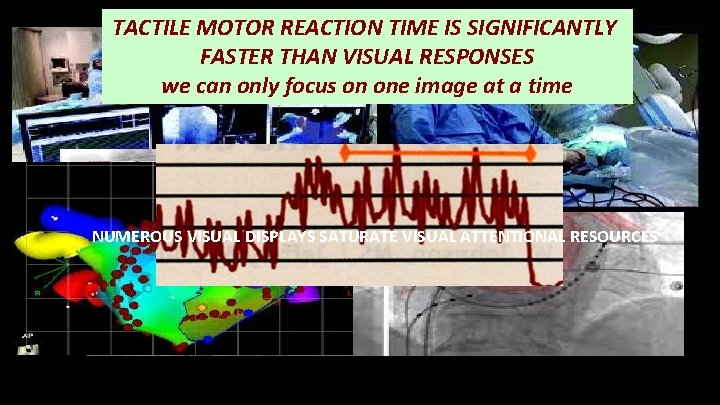
TACTILE MOTOR REACTION TIME IS SIGNIFICANTLY FASTER THAN VISUAL RESPONSES we can only focus on one image at a time NUMEROUS VISUAL DISPLAYS SATURATE VISUAL ATTENTIONAL RESOURCES
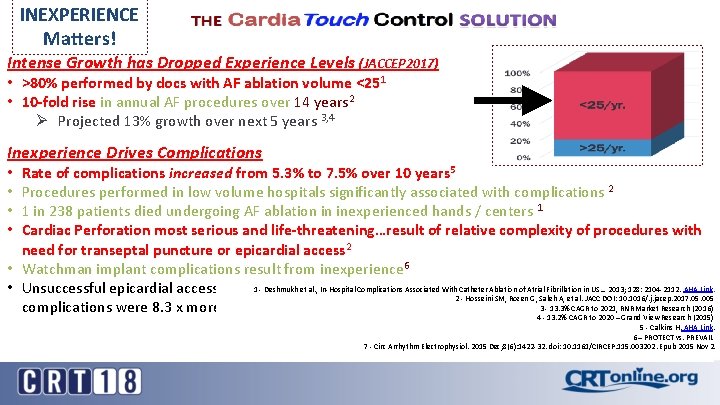
INEXPERIENCE Matters! Intense Growth has Dropped Experience Levels (JACCEP 2017) • >80% performed by docs with AF ablation volume <251 • 10 -fold rise in annual AF procedures over 14 years 2 Ø Projected 13% growth over next 5 years 3, 4 SENSE Tissue Contact Force, Blood Flow, Events Inexperience. Pressure, Drives. Biophysical Complications Rate of complications increased from 5. 3% to 7. 5% over 10 years 5 Procedures performed in low volume hospitals significantly associated with complications 2 1 in 238 patients died undergoing AF ablation in inexperienced hands / centers 1 Cardiac Perforation most serious and life-threatening…result of relative complexity of procedures with need for transeptal puncture or epicardial access 2 • Watchman implant complications result from inexperience 6 1 - Deshmukh et al. , In-Hospital Complications Associated With Catheter Ablation of Atrial Fibrillation in US… 2013; 128: 2104 -2112. AHA Link. • Unsuccessful epicardial access occurs 6% of cases with acute complications occurring in 9% - 2 - Hosseini SM, Rozen G, Saleh A, et al. JACC DOI: 10. 1016/. j. jacep. 2017. 05. 005 3 - 13. 3% CAGR to 2021, RNR Market Research (2016) complications were 8. 3 x more likely after no or limited epicardial RFA 7 • • PALPATE Tissue 4 - 13. 2% CAGR to 2020 – Grand View Research (2015) Contact Force, 5 - Calkins H. AHA Link. Blood 6 – PROTECT vs. PREVAIL Flow, Pressure, Biophysical Events 7 - Circ Arrhythm Electrophysiol. 2015 Dec; 8(6): 1422 -32. doi: 10. 1161/CIRCEP. 115. 003202. Epub 2015 Nov 2.
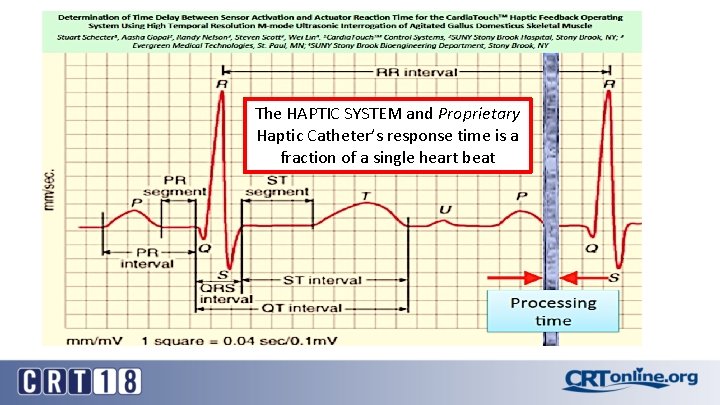
The HAPTIC SYSTEM and Proprietary Haptic Catheter’s response time is a fraction of a single heart beat
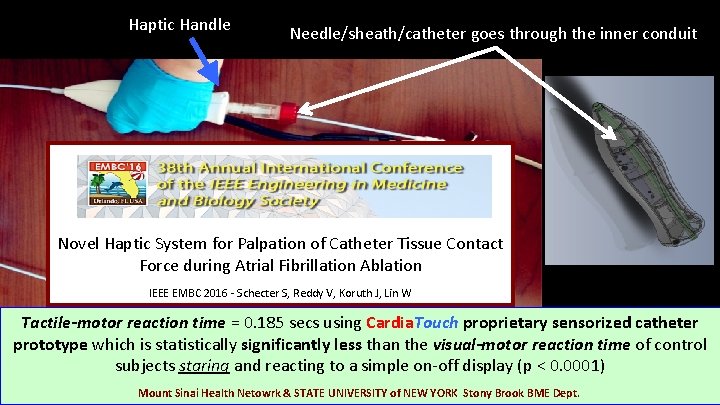
Haptic Handle Needle/sheath/catheter goes through the inner conduit Novel Haptic System for Palpation of Catheter Tissue Contact Force during Atrial Fibrillation Ablation IEEE EMBC 2016 - Schecter S, Reddy V, Koruth J, Lin W Tactile-motor reaction time = 0. 185 secs using Cardia. Touch proprietary sensorized catheter prototype which is statistically significantly less than the visual-motor Computing Systemreaction time of control DEPLOYED SENSOR(S) subjects staring and reacting to a simple on-off display (p < 0. 0001) (Control panel + CPU) ACQUISITION OF BIOPHYSICAL SIGNALS Mount Sinai Health Netowrk & STATE UNIVERSITY of NEW YORK Stony Brook BME Dept.
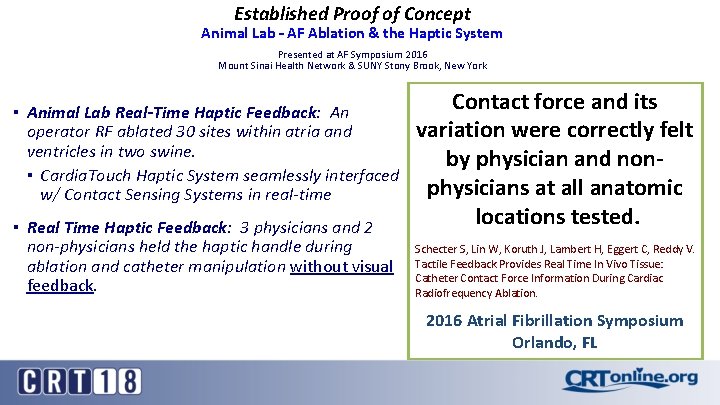
Established Proof of Concept Animal Lab – AF Ablation & the Haptic System Presented at AF Symposium 2016 Mount Sinai Health Network & SUNY Stony Brook, New York ▪ Animal Lab Real-Time Haptic Feedback: An operator RF ablated 30 sites within atria and ventricles in two swine. ▪ Cardia. Touch Haptic System seamlessly interfaced w/ Contact Sensing Systems in real-time ▪ Real Time Haptic Feedback: 3 physicians and 2 non-physicians held the haptic handle during ablation and catheter manipulation without visual feedback. Contact force and its variation were correctly felt by physician and nonphysicians at all anatomic locations tested. Schecter S, Lin W, Koruth J, Lambert H, Eggert C, Reddy V. Tactile Feedback Provides Real Time In Vivo Tissue: Catheter Contact Force Information During Cardiac Radiofrequency Ablation. 2016 Atrial Fibrillation Symposium Orlando, FL
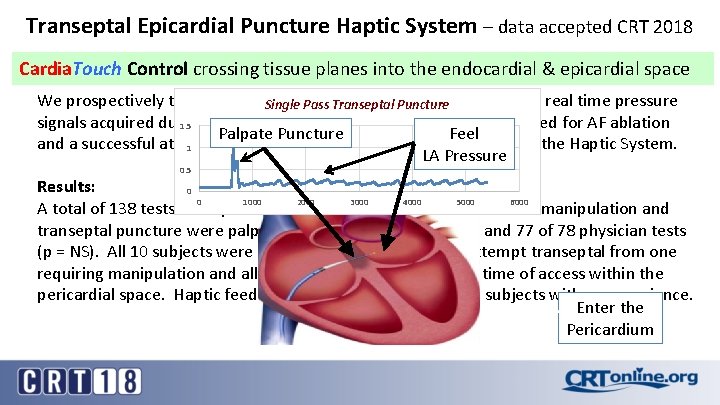
Transeptal Epicardial Puncture Haptic System – data accepted CRT 2018 Cardia. Touch Control. Schecter S, Lin W, Fan R, Koruth J, Reddy V, Rashba E crossing tissue planes into the endocardial & epicardial space We prospectively tested the Haptic System by storing and processing real time pressure Single Pass Transeptal Puncture signals acquired during 13 consecutive transeptal punctures performed for AF ablation 1. 5 Palpate Puncture Feel and a successful attempt at epicardial access and input the data into the Haptic System. 1 LA Pressure 0. 5 Results: 0 0 1000 2000 3000 4000 5000 6000 A total of 138 tests were performed. Tangible sensations of catheter manipulation and transeptal puncture were palpated in 52 of 52 non-physician and 77 of 78 physician tests (p = NS). All 10 subjects were able to differentiate a single attempt transeptal from one requiring manipulation and all 8 subjects correctly identified time of access within the pericardial space. Haptic feedback intuitive to non-physician subjects with no experience. Enter the Pericardium