California v Greenwood A Fourth Amendment Case 2003

- Slides: 16
California v. Greenwood A Fourth Amendment Case © 2003 Constitutional Rights Foundation All rights reserved.
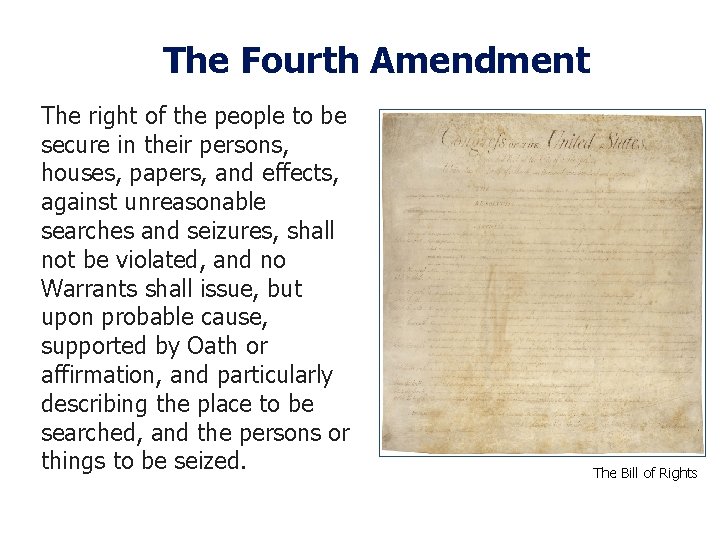
The Fourth Amendment The right of the people to be secure in their persons, houses, papers, and effects, against unreasonable searches and seizures, shall not be violated, and no Warrants shall issue, but upon probable cause, supported by Oath or affirmation, and particularly describing the place to be searched, and the persons or things to be seized. The Bill of Rights
You are going to take California v. Greenwood to the Supreme Court. The U. S. Supreme Court had to decide these questions: • Did the police conduct a search when they went through Greenwood’s trash? • Did Greenwood have a reasonable expectation that his trash would remain private?
You will take on the roles of: Justices of the U. S. Supreme Court Attorneys for the State of California Attorneys for Billy Greenwood
Rules. Moot for. Court oral argument – The Trial 1. Attorneys for the State of California will have three minutes to present their case. 2. Attorneys for Greenwood will then have three minutes to present their case. *Justices can ask questions at any point during an attorney’s argument. 3. The justices will have two minutes to ask any more questions.
Rules for the decision 1. The justices will have two minutes to discuss the case, sharing what they thought were the most and least persuasive arguments. 1. Each triad of justices will hold a vote to issue their ruling. 3. The majority and any dissenting justices will explain the reasoning for their votes.
Poll of Justices • How many panels voted for the state of California? • How many voted for Greenwood? • How many panels were unanimous in their decision? • How many had a dissenting justice (one voting differently than the other two)?
Debrief • What was the most persuasive argument you heard? • Which side in the case do you think had the stronger arguments? Why? • What facts of the case do you think were the most important for the state of California?
Debrief(cont. ) • What facts of the case do you think were most important for Greenwood? • How do you think the Supreme Court decided this case? What makes you think the court decided the case that way?
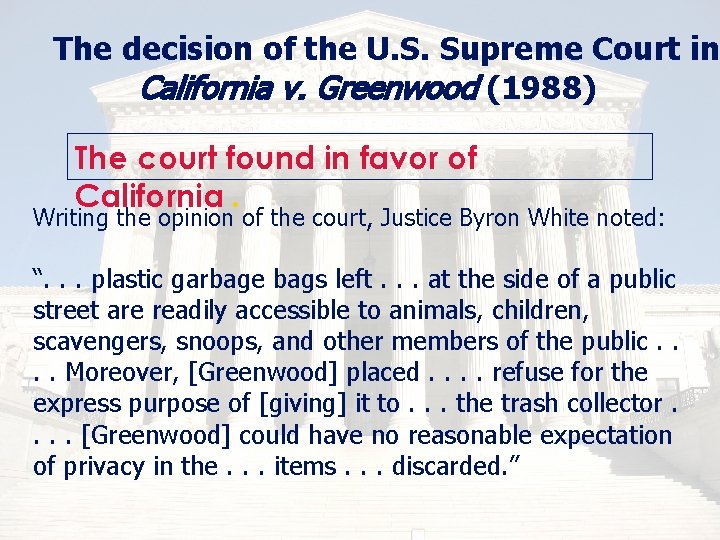
The decision of the U. S. Supreme Court in California v. Greenwood (1988) The court found in favor of California. Writing the opinion of the court, Justice Byron White noted: “. . . plastic garbage bags left. . . at the side of a public street are readily accessible to animals, children, scavengers, snoops, and other members of the public. . Moreover, [Greenwood] placed. . refuse for the express purpose of [giving] it to. . . the trash collector. . [Greenwood] could have no reasonable expectation of privacy in the. . . items. . . discarded. ”
Dissent Writing in dissent, Justice William Brennan argued: “Society (should be prepared) to recognize as reasonable an individual’s expectations of privacy in the most private of personal effects sealed in an opaque container and disposed. . . so as to comingle it. . . with the trash of others. . The mere possibility that unwelcome meddlers might open and rummage through the containers does not negate the expectation of privacy in its contents any more than the possibility of a burglary negates the expectations of privacy in a home. ”
What do you think? • Did the police conduct a search when they went through Greenwood’s trash? • Did Greenwood have a reasonable expectation that his trash would remain private? • Do you agree with the court’s decision? Why or why not?
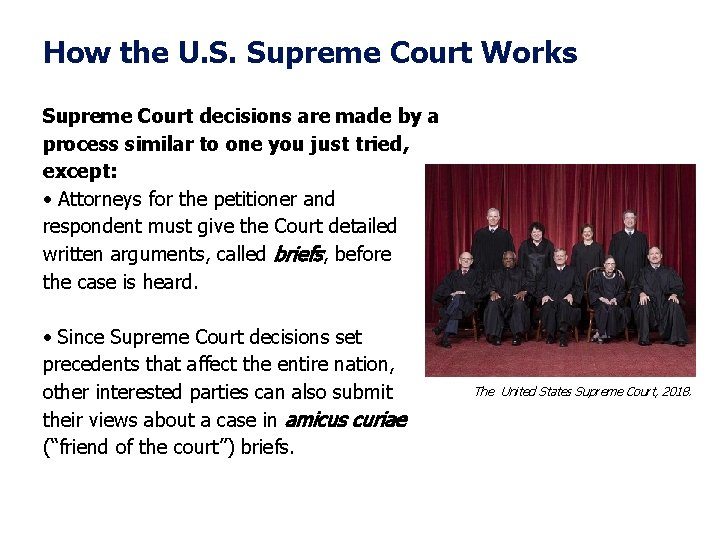
How the U. S. Supreme Court Works Supreme Court decisions are made by a process similar to one you just tried, except: • Attorneys for the petitioner and respondent must give the Court detailed written arguments, called briefs, before the case is heard. • Since Supreme Court decisions set precedents that affect the entire nation, other interested parties can also submit their views about a case in amicus curiae (“friend of the court”) briefs. The United States Supreme Court, 2018.
How the U. S. Supreme Court Works (cont. ) • During oral arguments , each side is allowed one half hour which includes questioning by the justices. This time limit is strictly enforced. • When the court reaches a decision, the Chief Justice assigns one of the justices to write an explanation of that decision called the majority opinion. • Justices who support the decision but differ with the majority's reasoning may write a concurring opinion. • If one or more justices disagree with the majority, they typically write a dissenting opinion.
Write a short essay using the following prompt: th 4 Based on what you’ve learned about the Amendment and search and seizure, does the Greenwood decision th Amendment rightly expand or restrict an individual’s 4 right? In organizing and writing your essay: • Briefly summarize the Greenwood case. • Indicate whether the court’s decision expanded or restricted an individuals 4 th Amendment right. • List two facts that support your thesis statement. • Cite a previous court case that supports your thesis statement. • Develop an argument for fairness that supports your thesis statement.
California v. Greenwood: A Supreme Court Case Designed by Marshall Croddy Written by Keri Doggett & Bill Hayes Special thanks to Honorable John Kronstadt, member of CRF Board of Directors, for inspiration and input. © 2003 Constitutional Rights Foundation All rights reserved.