Azimuthal symmetry of HCAL readouts O Kodolova SINP
- Slides: 16
Azimuthal symmetry of HCAL readouts O. Kodolova (SINP MSU)
symmetry: goal and data stream choice Goal is to install the relative scale within each eta-ring. - using the phi-symmetric events equalize the response of HCAL readouts - choice of data stream may be different for the different eta regions: HB/HE/HF Current data stream choices: - minbias events - low momentum isolated tracks (10 -15 -25 Ge. V) Both choices have + and - features
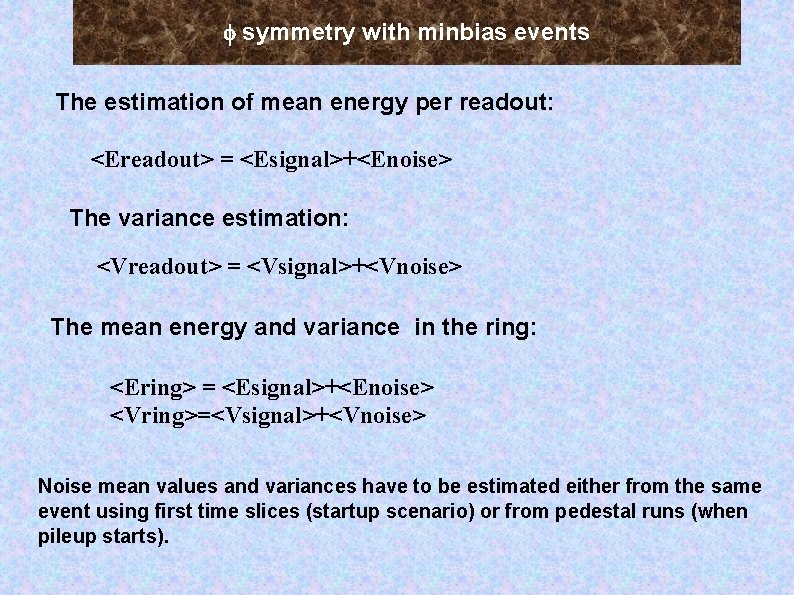
symmetry with minbias events The estimation of mean energy per readout: <Ereadout> = <Esignal>+<Enoise> The variance estimation: <Vreadout> = <Vsignal>+<Vnoise> The mean energy and variance in the ring: <Ering> = <Esignal>+<Enoise> <Vring>=<Vsignal>+<Vnoise> Noise mean values and variances have to be estimated either from the same event using first time slices (startup scenario) or from pedestal runs (when pileup starts).
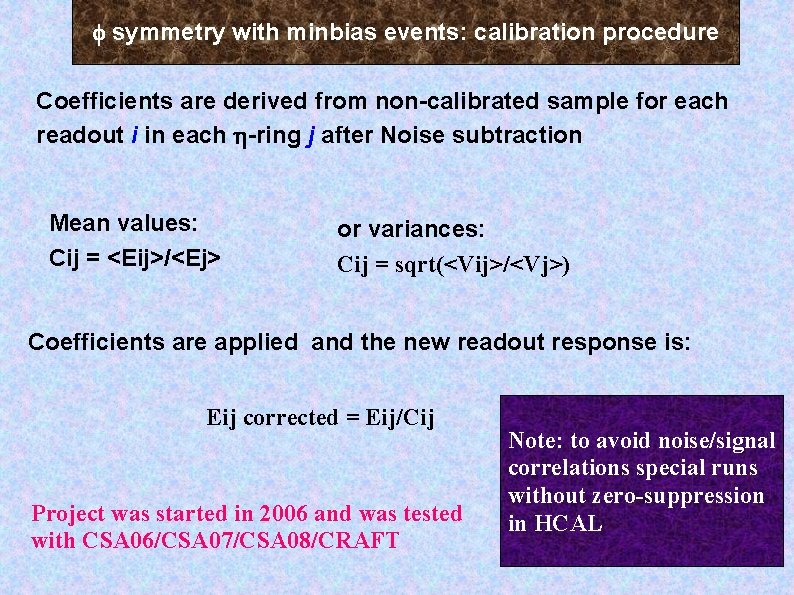
symmetry with minbias events: calibration procedure Coefficients are derived from non-calibrated sample for each readout i in each -ring j after Noise subtraction Mean values: Cij = <Eij>/<Ej> or variances: Cij = sqrt(<Vij>/<Vj>) Coefficients are applied and the new readout response is: Eij corrected = Eij/Cij Project was started in 2006 and was tested with CSA 06/CSA 07/CSA 08/CRAFT Note: to avoid noise/signal correlations special runs without zero-suppression in HCAL
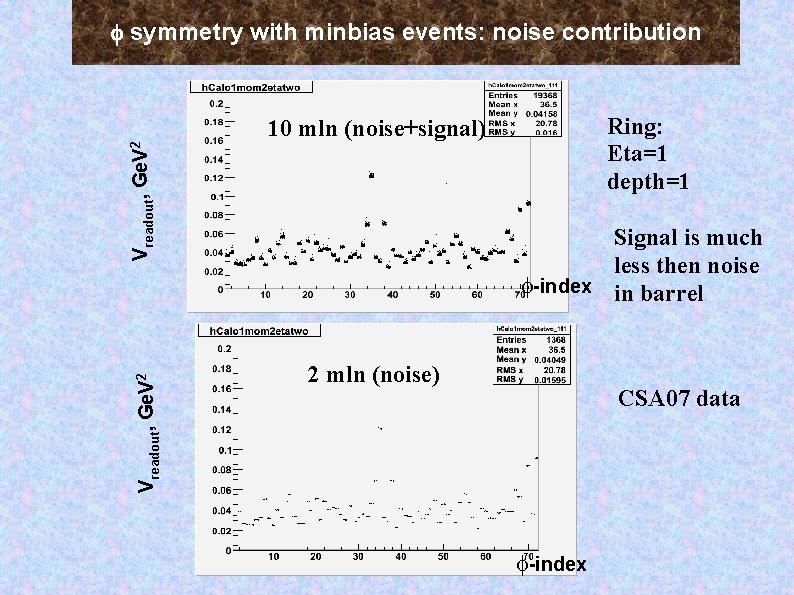
Vreadout, Ge. V 2 symmetry with minbias events: noise contribution Ring: Eta=1 depth=1 10 mln (noise+signal) Signal is much less then noise -index in barrel 2 mln (noise) CSA 07 data -index
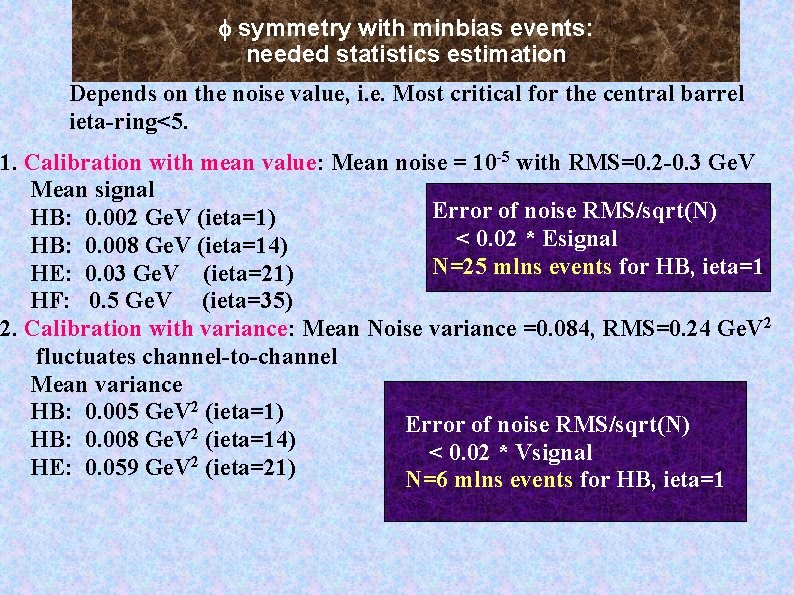
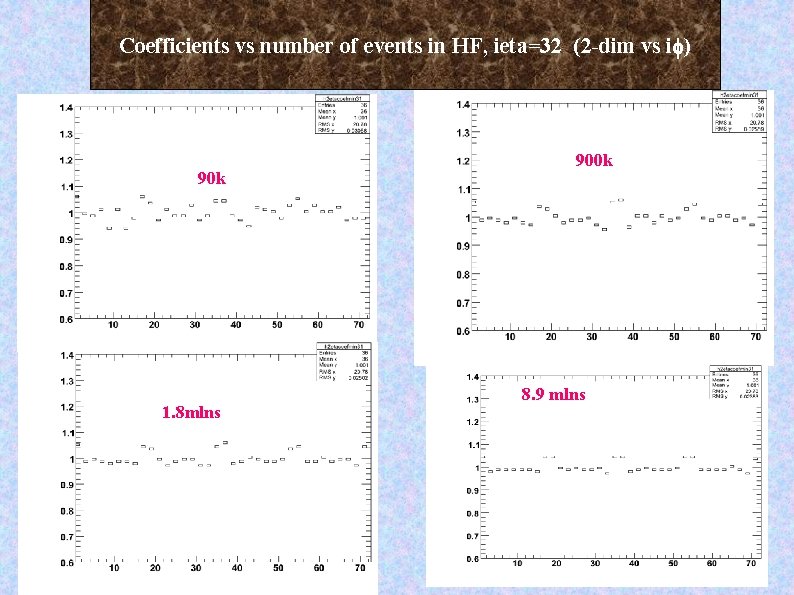
symmetry with minbias events: needed statistics estimation Depends on the noise value, i. e. Most critical for the central barrel ieta-ring<5. 1. Calibration with mean value: Mean noise = 10 -5 with RMS=0. 2 -0. 3 Ge. V Mean signal Error of noise RMS/sqrt(N) HB: 0. 002 Ge. V (ieta=1) < 0. 02 * Esignal HB: 0. 008 Ge. V (ieta=14) N=25 mlns events for HB, ieta=1 HE: 0. 03 Ge. V (ieta=21) HF: 0. 5 Ge. V (ieta=35) 2. Calibration with variance: Mean Noise variance =0. 084, RMS=0. 24 Ge. V 2 fluctuates channel-to-channel Mean variance HB: 0. 005 Ge. V 2 (ieta=1) Error of noise RMS/sqrt(N) HB: 0. 008 Ge. V 2 (ieta=14) < 0. 02 * Vsignal 2 HE: 0. 059 Ge. V (ieta=21) N=6 mlns events for HB, ieta=1
Coefficients vs number of events in HF, ieta=32 (2 -dim vs i ) 90 k 1. 8 mlns 900 k 8. 9 mlns
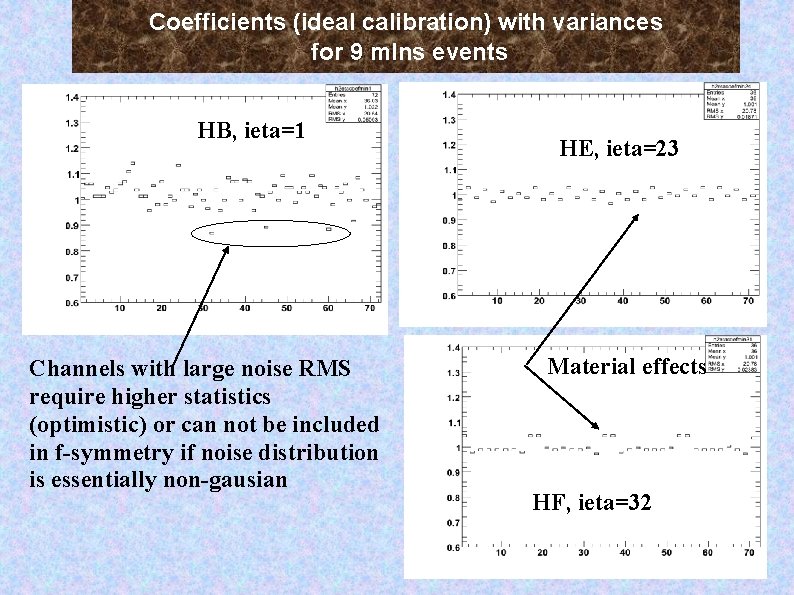
Coefficients (ideal calibration) with variances for 9 mlns events HB, ieta=1 Channels with large noise RMS require higher statistics (optimistic) or can not be included in f-symmetry if noise distribution is essentially non-gausian HE, ieta=23 Material effects HF, ieta=32
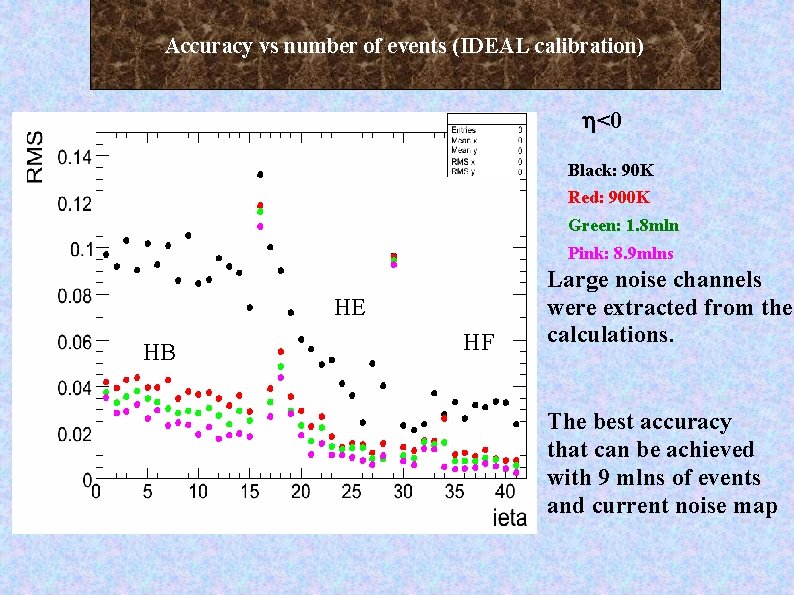
Accuracy vs number of events (IDEAL calibration) <0 Black: 90 K Red: 900 K Green: 1. 8 mln Pink: 8. 9 mlns HE HB HF Large noise channels were extracted from the calculations. The best accuracy that can be achieved with 9 mlns of events and current noise map
Azimuthal symmetry jobs with CRAFT L 1 trigger : EG and Muon Al. Ca. RAW is created at HLT step to be sent to Tier 0 only HCAL RAW data (without zero-suppression) Special reconstruction at Tier 0 followed by Al. CARECO production Time slices 1 -4 for noise reconstruction Time slices 5 -8 for signal reconstruction It can be used to study the level of noise and noise stability 160 mlns events are at CAF: same amount for noise and signal events. 50 mlns were analyzed: 4 days of data collected from 29 st of Oct to 1 st of Nov. ~2 days with HF on.
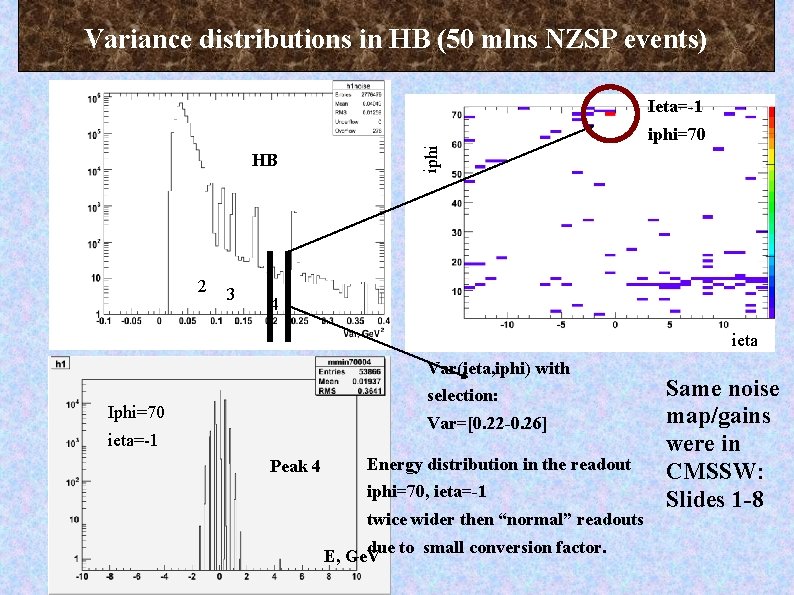
Variance distributions in HB (50 mlns NZSP events) Ieta=-1 HB 2 3 iphi=70 4 ieta Var(ieta, iphi) with selection: Iphi=70 Var=[0. 22 -0. 26] ieta=-1 Peak 4 Energy distribution in the readout iphi=70, ieta=-1 twice wider then “normal” readouts due to small conversion factor. E, Ge. V Same noise map/gains were in CMSSW: Slides 1 -8
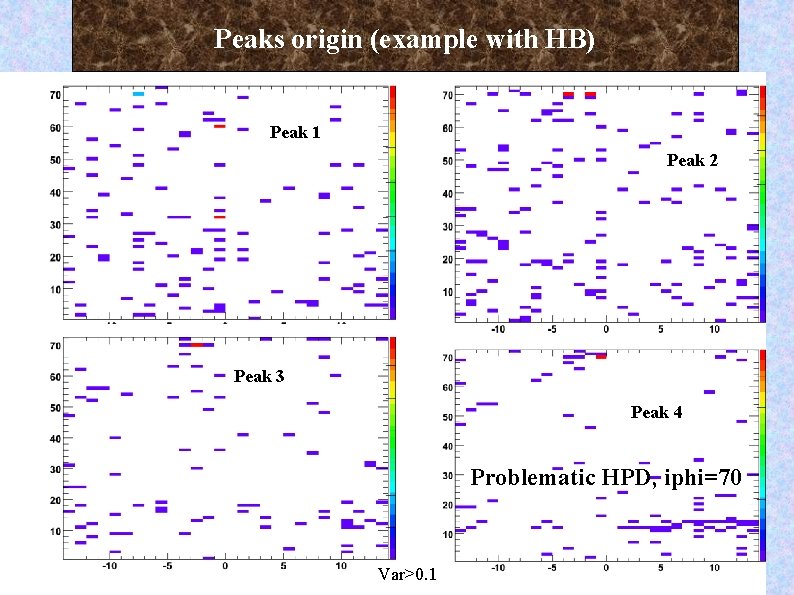
Peaks origin (example with HB) Peak 1 Peak 2 Peak 3 Peak 4 Problematic HPD, iphi=70 Var>0. 1
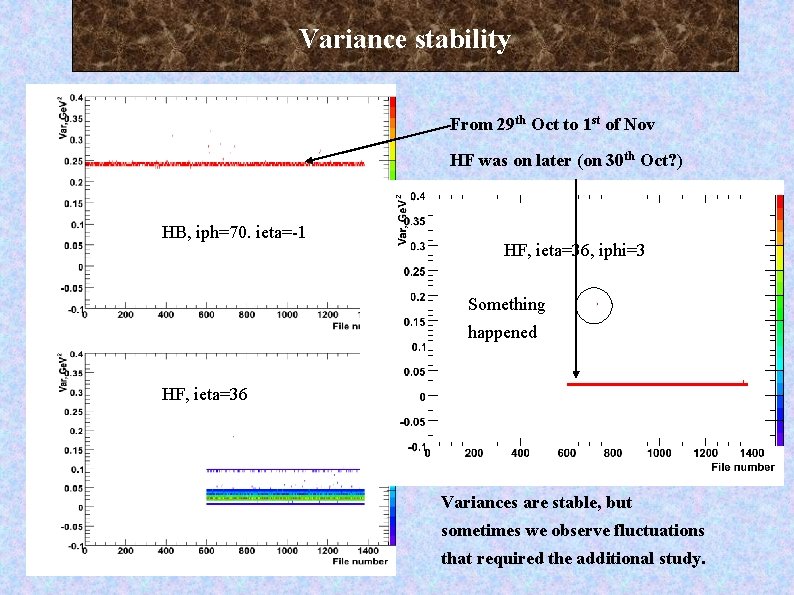
Variance stability From 29 th Oct to 1 st of Nov HF was on later (on 30 th Oct? ) HB, iph=70. ieta=-1 HF, ieta=36, iphi=3 Something happened HF, ieta=36 Variances are stable, but sometimes we observe fluctuations that required the additional study.
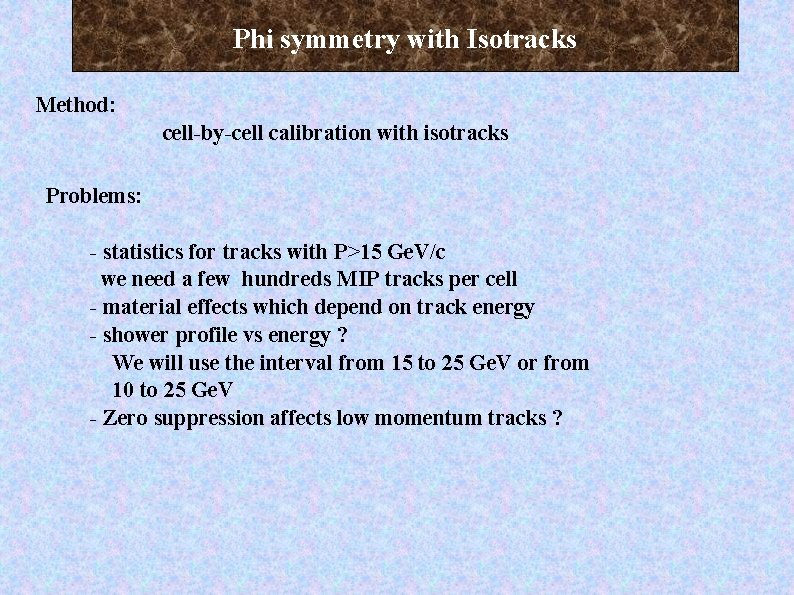
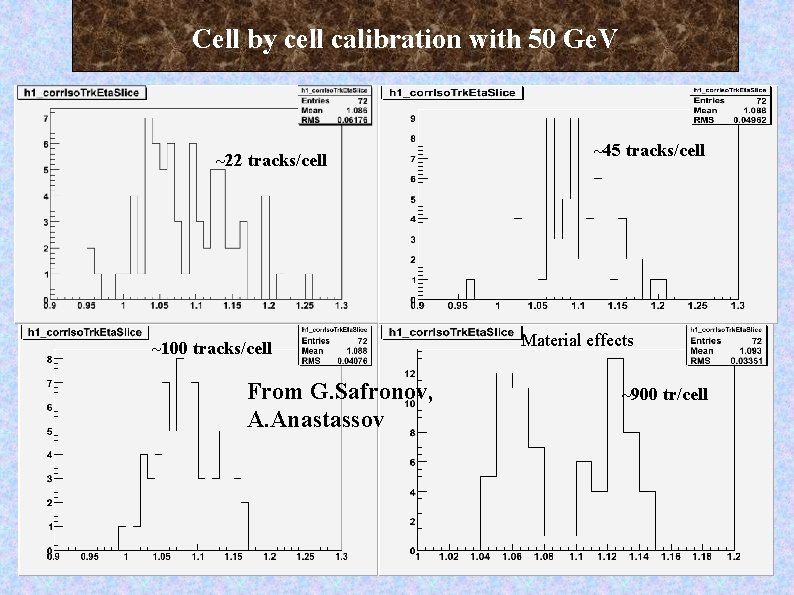
Phi symmetry with Isotracks Method: cell-by-cell calibration with isotracks Problems: - statistics for tracks with P>15 Ge. V/c we need a few hundreds MIP tracks per cell - material effects which depend on track energy - shower profile vs energy ? We will use the interval from 15 to 25 Ge. V or from 10 to 25 Ge. V - Zero suppression affects low momentum tracks ?
Cell by cell calibration with 50 Ge. V ~22 tracks/cell ~100 tracks/cell From G. Safronov, A. Anastassov ~45 tracks/cell Material effects ~900 tr/cell
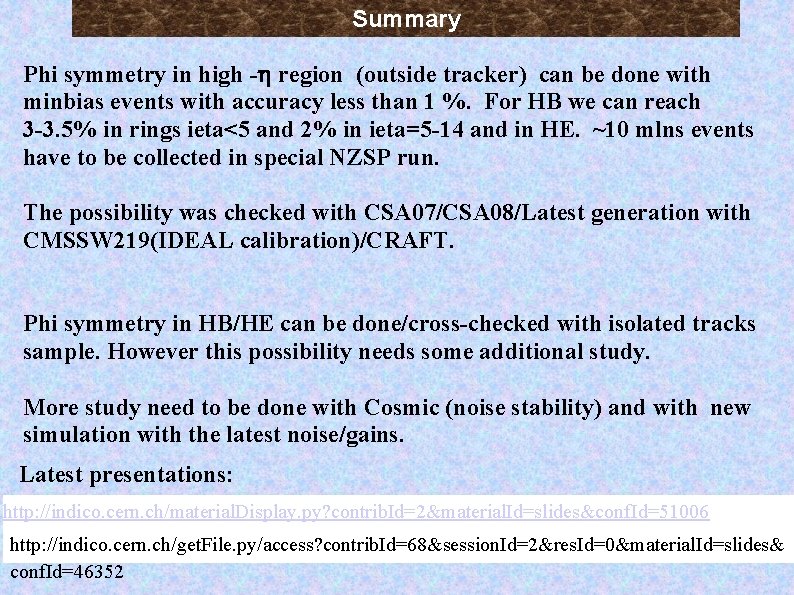
Summary Phi symmetry in high - region (outside tracker) can be done with minbias events with accuracy less than 1 %. For HB we can reach 3 -3. 5% in rings ieta<5 and 2% in ieta=5 -14 and in HE. ~10 mlns events have to be collected in special NZSP run. The possibility was checked with CSA 07/CSA 08/Latest generation with CMSSW 219(IDEAL calibration)/CRAFT. Phi symmetry in HB/HE can be done/cross-checked with isolated tracks sample. However this possibility needs some additional study. More study need to be done with Cosmic (noise stability) and with new simulation with the latest noise/gains. Latest presentations: http: //indico. cern. ch/material. Display. py? contrib. Id=2&material. Id=slides&conf. Id=51006 http: //indico. cern. ch/get. File. py/access? contrib. Id=68&session. Id=2&res. Id=0&material. Id=slides& conf. Id=46352