
Plans for Calorimeter Trigger Studies with Upgraded HCAL


- Slides: 18
Plans for Calorimeter Trigger Studies with Upgraded HCAL Jane Nachtman with input from Drew Baden, Jeremy Mans, Chris Tully CMS Calorimeter Trigger Upgrades Workshop February 19, 2009 1
Today’s talk l l Motivation Hardware proposals è è l Studies needed è è è l l l Longitudinal segmentation Pulse timing Bandwidth issues Combine ECAL and HCAL Lepton isolation Timing vs peak detection Improved resolution, performance of existing triggers What do we get/need from hardware upgrades to maintain or improve performance? Status of simulation People
Motivation l Calorimeter hardware/electronics are proposed to be upgraded HCAL Si. PM’s give finer segmentation, timing info è Trigger electronics m. TCA platform è l l l How can the trigger benefit from upgrades? What does the trigger need to maintain performance? Interface between trigger and hardware groups Define studies è Feedback for upgrade planning è
Si. PM for HCAL l l HPD’s (Hybrid Photo-Detectors) will be replaced, probably by Si. PM’s (Silicon Photo-Multiplier) è Driven by need for quieter, higher gain devices Benefits: è Improved performance of current triggers è Allows longitudinal segmentation of HCAL readout è High gain means can get a good pulse timing measurement (split readout into ADC and TDC)
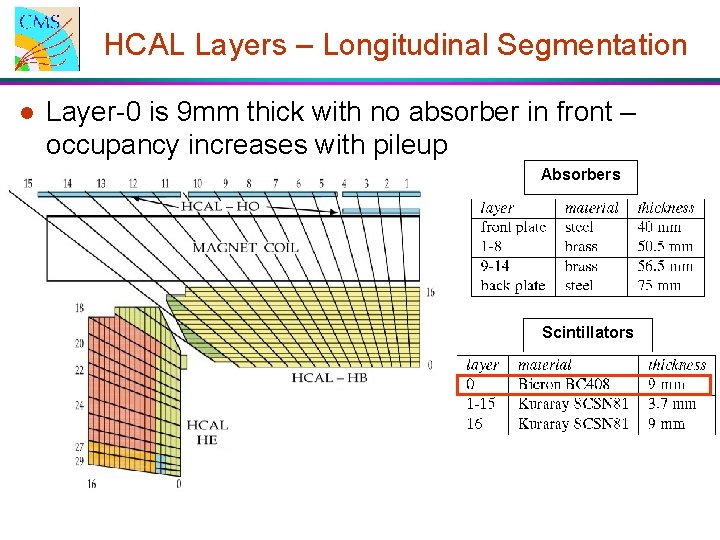
HCAL Layers – Longitudinal Segmentation l Layer-0 is 9 mm thick with no absorber in front – occupancy increases with pileup Absorbers Scintillators
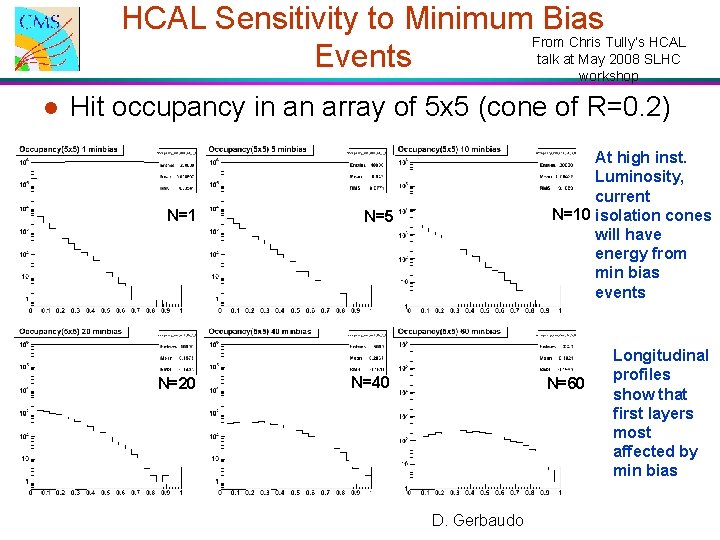
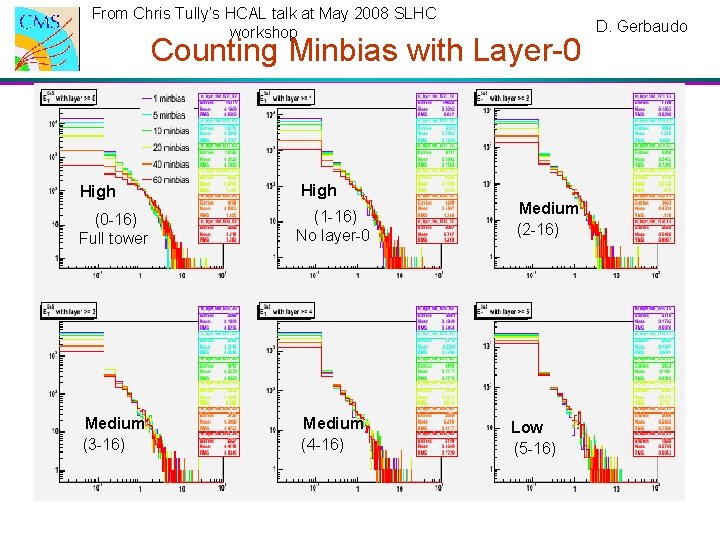
HCAL Sensitivity to Minimum Bias From Chris Tully’s HCAL talk at May 2008 SLHC Events workshop l Hit occupancy in an array of 5 x 5 (cone of R=0. 2) N=1 N=20 At high inst. Luminosity, current N=10 isolation cones will have energy from min bias events N=5 N=40 N=60 D. Gerbaudo Longitudinal profiles show that first layers most affected by min bias
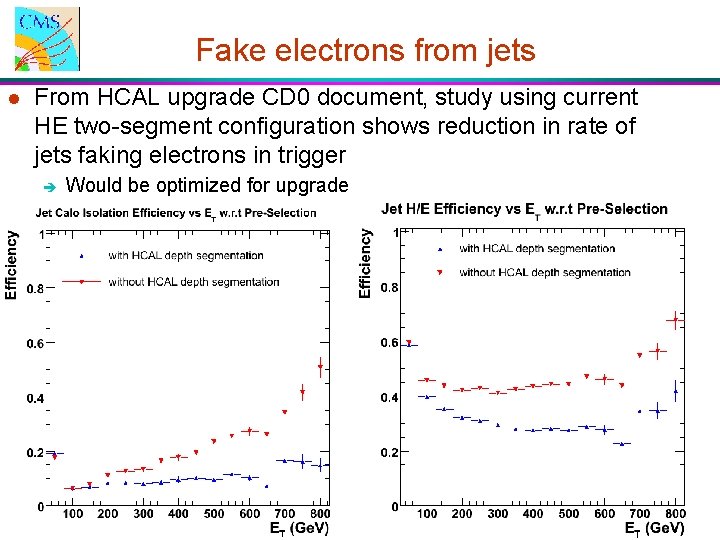
Fake electrons from jets l From HCAL upgrade CD 0 document, study using current HE two-segment configuration shows reduction in rate of jets faking electrons in trigger è Would be optimized for upgrade 7
Longitudinal Segmentation Studies l Studies needed: Optimal configuration of segmentation è Lepton isolation Consider e, m, t separately è Current muon trigger does not use isolation, but may help in upgrade Exclude front layers to reduce min bias contribution to isolation cone energy ð May be h dependence Optimize cone sizes Jet faking lepton rates
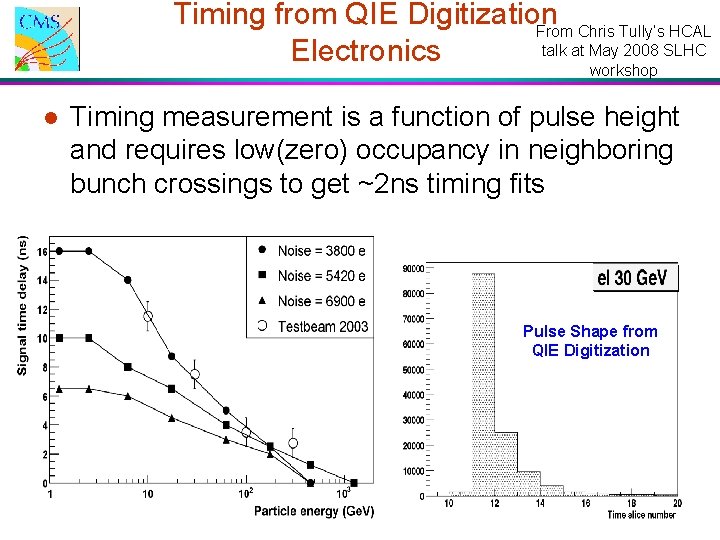
Pulse Time l Pulse time more precisely obtained with Si. PM’s è l Will be needed in SLHC as out-of-time pileup will hurt time resolution Current peak detection methods suffer from large time slewing effect for low energy (<10 Ge. V) Plot from Chris Tully’s May 2008 SLHC workshop talk 9
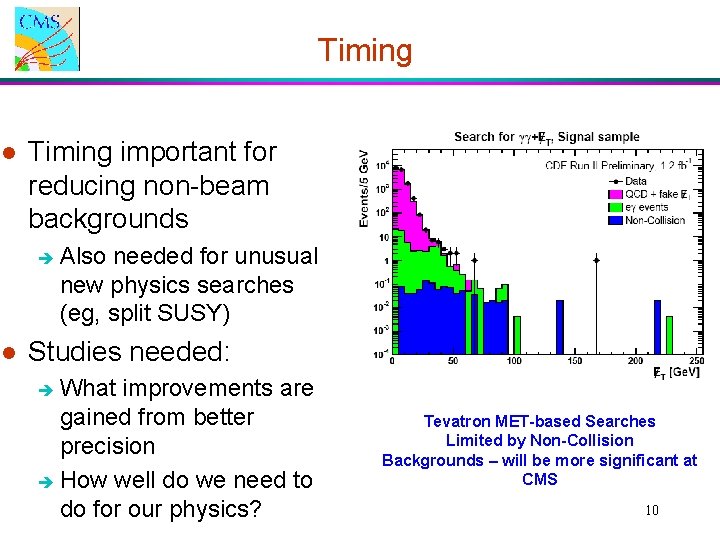
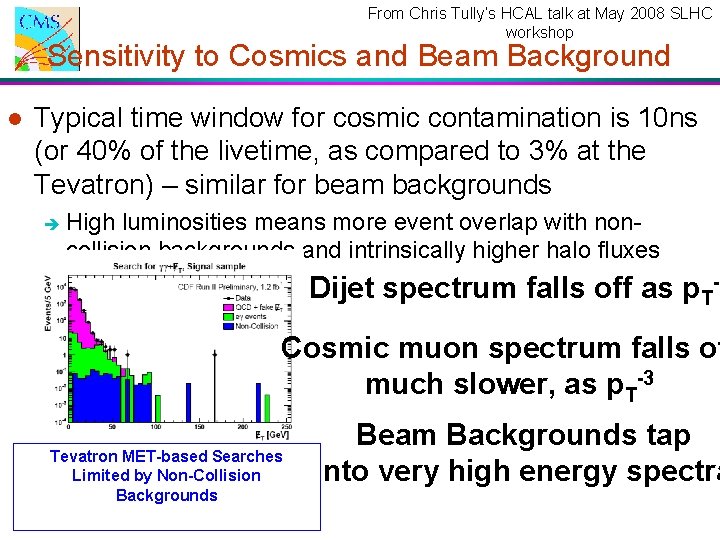
Timing l Timing important for reducing non-beam backgrounds è l Also needed for unusual new physics searches (eg, split SUSY) Studies needed: What improvements are gained from better precision è How well do we need to do for our physics? è Tevatron MET-based Searches Limited by Non-Collision Backgrounds – will be more significant at CMS 10
Bandwidth Issues l Increased number of channels but same overall data volume Can possibly gain some bandwidth, but not enough to make up what is needed – need to reduce in other ways è Seeded readout matched to ECAL? è What ADC range is needed? Saturation issues could become important è l Studies: è Impact of options on jet triggers especially 11
Status l l l Extensive simulation studies done with “current detector” – see Sridhara and Kevin’s talk on Wisconsin simulation and algorithm improvements Many upgrade proposal studies will need modifications to detector simulation, can then feed into Wisconsin simulation è Maybe a new TP object needed, with long. segment energies and TDC info Current detector simulation status: è DESY group -- HCAL layer sim, now in CMSSW 2_2_3 Sim. Hit level until Si. PM signal and new ADC coded è New CMSSW 3_x -- new version and tune for Geant (thanks to Calorimeter Simulation Taskforce) Reproduces testbeam better 12 Should be used (may be available in CMSSW 2_2_? )
People l Effort is just beginning Trying to find out who is interested, recruit new people Groups: Princeton, Iowa, Boston U. , DESY l Please let us know if you are interested!! l l 13
Backup slides 14
From Chris Tully’s HCAL talk at May 2008 SLHC workshop Counting Minbias with Layer-0 High (0 -16) Full tower (1 -16) No layer-0 Medium (3 -16) Medium (4 -16) Medium (2 -16) Low (5 -16) D. Gerbaudo
Timing from QIE Digitization From Chris Tully’s HCAL talk at May 2008 SLHC Electronics workshop l Timing measurement is a function of pulse height and requires low(zero) occupancy in neighboring bunch crossings to get ~2 ns timing fits Pulse Shape from QIE Digitization
From Chris Tully’s HCAL talk at May 2008 SLHC workshop Sensitivity to Cosmics and Beam Background l Typical time window for cosmic contamination is 10 ns (or 40% of the livetime, as compared to 3% at the Tevatron) – similar for beam backgrounds è High luminosities means more event overlap with noncollision backgrounds and intrinsically higher halo fluxes Dijet spectrum falls off as p. T-7 Cosmic muon spectrum falls of much slower, as p. T-3 Tevatron MET-based Searches Limited by Non-Collision Backgrounds Beam Backgrounds tap into very high energy spectra
From Chris Tully’s HCAL talk at May 2008 SLHC workshop Proposal in a Nutshell l Introduce longitudinal segmentation è è è l l Decouples layer-0 sensitivity to minbias Allows for radiation damage corrections in HE Reduces active volume subject to non-Collision backgrounds (producing no hits in inner layers) Reduce instrumental backgrounds that require pattern recognition in low occupancy events Introduce timing measurements that are robust in high occupancy events Increase the FED readout capabilities to accommodate x 4 increase in channel count and TDC+ADC readout Increase the functionality and processing speed of the Level-1 Trigger Primitive generator to use the new timing data and increased granularity for background rejection and to improve lepton isolation variables at high luminosity