Audition Day 8 Music Cognition MUSC 495 02




- Slides: 43
Audition Day 8 Music Cognition MUSC 495. 02, NSCI 466, NSCI 710. 03 Harry Howard Barbara Jazwinski Tulane University Music Cognition - Jazwinski & Howard - Tulane University
Course administration l Spend provost's money 9/25/2020 Music Cognition - Jazwinski & Howard - Tulane University 2
Macrostructure of the brain The parts of the brain that you can see with the naked eye Music Cognition - Jazwinski & Howard - Tulane University
Questions l What are the axes of the brain? l What are the lobes of the brain and what do they do? l What are the main connections between parts of the brain? l What are three ways of referring to areas of the brain? 9/25/2020 Music Cognition - Jazwinski & Howard - Tulane University 4
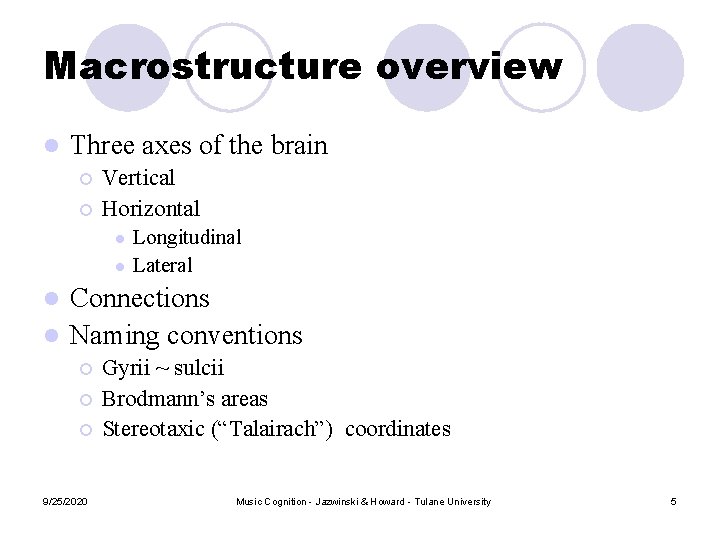
Macrostructure overview l Three axes of the brain ¡ ¡ Vertical Horizontal l l Longitudinal Lateral Connections l Naming conventions l ¡ ¡ ¡ 9/25/2020 Gyrii ~ sulcii Brodmann’s areas Stereotaxic (“Talairach”) coordinates Music Cognition - Jazwinski & Howard - Tulane University 5
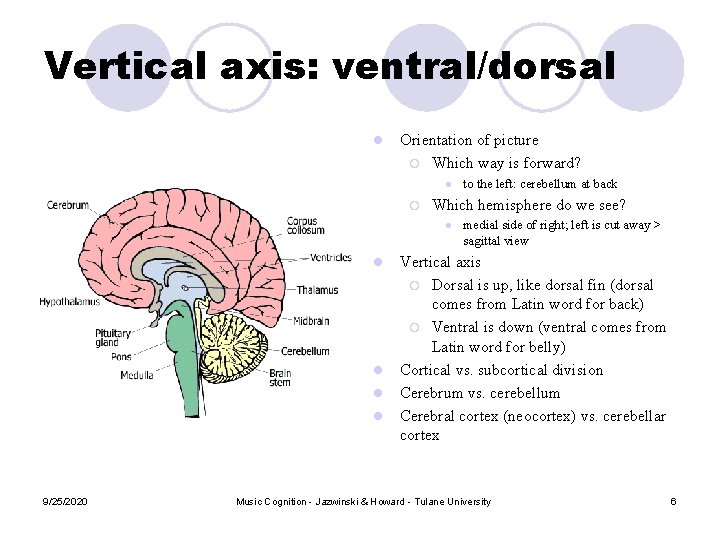
Vertical axis: ventral/dorsal l Orientation of picture ¡ Which way is forward? l ¡ Which hemisphere do we see? l l l 9/25/2020 to the left: cerebellum at back medial side of right; left is cut away > sagittal view Vertical axis ¡ Dorsal is up, like dorsal fin (dorsal comes from Latin word for back) ¡ Ventral is down (ventral comes from Latin word for belly) Cortical vs. subcortical division Cerebrum vs. cerebellum Cerebral cortex (neocortex) vs. cerebellar cortex Music Cognition - Jazwinski & Howard - Tulane University 6
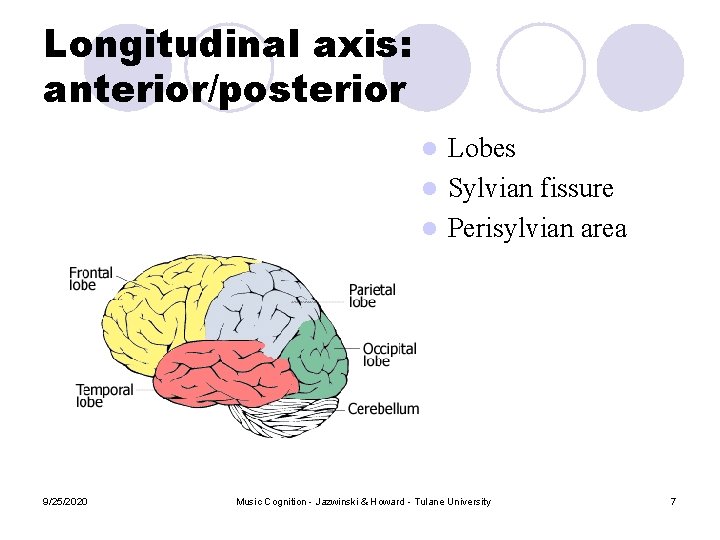
Longitudinal axis: anterior/posterior Lobes l Sylvian fissure l Perisylvian area l 9/25/2020 Music Cognition - Jazwinski & Howard - Tulane University 7
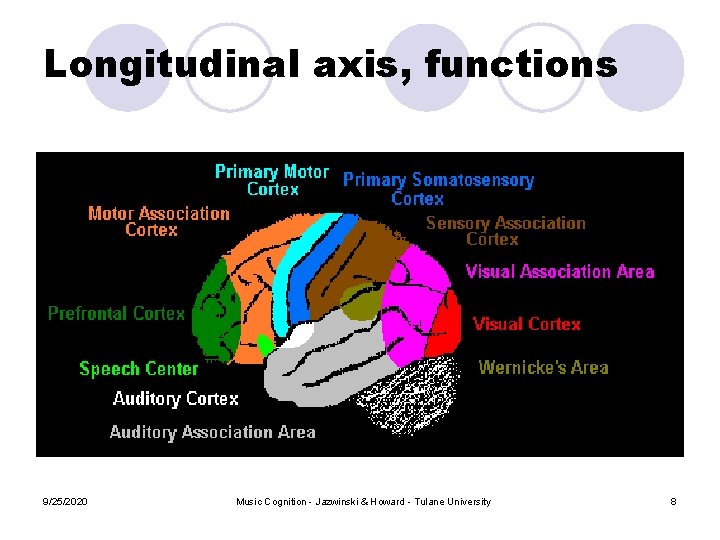
Longitudinal axis, functions 9/25/2020 Music Cognition - Jazwinski & Howard - Tulane University 8
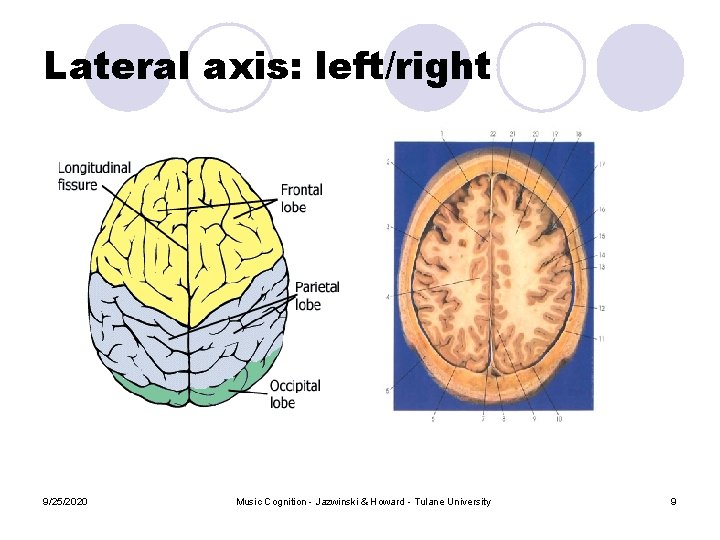
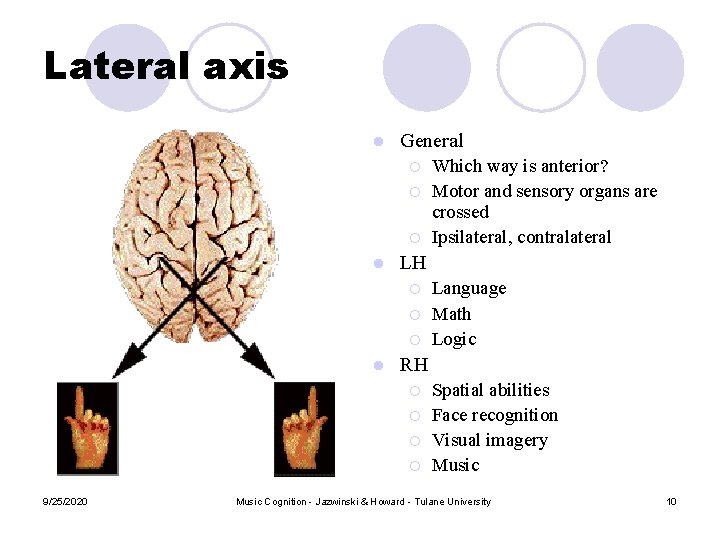
Lateral axis: left/right 9/25/2020 Music Cognition - Jazwinski & Howard - Tulane University 9
Lateral axis l General ¡ ¡ ¡ l LH ¡ ¡ ¡ l Language Math Logic RH ¡ ¡ 9/25/2020 Which way is anterior? Motor and sensory organs are crossed Ipsilateral, contralateral Spatial abilities Face recognition Visual imagery Music Cognition - Jazwinski & Howard - Tulane University 10
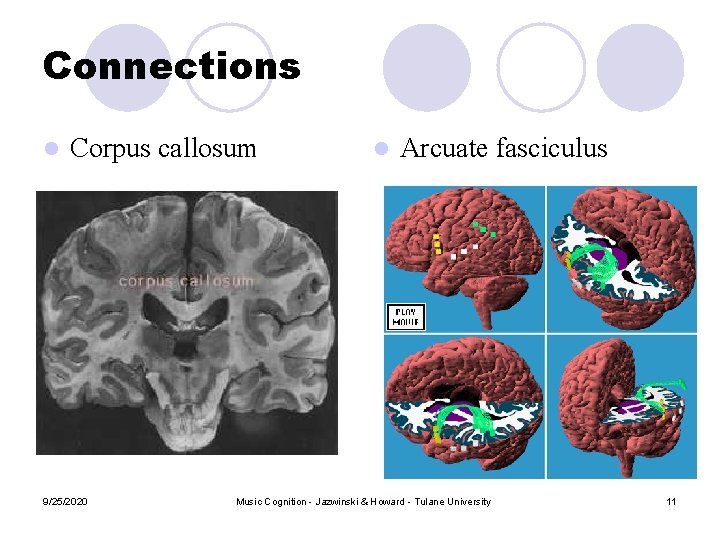
Connections l Corpus callosum 9/25/2020 l Arcuate fasciculus Music Cognition - Jazwinski & Howard - Tulane University 11
Naming conventions How to refer to specific areas of the brain Music Cognition - Jazwinski & Howard - Tulane University
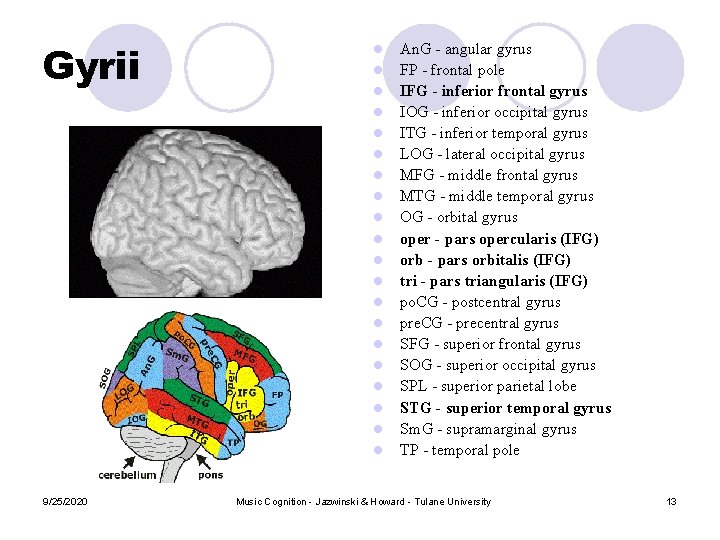
Gyrii l l l l l 9/25/2020 An. G - angular gyrus FP - frontal pole IFG - inferior frontal gyrus IOG - inferior occipital gyrus ITG - inferior temporal gyrus LOG - lateral occipital gyrus MFG - middle frontal gyrus MTG - middle temporal gyrus OG - orbital gyrus oper - pars opercularis (IFG) orb - pars orbitalis (IFG) tri - pars triangularis (IFG) po. CG - postcentral gyrus pre. CG - precentral gyrus SFG - superior frontal gyrus SOG - superior occipital gyrus SPL - superior parietal lobe STG - superior temporal gyrus Sm. G - supramarginal gyrus TP - temporal pole Music Cognition - Jazwinski & Howard - Tulane University 13
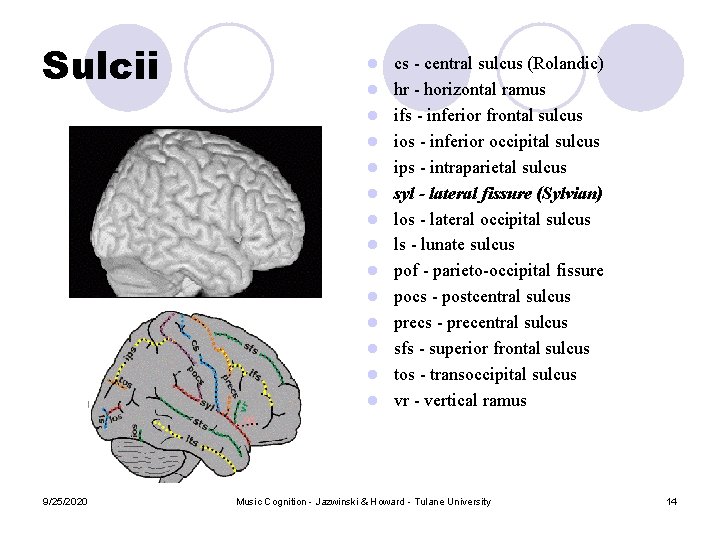
Sulcii l l l l 9/25/2020 cs - central sulcus (Rolandic) hr - horizontal ramus ifs - inferior frontal sulcus ios - inferior occipital sulcus ips - intraparietal sulcus syl - lateral fissure (Sylvian) los - lateral occipital sulcus ls - lunate sulcus pof - parieto-occipital fissure pocs - postcentral sulcus precs - precentral sulcus sfs - superior frontal sulcus tos - transoccipital sulcus vr - vertical ramus Music Cognition - Jazwinski & Howard - Tulane University 14
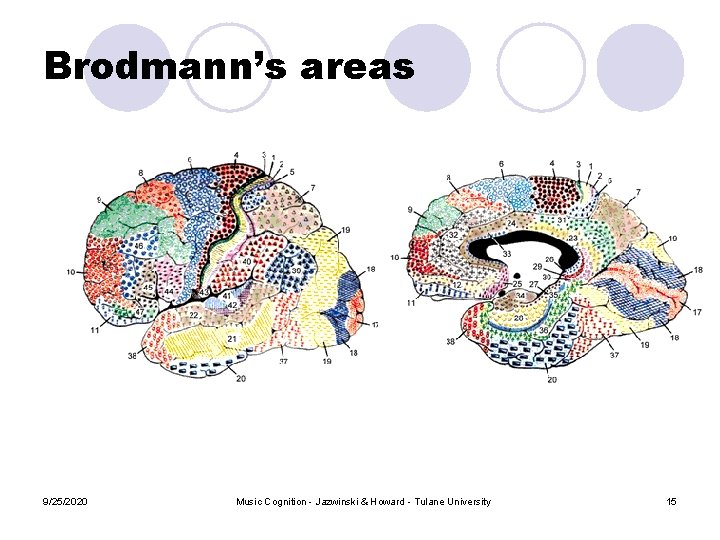
Brodmann’s areas 9/25/2020 Music Cognition - Jazwinski & Howard - Tulane University 15
Brodmann’s areas, functions 9/25/2020 Music Cognition - Jazwinski & Howard - Tulane University 16
Frequency Music Cognition - Jazwinski & Howard - Tulane University
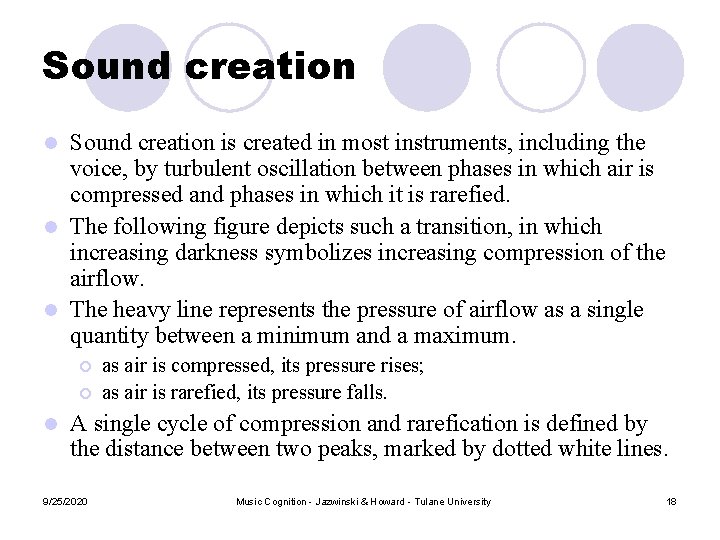
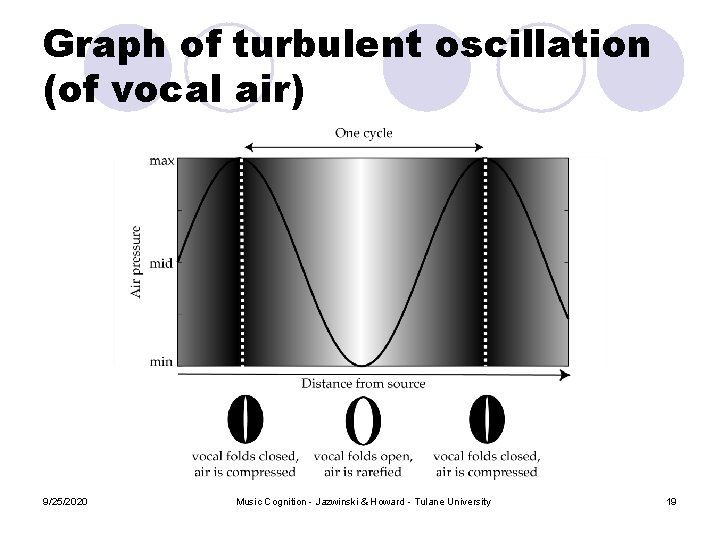
Sound creation is created in most instruments, including the voice, by turbulent oscillation between phases in which air is compressed and phases in which it is rarefied. l The following figure depicts such a transition, in which increasing darkness symbolizes increasing compression of the airflow. l The heavy line represents the pressure of airflow as a single quantity between a minimum and a maximum. l ¡ ¡ l as air is compressed, its pressure rises; as air is rarefied, its pressure falls. A single cycle of compression and rarefication is defined by the distance between two peaks, marked by dotted white lines. 9/25/2020 Music Cognition - Jazwinski & Howard - Tulane University 18
Graph of turbulent oscillation (of vocal air) 9/25/2020 Music Cognition - Jazwinski & Howard - Tulane University 19
Frequency l This cycling of airflow has a certain frequency ¡ the frequency of a phenomenon refers to the number of units that occur during some fixed extent of measurement. l The basic unit of frequency, the hertz (Hz), is defined as one cycle per second. 9/25/2020 Music Cognition - Jazwinski & Howard - Tulane University 20
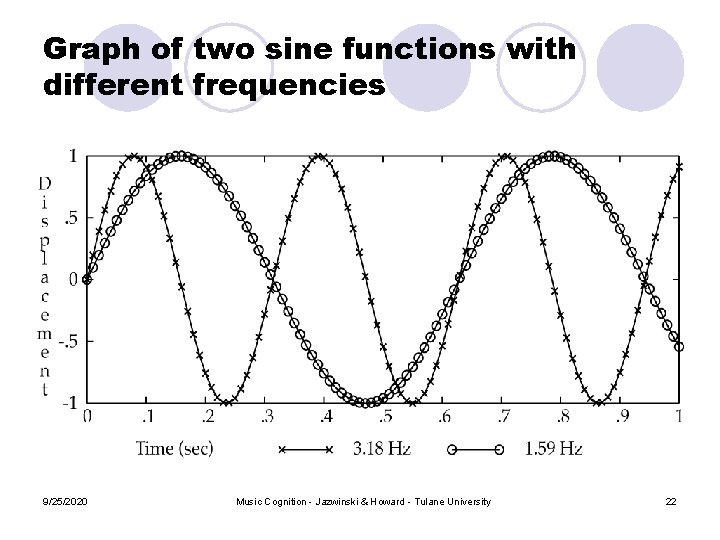
Two sine functions with different frequencies l A simple illustration can be found in the next diagram. It consists of the graphs of two sine functions. ¡ The one marked with o’s, like beads on a necklace, completes an entire cycle in 0. 628 s, which gives it a frequency of 1. 59 Hz. ¡ The other wave, marked with x’s so that it looks like barbed wire, completes two cycles in this period. Thus, its frequency is twice as much, 3. 18 Hz. 9/25/2020 Music Cognition - Jazwinski & Howard - Tulane University 21
Graph of two sine functions with different frequencies 9/25/2020 Music Cognition - Jazwinski & Howard - Tulane University 22
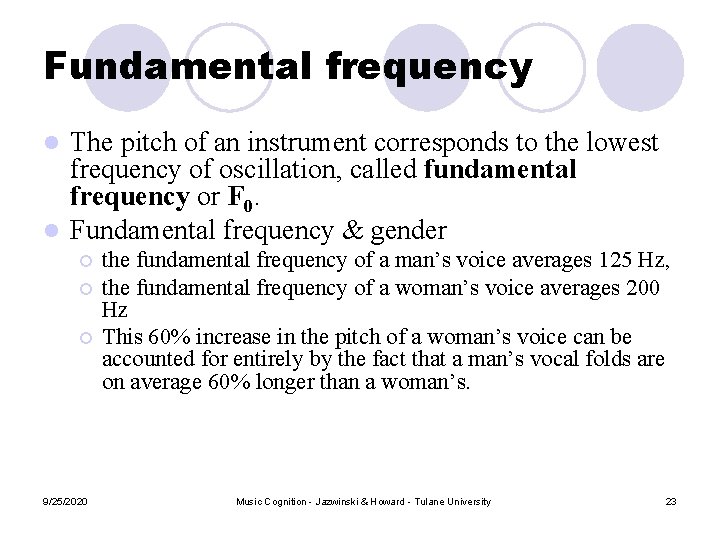
Fundamental frequency The pitch of an instrument corresponds to the lowest frequency of oscillation, called fundamental frequency or F 0. l Fundamental frequency & gender l ¡ ¡ ¡ 9/25/2020 the fundamental frequency of a man’s voice averages 125 Hz, the fundamental frequency of a woman’s voice averages 200 Hz This 60% increase in the pitch of a woman’s voice can be accounted for entirely by the fact that a man’s vocal folds are on average 60% longer than a woman’s. Music Cognition - Jazwinski & Howard - Tulane University 23
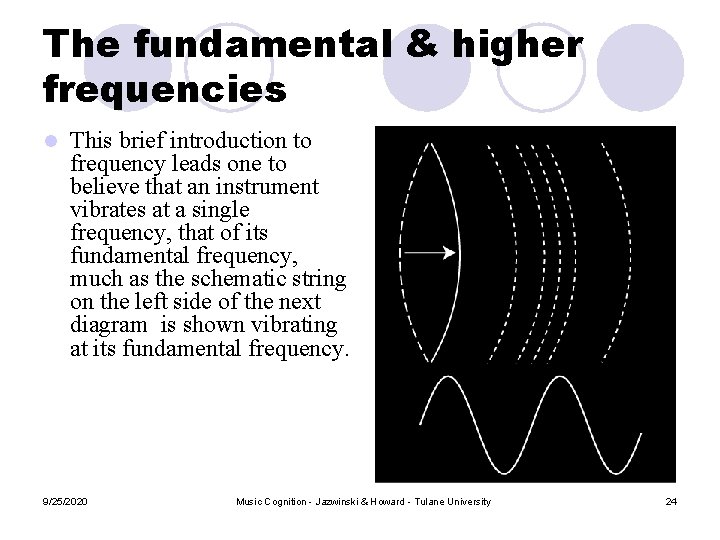
The fundamental & higher frequencies l This brief introduction to frequency leads one to believe that an instrument vibrates at a single frequency, that of its fundamental frequency, much as the schematic string on the left side of the next diagram is shown vibrating at its fundamental frequency. 9/25/2020 Music Cognition - Jazwinski & Howard - Tulane University 24
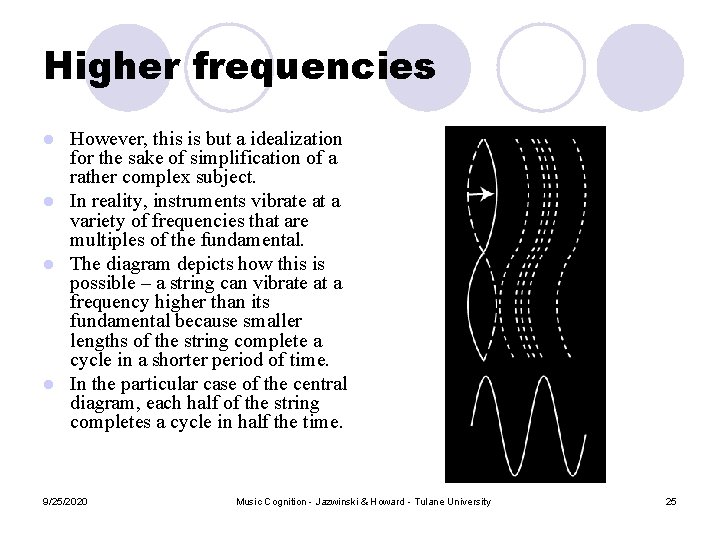
Higher frequencies However, this is but a idealization for the sake of simplification of a rather complex subject. l In reality, instruments vibrate at a variety of frequencies that are multiples of the fundamental. l The diagram depicts how this is possible – a string can vibrate at a frequency higher than its fundamental because smaller lengths of the string complete a cycle in a shorter period of time. l In the particular case of the central diagram, each half of the string completes a cycle in half the time. l 9/25/2020 Music Cognition - Jazwinski & Howard - Tulane University 25
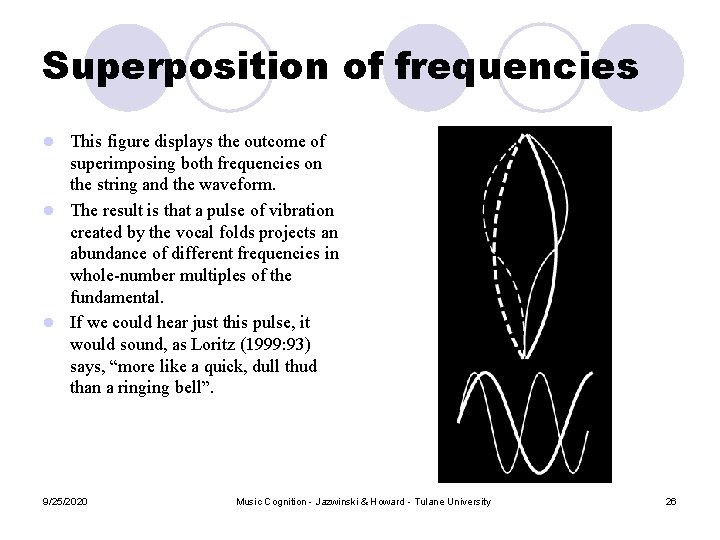
Superposition of frequencies This figure displays the outcome of superimposing both frequencies on the string and the waveform. l The result is that a pulse of vibration created by the vocal folds projects an abundance of different frequencies in whole-number multiples of the fundamental. l If we could hear just this pulse, it would sound, as Loritz (1999: 93) says, “more like a quick, dull thud than a ringing bell”. l 9/25/2020 Music Cognition - Jazwinski & Howard - Tulane University 26
Audition Music Cognition - Jazwinski & Howard - Tulane University
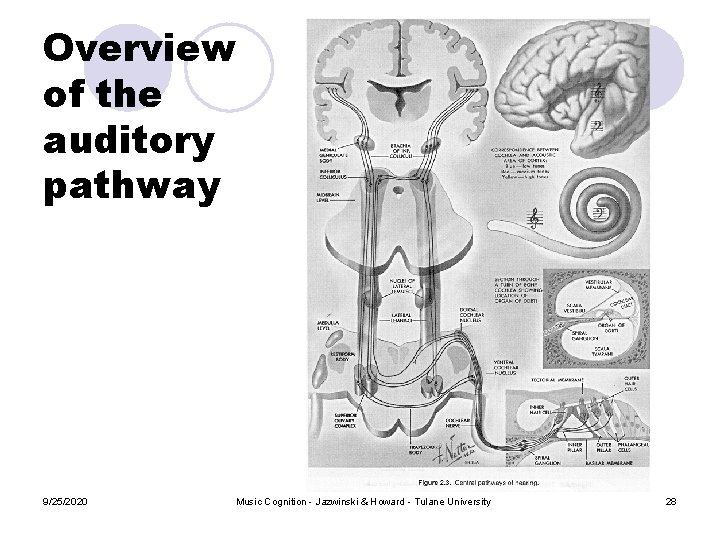
Overview of the auditory pathway 9/25/2020 Music Cognition - Jazwinski & Howard - Tulane University 28
Auditory transduction: the cochlea The cochlea is filled with a watery liquid, which moves in response to vibrations coming from the middle ear via the oval window. l As the fluid moves, thousands of "hair cells" are set in motion, and convert that motion to electrical signals that are communicated via neurotransmitters to many thousands of nerve cells. l These primary auditory neurons transform the signals into electrical impulses known as action potentials, which travel along the auditory nerve to structures in the brainstem for further processing. l 9/25/2020 Music Cognition - Jazwinski & Howard - Tulane University 29
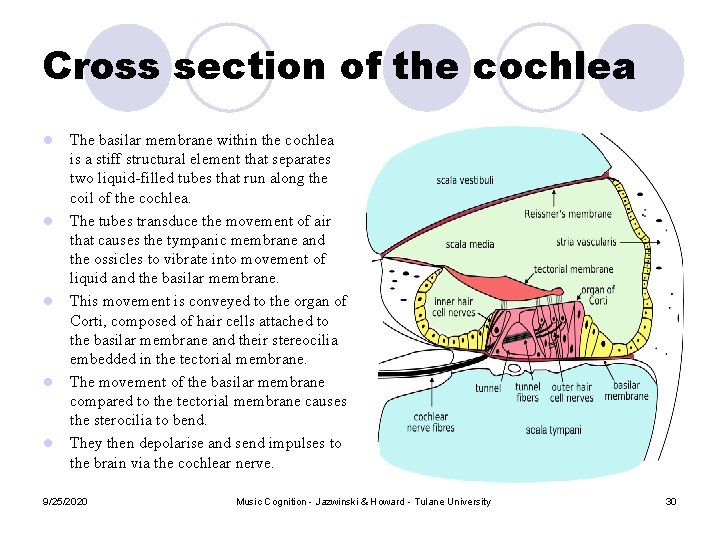
Cross section of the cochlea l l l The basilar membrane within the cochlea is a stiff structural element that separates two liquid-filled tubes that run along the coil of the cochlea. The tubes transduce the movement of air that causes the tympanic membrane and the ossicles to vibrate into movement of liquid and the basilar membrane. This movement is conveyed to the organ of Corti, composed of hair cells attached to the basilar membrane and their stereocilia embedded in the tectorial membrane. The movement of the basilar membrane compared to the tectorial membrane causes the sterocilia to bend. They then depolarise and send impulses to the brain via the cochlear nerve. 9/25/2020 Music Cognition - Jazwinski & Howard - Tulane University 30
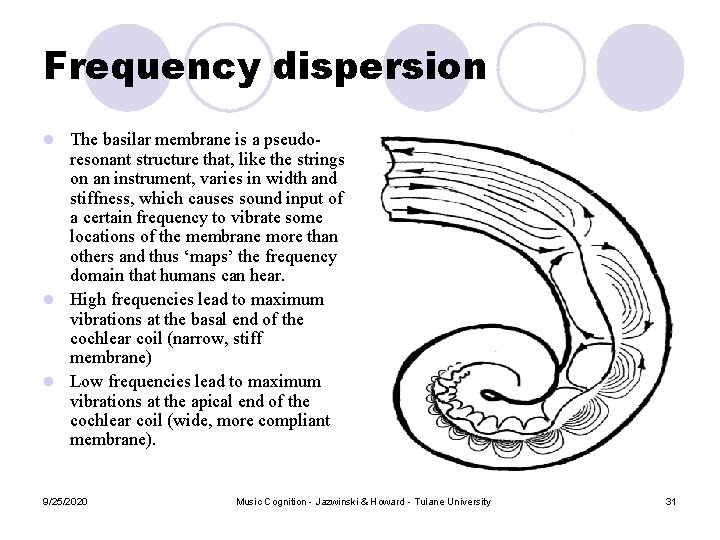
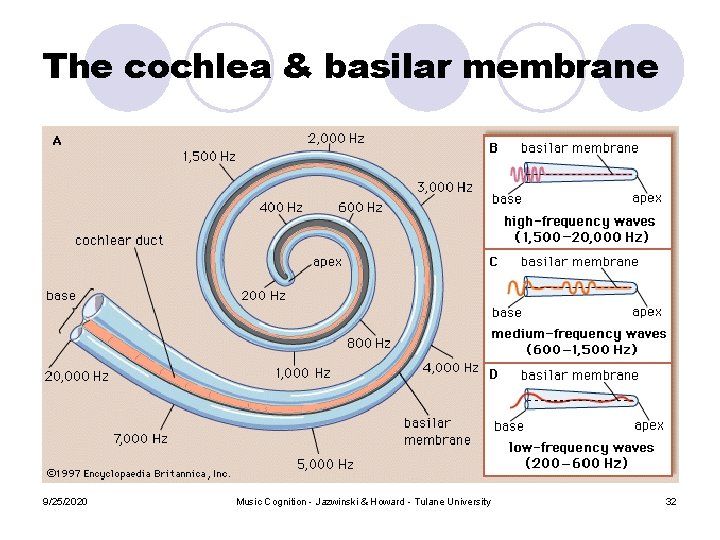
Frequency dispersion The basilar membrane is a pseudoresonant structure that, like the strings on an instrument, varies in width and stiffness, which causes sound input of a certain frequency to vibrate some locations of the membrane more than others and thus ‘maps’ the frequency domain that humans can hear. l High frequencies lead to maximum vibrations at the basal end of the cochlear coil (narrow, stiff membrane) l Low frequencies lead to maximum vibrations at the apical end of the cochlear coil (wide, more compliant membrane). l 9/25/2020 Music Cognition - Jazwinski & Howard - Tulane University 31
The cochlea & basilar membrane 9/25/2020 Music Cognition - Jazwinski & Howard - Tulane University 32
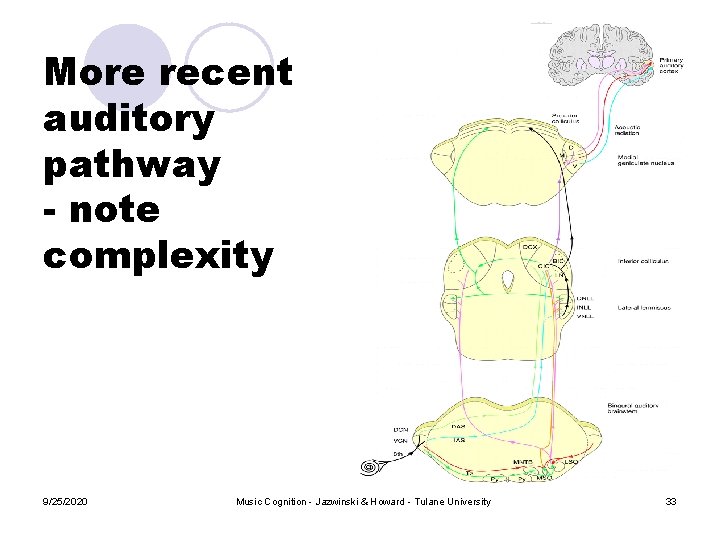
More recent auditory pathway - note complexity 9/25/2020 Music Cognition - Jazwinski & Howard - Tulane University 33
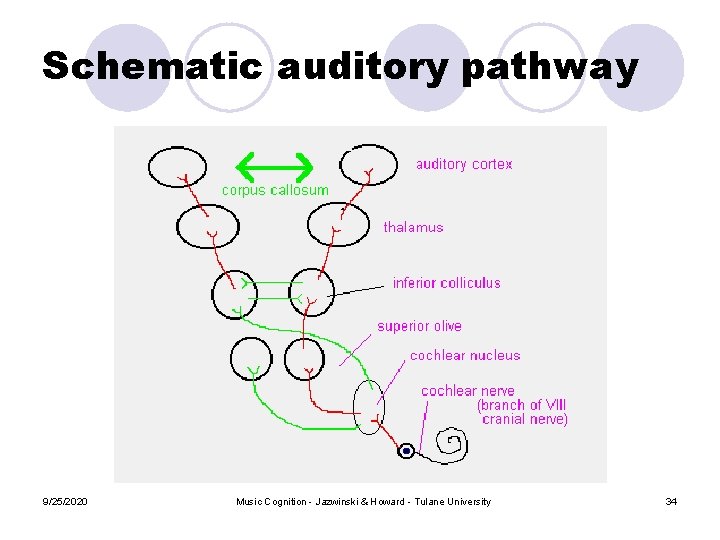
Schematic auditory pathway 9/25/2020 Music Cognition - Jazwinski & Howard - Tulane University 34
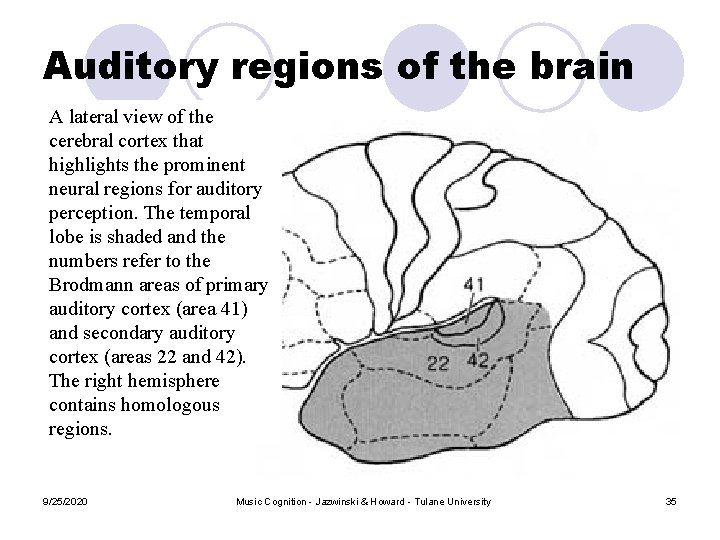
Auditory regions of the brain A lateral view of the cerebral cortex that highlights the prominent neural regions for auditory perception. The temporal lobe is shaded and the numbers refer to the Brodmann areas of primary auditory cortex (area 41) and secondary auditory cortex (areas 22 and 42). The right hemisphere contains homologous regions. 9/25/2020 Music Cognition - Jazwinski & Howard - Tulane University 35
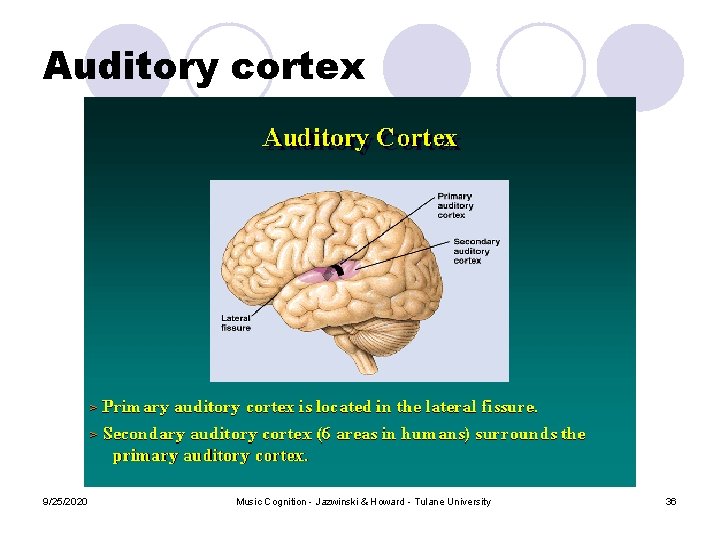
Auditory cortex 9/25/2020 Music Cognition - Jazwinski & Howard - Tulane University 36
Primary auditory cortex (A 1) tonotopic map 9/25/2020 Music Cognition - Jazwinski & Howard - Tulane University 37
Absolute vs. relative pitch l Thus A 1 represents absolute pitch l We do not know how relative pitch is represented 9/25/2020 Music Cognition - Jazwinski & Howard - Tulane University 38
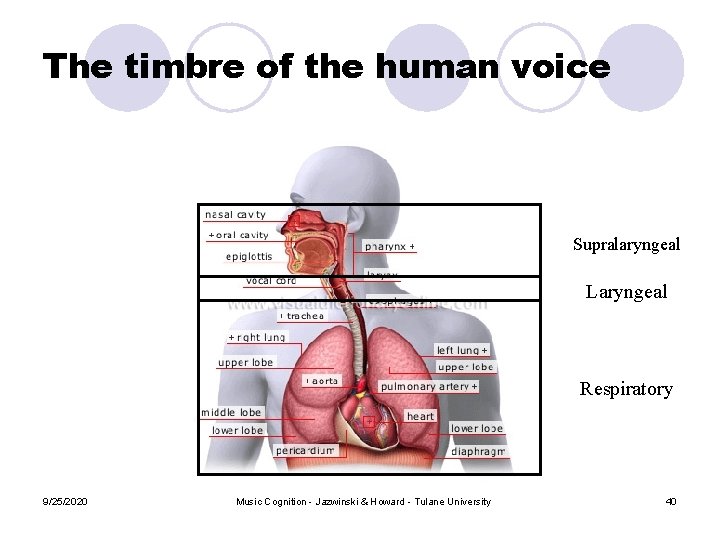
Timbre l Different parts of a musical instrument vibrate ¡ with different onsets (attack) l See Levitin’s discussion of Schaeffer’s perceptual experiments on onset (attack), pp. 53 -4. ¡ at different frequencies (steady state) ¡ for different durations (flux or decay) 9/25/2020 Music Cognition - Jazwinski & Howard - Tulane University 39
The timbre of the human voice Supralaryngeal Laryngeal Respiratory 9/25/2020 Music Cognition - Jazwinski & Howard - Tulane University 40
Back to our regularly scheduled program Music Cognition - Jazwinski & Howard - Tulane University
Ingredients of music cognition mostly receptive, mostly from Levitin 9/25/2020 Music Cognition - Jazwinski & Howard - Tulane University 42
Next Monday Go over other musical perceptual attributes § 1 -2 of Levitin Music Cognition - Jazwinski & Howard - Tulane University