Assessing Authentic Research Learning Experiences Prof Lynn Cominsky
- Slides: 12
Assessing Authentic Research Learning Experiences Prof. Lynn Cominsky Department of Physics & Astronomy Department of Chemistry Sonoma State University May 19, 2006 Cominsky/NCES
Authentic Research Learning Experiences • Both the departments of P&A and Chemistry have instituted “capstone” courses which attempt to emulate authentic research experiences for graduating seniors • Both departments also have learning objectives, all of which are to be demonstrated by graduating seniors • Big question: how do we construct meaningful summative assessments for widely differing capstone projects that can be fed back to improve our programs? May 19, 2006 Cominsky/NCES 2
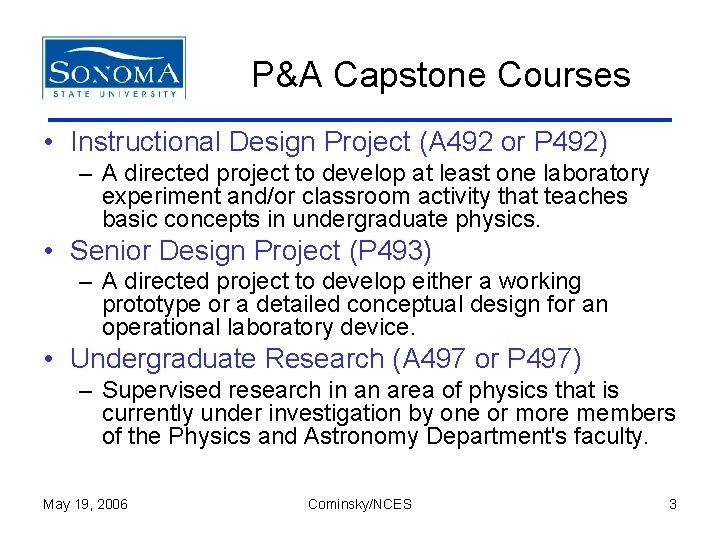
P&A Capstone Courses • Instructional Design Project (A 492 or P 492) – A directed project to develop at least one laboratory experiment and/or classroom activity that teaches basic concepts in undergraduate physics. • Senior Design Project (P 493) – A directed project to develop either a working prototype or a detailed conceptual design for an operational laboratory device. • Undergraduate Research (A 497 or P 497) – Supervised research in an area of physics that is currently under investigation by one or more members of the Physics and Astronomy Department's faculty. May 19, 2006 Cominsky/NCES 3
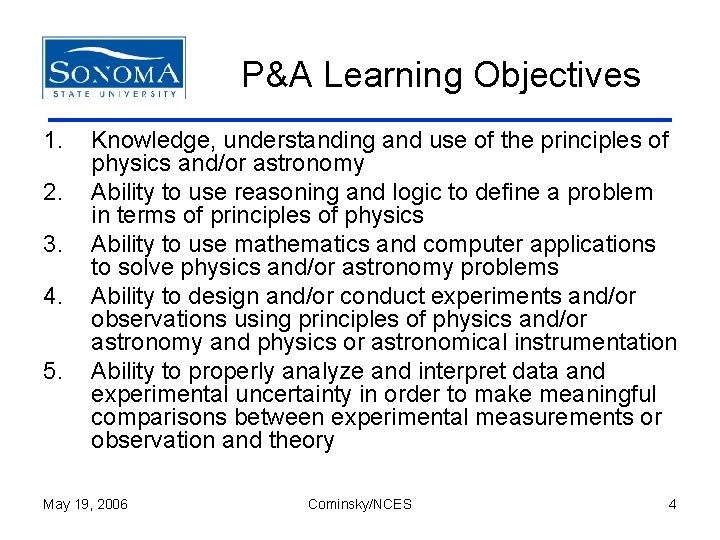
P&A Learning Objectives 1. 2. 3. 4. 5. Knowledge, understanding and use of the principles of physics and/or astronomy Ability to use reasoning and logic to define a problem in terms of principles of physics Ability to use mathematics and computer applications to solve physics and/or astronomy problems Ability to design and/or conduct experiments and/or observations using principles of physics and/or astronomy and physics or astronomical instrumentation Ability to properly analyze and interpret data and experimental uncertainty in order to make meaningful comparisons between experimental measurements or observation and theory May 19, 2006 Cominsky/NCES 4
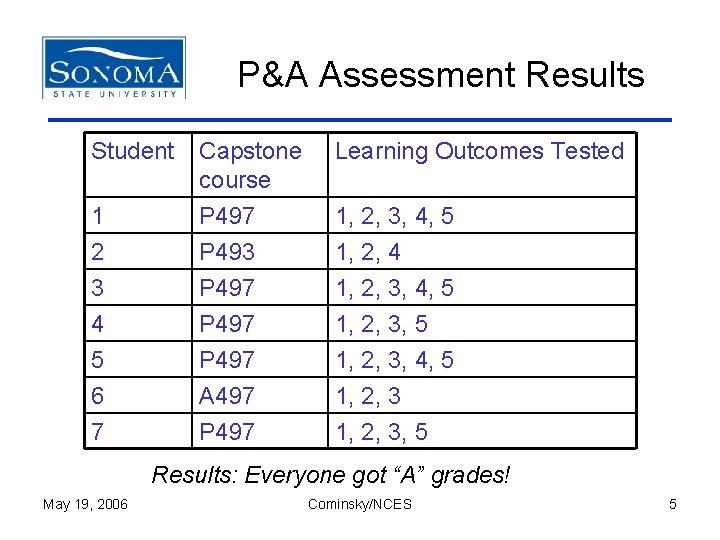
P&A Assessment Results Student Capstone course Learning Outcomes Tested 1 2 3 4 5 6 7 P 493 P 497 A 497 P 497 1, 2, 3, 4, 5 1, 2, 4 1, 2, 3, 4, 5 1, 2, 3, 5 Results: Everyone got “A” grades! May 19, 2006 Cominsky/NCES 5
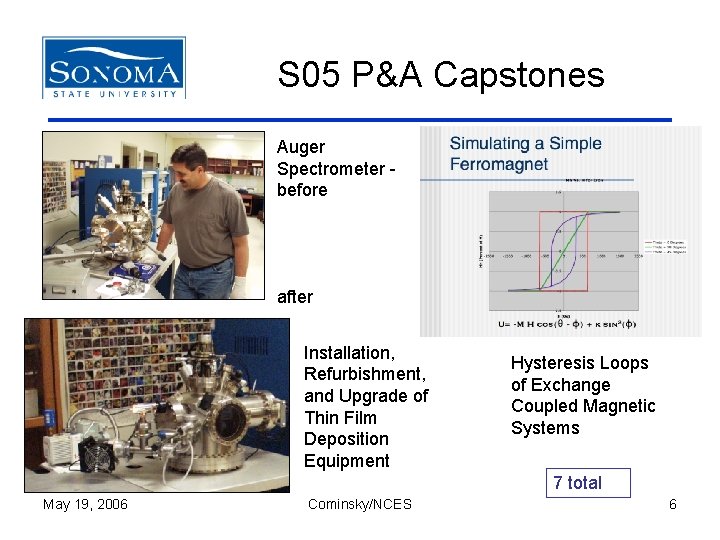
S 05 P&A Capstones Auger Spectrometer before after Installation, Refurbishment, and Upgrade of Thin Film Deposition Equipment Hysteresis Loops of Exchange Coupled Magnetic Systems 7 total May 19, 2006 Cominsky/NCES 6
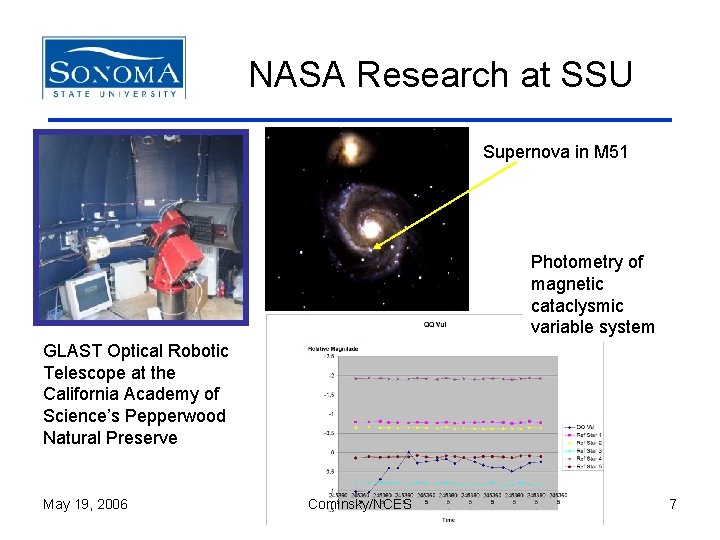
NASA Research at SSU Supernova in M 51 Photometry of magnetic cataclysmic variable system GLAST Optical Robotic Telescope at the California Academy of Science’s Pepperwood Natural Preserve May 19, 2006 Cominsky/NCES 7
Chemistry Capstone Courses • All courses have 1 hour lecture & 6 hours of lab/week • Chem 401 – BA in Chemistry – Instrumental Analysis and Chemical Synthesis – The projects will cover the synthesis of organic, and inorganic molecules and characterization of student-prepared molecules. • Chem 402 – BS in Chemistry – Advanced Synthesis and Instrumental Analysis – Project-based synthesis, purification, and characterization of inorganic, organic and organometallic molecules. • Chem 441 – BS in Biochemistry – Biochemical Methods – Project-based laboratory course involving isolation, purification and characterization of proteins from natural sources. May 19, 2006 Cominsky/NCES 8
Chemistry Learning Objectives 1. 2. 3. 4. 5. 6. 7. 8. 9. 10. 11. Develop conceptual understanding and problem-solving abilities in the fundamental chemical subfields of analytical chemistry, biochemistry, inorganic chemistry, and physical chemistry; Gain a foundation of physics and mathematics and integrate these areas with chemical principles; Learn the relevance of chemistry and its interdisciplinary ties to other fields and society, in order to become a scientifically literate and ethical citizen Perform accurate and precise quantitative measurements; Synthesize and characterize inorganic and organic compounds; Learn proper and ethical laboratory practices, including safety, waste management, and record keeping; Use and understand modern instruments, including NMR, IR, UV-vis, and mass spectrometers, and chromatographic and electrochemical instruments; Interpret experimental results and draw reasonable conclusions; Develop proficiency with computers for data acquisition and analysis, simulation, theoretical prediction, access to information, and report preparation; Plan, design, and execute experiments based on chemical literature; Communicate effectively through written and oral reports. May 19, 2006 Cominsky/NCES 9
Chemistry Assessment Goals • Conduct assessment of one learning objective (or all) using an indirect or direct approach – Indirect: Review of capstone projects and authentic research learning experience courses • Provide evidence of assessment – We will discuss the capstone projects and authentic research learning results with respect to at least one learning objective, and use our rubrics to ensure summative standardization. May 19, 2006 Cominsky/NCES 10
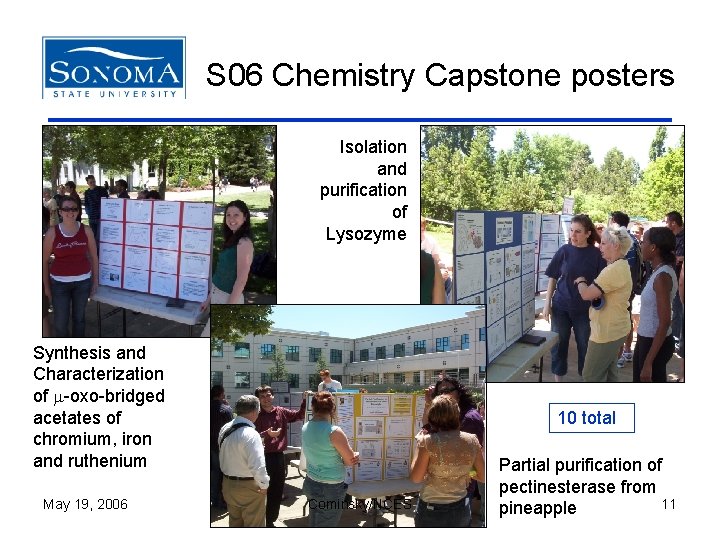
S 06 Chemistry Capstone posters Isolation and purification of Lysozyme Synthesis and Characterization of m-oxo-bridged acetates of chromium, iron and ruthenium May 19, 2006 10 total Cominsky/NCES Partial purification of pectinesterase from 11 pineapple
Current vs. best practices • Chemistry has rubrics for assessing posters, lab partners and group presentations. . but not tied to learning outcomes • P&A has learning outcomes but no rubrics or consistency – each student is graded individually by faculty advisor • What do you think we should be doing? May 19, 2006 Cominsky/NCES 12