Arpad Kovacs CS 284 Hierarchical Mesh Decomposition Using

- Slides: 21
Arpad Kovacs CS 284 Hierarchical Mesh Decomposition Using Fuzzy Clustering and Cuts Katz and Tal, Siggraph 2003 CS 284 Paper Presentation Arpad Kovacs 2009. 11. 16 1
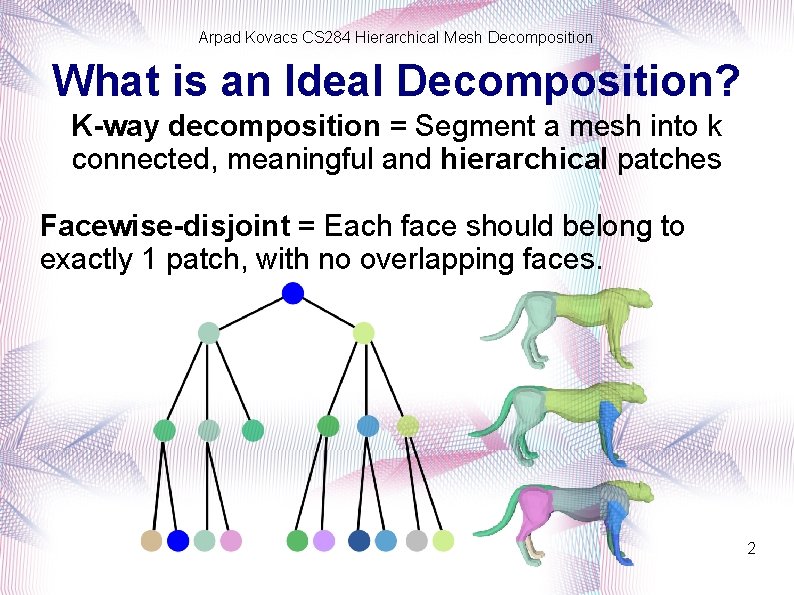
Arpad Kovacs CS 284 Hierarchical Mesh Decomposition What is an Ideal Decomposition? K-way decomposition = Segment a mesh into k connected, meaningful and hierarchical patches Facewise-disjoint = Each face should belong to exactly 1 patch, with no overlapping faces. 2
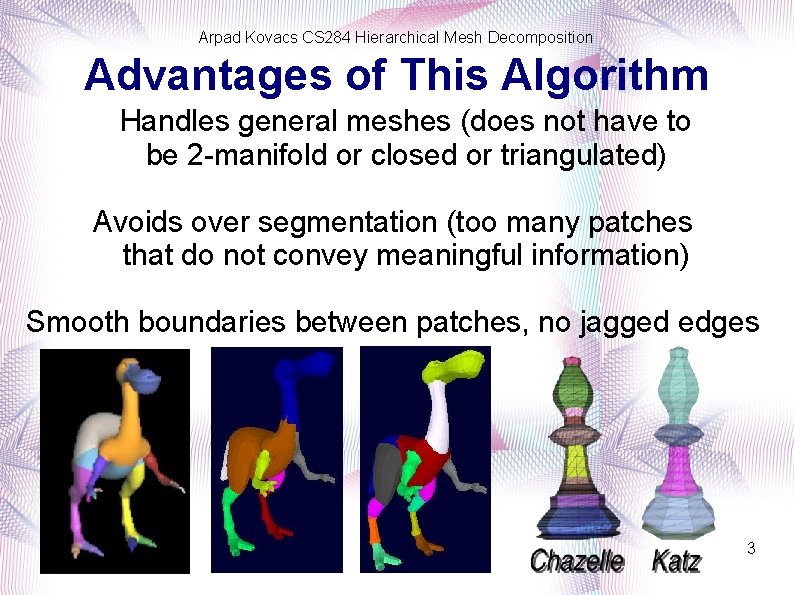
Arpad Kovacs CS 284 Hierarchical Mesh Decomposition Advantages of This Algorithm Handles general meshes (does not have to be 2 -manifold or closed or triangulated) Avoids over segmentation (too many patches that do not convey meaningful information) Smooth boundaries between patches, no jagged edges 3
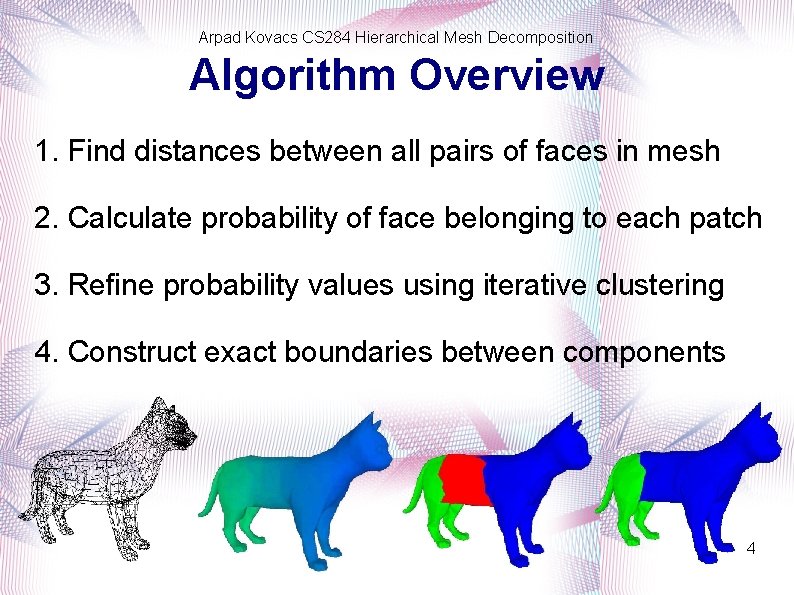
Arpad Kovacs CS 284 Hierarchical Mesh Decomposition Algorithm Overview 1. Find distances between all pairs of faces in mesh 2. Calculate probability of face belonging to each patch 3. Refine probability values using iterative clustering 4. Construct exact boundaries between components 4
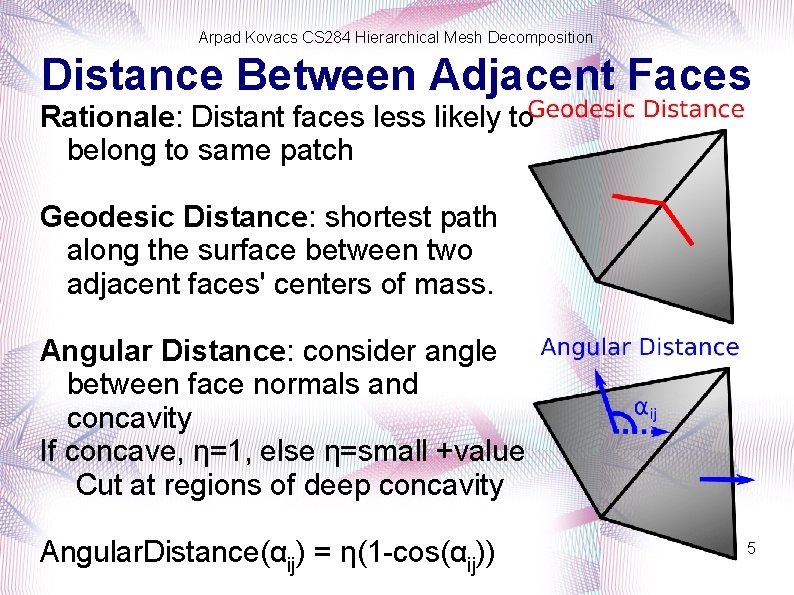
Arpad Kovacs CS 284 Hierarchical Mesh Decomposition Distance Between Adjacent Faces Rationale: Distant faces less likely to belong to same patch Geodesic Distance: shortest path along the surface between two adjacent faces' centers of mass. Angular Distance: consider angle between face normals and concavity If concave, η=1, else η=small +value Cut at regions of deep concavity Angular. Distance(αij) = η(1 -cos(αij)) 5
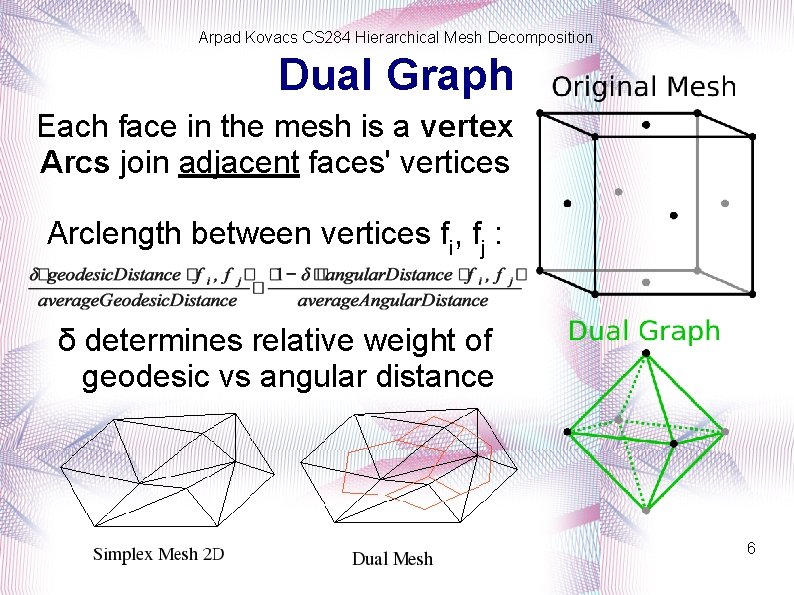
Arpad Kovacs CS 284 Hierarchical Mesh Decomposition Dual Graph Each face in the mesh is a vertex Arcs join adjacent faces' vertices Arclength between vertices fi, fj : δ determines relative weight of geodesic vs angular distance 6
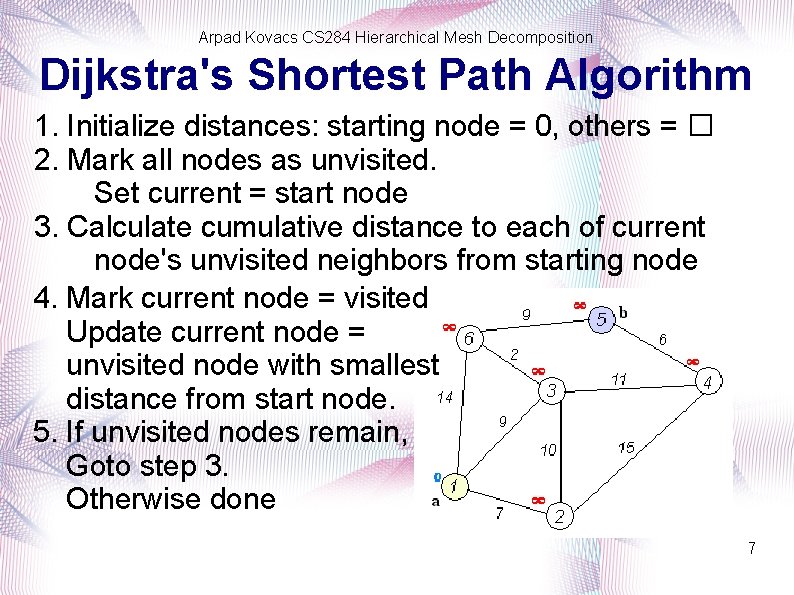
Arpad Kovacs CS 284 Hierarchical Mesh Decomposition Dijkstra's Shortest Path Algorithm 1. Initialize distances: starting node = 0, others = � 2. Mark all nodes as unvisited. Set current = start node 3. Calculate cumulative distance to each of current node's unvisited neighbors from starting node 4. Mark current node = visited Update current node = unvisited node with smallest distance from start node. 5. If unvisited nodes remain, Goto step 3. Otherwise done 7
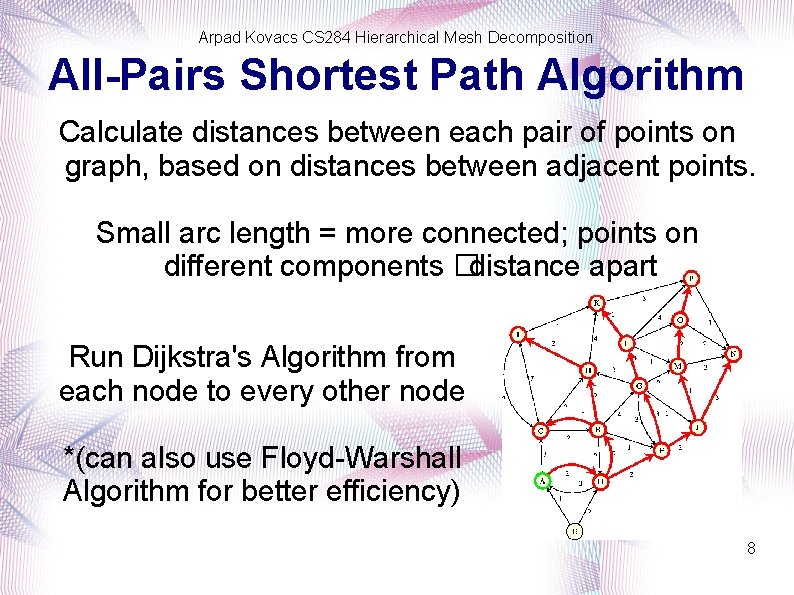
Arpad Kovacs CS 284 Hierarchical Mesh Decomposition All-Pairs Shortest Path Algorithm Calculate distances between each pair of points on graph, based on distances between adjacent points. Small arc length = more connected; points on different components �distance apart Run Dijkstra's Algorithm from each node to every other node *(can also use Floyd-Warshall Algorithm for better efficiency) 8
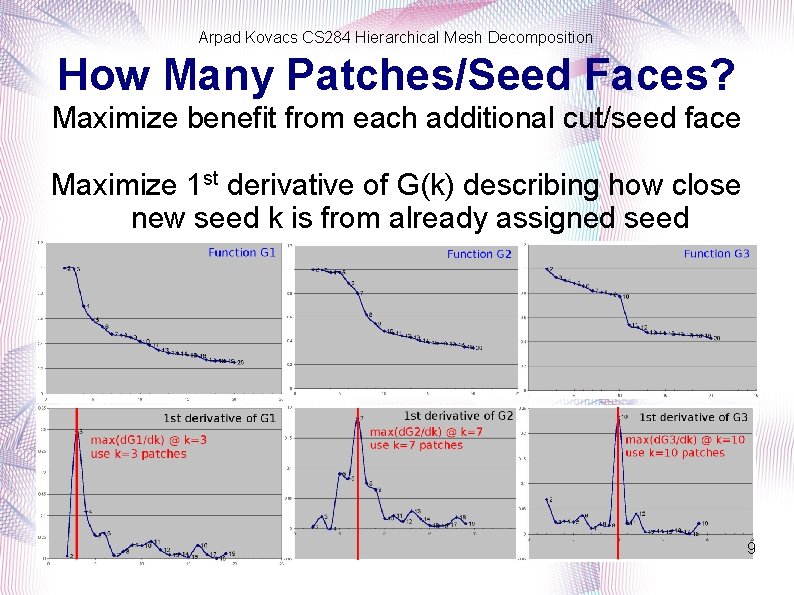
Arpad Kovacs CS 284 Hierarchical Mesh Decomposition How Many Patches/Seed Faces? Maximize benefit from each additional cut/seed face Maximize 1 st derivative of G(k) describing how close new seed k is from already assigned seed 9
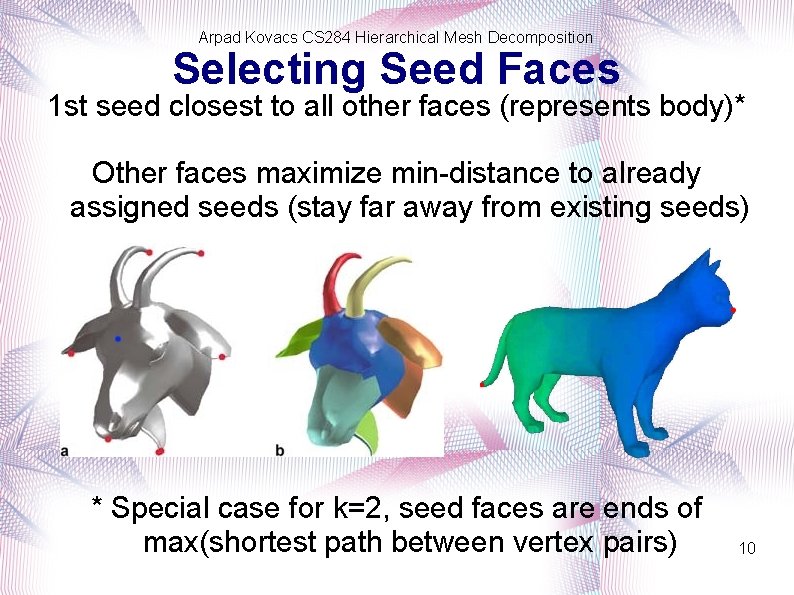
Arpad Kovacs CS 284 Hierarchical Mesh Decomposition Selecting Seed Faces 1 st seed closest to all other faces (represents body)* Other faces maximize min-distance to already assigned seeds (stay far away from existing seeds) * Special case for k=2, seed faces are ends of max(shortest path between vertex pairs) 10
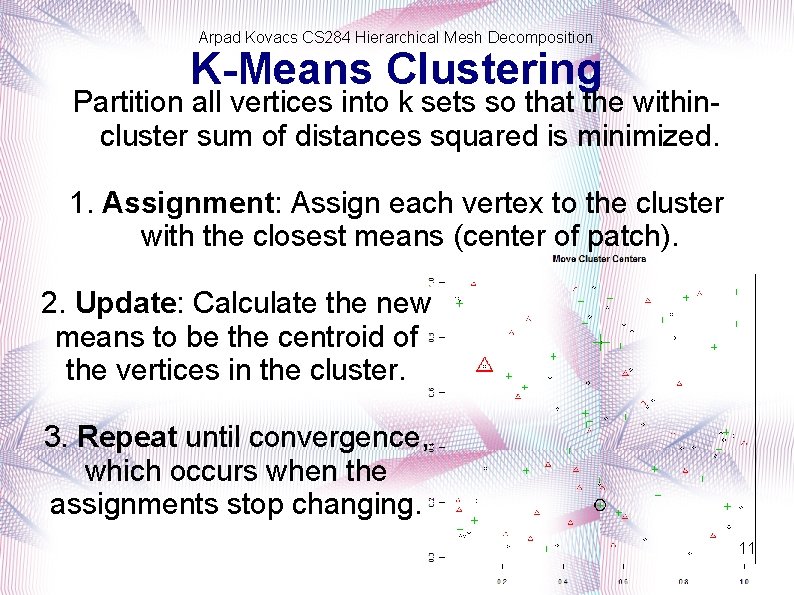
Arpad Kovacs CS 284 Hierarchical Mesh Decomposition K-Means Clustering Partition all vertices into k sets so that the withincluster sum of distances squared is minimized. 1. Assignment: Assign each vertex to the cluster with the closest means (center of patch). 2. Update: Calculate the new means to be the centroid of the vertices in the cluster. 3. Repeat until convergence, which occurs when the assignments stop changing. 11
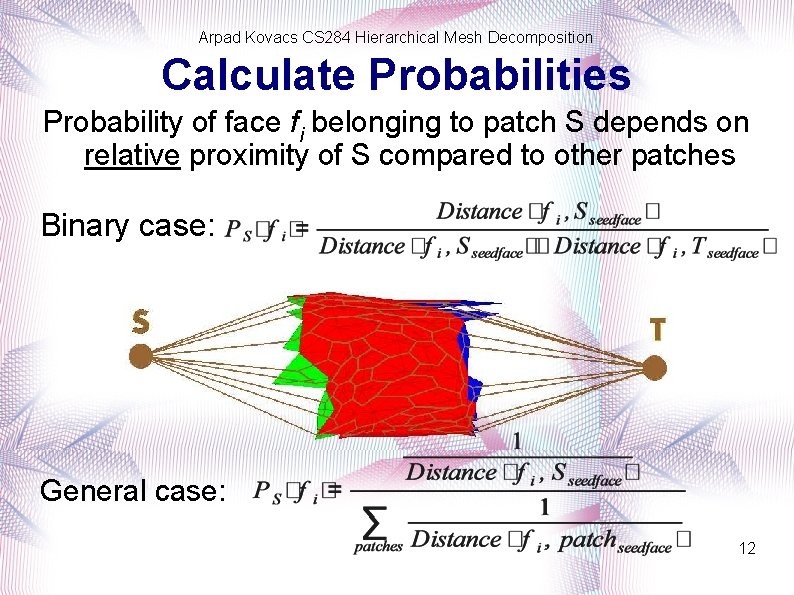
Arpad Kovacs CS 284 Hierarchical Mesh Decomposition Calculate Probabilities Probability of face fi belonging to patch S depends on relative proximity of S compared to other patches Binary case: General case: 12
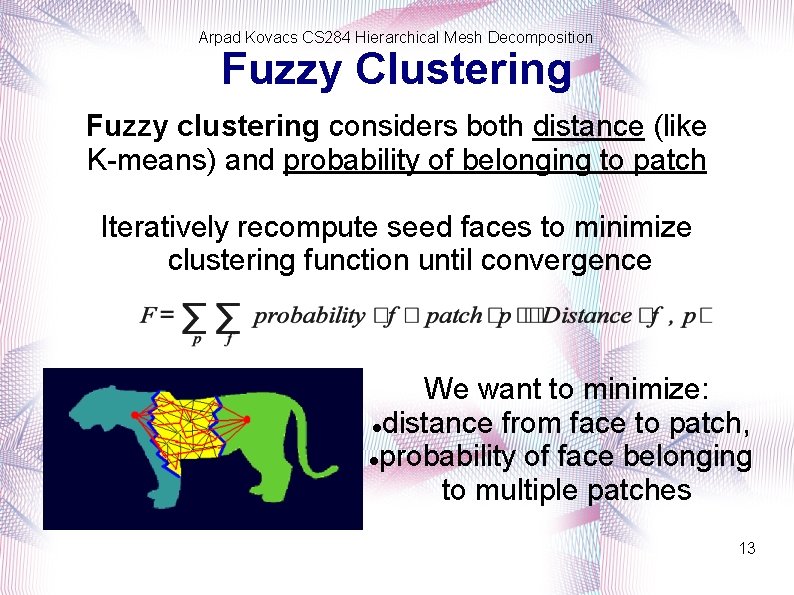
Arpad Kovacs CS 284 Hierarchical Mesh Decomposition Fuzzy Clustering Fuzzy clustering considers both distance (like K-means) and probability of belonging to patch Iteratively recompute seed faces to minimize clustering function until convergence We want to minimize: distance from face to patch, probability of face belonging to multiple patches 13
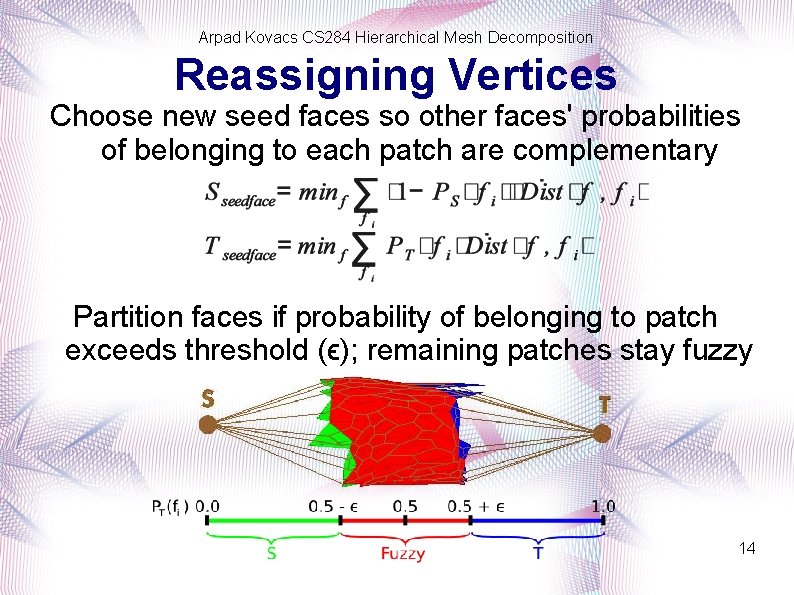
Arpad Kovacs CS 284 Hierarchical Mesh Decomposition Reassigning Vertices Choose new seed faces so other faces' probabilities of belonging to each patch are complementary Partition faces if probability of belonging to patch exceeds threshold (ϵ); remaining patches stay fuzzy 14
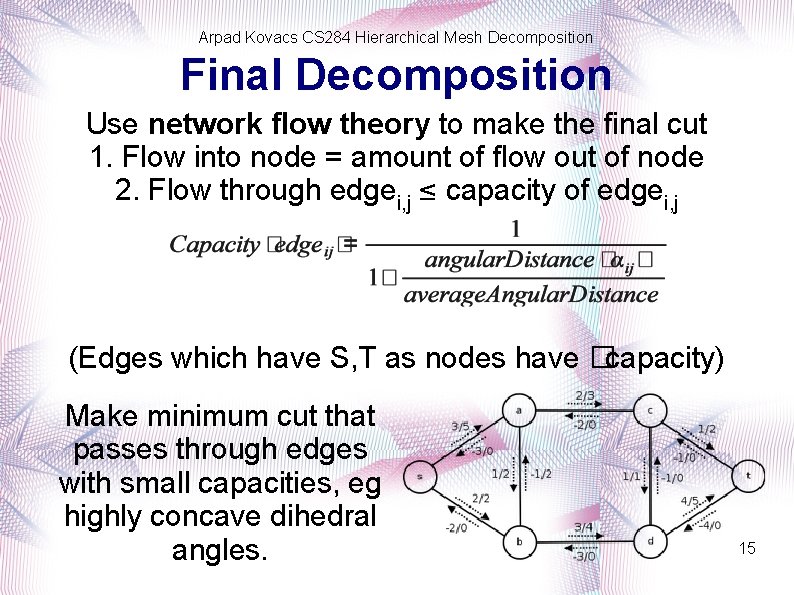
Arpad Kovacs CS 284 Hierarchical Mesh Decomposition Final Decomposition Use network flow theory to make the final cut 1. Flow into node = amount of flow out of node 2. Flow through edgei, j ≤ capacity of edgei, j (Edges which have S, T as nodes have �capacity) Make minimum cut that passes through edges with small capacities, eg highly concave dihedral angles. 15
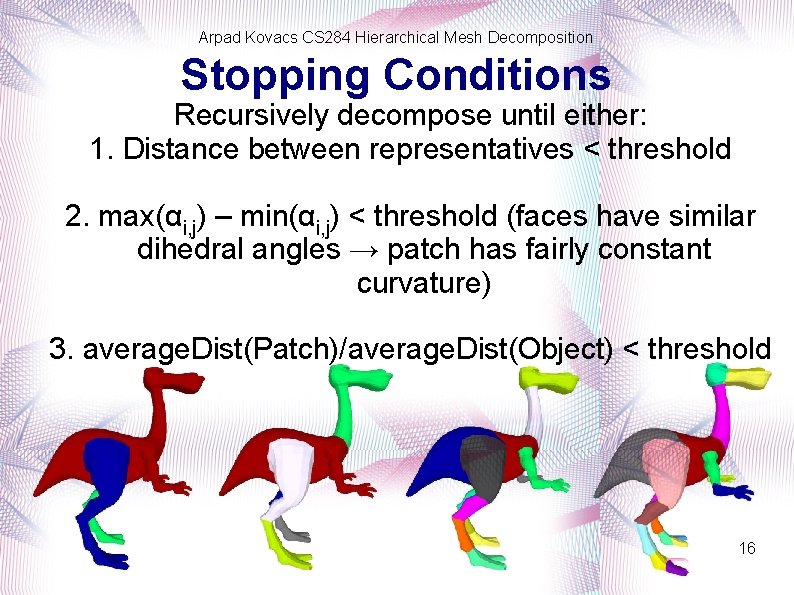
Arpad Kovacs CS 284 Hierarchical Mesh Decomposition Stopping Conditions Recursively decompose until either: 1. Distance between representatives < threshold 2. max(αi, j) – min(αi, j) < threshold (faces have similar dihedral angles → patch has fairly constant curvature) 3. average. Dist(Patch)/average. Dist(Object) < threshold 16
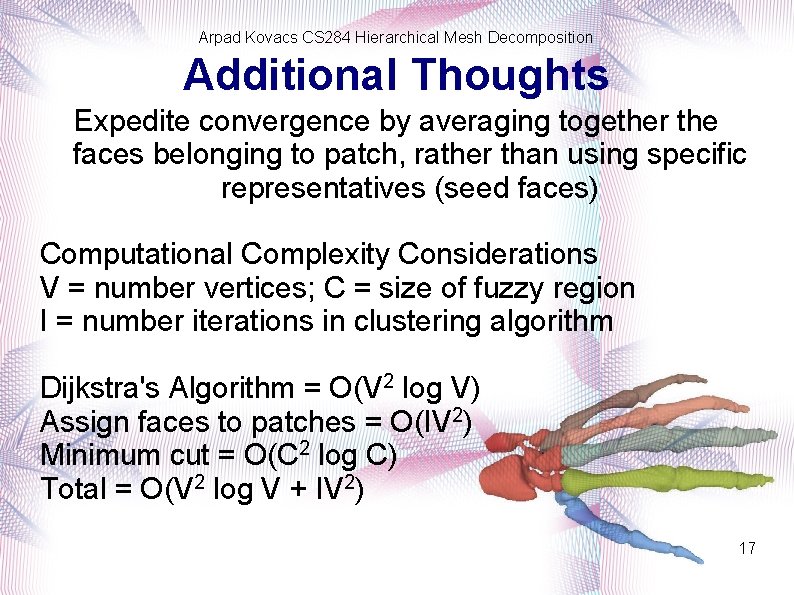
Arpad Kovacs CS 284 Hierarchical Mesh Decomposition Additional Thoughts Expedite convergence by averaging together the faces belonging to patch, rather than using specific representatives (seed faces) Computational Complexity Considerations V = number vertices; C = size of fuzzy region I = number iterations in clustering algorithm Dijkstra's Algorithm = O(V 2 log V) Assign faces to patches = O(IV 2) Minimum cut = O(C 2 log C) Total = O(V 2 log V + IV 2) 17
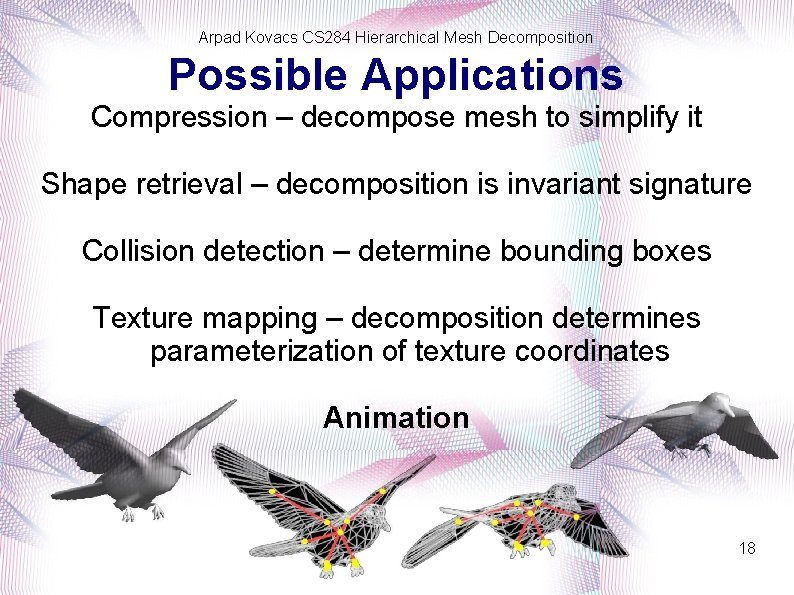
Arpad Kovacs CS 284 Hierarchical Mesh Decomposition Possible Applications Compression – decompose mesh to simplify it Shape retrieval – decomposition is invariant signature Collision detection – determine bounding boxes Texture mapping – decomposition determines parameterization of texture coordinates Animation 18
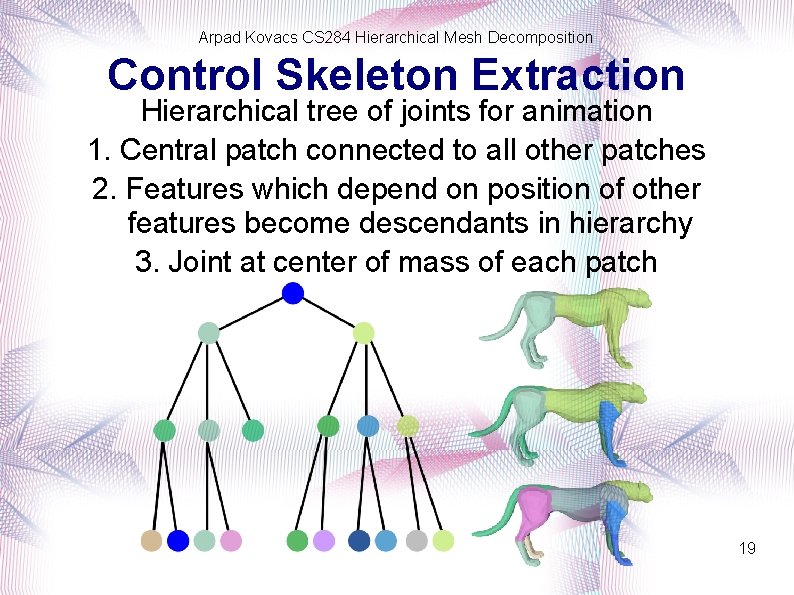
Arpad Kovacs CS 284 Hierarchical Mesh Decomposition Control Skeleton Extraction Hierarchical tree of joints for animation 1. Central patch connected to all other patches 2. Features which depend on position of other features become descendants in hierarchy 3. Joint at center of mass of each patch 19
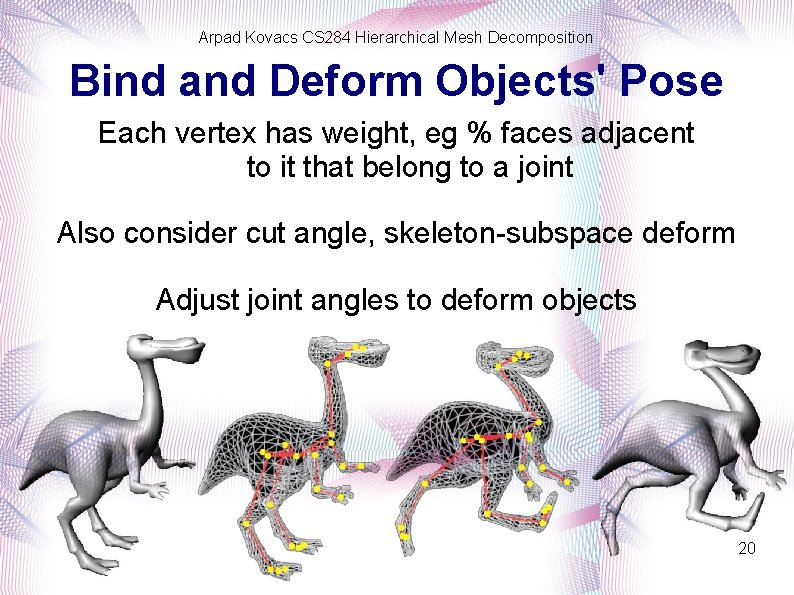
Arpad Kovacs CS 284 Hierarchical Mesh Decomposition Bind and Deform Objects' Pose Each vertex has weight, eg % faces adjacent to it that belong to a joint Also consider cut angle, skeleton-subspace deform Adjust joint angles to deform objects 20
Arpad Kovacs CS 284 Hierarchical Mesh Decomposition Works Cited Images, algorithms, and multimedia material from: Sagi Katz, Ayellet Tal: Hierarchical Mesh Decomposition Using Fuzzy Clustering and Cuts http: //webee. technion. ac. il/~ayellet/Ps/0325_ayt. pdf Attene, Katz, Mortara, Patane, Spagnuolo, Tal Mesh Segmentation – A Comparative Study http: //www. ima. ge. cnr. it/ima/personal/attene/Persona l. Page/pdf/Mesh. Segm_SMI 06. pdf 21