
FeatureAligned TMeshes Ashish Myles Nico Pietroni Denis Kovacs

- Slides: 25
Feature-Aligned T-Meshes Ashish Myles† Nico Pietroni* Denis Kovacs† Denis Zorin† New York University * ISTI, Italian National Research Council †
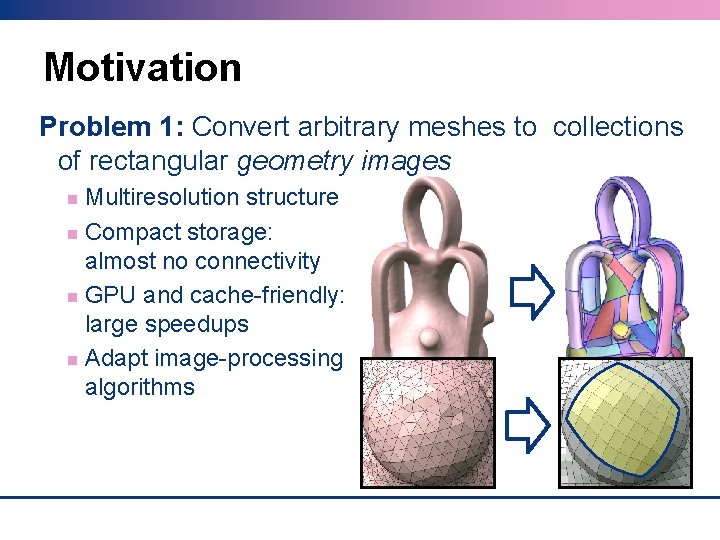
Motivation Problem 1: Convert arbitrary meshes to collections of rectangular geometry images Multiresolution structure Compact storage: almost no connectivity GPU and cache-friendly: large speedups Adapt image-processing algorithms
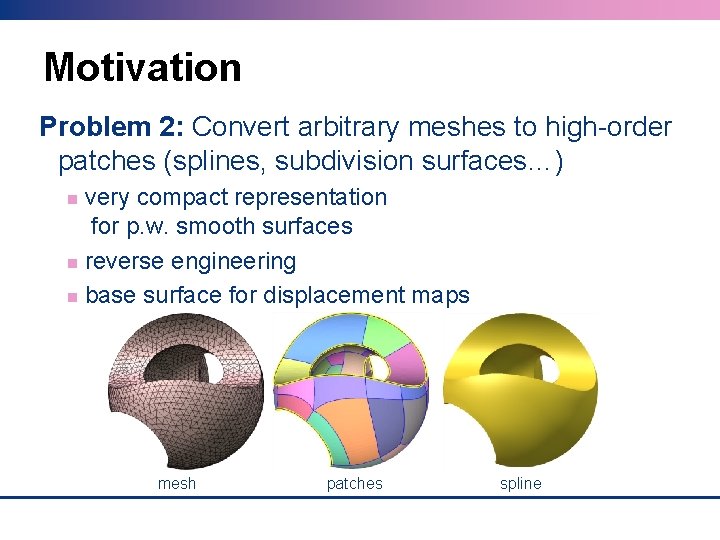
Motivation Problem 2: Convert arbitrary meshes to high-order patches (splines, subdivision surfaces…) very compact representation for p. w. smooth surfaces reverse engineering base surface for displacement maps mesh patches spline
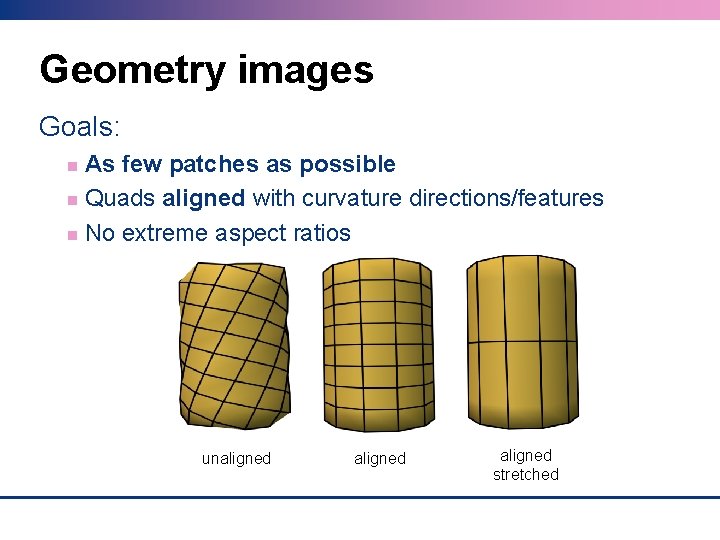
Geometry images Goals: As few patches as possible Quads aligned with curvature directions/features No extreme aspect ratios unaligned stretched
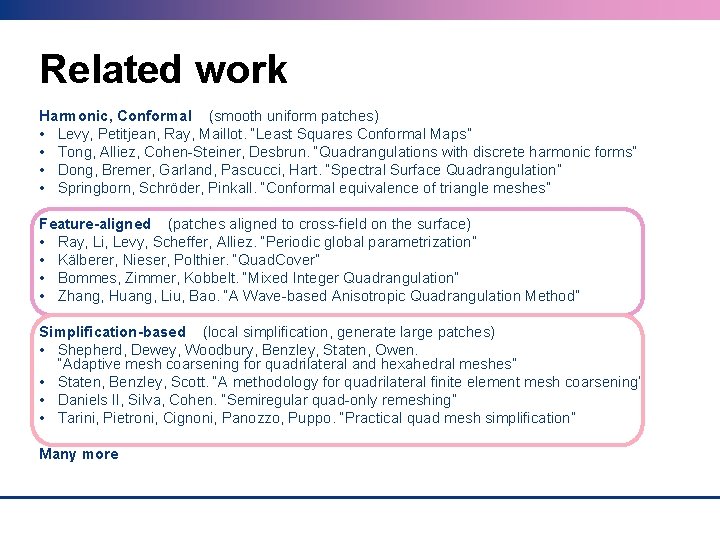
Related work Harmonic, Conformal (smooth uniform patches) • Levy, Petitjean, Ray, Maillot. “Least Squares Conformal Maps” • Tong, Alliez, Cohen-Steiner, Desbrun. “Quadrangulations with discrete harmonic forms” • Dong, Bremer, Garland, Pascucci, Hart. “Spectral Surface Quadrangulation” • Springborn, Schröder, Pinkall. “Conformal equivalence of triangle meshes” Feature-aligned (patches aligned to cross-field on the surface) • Ray, Li, Levy, Scheffer, Alliez. “Periodic global parametrization” • Kälberer, Nieser, Polthier. “Quad. Cover” • Bommes, Zimmer, Kobbelt. “Mixed Integer Quadrangulation” • Zhang, Huang, Liu, Bao. “A Wave-based Anisotropic Quadrangulation Method” Simplification-based (local simplification, generate large patches) • Shepherd, Dewey, Woodbury, Benzley, Staten, Owen. “Adaptive mesh coarsening for quadrilateral and hexahedral meshes” • Staten, Benzley, Scott. “A methodology for quadrilateral finite element mesh coarsening” • Daniels II, Silva, Cohen. “Semiregular quad-only remeshing” • Tarini, Pietroni, Cignoni, Panozzo, Puppo. “Practical quad mesh simplification” Many more
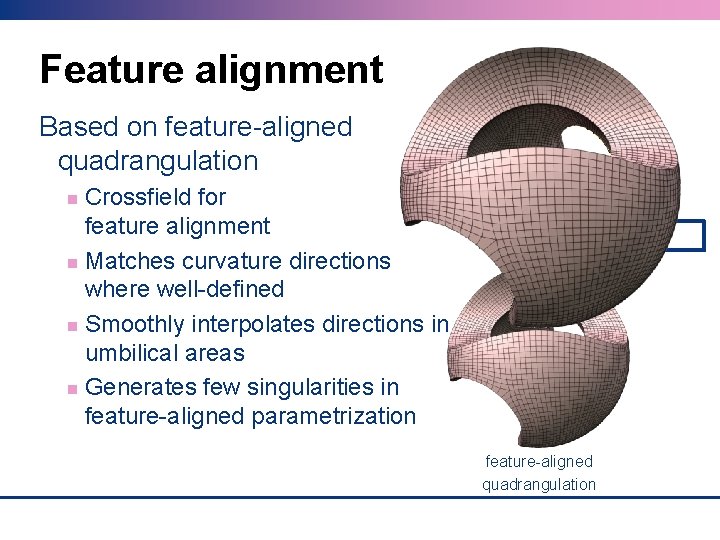
Feature alignment Based on feature-aligned quadrangulation Crossfield for feature alignment Matches curvature directions where well-defined Smoothly interpolates directions in umbilical areas Generates few singularities in feature-aligned parametrization crossfield feature-aligned quadrangulation
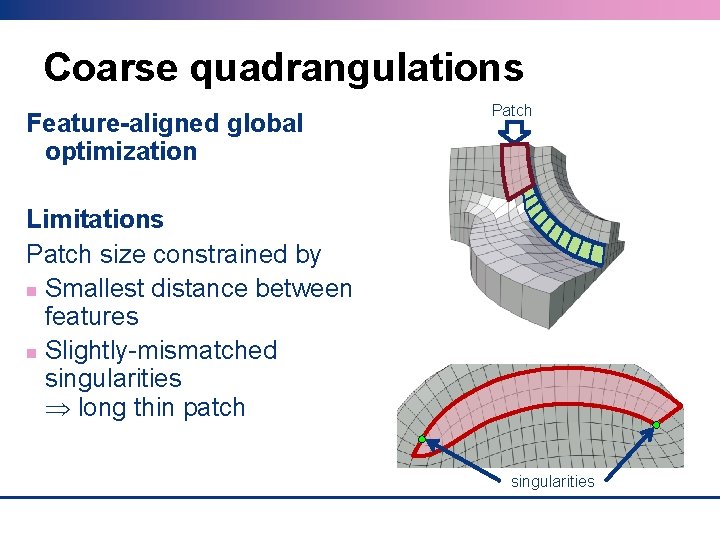
Coarse quadrangulations Feature-aligned global optimization Patch Limitations Patch size constrained by Smallest distance between features Slightly-mismatched singularities long thin patch singularities
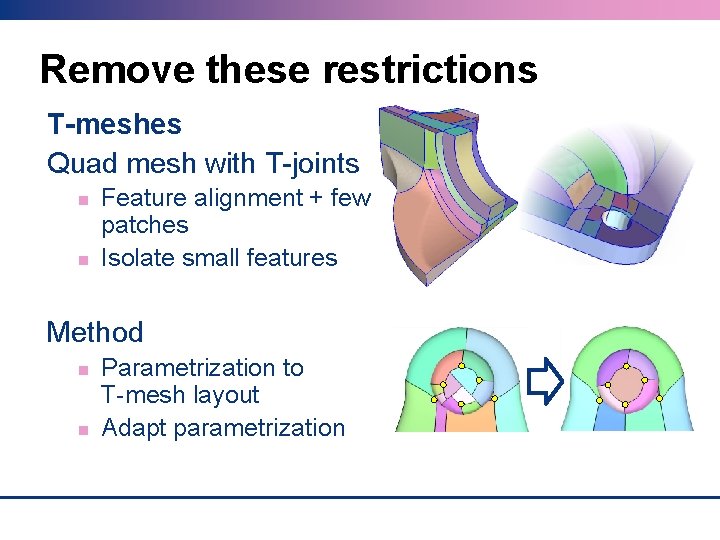
Remove these restrictions T-meshes Quad mesh with T-joints Feature alignment + few patches Isolate small features Method Parametrization to T-mesh layout Adapt parametrization
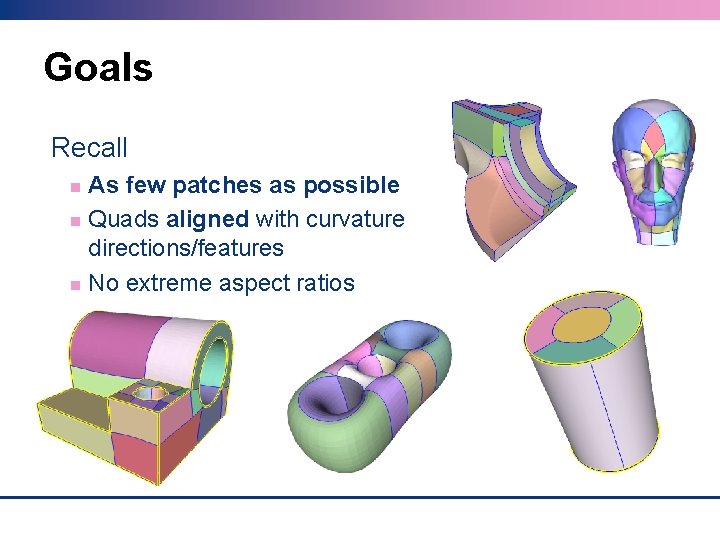
Goals Recall As few patches as possible Quads aligned with curvature directions/features No extreme aspect ratios
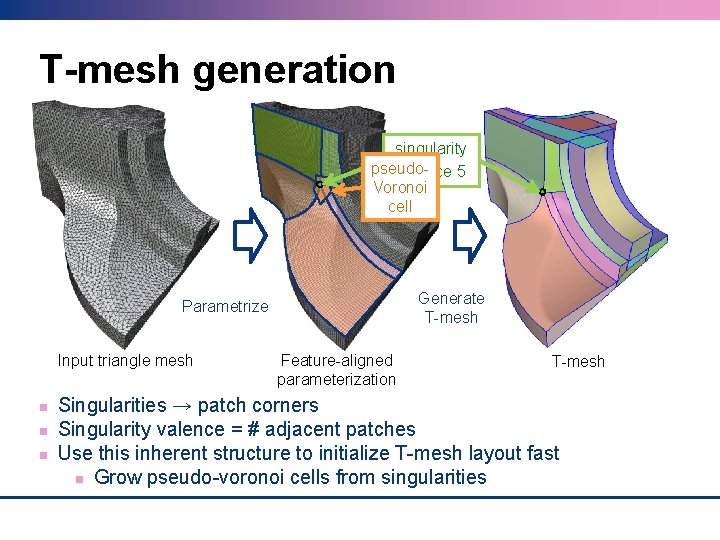
T-mesh generation singularity pseudovalence 5 Voronoi cell Generate T-mesh Parametrize Input triangle mesh Feature-aligned parameterization T-mesh Singularities → patch corners Singularity valence = # adjacent patches Use this inherent structure to initialize T-mesh layout fast Grow pseudo-voronoi cells from singularities
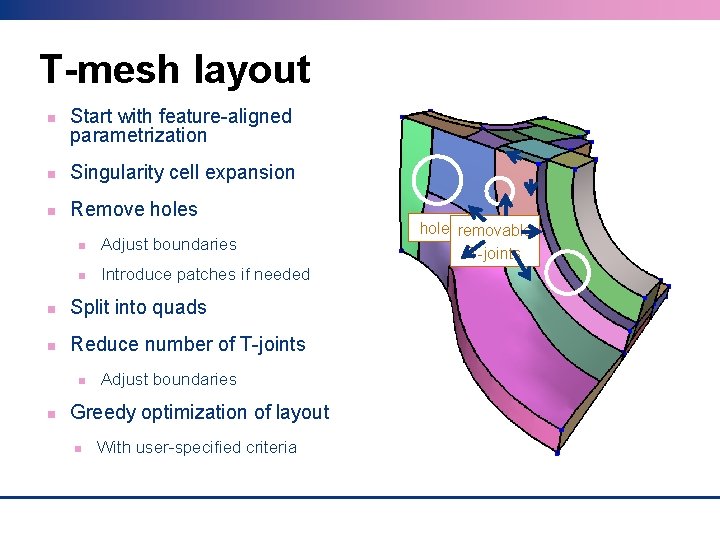
T-mesh layout Start with feature-aligned parametrization Singularity cell expansion Remove holes Adjust boundaries Introduce patches if needed Split into quads Reduce number of T-joints Adjust boundaries Greedy optimization of layout With user-specified criteria holesremovable T-joints
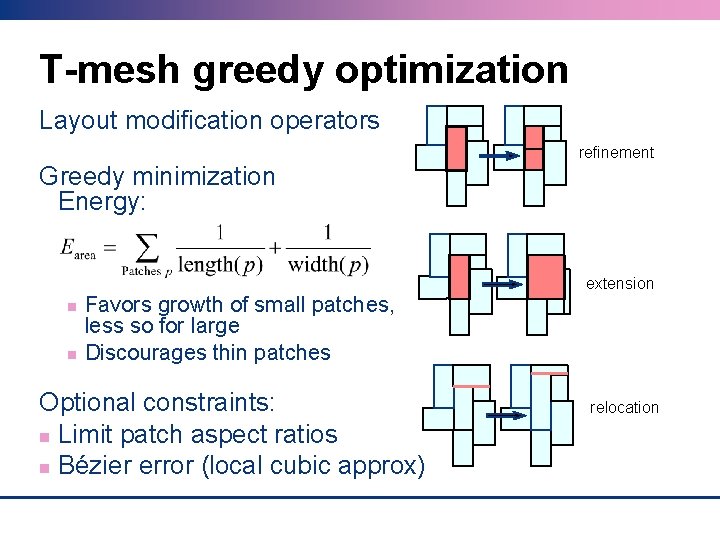
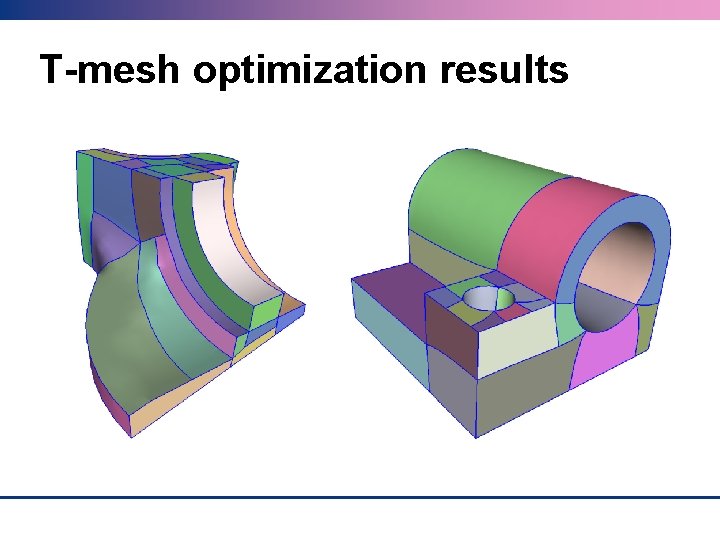
T-mesh greedy optimization Layout modification operators Greedy minimization Energy: Favors growth of small patches, less so for large Discourages thin patches Optional constraints: Limit patch aspect ratios Bézier error (local cubic approx) refinement extension relocation
T-mesh optimization results
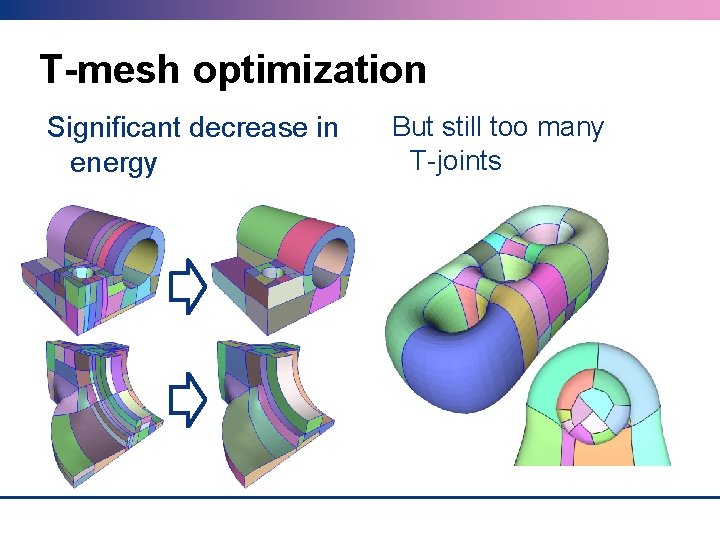
T-mesh optimization Significant decrease in energy But still too many T-joints
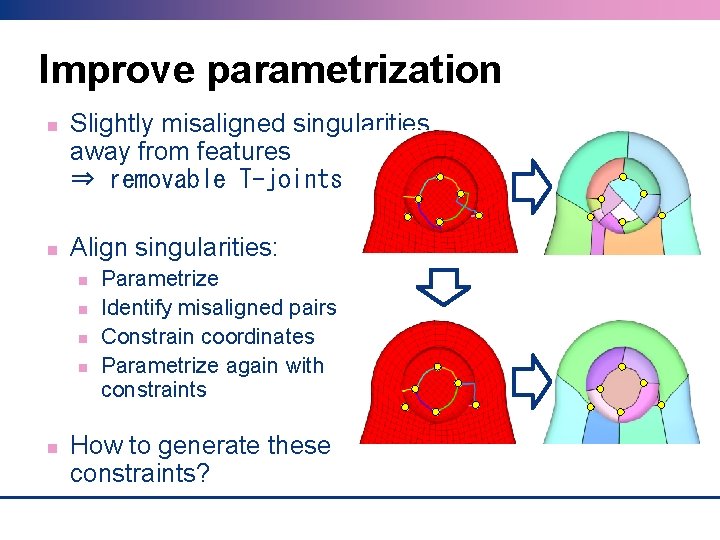
Improve parametrization Slightly misaligned singularities away from features ⇒ removable T-joints Align singularities: Parametrize Identify misaligned pairs Constrain coordinates Parametrize again with constraints How to generate these constraints?
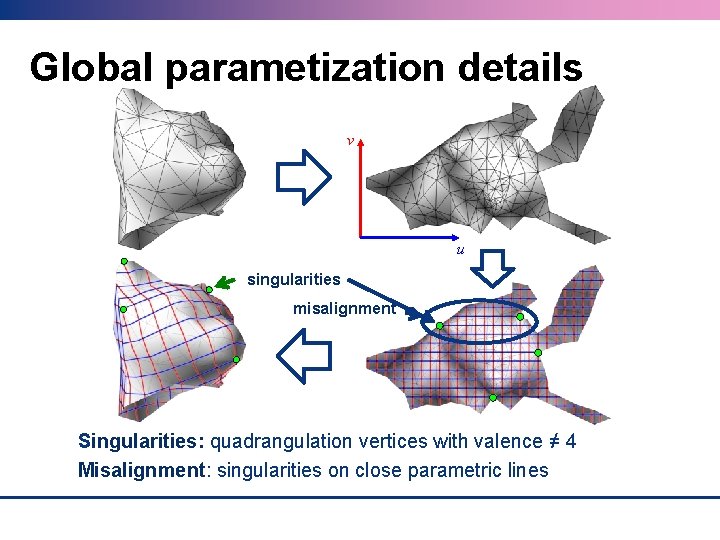
Global parametization details v u singularities misalignment Singularities: quadrangulation vertices with valence ≠ 4 Misalignment: singularities on close parametric lines
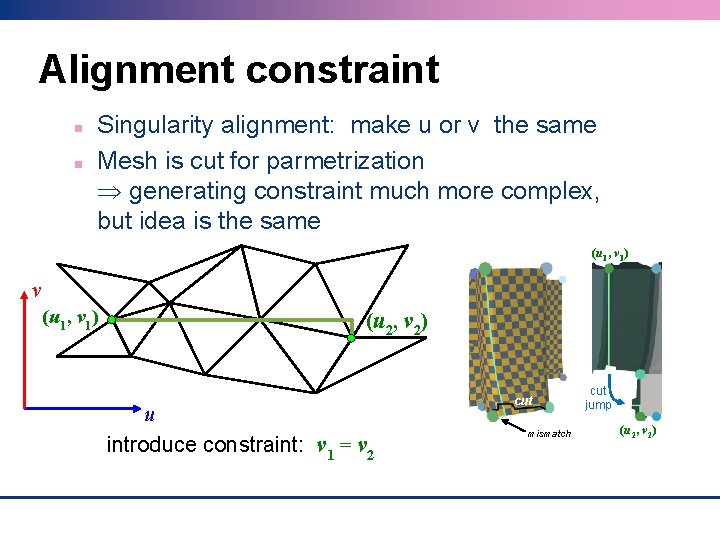
Alignment constraint Singularity alignment: make u or v the same Mesh is cut for parmetrization generating constraint much more complex, but idea is the same (u 1, v 1) v (u 1, v 1) (u 2, v 2) u introduce constraint: v 1 = v 2 cut mismatch cut jump (u 2, v 2)
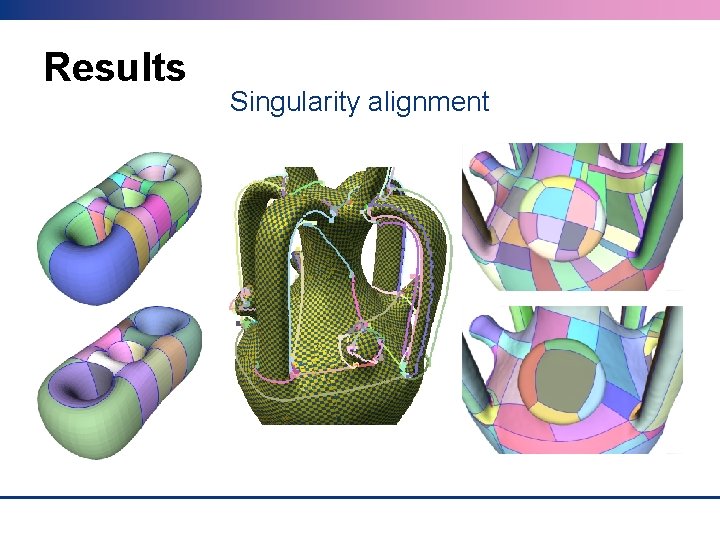
Results Singularity alignment
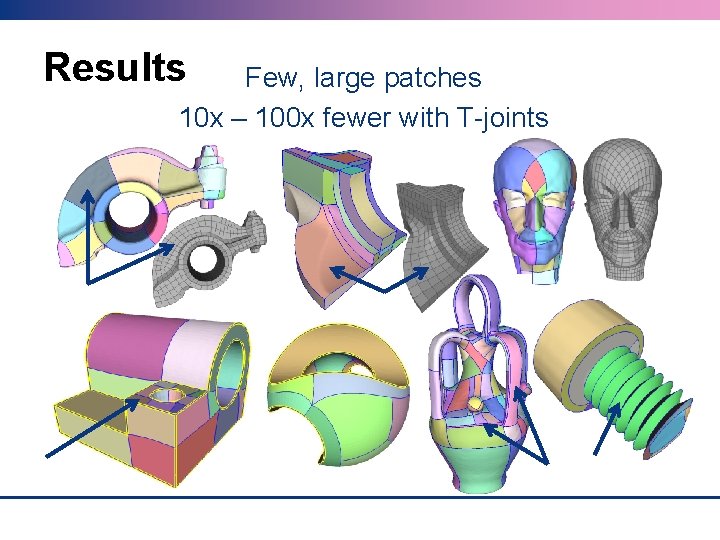
Results Few, large patches 10 x – 100 x fewer with T-joints
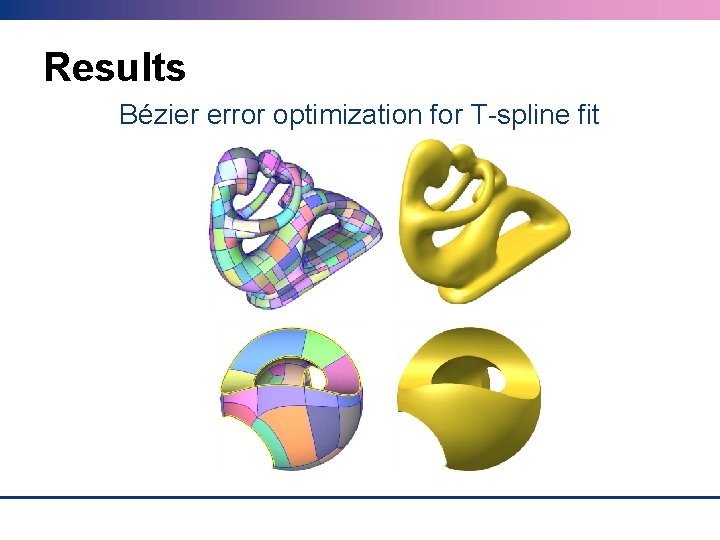
Results Bézier error optimization for T-spline fit
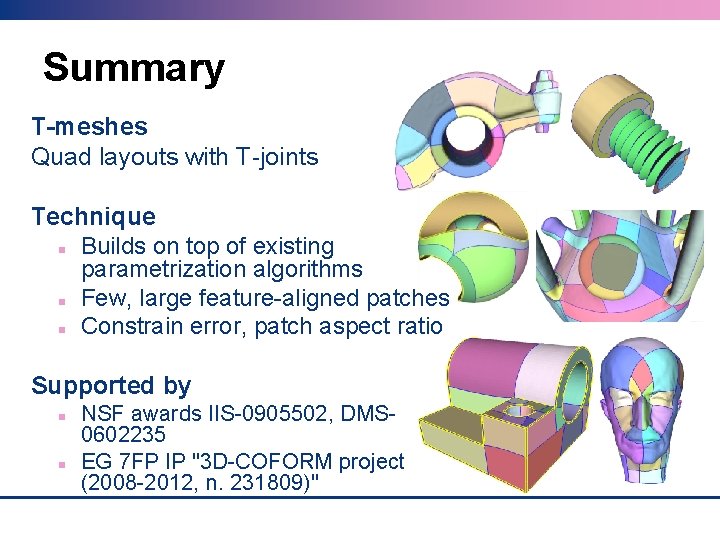
Summary T-meshes Quad layouts with T-joints Technique Builds on top of existing parametrization algorithms Few, large feature-aligned patches Constrain error, patch aspect ratio Supported by NSF awards IIS-0905502, DMS 0602235 EG 7 FP IP "3 D-COFORM project (2008 -2012, n. 231809)"
Thank you
Backup slides
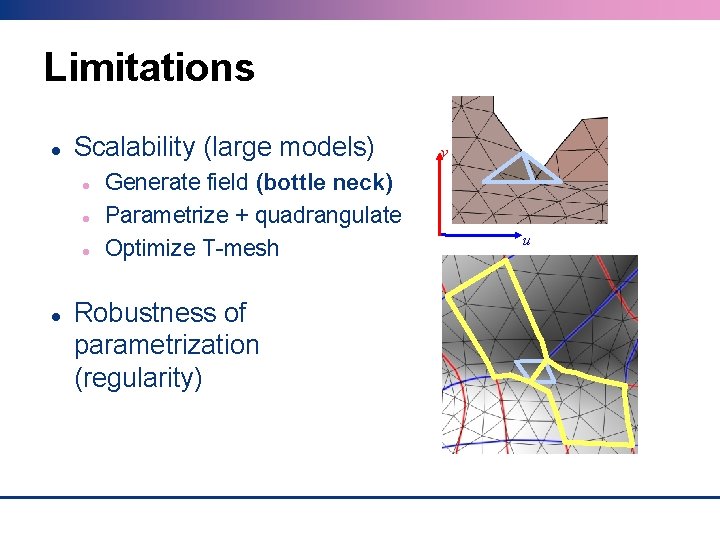
Limitations Scalability (large models) Generate field (bottle neck) Parametrize + quadrangulate Optimize T-mesh Robustness of parametrization (regularity) v u
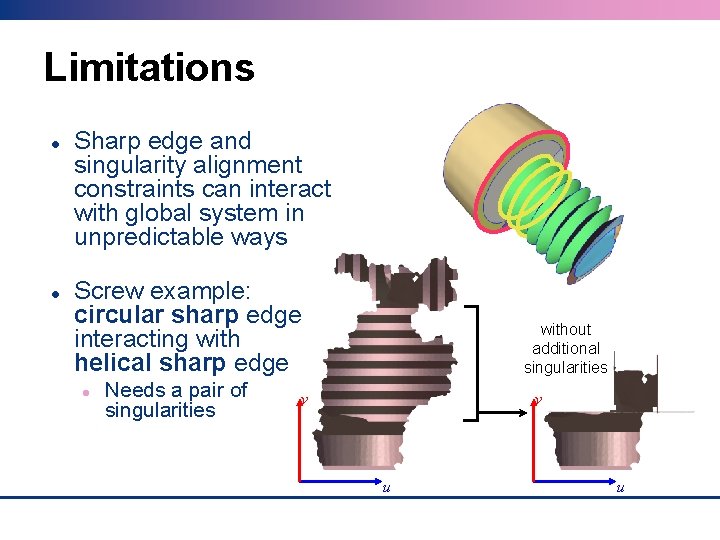
Limitations Sharp edge and singularity alignment constraints can interact with global system in unpredictable ways Screw example: circular sharp edge interacting with helical sharp edge Needs a pair of singularities without additional singularities v v u u