Applications of Domaindomain Interactions in pathways study KaLok



- Slides: 27
Applications of Domain-domain Interactions in pathways study Ka-Lok Ng (吳家樂) Department of Bioinformatics (生資學系) Asia University (亞洲大學)
Content Applications of Domain-domain Interactions in pathways study Motivation Can we determine whether two proteins could possibly interact ? (1) Domain pair combination model to derive putative domain-domain interactions (DDI) (2) Validation with Inter. Dom (3) Prediction service – a web interface (i) reconstruction of protein-protein interaction (PPI) pathways, (ii) regulatory order of PPI (4) System biology approach – Disease regulatory network (work in progress)
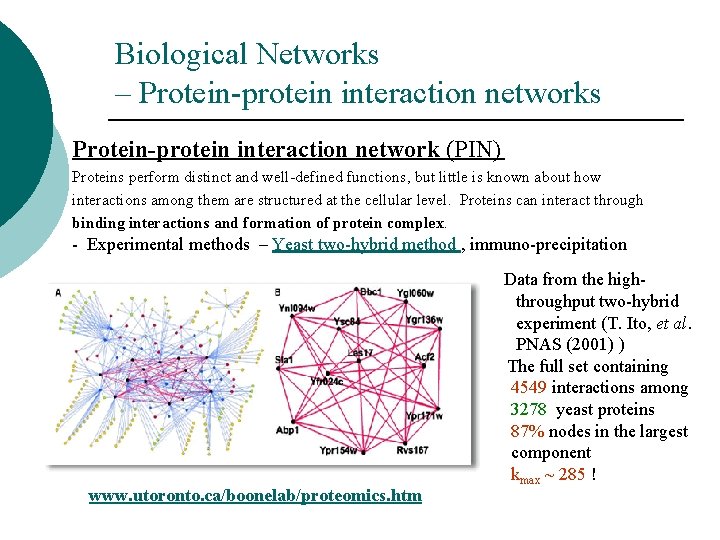
Biological Networks – Protein-protein interaction networks Protein-protein interaction network (PIN) Proteins perform distinct and well-defined functions, but little is known about how interactions among them are structured at the cellular level. Proteins can interact through binding interactions and formation of protein complex. - Experimental methods – Yeast two-hybrid method , immuno-precipitation www. utoronto. ca/boonelab/proteomics. htm Data from the highthroughput two-hybrid experiment (T. Ito, et al. PNAS (2001) ) The full set containing 4549 interactions among 3278 yeast proteins 87% nodes in the largest component kmax ~ 285 !
Large scale prediction of DDI from PPI Motivation Can we determine whether two proteins could possibly interact ? How could we apply the prediction ? Several approaches have been applied to this problem using the following methods: ¡ association method [Deng et al. 2002], ¡ domain pair exclusion analysis [Riley et al. 2005], ¡ integrative approach [Ng et al. 2003], and ¡ domain combination pair approach [Han et al. 2004]
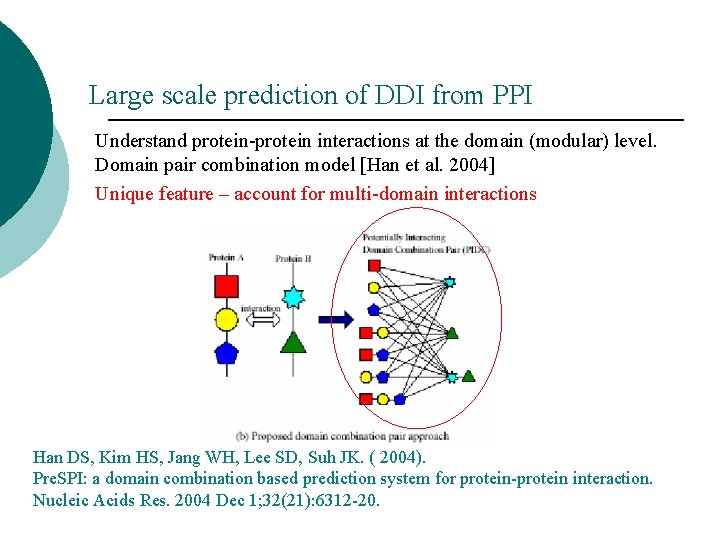
Large scale prediction of DDI from PPI Understand protein-protein interactions at the domain (modular) level. Domain pair combination model [Han et al. 2004] Unique feature – account for multi-domain interactions Han DS, Kim HS, Jang WH, Lee SD, Suh JK. ( 2004). Pre. SPI: a domain combination based prediction system for protein-protein interaction. Nucleic Acids Res. 2004 Dec 1; 32(21): 6312 -20.
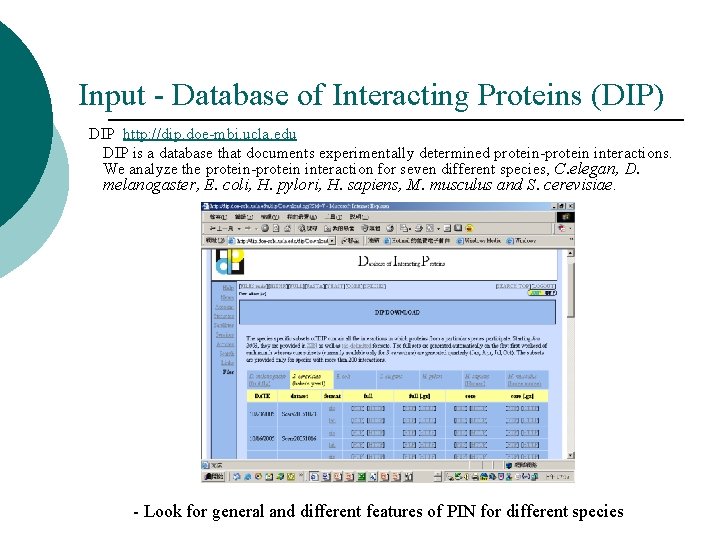
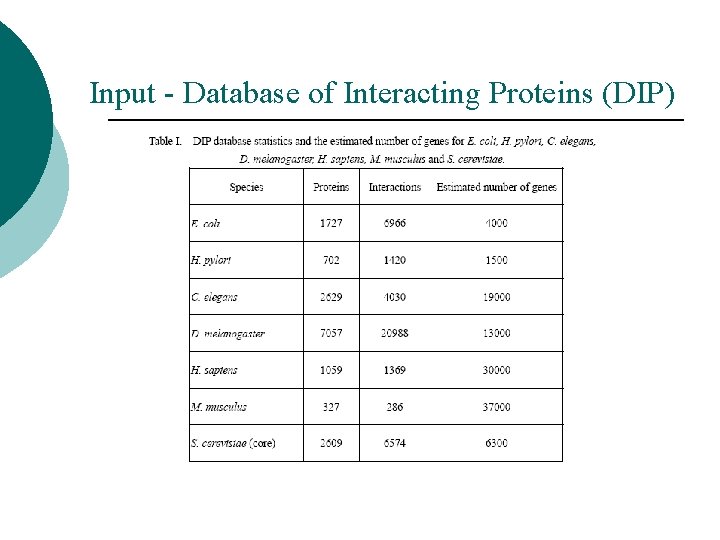
Input - Database of Interacting Proteins (DIP) DIP http: //dip. doe-mbi. ucla. edu DIP is a database that documents experimentally determined protein-protein interactions. We analyze the protein-protein interaction for seven different species, C. elegan, D. melanogaster, E. coli, H. pylori, H. sapiens, M. musculus and S. cerevisiae. - Look for general and different features of PIN for different species
Input - Database of Interacting Proteins (DIP)
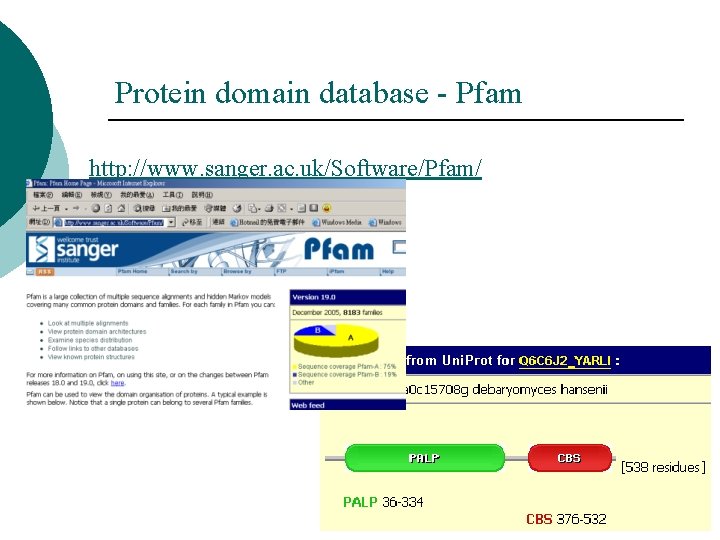
Protein domain database - Pfam http: //www. sanger. ac. uk/Software/Pfam/
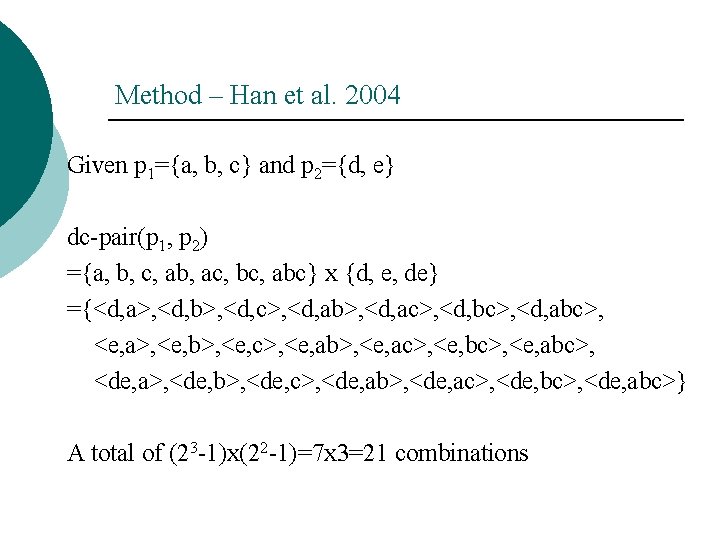
Method – Han et al. 2004 Given p 1={a, b, c} and p 2={d, e} dc-pair(p 1, p 2) ={a, b, c, ab, ac, bc, abc} x {d, e, de} ={<d, a>, <d, b>, <d, c>, <d, ab>, <d, ac>, <d, bc>, <d, abc>, <e, a>, <e, b>, <e, c>, <e, ab>, <e, ac>, <e, bc>, <e, abc>, <de, a>, <de, b>, <de, c>, <de, ab>, <de, ac>, <de, bc>, <de, abc>} A total of (23 -1)x(22 -1)=7 x 3=21 combinations
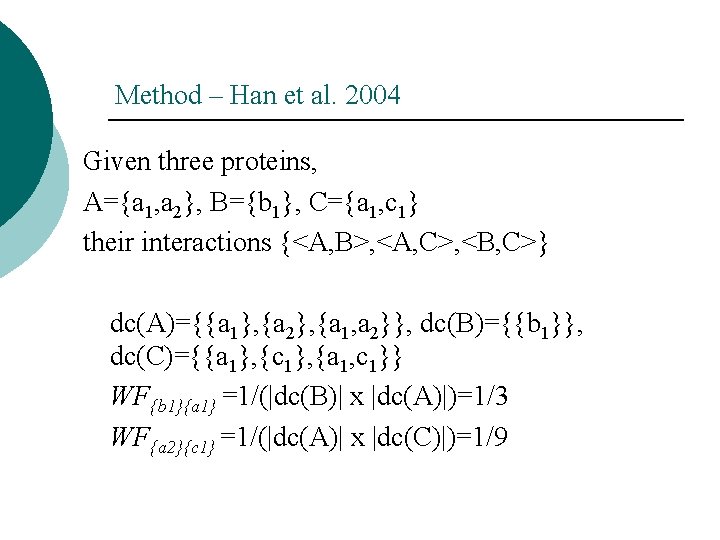
Method – Han et al. 2004 Given three proteins, A={a 1, a 2}, B={b 1}, C={a 1, c 1} their interactions {<A, B>, <A, C>, <B, C>} dc(A)={{a 1}, {a 2}, {a 1, a 2}}, dc(B)={{b 1}}, dc(C)={{a 1}, {c 1}, {a 1, c 1}} WF{b 1}{a 1} =1/(|dc(B)| x |dc(A)|)=1/3 WF{a 2}{c 1} =1/(|dc(A)| x |dc(C)|)=1/9
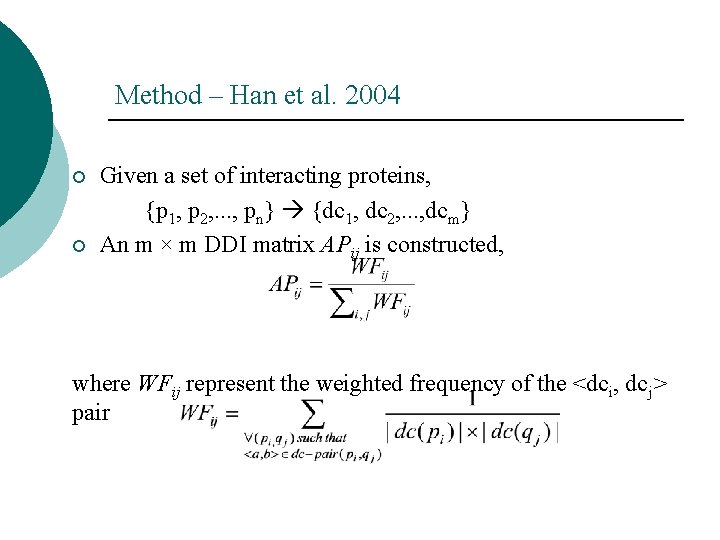
Method – Han et al. 2004 ¡ ¡ Given a set of interacting proteins, {p 1, p 2, . . . , pn} {dc 1, dc 2, . . . , dcm} An m × m DDI matrix APij is constructed, where WFij represent the weighted frequency of the <dci, dcj> pair
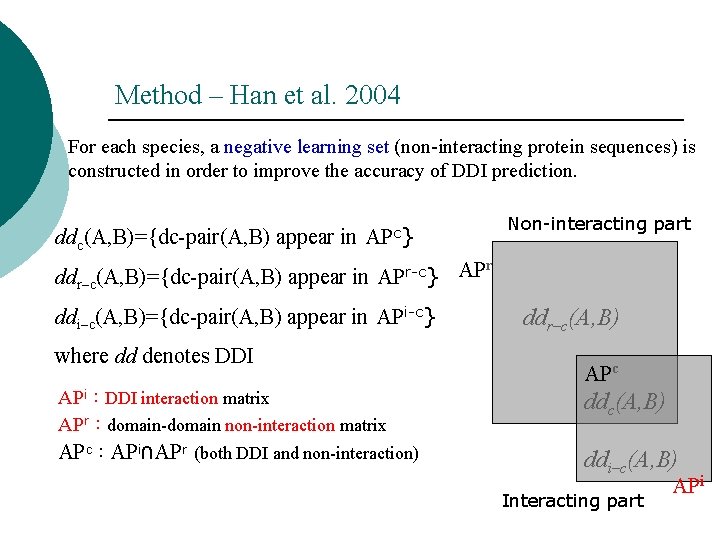
Method – Han et al. 2004 For each species, a negative learning set (non-interacting protein sequences) is constructed in order to improve the accuracy of DDI prediction. ddc(A, B)={dc-pair(A, B) appear in APc} Non-interacting part r ddr–c(A, B)={dc-pair(A, B) appear in APr-c} AP ddi–c(A, B)={dc-pair(A, B) appear in APi-c} where dd denotes DDI ddr–c(A, B) APc APi:DDI interaction matrix APr:domain-domain non-interaction matrix ddc(A, B) APc:APi∩APr (both DDI and non-interaction) ddi–c(A, B) Interacting part APi
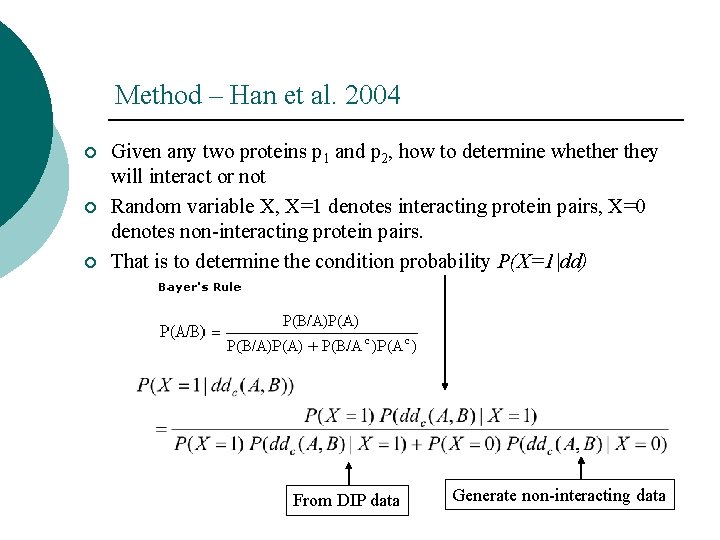
Method – Han et al. 2004 ¡ ¡ ¡ Given any two proteins p 1 and p 2, how to determine whether they will interact or not Random variable X, X=1 denotes interacting protein pairs, X=0 denotes non-interacting protein pairs. That is to determine the condition probability P(X=1|dd) From DIP data Generate non-interacting data
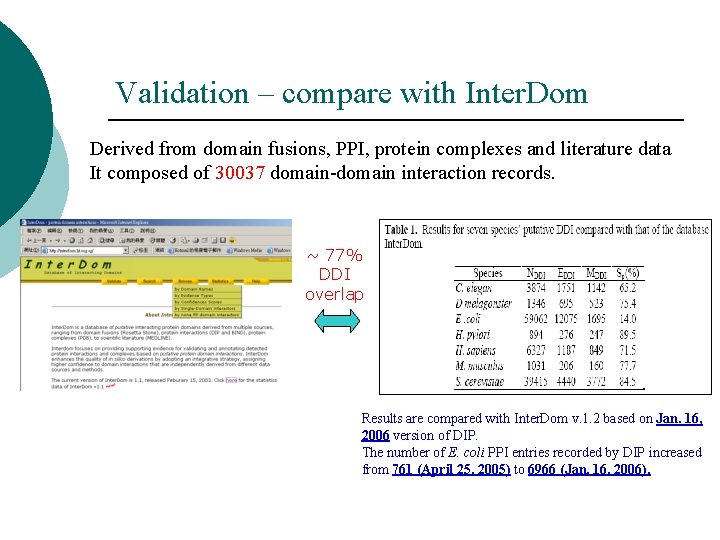
Validation – compare with Inter. Dom Derived from domain fusions, PPI, protein complexes and literature data It composed of 30037 domain-domain interaction records. ~ 77% DDI overlap Results are compared with Inter. Dom v. 1. 2 based on Jan. 16, 2006 version of DIP. The number of E. coli PPI entries recorded by DIP increased from 761 (April 25, 2005) to 6966 (Jan. 16, 2006).
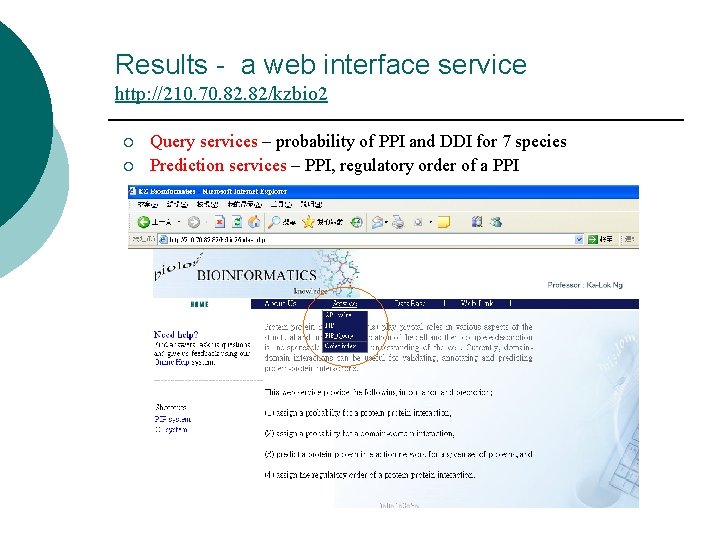
Results - a web interface service http: //210. 70. 82/kzbio 2 ¡ ¡ Query services – probability of PPI and DDI for 7 species Prediction services – PPI, regulatory order of a PPI
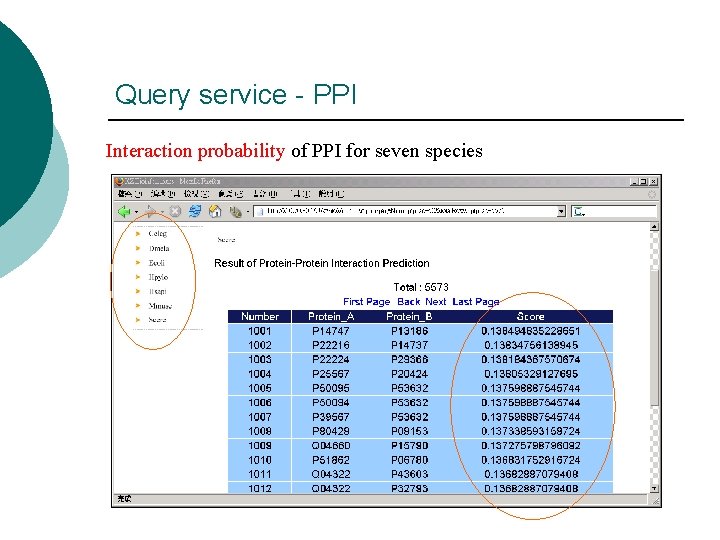
Query service - PPI Interaction probability of PPI for seven species
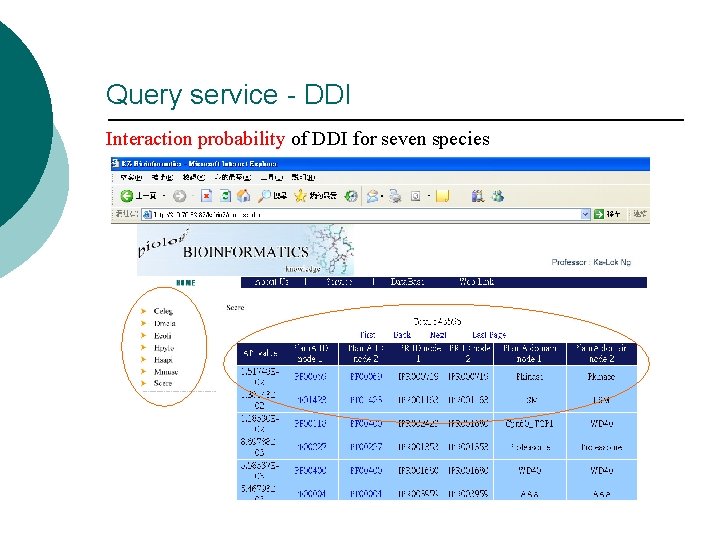
Query service - DDI Interaction probability of DDI for seven species
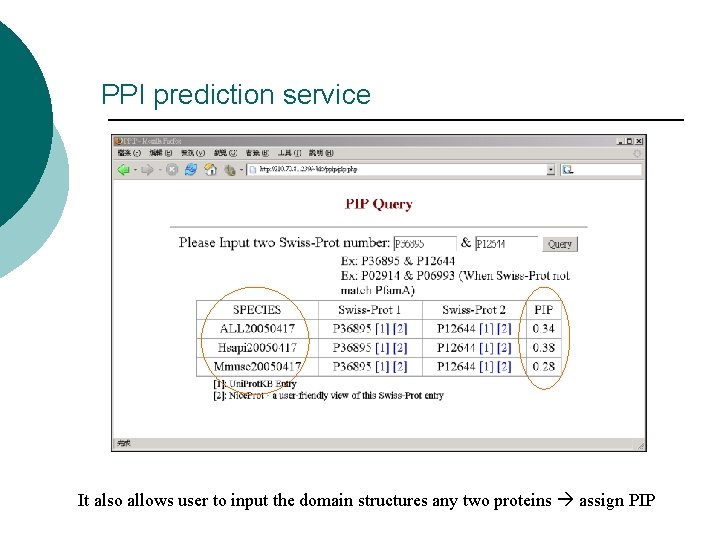
PPI prediction service It also allows user to input the domain structures any two proteins assign PIP
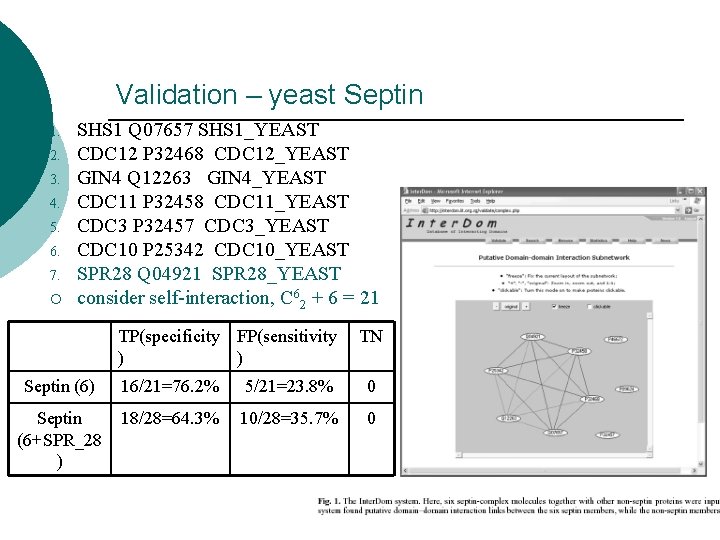
Validation – yeast Septin 1. 2. 3. 4. 5. 6. 7. ¡ SHS 1 Q 07657 SHS 1_YEAST CDC 12 P 32468 CDC 12_YEAST GIN 4 Q 12263 GIN 4_YEAST CDC 11 P 32458 CDC 11_YEAST CDC 3 P 32457 CDC 3_YEAST CDC 10 P 25342 CDC 10_YEAST SPR 28 Q 04921 SPR 28_YEAST consider self-interaction, C 62 + 6 = 21 TP(specificity FP(sensitivity ) ) TN Septin (6) 16/21=76. 2% 5/21=23. 8% 0 Septin (6+SPR_28 ) 18/28=64. 3% 10/28=35. 7% 0
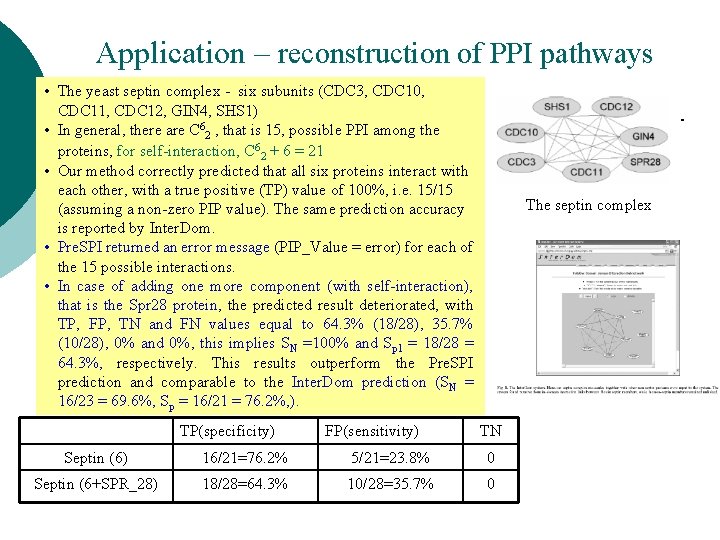
Application – reconstruction of PPI pathways • The yeast septin complex - six subunits (CDC 3, CDC 10, CDC 11, CDC 12, GIN 4, SHS 1) • In general, there are C 62 , that is 15, possible PPI among the proteins, for self-interaction, C 62 + 6 = 21 • Our method correctly predicted that all six proteins interact with each other, with a true positive (TP) value of 100%, i. e. 15/15 (assuming a non-zero PIP value). The same prediction accuracy is reported by Inter. Dom. • Pre. SPI returned an error message (PIP_Value = error) for each of the 15 possible interactions. • In case of adding one more component (with self-interaction), that is the Spr 28 protein, the predicted result deteriorated, with TP, FP, TN and FN values equal to 64. 3% (18/28), 35. 7% (10/28), 0% and 0%, this implies SN =100% and Sp 1 = 18/28 = 64. 3%, respectively. This results outperform the Pre. SPI prediction and comparable to the Inter. Dom prediction (SN = 16/23 = 69. 6%, Sp = 16/21 = 76. 2%, ). TP(specificity) FP(sensitivity) The septin complex TN Septin (6) 16/21=76. 2% 5/21=23. 8% 0 Septin (6+SPR_28) 18/28=64. 3% 10/28=35. 7% 0
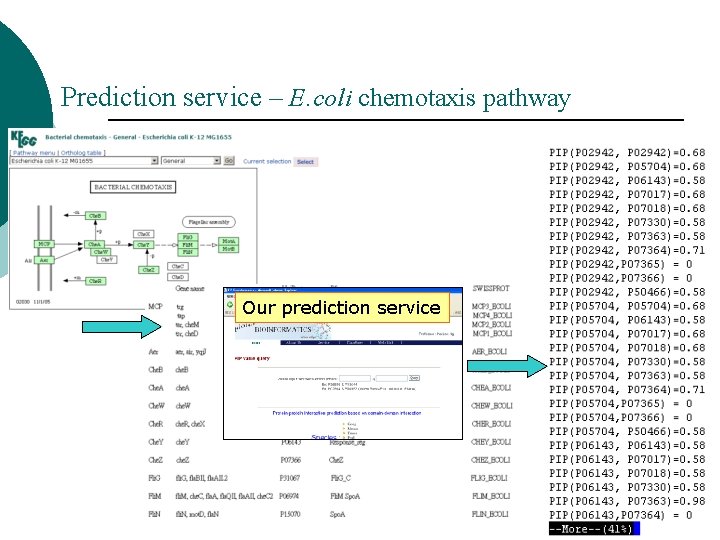
Prediction service – E. coli chemotaxis pathway Our prediction service
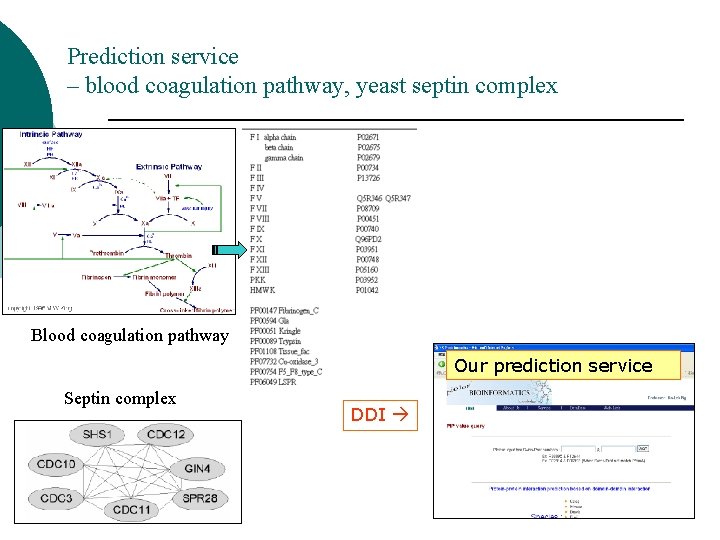
Prediction service – blood coagulation pathway, yeast septin complex Blood coagulation pathway Our prediction service Septin complex DDI
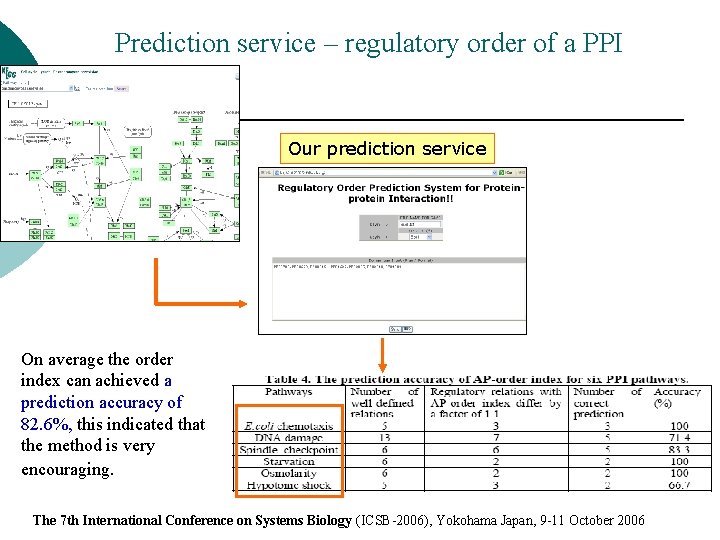
Prediction service – regulatory order of a PPI Our prediction service On average the order index can achieved a prediction accuracy of 82. 6%, this indicated that the method is very encouraging. The 7 th International Conference on Systems Biology (ICSB-2006), Yokohama Japan, 9 -11 October 2006
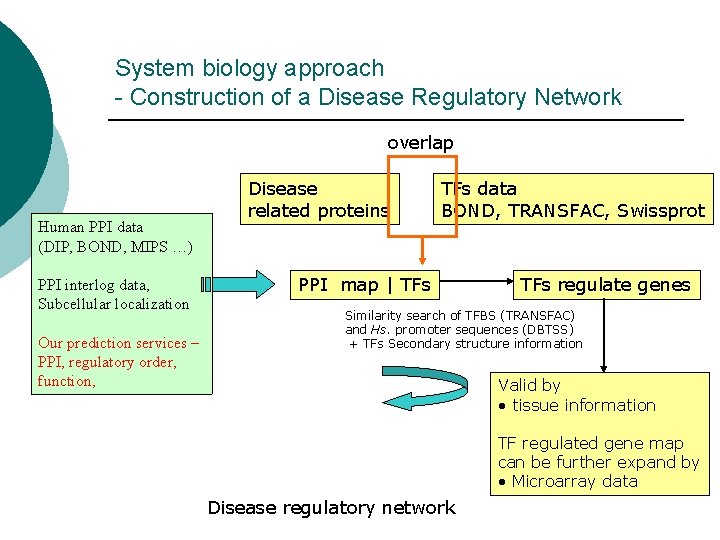
System biology approach - Construction of a Disease Regulatory Network overlap Human PPI data (DIP, BOND, MIPS …) PPI interlog data, Subcellular localization Our prediction services – PPI, regulatory order, function, Disease related proteins TFs data BOND, TRANSFAC, Swissprot PPI map | TFs regulate genes Similarity search of TFBS (TRANSFAC) and Hs. promoter sequences (DBTSS) + TFs Secondary structure information Valid by • tissue information TF regulated gene map can be further expand by • Microarray data Disease regulatory network
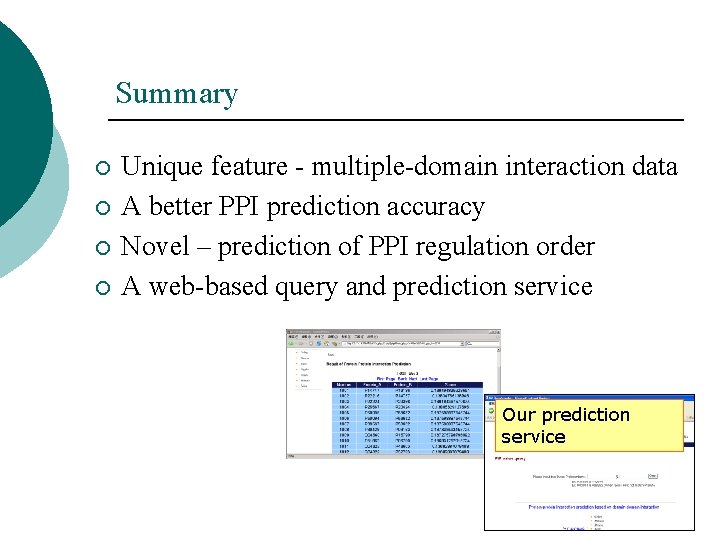
Summary ¡ ¡ Unique feature - multiple-domain interaction data A better PPI prediction accuracy Novel – prediction of PPI regulation order A web-based query and prediction service Our prediction service
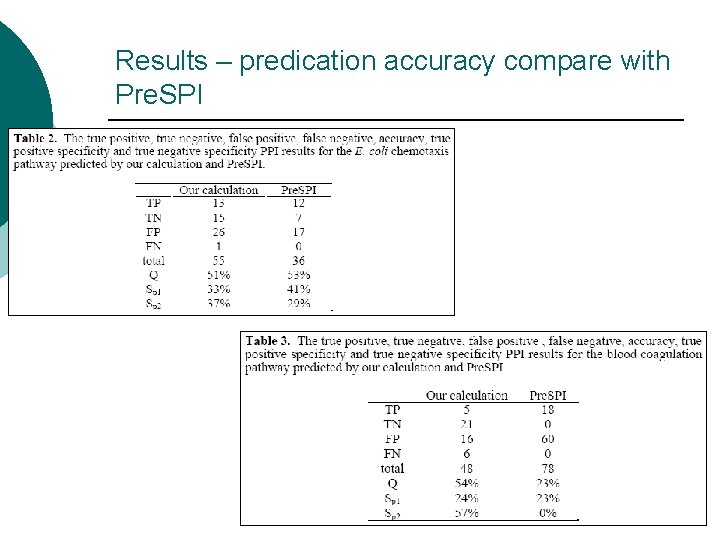
Results – predication accuracy compare with Pre. SPI