APPLICATIONS OF DEXMEDETOMIDINE IN PEDIATRIC PROCEDURAL SEDATION John


- Slides: 43
APPLICATIONS OF DEXMEDETOMIDINE IN PEDIATRIC PROCEDURAL SEDATION John Berkenbosch, MD Director, University Children’s Sedation Service Associate Professor Pediatrics/Pediatric Critical Care University of Louisville john. berkenbosch@louisville. edu
GOALS • Understand the pharmacology, physiology, and clinical properties of dexmedetomidine • Review clinical experience with dexmedetomidine for pediatric procedural sedation • Adverse Events/Safety Profile • Coadministrations • Alternative administration methods • Discuss practical issues related to use
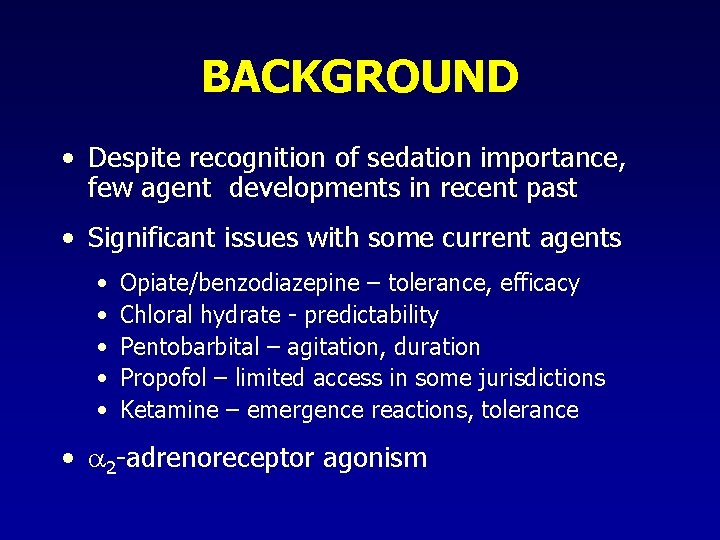
BACKGROUND • Despite recognition of sedation importance, few agent developments in recent past • Significant issues with some current agents • • • Opiate/benzodiazepine – tolerance, efficacy Chloral hydrate - predictability Pentobarbital – agitation, duration Propofol – limited access in some jurisdictions Ketamine – emergence reactions, tolerance • 2 -adrenoreceptor agonism
BACKGROUND 2 RECPTOR AGONISTS • Prototype agent is clonidine • More recent applications in clinical practice • • Sedation Behavior disorders (ADHD) Drug withdrawal Hypertension • Problem – hypotension, oral = slow • Solution – 2 nd generation - 2 specificity
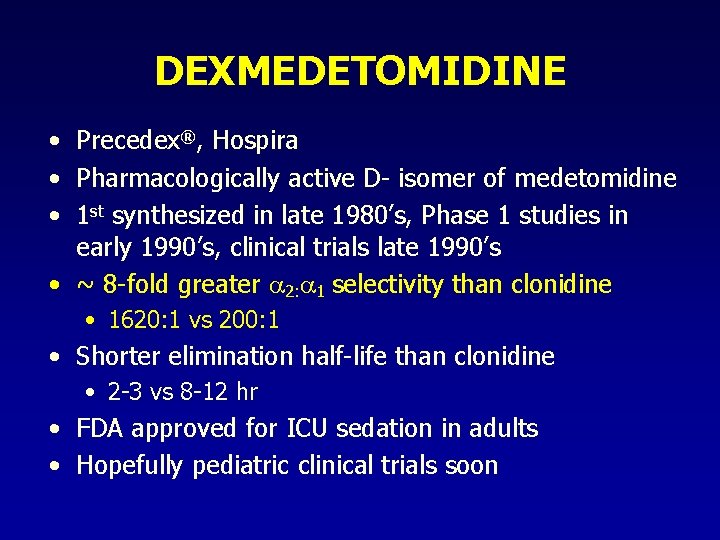
DEXMEDETOMIDINE • Precedex®, Hospira • Pharmacologically active D- isomer of medetomidine • 1 st synthesized in late 1980’s, Phase 1 studies in early 1990’s, clinical trials late 1990’s • ~ 8 -fold greater 2: 1 selectivity than clonidine • 1620: 1 vs 200: 1 • Shorter elimination half-life than clonidine • 2 -3 vs 8 -12 hr • FDA approved for ICU sedation in adults • Hopefully pediatric clinical trials soon
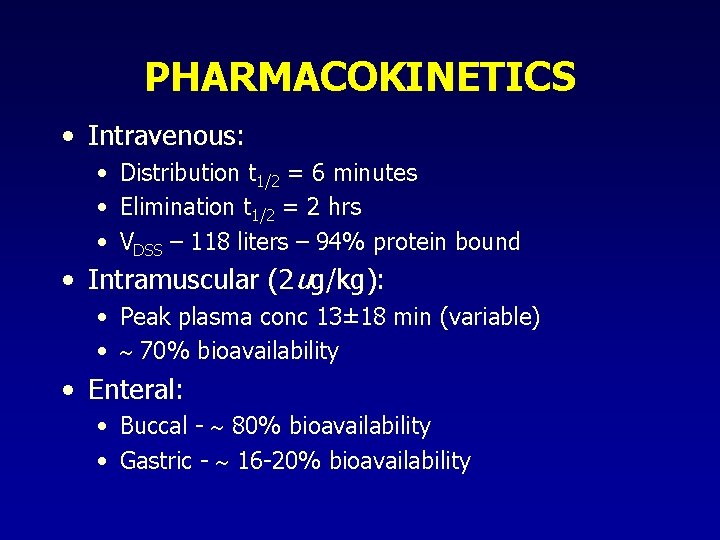
PHARMACOKINETICS • Intravenous: • Distribution t 1/2 = 6 minutes • Elimination t 1/2 = 2 hrs • VDSS – 118 liters – 94% protein bound • Intramuscular (2 ug/kg): • Peak plasma conc 13± 18 min (variable) • 70% bioavailability • Enteral: • Buccal - 80% bioavailability • Gastric - 16 -20% bioavailability
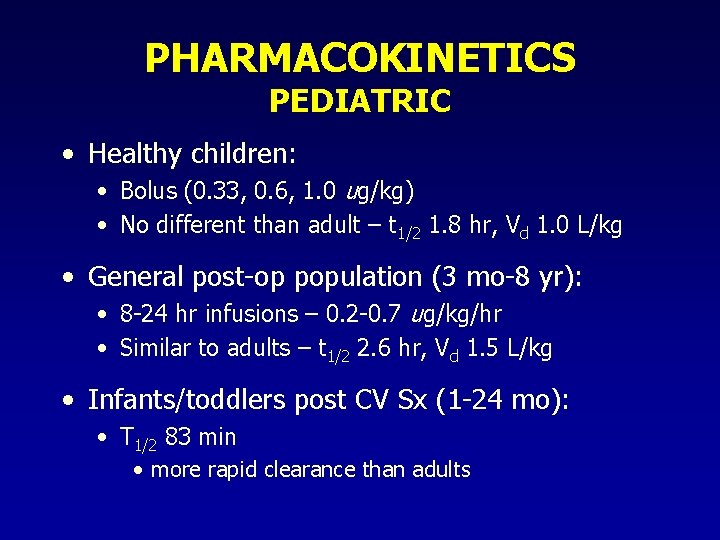
PHARMACOKINETICS PEDIATRIC • Healthy children: • Bolus (0. 33, 0. 6, 1. 0 ug/kg) • No different than adult – t 1/2 1. 8 hr, Vd 1. 0 L/kg • General post-op population (3 mo-8 yr): • 8 -24 hr infusions – 0. 2 -0. 7 ug/kg/hr • Similar to adults – t 1/2 2. 6 hr, Vd 1. 5 L/kg • Infants/toddlers post CV Sx (1 -24 mo): • T 1/2 83 min • more rapid clearance than adults
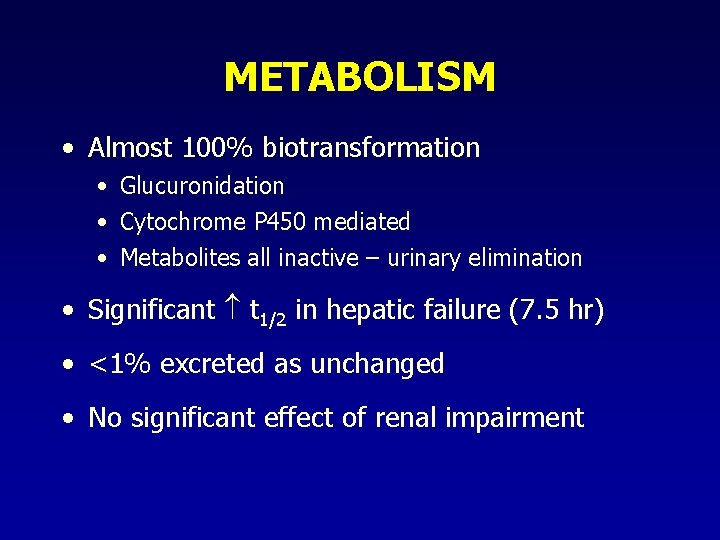
METABOLISM • Almost 100% biotransformation • Glucuronidation • Cytochrome P 450 mediated • Metabolites all inactive – urinary elimination • Significant t 1/2 in hepatic failure (7. 5 hr) • <1% excreted as unchanged • No significant effect of renal impairment
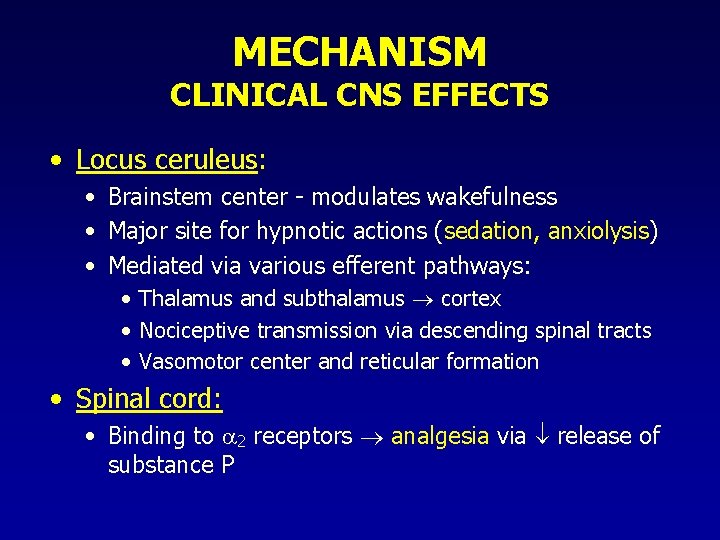
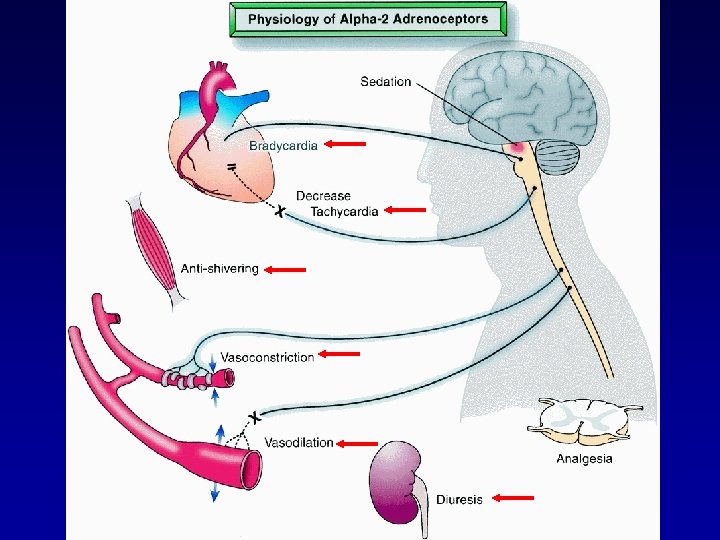
MECHANISM CLINICAL CNS EFFECTS • Locus ceruleus: • Brainstem center - modulates wakefulness • Major site for hypnotic actions (sedation, anxiolysis) • Mediated via various efferent pathways: • Thalamus and subthalamus cortex • Nociceptive transmission via descending spinal tracts • Vasomotor center and reticular formation • Spinal cord: • Binding to 2 receptors analgesia via release of substance P
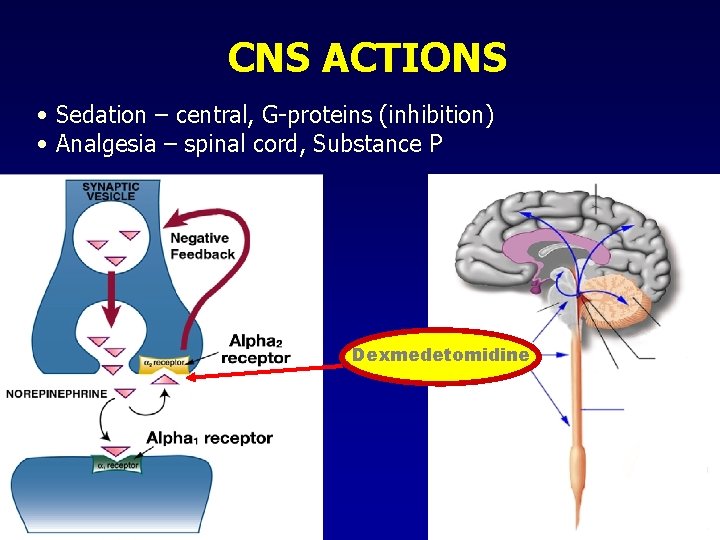
CNS ACTIONS • Sedation – central, G-proteins (inhibition) • Analgesia – spinal cord, Substance P Dexmedetomidine
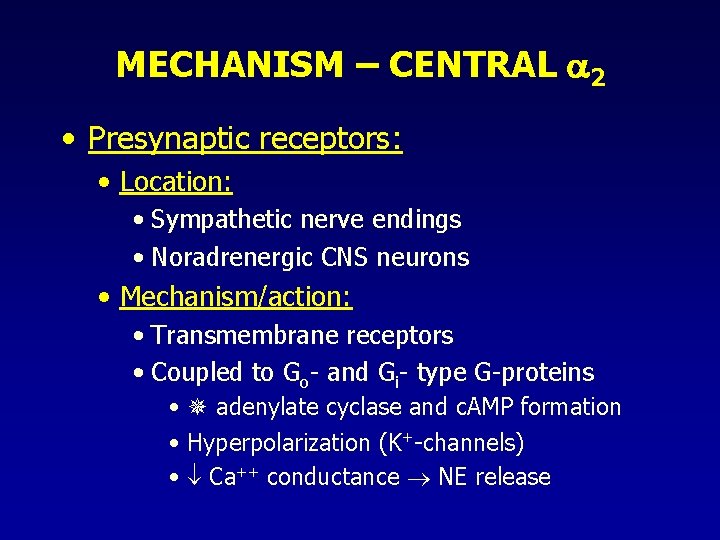
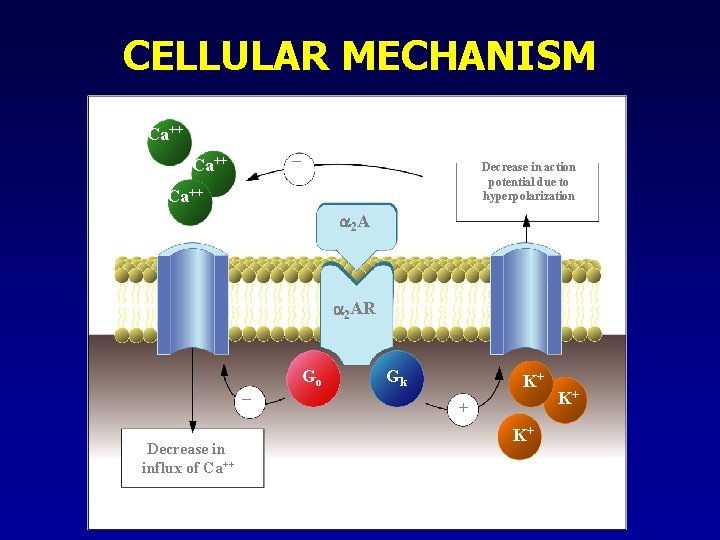
MECHANISM – CENTRAL 2 • Presynaptic receptors: • Location: • Sympathetic nerve endings • Noradrenergic CNS neurons • Mechanism/action: • Transmembrane receptors • Coupled to Go- and Gi- type G-proteins • adenylate cyclase and c. AMP formation • Hyperpolarization (K+-channels) • Ca++ conductance NE release
CELLULAR MECHANISM Ca++ – Ca++ Decrease in action potential due to hyperpolarization Ca++ 2 A 2 AR – Decrease in influx of Ca++ Go Gk K+ + K+ K+
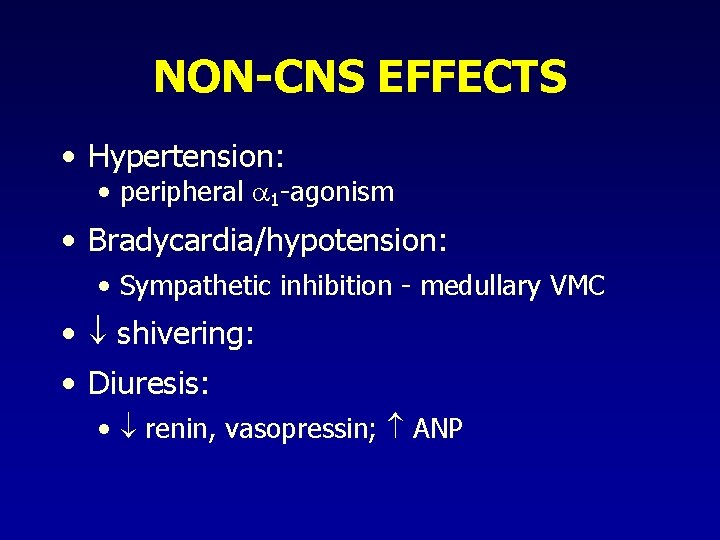
NON-CNS EFFECTS • Hypertension: • peripheral 1 -agonism • Bradycardia/hypotension: • Sympathetic inhibition - medullary VMC • shivering: • Diuresis: • renin, vasopressin; ANP
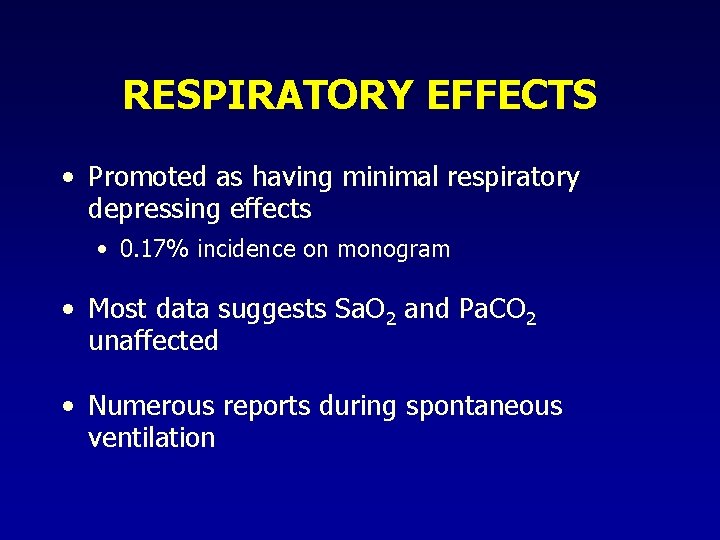
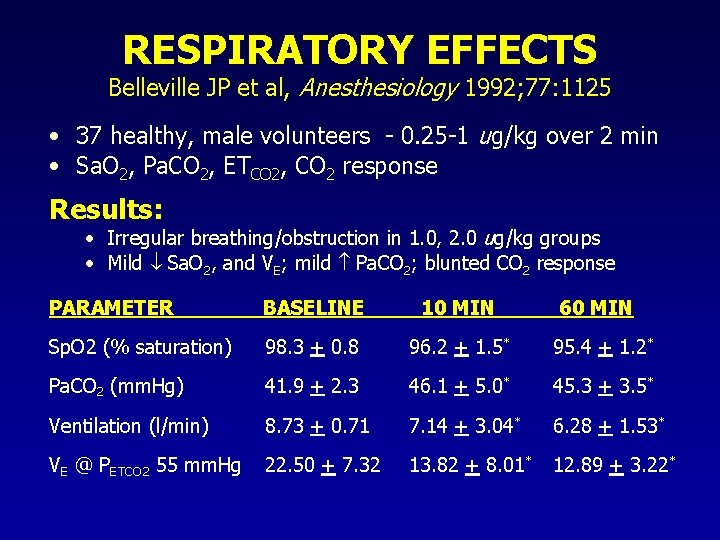
RESPIRATORY EFFECTS • Promoted as having minimal respiratory depressing effects • 0. 17% incidence on monogram • Most data suggests Sa. O 2 and Pa. CO 2 unaffected • Numerous reports during spontaneous ventilation
RESPIRATORY EFFECTS Belleville JP et al, Anesthesiology 1992; 77: 1125 • 37 healthy, male volunteers - 0. 25 -1 ug/kg over 2 min • Sa. O 2, Pa. CO 2, ETCO 2, CO 2 response Results: • Irregular breathing/obstruction in 1. 0, 2. 0 ug/kg groups • Mild Sa. O 2, and VE; mild Pa. CO 2; blunted CO 2 response PARAMETER BASELINE 10 MIN 60 MIN Sp. O 2 (% saturation) 98. 3 + 0. 8 96. 2 + 1. 5* 95. 4 + 1. 2* Pa. CO 2 (mm. Hg) 41. 9 + 2. 3 46. 1 + 5. 0* 45. 3 + 3. 5* Ventilation (l/min) 8. 73 + 0. 71 7. 14 + 3. 04* 6. 28 + 1. 53* VE @ PETCO 2 55 mm. Hg 22. 50 + 7. 32 13. 82 + 8. 01* 12. 89 + 3. 22*
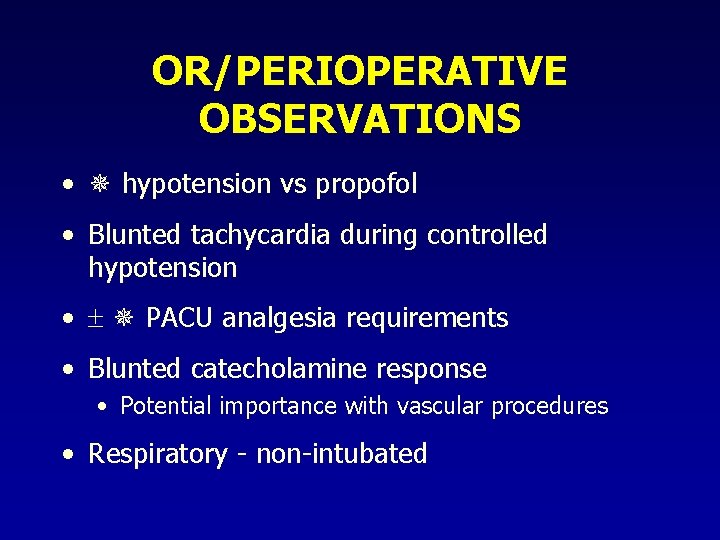
OR/PERIOPERATIVE OBSERVATIONS • hypotension vs propofol • Blunted tachycardia during controlled hypotension • PACU analgesia requirements • Blunted catecholamine response • Potential importance with vascular procedures • Respiratory - non-intubated
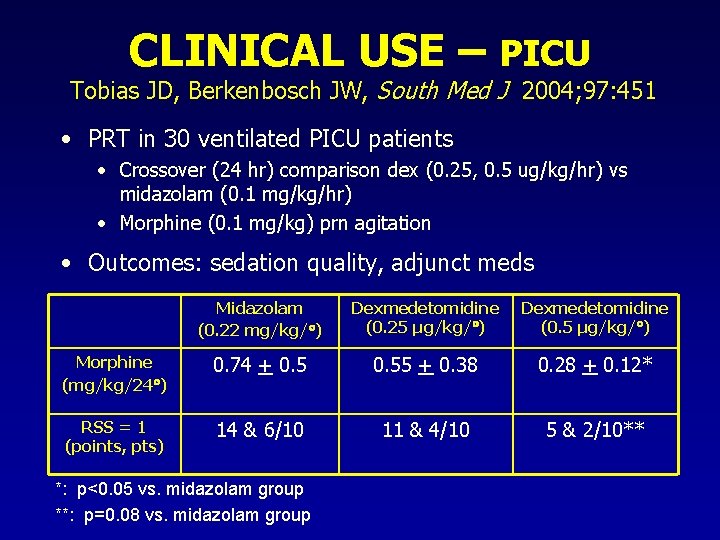
CLINICAL USE – PICU Tobias JD, Berkenbosch JW, South Med J 2004; 97: 451 • PRT in 30 ventilated PICU patients • Crossover (24 hr) comparison dex (0. 25, 0. 5 ug/kg/hr) vs midazolam (0. 1 mg/kg/hr) • Morphine (0. 1 mg/kg) prn agitation • Outcomes: sedation quality, adjunct meds Midazolam (0. 22 mg/kg/ ) Dexmedetomidine (0. 25 µg/kg/ ) Dexmedetomidine (0. 5 µg/kg/ ) Morphine (mg/kg/24 ) 0. 74 + 0. 55 + 0. 38 0. 28 + 0. 12* RSS = 1 (points, pts) 14 & 6/10 11 & 4/10 5 & 2/10** *: p<0. 05 vs. midazolam group **: p=0. 08 vs. midazolam group
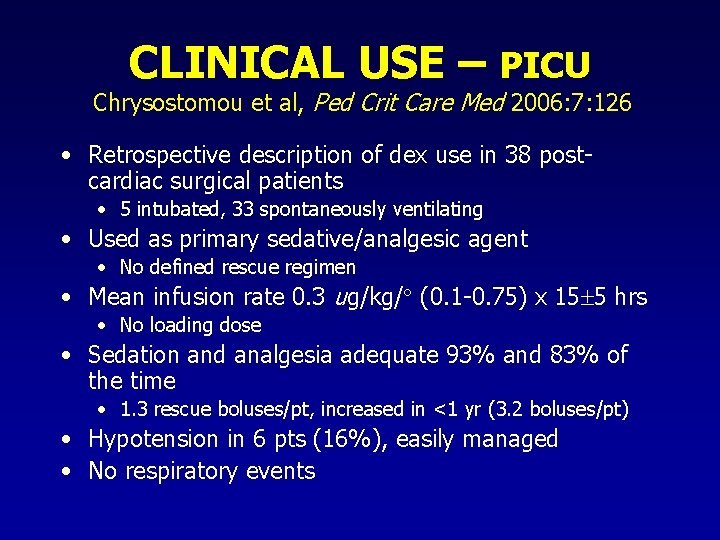
CLINICAL USE – PICU Chrysostomou et al, Ped Crit Care Med 2006: 7: 126 • Retrospective description of dex use in 38 postcardiac surgical patients • 5 intubated, 33 spontaneously ventilating • Used as primary sedative/analgesic agent • No defined rescue regimen • Mean infusion rate 0. 3 ug/kg/ (0. 1 -0. 75) x 15 5 hrs • No loading dose • Sedation and analgesia adequate 93% and 83% of the time • 1. 3 rescue boluses/pt, increased in <1 yr (3. 2 boluses/pt) • Hypotension in 6 pts (16%), easily managed • No respiratory events
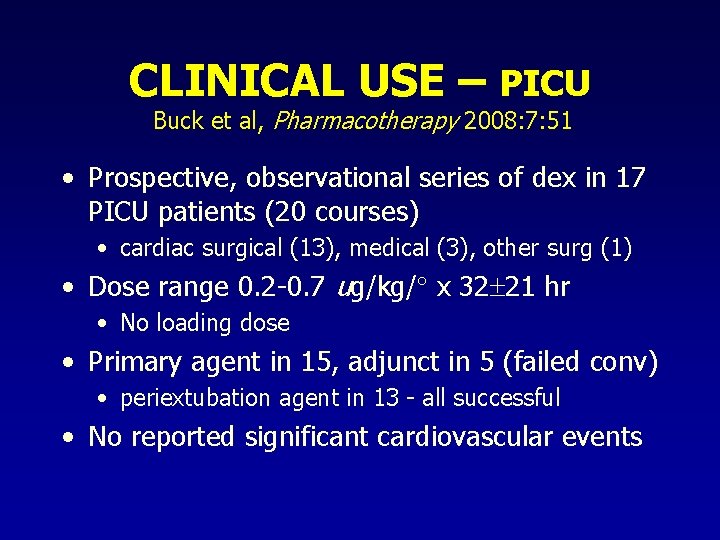
CLINICAL USE – PICU Buck et al, Pharmacotherapy 2008: 7: 51 • Prospective, observational series of dex in 17 PICU patients (20 courses) • cardiac surgical (13), medical (3), other surg (1) • Dose range 0. 2 -0. 7 ug/kg/ x 32 21 hr • No loading dose • Primary agent in 15, adjunct in 5 (failed conv) • periextubation agent in 13 - all successful • No reported significant cardiovascular events
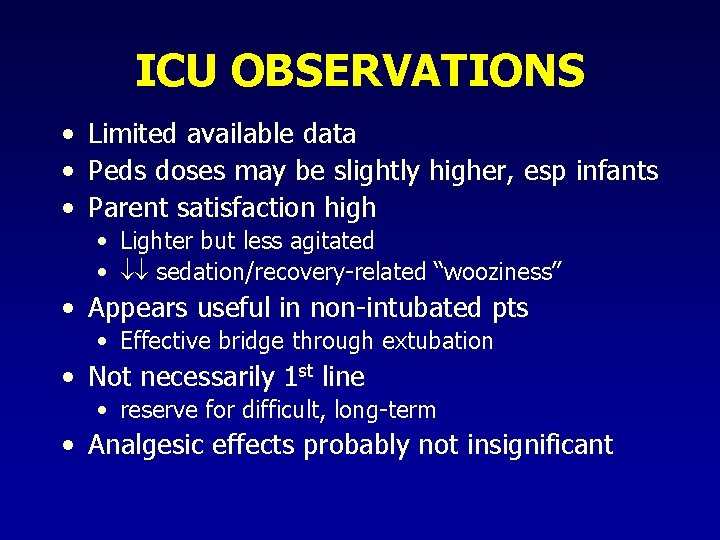
ICU OBSERVATIONS • Limited available data • Peds doses may be slightly higher, esp infants • Parent satisfaction high • Lighter but less agitated • sedation/recovery-related “wooziness” • Appears useful in non-intubated pts • Effective bridge through extubation • Not necessarily 1 st line • reserve for difficult, long-term • Analgesic effects probably not insignificant
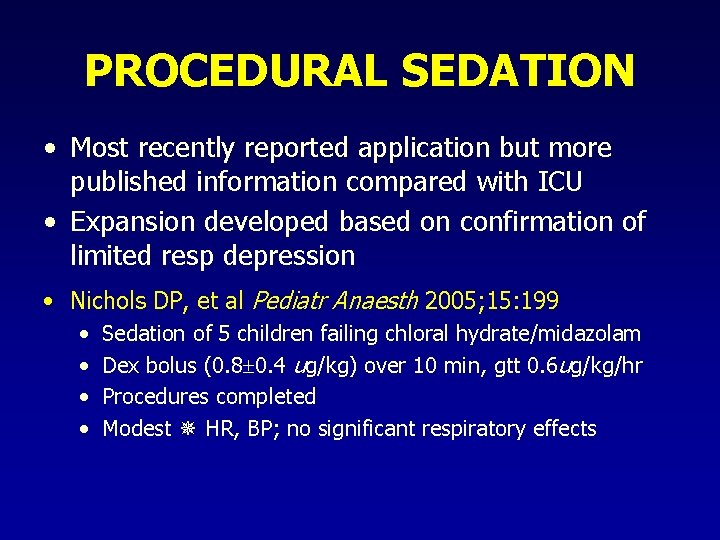
PROCEDURAL SEDATION • Most recently reported application but more published information compared with ICU • Expansion developed based on confirmation of limited resp depression • Nichols DP, et al Pediatr Anaesth 2005; 15: 199 • • Sedation of 5 children failing chloral hydrate/midazolam Dex bolus (0. 8 0. 4 ug/kg) over 10 min, gtt 0. 6 ug/kg/hr Procedures completed Modest HR, BP; no significant respiratory effects
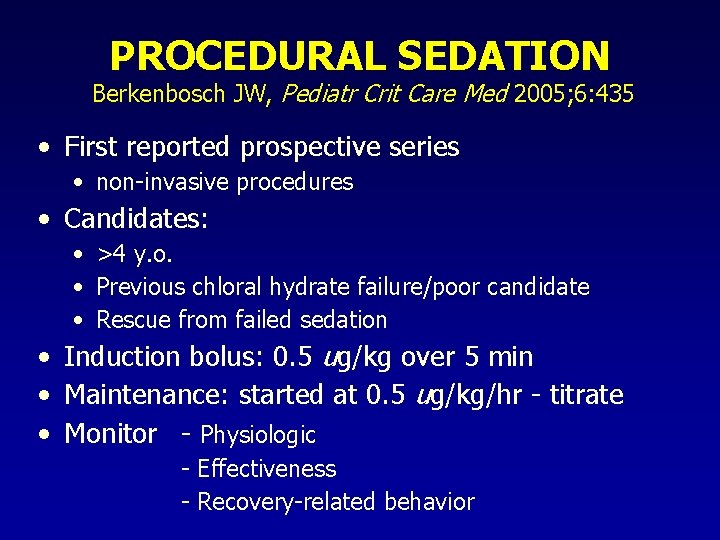
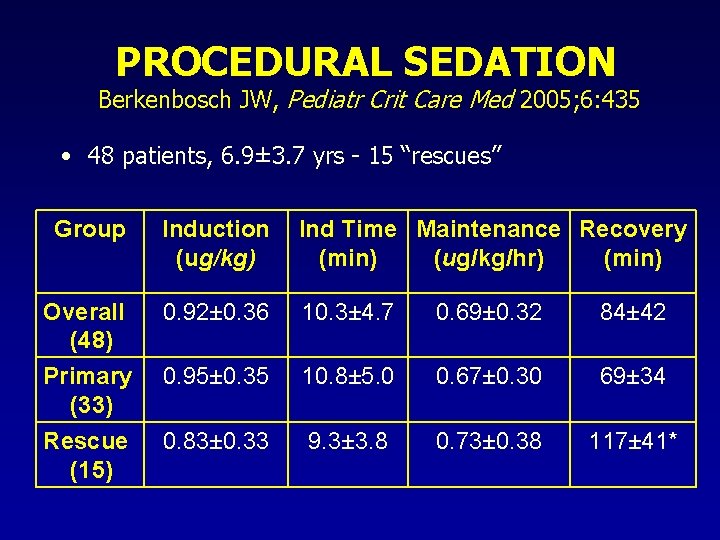
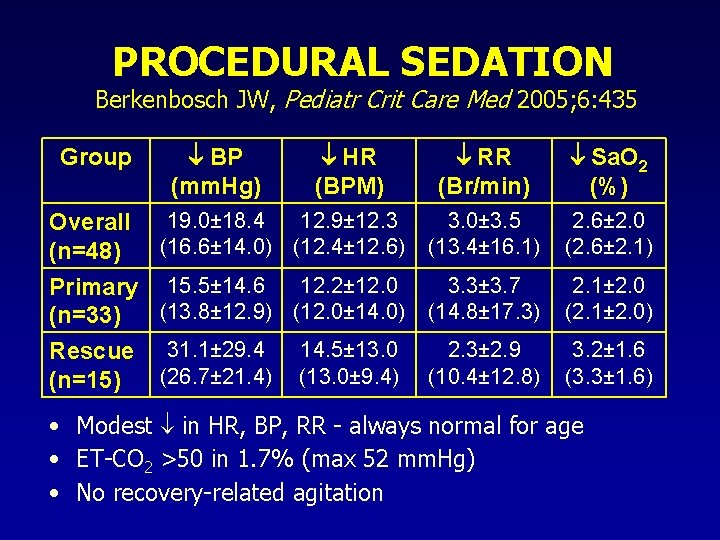
PROCEDURAL SEDATION Berkenbosch JW, Pediatr Crit Care Med 2005; 6: 435 • First reported prospective series • non-invasive procedures • Candidates: • >4 y. o. • Previous chloral hydrate failure/poor candidate • Rescue from failed sedation • Induction bolus: 0. 5 ug/kg over 5 min • Maintenance: started at 0. 5 ug/kg/hr - titrate • Monitor - Physiologic - Effectiveness - Recovery-related behavior
PROCEDURAL SEDATION Berkenbosch JW, Pediatr Crit Care Med 2005; 6: 435 • 48 patients, 6. 9± 3. 7 yrs - 15 “rescues” Group Induction (ug/kg) Ind Time Maintenance Recovery (min) (ug/kg/hr) (min) Overall (48) 0. 92± 0. 36 10. 3± 4. 7 0. 69± 0. 32 84± 42 Primary (33) Rescue (15) 0. 95± 0. 35 10. 8± 5. 0 0. 67± 0. 30 69± 34 0. 83± 0. 33 9. 3± 3. 8 0. 73± 0. 38 117± 41*
PROCEDURAL SEDATION Berkenbosch JW, Pediatr Crit Care Med 2005; 6: 435 RR (Br/min) Sa. O 2 (%) 3. 0± 3. 5 (13. 4± 16. 1) 2. 6± 2. 0 (2. 6± 2. 1) 3. 3± 3. 7 Primary 15. 5± 14. 6 12. 2± 12. 0 (13. 8± 12. 9) (12. 0± 14. 0) (14. 8± 17. 3) (n=33) 2. 3± 2. 9 Rescue 31. 1± 29. 4 14. 5± 13. 0 (26. 7± 21. 4) (13. 0± 9. 4) (10. 4± 12. 8) (n=15) 2. 1± 2. 0 (2. 1± 2. 0) Group Overall (n=48) BP (mm. Hg) HR (BPM) 19. 0± 18. 4 12. 9± 12. 3 (16. 6± 14. 0) (12. 4± 12. 6) 3. 2± 1. 6 (3. 3± 1. 6) • Modest in HR, BP, RR - always normal for age • ET-CO 2 >50 in 1. 7% (max 52 mm. Hg) • No recovery-related agitation
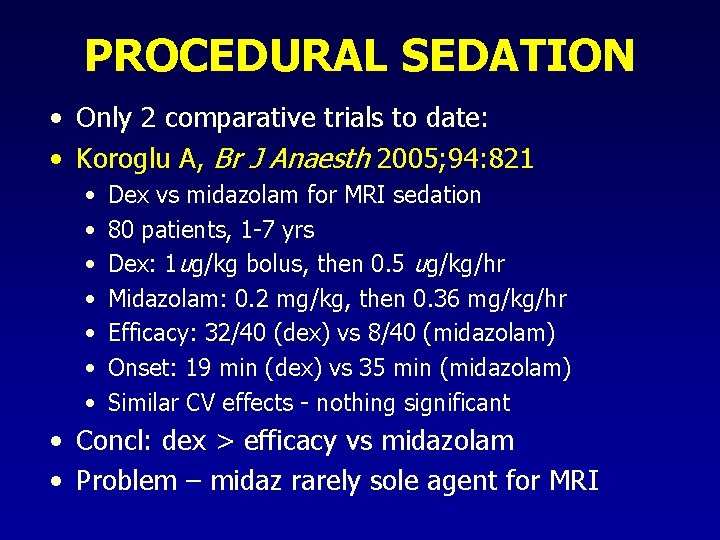
PROCEDURAL SEDATION • Only 2 comparative trials to date: • Koroglu A, Br J Anaesth 2005; 94: 821 • • Dex vs midazolam for MRI sedation 80 patients, 1 -7 yrs Dex: 1 ug/kg bolus, then 0. 5 ug/kg/hr Midazolam: 0. 2 mg/kg, then 0. 36 mg/kg/hr Efficacy: 32/40 (dex) vs 8/40 (midazolam) Onset: 19 min (dex) vs 35 min (midazolam) Similar CV effects - nothing significant • Concl: dex > efficacy vs midazolam • Problem – midaz rarely sole agent for MRI
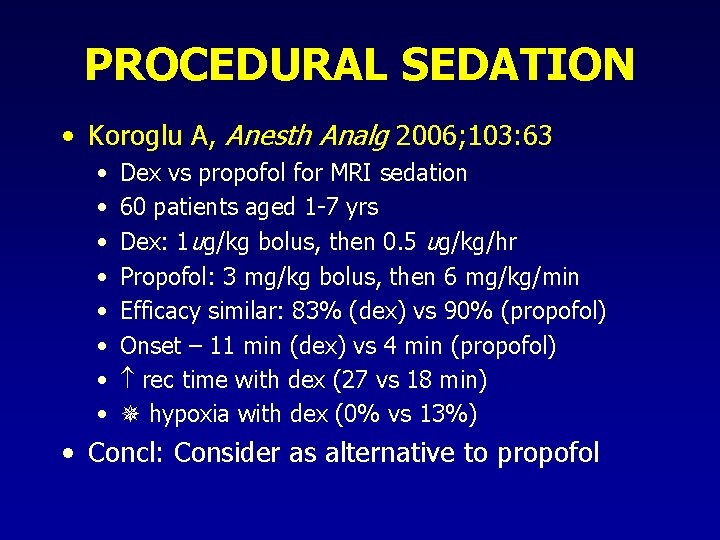
PROCEDURAL SEDATION • Koroglu A, Anesth Analg 2006; 103: 63 • • Dex vs propofol for MRI sedation 60 patients aged 1 -7 yrs Dex: 1 ug/kg bolus, then 0. 5 ug/kg/hr Propofol: 3 mg/kg bolus, then 6 mg/kg/min Efficacy similar: 83% (dex) vs 90% (propofol) Onset – 11 min (dex) vs 4 min (propofol) rec time with dex (27 vs 18 min) hypoxia with dex (0% vs 13%) • Concl: Consider as alternative to propofol
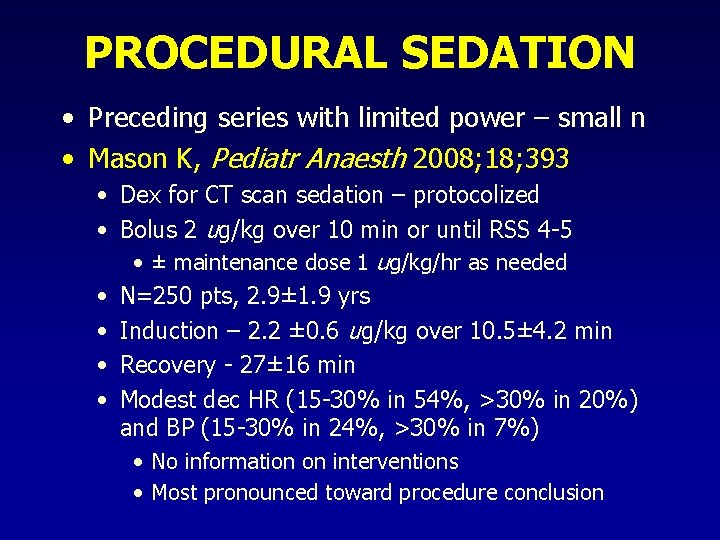
PROCEDURAL SEDATION • Preceding series with limited power – small n • Mason K, Pediatr Anaesth 2008; 18; 393 • Dex for CT scan sedation – protocolized • Bolus 2 ug/kg over 10 min or until RSS 4 -5 • ± maintenance dose 1 ug/kg/hr as needed • N=250 pts, 2. 9± 1. 9 yrs • Induction – 2. 2 ± 0. 6 ug/kg over 10. 5± 4. 2 min • Recovery - 27± 16 min • Modest dec HR (15 -30% in 54%, >30% in 20%) and BP (15 -30% in 24%, >30% in 7%) • No information on interventions • Most pronounced toward procedure conclusion
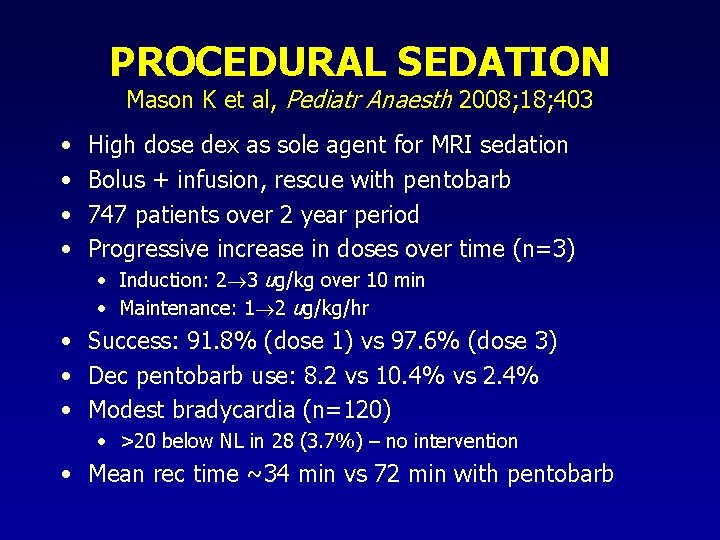
PROCEDURAL SEDATION Mason K et al, Pediatr Anaesth 2008; 18; 403 • • High dose dex as sole agent for MRI sedation Bolus + infusion, rescue with pentobarb 747 patients over 2 year period Progressive increase in doses over time (n=3) • Induction: 2 3 ug/kg over 10 min • Maintenance: 1 2 ug/kg/hr • Success: 91. 8% (dose 1) vs 97. 6% (dose 3) • Dec pentobarb use: 8. 2 vs 10. 4% vs 2. 4% • Modest bradycardia (n=120) • >20 below NL in 28 (3. 7%) – no intervention • Mean rec time ~34 min vs 72 min with pentobarb
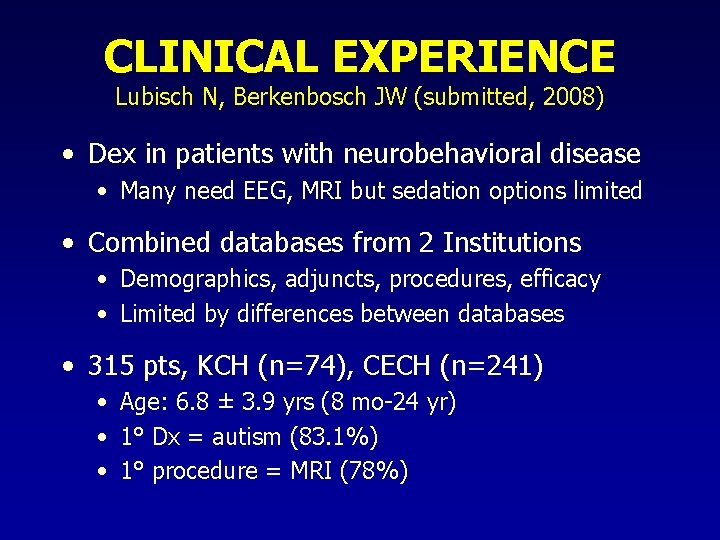
CLINICAL EXPERIENCE Lubisch N, Berkenbosch JW (submitted, 2008) • Dex in patients with neurobehavioral disease • Many need EEG, MRI but sedation options limited • Combined databases from 2 Institutions • Demographics, adjuncts, procedures, efficacy • Limited by differences between databases • 315 pts, KCH (n=74), CECH (n=241) • Age: 6. 8 ± 3. 9 yrs (8 mo-24 yr) • 1° Dx = autism (83. 1%) • 1° procedure = MRI (78%)
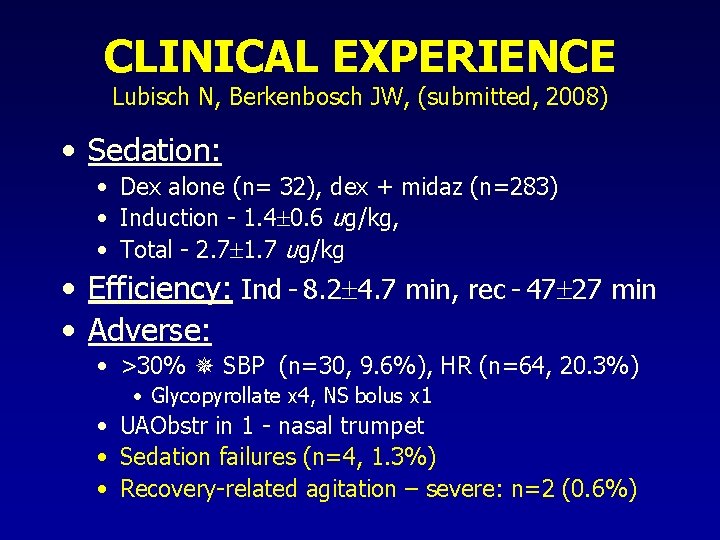
CLINICAL EXPERIENCE Lubisch N, Berkenbosch JW, (submitted, 2008) • Sedation: • Dex alone (n= 32), dex + midaz (n=283) • Induction - 1. 4 0. 6 ug/kg, • Total - 2. 7 1. 7 ug/kg • Efficiency: Ind - 8. 2 4. 7 min, rec - 47 27 min • Adverse: • >30% SBP (n=30, 9. 6%), HR (n=64, 20. 3%) • Glycopyrollate x 4, NS bolus x 1 • UAObstr in 1 - nasal trumpet • Sedation failures (n=4, 1. 3%) • Recovery-related agitation – severe: n=2 (0. 6%)
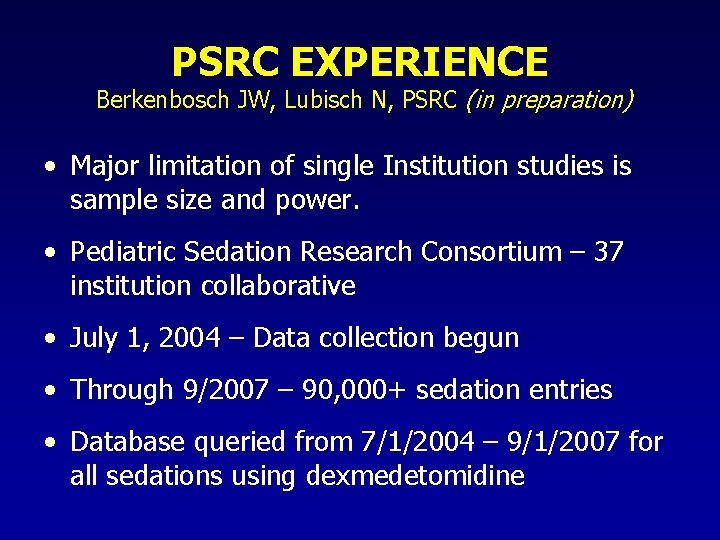
PSRC EXPERIENCE Berkenbosch JW, Lubisch N, PSRC (in preparation) • Major limitation of single Institution studies is sample size and power. • Pediatric Sedation Research Consortium – 37 institution collaborative • July 1, 2004 – Data collection begun • Through 9/2007 – 90, 000+ sedation entries • Database queried from 7/1/2004 – 9/1/2007 for all sedations using dexmedetomidine
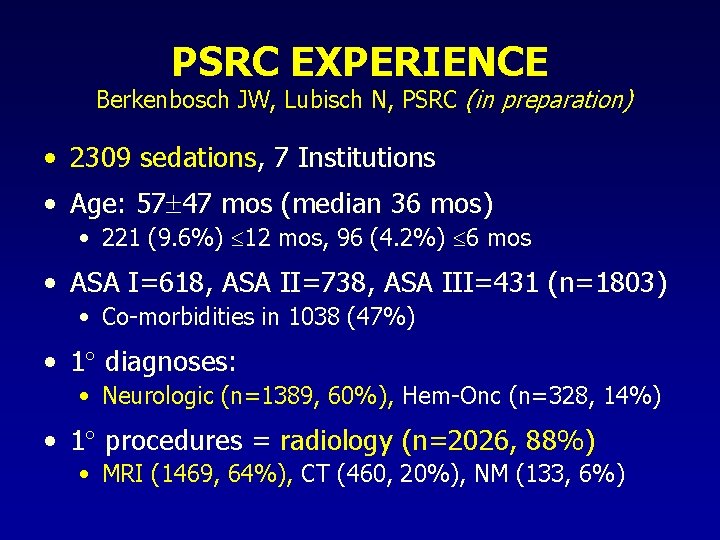
PSRC EXPERIENCE Berkenbosch JW, Lubisch N, PSRC (in preparation) • 2309 sedations, 7 Institutions • Age: 57 47 mos (median 36 mos) • 221 (9. 6%) 12 mos, 96 (4. 2%) 6 mos • ASA I=618, ASA II=738, ASA III=431 (n=1803) • Co-morbidities in 1038 (47%) • 1 diagnoses: • Neurologic (n=1389, 60%), Hem-Onc (n=328, 14%) • 1 procedures = radiology (n=2026, 88%) • MRI (1469, 64%), CT (460, 20%), NM (133, 6%)
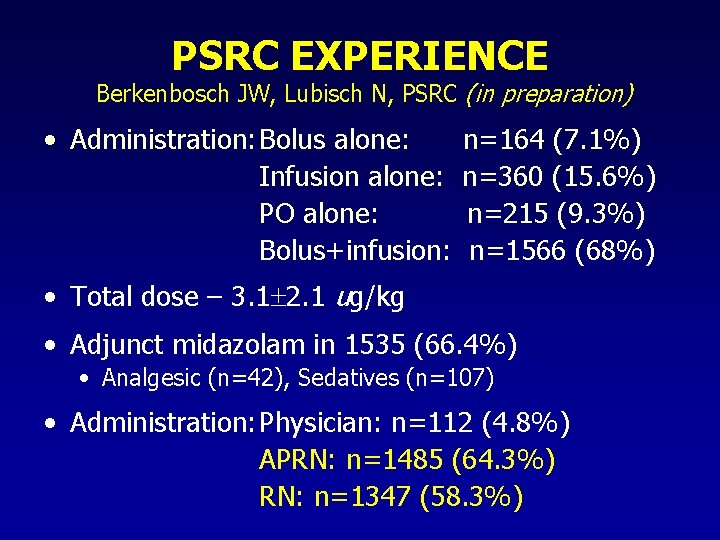
PSRC EXPERIENCE Berkenbosch JW, Lubisch N, PSRC (in preparation) • Administration: Bolus alone: Infusion alone: PO alone: Bolus+infusion: n=164 (7. 1%) n=360 (15. 6%) n=215 (9. 3%) n=1566 (68%) • Total dose – 3. 1 2. 1 ug/kg • Adjunct midazolam in 1535 (66. 4%) • Analgesic (n=42), Sedatives (n=107) • Administration: Physician: n=112 (4. 8%) APRN: n=1485 (64. 3%) RN: n=1347 (58. 3%)
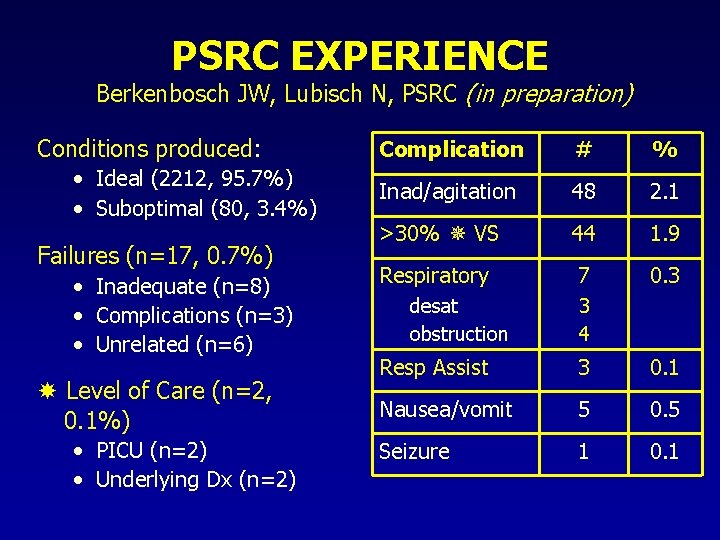
PSRC EXPERIENCE Berkenbosch JW, Lubisch N, PSRC (in preparation) Conditions produced: • Ideal (2212, 95. 7%) • Suboptimal (80, 3. 4%) Failures (n=17, 0. 7%) • Inadequate (n=8) • Complications (n=3) • Unrelated (n=6) Level of Care (n=2, 0. 1%) • PICU (n=2) • Underlying Dx (n=2) Complication # % Inad/agitation 48 2. 1 >30% VS 44 1. 9 Respiratory 7 0. 3 desat obstruction 3 4 Resp Assist 3 0. 1 Nausea/vomit 5 0. 5 Seizure 1 0. 1
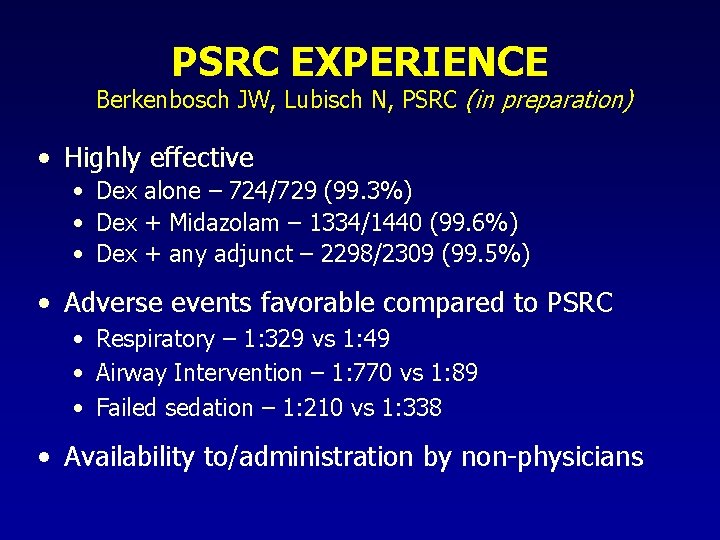
PSRC EXPERIENCE Berkenbosch JW, Lubisch N, PSRC (in preparation) • Highly effective • Dex alone – 724/729 (99. 3%) • Dex + Midazolam – 1334/1440 (99. 6%) • Dex + any adjunct – 2298/2309 (99. 5%) • Adverse events favorable compared to PSRC • Respiratory – 1: 329 vs 1: 49 • Airway Intervention – 1: 770 vs 1: 89 • Failed sedation – 1: 210 vs 1: 338 • Availability to/administration by non-physicians
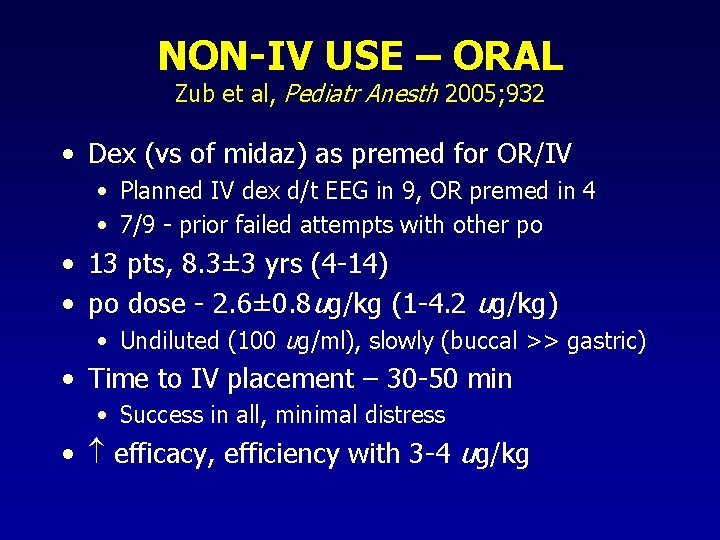
NON-IV USE – ORAL Zub et al, Pediatr Anesth 2005; 932 • Dex (vs of midaz) as premed for OR/IV • Planned IV dex d/t EEG in 9, OR premed in 4 • 7/9 - prior failed attempts with other po • 13 pts, 8. 3± 3 yrs (4 -14) • po dose - 2. 6± 0. 8 ug/kg (1 -4. 2 ug/kg) • Undiluted (100 ug/ml), slowly (buccal >> gastric) • Time to IV placement – 30 -50 min • Success in all, minimal distress • efficacy, efficiency with 3 -4 ug/kg
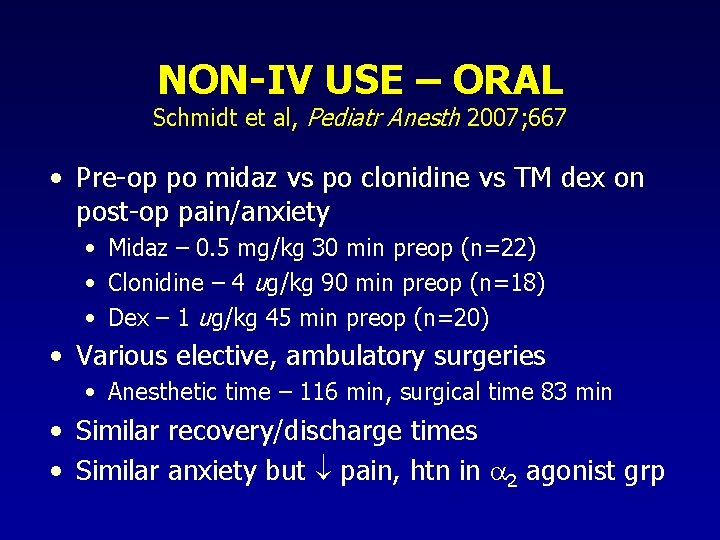
NON-IV USE – ORAL Schmidt et al, Pediatr Anesth 2007; 667 • Pre-op po midaz vs po clonidine vs TM dex on post-op pain/anxiety • Midaz – 0. 5 mg/kg 30 min preop (n=22) • Clonidine – 4 ug/kg 90 min preop (n=18) • Dex – 1 ug/kg 45 min preop (n=20) • Various elective, ambulatory surgeries • Anesthetic time – 116 min, surgical time 83 min • Similar recovery/discharge times • Similar anxiety but pain, htn in 2 agonist grp
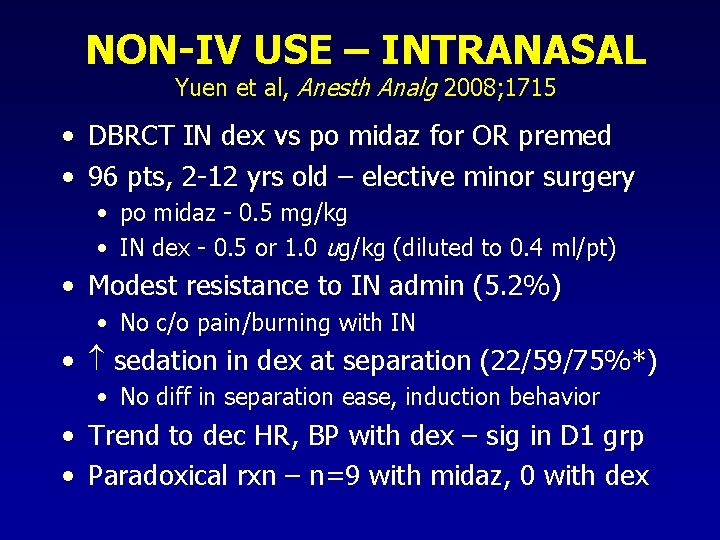
NON-IV USE – INTRANASAL Yuen et al, Anesth Analg 2008; 1715 • DBRCT IN dex vs po midaz for OR premed • 96 pts, 2 -12 yrs old – elective minor surgery • po midaz - 0. 5 mg/kg • IN dex - 0. 5 or 1. 0 ug/kg (diluted to 0. 4 ml/pt) • Modest resistance to IN admin (5. 2%) • No c/o pain/burning with IN • sedation in dex at separation (22/59/75%*) • No diff in separation ease, induction behavior • Trend to dec HR, BP with dex – sig in D 1 grp • Paradoxical rxn – n=9 with midaz, 0 with dex
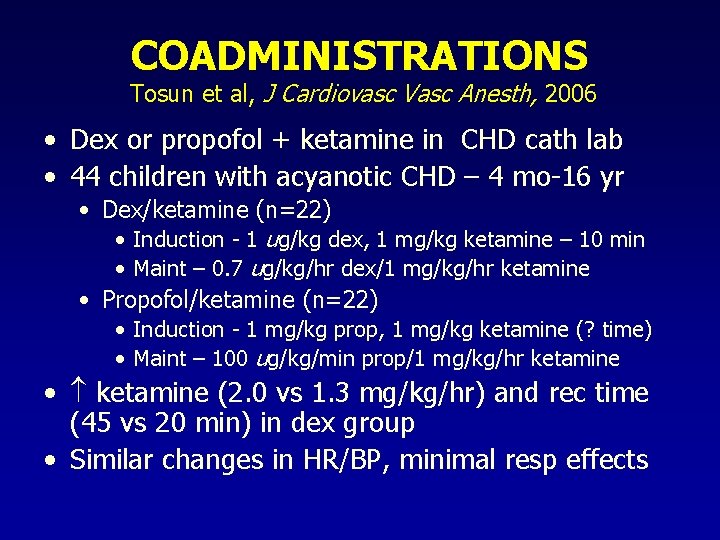
COADMINISTRATIONS Tosun et al, J Cardiovasc Vasc Anesth, 2006 • Dex or propofol + ketamine in CHD cath lab • 44 children with acyanotic CHD – 4 mo-16 yr • Dex/ketamine (n=22) • Induction - 1 ug/kg dex, 1 mg/kg ketamine – 10 min • Maint – 0. 7 ug/kg/hr dex/1 mg/kg/hr ketamine • Propofol/ketamine (n=22) • Induction - 1 mg/kg prop, 1 mg/kg ketamine (? time) • Maint – 100 ug/kg/min prop/1 mg/kg/hr ketamine • ketamine (2. 0 vs 1. 3 mg/kg/hr) and rec time (45 vs 20 min) in dex group • Similar changes in HR/BP, minimal resp effects
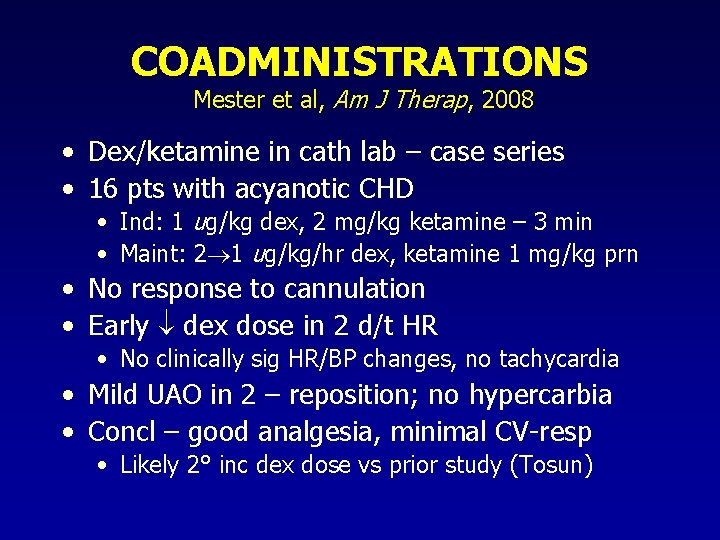
COADMINISTRATIONS Mester et al, Am J Therap, 2008 • Dex/ketamine in cath lab – case series • 16 pts with acyanotic CHD • Ind: 1 ug/kg dex, 2 mg/kg ketamine – 3 min • Maint: 2 1 ug/kg/hr dex, ketamine 1 mg/kg prn • No response to cannulation • Early dex dose in 2 d/t HR • No clinically sig HR/BP changes, no tachycardia • Mild UAO in 2 – reposition; no hypercarbia • Concl – good analgesia, minimal CV-resp • Likely 2° inc dex dose vs prior study (Tosun)
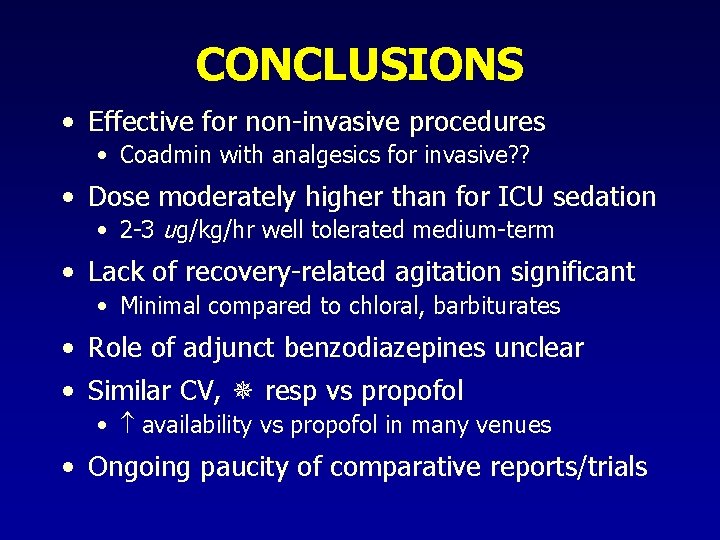
CONCLUSIONS • Effective for non-invasive procedures • Coadmin with analgesics for invasive? ? • Dose moderately higher than for ICU sedation • 2 -3 ug/kg/hr well tolerated medium-term • Lack of recovery-related agitation significant • Minimal compared to chloral, barbiturates • Role of adjunct benzodiazepines unclear • Similar CV, resp vs propofol • availability vs propofol in many venues • Ongoing paucity of comparative reports/trials
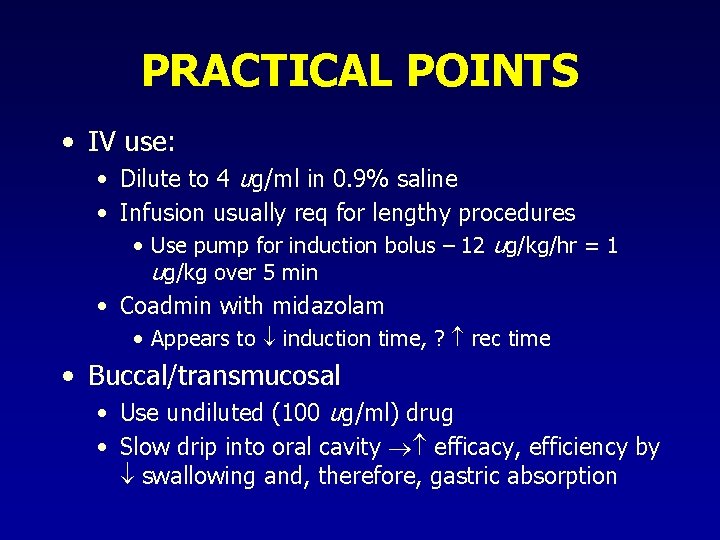
PRACTICAL POINTS • IV use: • Dilute to 4 ug/ml in 0. 9% saline • Infusion usually req for lengthy procedures • Use pump for induction bolus – 12 ug/kg/hr = 1 ug/kg over 5 min • Coadmin with midazolam • Appears to induction time, ? rec time • Buccal/transmucosal • Use undiluted (100 ug/ml) drug • Slow drip into oral cavity efficacy, efficiency by swallowing and, therefore, gastric absorption