AP Economics 1 Copyright ACDC Leadership 2015 QUIZ

- Slides: 32
AP Economics ® 1 Copyright ACDC Leadership 2015
QUIZ 1. What are 2 applications to the classroom related to the Spider Web activity? 2. What were the 4 applications to the classroom related to the Cow Analogy? 3. What are the names of my three kids? Did you get all the handouts? HOMEWORK: Bring a Spiral Notebook (make sure it has 5 sections!!) 2
3
Unit 1: Basic Economic Concepts I WON THE LOTTERY! I’ll give you anything you want other than money. What do you want? Would your list ever end? Why not? Scarcity!!! 4
What is Economics? • Economics is the science of scarcity. • Scarcity- we have unlimited wants but limited resources. • Since we are unable to have everything we desire, we must make choices on how we will use our resources. Economics is the study of _______. choices In economics we will study the choices of individuals, firms, and governments. 5 Copyright ACDC Leadership 2015
Examples: You must choose between buying jeans or buying shoes. Businesses must choose how many people to hire Governments must choose how much to spend on welfare. Textbook Definition Economics- Social science concerned with the efficient use of scarce resources to achieve maximum satisfaction of economic wants. (Study of how individuals and societies deal with ____) scarcity 6 Copyright ACDC Leadership 2015
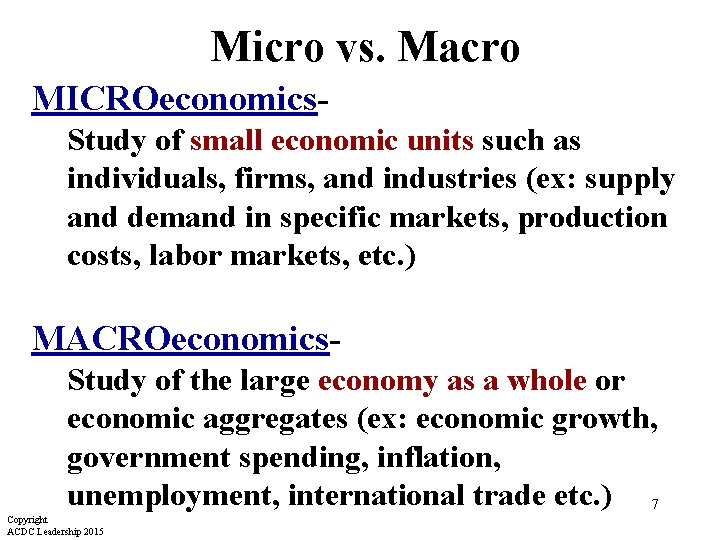
Micro vs. Macro MICROeconomics. Study of small economic units such as individuals, firms, and industries (ex: supply and demand in specific markets, production costs, labor markets, etc. ) MACROeconomics. Study of the large economy as a whole or economic aggregates (ex: economic growth, government spending, inflation, unemployment, international trade etc. ) 7 Copyright ACDC Leadership 2015
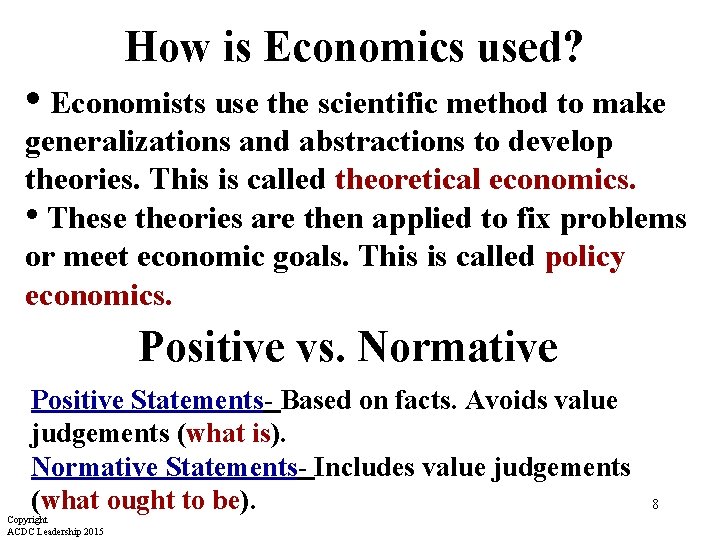
How is Economics used? • Economists use the scientific method to make generalizations and abstractions to develop theories. This is called theoretical economics. • These theories are then applied to fix problems or meet economic goals. This is called policy economics. Positive vs. Normative Positive Statements- Based on facts. Avoids value judgements (what is). Normative Statements- Includes value judgements (what ought to be). Copyright ACDC Leadership 2015 8
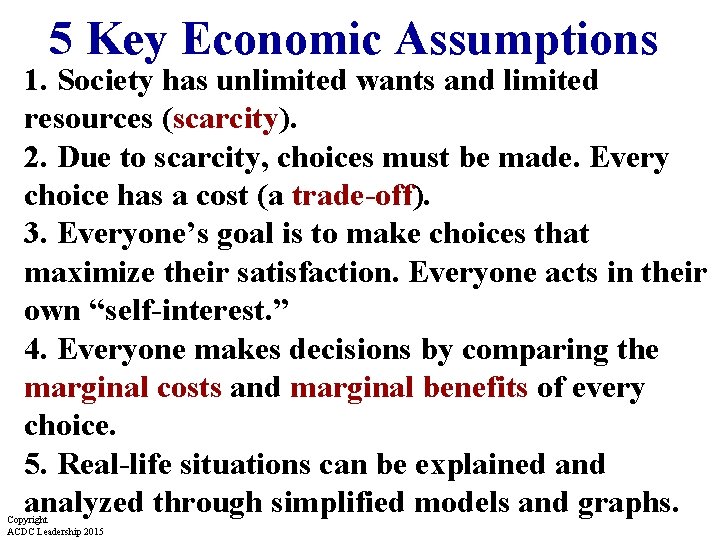
5 Key Economic Assumptions 1. Society has unlimited wants and limited resources (scarcity). 2. Due to scarcity, choices must be made. Every choice has a cost (a trade-off). 3. Everyone’s goal is to make choices that maximize their satisfaction. Everyone acts in their own “self-interest. ” 4. Everyone makes decisions by comparing the marginal costs and marginal benefits of every choice. 5. Real-life situations can be explained and 9 analyzed through simplified models and graphs. Copyright ACDC Leadership 2015
Copyright ACDC Leadership 2015
11 Copyright ACDC Leadership 2015
12 Copyright ACDC Leadership 2015
13 Copyright ACDC Leadership 2015
14 Copyright ACDC Leadership 2015
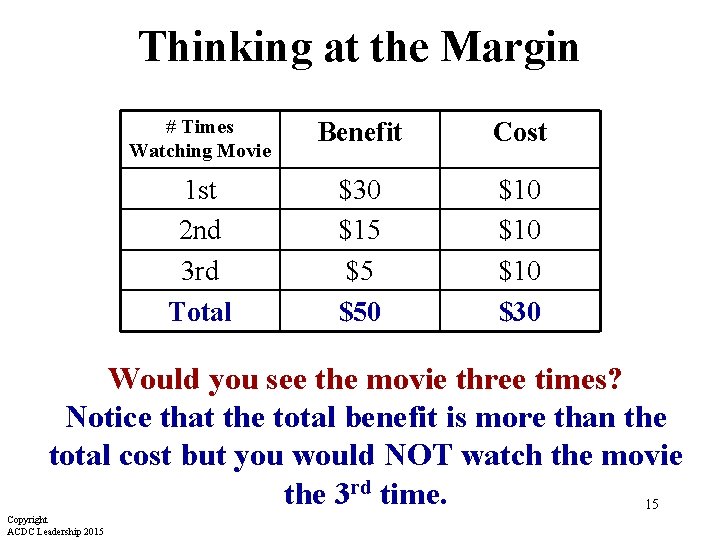
Thinking at the Margin # Times Watching Movie Benefit Cost 1 st 2 nd 3 rd Total $30 $15 $5 $50 $10 $10 $30 Would you see the movie three times? Notice that the total benefit is more than the total cost but you would NOT watch the movie the 3 rd time. 15 Copyright ACDC Leadership 2015
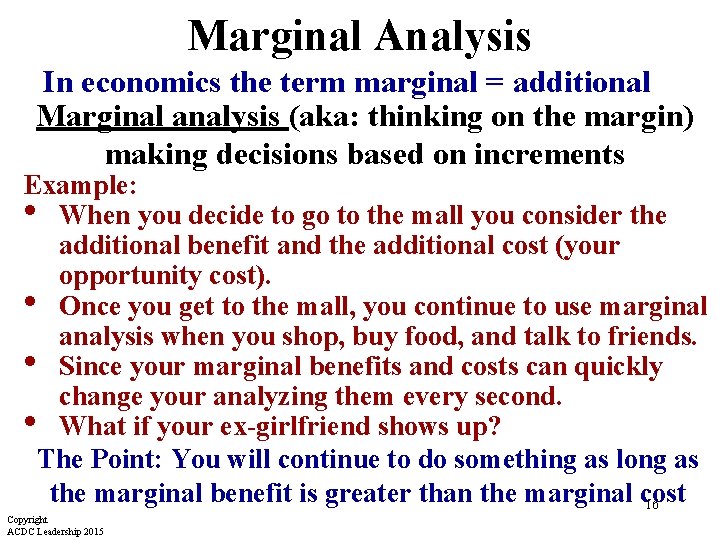
Marginal Analysis In economics the term marginal = additional Marginal analysis (aka: thinking on the margin) making decisions based on increments Example: • When you decide to go to the mall you consider the additional benefit and the additional cost (your opportunity cost). • Once you get to the mall, you continue to use marginal analysis when you shop, buy food, and talk to friends. • Since your marginal benefits and costs can quickly change your analyzing them every second. • What if your ex-girlfriend shows up? The Point: You will continue to do something as long as the marginal benefit is greater than the marginal cost 16 Copyright ACDC Leadership 2015
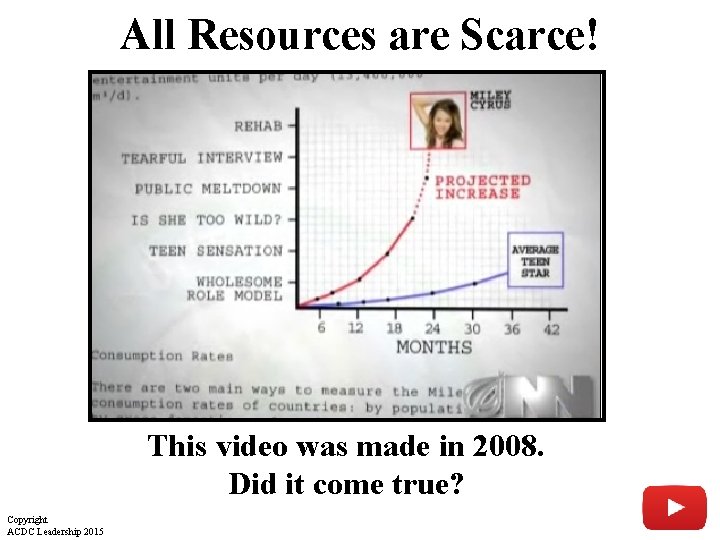
All Resources are Scarce! This video was made in 2008. Did it come true? Copyright ACDC Leadership 2015
Copyright ACDC Leadership 2015 18
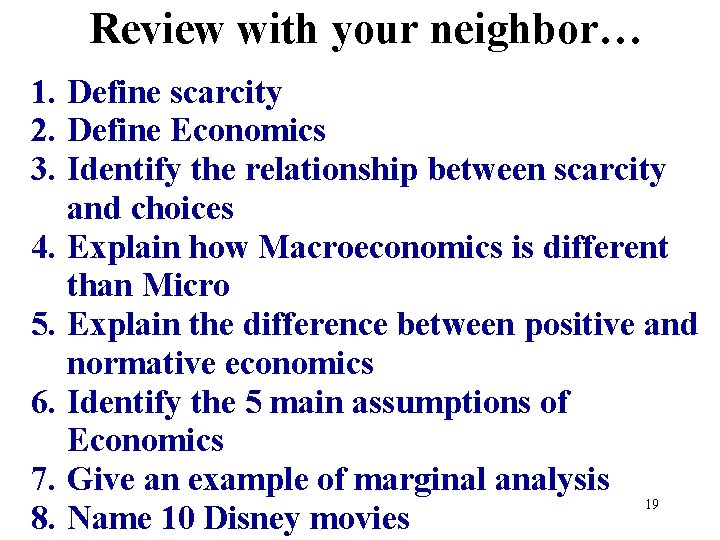
Review with your neighbor… 1. Define scarcity 2. Define Economics 3. Identify the relationship between scarcity and choices 4. Explain how Macroeconomics is different than Micro 5. Explain the difference between positive and normative economics 6. Identify the 5 main assumptions of Economics 7. Give an example of marginal analysis 19 8. Name 10 Disney movies
Analyzing Choices 20 Copyright ACDC Leadership 2015
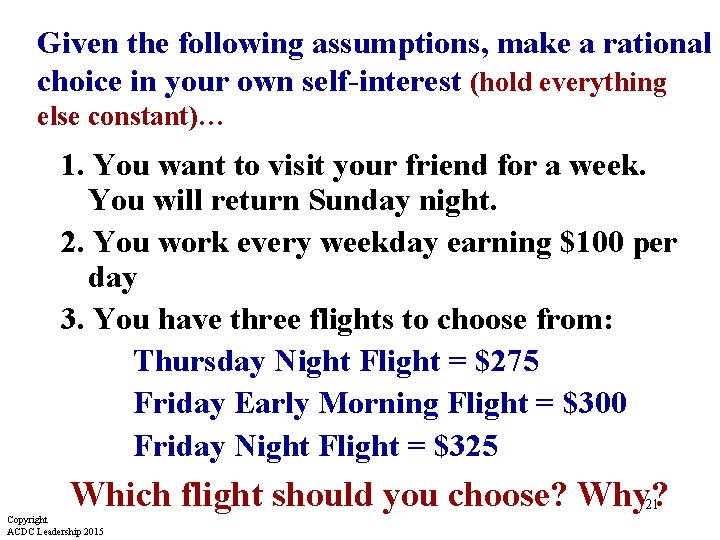
Given the following assumptions, make a rational choice in your own self-interest (hold everything else constant)… 1. You want to visit your friend for a week. You will return Sunday night. 2. You work every weekday earning $100 per day 3. You have three flights to choose from: Thursday Night Flight = $275 Friday Early Morning Flight = $300 Friday Night Flight = $325 Which flight should you choose? Why? 21 Copyright ACDC Leadership 2015
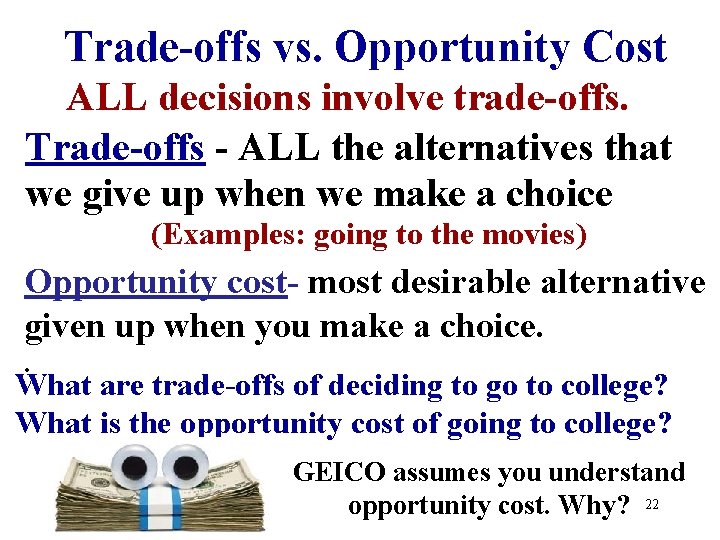
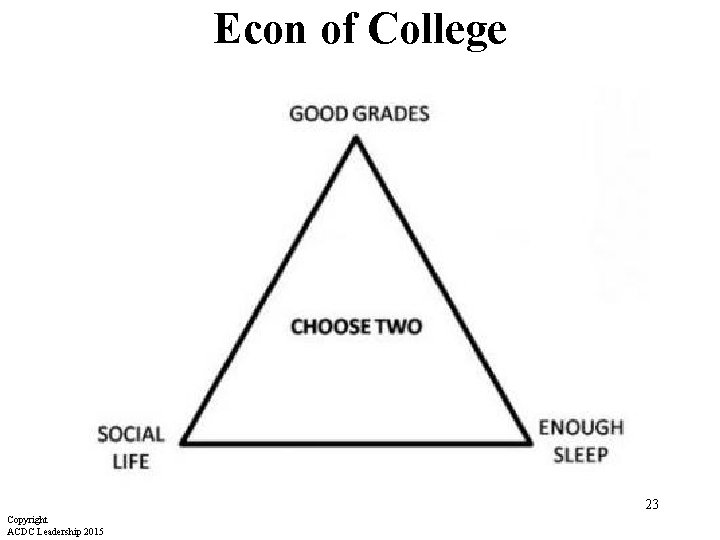
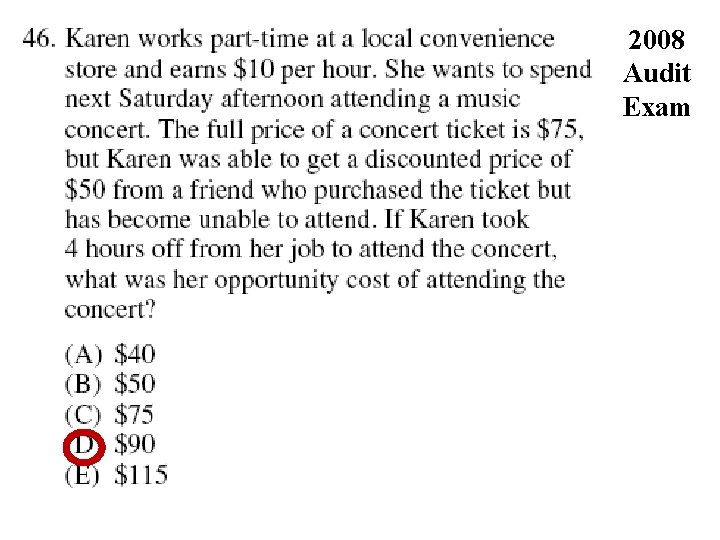
Trade-offs vs. Opportunity Cost ALL decisions involve trade-offs. Trade-offs - ALL the alternatives that we give up when we make a choice (Examples: going to the movies) Opportunity cost- most desirable alternative given up when you make a choice. . What are trade-offs of deciding to go to college? What is the opportunity cost of going to college? GEICO assumes you understand opportunity cost. Why? 22
Econ of College 23 Copyright ACDC Leadership 2015
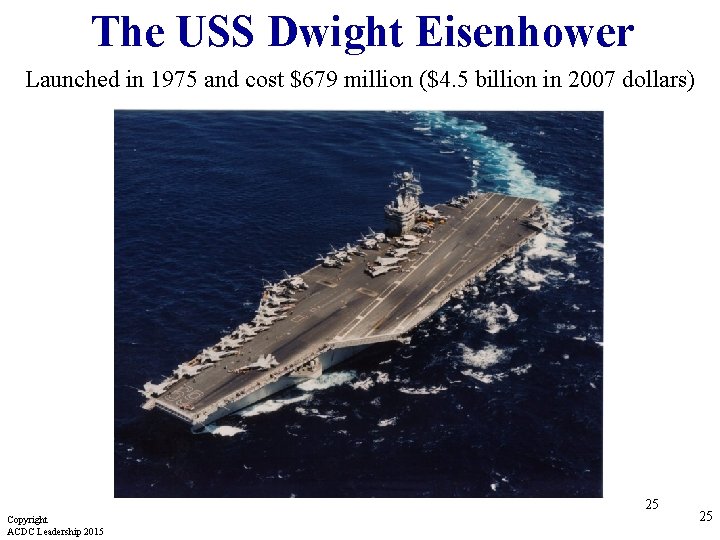
Guns and Butter "Every gun that is made, every warship launched, every rocket fired signifies, in the final sense, a theft from those who hunger and are not fed, those who are cold and are not clothed. This world in arms is not spending money alone. It is spending the sweat of its laborers, the genius of its scientists, the hopes of its children. ” “The cost of one modern heavy bomber is this: a modern brick school in more than 30 cities. It is two electric power plants, each serving a town of 60, 000 population. It is two fine, fully equipped hospitals. It is some fifty miles of concrete pavement. ” “We pay for a single fighter plane with a half million bushels of wheat. We pay for a single destroyer with new homes that could have housed more than 8, 000 people. ” -Dwight Eisenhower 24 Speaking against the military build up of the cold war Copyright ACDC Leadership 2015
The USS Dwight Eisenhower Launched in 1975 and cost $679 million ($4. 5 billion in 2007 dollars) 25 Copyright ACDC Leadership 2015 25
2008 Audit Exam
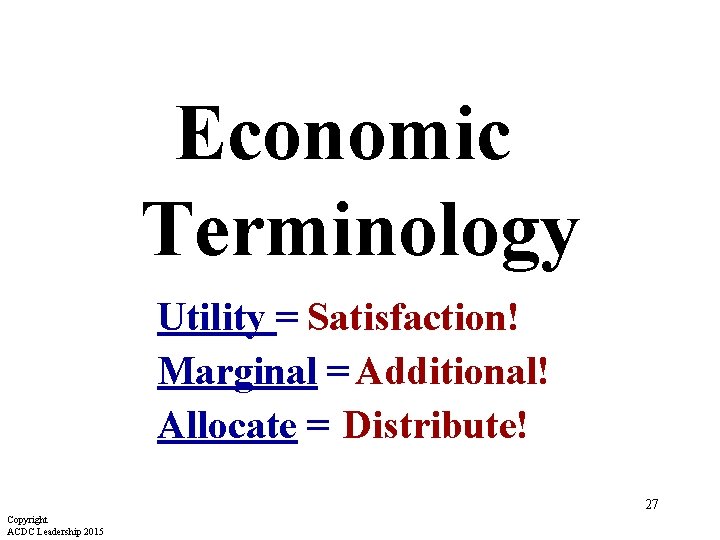
Economic Terminology Utility = Satisfaction! Marginal = Additional! Allocate = Distribute! 27 Copyright ACDC Leadership 2015
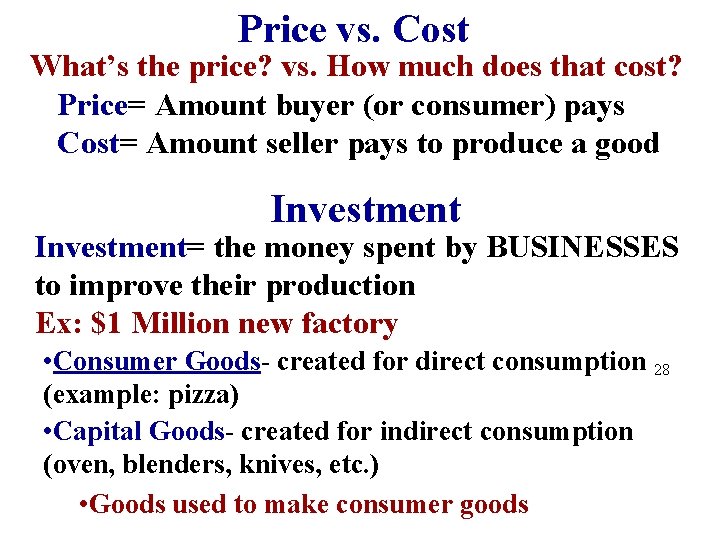
Price vs. Cost What’s the price? vs. How much does that cost? Price= Amount buyer (or consumer) pays Cost= Amount seller pays to produce a good Investment= the money spent by BUSINESSES to improve their production Ex: $1 Million new factory • Consumer Goods- created for direct consumption 28 (example: pizza) • Capital Goods- created for indirect consumption (oven, blenders, knives, etc. ) • Goods used to make consumer goods
The 4 Factors of Production 29 Copyright ACDC Leadership 2015
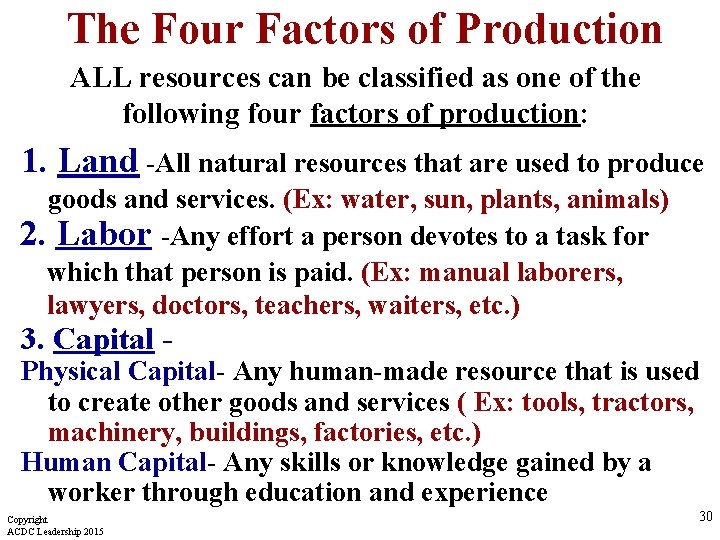
The Four Factors of Production ALL resources can be classified as one of the following four factors of production: 1. Land -All natural resources that are used to produce goods and services. (Ex: water, sun, plants, animals) 2. Labor -Any effort a person devotes to a task for which that person is paid. (Ex: manual laborers, lawyers, doctors, teachers, waiters, etc. ) 3. Capital - Physical Capital- Any human-made resource that is used to create other goods and services ( Ex: tools, tractors, machinery, buildings, factories, etc. ) Human Capital- Any skills or knowledge gained by a worker through education and experience Copyright ACDC Leadership 2015 30
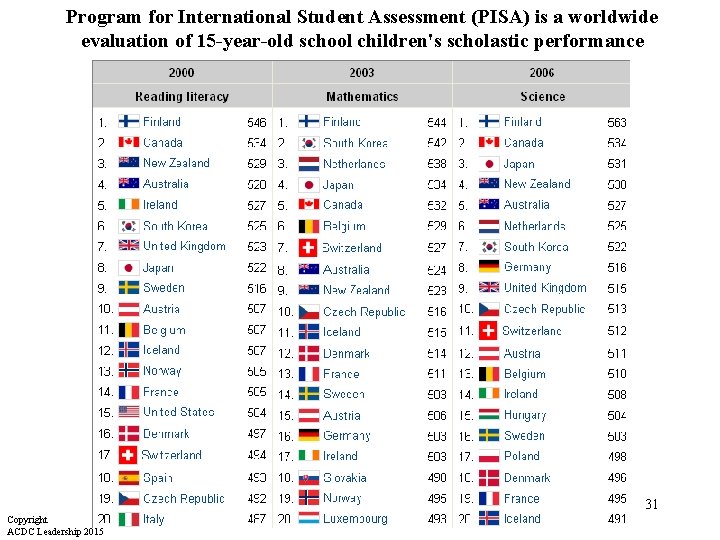
Program for International Student Assessment (PISA) is a worldwide evaluation of 15 -year-old school children's scholastic performance 31 Copyright ACDC Leadership 2015
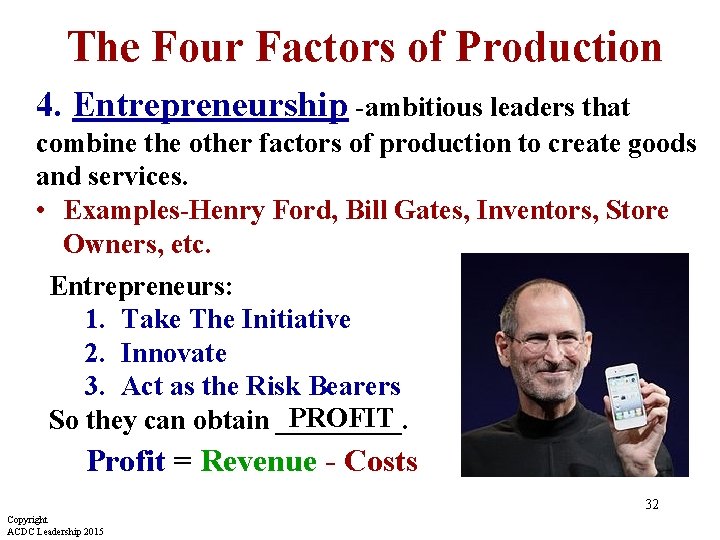
The Four Factors of Production 4. Entrepreneurship -ambitious leaders that combine the other factors of production to create goods and services. • Examples-Henry Ford, Bill Gates, Inventors, Store Owners, etc. Entrepreneurs: 1. Take The Initiative 2. Innovate 3. Act as the Risk Bearers PROFIT So they can obtain _____. Profit = Revenue - Costs 32 Copyright ACDC Leadership 2015