
WELCOME to the SAASTA Astro Quiz 2017 NATIONAL




- Slides: 41
WELCOME to the SAASTA Astro. Quiz 2017 NATIONAL FINALS 5 OCTOBER 2017
RULES OF THE QUIZ • The audience must be silent throughout the quiz and NOT whisper to anyone. • No resource material can be taken into the quiz venue. • Teams have up to 1 minute to discuss each answer and must reveal their answers immediately when the signal is given that the time is up. • The scores will be calculated and given after THE FIRST ten questions ONLY and overall winners will be announced at the Awards function in the evening. • The audience will get a chance to win prizes! • A tie-break will be settled on a “sudden death” basis, involving tied teams only (i. e. as soon as a team falls behind on correct answers, it is knocked out).
QUESTION 1 Which of the following objects is the largest? A. B. C. D. Star Galaxy solar system planet
QUESTION 2 What country launched the world's first artificial satellite, the Sputnik? A. B. C. D. China Germany USSR United States
QUESTION 3 Isaac Newton created the first ____ telescope. A. B. C. D. Refracting Reflecting Transmitting Rotating
QUESTION 4 Which of the following is NOT one of the four broad categories of satellites? A. B. C. D. Intelligence Scientific Communication Navigation
QUESTION 5 Probes have been used to investigate only other planets. A. False B. True
QUESTION 6 On Friday, 15 September 2017, one spacecraft crashed into a certain planet. Which spacecraft was that? A. B. C. D. Soyuz Opportunity Cassini Voyager 1
QUESTION 7 A building containing one or more telescopes is referred to as: A. B. C. D. An Observatory An Astrobuilding An Observation House A Star Deck
QUESTION 8 What colour is a star when it is cool? A. B. C. D. Blue Yellow Green Orange
QUESTION 9 An Astronomical Unit (AU) is the average distance between…? A. B. C. D. The Sun and the Moon The Sun and Pluto The Sun and the Earth The Earth and the Moon
QUESTION 10 A spacecraft crashed into which planet on 15 September 2017? A. B. C. D. Mars Jupiter Uranus Saturn
QUESTION 11 Which of the following statements about Mars is true? A. B. C. D. It is the only planet except Earth to be visited by humans C and D below It is believed that liquid water once formed rivers and ocean on the surface of Mars millions of years ago. Ice water has been found on Mars surface
QUESTION 12 Which of the following is true? A. Venus is hotter than Mercury because of the greenhouse effect B. Mercury is hotter than Venus because it is nearest to the Sun C. Jupiter is hotter than Mercury because it is the largest planet in the solar system D. None of the above
QUESTION 13 Which of the following is not true? A. All planets revolve around the Sun in the same direction B. The tilt of the rotation axis of Uranus is unlike any other planet in the solar system C. All planets revolve around the Sun in the same direction, except Mars D. A and B above
QUESTION 14 Choose the true statements about Ceres. It is: i. in the Kuiper Belt. ii. a dwarf planet. iii. in the asteroid belt. iv. the largest comet. The true statements are: A. i & ii B. ii & iii C. i & iii D. i & iv
QUESTION 15 The time interval between identical lunar (e. g between full moon and full moon) phases is approximately: A. B. C. D. 29. 5 days 31 days 27. 3 days 30 days or 31 days depending on length of the month
QUESTION 16 Tswaing, Vredefort, Morokweng and Kalkkop are: A. B. C. D. Villages in South Africa Impact craters outside South Africa Dwarf planets in the Kuiper Belt Impact craters in South Africa
QUESTION 17 The largest verified and the second oldest crater is: A. B. C. D. Tswaing Kalkkop Vredefort Morokweng
QUESTION 18 Unlike the Earth, the Moon does not have an atmosphere to protect itself from impacting bodies. A. True B. False
QUESTION 19 In which South African province do we find the Vredefort crater? A. B. C. D. Eastern Cape Free State North West Limpopo
QUESTION 20 There are not as many craters on Earth as on the Moon because: A. B. C. D. The Earth is bigger than the Moon and cannot be attacked easily by asteroids The Earth has effective erosion mechanisms that erode away craters at a rapid rate The Earth moves at a faster speed than the Moon and so it is missed The surface of the Moon is softer than that of the Earth’s and hence it is more sensitive
QUESTION 21 Ordered from hottest to coolest stars, which arrangement is correct? A. B. C. D. Red; white; blue; yellow White; Red; blue; yellow Blue; White; Yellow; Red White; blue; Red; yellow
QUESTION 22 Stars are formed in clouds of gas and dust known as: A. B. C. D. Nebulae Planets Galaxies Craters
QUESTION 23 The exact lifetime of a star depends on its: A. B. C. D. Colour Temperature Brightness Mass
QUESTION 24 White dwarfs are formed from the collapse of low mass stars, whilst neutron stars are formed in the collapse of a massive star’s core. A. False B. True
QUESTION 25 Which of the following planets is the fourth largest by diameter and third most massive planet? A. B. C. D. Earth Uranus Neptune Saturn
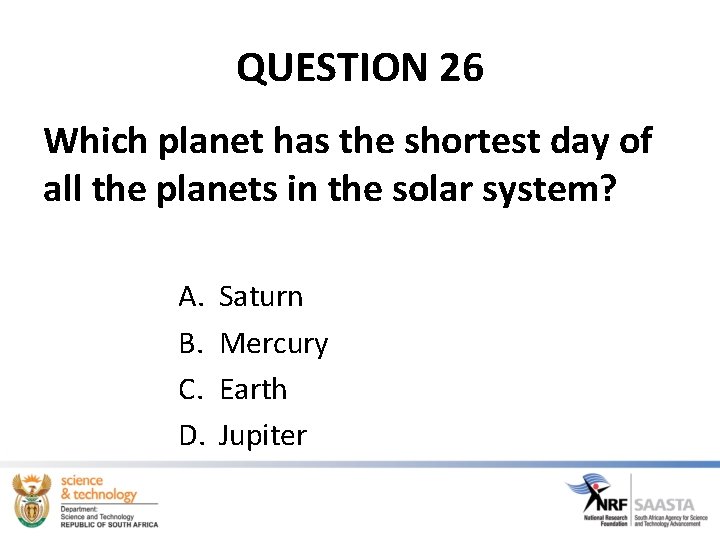
QUESTION 26 Which planet has the shortest day of all the planets in the solar system? A. B. C. D. Saturn Mercury Earth Jupiter
QUESTION 27 Which of the following planets has the highest density of all the planets in the solar system? A. B. C. D. Earth Jupiter Neptune Saturn
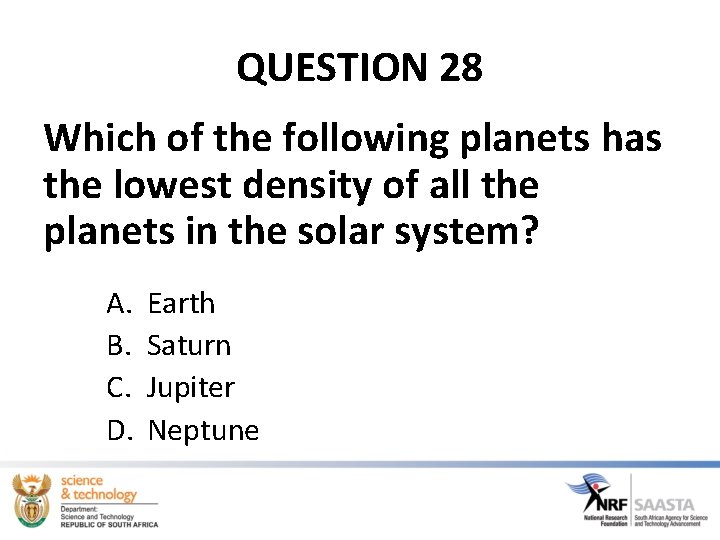
QUESTION 28 Which of the following planets has the lowest density of all the planets in the solar system? A. B. C. D. Earth Saturn Jupiter Neptune
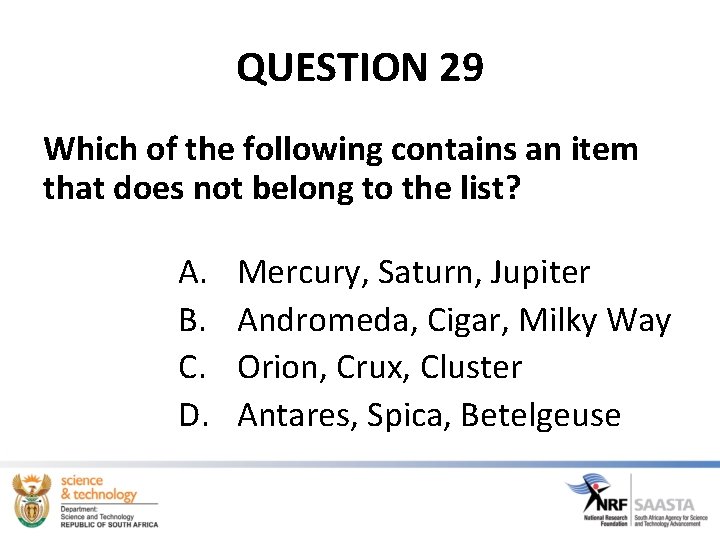
QUESTION 29 Which of the following contains an item that does not belong to the list? A. B. C. D. Mercury, Saturn, Jupiter Andromeda, Cigar, Milky Way Orion, Crux, Cluster Antares, Spica, Betelgeuse
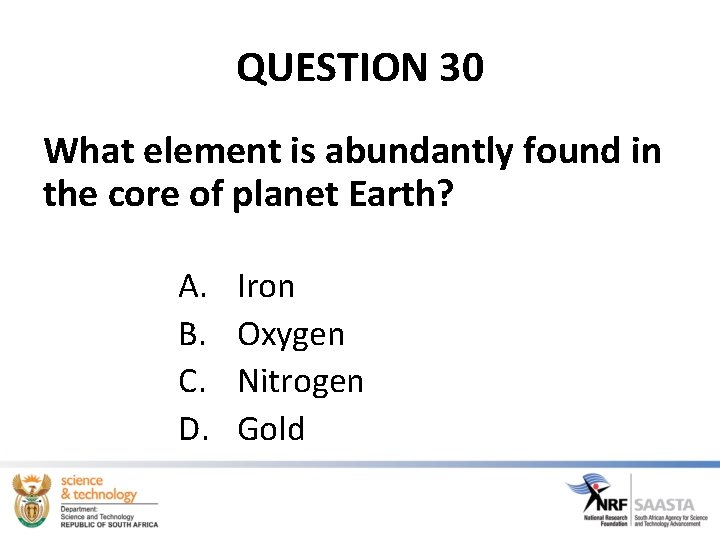
QUESTION 30 What element is abundantly found in the core of planet Earth? A. B. C. D. Iron Oxygen Nitrogen Gold
THANK YOU FOR PARTICIPATING
SUDDEN DEATH TIE BREAKERS
PLEASE REMEMBER: The first team to get the first correct answer is the winner! ALL THE BEST!
QUESTION 1 South Africa's Meer. KAT telescope is an SKA precursor or 'pathfinder' telescope. How many dish-shaped antennas will it consist of? A. B. C. D. 46 47 64 74
QUESTION 2 The nearest planet to the Sun with more than one moon is: A. Mercury B. Mars C. Venus D. Earth
QUESTION 3 Which of the following statements is the most accurate about the seasons? A. Seasons occur because the Sun goes around the Earth B. Seasons occur because the Earth goes around the Sun C. Seasons occur because the Earth goes around the Sun and its axis is tilted at 23. 50 to the plane of its orbit D. Seasons occur because the Earth’s orbit brings it nearer and further away from the Sun
QUESTION 4 Which one of the following is true? A. A galaxy is made of a few collections of stars held together by gravity B. None of the stars in a galaxy have the same gravity C. Galaxies contain stars only D. A galaxy is a collection of many stars, gas and dust which are held together by gravity
QUESTION 5 Planets in the solar system shine by: A. Nuclear fusion in their cores B. Refracting sunlight C. Reflecting sunlight D. B and C above
THANK YOU FOR PARTICIPATING!