
AQA Paper 3 what is it Covers ALL


- Slides: 17
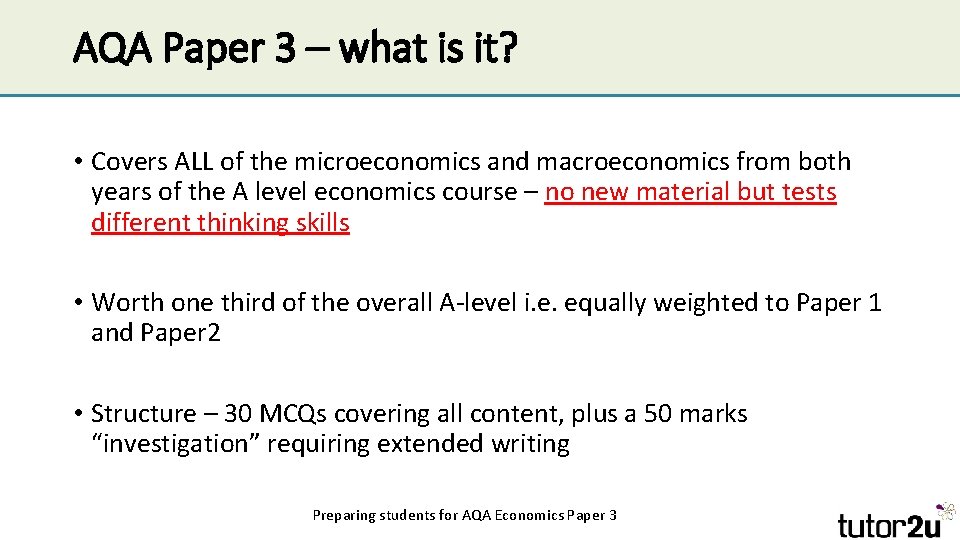
AQA Paper 3 – what is it? • Covers ALL of the microeconomics and macroeconomics from both years of the A level economics course – no new material but tests different thinking skills • Worth one third of the overall A-level i. e. equally weighted to Paper 1 and Paper 2 • Structure – 30 MCQs covering all content, plus a 50 marks “investigation” requiring extended writing Preparing students for AQA Economics Paper 3
Exam focus – paper structure • Section A • 30 MCQs • Mix of AS and 2 nd year A level content, across micro and macro topics • Easy place to test quantitative skills (minimum 20% across the entire A-level assessment) • No longer than 45 minutes • Section B “investigation” • 50 marks • 10 m data comparison/handling exercise • 15 m explanation question • 25 m essay/judgement question Preparing students for AQA Economics Paper 3
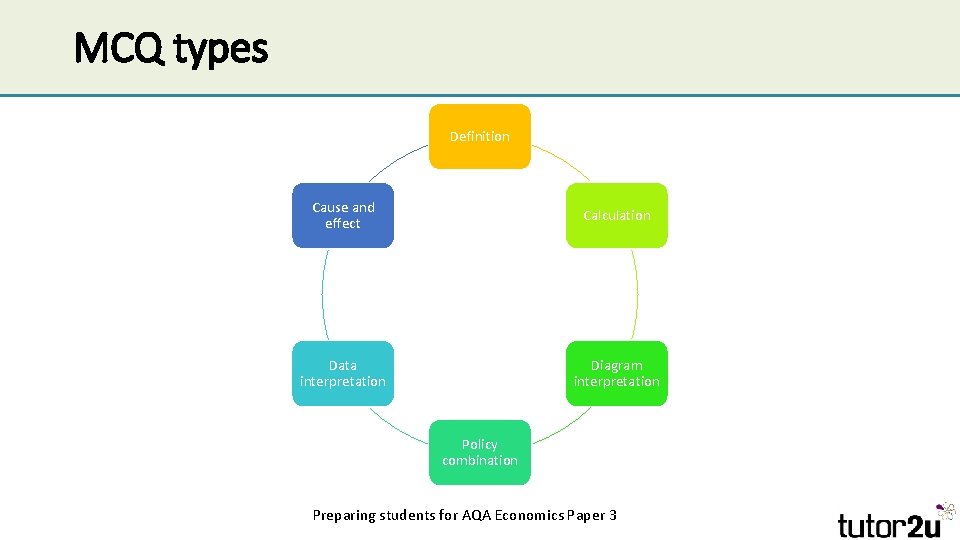
MCQ types Definition Cause and effect Calculation Data interpretation Diagram interpretation Policy combination Preparing students for AQA Economics Paper 3
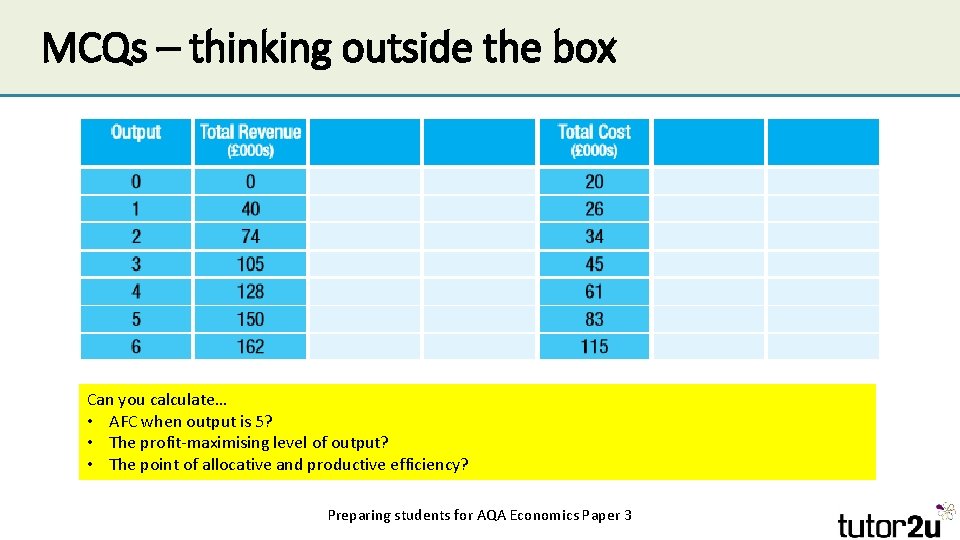
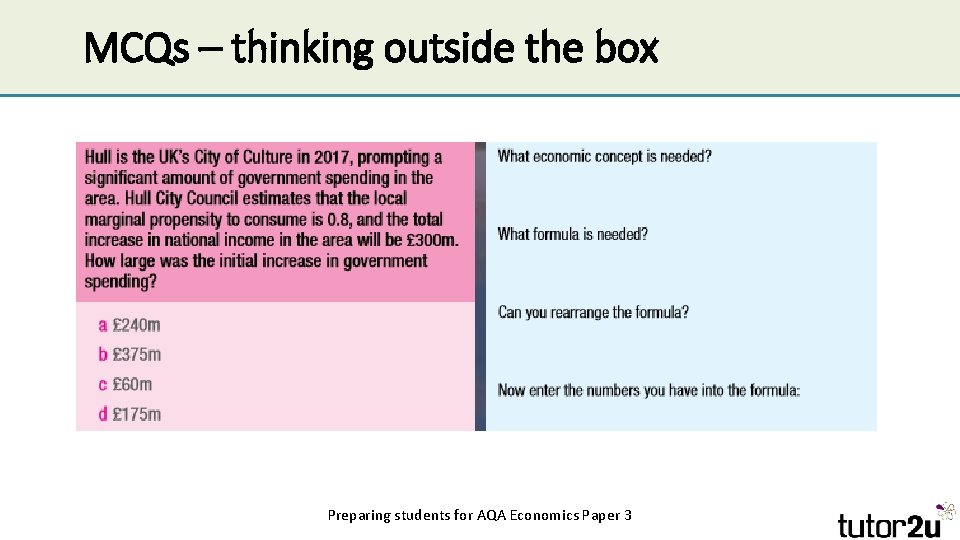
MCQs – thinking outside the box Can you calculate… • AFC when output is 5? • The profit-maximising level of output? • The point of allocative and productive efficiency? Preparing students for AQA Economics Paper 3
MCQs – thinking outside the box Preparing students for AQA Economics Paper 3
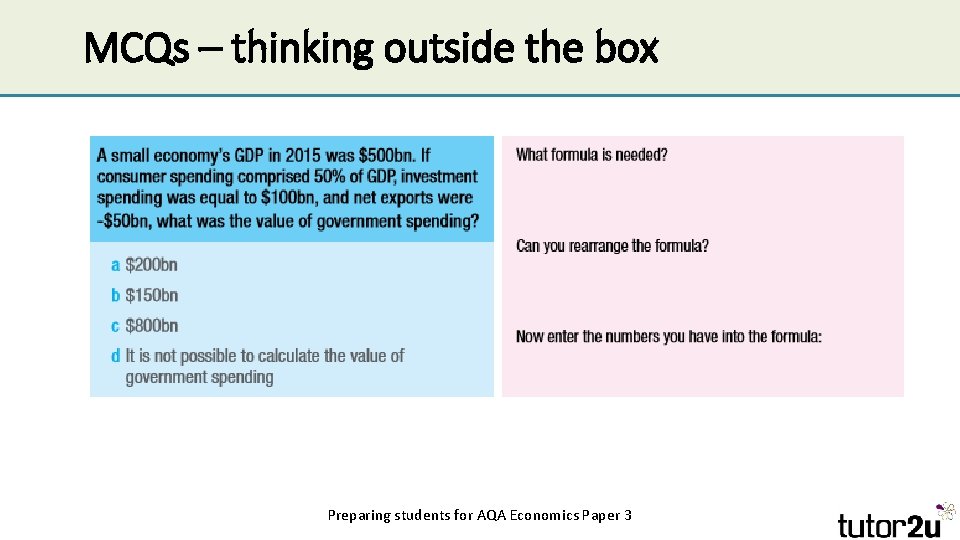
MCQs – thinking outside the box Preparing students for AQA Economics Paper 3
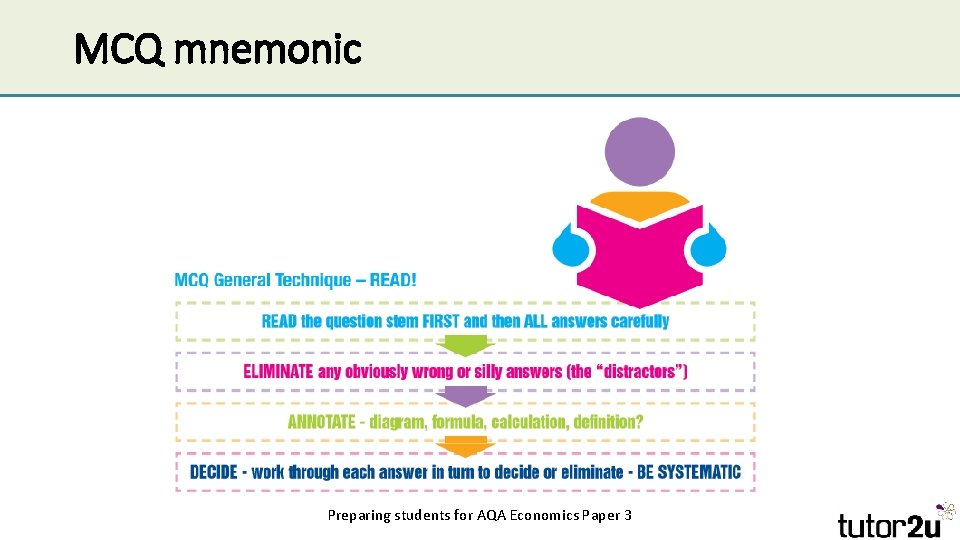
MCQ mnemonic Preparing students for AQA Economics Paper 3
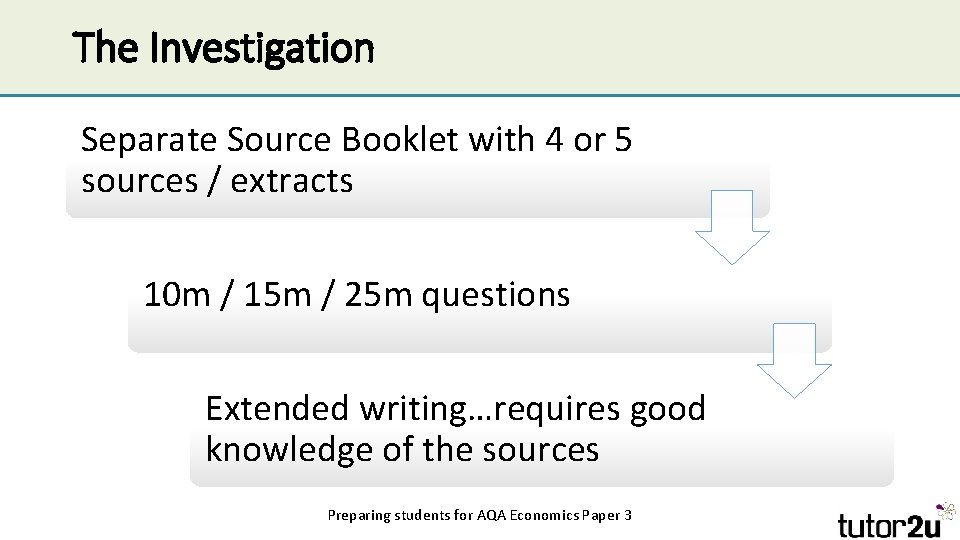
The Investigation Separate Source Booklet with 4 or 5 sources / extracts 10 m / 15 m / 25 m questions Extended writing…requires good knowledge of the sources Preparing students for AQA Economics Paper 3
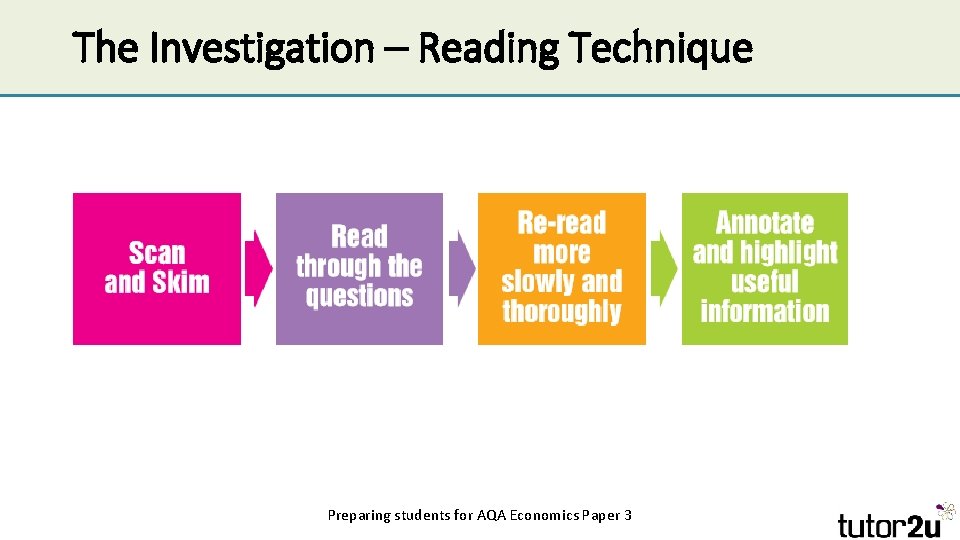
The Investigation – Reading Technique Preparing students for AQA Economics Paper 3
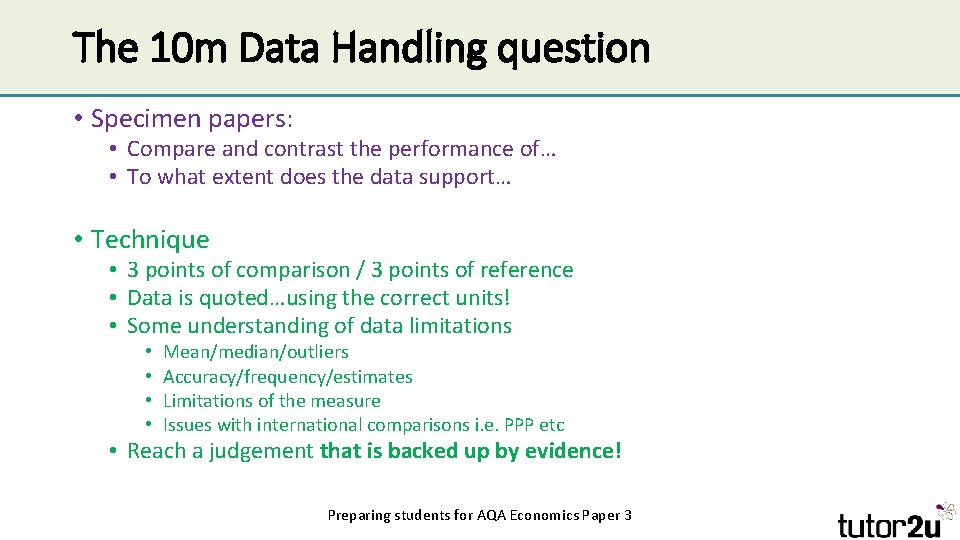
The 10 m Data Handling question • Specimen papers: • Compare and contrast the performance of… • To what extent does the data support… • Technique • 3 points of comparison / 3 points of reference • Data is quoted…using the correct units! • Some understanding of data limitations • • Mean/median/outliers Accuracy/frequency/estimates Limitations of the measure Issues with international comparisons i. e. PPP etc • Reach a judgement that is backed up by evidence! Preparing students for AQA Economics Paper 3
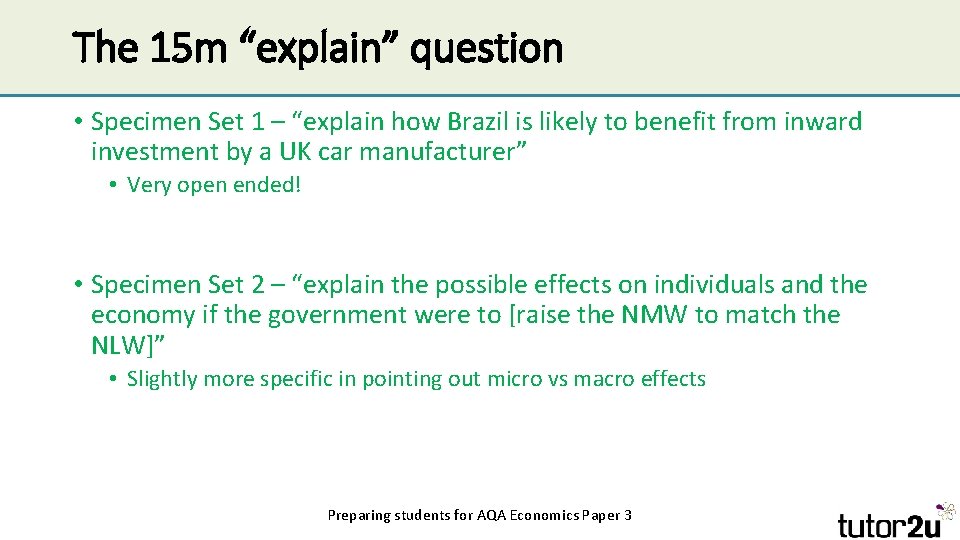
The 15 m “explain” question • Specimen Set 1 – “explain how Brazil is likely to benefit from inward investment by a UK car manufacturer” • Very open ended! • Specimen Set 2 – “explain the possible effects on individuals and the economy if the government were to [raise the NMW to match the NLW]” • Slightly more specific in pointing out micro vs macro effects Preparing students for AQA Economics Paper 3
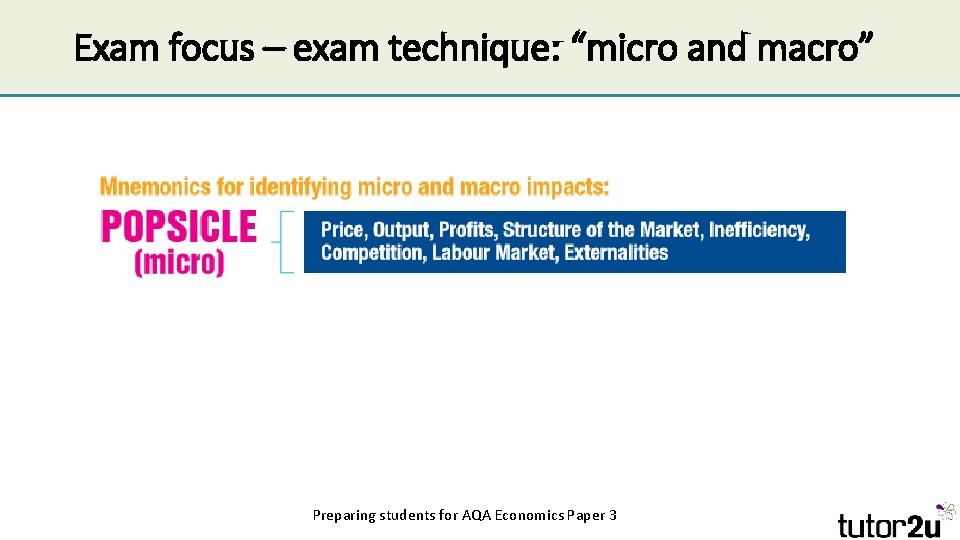
Exam focus – exam technique: “micro and macro” Preparing students for AQA Economics Paper 3
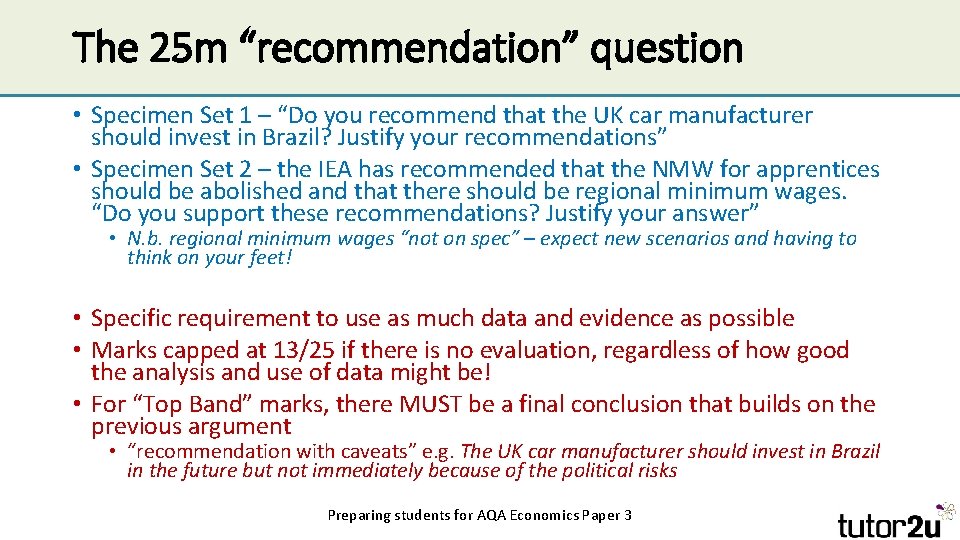
The 25 m “recommendation” question • Specimen Set 1 – “Do you recommend that the UK car manufacturer should invest in Brazil? Justify your recommendations” • Specimen Set 2 – the IEA has recommended that the NMW for apprentices should be abolished and that there should be regional minimum wages. “Do you support these recommendations? Justify your answer” • N. b. regional minimum wages “not on spec” – expect new scenarios and having to think on your feet! • Specific requirement to use as much data and evidence as possible • Marks capped at 13/25 if there is no evaluation, regardless of how good the analysis and use of data might be! • For “Top Band” marks, there MUST be a final conclusion that builds on the previous argument • “recommendation with caveats” e. g. The UK car manufacturer should invest in Brazil in the future but not immediately because of the political risks Preparing students for AQA Economics Paper 3
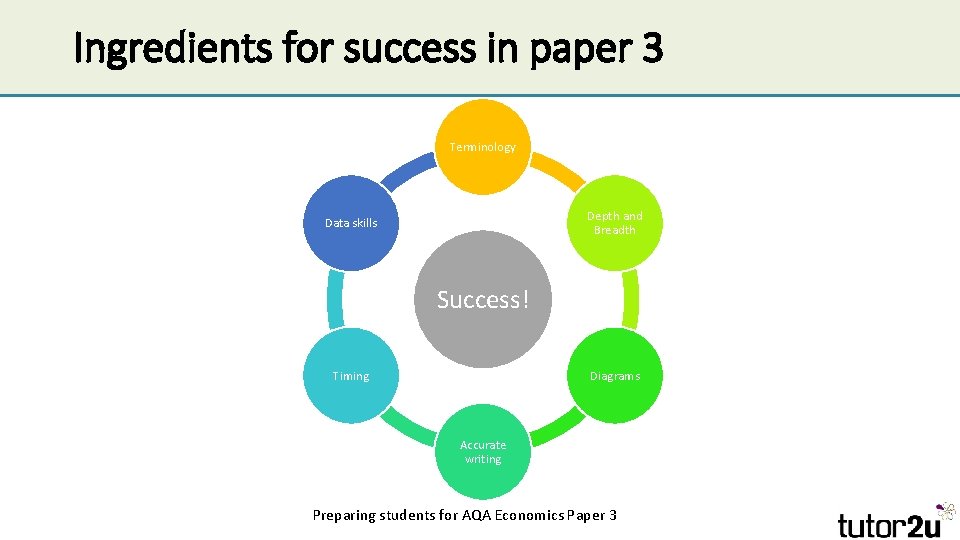
Ingredients for success in paper 3 Terminology Depth and Breadth Data skills Success! Timing Diagrams Accurate writing Preparing students for AQA Economics Paper 3
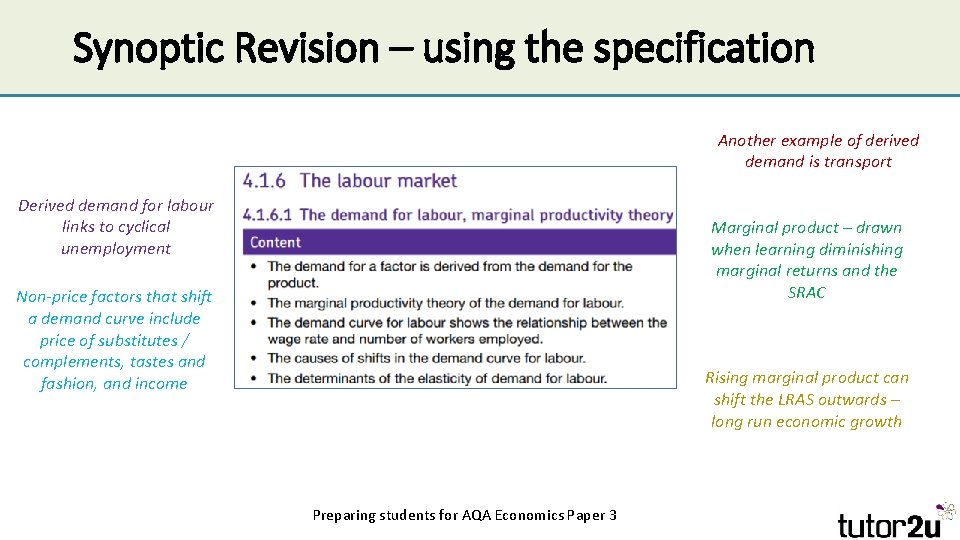
Obvious synoptic topics Labour Markets Financial Markets • Productivity, Poverty / inequality • Micro – wage rates, labour market failure etc • Macro – SRAS and costs, LRAS position, unemployment, flexibility • Micro – analysis of different markets e. g. bonds; types of bank & objectives; bubbles • Macro – monetary policy, operation of the Central Bank, financial regulation Behavioural Economics • Micro – decision making, factors influencing D&S • Macro – nudges for fiscal policy, supply side policies etc Technological issues, and competition policy • Factors influencing market structures / costs / external economies of scale • Factors affecting LRAS Preparing students for AQA Economics Paper 3 Externalities • Micro – types of market failure • Macro – disadvantages of growth and international trade Development Economics • Micro Commodity markets, inequality, health & education • Macro – policies, trade
Synoptic Revision – using the specification Another example of derived demand is transport Derived demand for labour links to cyclical unemployment Marginal product – drawn when learning diminishing marginal returns and the SRAC Non-price factors that shift a demand curve include price of substitutes / complements, tastes and fashion, and income Rising marginal product can shift the LRAS outwards – long run economic growth Preparing students for AQA Economics Paper 3
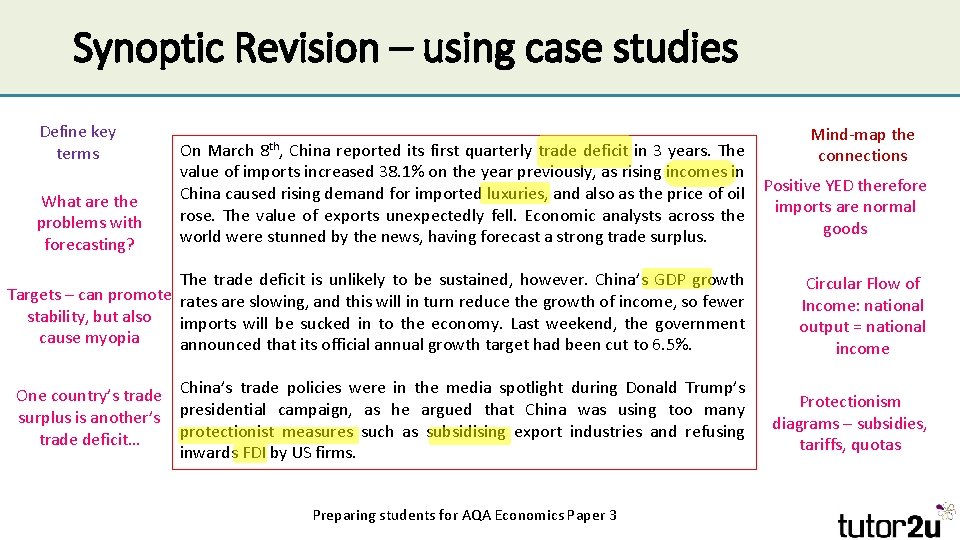
Synoptic Revision – using case studies Define key terms Mind-map the connections On March China reported its first quarterly trade deficit in 3 years. The value of imports increased 38. 1% on the year previously, as rising incomes in China caused rising demand for imported luxuries, and also as the price of oil rose. The value of exports unexpectedly fell. Economic analysts across the world were stunned by the news, having forecast a strong trade surplus. Positive YED therefore imports are normal goods The trade deficit is unlikely to be sustained, however. China’s GDP growth Targets – can promote rates are slowing, and this will in turn reduce the growth of income, so fewer stability, but also imports will be sucked in to the economy. Last weekend, the government cause myopia announced that its official annual growth target had been cut to 6. 5%. Circular Flow of Income: national output = national income One country’s trade China’s trade policies were in the media spotlight during Donald Trump’s surplus is another’s presidential campaign, as he argued that China was using too many protectionist measures such as subsidising export industries and refusing trade deficit… inwards FDI by US firms. Protectionism diagrams – subsidies, tariffs, quotas What are the problems with forecasting? 8 th, Preparing students for AQA Economics Paper 3