An ESP Program for Students of Tourism Simon

- Slides: 18
An ESP Program for Students of Tourism Simon Magennis Professor: Dr. Hsiu-Hui Su 10022601 Min-Han Tsai
INTRODUCTION • There is surprisingly little literature on the subject which is about tourism industry English. • The professional literature has not adequately defined or addressed the topic of ESP in the tourism industry , nor have many English language programs and materials been created specially for this area. • Describing English for tourism professionals in greater detail and documenting 3 years of teaching English to students of tourism at degree level in Portugal.
The School • ISAI is a private, fee-based college in Porto, Portugal. • ISAI awards 3 and 4 year degrees that are recognized by the Portuguese Ministry of Education and serve as professional qualifications for those seeking a career in the tourism industry. • The formal statement of the program content is broad enough to allow language teachers and academic coordinators to interpret it in light of the actual classroom situation. • Levels or standards, as well as actual content, are ultimately the responsibility of the staff directly at the chalkboard.
Students • Portuguese students have fewer difficulties with English than their peers in Spain because the broad Portuguese phonetic system enables students to learn an accentless English with few pronunciation difficulties. • Language levels among students at the ISAI have varied considerably from year to year. • Private, fee-paying colleges are often viewed as second choices to public universities, as entrance is not usually limited once students have satisfied the minimum requirement of a 12 -grade education. • Some students with high scores are strongly motivated to develop careers in tourism and select the program as their first choice, but others there are few higher education options open to them due to their low examination scores.
ETP • A preliminary definition of ETP could divide its domains into for areas: face-to-face customer service, back-office routine, line management, and strategic planning. • This characterization of ETP offers a broad prioritized view of appropriate situations for inclusion at different stages. (customer service is for the earlier part of the course, but the strategic management elements are more appropriate at the end. ) • This classification also corresponds to some extent to the other content areas of the degree.
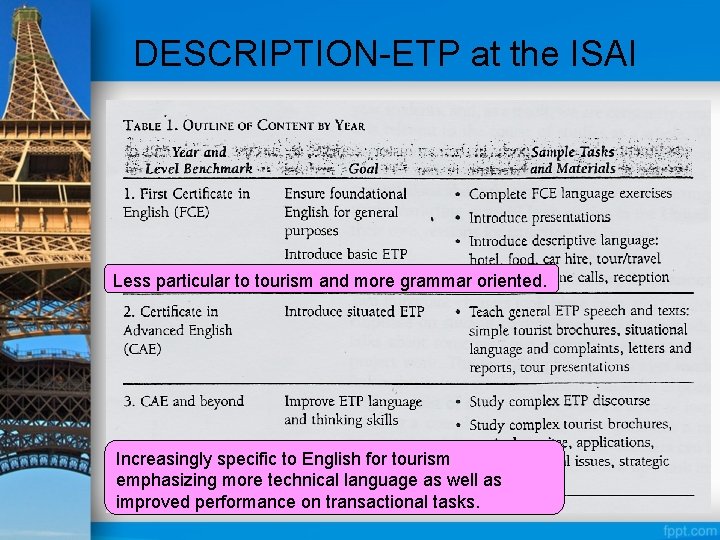
DESCRIPTION-ETP at the ISAI Less particular to tourism and more grammar oriented. Increasingly specific to English for tourism emphasizing more technical language as well as improved performance on transactional tasks.
DISTINGUSHING FEATURES • Goal-Directed Learning • Relevant Materials • Learning Activities in Reinforcing Sequences • Testing and Evaluation
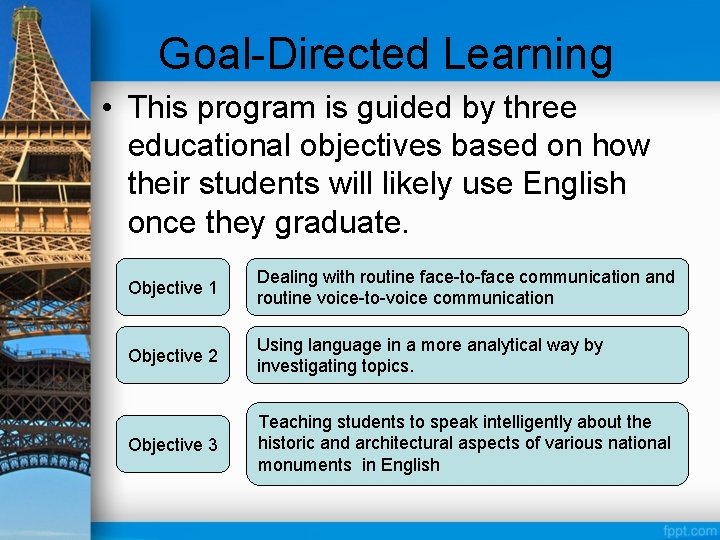
Goal-Directed Learning • This program is guided by three educational objectives based on how their students will likely use English once they graduate. Objective 1 Dealing with routine face-to-face communication and routine voice-to-voice communication Objective 2 Using language in a more analytical way by investigating topics. Objective 3 Teaching students to speak intelligently about the historic and architectural aspects of various national monuments in English
Relevant Materials • Discussing the elements of Baroque and Gothic architecture in our ETP class and ask students to give oral presentations about the major monuments in Portugal. • Asking students to study marketing material from resorts in the United States and have them produce their own versions for attractions in Portugal.
Learning Activities in Reinforcing Sequences • The first important change was an increasing emphasis on student presentations of various kinds. • The second type of presentations results from a conscious attempt to link activities into reinforcing sequences as far as possible.
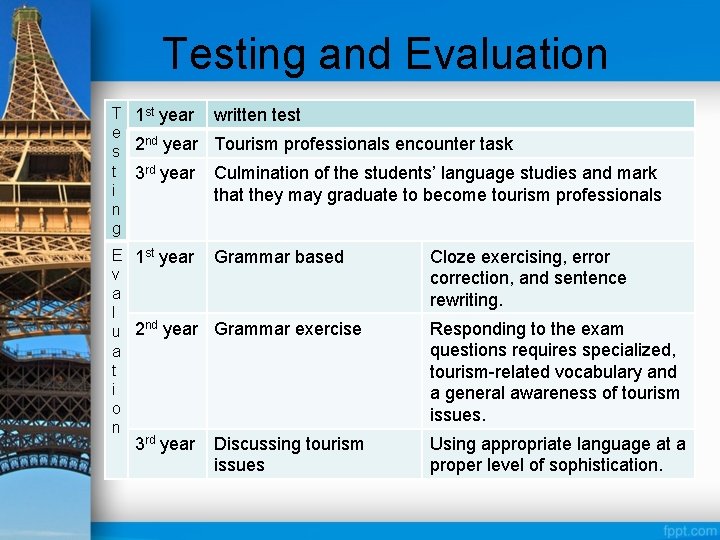
Testing and Evaluation T 1 st year e nd s 2 year t 3 rd year i n g written test E 1 st year v a l nd u 2 year a t i o n Grammar based Cloze exercising, error correction, and sentence rewriting. Grammar exercise Responding to the exam questions requires specialized, tourism-related vocabulary and a general awareness of tourism issues. Discussing tourism issues Using appropriate language at a proper level of sophistication. 3 rd year Tourism professionals encounter task Culmination of the students’ language studies and mark that they may graduate to become tourism professionals
PRACTICAL IDEAS Supplement Textbooks With Authentic Materials • Textbook: Test Your Business English: Hotel and Catering(Pohl, 1996) and Toursim(Mc. Burney, 1996) • Travel magazines, travel supplements, and advertisements in newspapers; tourism textbooks for native speakers; travel brochures; first language and second language encyclopedias; travel guides; and materials found on the Internet. • Brochure, basis for many activities, are worth collecting. It includes useful country files that develop the students’ content knowledge and reading skills and serve as models for presenting factual information.
Include a Variety of Workplace. Related Activities • City Guide Leaflet and Tourist Office Role Play • Short and Long Presentations • Brochure Activities • Other Role Plays
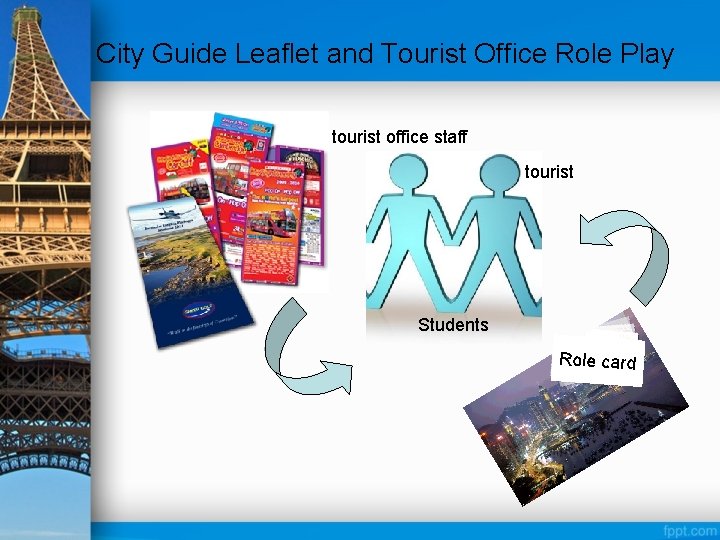
City Guide Leaflet and Tourist Office Role Play tourist office staff tourist Students Role card
Short and Long Presentations • The initial objective is simply to ensure that all the students overcome their nervousness and actually present something. • During the presentation, teacher answers vocabulary queries and gives individual attention to grammar that frequently arise. • Taking notes, asking a few of students to summarize what a speaker has said and using a worksheet are ensuring way that student listen. • A major objective is to familiarize students with speaking about Portuguese monuments and attractions before audience.
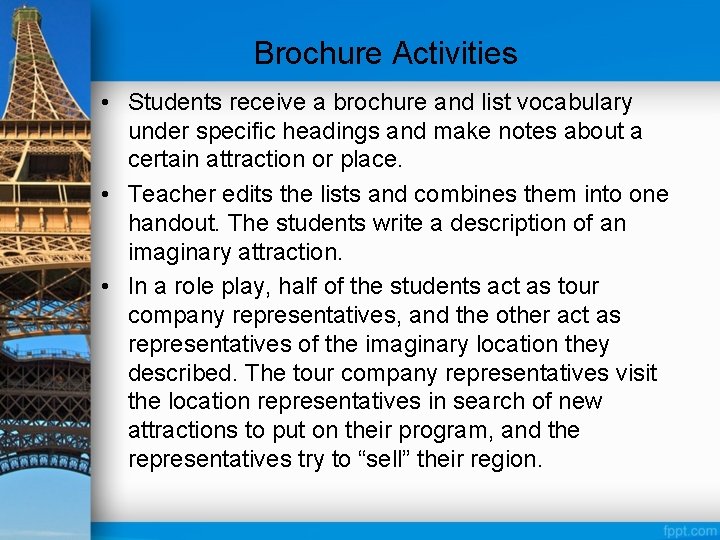
Brochure Activities • Students receive a brochure and list vocabulary under specific headings and make notes about a certain attraction or place. • Teacher edits the lists and combines them into one handout. The students write a description of an imaginary attraction. • In a role play, half of the students act as tour company representatives, and the other act as representatives of the imaginary location they described. The tour company representatives visit the location representatives in search of new attractions to put on their program, and the representatives try to “sell” their region.
CONCLUSION • Developing more material related to local geography and art history in cooperation with the content teachers in these areas. • The program will probably also increase its use of the Internet to avoid duplication of effort and another advantage is that suitable authoring tools are becoming easier to use and less expensive. • More generally, training in languages will become ever more important with the tourism industry, and many of the language skills required are identical across languages as tourists worldwide have essentially the same set of needs and tourism industry the same set of products. A systematic approach to defining these language requirements would be beneficial for all involved.
Thank for listening~!!