Aim How accurate are our memories How can



- Slides: 31
Aim: How accurate are our memories? How can false memories be created? DO NOW: • What is a PEG Word Device? Homework • Read “How Reliable is Eyewitness Testimony? ” and write a response. • Wednesday- Memory and Problem Solving Test
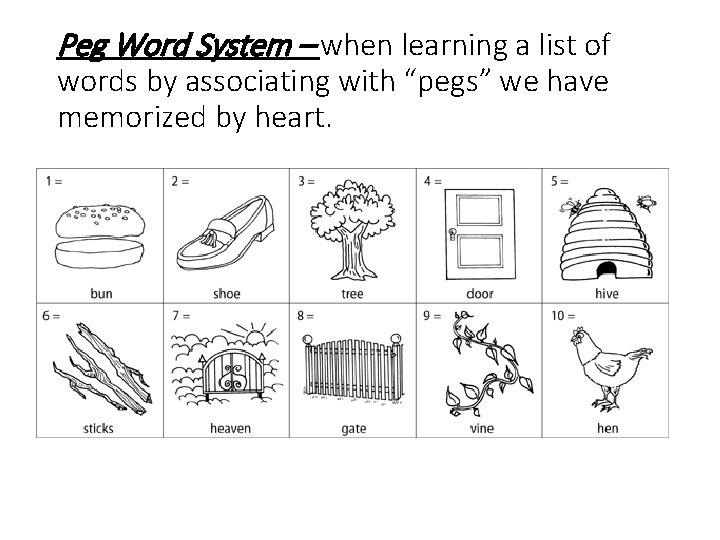
Peg Word System – when learning a list of words by associating with “pegs” we have memorized by heart.
THEORIES OF FORGETTING What are some theories of forgetting?
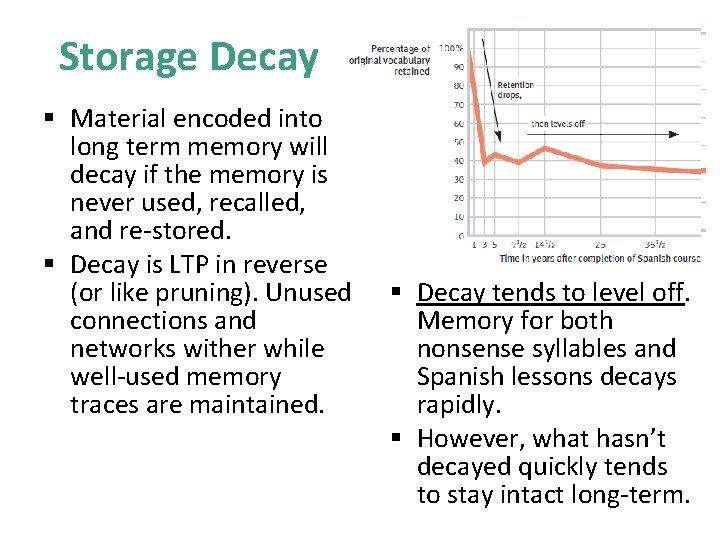
Storage Decay § Material encoded into long term memory will decay if the memory is never used, recalled, and re-stored. § Decay is LTP in reverse (or like pruning). Unused connections and networks wither while well-used memory traces are maintained. § Decay tends to level off. Memory for both nonsense syllables and Spanish lessons decays rapidly. § However, what hasn’t decayed quickly tends to stay intact long-term.
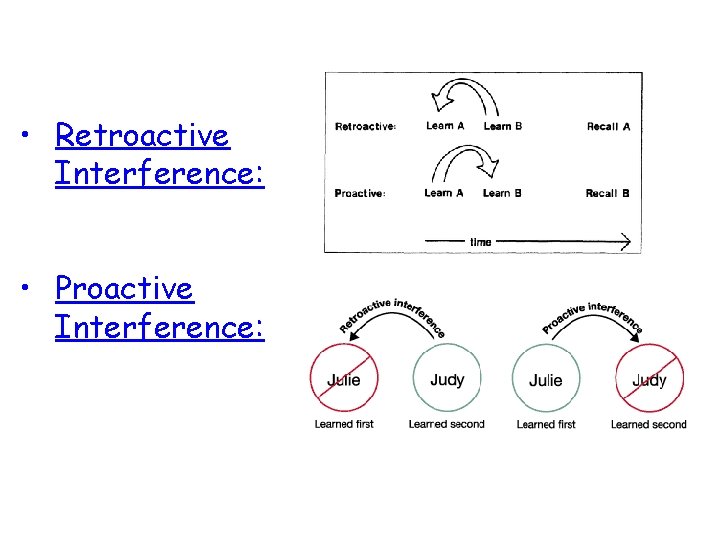
Interference and Positive Transfer § Old and new memories can interfere with each other, making it difficult to store new memories and retrieve old ones. § Occasionally, the opposite happens. In positive transfer, old information (like algebra) makes it easier to learn related new information (like calculus). § Proactive interference occurs when past information interferes (in a forward-acting way) with learning new information. § You have many strong memories of a previous principal, and this memory makes it difficult to learn the new principal’s name. § You had to change email passwords, but you keep typing the old one and can’t seem to memorize the new one.
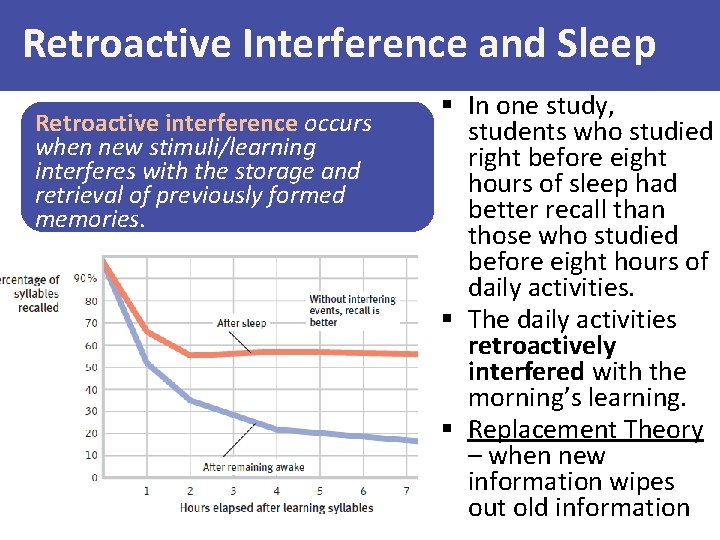
Retroactive Interference and Sleep Retroactive interference occurs when new stimuli/learning interferes with the storage and retrieval of previously formed memories. § In one study, students who studied right before eight hours of sleep had better recall than those who studied before eight hours of daily activities. § The daily activities retroactively interfered with the morning’s learning. § Replacement Theory – when new information wipes out old information
• Retroactive Interference: • Proactive Interference:
• Give an example of retroactive and proactive interference in your own life. • How and when do these types of interference occur? • What are some ways you can combat this interference? • How could you personally avoid this interference?
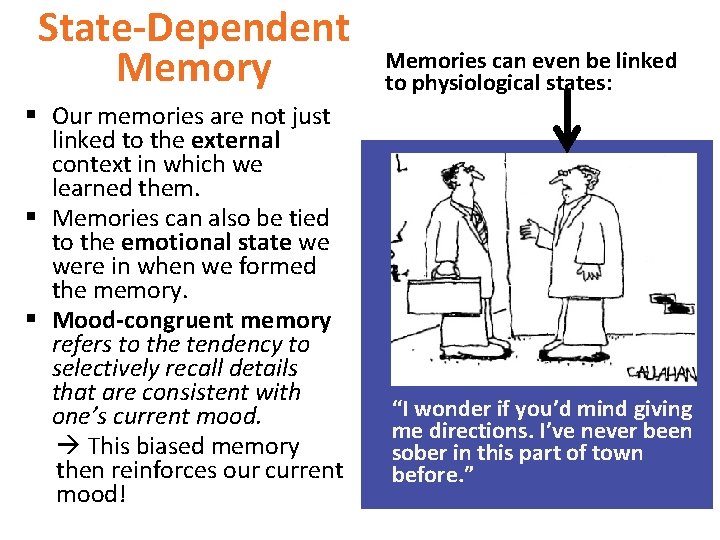
State-Dependent Memory § Our memories are not just linked to the external context in which we learned them. § Memories can also be tied to the emotional state we were in when we formed the memory. § Mood-congruent memory refers to the tendency to selectively recall details that are consistent with one’s current mood. This biased memory then reinforces our current mood! Memories can even be linked to physiological states: “I wonder if you’d mind giving me directions. I’ve never been sober in this part of town before. ”
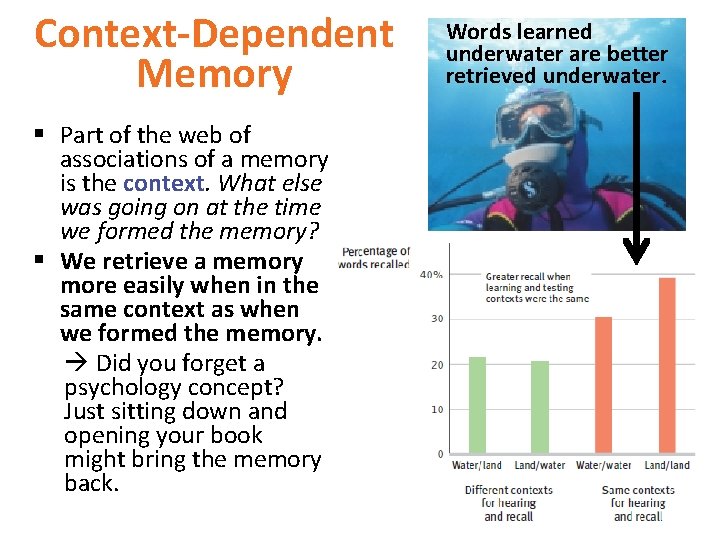
Context-Dependent Memory § Part of the web of associations of a memory is the context. What else was going on at the time we formed the memory? § We retrieve a memory more easily when in the same context as when we formed the memory. Did you forget a psychology concept? Just sitting down and opening your book might bring the memory back. Words learned underwater are better retrieved underwater.
Context/ Cue Dependent – Can’t retrieve info in memory due to insufficient cues for recall – Study in which subjects presented photos with and odor present, asked to recall photos w/ same or different odor present. Who did better? How could you apply this theory to helping me find my misplaced keys?
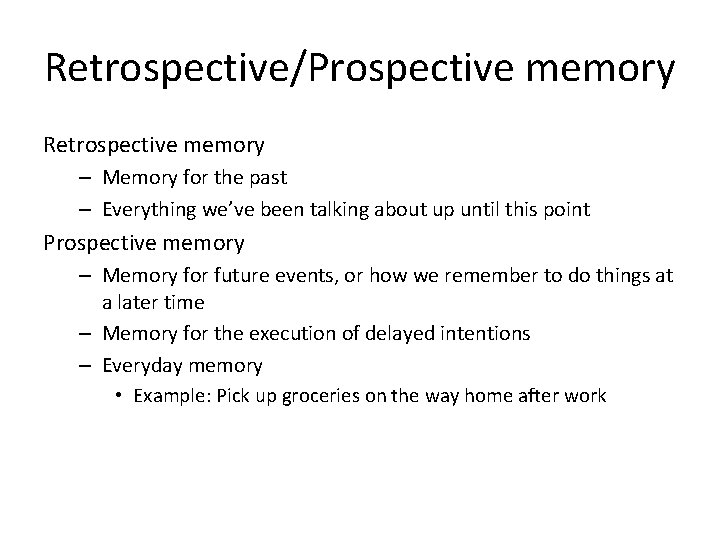
Retrospective/Prospective memory Retrospective memory – Memory for the past – Everything we’ve been talking about up until this point Prospective memory – Memory for future events, or how we remember to do things at a later time – Memory for the execution of delayed intentions – Everyday memory • Example: Pick up groceries on the way home after work
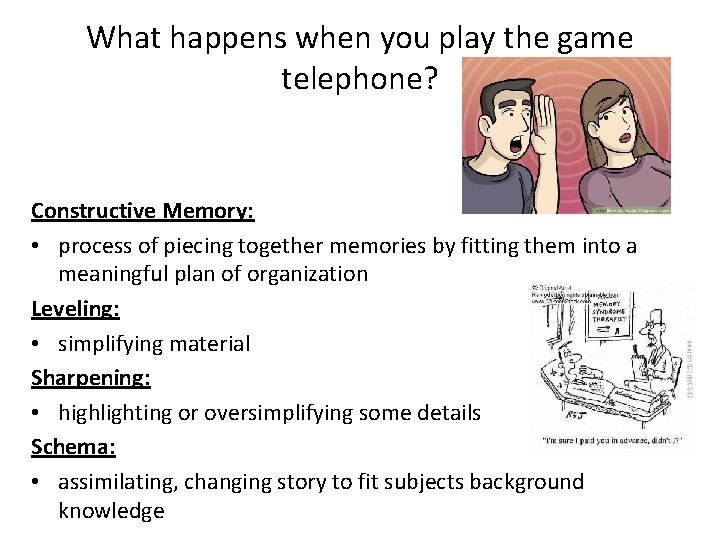
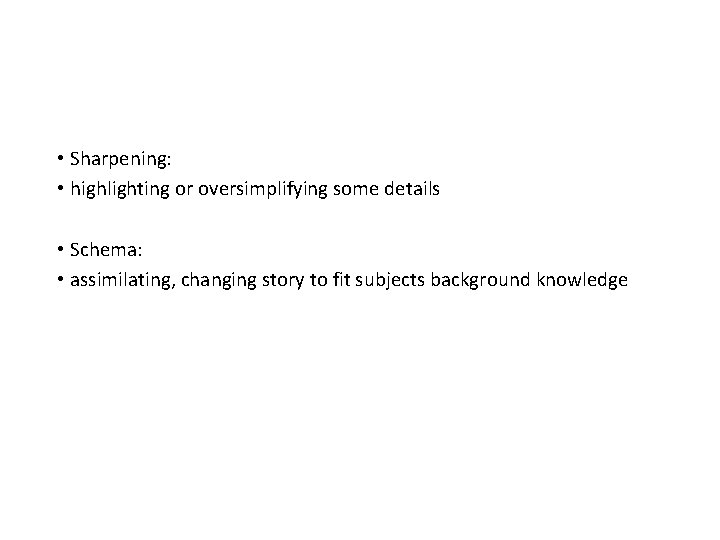
What happens when you play the game telephone? Constructive Memory: • process of piecing together memories by fitting them into a meaningful plan of organization Leveling: • simplifying material Sharpening: • highlighting or oversimplifying some details Schema: • assimilating, changing story to fit subjects background knowledge
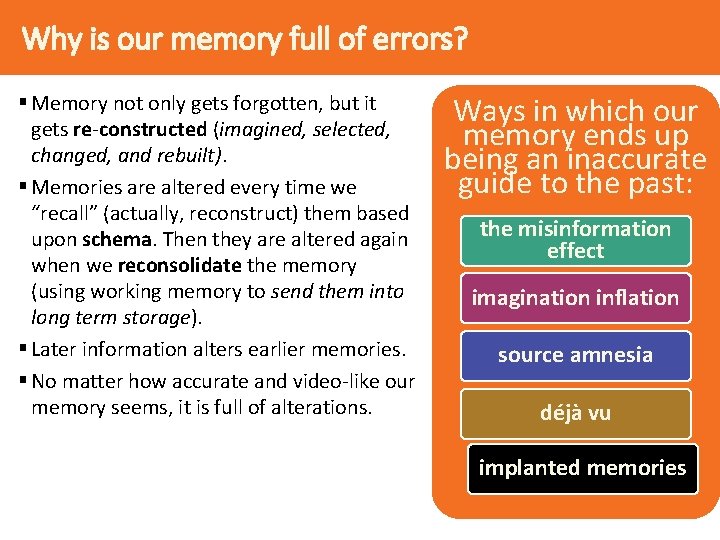
Why is our memory full of errors? § Memory not only gets forgotten, but it gets re-constructed (imagined, selected, changed, and rebuilt). § Memories are altered every time we “recall” (actually, reconstruct) them based upon schema. Then they are altered again when we reconsolidate the memory (using working memory to send them into long term storage). § Later information alters earlier memories. § No matter how accurate and video-like our memory seems, it is full of alterations. Ways in which our memory ends up being an inaccurate guide to the past: the misinformation effect imagination inflation source amnesia déjà vu implanted memories
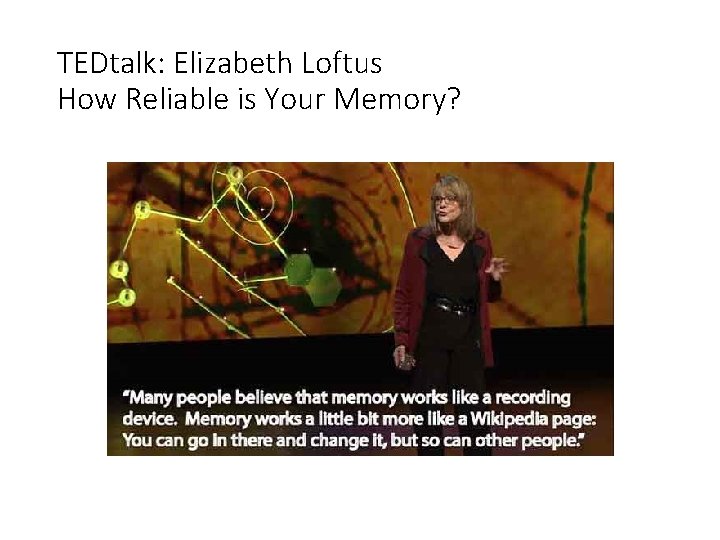
TEDtalk: Elizabeth Loftus How Reliable is Your Memory?
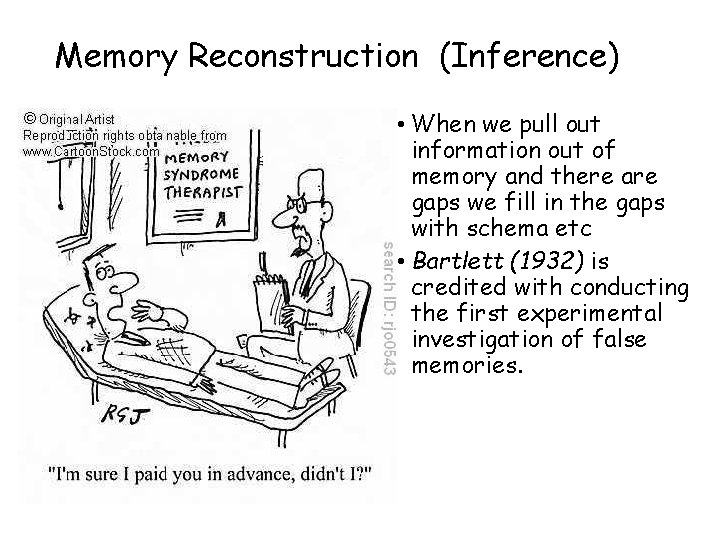
Memory Reconstruction (Inference) • When we pull out information out of memory and there are gaps we fill in the gaps with schema etc • Bartlett (1932) is credited with conducting the first experimental investigation of false memories.
Source Misattribution • When reconstructing memories we rely on many different sources and as a result we can’t distinguish your actual memory of an event w/ information you got from elsewhere. • Eg- sleeper effect – an argument that is not persuasive (it comes from a questionable source) becomes persuasive over time (mere exposure effect) – it leads to delayed attitude change over time • Confabulation - Believing something happened that never really happened
Aim: What factors influence the accuracy of eyewitness testimony? ? DO NOW: • Take out HW – Response to Article/TED TALK. • How do you think that witness went from “I think its him” to “I am positive its him”? • What factors help/hinder eyewitnesses? Homework • Wednesday- Memory and Problem Solving Test
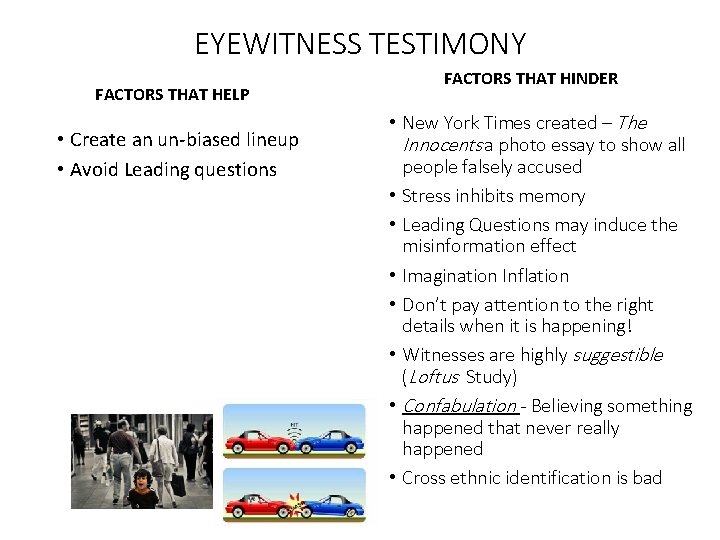
EYEWITNESS TESTIMONY FACTORS THAT HELP • Create an un-biased lineup • Avoid Leading questions FACTORS THAT HINDER • New York Times created – The Innocents a photo essay to show all people falsely accused • Stress inhibits memory • Leading Questions may induce the misinformation effect • Imagination Inflation • Don’t pay attention to the right details when it is happening! • Witnesses are highly suggestible (Loftus Study) • Confabulation - Believing something happened that never really happened • Cross ethnic identification is bad
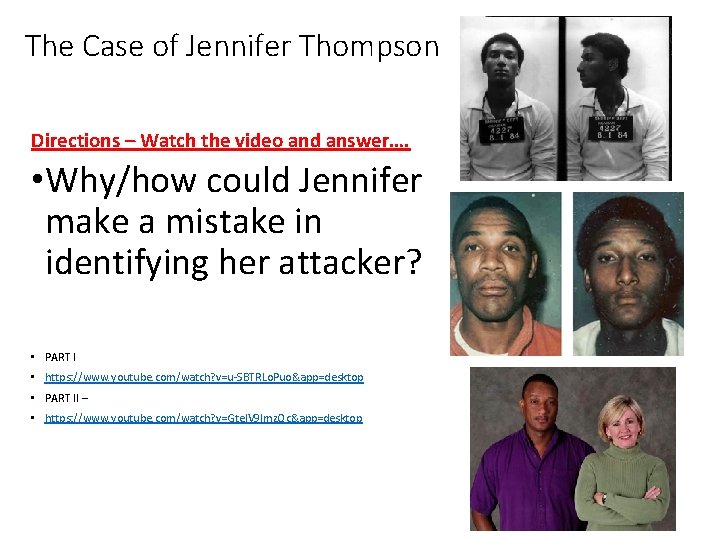
The Case of Jennifer Thompson Directions – Watch the video and answer…. • Why/how could Jennifer make a mistake in identifying her attacker? • PART I • https: //www. youtube. com/watch? v=u-SBTRLo. Puo&app=desktop • PART II – • https: //www. youtube. com/watch? v=Gtel. V 9 lmz. Qc&app=desktop
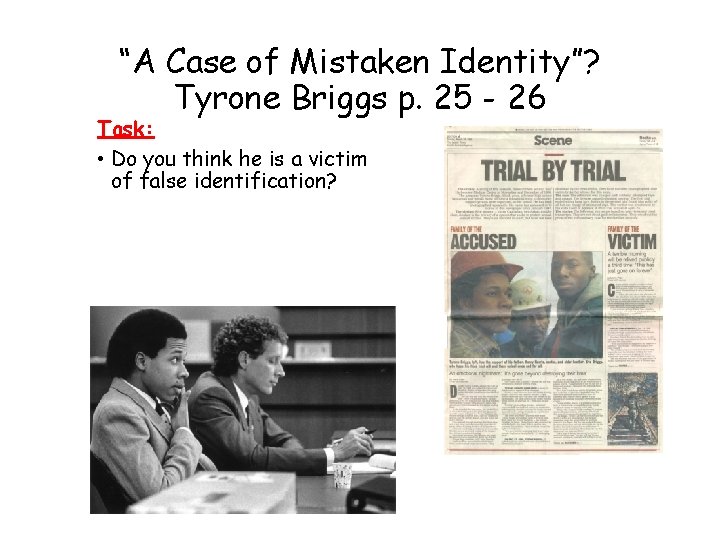
“A Case of Mistaken Identity”? Tyrone Briggs p. 25 - 26 Task: • Do you think he is a victim of false identification?
Source Amnesia • We remember an event but we can’t remember where we heard/ saw the information. • Cryptomnesia – think you come up with a new idea but you just retrieved it from old memory and fail to attribute to proper so • Attributing to the wrong source an event that we have experienced, heard about, read about, or imagined. (Also called source misattribution) Source amnesia, along with the misinformation effect, is at the heart of many false memories.
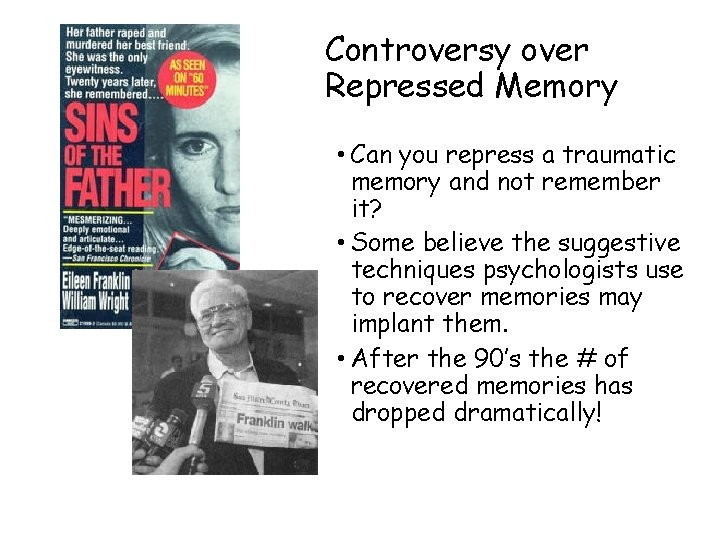
Controversy over Repressed Memory • Can you repress a traumatic memory and not remember it? • Some believe the suggestive techniques psychologists use to recover memories may implant them. • After the 90’s the # of recovered memories has dropped dramatically!
Motivated Forgetting § Memory is fallible and changeable, but can we practice motivated forgetting, that is, choosing to forget or to change our memories? § Sigmund Freud believed that we sometimes make an unconscious decision to bury our anxietyprovoking memories and hide them from conscious awareness. He called this repression. § New techniques of psychotherapy and medication interventions may allow us to “erase” (prevent reconsolidation of) recalled memories. Motivated forgetting is not common. More often: 1. recall is full of errors. 2. people try not to think about painful memories. If they fail to rehearse those memories, the memories can fade.
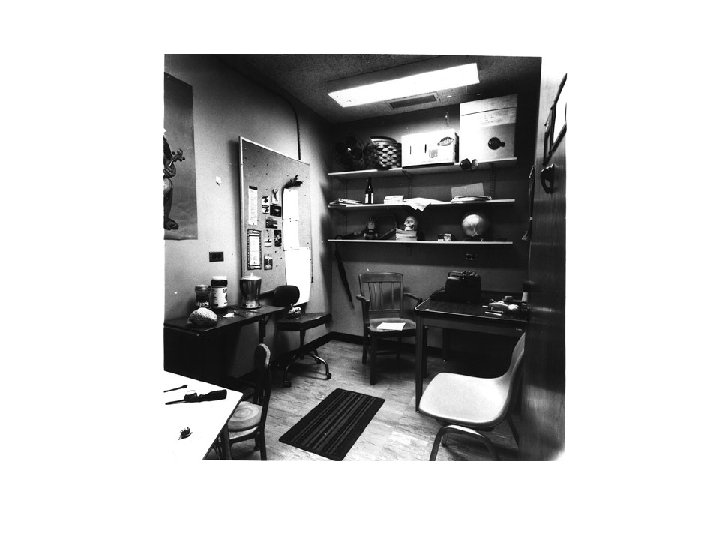
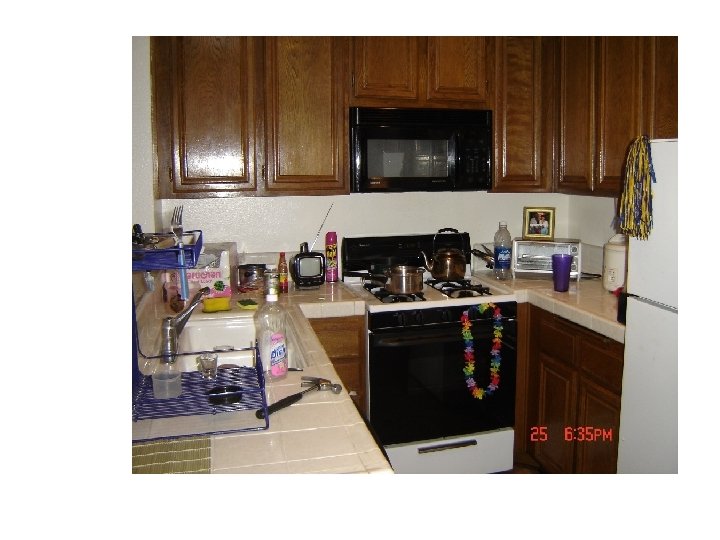
• Look at the next picture for about 2 minutes. Try to remember as many details. You will be asked to recall what you saw.
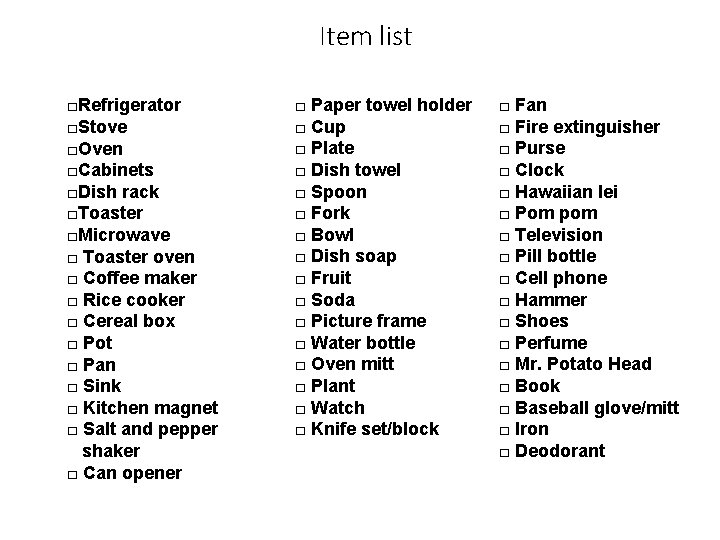
Item list □Refrigerator □Stove □Oven □Cabinets □Dish rack □Toaster □Microwave □ Toaster oven □ Coffee maker □ Rice cooker □ Cereal box □ Pot □ Pan □ Sink □ Kitchen magnet □ Salt and pepper shaker □ Can opener □ Paper towel holder □ Cup □ Plate □ Dish towel □ Spoon □ Fork □ Bowl □ Dish soap □ Fruit □ Soda □ Picture frame □ Water bottle □ Oven mitt □ Plant □ Watch □ Knife set/block □ Fan □ Fire extinguisher □ Purse □ Clock □ Hawaiian lei □ Pom pom □ Television □ Pill bottle □ Cell phone □ Hammer □ Shoes □ Perfume □ Mr. Potato Head □ Book □ Baseball glove/mitt □ Iron □ Deodorant
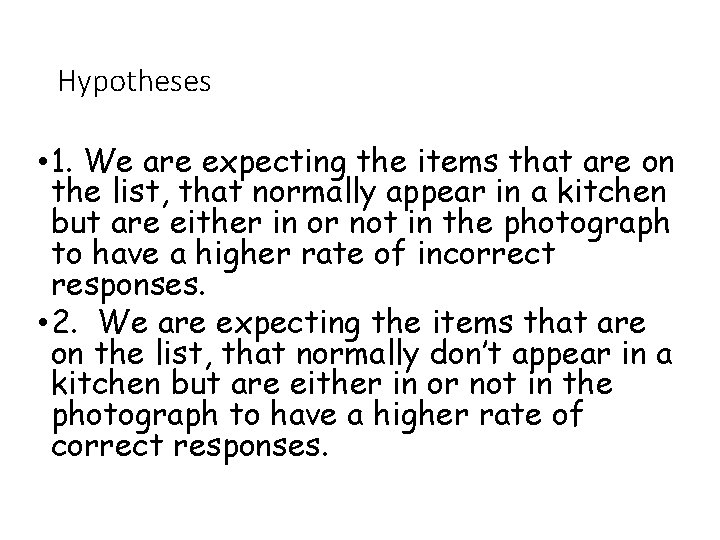
Hypotheses • 1. We are expecting the items that are on the list, that normally appear in a kitchen but are either in or not in the photograph to have a higher rate of incorrect responses. • 2. We are expecting the items that are on the list, that normally don’t appear in a kitchen but are either in or not in the photograph to have a higher rate of correct responses.
• Sharpening: • highlighting or oversimplifying some details • Schema: • assimilating, changing story to fit subjects background knowledge
• http: //www. npr. org/2012/07/20/157129970/eyewitness-testimonycan-be-problematic-at-trial • https: //www. youtube. com/watch? v=_RLv. SGYx. DIs • https: //www. youtube. com/watch? v=PQr_IJv. Yzb. A • http: //www. ted. com/talks/elizabeth_loftus_the_fiction_of_memory