Agricultural Development Economics Division ESA REGIONAL TRAINING WORKSHOP


- Slides: 32
Agricultural Development Economics Division (ESA) REGIONAL TRAINING WORKSHOP Agribusiness PPPs and Territorial Investment Approaches for Agro-industrial Development Bangkok, Thailand July 20 -22 nd, 2016 Session 1 INTRODUCTION TO AGRO-INDUSTRIAL INVESTMENT TOOLS www. fao. org/economic/esa
Agricultural Development Economics Division (ESA) LEARNING OBJECTIVES You will learn about: • The importance of agribusiness & agroindustries to agricultural transformation in Southeast Asia • Why public and private investment is necessary • What tools are available to help attract investment into the sector www. fao. org/economic/esa
Agricultural Development Economics Division (ESA) WARMING UP EXERCISE From your experience… • What do the terms agribusiness and agro-industry mean to you? • Are they a priority in your country’s agricultural development policies and strategies? • Does your country measure the contribution made to GDP from agriculture AND agribusiness? www. fao. org/economic/esa
Agricultural Development Economics Division (ESA) CONTENT • • • Agribusiness and agro-industry as a driver of agricultural transformation Mega trends shaping agricultural transformation in Southeast Asia Mainstreaming agro-industrial investment tools – which tools are commonly promoted and why? www. fao. org/economic/esa
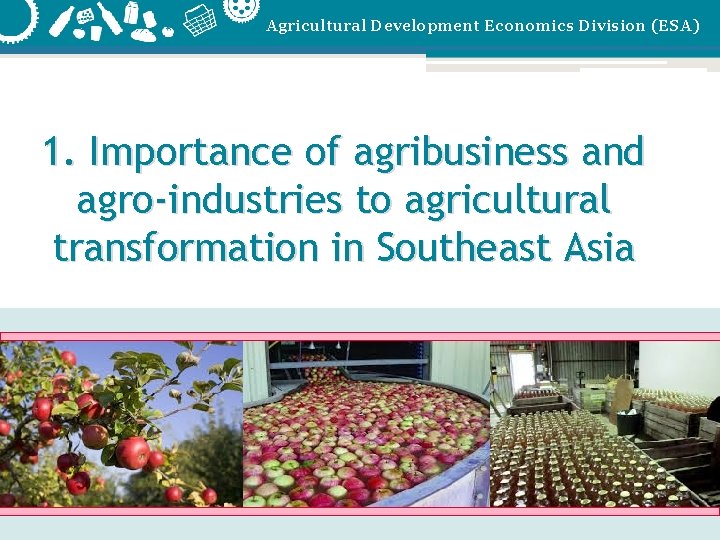
Agricultural Development Economics Division (ESA) 1. Importance of agribusiness and agro-industries to agricultural transformation in Southeast Asia www. fao. org/economic/esa
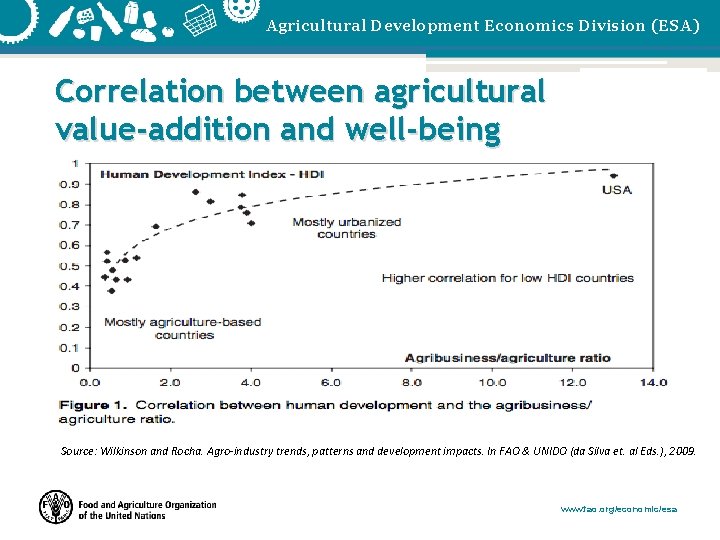
Agricultural Development Economics Division (ESA) Why agro-industry? AGRO-INDUSTRY REFERS TO THE TRANSFORMATION (MANUFACTURING / PROCESSING) OF AGRICULTURAL PRODUCTS (THE SUB-SECTOR). WHY FOCUS ON AGRO-INDUSTRY? • Increased per capita income and urbanization generate higher demand for high-value products. • Positive impact on food security. • Positive correlation between agricultural value-addition and wellbeing. • Higher labour productivity. www. fao. org/economic/esa
Agricultural Development Economics Division (ESA) Correlation between agricultural value-addition and well-being Source: Wilkinson and Rocha. Agro-industry trends, patterns and development impacts. In FAO & UNIDO (da Silva et. al Eds. ), 2009. www. fao. org/economic/esa
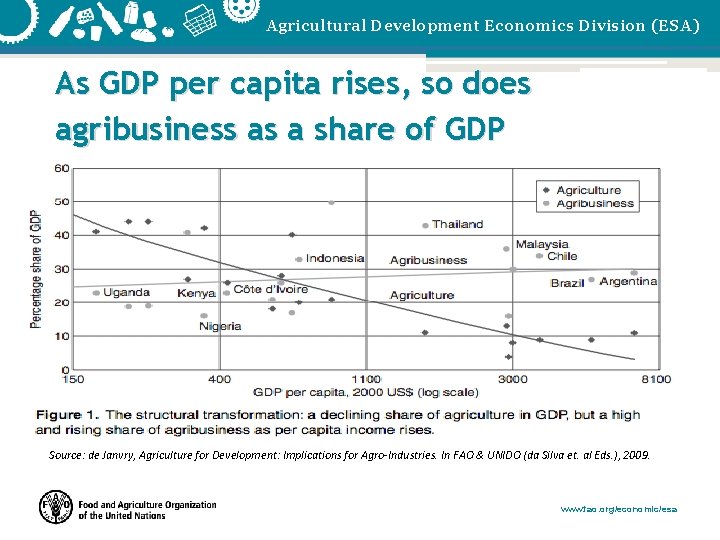
Agricultural Development Economics Division (ESA) As GDP per capita rises, so does agribusiness as a share of GDP Source: de Janvry, Agriculture for Development: Implications for Agro-Industries. In FAO & UNIDO (da Silva et. al Eds. ), 2009. www. fao. org/economic/esa
Agricultural Development Economics Division (ESA) World Bank Study 2013 – Measuring Agribusiness in East Asia Research questions: • Place and role of agribusiness over time and between countries • What patterns can we observe? What are the paths and trajectories? • Role of private sector investment in agro-industry and agribusiness • What are the policy implications of the changes taking place? www. fao. org/economic/esa
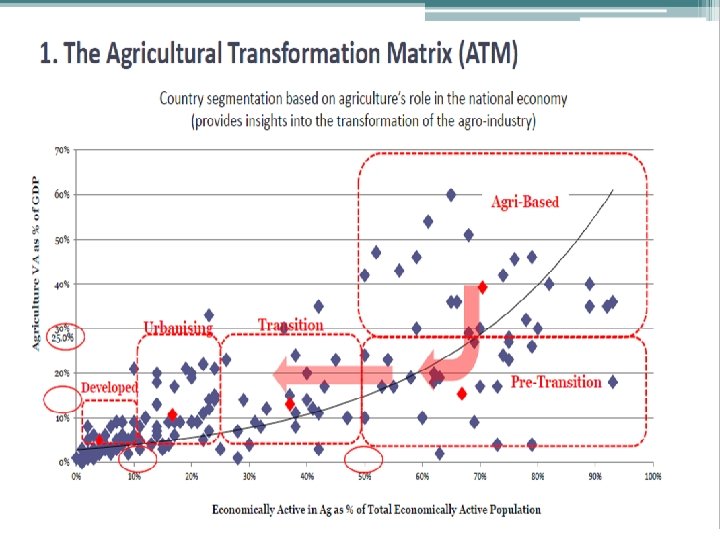
Agricultural Development Economics Division (ESA) www. fao. org/economic/esa
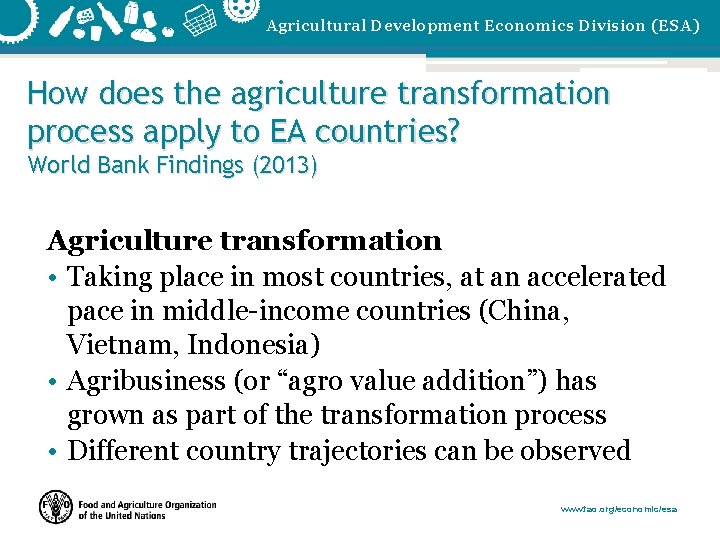
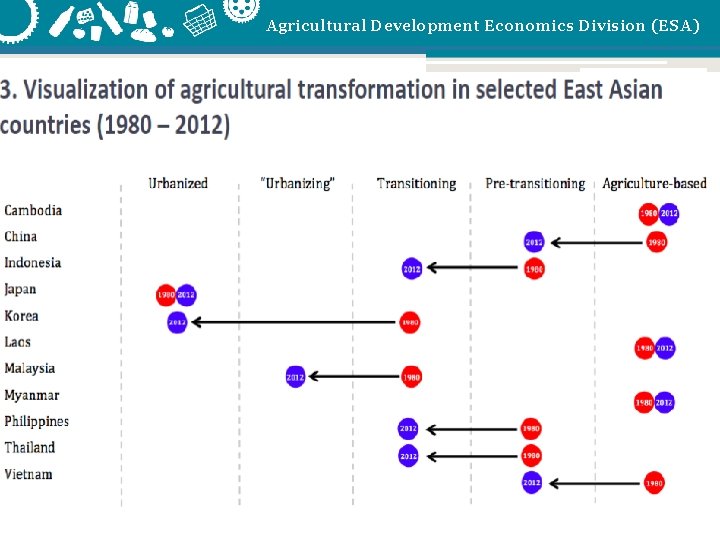
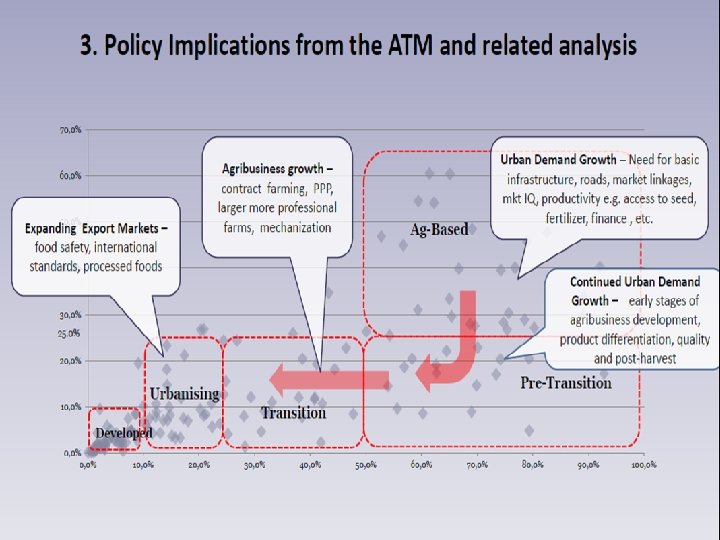
Agricultural Development Economics Division (ESA) How does the agriculture transformation process apply to EA countries? World Bank Findings (2013) Agriculture transformation • Taking place in most countries, at an accelerated pace in middle-income countries (China, Vietnam, Indonesia) • Agribusiness (or “agro value addition”) has grown as part of the transformation process • Different country trajectories can be observed www. fao. org/economic/esa
Agricultural Development Economics Division (ESA) www. fao. org/economic/esa
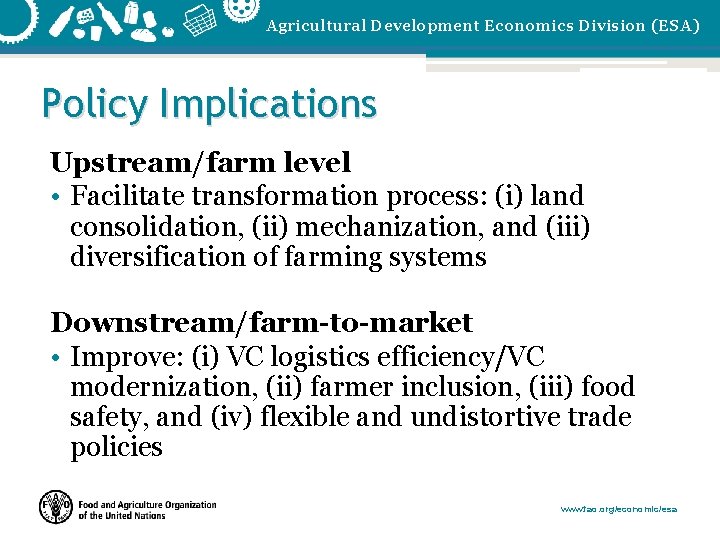
Agricultural Development Economics Division (ESA) Policy Implications Upstream/farm level • Facilitate transformation process: (i) land consolidation, (ii) mechanization, and (iii) diversification of farming systems Downstream/farm-to-market • Improve: (i) VC logistics efficiency/VC modernization, (ii) farmer inclusion, (iii) food safety, and (iv) flexible and undistortive trade policies www. fao. org/economic/esa
Agricultural Development Economics Division (ESA) 2. Megatrends shaping agricultural transformation in Southeast Asia www. fao. org/economic/esa
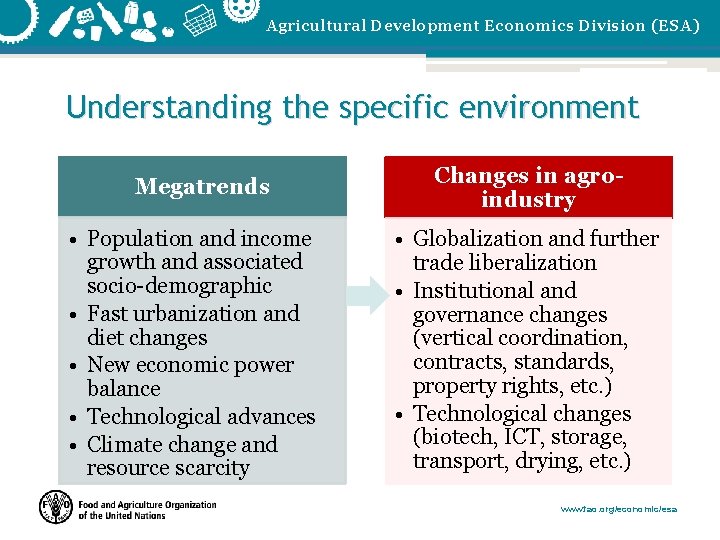
Agricultural Development Economics Division (ESA) Understanding the specific environment Megatrends • Population and income growth and associated socio-demographic • Fast urbanization and diet changes • New economic power balance • Technological advances • Climate change and resource scarcity Changes in agroindustry • Globalization and further trade liberalization • Institutional and governance changes (vertical coordination, contracts, standards, property rights, etc. ) • Technological changes (biotech, ICT, storage, transport, drying, etc. ) www. fao. org/economic/esa
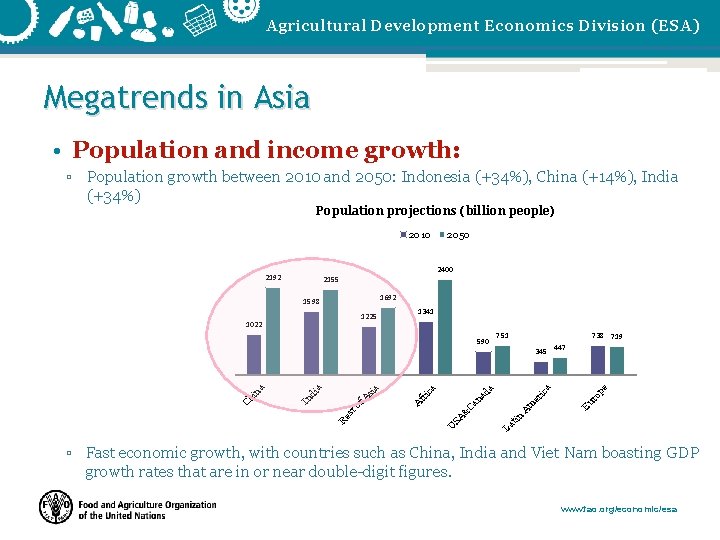
Agricultural Development Economics Division (ESA) Megatrends in Asia • Population and income growth: ▫ Population growth between 2010 and 2050: Indonesia (+34%), China (+14%), India (+34%) Population projections (billion people) 2010 2050 2400 2192 2155 1692 1341 751 738 719 a ic er Am in & SA La t Ca na da ic a Af r U Re st of A si a ia In d Ch in a 345 447 e 590 op 1225 1022 Eu r 1598 ▫ Fast economic growth, with countries such as China, India and Viet Nam boasting GDP growth rates that are in or near double-digit figures. www. fao. org/economic/esa
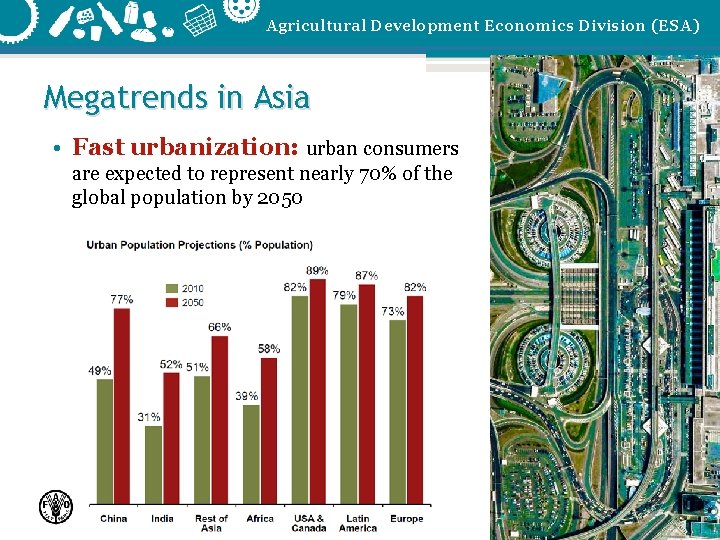
Agricultural Development Economics Division (ESA) Megatrends in Asia • Fast urbanization: urban consumers are expected to represent nearly 70% of the global population by 2050 www. fao. org/economic/esa
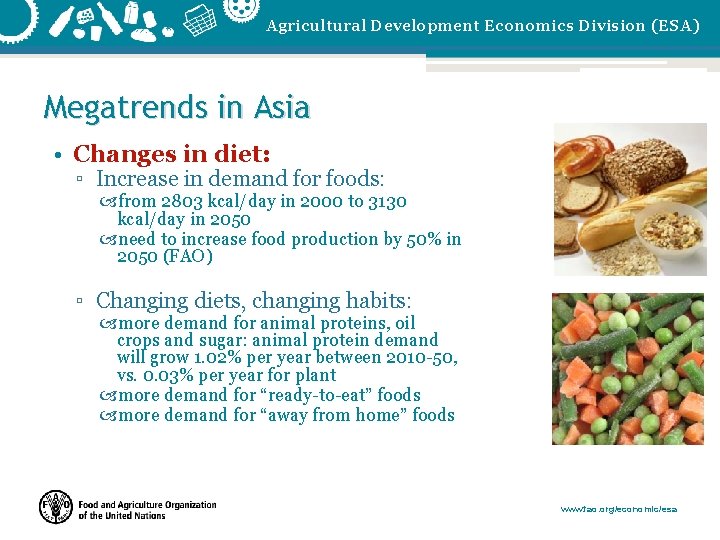
Agricultural Development Economics Division (ESA) Megatrends in Asia • Changes in diet: ▫ Increase in demand for foods: from 2803 kcal/day in 2000 to 3130 kcal/day in 2050 need to increase food production by 50% in 2050 (FAO) ▫ Changing diets, changing habits: more demand for animal proteins, oil crops and sugar: animal protein demand will grow 1. 02% per year between 2010 -50, vs. 0. 03% per year for plant more demand for “ready-to-eat” foods more demand for “away from home” foods www. fao. org/economic/esa
Agricultural Development Economics Division (ESA) Megatrends in Asia • New economic power balance: • US$233 billion of FDI in 2009, up from US$21 billion in 1990. • Trend towards larger investments in infrastructure: ▫ US$4 trillion invested globally in 2012, to more than 9 trillion in 2025, of which 60% in Asia and the Pacific. • 32 % of the world’s international trade flows driven by Asian countries in 2010 • 90% of the world’s rice produced in Asia and more than 40 % of its wheat • More than 50 % of its rubber, spices, vegetables, tobacco, eggs, fibres, nuts and vegetable oils, including palm-oil. www. fao. org/economic/esa
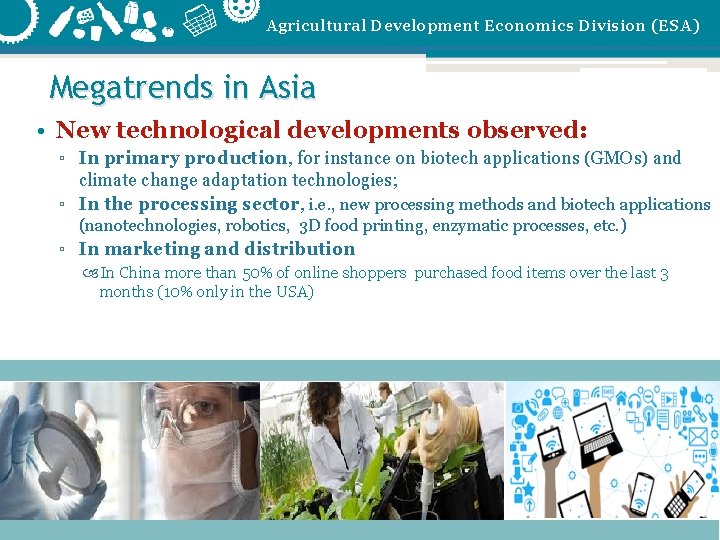
Agricultural Development Economics Division (ESA) Megatrends in Asia • New technological developments observed: ▫ In primary production, for instance on biotech applications (GMOs) and climate change adaptation technologies; ▫ In the processing sector, i. e. , new processing methods and biotech applications (nanotechnologies, robotics, 3 D food printing, enzymatic processes, etc. ) ▫ In marketing and distribution In China more than 50% of online shoppers purchased food items over the last 3 months (10% only in the USA) www. fao. org/economic/esa
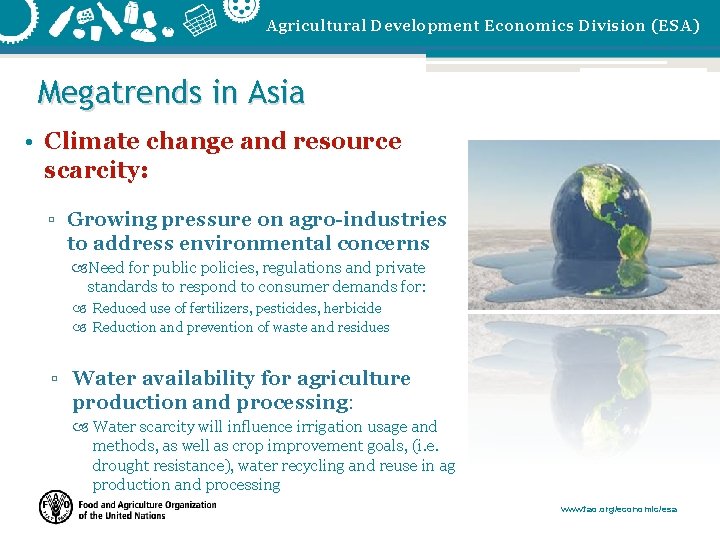
Agricultural Development Economics Division (ESA) Megatrends in Asia • Climate change and resource scarcity: ▫ Growing pressure on agro-industries to address environmental concerns Need for public policies, regulations and private standards to respond to consumer demands for: Reduced use of fertilizers, pesticides, herbicide Reduction and prevention of waste and residues ▫ Water availability for agriculture production and processing: Water scarcity will influence irrigation usage and methods, as well as crop improvement goals, (i. e. drought resistance), water recycling and reuse in ag production and processing www. fao. org/economic/esa
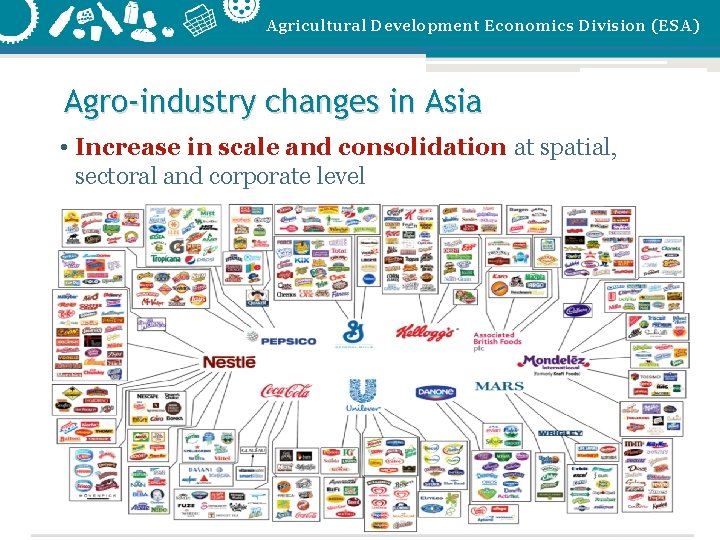
Agricultural Development Economics Division (ESA) Agro-industry changes in Asia • Increase in scale and consolidation at spatial, sectoral and corporate level www. fao. org/economic/esa
Agricultural Development Economics Division (ESA) Agro-industry changes in Asia • Internationalization of markets and ownership: orientation to multinationalization and exports Voluntary standards • Increased use of coordination / control mechanisms (voluntary standards, contract farming, etc. ) www. fao. org/economic/esa
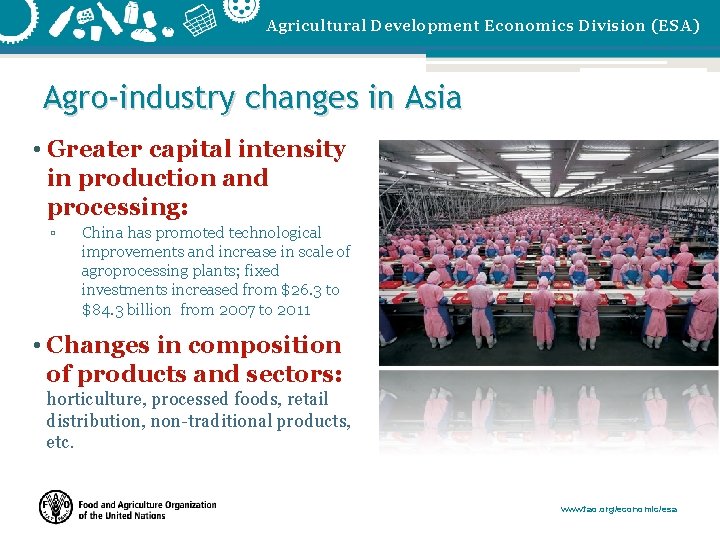
Agricultural Development Economics Division (ESA) Agro-industry changes in Asia • Greater capital intensity in production and processing: ▫ China has promoted technological improvements and increase in scale of agroprocessing plants; fixed investments increased from $26. 3 to $84. 3 billion from 2007 to 2011 • Changes in composition of products and sectors: horticulture, processed foods, retail distribution, non-traditional products, etc. www. fao. org/economic/esa
Agricultural Development Economics Division (ESA) 3. Mainstreaming agro-industrial investment tools www. fao. org/economic/esa
Agricultural Development Economics Division (ESA) Transformation requires investment • Historically low levels of public budget allocation • Estimated US$83 billion annually needed to meet targets for reducing poverty and malnourished (Schmidhuber, Bruinsma and Boedeker 2009). • Scale of investment required beyond the means of the public sector • Mobilization of additional resources from private sector critical • Access to financial services & tools www. fao. org/economic/esa
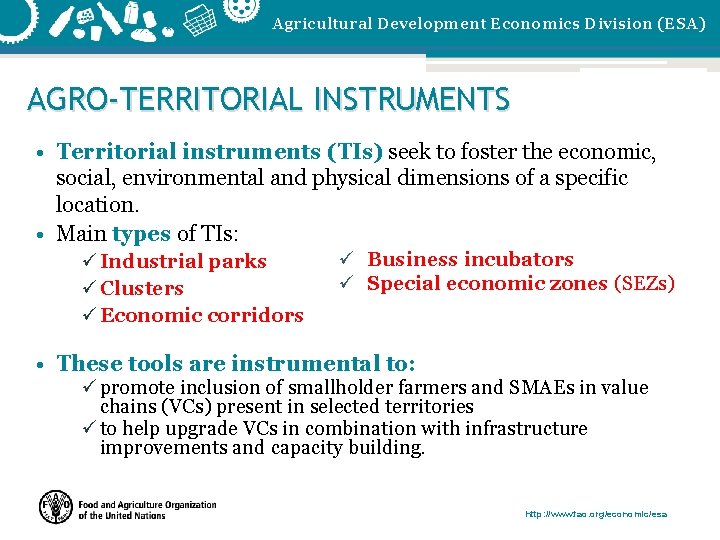
Agricultural Development Economics Division (ESA) AGRO-TERRITORIAL INSTRUMENTS • Territorial instruments (TIs) seek to foster the economic, social, environmental and physical dimensions of a specific location. • Main types of TIs: ü Industrial parks ü Clusters ü Economic corridors ü Business incubators ü Special economic zones (SEZs) • These tools are instrumental to: ü promote inclusion of smallholder farmers and SMAEs in value chains (VCs) present in selected territories ü to help upgrade VCs in combination with infrastructure improvements and capacity building. http: //www. fao. org/economic/esa
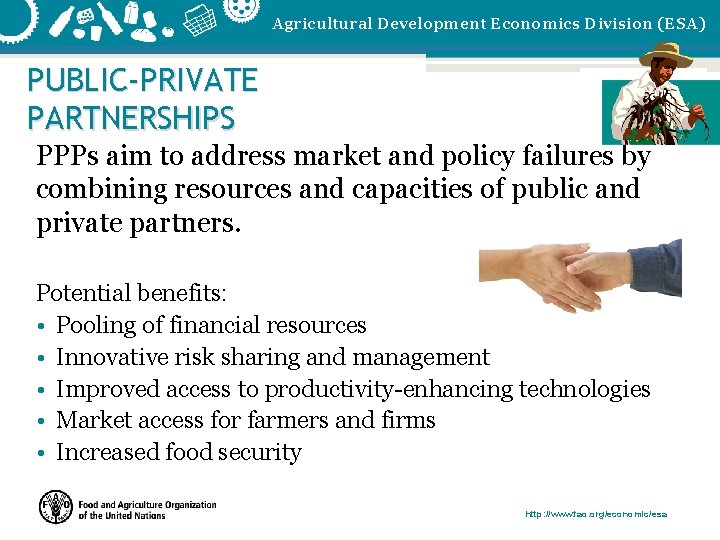
Agricultural Development Economics Division (ESA) PUBLIC-PRIVATE PARTNERSHIPS PPPs aim to address market and policy failures by combining resources and capacities of public and private partners. Potential benefits: • Pooling of financial resources • Innovative risk sharing and management • Improved access to productivity-enhancing technologies • Market access for farmers and firms • Increased food security http: //www. fao. org/economic/esa
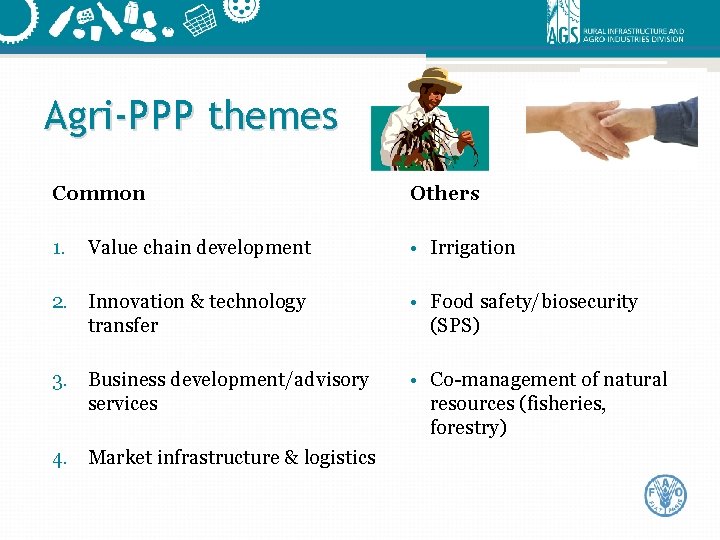
Agri-PPP themes Common Others 1. • Irrigation Value chain development 2. Innovation & technology transfer • Food safety/biosecurity (SPS) 3. Business development/advisory services • Co-management of natural resources (fisheries, forestry) 4. Market infrastructure & logistics
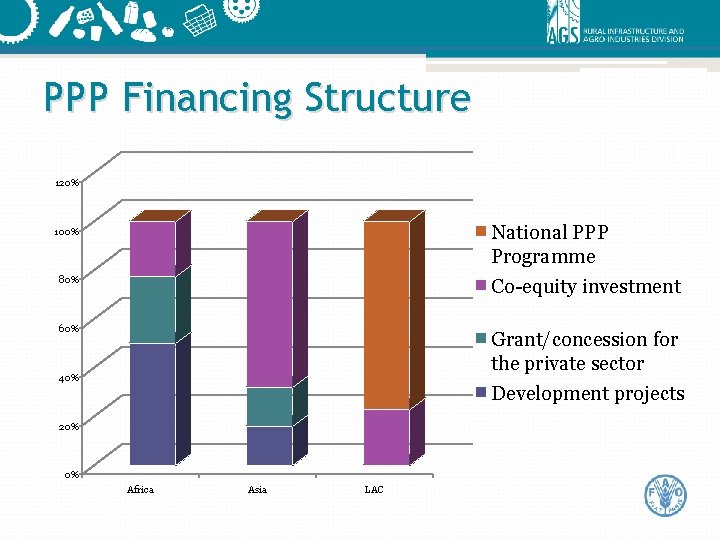
PPP Financing Structure 120% National PPP Programme Co-equity investment 100% 80% 60% Grant/concession for the private sector Development projects 40% 20% 0% Africa Asia LAC
Agricultural Development Economics Division (ESA) THANK YOU! www. fao. org/economic/esa