Adrenergic Antagonists Saja Hamed Ph D 1 Alpha
- Slides: 24
Adrenergic Antagonists Saja Hamed, Ph. D 1
Alpha- adrenergic antagonists: Therapeutic applications: o o o essential hypertension: by blocking alpha 1 receptors on arterioles and veins vasodilation reversal of toxicity from alpha 1 agonists Benign prostatic hyperplasia: Block alpha 1 receptors reduced contraction of smooth muscle in the bladder neck and prostatic capsule Reduce urinary urgency Saja Hamed, Ph. D 2
Alpha- adrenergic antagonists: Therapeutic applications: o o Pheochromocytoma: A catecholaminesecreting tumor Raynaud’s disease: Peripheral vascular disorder characterized by vasospasm in the toes and fingers local sensation if cold and pain Saja Hamed, Ph. D 3
Alpha- adrenergic antagonists: Adverse effects: o Ø Ø orthostatic hypotension: blockade of alpha receptors on veins reduced venous tone blood accumulate in veins when patient assumes erect position reduced return of blood to the heart reduced cardiac output decrease BP reduce blood flow to brain lightheadedness, dizziness Saja Hamed, Ph. D 4
Alpha- adrenergic antagonists: Adverse effects: o Ø q reflex tachycardia: blockade of vascular alpha 1 receptors vasodilation reduce BP baroreceptor initiate a reflex increase in heart rate via the ANS Nasal congestion: dilate blood vessels in the nasal mucosa Saja Hamed, Ph. D 5
Alpha- adrenergic antagonists: Adverse effects: o Ø Ø Inhibition of ejaculation: Blockade of alpha 1 receptors Can cause impotence Reversible when the alpha blocker is withdrawn Can be a major reason for noncompliance change the medication Saja Hamed, Ph. D 6
Alpha- adrenergic antagonists: a. Prazosin: o o o selective blockade of alpha 1 adrenergic receptors hypertension: dilate arterioles and veins relaxation of smooth muscle in bladder neck and prostatic capsule Saja Hamed, Ph. D 7
Alpha- adrenergic antagonists: a. Prazosin: Adverse effects: o o orthostatic hypotension, reflex tachycardia, inhibition of ejaculation, and nasal congestion first dose effect: n 1% of patients n lose consciousness 30 -60 minutes after receiving their first dose n result of sever postural hypotension n minimize it by using small initial dose (1 mg or less) n beginning the treatment: avoid driving and other hazardous activity for 12 -24 hours n administer the initial dose at bed time Saja Hamed, Ph. D 8
Alpha- adrenergic antagonists: b. Phentolamine: o o o blocks alpha 1 and alpha 2 receptors treatment of pheochromocytoma prevention of tissue necrosis following extravasation of drugs that produce alpha 1 -mediated vasoconstriction Saja Hamed, Ph. D 9
Alpha- adrenergic antagonists: b. Phentolamine: Adverse effects: o Like prazosin o Produces greater reflex tachycardia than prazosin due to alpha 2 blockade o Overdose can produce profound hypotension elevate BP with NE. Epinephrine should not be used? Saja Hamed, Ph. D 10
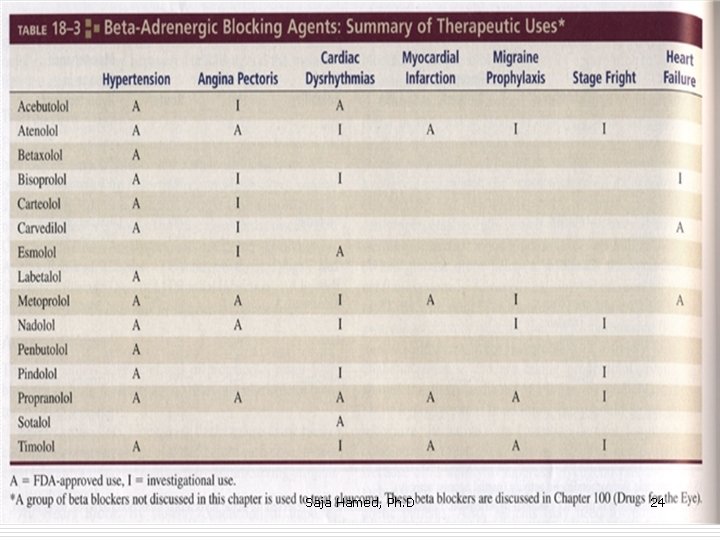
Beta- adrenergic antagonists: Therapeutic applications: o o o Angina pectoris: by blocking beta 1 receptors in the heart decrease cardiac work Hypertension: Beta adrenergic blocking agents are drugs of choice for hypertension Cardiac dysrhythmias: Blocking cardiac beta 1 receptors decrease the rate of sinus nodal discharge and suppress conduction of atrial impulses through the AV node Saja Hamed, Ph. D 11
Beta- adrenergic antagonists: Therapeutic applications: o o Myocardial infarction: MI: region of myocardial necrosis caused by localized interruption of blood flow to the heart wall Migraine: If taken prophylactically they can reduce the frequency of migraine attack Saja Hamed, Ph. D 12
Beta- adrenergic antagonists: Adverse effects: o o bradycardia reduced cardiac output: - by decreasing heart rate and force of contraction - beta blockers must be used with great caution in patients with heart failure or reduced cardiac reserve Saja Hamed, Ph. D 13
Beta- adrenergic antagonists: Adverse effects: o o AV heart block: Rebound excitation: - Increased cardiac activity in response to abrupt cessation of beta blocker therapy - Long term use of beta blockers sensitize the heart to catecholamines - If withdrawn abruptly anginal pain or dysrhythmias - Withdraw gradually taper the dose over a period of 1 to 2 weeks (Note: warn patients against abrupt cessation. Carry adequate supply of beta blockers when traveling) Saja Hamed, Ph. D 14
Beta- adrenergic antagonists: Adverse effects: o o Bronchoconstriction: Beta 2 blockers are contraindicated in asthma Inhibition of glycogenolysis: If diabetic patient requires a betablocker, a beta 1 -selective agent should be chosen Saja Hamed, Ph. D 15
Beta- adrenergic antagonists: a. Propranolol (Inderal®): o o nonselective beta adrenergic antagonists highly lipid soluble Therapeutic uses: o hypertension o angina pectoris o cardiac dysrhythmias o myocardial infarction o migraine headache Saja Hamed, Ph. D 16
Beta- adrenergic antagonists: a. Propranolol (Inderal®): Adverse effects: o refer to previous adverse effects o in addition CNS effects: - depression and insomnia - nightmares and hallucinations - used with care in patients with a history of depression Saja Hamed, Ph. D 17
Beta- adrenergic antagonists: a. Propranolol (Inderal®): Precautions and contraindications: o should be avoided in patients with a history of anaphylaxis o must be used with caution by diabetic patients: - suppress glycogenolysis - masking tachycardia - warn the patients that tachycardia is no longer an indication of hypoglycemia - should be taught alternative signs: sweating, hunger, fatigue, poor concentration) Saja Hamed, Ph. D 18
Beta- adrenergic antagonists: a. Propranolol (Inderal®): Drug Interactions: o calcium channel blockers: o cardiac effect of certain calcium channel blockers (e. g. verapamil) are identical to those of propranolol o impeded early recognition of insulin induced hypoglycemia o Note: the dosage must be adjusted by monitoring the patient’s response and not by relying on dosing information in a drug reference Saja Hamed, Ph. D 19
Beta- adrenergic antagonists: b. Metoprolol: o o Cardioselective agent Preferred for patients with asthma or diabetes Hypertension, angina pectoris, myocardial infarctions Deprive the diabetic patient of early indication of hypoglycemia Saja Hamed, Ph. D 20
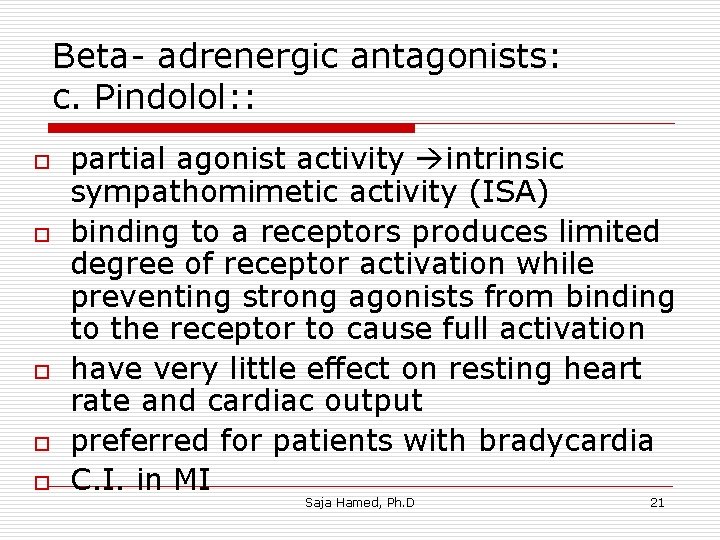
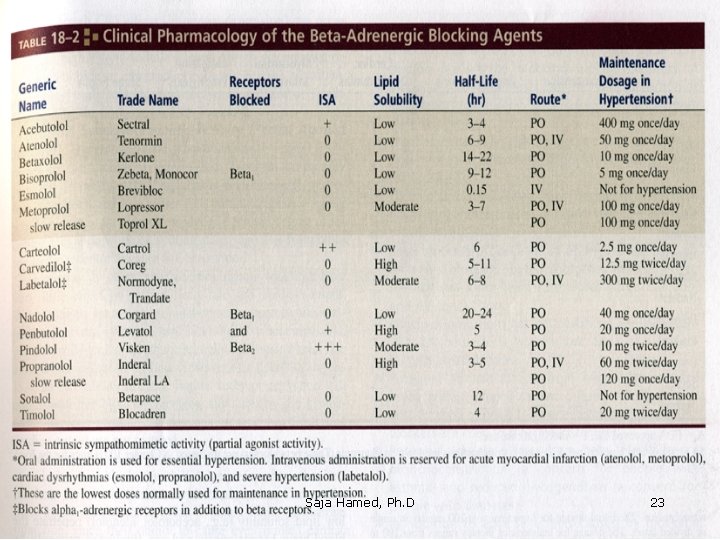
Beta- adrenergic antagonists: c. Pindolol: : o o o partial agonist activity intrinsic sympathomimetic activity (ISA) binding to a receptors produces limited degree of receptor activation while preventing strong agonists from binding to the receptor to cause full activation have very little effect on resting heart rate and cardiac output preferred for patients with bradycardia C. I. in MI Saja Hamed, Ph. D 21
Saja Hamed, Ph. D 22
Saja Hamed, Ph. D 23
Saja Hamed, Ph. D 24