ACE PERSONAL TRAINER MANUAL 5 th Edition Chapter






- Slides: 26
ACE PERSONAL TRAINER MANUAL 5 th Edition Chapter 9: Functional Programming for Stability-Mobility and Movement Lesson 9. 2
LEARNING OBJECTIVES • After completing this session, you will be able to: ü Discuss the importance of promoting proximal mobility of the hips and thoracic spine, and demonstrate exercises and stretches for each ü Discuss the importance of promoting proximal stability of the scapulothoracic region and distal mobility of the glenohumeral joint, and demonstrate exercises and stretches for each ü Discuss the importance distal mobility, and its effect on the kinetic chain © 2014 ACE
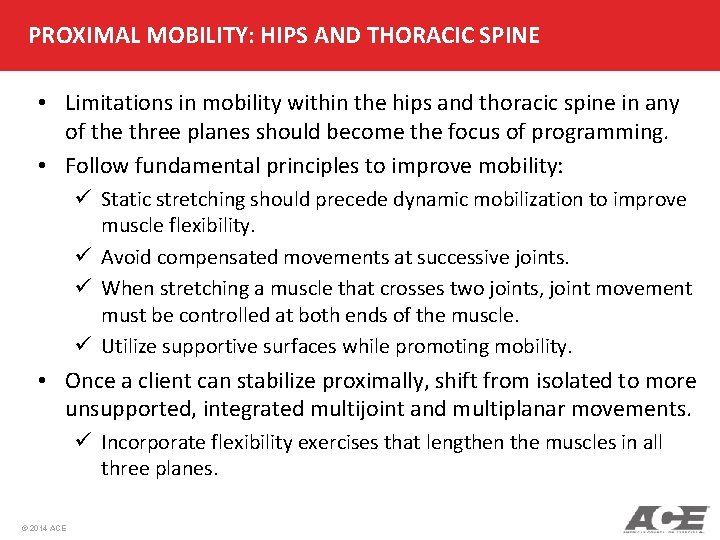
PROXIMAL MOBILITY: HIPS AND THORACIC SPINE • Limitations in mobility within the hips and thoracic spine in any of the three planes should become the focus of programming. • Follow fundamental principles to improve mobility: ü Static stretching should precede dynamic mobilization to improve muscle flexibility. ü Avoid compensated movements at successive joints. ü When stretching a muscle that crosses two joints, joint movement must be controlled at both ends of the muscle. ü Utilize supportive surfaces while promoting mobility. • Once a client can stabilize proximally, shift from isolated to more unsupported, integrated multijoint and multiplanar movements. ü Incorporate flexibility exercises that lengthen the muscles in all three planes. © 2014 ACE
CAT-CAMEL • Objective: improve extensibility within the lumbar extensor muscles © 2014 ACE
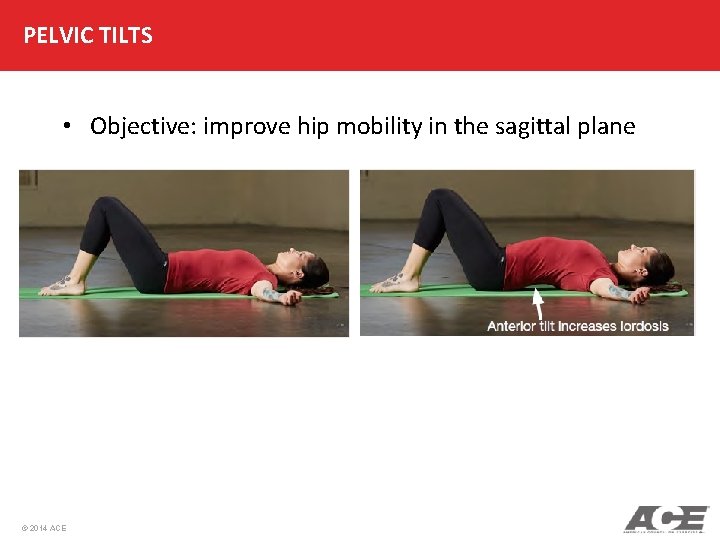
PELVIC TILTS • Objective: improve hip mobility in the sagittal plane © 2014 ACE
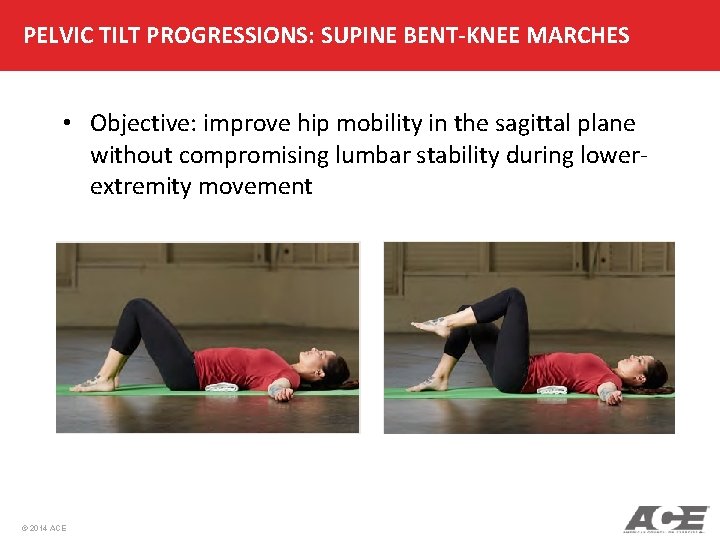
PELVIC TILT PROGRESSIONS: SUPINE BENT-KNEE MARCHES • Objective: improve hip mobility in the sagittal plane without compromising lumbar stability during lowerextremity movement © 2014 ACE
PELVIC TILT PROGRESSIONS: MODIFIED DEAD BUG WITH REVERSE BENT-KNEE MARCHES • Objective: improve hip mobility in the sagittal plane without compromising lumbar stability during lowerextremity movement © 2014 ACE
HIP FLEXOR MOBILITY: LYING HIP FLEXOR STRETCH • Objective: improve mobility of the hip flexors in the sagittal plane without compromising lumbar stability © 2014 ACE
HIP FLEXOR MOBILITY: HALF-KNEELING TRIPLANAR STRETCH • Objective: improve mobility of the hip flexors in all three planes without compromising lumbar stability © 2014 ACE
HIP FLEXOR MOBILITY PROGRESSION: HALF-KNEELING • Objective: improve mobility of the hip flexors in all three planes without compromising lumbar stability © 2014 ACE
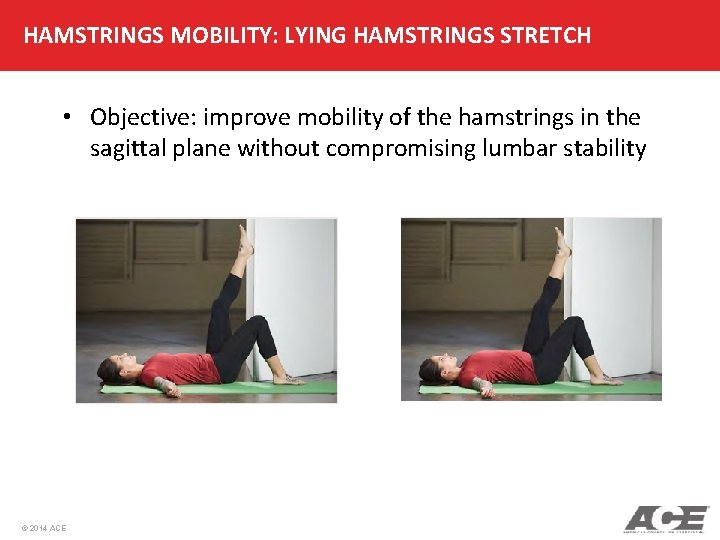
HAMSTRINGS MOBILITY: LYING HAMSTRINGS STRETCH • Objective: improve mobility of the hamstrings in the sagittal plane without compromising lumbar stability © 2014 ACE
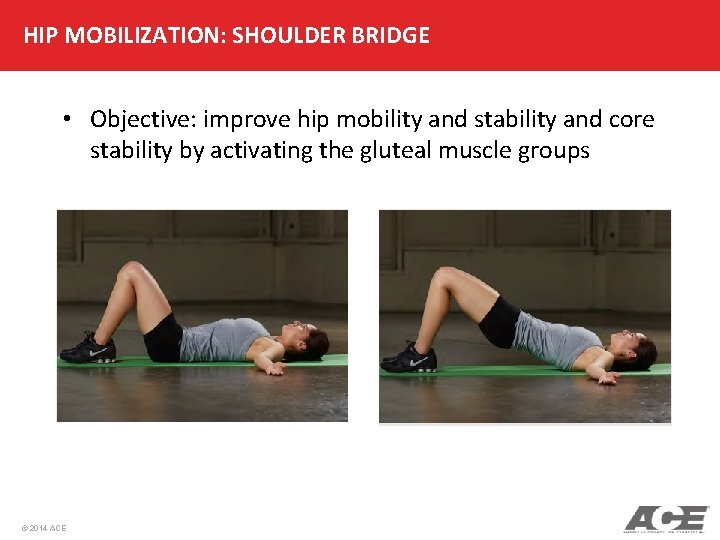
HIP MOBILIZATION: SHOULDER BRIDGE • Objective: improve hip mobility and stability and core stability by activating the gluteal muscle groups © 2014 ACE
HIP MOBILIZATION: SUPINE 90 -90 HIP ROTATOR STRETCH • Objective: improve hip mobility in the transverse plane © 2014 ACE
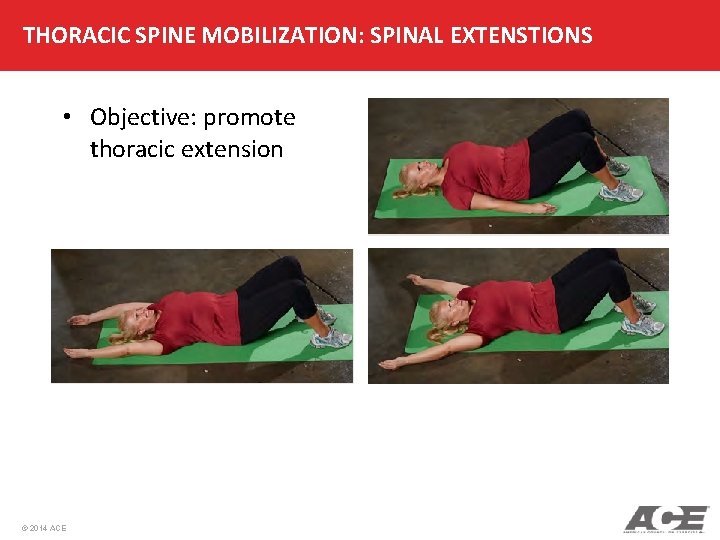
THORACIC SPINE MOBILIZATION: SPINAL EXTENSTIONS • Objective: promote thoracic extension © 2014 ACE
THORACIC SPINE MOBILIZATION: SPINAL TWISTS • Objective: promote trunk rotation, primarily through the thoracic spine with some lateral hip mobility © 2014 ACE
POSTERIOR MOBILIZATION: ROCKING QUADRUPEDS • Objective: promote hip and thoracic mobility while simultaneously maintaining lumbar stability © 2014 ACE
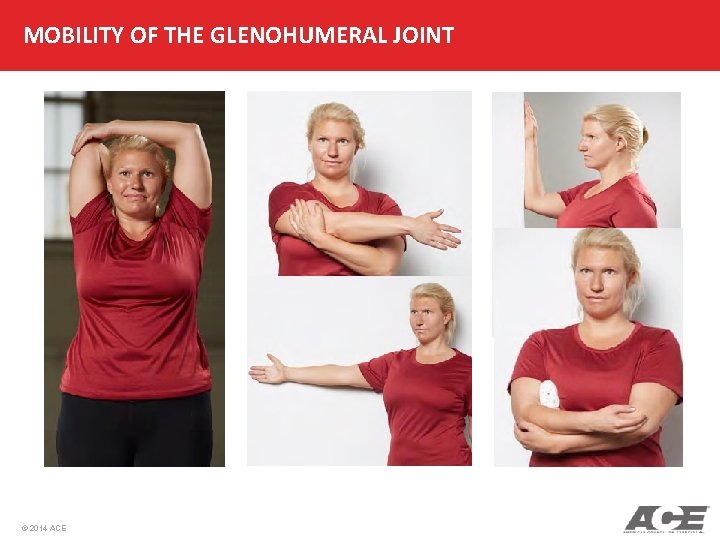
PROXIMAL STABILITY OF THE SCAPULOTHORACIC REGION AND DISTAL MOBILITY OF THE GLENOHUMERAL JOINT • The glenohumeral joint is highly mobile – movement is contingent upon the stability of the scapulothoracic region. • Parascapular muscles (i. e. , serratus anterior, rhomboids, and lower trapezius) cause movement of the scapulae, and maintain stability against the rib cage • A lack of thoracic spine mobility compromises stability of the scapulothoracic region, which affects mobility of the glenohumeral joint • Promoting stability within the scapulothoracic region requires thoracic mobility in addition to other key factors: ü ü © 2014 ACE Tissue extensibility (both active and passive structures) Healthy rotator cuff muscle function Muscle balance within the parascapular muscles Ability to resist upward glide and impingement against the coracoacromial arch during deltoid action
MOBILITY OF THE GLENOHUMERAL JOINT © 2014 ACE
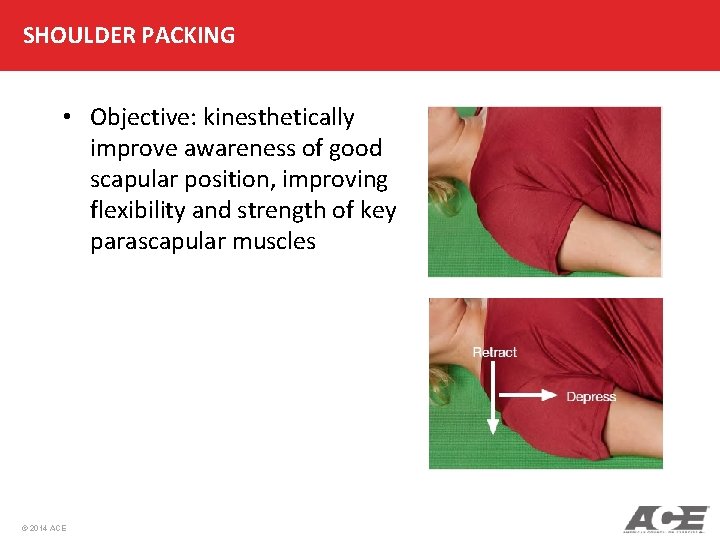
SHOULDER PACKING • Objective: kinesthetically improve awareness of good scapular position, improving flexibility and strength of key parascapular muscles © 2014 ACE
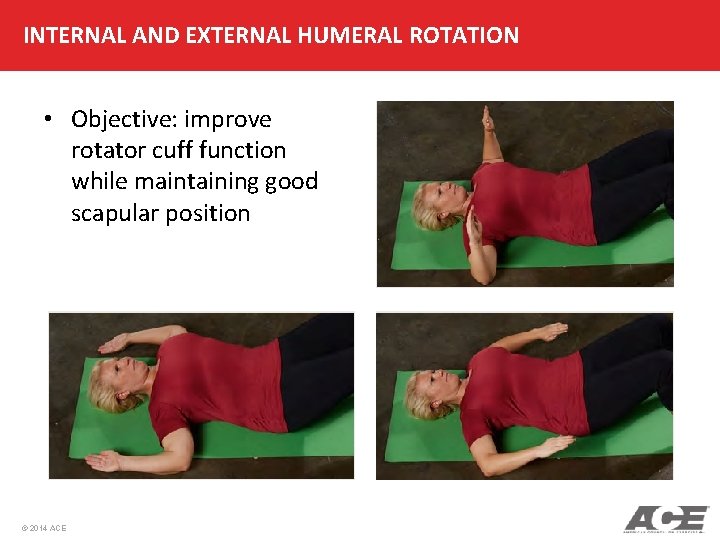
INTERNAL AND EXTERNAL HUMERAL ROTATION • Objective: improve rotator cuff function while maintaining good scapular position © 2014 ACE
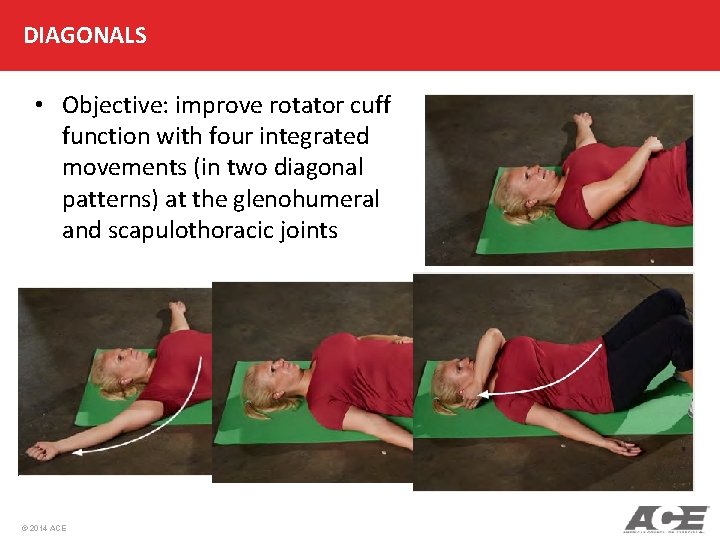
DIAGONALS • Objective: improve rotator cuff function with four integrated movements (in two diagonal patterns) at the glenohumeral and scapulothoracic joints © 2014 ACE
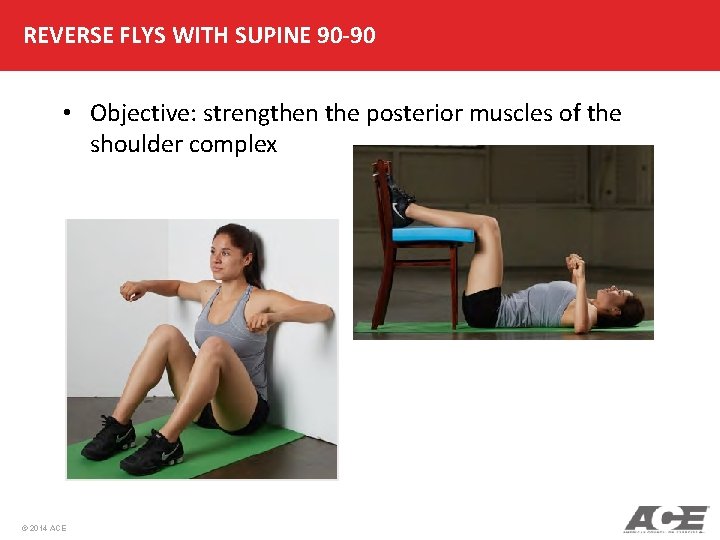
REVERSE FLYS WITH SUPINE 90 -90 • Objective: strengthen the posterior muscles of the shoulder complex © 2014 ACE
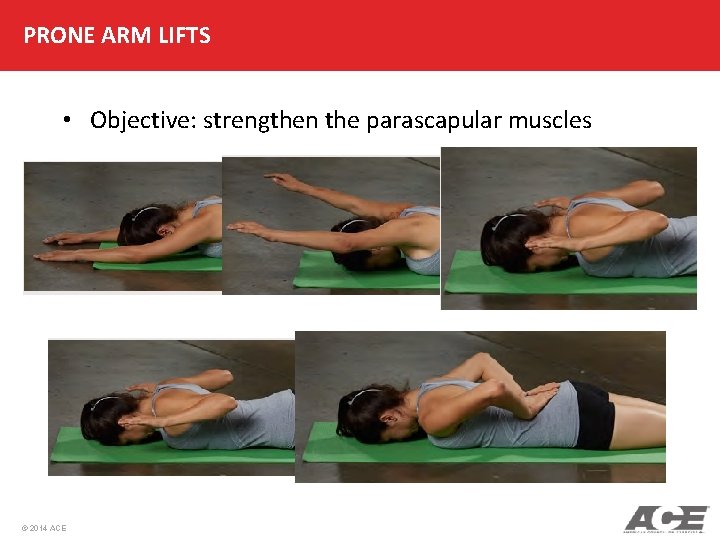
PRONE ARM LIFTS • Objective: strengthen the parascapular muscles © 2014 ACE
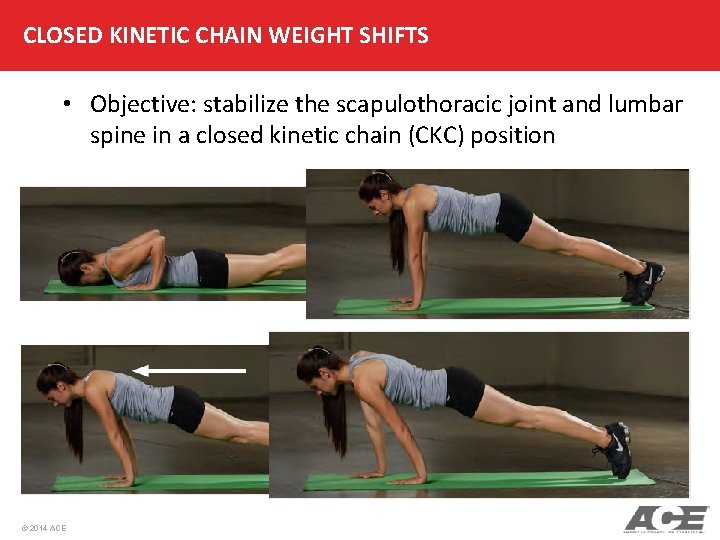
CLOSED KINETIC CHAIN WEIGHT SHIFTS • Objective: stabilize the scapulothoracic joint and lumbar spine in a closed kinetic chain (CKC) position © 2014 ACE
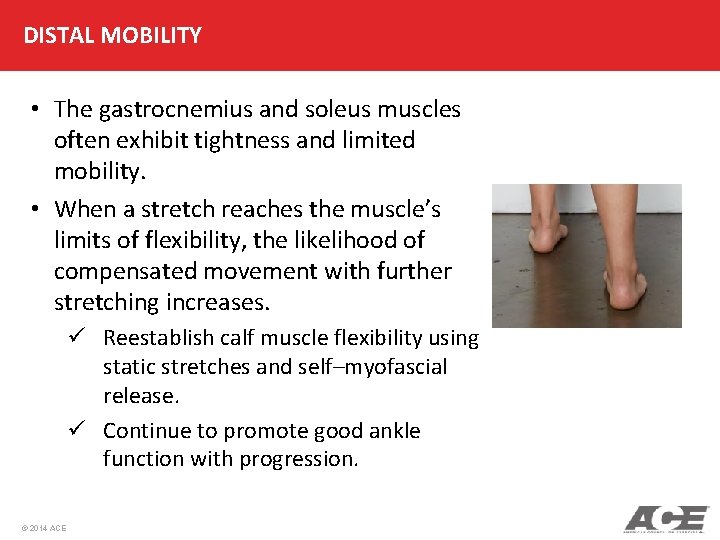
DISTAL MOBILITY • The gastrocnemius and soleus muscles often exhibit tightness and limited mobility. • When a stretch reaches the muscle’s limits of flexibility, the likelihood of compensated movement with further stretching increases. ü Reestablish calf muscle flexibility using static stretches and self–myofascial release. ü Continue to promote good ankle function with progression. © 2014 ACE
SUMMARY • Movement efficiency involves a synergistic approach between stability and mobility where “proximal stability promotes distal mobility. ” • Proximal mobility includes movement of the hips, thoracic spine, and scapulothoracic region, whereas distal mobility includes the glenohumeral joint and ankle. • To enhance extensibility and mobility, trainer can employ several different stretching modalities, including selfmyofascial release, to help increase range of motion (ROM) and reduce hypertonicity. • Proper joint alignment facilitates effective muscle action and joint movement, serving as the platform from which good exercise technique is built. © 2014 ACE