Accelerated Talent Management ATM Using Whole Systems Methodology


- Slides: 22
Accelerated Talent Management (ATM) Using Whole Systems Methodology By William J. Rothwell, Ph. D. , SPHR, CPLP Fellow Roland Sullivan, MSOD, RODC Email: wjr 9@psu. edu ©Copyright 2013 by William J. Rothwell and Roland Sullivan
Opening Poll How many of you : � Have heard the term whole systems transformational change? � Are experiencing challenges with your organization’s talent management or succession planning program? � Wish that management decisions would move faster? ©Copyright 2013 by William J. Rothwell and Roland Sullivan
Part I: Introduction ©Copyright 2013 by William J. Rothwell and Roland Sullivan
Overview Traditional talent management programs often fail because much essential infrastructure to support it is missing. (About 70 percent of all talent management programs fail in the first 3 years. ) Accelerated talent management (ATM) is a planned approach to accelerating the success of talent management by speeding up the process of building the essential infrastructure needed to support a talent management program. Examples of such infrastructure includes clear and measurable talent management goals, alignment of management thinking with the goals, clarity on role responsibilities, clarity on accountability systems, competency models, assessment methods, and much more. ©Copyright 2013 by William J. Rothwell and Roland Sullivan
Overview In this webinar William J. Rothwell and Roland L. Sullivan focus on rethinking talent management by pairing up the components of best-practice talent programs with so-called Whole Systems Transformational change. ©Copyright 2013 by William J. Rothwell and Roland Sullivan
Objectives Upon completing this presentation, participants will be able to: � Review traditional talent management � Review Whole Systems Transformational Change � Describe how to align talent management and whole systems change to yield ATM ©Copyright 2013 by William J. Rothwell and Roland Sullivan
Organization Part I: Part III: Part IV: Part V: Introduction Traditional Talent Management Whole Systems Transformational Change Accelerated Talent Management (ATM)™ Conclusion and Final Questions ©Copyright 2013 by William J. Rothwell and Roland Sullivan
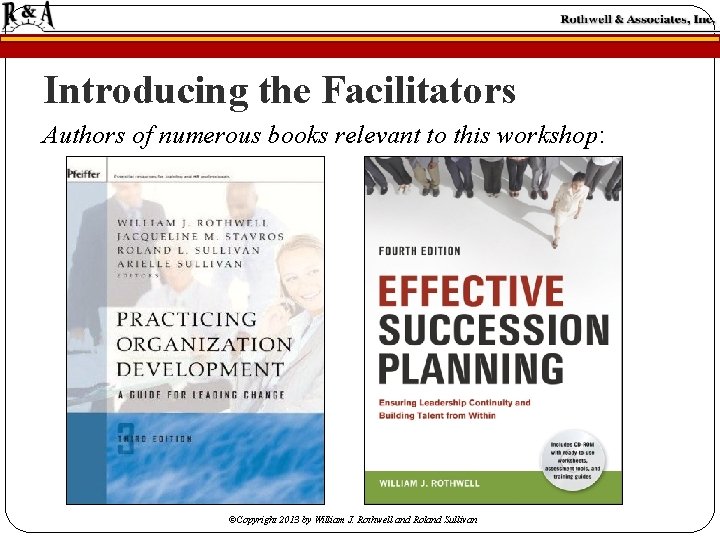
Introducing the Facilitators Authors of numerous books relevant to this workshop: ©Copyright 2013 by William J. Rothwell and Roland Sullivan
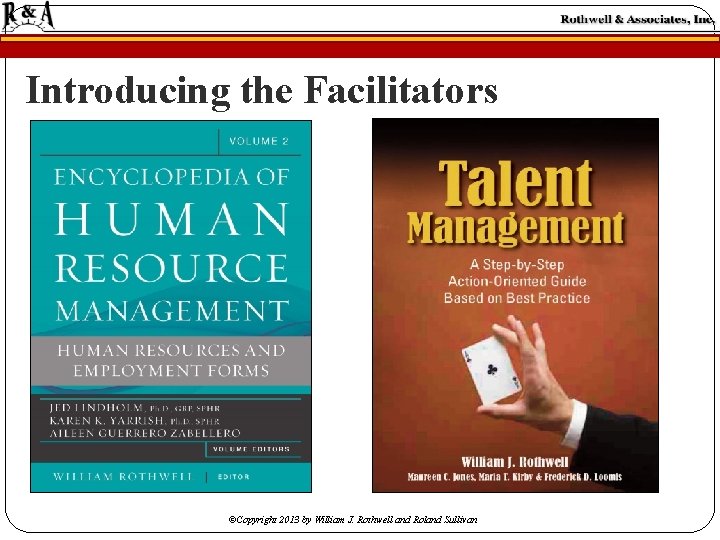
Introducing the Facilitators ©Copyright 2013 by William J. Rothwell and Roland Sullivan
Part II: Traditional Talent Management ©Copyright 2013 by William J. Rothwell and Roland Sullivan
What Is Talent Management? Talent management is the continuing process of � Attracting � Developing � Retaining � Deploying � Transferring the knowledge of the best people ©Copyright 2013 by William J. Rothwell and Roland Sullivan
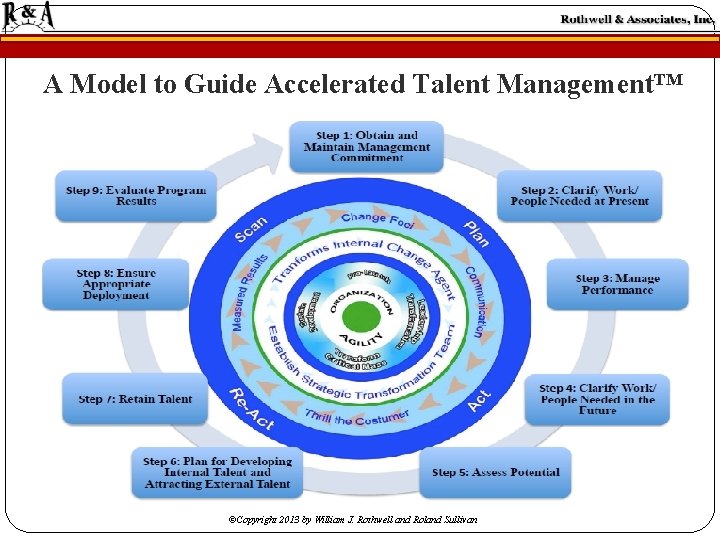
What Best Practice Model Guides Talent Management? Step 1: Obtain and Maintain Management Commitment Step 9: Evaluate Program Results Step 2: Clarify Work/People Needed at Present Step 8: Ensure Appropriate Deployment Step 3: Manage Performance Step 7: Retain Talent Step 4: Clarify Work/People Needed in the Future to Achieve Strategic Goals Step 6: Plan for Developing Internal Talent and Attracting External Talent Step 5: Assess Potential Source: Adapted from Rothwell, W. (2010). Effective succession planning: Ensuring leadership continuity and building talent from within. New York: AMACOM. ©Copyright 2013 by William J. Rothwell and Roland Sullivan
Part III: Whole Systems Transformational Change ©Copyright 2013 by William J. Rothwell and Roland Sullivan
What Is Whole Systems Transformational Change? Whole systems transformational change is a systematic approach to organizational or group change that involves, and thereby seeks to build the support and commitment, of all key internal and external stakeholders whose support is essential for change to last ©Copyright 2013 by William J. Rothwell and Roland Sullivan
How Does Whole Systems Transformational Change Work? � There are many approaches to WSTC � One example of the application of WSTC is the Appreciative Inquiry Summit � However, one approach relies on a key model to drive the systematic change effort ©Copyright 2013 by William J. Rothwell and Roland Sullivan
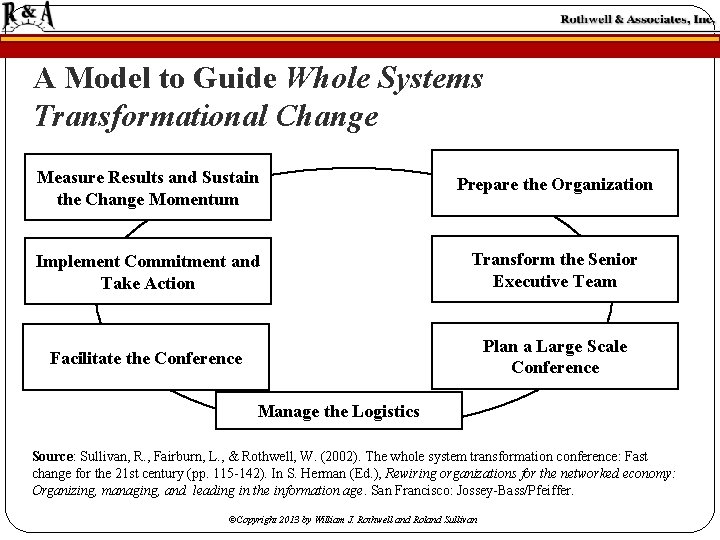
A Model to Guide Whole Systems Transformational Change Measure Results and Sustain the Change Momentum Prepare the Organization Implement Commitment and Take Action Transform the Senior Executive Team Facilitate the Conference Plan a Large Scale Conference Manage the Logistics Source: Sullivan, R. , Fairburn, L. , & Rothwell, W. (2002). The whole system transformation conference: Fast change for the 21 st century (pp. 115 -142). In S. Herman (Ed. ), Rewiring organizations for the networked economy: Organizing, managing, and leading in the information age. San Francisco: Jossey-Bass/Pfeiffer. ©Copyright 2013 by William J. Rothwell and Roland Sullivan
Part IV: Accelerated Talent Management (ATM)™ Part V: Conclusion and Final Questions and Answers ©Copyright 2013 by William J. Rothwell and Roland Sullivan
What Is Accelerated Talent Management™? Accelerated Talent Management™: � Is the application of Whole Systems Transformational Change to Talent Management and Succession Planning � Relies on a launch summit and subsequent follow up to build, and sustain, management and stakeholder commitment to the talent management/succession effort � Overcomes the typical problem with traditional talent management of building/maintaining management commitment and support ©Copyright 2013 by William J. Rothwell and Roland Sullivan
How Does Accelerated Talent Management™ Solve Typical Problems with Talent Management/Succession Planning? Accelerated Talent Management™: � Helps to ensure involvement and build commitment from many stakeholder groups � Builds the infrastructure frequently lacking, and timeconsuming to develop, in many talent programs � Allows periodic review of program goals and results ©Copyright 2013 by William J. Rothwell and Roland Sullivan
A Model to Guide Accelerated Talent Management™ ©Copyright 2013 by William J. Rothwell and Roland Sullivan
Part V: Conclusion and Final Questions Part V: Conclusion and Final Questions and Answers ©Copyright 2013 by William J. Rothwell and Roland Sullivan
Final Questions & Answers ©Copyright 2013 by William J. Rothwell and Roland Sullivan