Academic Detailing Michael Allen MD Dalhousie University Continuing
- Slides: 28
Academic Detailing Michael Allen MD Dalhousie University Continuing Medical Education Improving Patient Safety Through Informed Medication Prescribing and Disposal Practices Portland ME October 2007
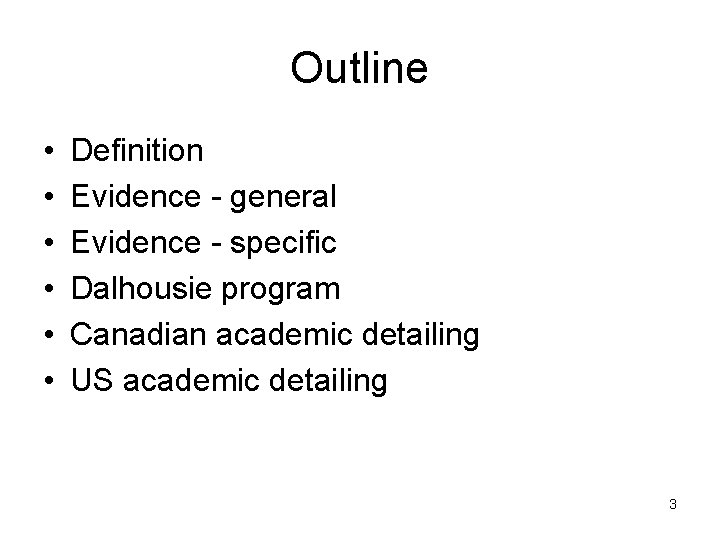
Outline • • • Definition Evidence - general Evidence - specific Dalhousie program Canadian academic detailing US academic detailing 3
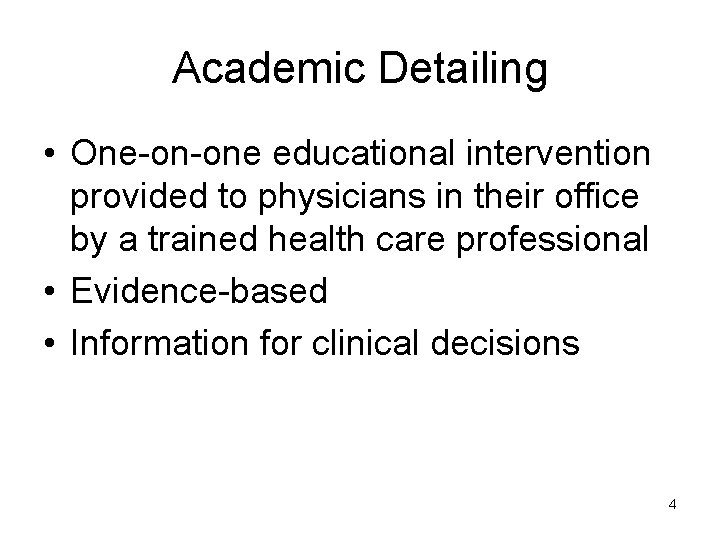
Academic Detailing • One-on-one educational intervention provided to physicians in their office by a trained health care professional • Evidence-based • Information for clinical decisions 4
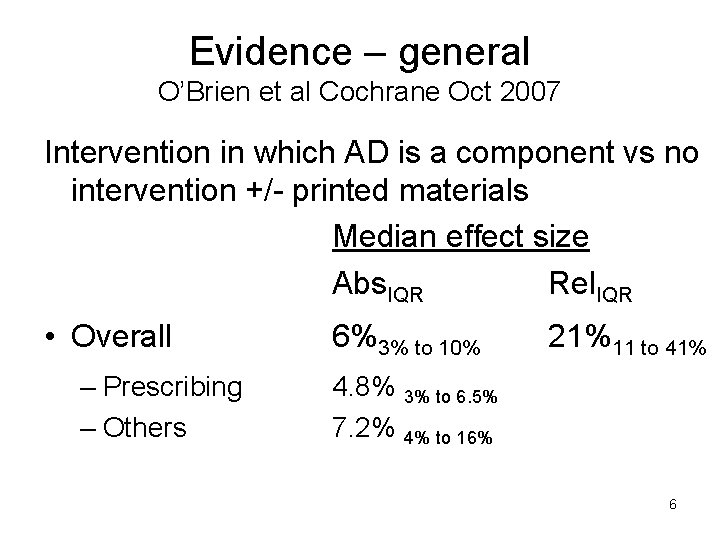
Evidence – general O’Brien et al Cochrane Oct 2007 Intervention in which AD is a component vs no intervention +/- printed materials Median effect size Abs. IQR Rel. IQR • Overall – Prescribing – Others 6%3% to 10% 21%11 to 41% 4. 8% 3% to 6. 5% 7. 2% 4% to 16% 6
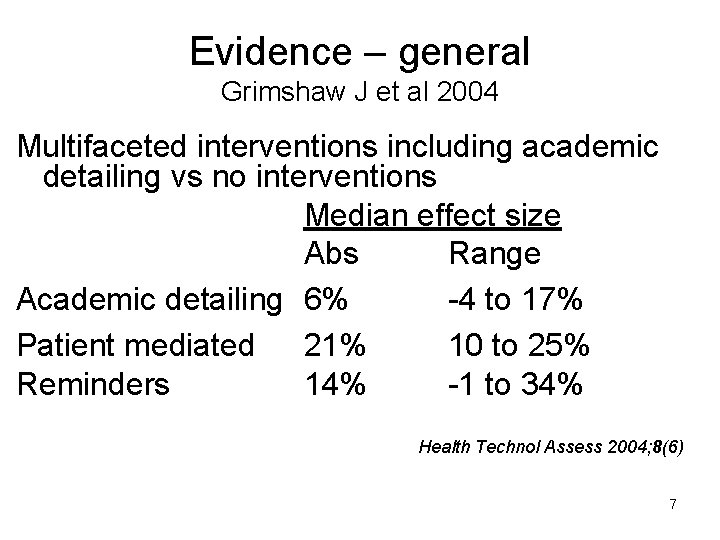
Evidence – general Grimshaw J et al 2004 Multifaceted interventions including academic detailing vs no interventions Median effect size Abs Range Academic detailing 6% -4 to 17% Patient mediated 21% 10 to 25% Reminders 14% -1 to 34% Health Technol Assess 2004; 8(6) 7
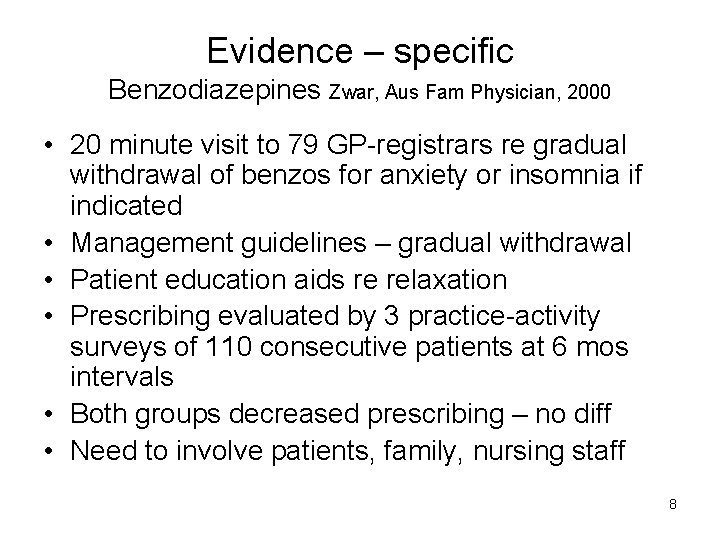
Evidence – specific Benzodiazepines Zwar, Aus Fam Physician, 2000 • 20 minute visit to 79 GP-registrars re gradual withdrawal of benzos for anxiety or insomnia if indicated • Management guidelines – gradual withdrawal • Patient education aids re relaxation • Prescribing evaluated by 3 practice-activity surveys of 110 consecutive patients at 6 mos intervals • Both groups decreased prescribing – no diff • Need to involve patients, family, nursing staff 8
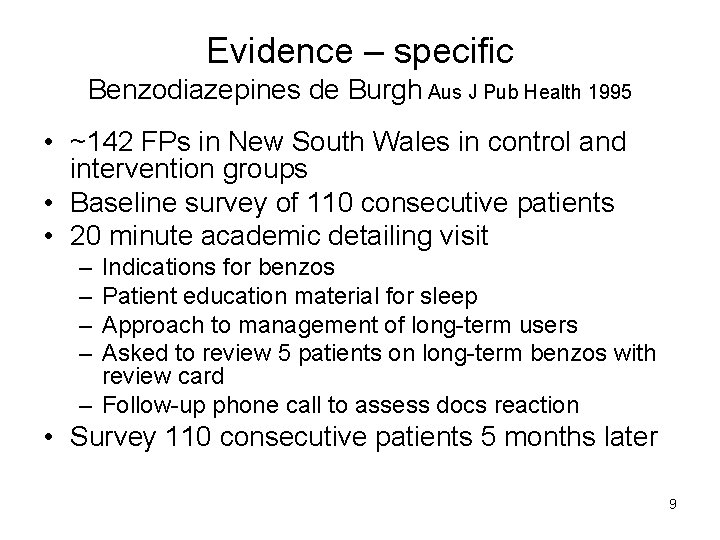
Evidence – specific Benzodiazepines de Burgh Aus J Pub Health 1995 • ~142 FPs in New South Wales in control and intervention groups • Baseline survey of 110 consecutive patients • 20 minute academic detailing visit – – Indications for benzos Patient education material for sleep Approach to management of long-term users Asked to review 5 patients on long-term benzos with review card – Follow-up phone call to assess docs reaction • Survey 110 consecutive patients 5 months later 9
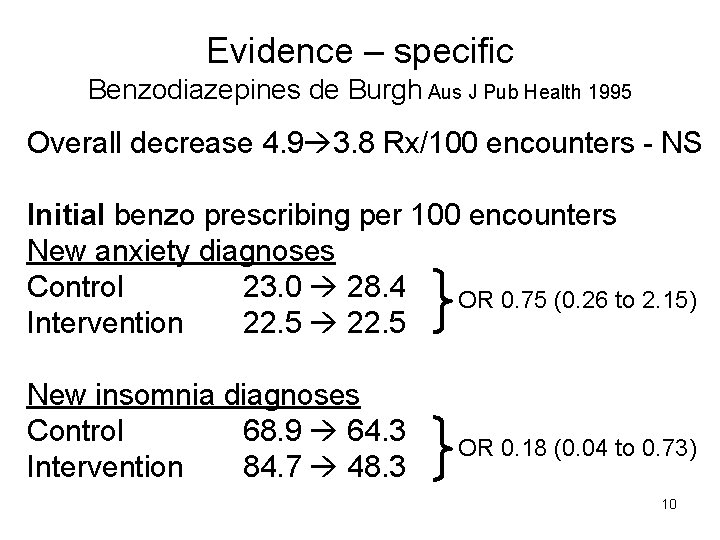
Evidence – specific Benzodiazepines de Burgh Aus J Pub Health 1995 Overall decrease 4. 9 3. 8 Rx/100 encounters - NS Initial benzo prescribing per 100 encounters New anxiety diagnoses Control 23. 0 28. 4 OR 0. 75 (0. 26 to 2. 15) Intervention 22. 5 New insomnia diagnoses Control 68. 9 64. 3 Intervention 84. 7 48. 3 OR 0. 18 (0. 04 to 0. 73) 10
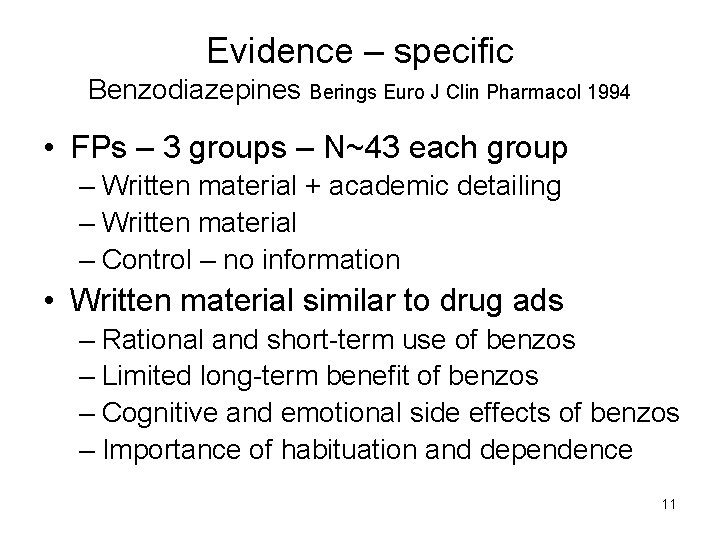
Evidence – specific Benzodiazepines Berings Euro J Clin Pharmacol 1994 • FPs – 3 groups – N~43 each group – Written material + academic detailing – Written material – Control – no information • Written material similar to drug ads – Rational and short-term use of benzos – Limited long-term benefit of benzos – Cognitive and emotional side effects of benzos – Importance of habituation and dependence 11
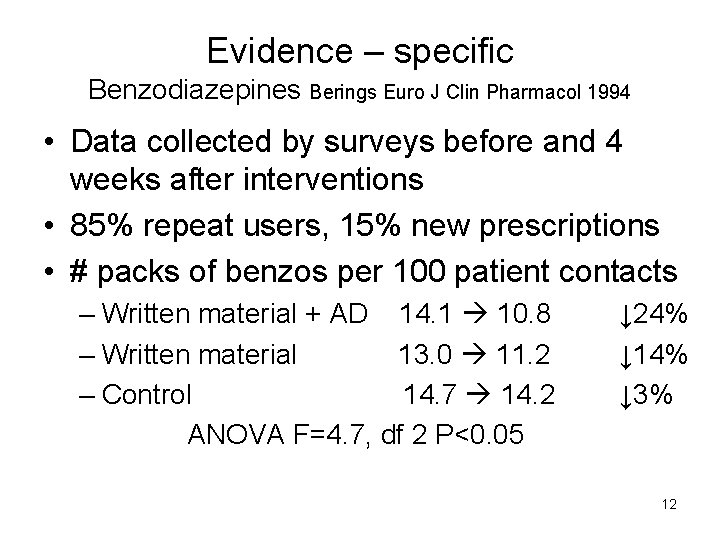
Evidence – specific Benzodiazepines Berings Euro J Clin Pharmacol 1994 • Data collected by surveys before and 4 weeks after interventions • 85% repeat users, 15% new prescriptions • # packs of benzos per 100 patient contacts – Written material + AD 14. 1 10. 8 – Written material 13. 0 11. 2 – Control 14. 7 14. 2 ANOVA F=4. 7, df 2 P<0. 05 ↓ 24% ↓ 14% ↓ 3% 12
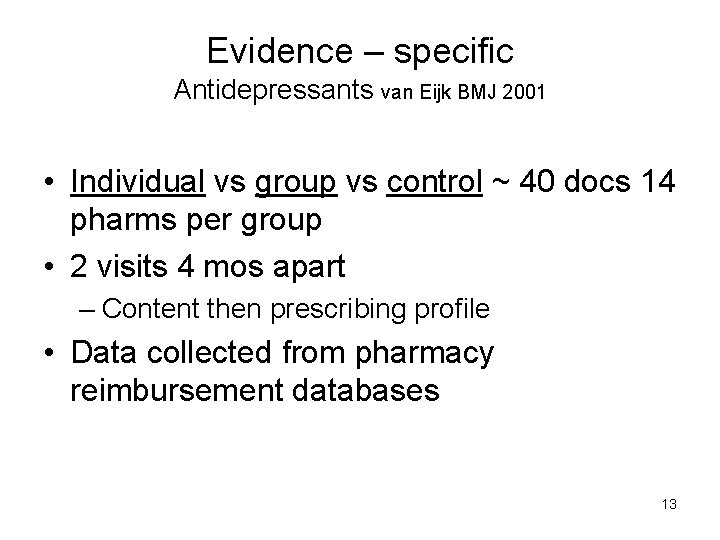
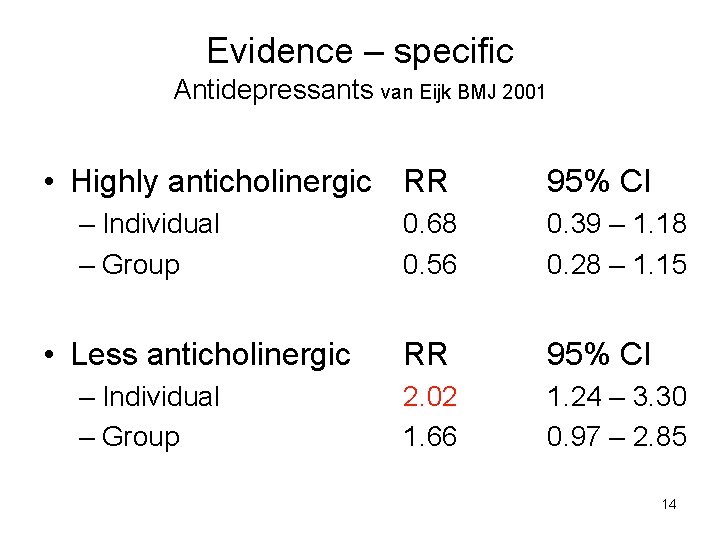
Evidence – specific Antidepressants van Eijk BMJ 2001 • Individual vs group vs control ~ 40 docs 14 pharms per group • 2 visits 4 mos apart – Content then prescribing profile • Data collected from pharmacy reimbursement databases 13
Evidence – specific Antidepressants van Eijk BMJ 2001 • Highly anticholinergic RR – Individual – Group • Less anticholinergic – Individual – Group 95% CI 0. 68 0. 56 0. 39 – 1. 18 0. 28 – 1. 15 RR 95% CI 2. 02 1. 66 1. 24 – 3. 30 0. 97 – 2. 85 14
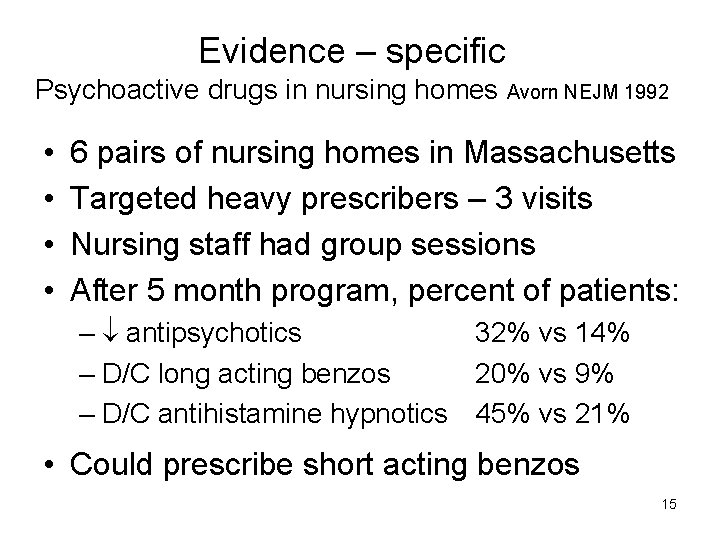
Evidence – specific Psychoactive drugs in nursing homes Avorn NEJM 1992 • • 6 pairs of nursing homes in Massachusetts Targeted heavy prescribers – 3 visits Nursing staff had group sessions After 5 month program, percent of patients: – antipsychotics 32% vs 14% – D/C long acting benzos 20% vs 9% – D/C antihistamine hypnotics 45% vs 21% • Could prescribe short acting benzos 15
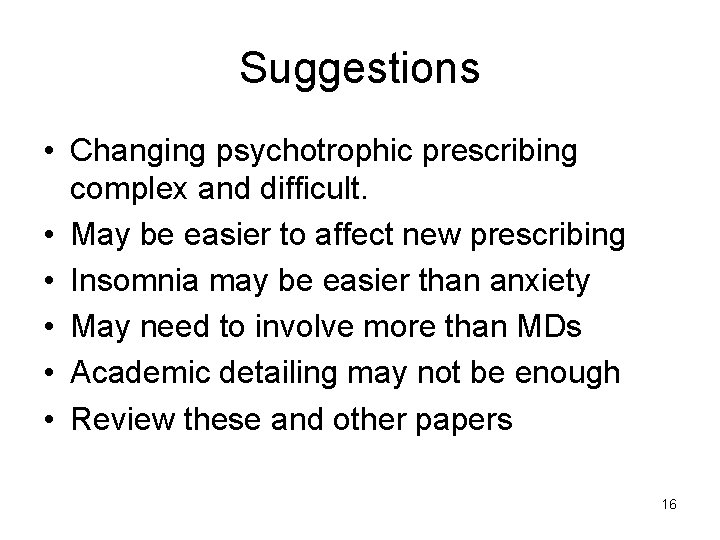
Suggestions • Changing psychotrophic prescribing complex and difficult. • May be easier to affect new prescribing • Insomnia may be easier than anxiety • May need to involve more than MDs • Academic detailing may not be enough • Review these and other papers 16
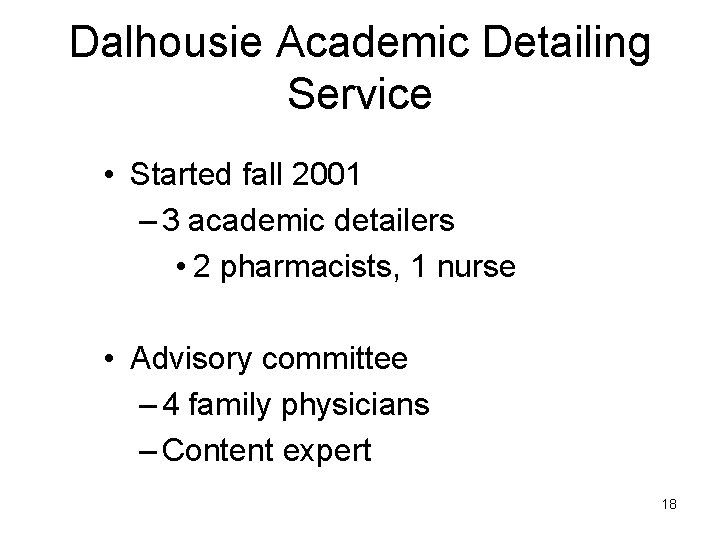
Dalhousie Academic Detailing Service • Started fall 2001 – 3 academic detailers • 2 pharmacists, 1 nurse • Advisory committee – 4 family physicians – Content expert 18
Dalhousie Academic Detailing Service • Each topic see ~ 350 FPs + – Nurse practitioners – Medical students/residents – Nurses – Pharmacists 19
Dalhousie Academic Detailing Service • Handout – 30 -40 page booklet – Summary statements – Double-sided laminate 20
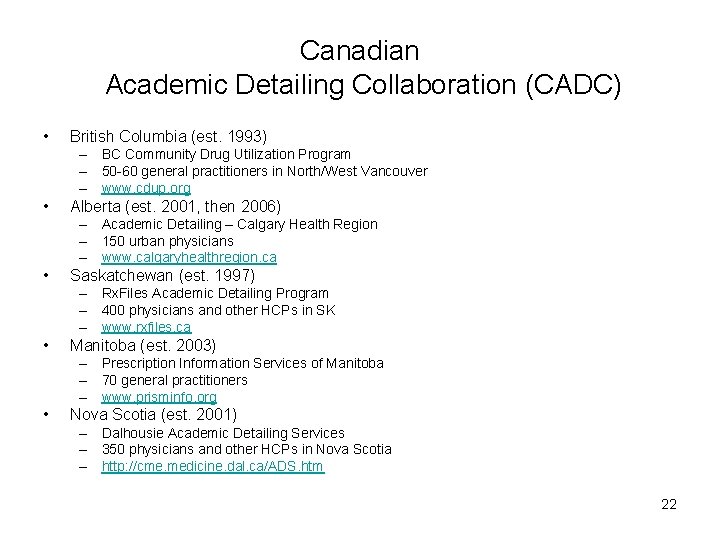
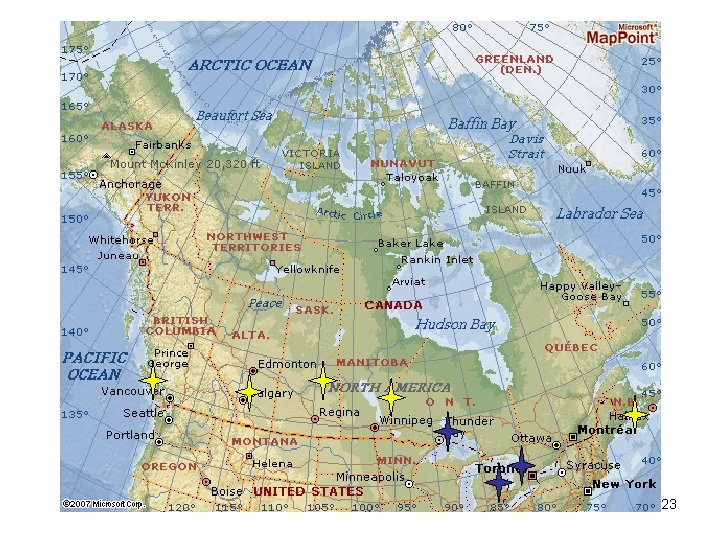
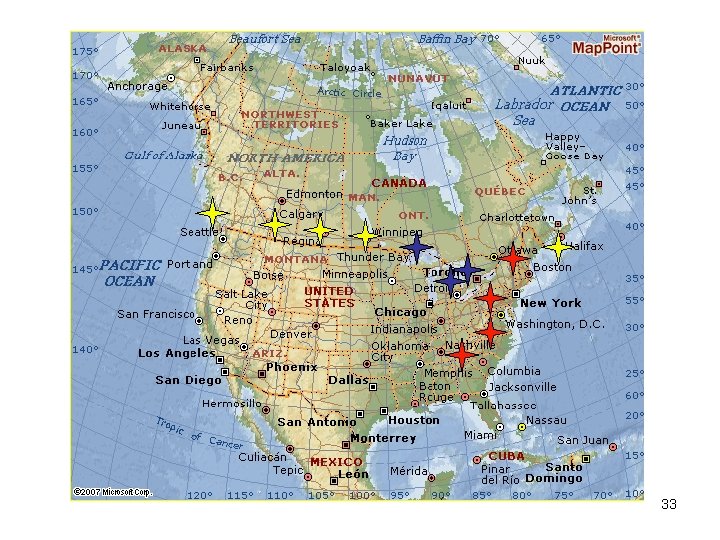
Canadian Academic Detailing Collaboration (CADC) • British Columbia (est. 1993) – BC Community Drug Utilization Program – 50 -60 general practitioners in North/West Vancouver – www. cdup. org • Alberta (est. 2001, then 2006) – Academic Detailing – Calgary Health Region – 150 urban physicians – www. calgaryhealthregion. ca • Saskatchewan (est. 1997) – Rx. Files Academic Detailing Program – 400 physicians and other HCPs in SK – www. rxfiles. ca • Manitoba (est. 2003) – Prescription Information Services of Manitoba – 70 general practitioners – www. prisminfo. org • Nova Scotia (est. 2001) – Dalhousie Academic Detailing Services – 350 physicians and other HCPs in Nova Scotia – http: //cme. medicine. dal. ca/ADS. htm 22
23
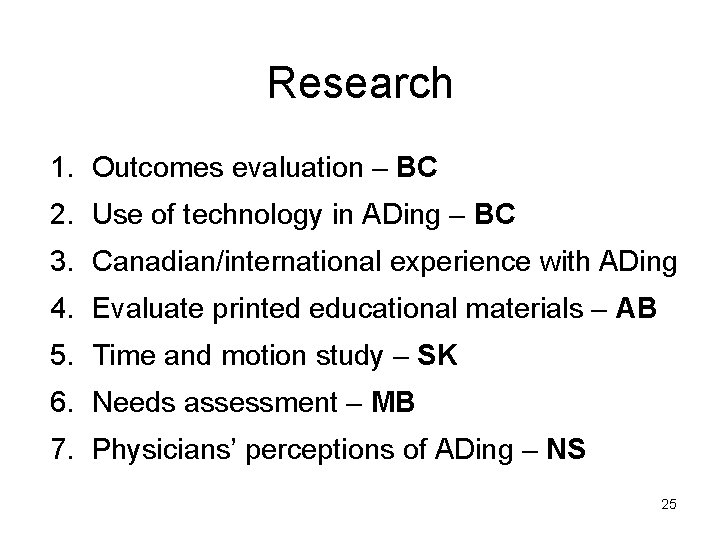
Research 1. Outcomes evaluation – BC 2. Use of technology in ADing – BC 3. Canadian/international experience with ADing 4. Evaluate printed educational materials – AB 5. Time and motion study – SK 6. Needs assessment – MB 7. Physicians’ perceptions of ADing – NS 25
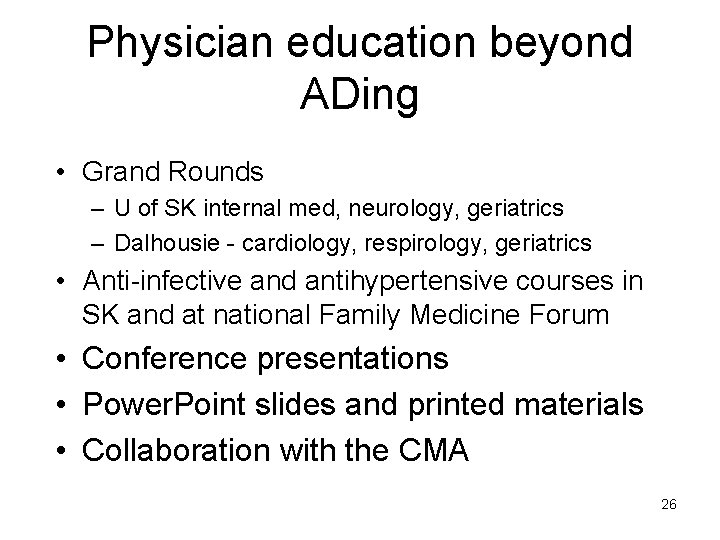
Physician education beyond ADing • Grand Rounds – U of SK internal med, neurology, geriatrics – Dalhousie - cardiology, respirology, geriatrics • Anti-infective and antihypertensive courses in SK and at national Family Medicine Forum • Conference presentations • Power. Point slides and printed materials • Collaboration with the CMA 26
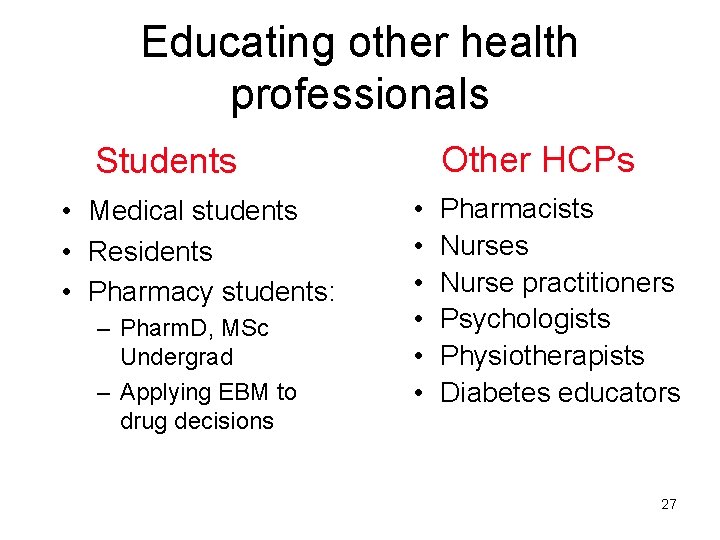
Educating other health professionals Other HCPs Students • Medical students • Residents • Pharmacy students: – Pharm. D, MSc Undergrad – Applying EBM to drug decisions • • • Pharmacists Nurse practitioners Psychologists Physiotherapists Diabetes educators 27
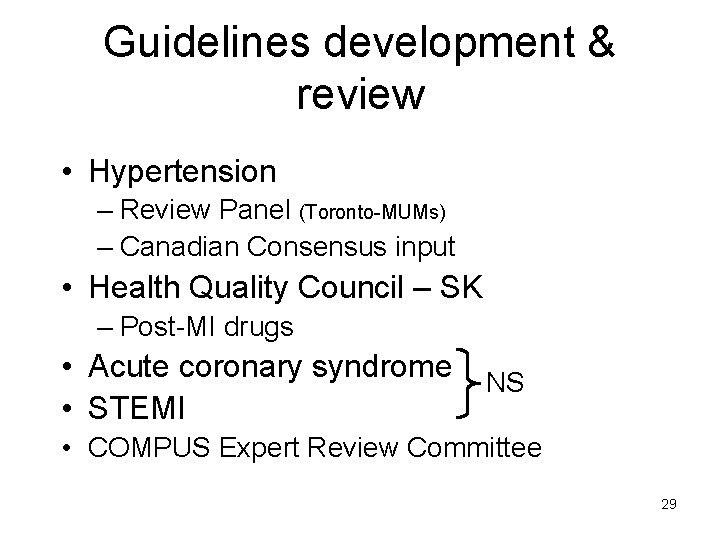
Guidelines development & review • Hypertension – Review Panel (Toronto-MUMs) – Canadian Consensus input • Health Quality Council – SK – Post-MI drugs • Acute coronary syndrome • STEMI NS • COMPUS Expert Review Committee 29
Commentaries/publications • Rx. Files Drug Comparison Chart Book – 6 th edition (current CMA best-seller) – All SK physicians, pharmacies & 3000+ nationally • Measuring prescribing improvements – Basic & Clinical Pharmacology & Toxicology 2006; 98, 243 -52. 30
Commentaries/publications • Coxibs – CMAJ 2005; 173: 83 • Statin guidelines – Can J Cardiol 2007 – AFP 2006; 73: 973 -4 31
33
Academic Detailing in USA • Kentucky – Frank May frank 149@bigpond. net. au • Pennsylvania – Independent Drug Information Service – Michelle Spetman mspetman@partners. org • Vermont – Charles Maclean Charles. Maclean@vtmednet. org – http: //www. med. uvm. edu/ahec/TB 1+BL. asp? Site. Area. ID=290 34
Michael Allen michael. allen@dal. ca cme. medicine. dal. ca/ADS. htm 35