
Transmitted by Uber VMAD04 10 Building a Framework
Transmitted by Uber VMAD-04 -10 Building a Framework for Self. Driving Safety October 2019 David Stamm - Product Safety
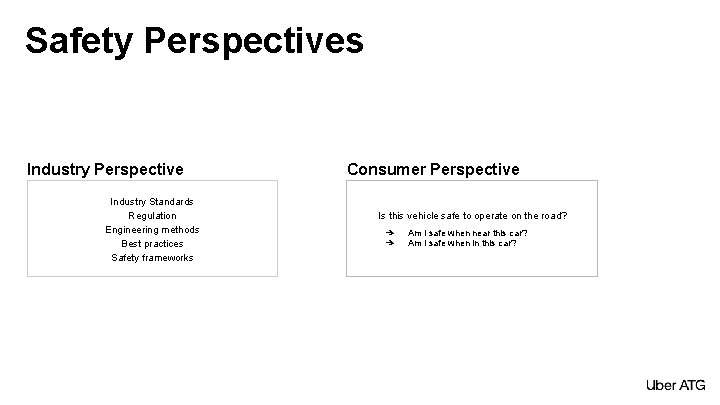
Safety Perspectives Industry Perspective Industry Standards Regulation Engineering methods Best practices Safety frameworks Consumer Perspective Is this vehicle safe to operate on the road? ➔ ➔ Am I safe when near this car? Am I safe when in this car?
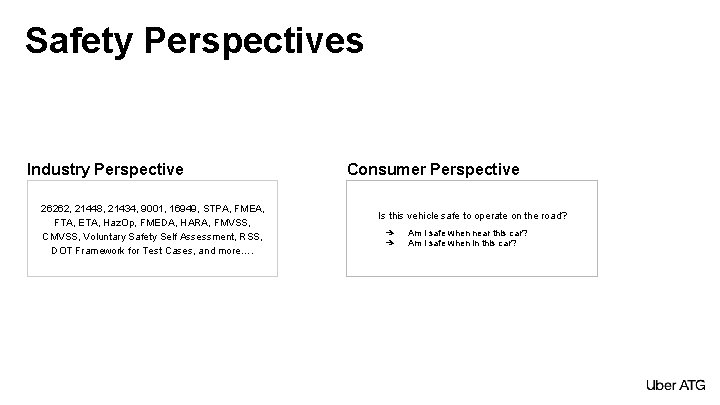
Safety Perspectives Industry Perspective 26262, 21448, 21434, 9001, 16949, STPA, FMEA, FTA, ETA, Haz. Op, FMEDA, HARA, FMVSS, CMVSS, Voluntary Safety Self Assessment, RSS, DOT Framework for Test Cases, and more…. Consumer Perspective Is this vehicle safe to operate on the road? ➔ ➔ Am I safe when near this car? Am I safe when in this car?
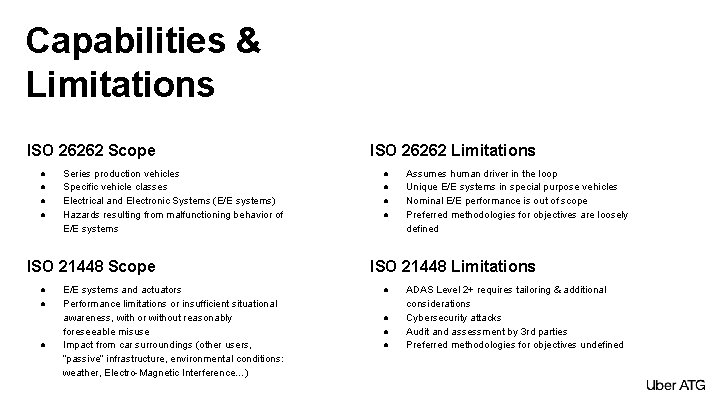
Capabilities & Limitations ISO 26262 Scope ● ● Series production vehicles Specific vehicle classes Electrical and Electronic Systems (E/E systems) Hazards resulting from malfunctioning behavior of E/E systems ISO 21448 Scope ● ● ● E/E systems and actuators Performance limitations or insufficient situational awareness, with or without reasonably foreseeable misuse Impact from car surroundings (other users, “passive” infrastructure, environmental conditions: weather, Electro-Magnetic Interference…) ISO 26262 Limitations ● ● Assumes human driver in the loop Unique E/E systems in special purpose vehicles Nominal E/E performance is out of scope Preferred methodologies for objectives are loosely defined ISO 21448 Limitations ● ● ADAS Level 2+ requires tailoring & additional considerations Cybersecurity attacks Audit and assessment by 3 rd parties Preferred methodologies for objectives undefined

Application to SDVs Applicable w/ tailoring Not Applicable SDV element fits fully in the intended scope and application. No tailoring or bespoke argumentation required. SDV element is out of the intended scope, but with tailoring and additional safety argumentation the method can be utilized. The method is not appropriate to be applied to the SDV element
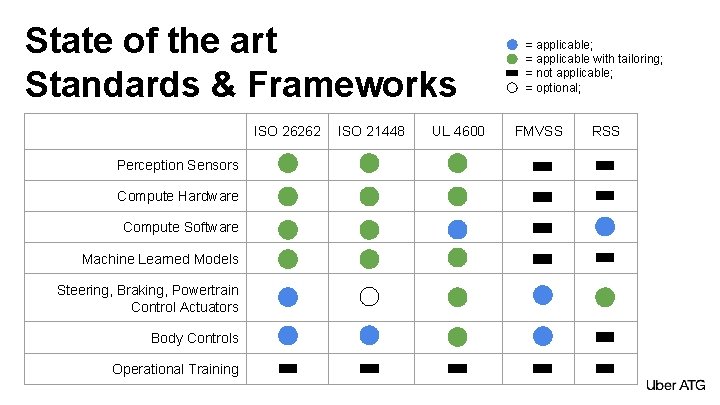
State of the art Standards & Frameworks ISO 26262 Perception Sensors Compute Hardware Compute Software Machine Learned Models Steering, Braking, Powertrain Control Actuators Body Controls Operational Training ISO 21448 UL 4600 = applicable; = applicable with tailoring; = not applicable; = optional; FMVSS RSS
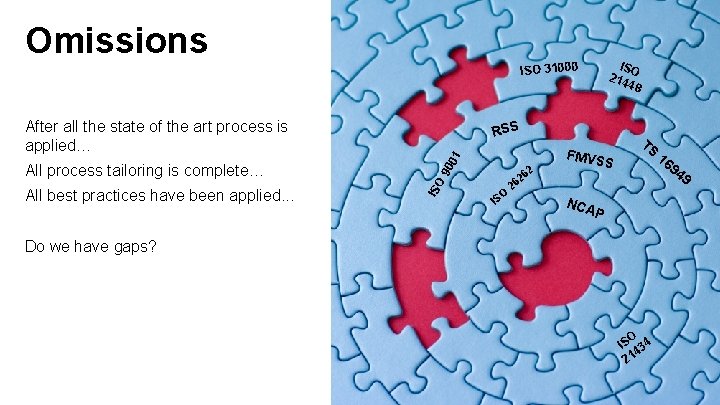
Omissions After all the state of the art process is applied… All best practices have been applied. . . 01 RSS 2 26 90 ISO All process tailoring is complete… ISO 214 48 ISO 31000 I SO FMVS S TS 94 9 26 NCA 16 P Do we have gaps? O IS 34 4 21
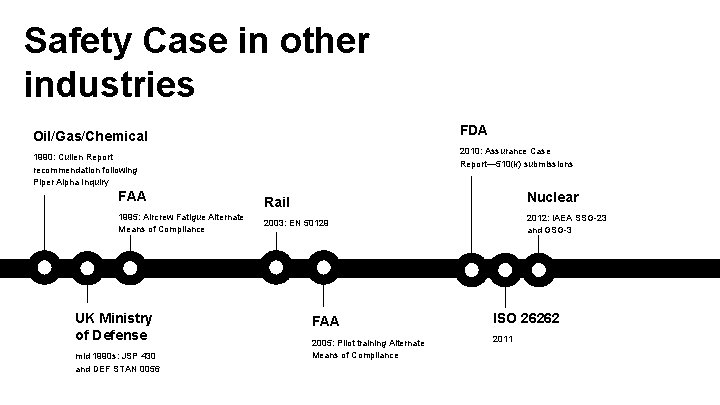
Safety Case in other industries FDA Oil/Gas/Chemical 2010: Assurance Case Report— 510(k) submissions 1990: Cullen Report recommendation following Piper Alpha Inquiry FAA 1995: Aircrew Fatigue Alternate Means of Compliance UK Ministry of Defense mid 1990 s: JSP 430 and DEF STAN 0056 Nuclear Rail 2012: IAEA SSG-23 and GSG-3 2003: EN 50129 FAA ISO 26262 2005: Pilot training Alternate Means of Compliance 2011
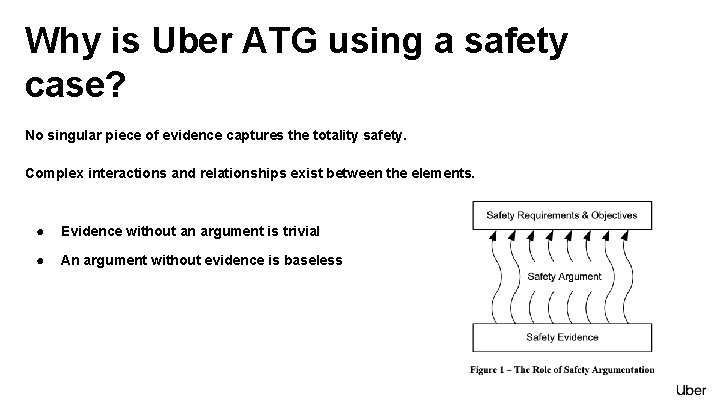
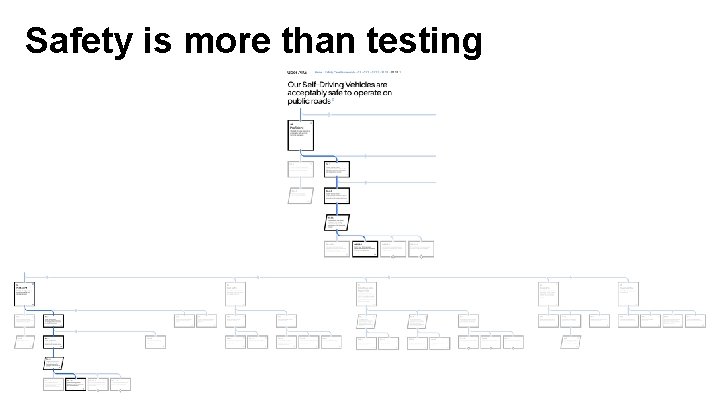
Why is Uber ATG using a safety case? No singular piece of evidence captures the totality safety. Complex interactions and relationships exist between the elements. ● Evidence without an argument is trivial ● An argument without evidence is baseless
Challenges Safety case pitfalls ● ● ● Logical errors in the development of the argument Errors in the relation of evidence to satisfying a goal Incomplete decomposition of top level goal Onerous to review by external entities Organizational failure - box checking, paper exercise, parity with product
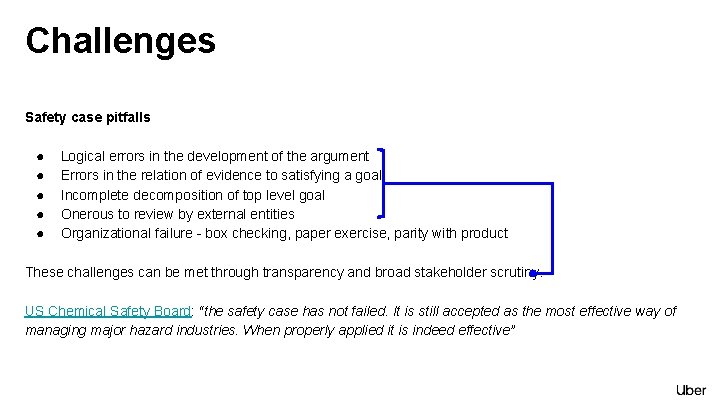
Challenges Safety case pitfalls ● ● ● Logical errors in the development of the argument Errors in the relation of evidence to satisfying a goal Incomplete decomposition of top level goal Onerous to review by external entities Organizational failure - box checking, paper exercise, parity with product These challenges can be met through transparency and broad stakeholder scrutiny. US Chemical Safety Board: “the safety case has not failed. It is still accepted as the most effective way of managing major hazard industries. When properly applied it is indeed effective”
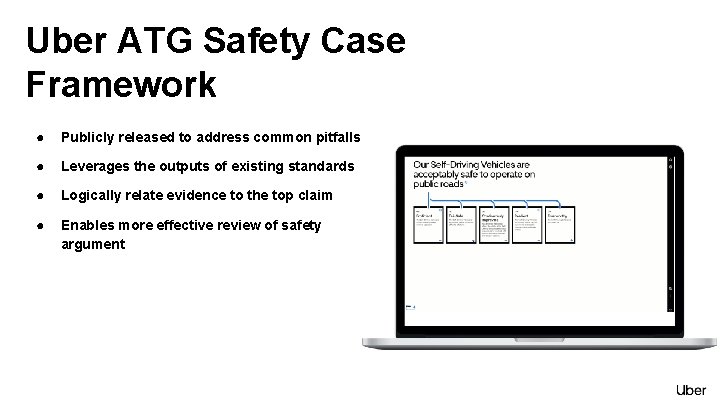
Uber ATG Safety Case Framework ● Publicly released to address common pitfalls ● Leverages the outputs of existing standards ● Logically relate evidence to the top claim ● Enables more effective review of safety argument
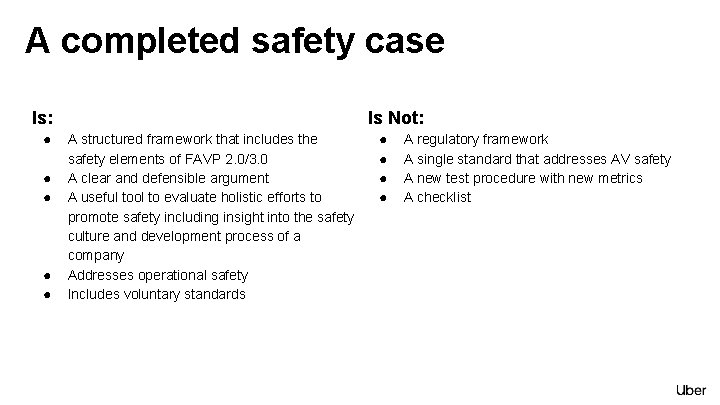
A completed safety case Is Not: Is: ● ● ● A structured framework that includes the safety elements of FAVP 2. 0/3. 0 A clear and defensible argument A useful tool to evaluate holistic efforts to promote safety including insight into the safety culture and development process of a company Addresses operational safety Includes voluntary standards ● ● A regulatory framework A single standard that addresses AV safety A new test procedure with new metrics A checklist
Safety is more than testing
Testing & The Safety Case The goal of testing The structured argument Comprehensive, validated, and representative testing is the goal. Testing must be done in context of a structured argument for safety. Unit, subsystem, system testing based on the ODD can achieve comprehensive coverage if done properly. Validation of testing focuses on the precision and accuracy of the test results. Representative testing derives from the ODD and misuse cases. Linkage of testing to safety goals is key. - Evidence without argument is trivia Claims without evidence is baseless
The Road Ahead We invite critical feedback Share, borrow, build We realize this framework is imperfect in its current form. It will take time to both finalize and fulfill. Freely use and build on this framework, whether in partnership with us or independently. No permission or attribution required. We hope this framework can serve as a jumping off point for broadening the conversation. We will be publishing further depths of the framework in the coming months. We will listen and refine our approach based on emerging standards and feedback from our peers, policymakers, other key stakeholders. We wish to collaborate on safety. We are willing to share openly to get started on a safe path forward, together.
- Slides: 17