A Case for Case Exploring the use of

- Slides: 14
A Case for Case Exploring the use of Case Studies in an on-line context Aa Michele Mc. Gill (Michele. Mc. Gill@usq. edu. au) Yvonne Findlay (Yvonne. Findlay@usq. edu. au) Michelle Turner (Michelle. Turner@usq. edu) Peter Mc. Ilveen (Peter. Mc. Ilveen@usq. edu. au) Anne Jasman (Anne. Jasman@usq. edu. au)
Rationale for using Case as a Teaching Strategy in Graduate Diploma Learning and Teaching � How beginning teachers build their professional understandings � Tacit knowledge � Unpacking personal learning and perceived teaching baggage � Role of narratives � Role of inquiry � Developing critical reflective practices
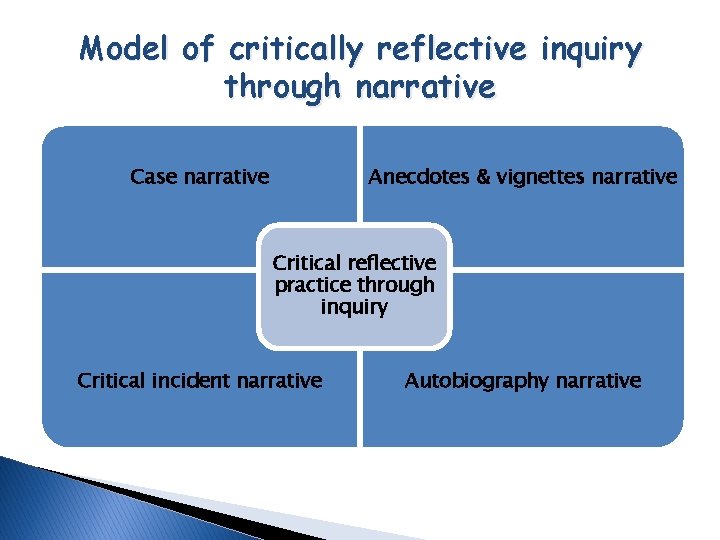
Model of critically reflective inquiry through narrative Case narrative Anecdotes & vignettes narrative Critical reflective practice through inquiry Critical incident narrative Autobiography narrative
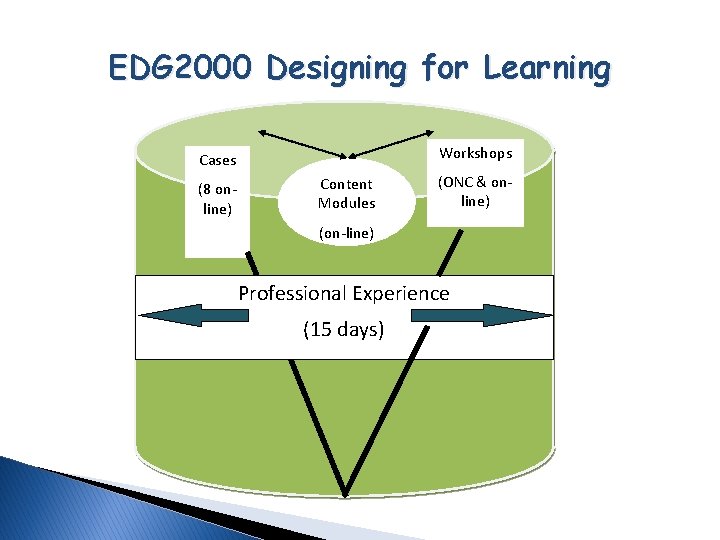
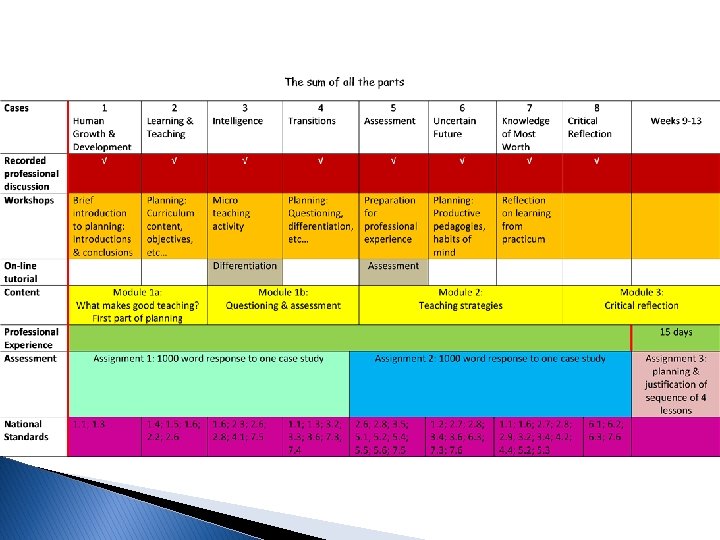
EDG 2000 Designing for Learning Workshops Cases (8 online) Content Modules (ONC & online) (on-line) Professional Experience (15 days)
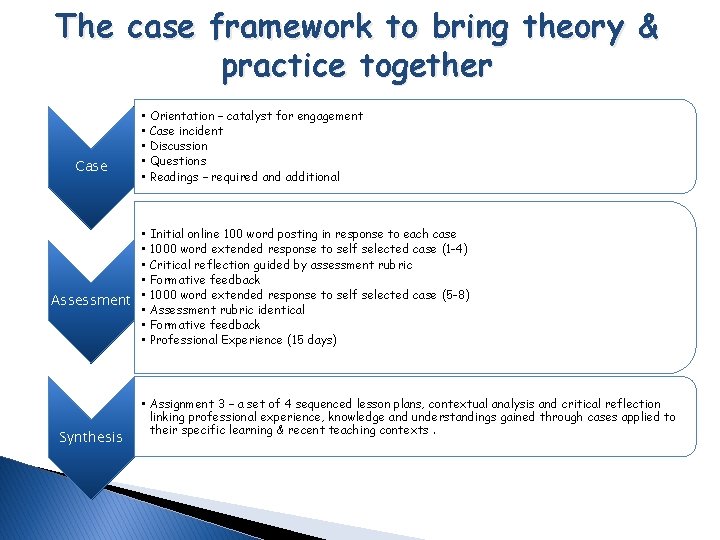
The case framework to bring theory & practice together Case • • • Assessment • • Synthesis Orientation – catalyst for engagement Case incident Discussion Questions Readings – required and additional Initial online 100 word posting in response to each case 1000 word extended response to self selected case (1 -4) Critical reflection guided by assessment rubric Formative feedback 1000 word extended response to self selected case (5 -8) Assessment rubric identical Formative feedback Professional Experience (15 days) • Assignment 3 – a set of 4 sequenced lesson plans, contextual analysis and critical reflection linking professional experience, knowledge and understandings gained through cases applied to their specific learning & recent teaching contexts.
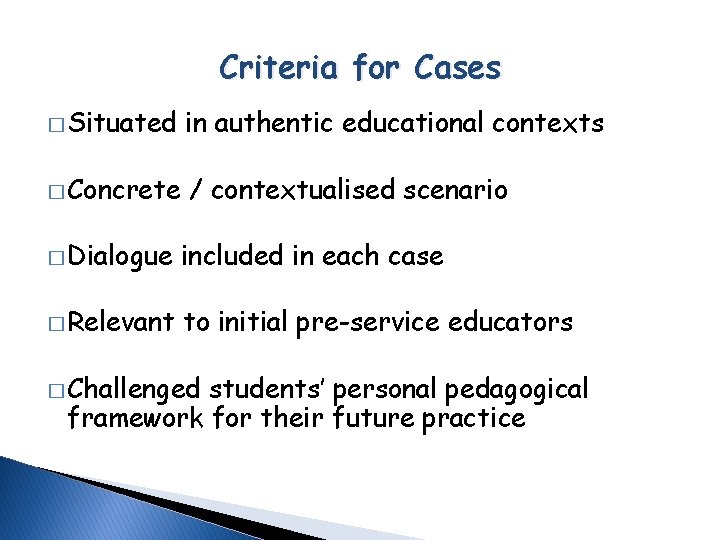
Criteria for Cases � Situated in authentic educational contexts � Concrete / contextualised scenario � Dialogue included in each case � Relevant to initial pre-service educators � Challenged students’ personal pedagogical framework for their future practice
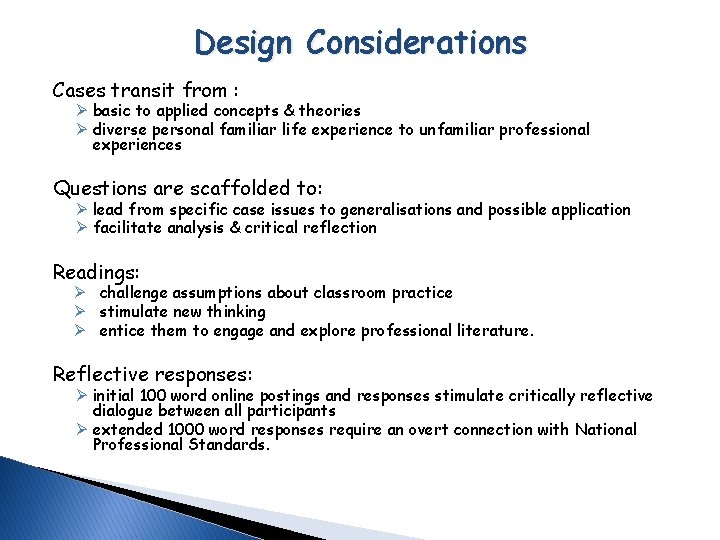
Design Considerations Cases transit from : Ø basic to applied concepts & theories Ø diverse personal familiar life experience to unfamiliar professional experiences Questions are scaffolded to: Ø lead from specific case issues to generalisations and possible application Ø facilitate analysis & critical reflection Readings: Ø challenge assumptions about classroom practice Ø stimulate new thinking Ø entice them to engage and explore professional literature. Reflective responses: Ø initial 100 word online postings and responses stimulate critically reflective dialogue between all participants Ø extended 1000 word responses require an overt connection with National Professional Standards.
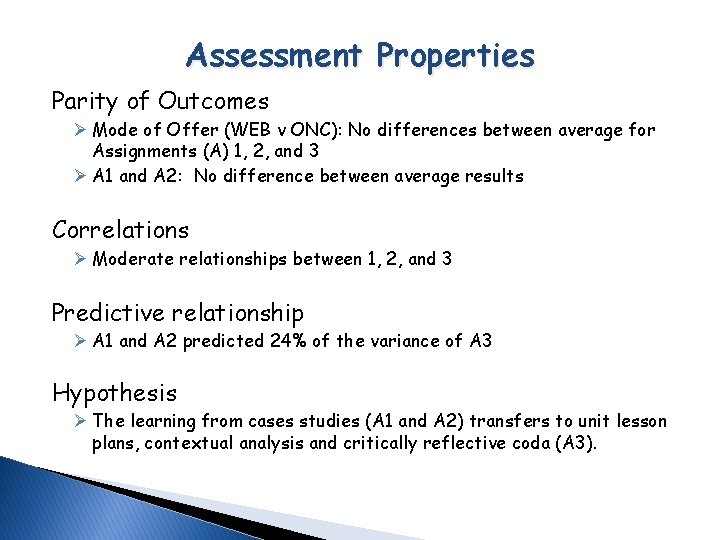
Assessment Properties Parity of Outcomes Ø Mode of Offer (WEB v ONC): No differences between average for Assignments (A) 1, 2, and 3 Ø A 1 and A 2: No difference between average results Correlations Ø Moderate relationships between 1, 2, and 3 Predictive relationship Ø A 1 and A 2 predicted 24% of the variance of A 3 Hypothesis Ø The learning from cases studies (A 1 and A 2) transfers to unit lesson plans, contextual analysis and critically reflective coda (A 3).
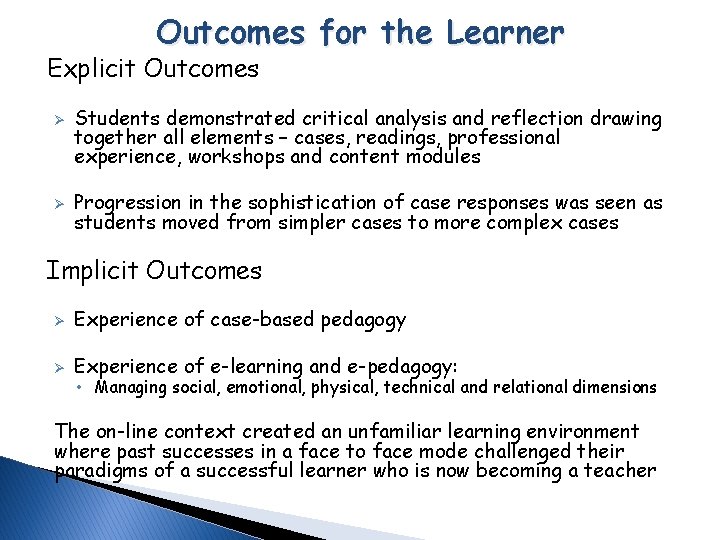
Outcomes for the Learner Explicit Outcomes Ø Ø Students demonstrated critical analysis and reflection drawing together all elements – cases, readings, professional experience, workshops and content modules Progression in the sophistication of case responses was seen as students moved from simpler cases to more complex cases Implicit Outcomes Ø Experience of case-based pedagogy Ø Experience of e-learning and e-pedagogy: • Managing social, emotional, physical, technical and relational dimensions The on-line context created an unfamiliar learning environment where past successes in a face to face mode challenged their paradigms of a successful learner who is now becoming a teacher
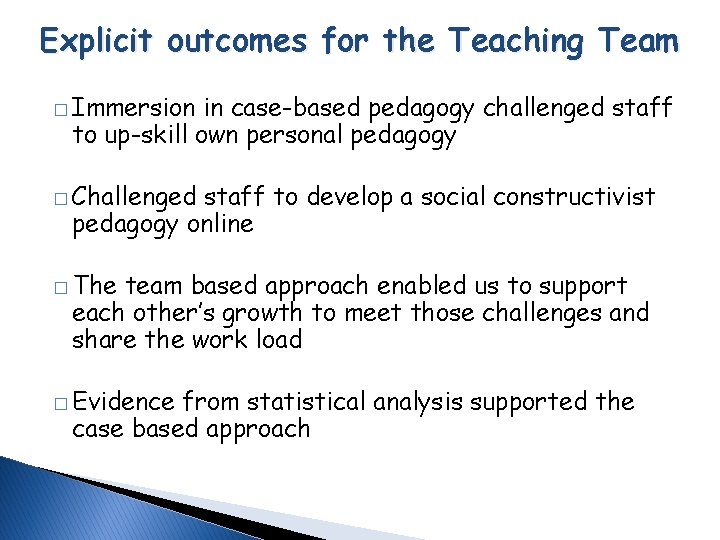
Explicit outcomes for the Teaching Team � Immersion in case-based pedagogy challenged staff to up-skill own personal pedagogy � Challenged staff to develop a social constructivist pedagogy online � The team based approach enabled us to support each other’s growth to meet those challenges and share the work load � Evidence from statistical analysis supported the case based approach
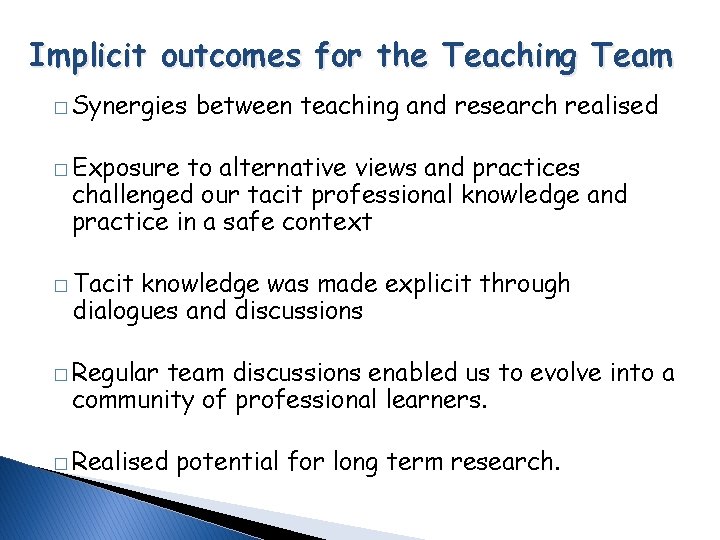
Implicit outcomes for the Teaching Team � Synergies between teaching and research realised � Exposure to alternative views and practices challenged our tacit professional knowledge and practice in a safe context � Tacit knowledge was made explicit through dialogues and discussions � Regular team discussions enabled us to evolve into a community of professional learners. � Realised potential for long term research.
A Case for Case Ø Ø Ø The case-based pedagogy disrupted prior successful experiences as learners and teachers The students experienced a process they could apply to their own journey to becoming and being a professional educator These cases provided a scaffolded learning journey for all—students and teaching team Ultimately we all learned about being a learner before being a teacher—whether in a face-to-face or on-line learning and teaching environment