9 Click to edit Master title style Click

- Slides: 43
9 Click to edit Master title style • Click to edit Master text styles – Second level Differential Analysis and • Third level Pricing – Fourth. Product level » Fifth level Student Version 11/22/2020 11
1 1 Prepare differential analysis reports for a variety of managerial decisions. 9 -2 1 -2 2
1 Sunk Costs that have been incurred in the past are not relevant to the decision. These costs are called sunk costs. 9 -3 1 -3 3
1 Differential Revenue Differential revenue is the amount of increase or decrease in revenue that is expected from a course of action as compared with an alternative action. 9 -4 1 -4 4
1 Differential Cost Differential cost is the amount of increase or decrease in cost that is expected from a course of action as compared with an alternative action. 9 -5 1 -5 5
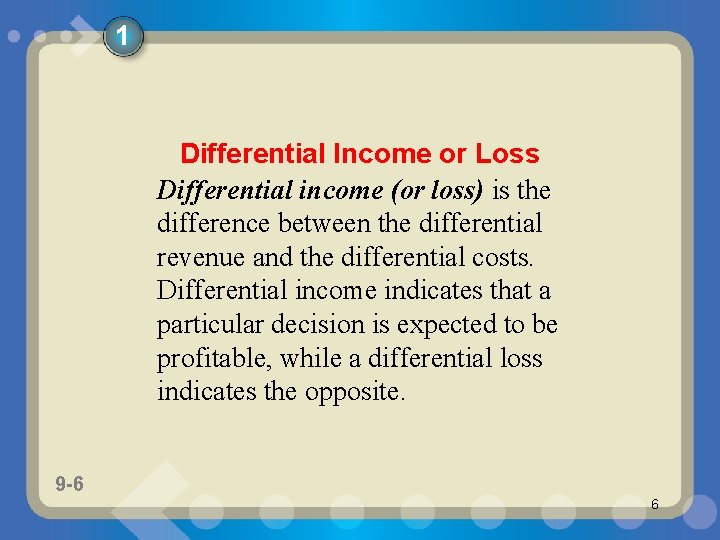
1 Differential Income or Loss Differential income (or loss) is the difference between the differential revenue and the differential costs. Differential income indicates that a particular decision is expected to be profitable, while a differential loss indicates the opposite. 9 -6 1 -6 6
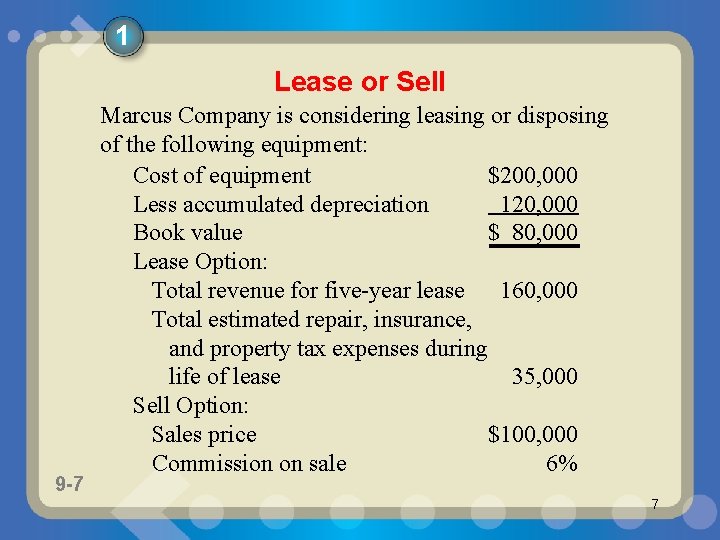
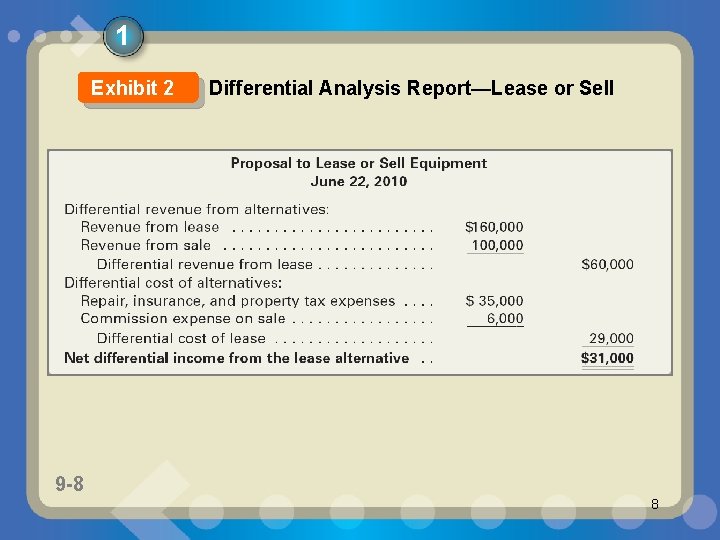
1 Lease or Sell 9 -7 1 -7 Marcus Company is considering leasing or disposing of the following equipment: Cost of equipment $200, 000 Less accumulated depreciation 120, 000 Book value $ 80, 000 Lease Option: Total revenue for five-year lease 160, 000 Total estimated repair, insurance, and property tax expenses during life of lease 35, 000 Sell Option: Sales price $100, 000 Commission on sale 6% 7
1 Exhibit 2 9 -8 1 -8 Differential Analysis Report—Lease or Sell 8
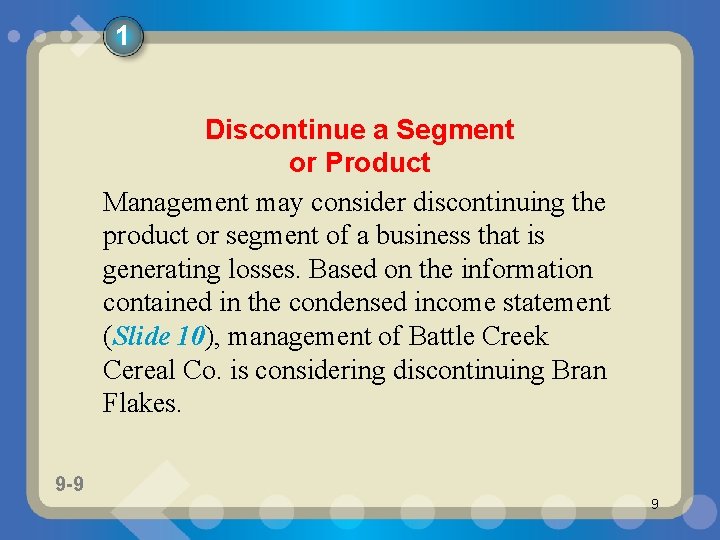
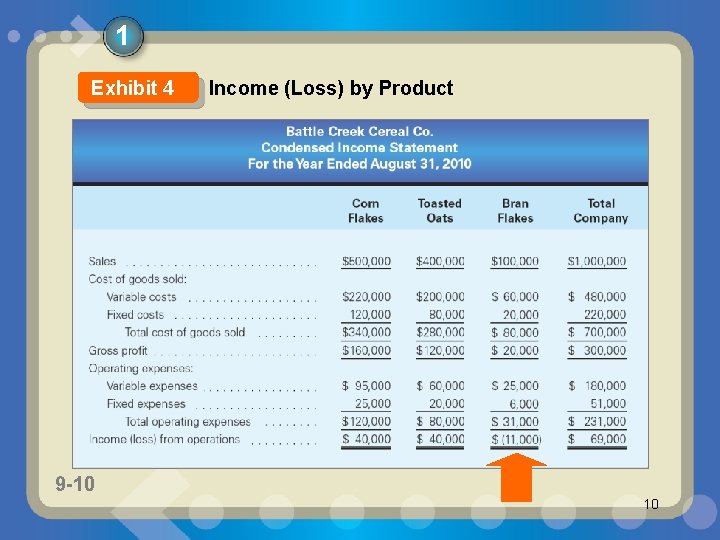
1 Discontinue a Segment or Product Management may consider discontinuing the product or segment of a business that is generating losses. Based on the information contained in the condensed income statement (Slide 10), management of Battle Creek Cereal Co. is considering discontinuing Bran Flakes. 9 -9 1 -9 9
1 Exhibit 4 9 -10 1 -10 Income (Loss) by Product 10
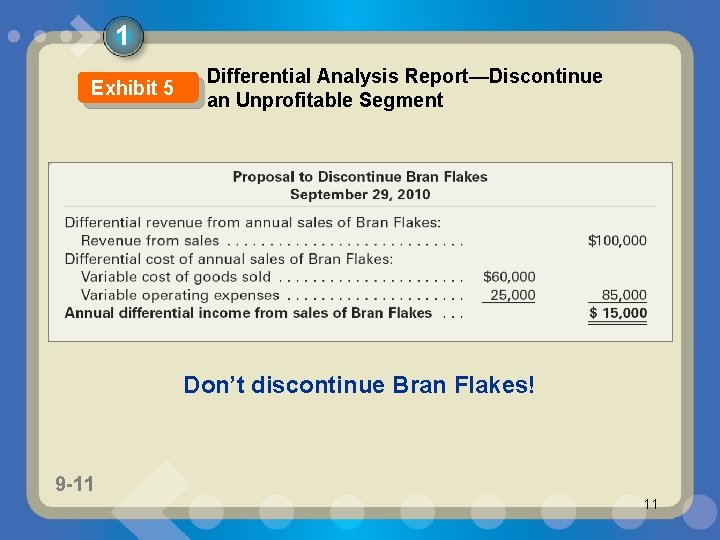
1 Exhibit 5 Differential Analysis Report—Discontinue an Unprofitable Segment Don’t discontinue Bran Flakes! 9 -11 11
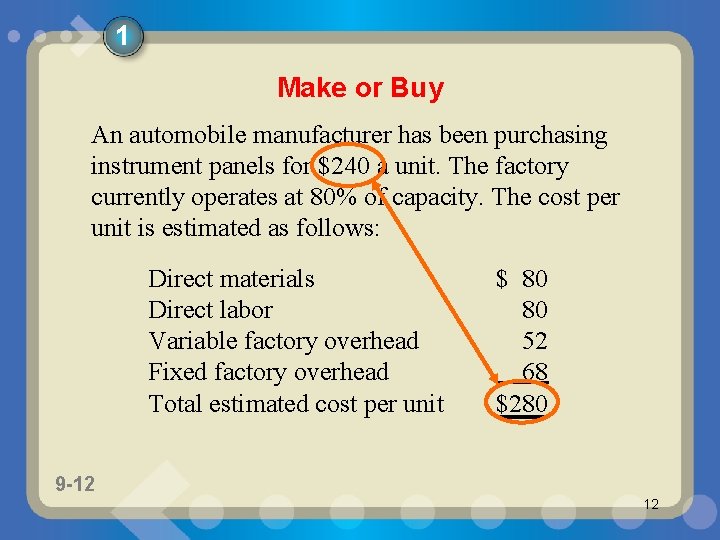
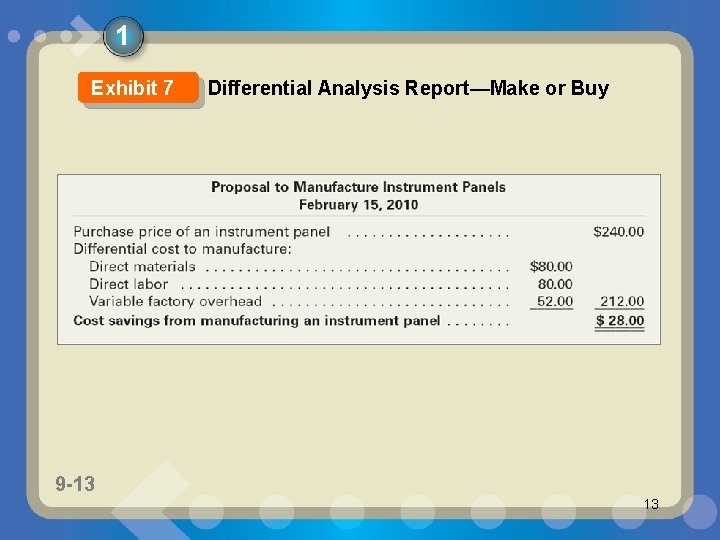
1 Make or Buy An automobile manufacturer has been purchasing instrument panels for $240 a unit. The factory currently operates at 80% of capacity. The cost per unit is estimated as follows: Direct materials Direct labor Variable factory overhead Fixed factory overhead Total estimated cost per unit 9 -12 1 -12 $ 80 80 52 68 $280 12
1 Exhibit 7 9 -13 1 -13 Differential Analysis Report—Make or Buy 13
1 Opportunity Cost The amount of income that is foregone from an alternative use of an asset, such as cash, is called an opportunity cost. 9 -14 14
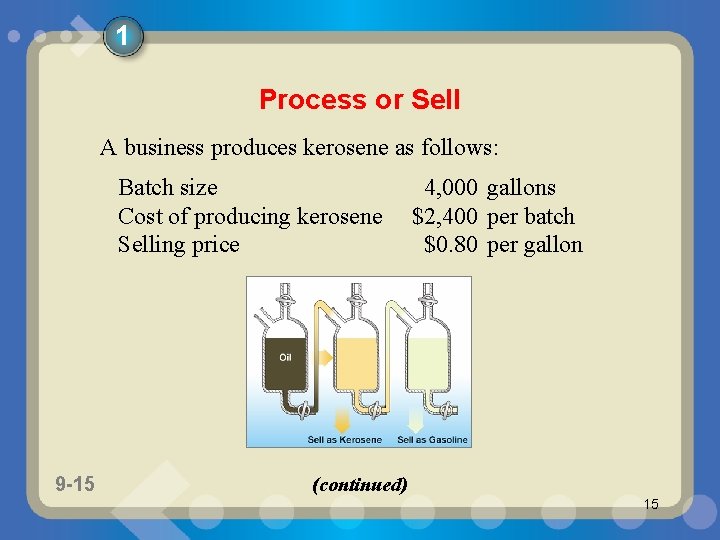
1 Process or Sell A business produces kerosene as follows: Batch size Cost of producing kerosene Selling price 9 -15 1 -15 4, 000 gallons $2, 400 per batch $0. 80 per gallon (continued) 15
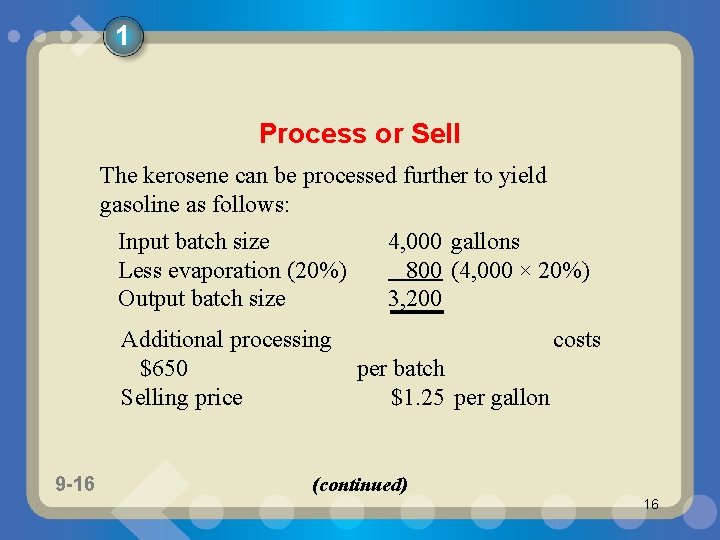
1 Process or Sell The kerosene can be processed further to yield gasoline as follows: Input batch size Less evaporation (20%) Output batch size Additional processing $650 Selling price 9 -16 1 -16 4, 000 gallons 800 (4, 000 × 20%) 3, 200 costs per batch $1. 25 per gallon (continued) 16
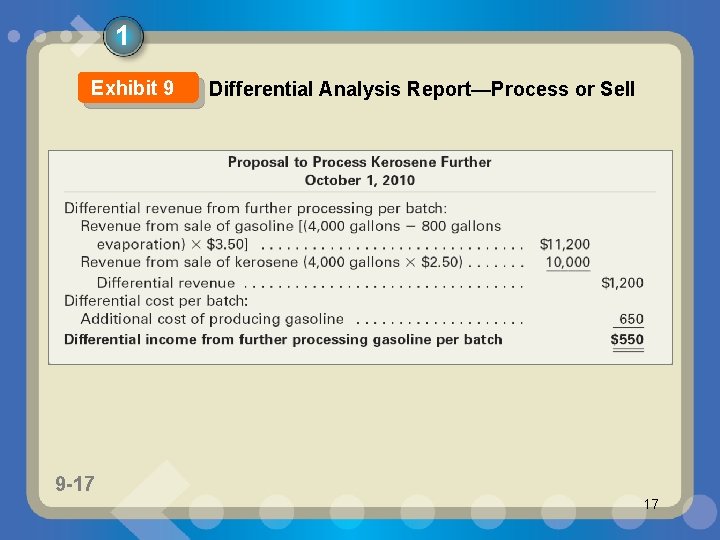
1 Exhibit 9 9 -17 1 -17 Differential Analysis Report—Process or Sell 17
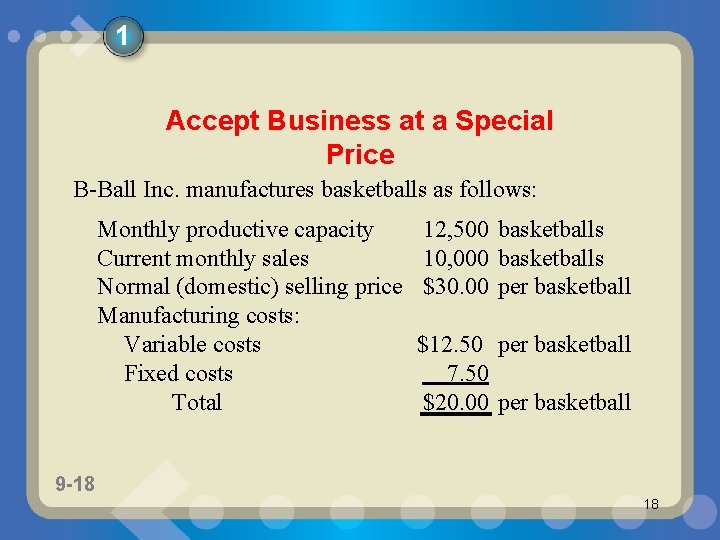
1 Accept Business at a Special Price B-Ball Inc. manufactures basketballs as follows: Monthly productive capacity Current monthly sales Normal (domestic) selling price Manufacturing costs: Variable costs Fixed costs Total 9 -18 12, 500 basketballs 10, 000 basketballs $30. 00 per basketball $12. 50 per basketball 7. 50 $20. 00 per basketball 18
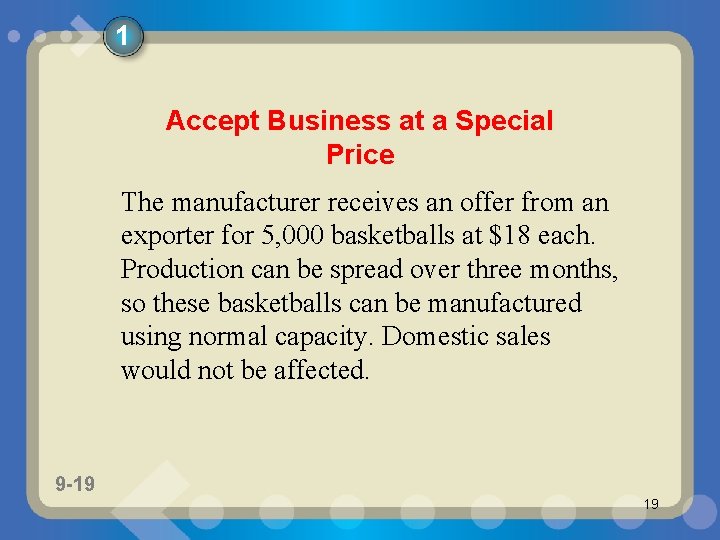
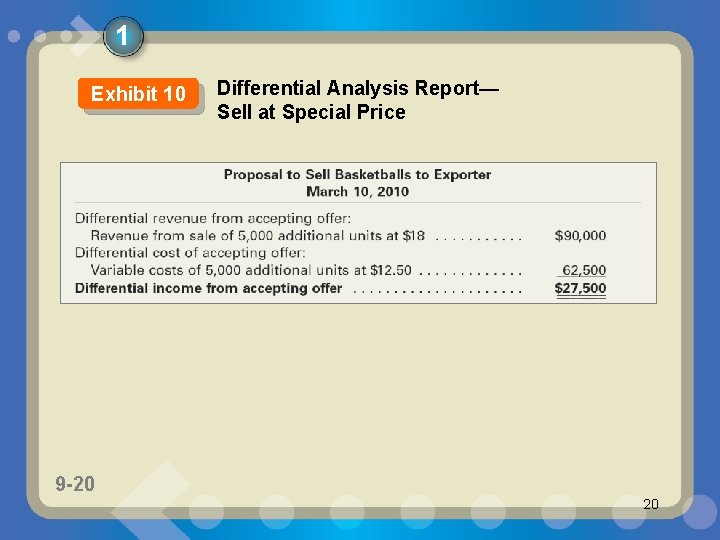
1 Accept Business at a Special Price The manufacturer receives an offer from an exporter for 5, 000 basketballs at $18 each. Production can be spread over three months, so these basketballs can be manufactured using normal capacity. Domestic sales would not be affected. 9 -19 19
1 Exhibit 10 9 -20 1 -20 Differential Analysis Report— Sell at Special Price 20
1 2 Determine the selling price of a product using the total cost, product cost, and variable cost concepts. 9 -21 1 -21 21
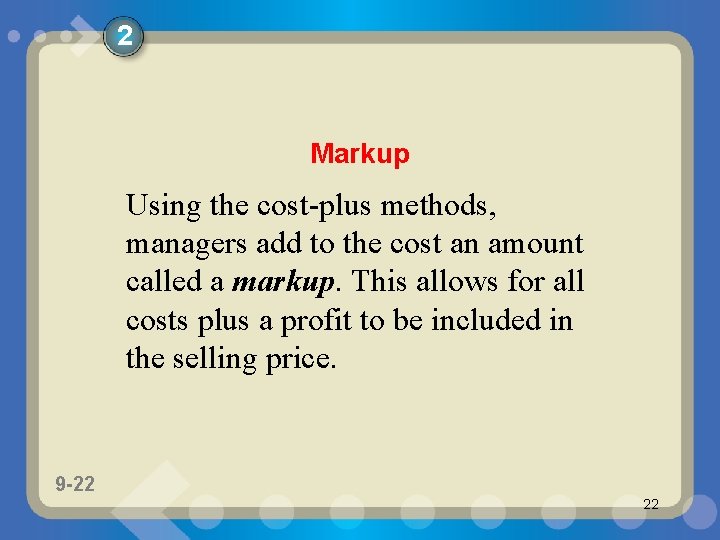
2 Markup Using the cost-plus methods, managers add to the cost an amount called a markup. This allows for all costs plus a profit to be included in the selling price. 9 -22 1 -22 22
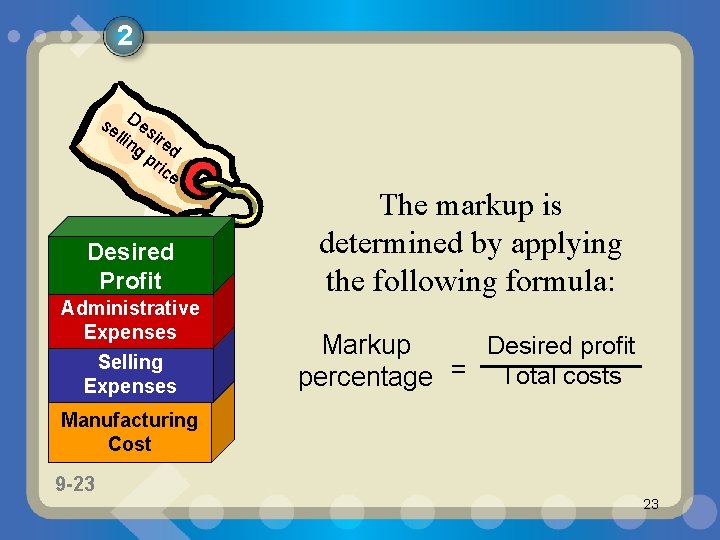
2 se Des llin ire d g pr ice Desired Profit Administrative Expenses Selling Expenses The markup is determined by applying the following formula: Markup Desired profit percentage = Total costs Manufacturing Cost 9 -23 1 -23 23
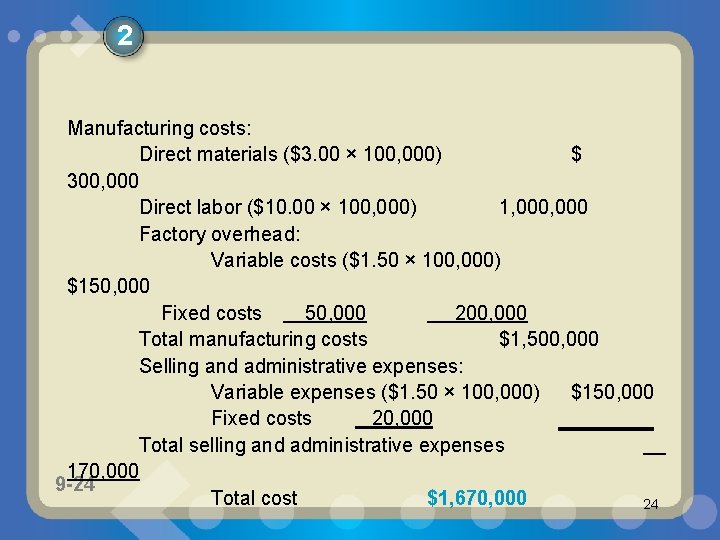
2 Manufacturing costs: Direct materials ($3. 00 × 100, 000) $ 300, 000 Direct labor ($10. 00 × 100, 000) 1, 000 Factory overhead: Variable costs ($1. 50 × 100, 000) $150, 000 Fixed costs 50, 000 200, 000 Total manufacturing costs $1, 500, 000 Selling and administrative expenses: Variable expenses ($1. 50 × 100, 000) $150, 000 Fixed costs 20, 000 Total selling and administrative expenses 170, 000 9 -24 1 -24 Total cost $1, 670, 000 24
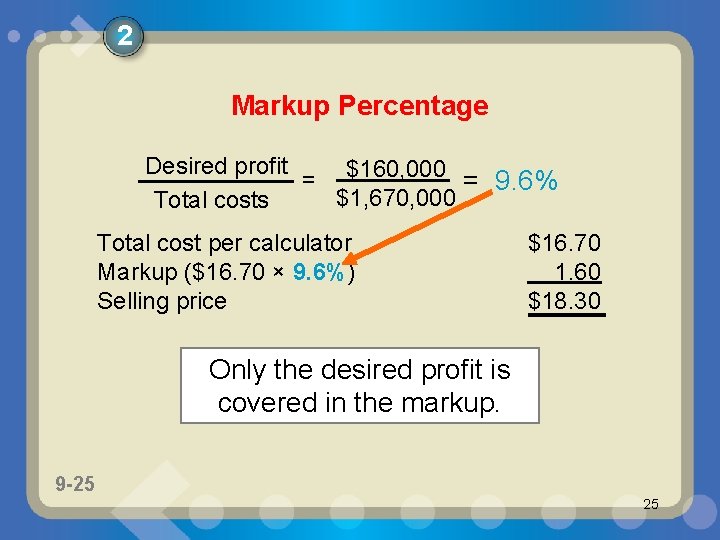
2 Markup Percentage Desired profit = $160, 000 = 9. 6% $1, 670, 000 Total costs Total cost per calculator Markup ($16. 70 × 9. 6%) Selling price $16. 70 1. 60 $18. 30 Only the desired profit is covered in the markup. 9 -25 1 -25 25
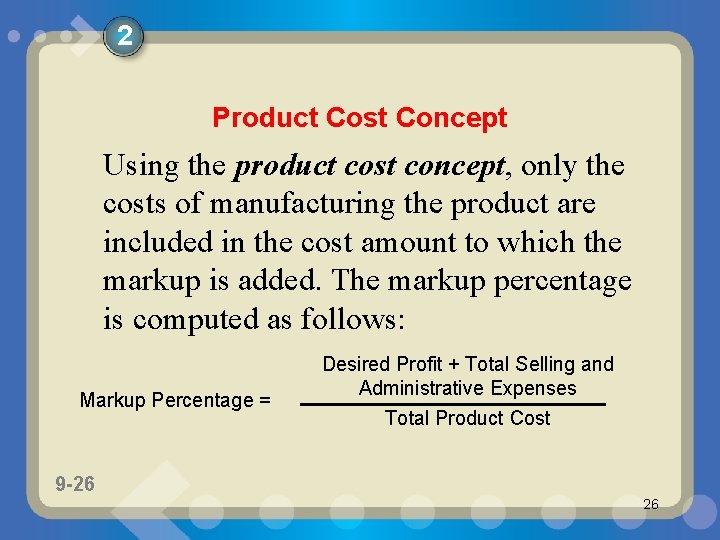
2 Product Cost Concept Using the product cost concept, only the costs of manufacturing the product are included in the cost amount to which the markup is added. The markup percentage is computed as follows: Markup Percentage = 9 -26 1 -26 Desired Profit + Total Selling and Administrative Expenses Total Product Cost 26
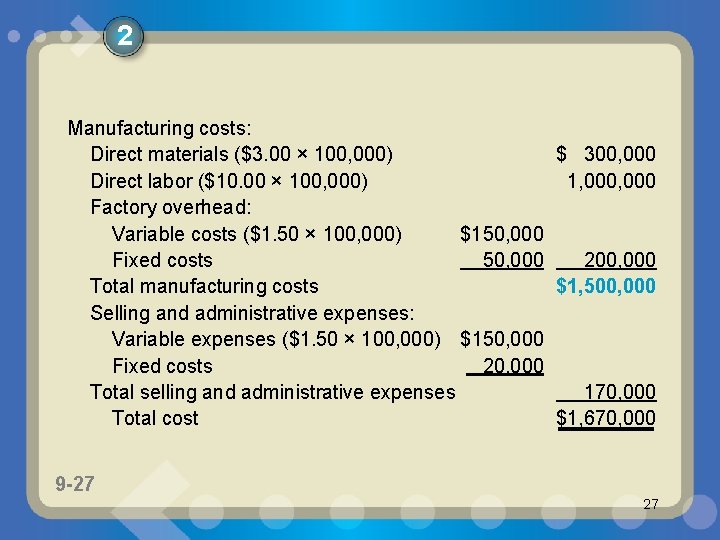
2 Manufacturing costs: Direct materials ($3. 00 × 100, 000) $ 300, 000 Direct labor ($10. 00 × 100, 000) 1, 000 Factory overhead: Variable costs ($1. 50 × 100, 000) $150, 000 Fixed costs 50, 000 200, 000 Total manufacturing costs $1, 500, 000 Selling and administrative expenses: Variable expenses ($1. 50 × 100, 000) $150, 000 Fixed costs 20, 000 Total selling and administrative expenses 170, 000 Total cost $1, 670, 000 9 -27 1 -27 27
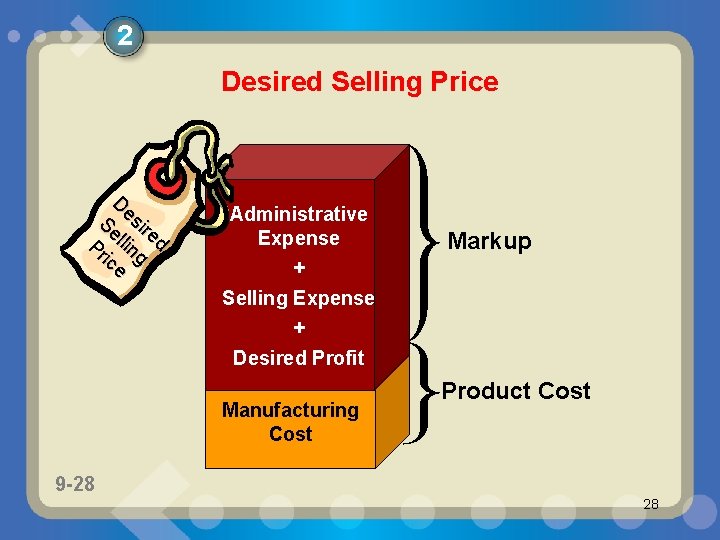
2 Desired Selling Price De Se sir e Pr llin d ice g Administrative Expense + Selling Expense + Desired Profit Manufacturing Cost 9 -28 1 -28 Markup Product Cost 28
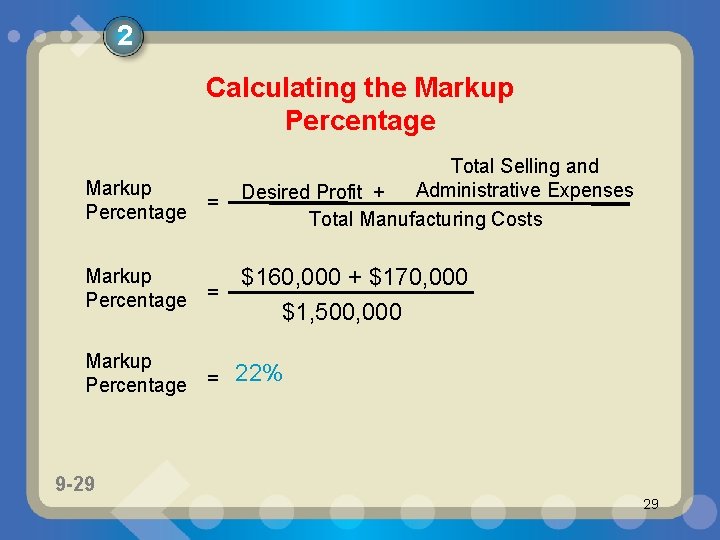
2 Calculating the Markup Percentage = Total Selling and Administrative Expenses Desired Profit + Total Manufacturing Costs Markup Percentage = $160, 000 + $170, 000 $1, 500, 000 Markup Percentage = 9 -29 1 -29 22% 29
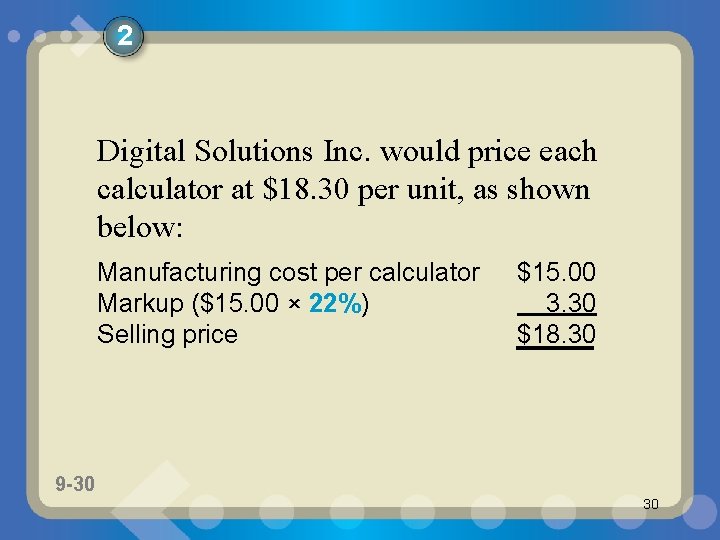
2 Digital Solutions Inc. would price each calculator at $18. 30 per unit, as shown below: Manufacturing cost per calculator Markup ($15. 00 × 22%) Selling price 9 -30 1 -30 $15. 00 3. 30 $18. 30 30
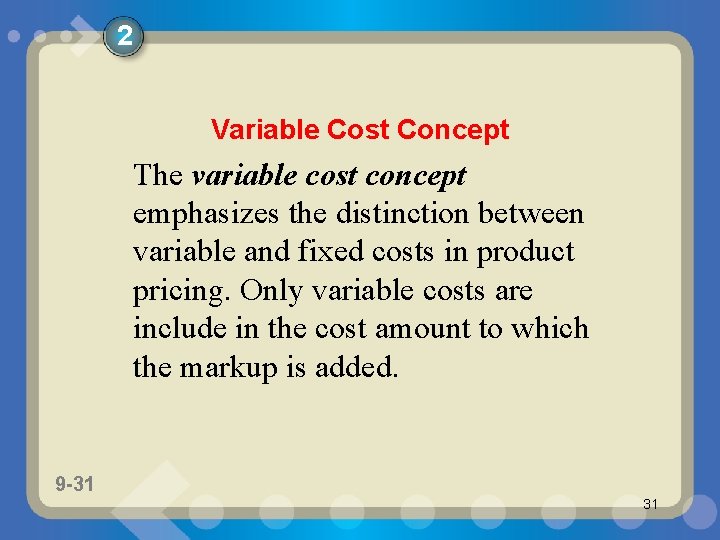
2 Variable Cost Concept The variable cost concept emphasizes the distinction between variable and fixed costs in product pricing. Only variable costs are include in the cost amount to which the markup is added. 9 -31 1 -31 31
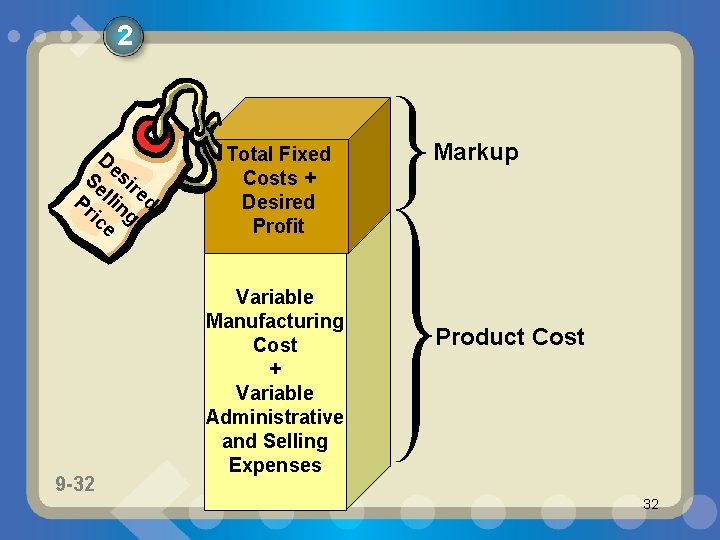
2 De Se sir Pr llin ed ic g e 9 -32 1 -32 Total Fixed Costs + Desired Profit Variable Manufacturing Cost + Variable Administrative and Selling Expenses Markup Product Cost 32
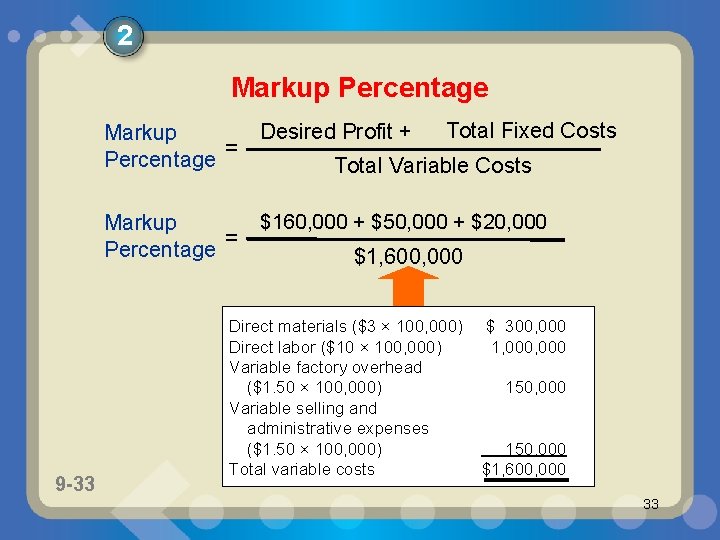
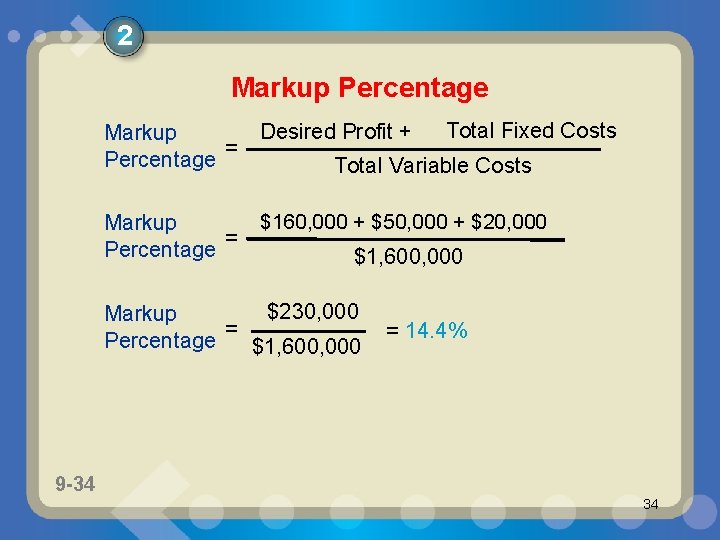
2 Markup Percentage 9 -33 1 -33 Total Fixed Costs Markup = Percentage Desired Profit + Markup = Percentage $160, 000 + $50, 000 + $20, 000 Total Variable Costs $1, 600, 000 Direct materials ($3 × 100, 000) Direct labor ($10 × 100, 000) Variable factory overhead ($1. 50 × 100, 000) Variable selling and administrative expenses ($1. 50 × 100, 000) Total variable costs $ 300, 000 1, 000 150, 000 $1, 600, 000 33
2 Markup Percentage Desired Profit + Markup = Percentage $160, 000 + $50, 000 + $20, 000 Total Variable Costs $1, 600, 000 $230, 000 Markup = Percentage $1, 600, 000 9 -34 1 -34 Total Fixed Costs Markup = Percentage = 14. 4% 34
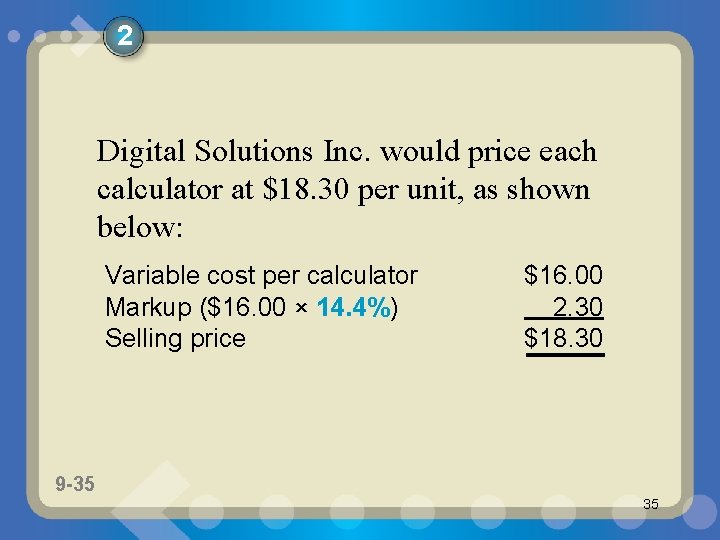
2 Digital Solutions Inc. would price each calculator at $18. 30 per unit, as shown below: Variable cost per calculator Markup ($16. 00 × 14. 4%) Selling price 9 -35 1 -35 $16. 00 2. 30 $18. 30 35
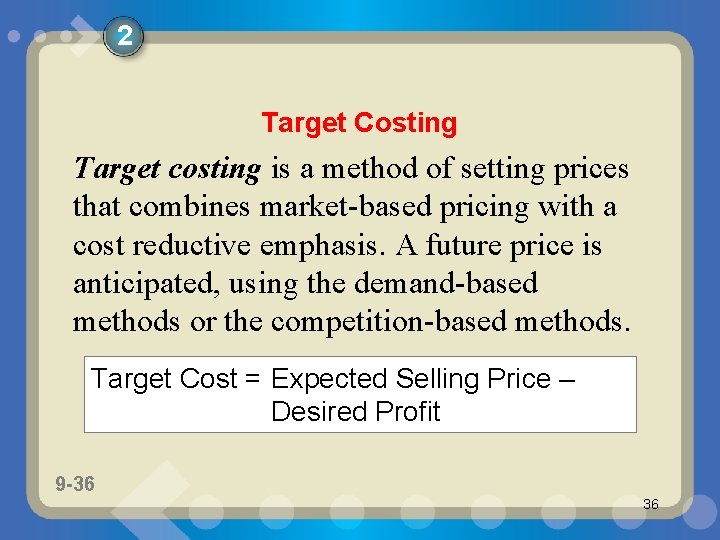
2 Target Costing Target costing is a method of setting prices that combines market-based pricing with a cost reductive emphasis. A future price is anticipated, using the demand-based methods or the competition-based methods. Target Cost = Expected Selling Price – Desired Profit 9 -36 1 -36 36
1 3 Compute the relative profitability of products in bottleneck production processes. 9 -37 1 -37 37
3 Production Bottlenecks and Profits A production bottleneck (or constraint) occurs at the point in the process where the demand for the company’s product exceeds the ability to produce the product. 9 -38 1 -38 38
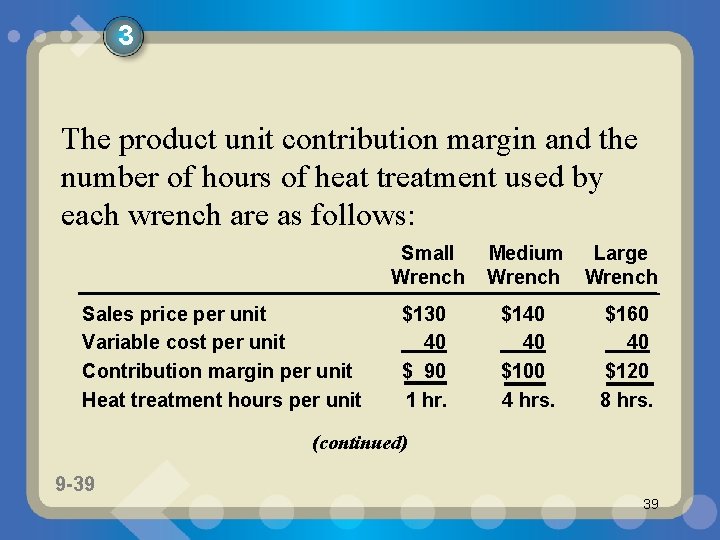
3 The product unit contribution margin and the number of hours of heat treatment used by each wrench are as follows: Sales price per unit Variable cost per unit Contribution margin per unit Heat treatment hours per unit Small Wrench Medium Wrench Large Wrench $130 40 $ 90 1 hr. $140 40 $100 4 hrs. $160 40 $120 8 hrs. (continued) 9 -39 1 -39 39
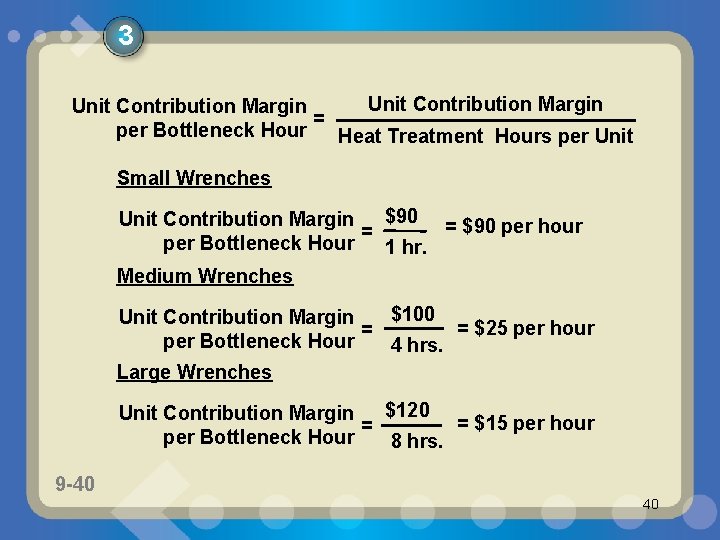
3 Unit Contribution Margin = per Bottleneck Hour Heat Treatment Hours per Unit Small Wrenches $90 Unit Contribution Margin = $90 per hour = per Bottleneck Hour 1 hr. Medium Wrenches $100 Unit Contribution Margin = $25 per hour = per Bottleneck Hour 4 hrs. Large Wrenches $120 Unit Contribution Margin = $15 per hour = per Bottleneck Hour 8 hrs. 9 -40 1 -40 40
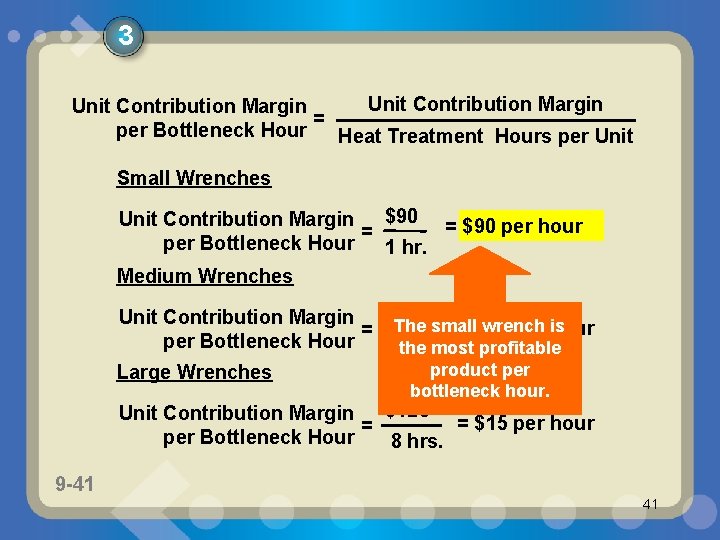
3 Unit Contribution Margin = per Bottleneck Hour Heat Treatment Hours per Unit Small Wrenches $90 Unit Contribution Margin = $90 per hour = per Bottleneck Hour 1 hr. Medium Wrenches $100 Unit Contribution Margin wrench is = $25 per hour = The small per Bottleneck Hour 4 the hrs. most profitable product per Large Wrenches bottleneck hour. $120 Unit Contribution Margin = $15 per hour = per Bottleneck Hour 8 hrs. 9 -41 1 -41 41
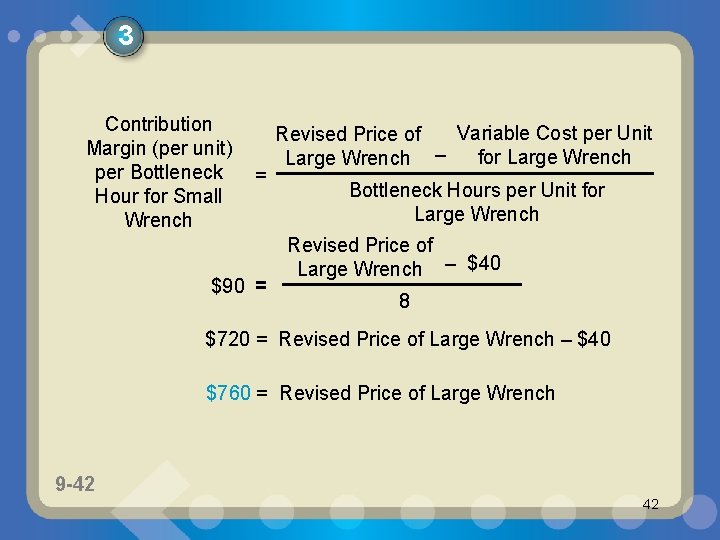
3 Contribution Margin (per unit) per Bottleneck Hour for Small Wrench = $90 = Variable Cost per Unit Revised Price of for Large Wrench – Bottleneck Hours per Unit for Large Wrench Revised Price of Large Wrench – $40 8 $720 = Revised Price of Large Wrench – $40 $760 = Revised Price of Large Wrench 9 -42 1 -42 42
9 -43 1 -43 43