8 3 Photosynthesis AHL Essential idea Light energy


- Slides: 36
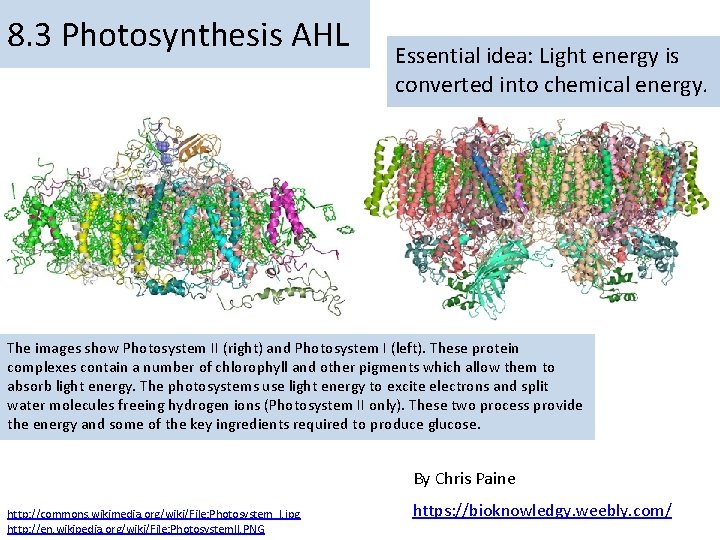
8. 3 Photosynthesis AHL Essential idea: Light energy is converted into chemical energy. The images show Photosystem II (right) and Photosystem I (left). These protein complexes contain a number of chlorophyll and other pigments which allow them to absorb light energy. The photosystems use light energy to excite electrons and split water molecules freeing hydrogen ions (Photosystem II only). These two process provide the energy and some of the key ingredients required to produce glucose. By Chris Paine http: //commons. wikimedia. org/wiki/File: Photosystem_I. jpg http: //en. wikipedia. org/wiki/File: Photosystem. II. PNG https: //bioknowledgy. weebly. com/
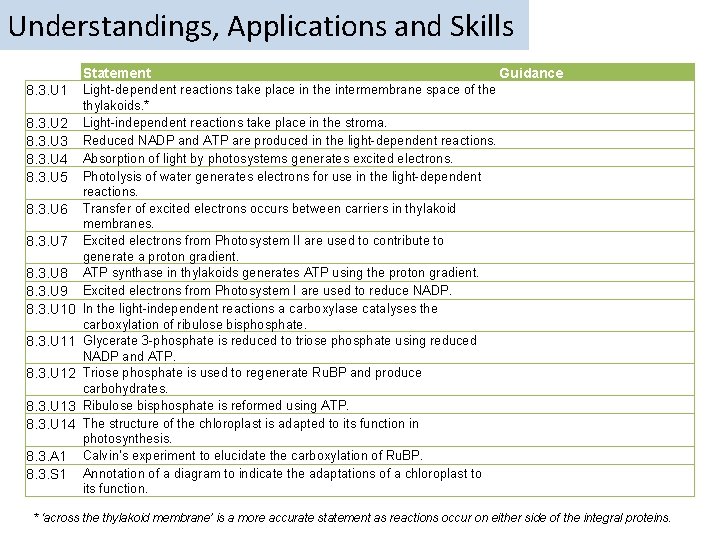
Understandings, Applications and Skills Statement 8. 3. U 1 8. 3. U 2 8. 3. U 3 8. 3. U 4 8. 3. U 5 8. 3. U 6 8. 3. U 7 8. 3. U 8 8. 3. U 9 8. 3. U 10 8. 3. U 11 8. 3. U 12 8. 3. U 13 8. 3. U 14 8. 3. A 1 8. 3. S 1 Guidance Light-dependent reactions take place in the intermembrane space of the thylakoids. * Light-independent reactions take place in the stroma. Reduced NADP and ATP are produced in the light-dependent reactions. Absorption of light by photosystems generates excited electrons. Photolysis of water generates electrons for use in the light-dependent reactions. Transfer of excited electrons occurs between carriers in thylakoid membranes. Excited electrons from Photosystem II are used to contribute to generate a proton gradient. ATP synthase in thylakoids generates ATP using the proton gradient. Excited electrons from Photosystem I are used to reduce NADP. In the light-independent reactions a carboxylase catalyses the carboxylation of ribulose bisphosphate. Glycerate 3 -phosphate is reduced to triose phosphate using reduced NADP and ATP. Triose phosphate is used to regenerate Ru. BP and produce carbohydrates. Ribulose bisphosphate is reformed using ATP. The structure of the chloroplast is adapted to its function in photosynthesis. Calvin’s experiment to elucidate the carboxylation of Ru. BP. Annotation of a diagram to indicate the adaptations of a chloroplast to its function. * ‘across the thylakoid membrane’ is a more accurate statement as reactions occur on either side of the integral proteins.
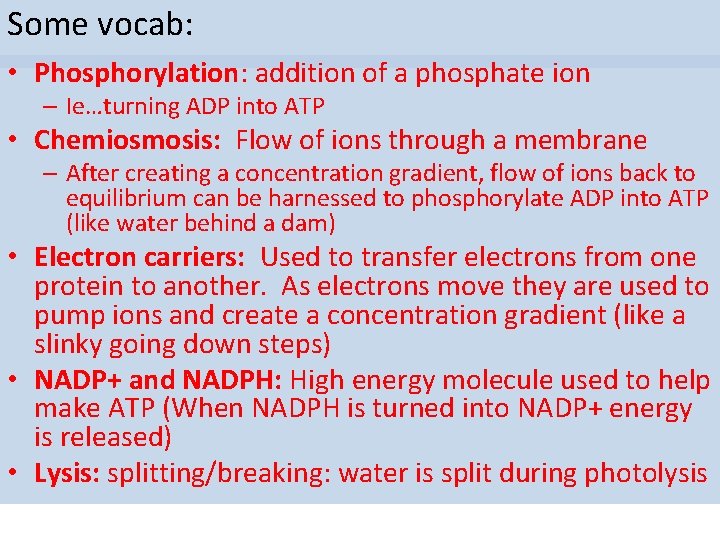
Some vocab: • Phosphorylation: addition of a phosphate ion – Ie…turning ADP into ATP • Chemiosmosis: Flow of ions through a membrane – After creating a concentration gradient, flow of ions back to equilibrium can be harnessed to phosphorylate ADP into ATP (like water behind a dam) • Electron carriers: Used to transfer electrons from one protein to another. As electrons move they are used to pump ions and create a concentration gradient (like a slinky going down steps) • NADP+ and NADPH: High energy molecule used to help make ATP (When NADPH is turned into NADP+ energy is released) • Lysis: splitting/breaking: water is split during photolysis
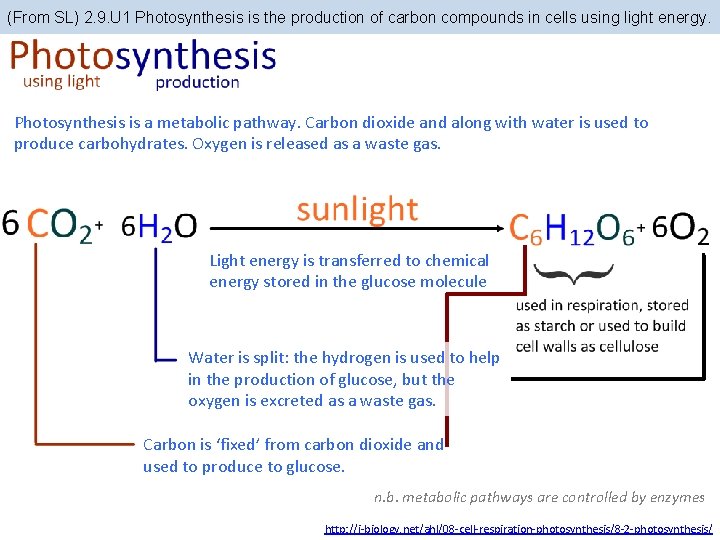
(From SL) 2. 9. U 1 Photosynthesis is the production of carbon compounds in cells using light energy. Photosynthesis is a metabolic pathway. Carbon dioxide and along with water is used to produce carbohydrates. Oxygen is released as a waste gas. Light energy is transferred to chemical energy stored in the glucose molecule Water is split: the hydrogen is used to help in the production of glucose, but the oxygen is excreted as a waste gas. Carbon is ‘fixed’ from carbon dioxide and used to produce to glucose. n. b. metabolic pathways are controlled by enzymes http: //i-biology. net/ahl/08 -cell-respiration-photosynthesis/8 -2 -photosynthesis/
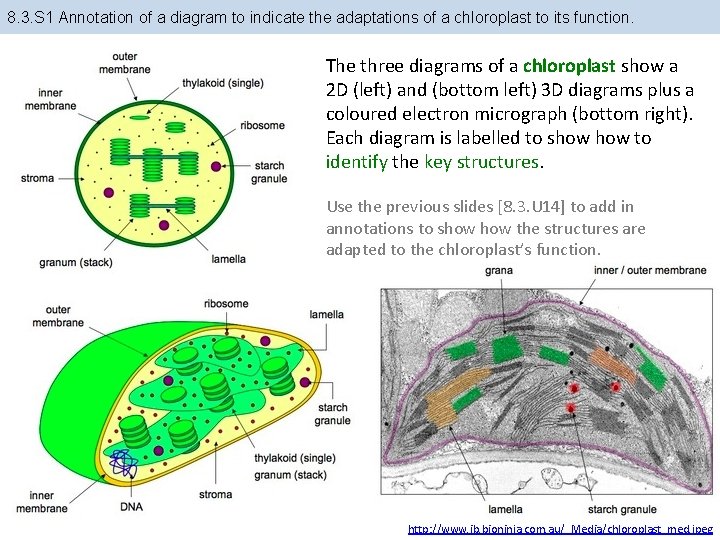
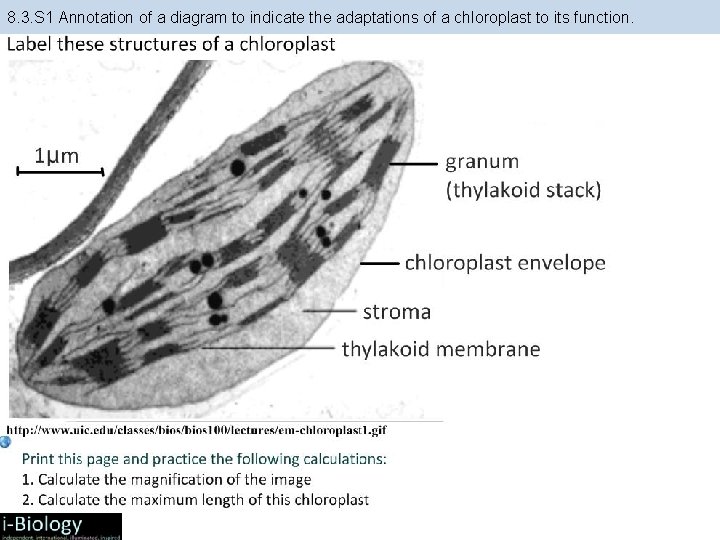
8. 3. S 1 Annotation of a diagram to indicate the adaptations of a chloroplast to its function. As the presentation progresses take note of how the structure of a chloroplast is adapted to its function.
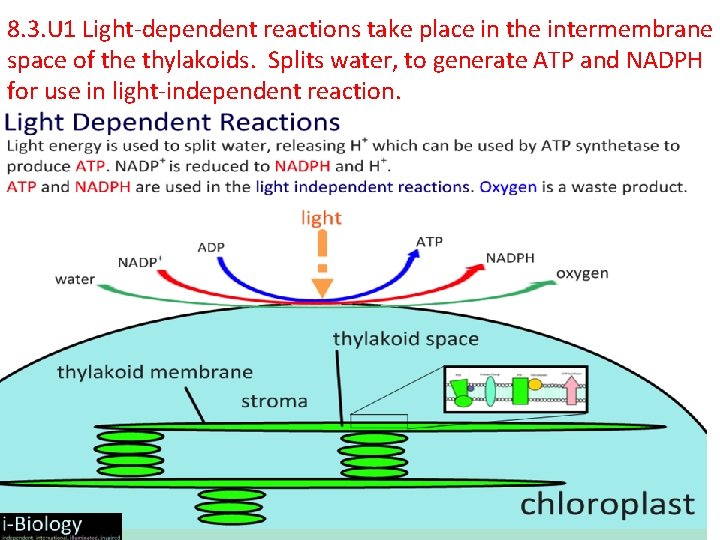
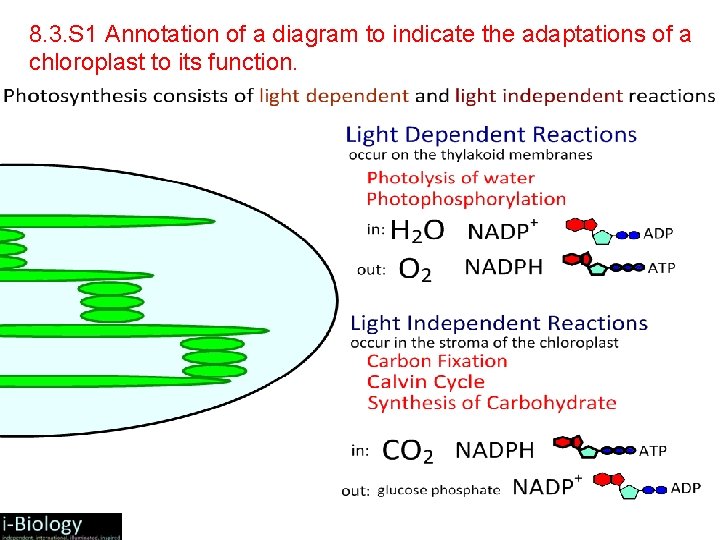
8. 3. U 1 Light-dependent reactions take place in the intermembrane space of the thylakoids. Splits water, to generate ATP and NADPH for use in light-independent reaction.
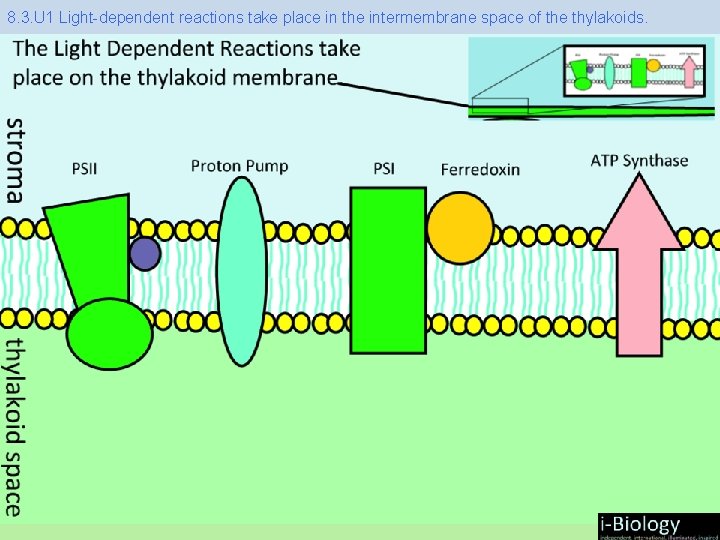
8. 3. U 1 Light-dependent reactions take place in the intermembrane space of the thylakoids.
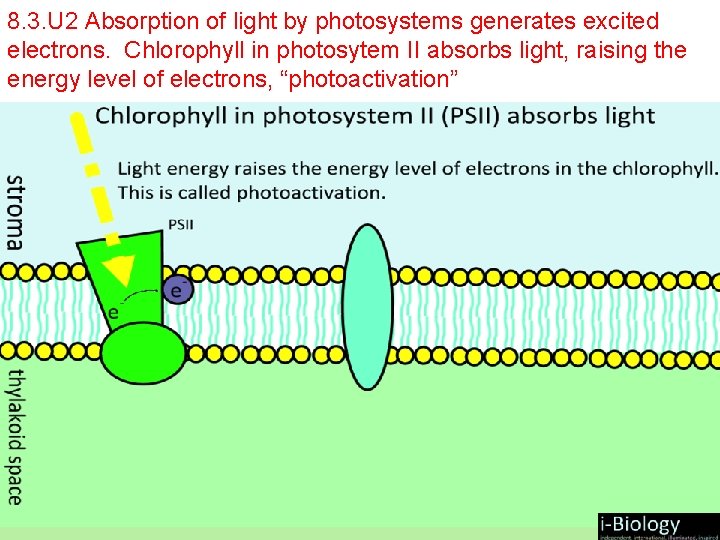
8. 3. U 2 Absorption of light by photosystems generates excited electrons. Chlorophyll in photosytem II absorbs light, raising the energy level of electrons, “photoactivation”
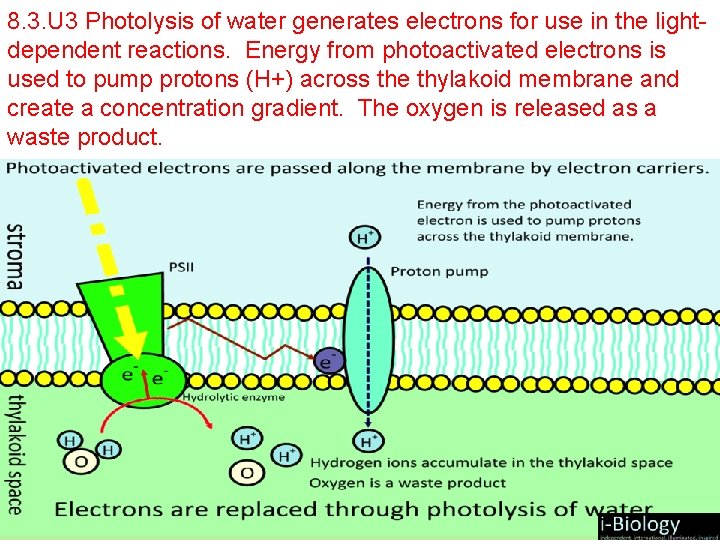
8. 3. U 3 Photolysis of water generates electrons for use in the lightdependent reactions. Energy from photoactivated electrons is used to pump protons (H+) across the thylakoid membrane and create a concentration gradient. The oxygen is released as a waste product.
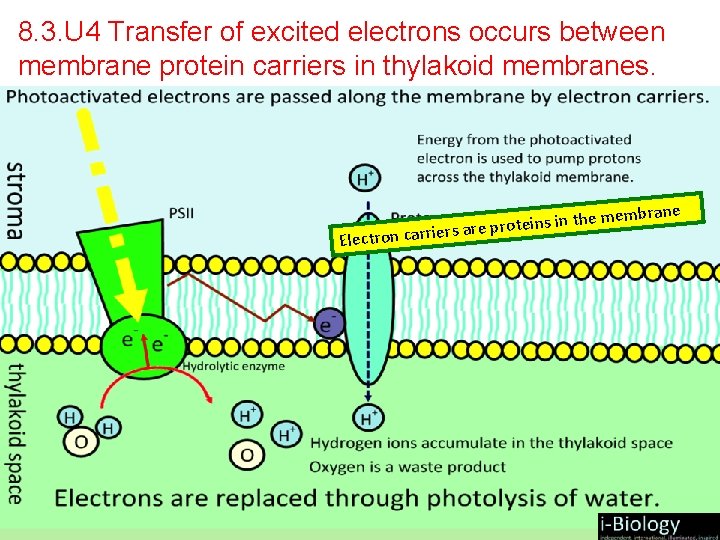
8. 3. U 4 Transfer of excited electrons occurs between membrane protein carriers in thylakoid membranes. Electron in the s in e t o r p e r a carriers membrane
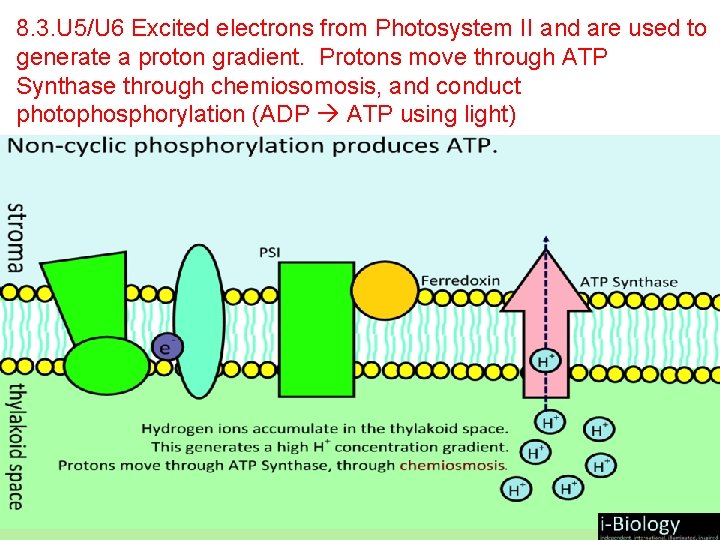
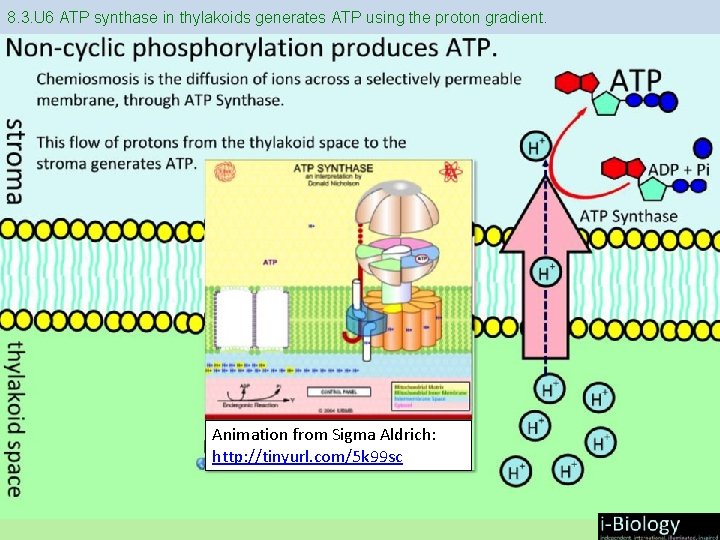
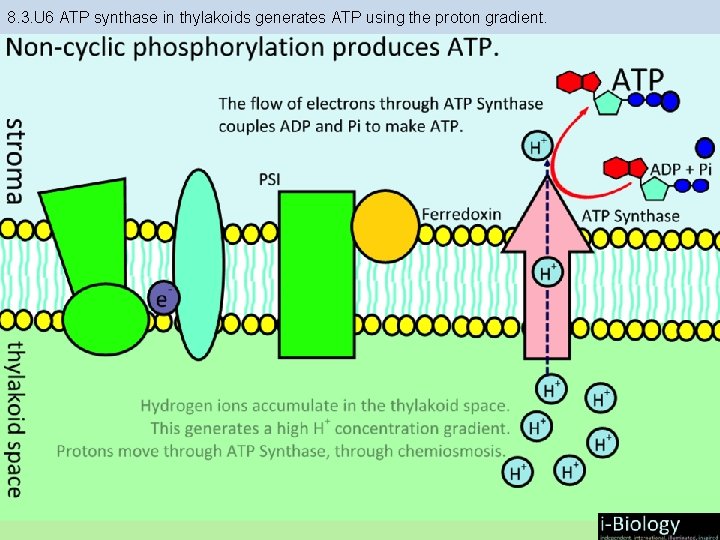
8. 3. U 5/U 6 Excited electrons from Photosystem II and are used to generate a proton gradient. Protons move through ATP Synthase through chemiosomosis, and conduct photophosphorylation (ADP ATP using light)
8. 3. U 6 ATP synthase in thylakoids generates ATP using the proton gradient. Animation from Sigma Aldrich: http: //tinyurl. com/5 k 99 sc
8. 3. U 6 ATP synthase in thylakoids generates ATP using the proton gradient.
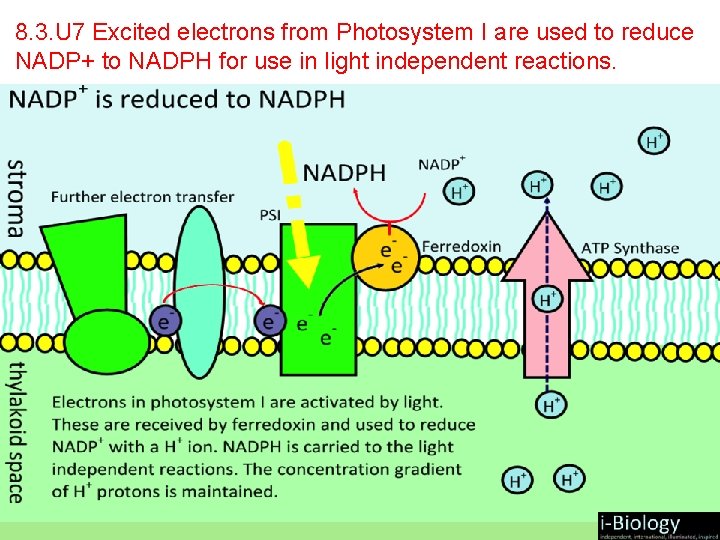
8. 3. U 7 Excited electrons from Photosystem I are used to reduce NADP+ to NADPH for use in light independent reactions.
8. 3. S 1 Annotation of a diagram to indicate the adaptations of a chloroplast to its function.
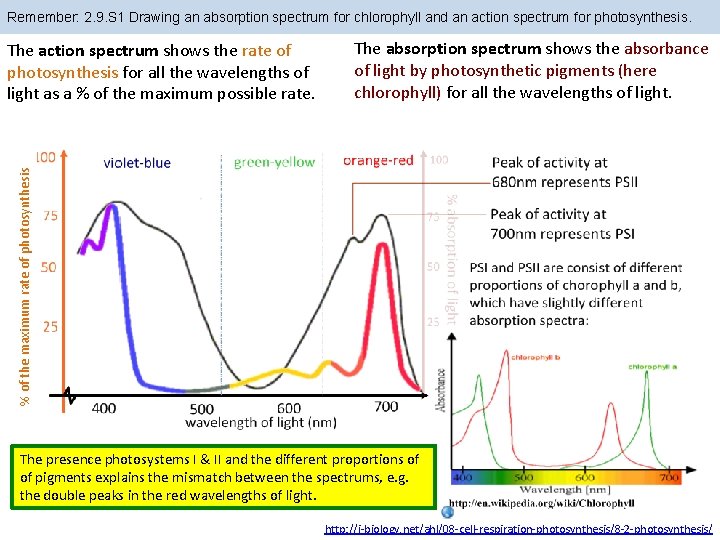
Remember: 2. 9. S 1 Drawing an absorption spectrum for chlorophyll and an action spectrum for photosynthesis. The absorption spectrum shows the absorbance of light by photosynthetic pigments (here chlorophyll) for all the wavelengths of light. % of the maximum rate of photosynthesis The action spectrum shows the rate of photosynthesis for all the wavelengths of light as a % of the maximum possible rate. The presence photosystems I & II and the different proportions of of pigments explains the mismatch between the spectrums, e. g. the double peaks in the red wavelengths of light. http: //i-biology. net/ahl/08 -cell-respiration-photosynthesis/8 -2 -photosynthesis/
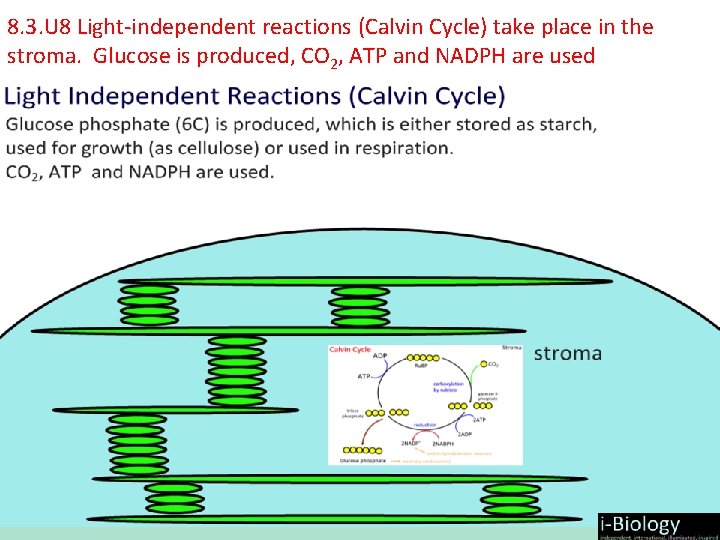
8. 3. U 8 Light-independent reactions (Calvin Cycle) take place in the stroma. Glucose is produced, CO 2, ATP and NADPH are used
Where does the light reaction take place? • Where does the Calvin Cycle take place? • What is the input/output of the light reaction? • What is the input/output of the Calvin cycle?
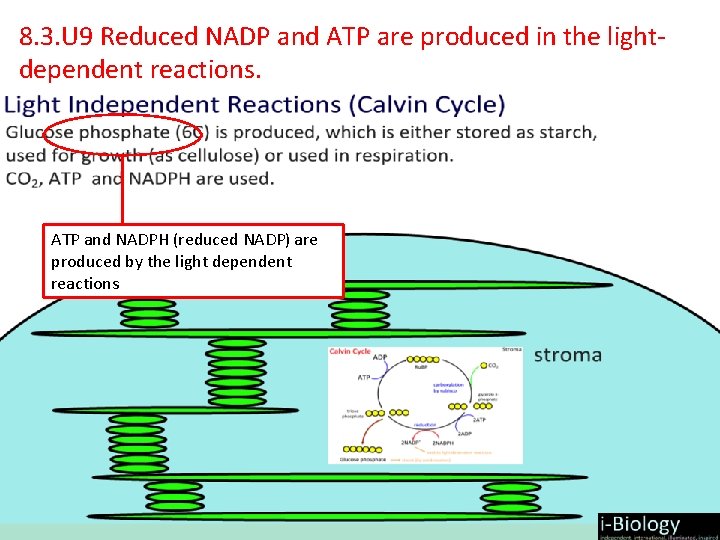
8. 3. U 9 Reduced NADP and ATP are produced in the lightdependent reactions. ATP and NADPH (reduced NADP) are produced by the light dependent reactions
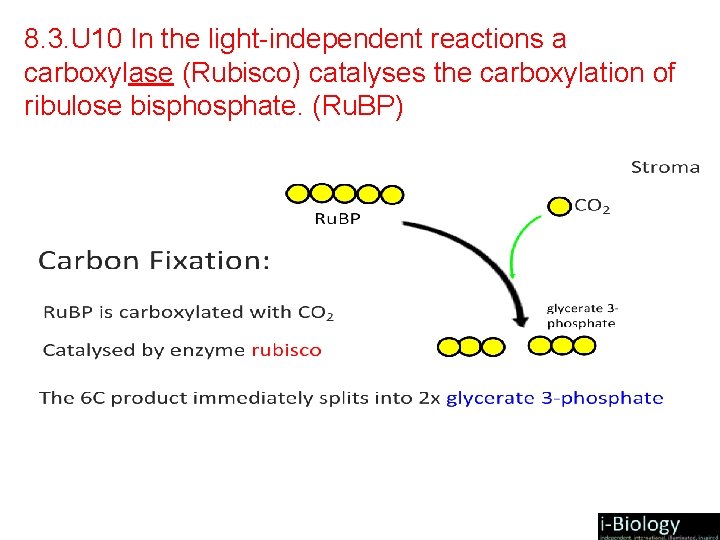
8. 3. U 10 In the light-independent reactions a carboxylase (Rubisco) catalyses the carboxylation of ribulose bisphosphate. (Ru. BP)
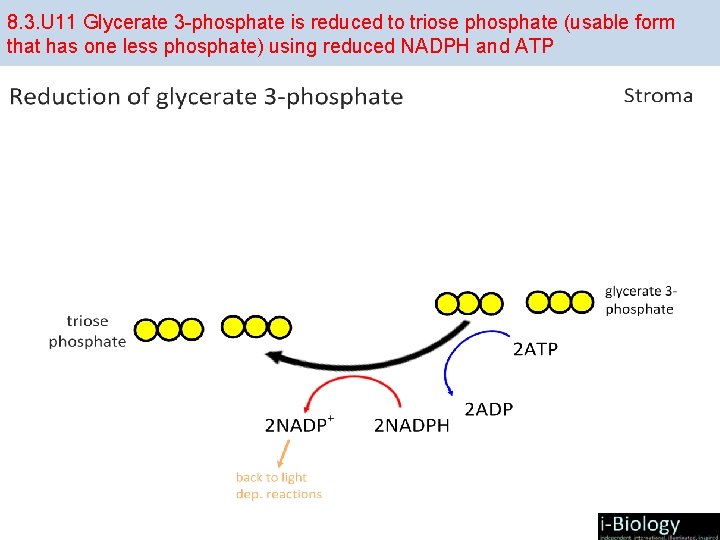
8. 3. U 11 Glycerate 3 -phosphate is reduced to triose phosphate (usable form that has one less phosphate) using reduced NADPH and ATP
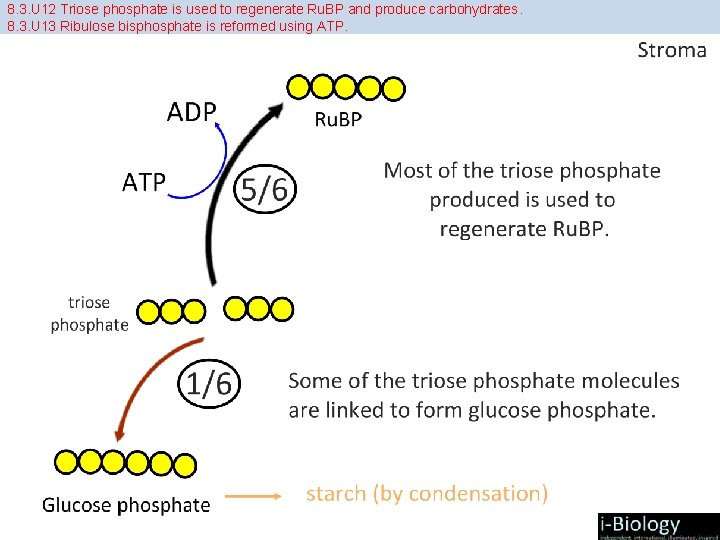
8. 3. U 12 Triose phosphate is used to regenerate Ru. BP and produce carbohydrates. 8. 3. U 13 Ribulose bisphosphate is reformed using ATP.
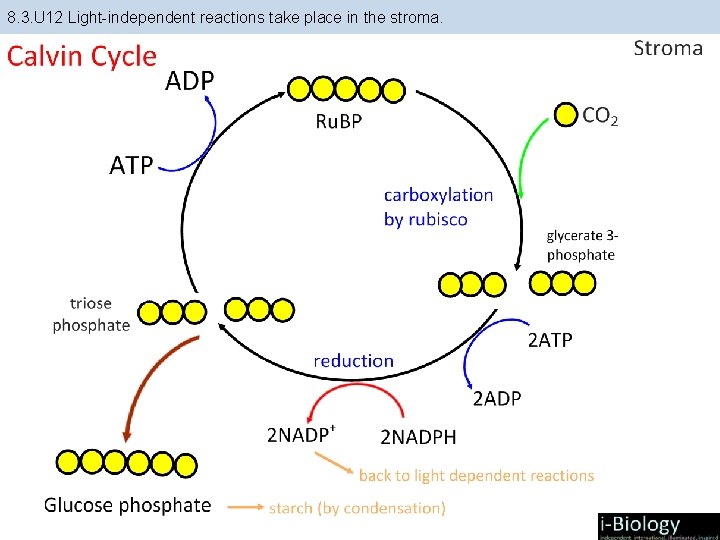
8. 3. U 12 Light-independent reactions take place in the stroma.
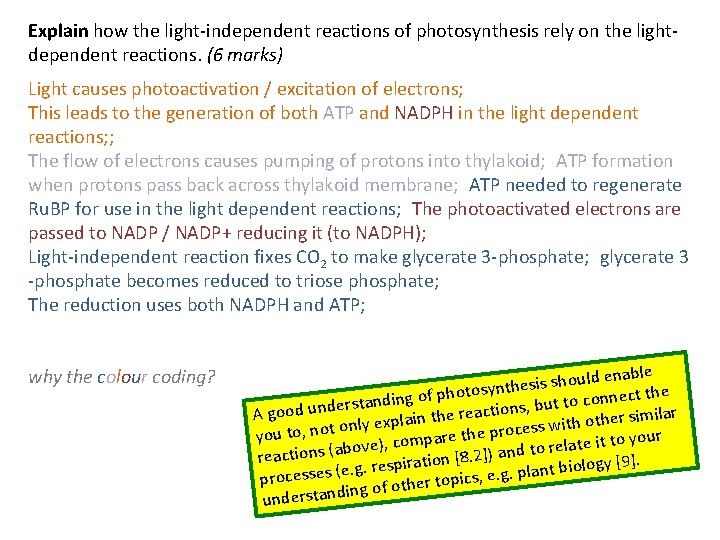
Explain how the light-independent reactions of photosynthesis rely on the lightdependent reactions. (6 marks)
Explain how the light-independent reactions of photosynthesis rely on the lightdependent reactions. (6 marks) Light causes photoactivation / excitation of electrons; This leads to the generation of both ATP and NADPH in the light dependent reactions; ; The flow of electrons causes pumping of protons into thylakoid; ATP formation when protons pass back across thylakoid membrane; ATP needed to regenerate Ru. BP for use in the light dependent reactions; The photoactivated electrons are passed to NADP / NADP+ reducing it (to NADPH); Light-independent reaction fixes CO 2 to make glycerate 3 -phosphate; glycerate 3 -phosphate becomes reduced to triose phosphate; The reduction uses both NADPH and ATP; why the colour coding? enable ld u o h s is s e h hotosynt p f o nect the g n o in c d n o t a t t s u r b e , reactions A good und e h similar t r in e h la t p o x h e it ly w n o e process h t you to, not e r a p to your m o it c e , t ) e la v e o r b o a t ( reactions [8. 2]) and n io t a ir p s logy [9]. e r io. b t. g n e ( la s p e. s proces topics, e. g r e h t o f o g in understand
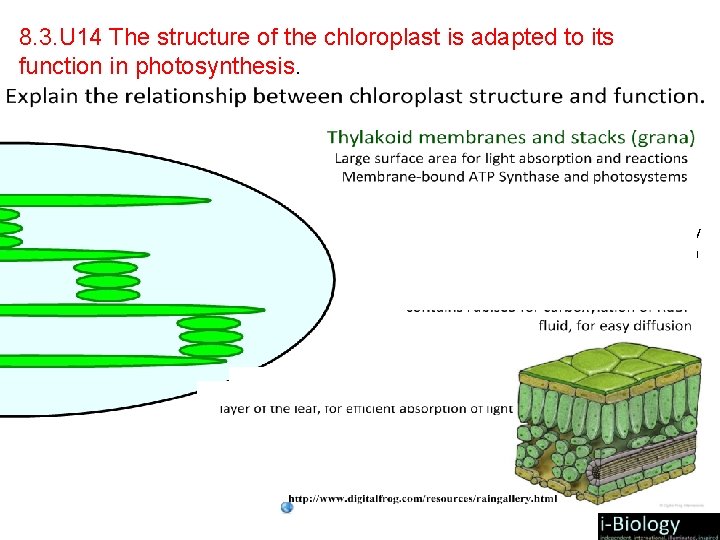
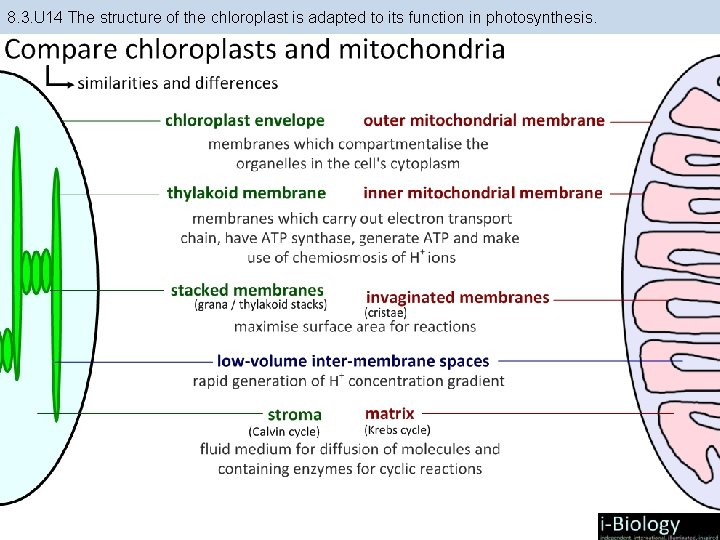
8. 3. U 14 The structure of the chloroplast is adapted to its function in photosynthesis. Palisade cells are found close to the top surface of leaves. They contain a high density of chloroplasts to enable efficient absorption of light.
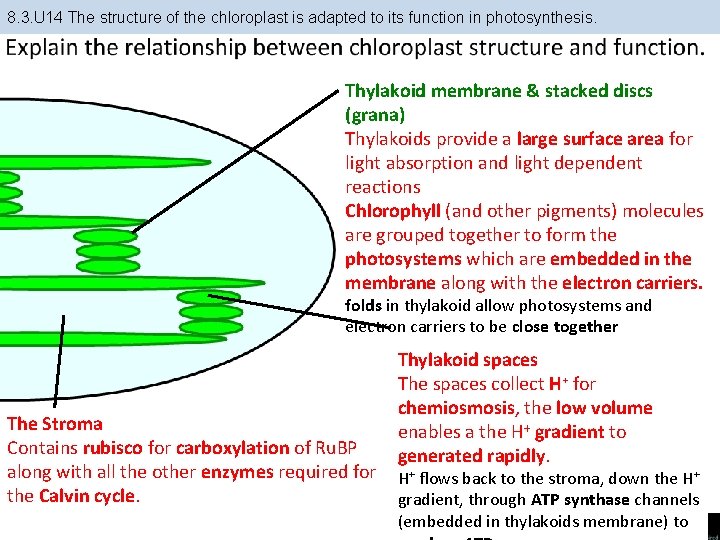
8. 3. U 14 The structure of the chloroplast is adapted to its function in photosynthesis. Thylakoid membrane & stacked discs (grana) Thylakoids provide a large surface area for light absorption and light dependent reactions Chlorophyll (and other pigments) molecules are grouped together to form the photosystems which are embedded in the membrane along with the electron carriers. folds in thylakoid allow photosystems and electron carriers to be close together The Stroma Contains rubisco for carboxylation of Ru. BP along with all the other enzymes required for the Calvin cycle. Thylakoid spaces The spaces collect H+ for chemiosmosis, the low volume enables a the H+ gradient to generated rapidly. H+ flows back to the stroma, down the H+ gradient, through ATP synthase channels (embedded in thylakoids membrane) to
8. 3. U 14 The structure of the chloroplast is adapted to its function in photosynthesis.
8. 3. U 14 The structure of the chloroplast is adapted to its function in photosynthesis.
8. 3. S 1 Annotation of a diagram to indicate the adaptations of a chloroplast to its function. The three diagrams of a chloroplast show a 2 D (left) and (bottom left) 3 D diagrams plus a coloured electron micrograph (bottom right). Each diagram is labelled to show to identify the key structures. Use the previous slides [8. 3. U 14] to add in annotations to show the structures are adapted to the chloroplast’s function. http: //www. ib. bioninja. com. au/_Media/chloroplast_med. jpeg
8. 3. S 1 Annotation of a diagram to indicate the adaptations of a chloroplast to its function.
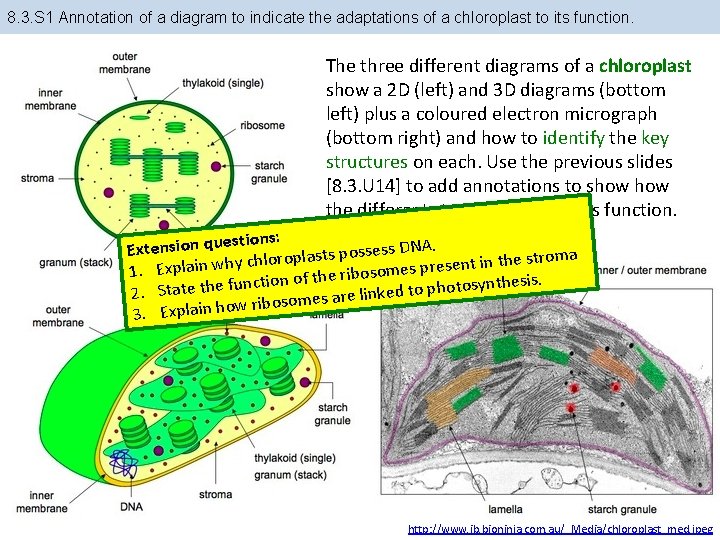
8. 3. S 1 Annotation of a diagram to indicate the adaptations of a chloroplast to its function. The three different diagrams of a chloroplast show a 2 D (left) and 3 D diagrams (bottom left) plus a coloured electron micrograph (bottom right) and how to identify the key structures on each. Use the previous slides [8. 3. U 14] to add annotations to show the different structures dictate its function. stions: ss DNA. Extension que e s s o p s t s la p o the stroma chlor y in h t n w e s in e r la p p x s E e 1. the ribosom f o n io t c n fu synthesis. e o t o h p o t d e 2. State th k n somes are li o ib r w o h in la 3. Exp http: //www. ib. bioninja. com. au/_Media/chloroplast_med. jpeg
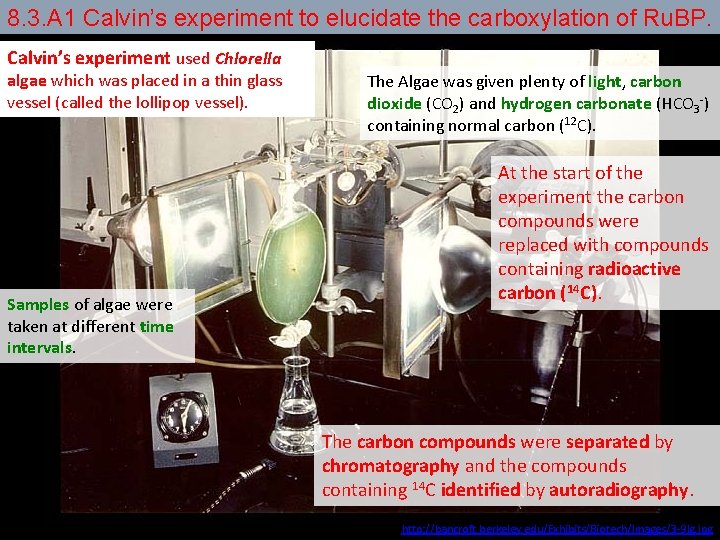
8. 3. A 1 Calvin’s experiment to elucidate the carboxylation of Ru. BP. Calvin’s experiment used Chlorella algae which was placed in a thin glass vessel (called the lollipop vessel). Samples of algae were taken at different time intervals. The Algae was given plenty of light, carbon dioxide (CO 2) and hydrogen carbonate (HCO 3 -) containing normal carbon (12 C). At the start of the experiment the carbon compounds were replaced with compounds containing radioactive carbon (14 C). The carbon compounds were separated by chromatography and the compounds containing 14 C identified by autoradiography. http: //bancroft. berkeley. edu/Exhibits/Biotech/Images/3 -9 lg. jpg
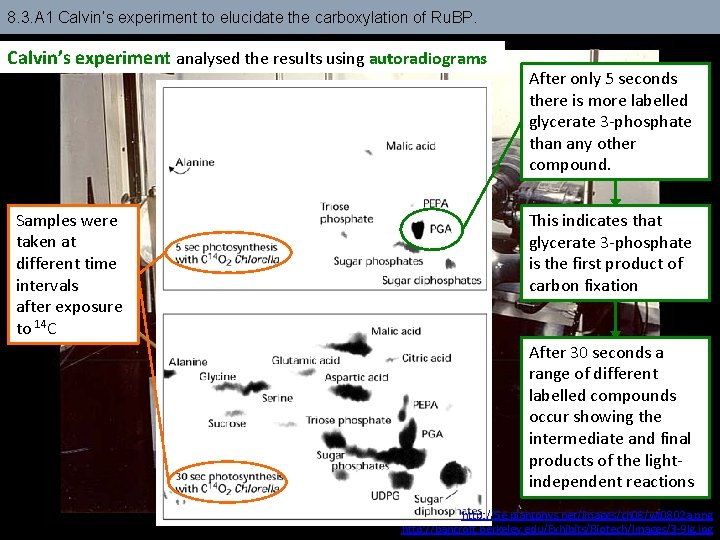
8. 3. A 1 Calvin’s experiment to elucidate the carboxylation of Ru. BP. Calvin’s experiment analysed the results using autoradiograms Samples were taken at different time intervals after exposure to 14 C After only 5 seconds there is more labelled glycerate 3 -phosphate than any other compound. This indicates that glycerate 3 -phosphate is the first product of carbon fixation After 30 seconds a range of different labelled compounds occur showing the intermediate and final products of the lightindependent reactions http: //5 e. plantphys. net/images/ch 08/wt 0802 a. png http: //bancroft. berkeley. edu/Exhibits/Biotech/Images/3 -9 lg. jpg
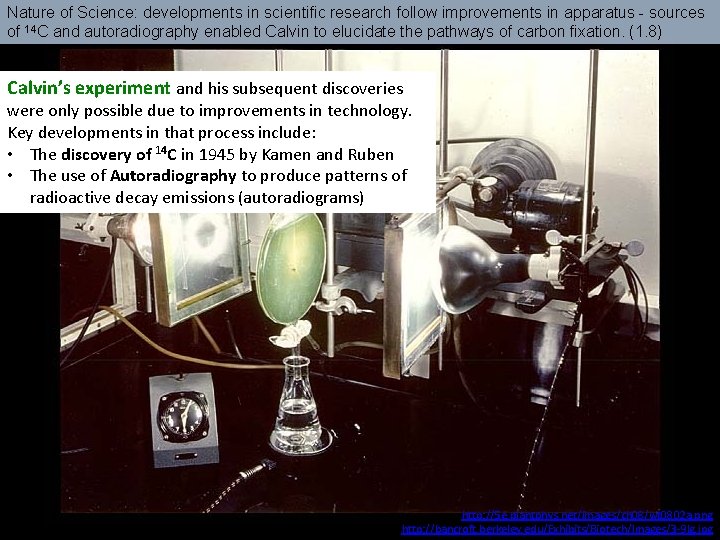
Nature of Science: developments in scientific research follow improvements in apparatus - sources of 14 C and autoradiography enabled Calvin to elucidate the pathways of carbon fixation. (1. 8) Calvin’s experiment and his subsequent discoveries were only possible due to improvements in technology. Key developments in that process include: • The discovery of 14 C in 1945 by Kamen and Ruben • The use of Autoradiography to produce patterns of radioactive decay emissions (autoradiograms) http: //5 e. plantphys. net/images/ch 08/wt 0802 a. png http: //bancroft. berkeley. edu/Exhibits/Biotech/Images/3 -9 lg. jpg
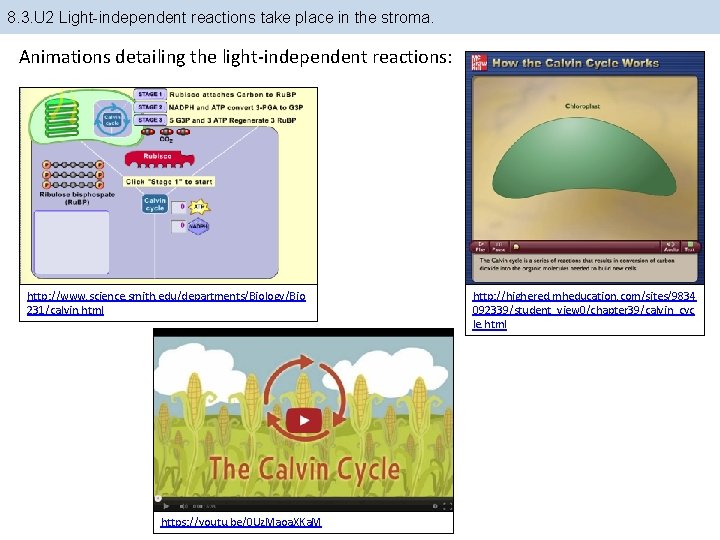
8. 3. U 2 Light-independent reactions take place in the stroma. Animations detailing the light-independent reactions: http: //www. science. smith. edu/departments/Biology/Bio 231/calvin. html https: //youtu. be/0 Uz. Maoa. XKa. M http: //highered. mheducation. com/sites/9834 092339/student_view 0/chapter 39/calvin_cyc le. html