
Photosynthesis Transpiration and Surface Energy Balance Please read
Photosynthesis, Transpiration, and Surface Energy Balance Please read article by Denning (1993, unpublished)
Photosynthesis • Levels of control – Controls in individual leaves – Control by canopy processes • Controlling factors – Direct controls: light, CO 2 – Indirect controls: water, nutrients
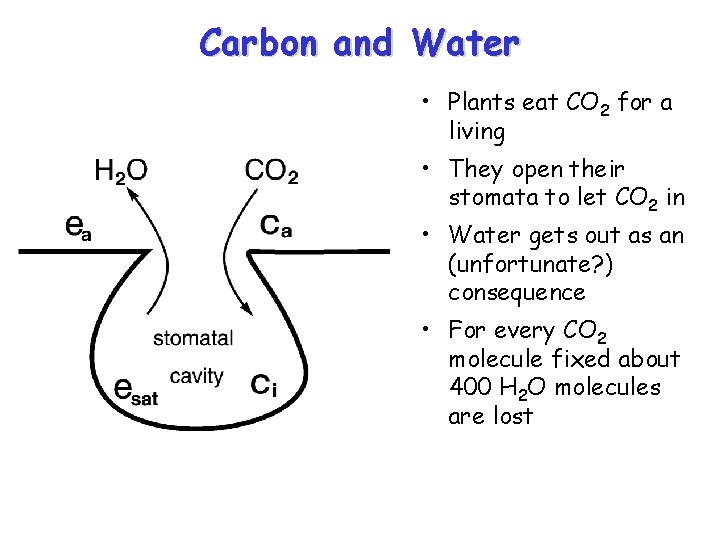
Carbon and Water • Plants eat CO 2 for a living • They open their stomata to let CO 2 in • Water gets out as an (unfortunate? ) consequence • For every CO 2 molecule fixed about 400 H 2 O molecules are lost
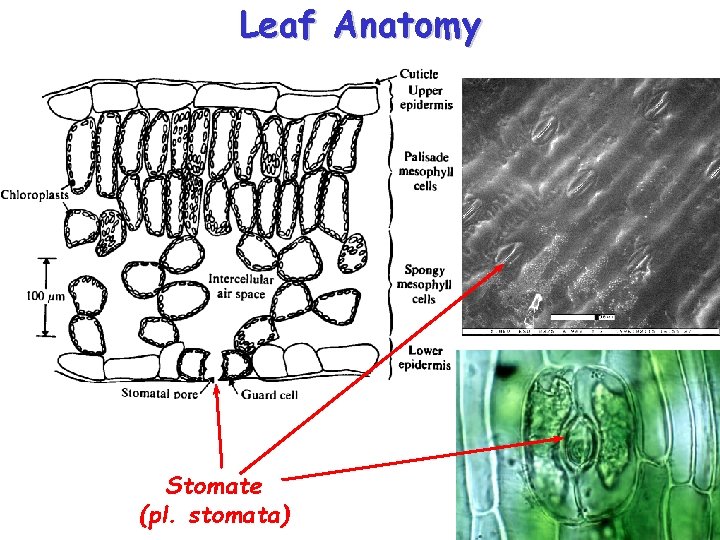
Leaf Anatomy Stomate (pl. stomata)

Measuring Transpiration and Photosynthesis • Control temperature, light level, humidity, and flow rates • Measure changes in water vapor and CO 2 concentration per unit time and leaf area Nobel, 1991
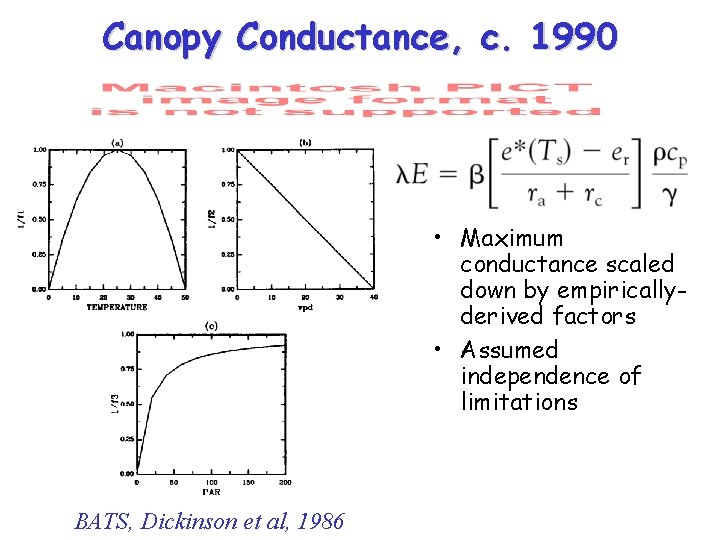
Canopy Conductance, c. 1990 • Maximum conductance scaled down by empiricallyderived factors • Assumed independence of limitations BATS, Dickinson et al, 1986
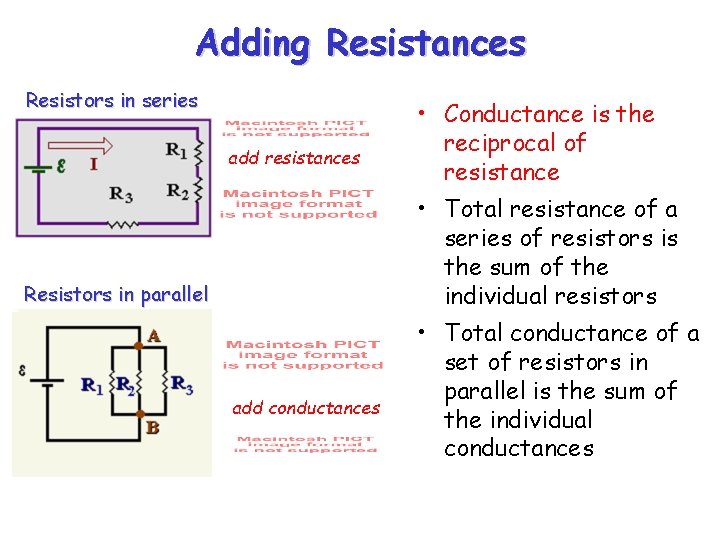
Adding Resistances Resistors in series add resistances • Conductance is the reciprocal of resistance • Total resistance of a series of resistors is the sum of the individual resistors Resistors in parallel add conductances • Total conductance of a set of resistors in parallel is the sum of the individual conductances
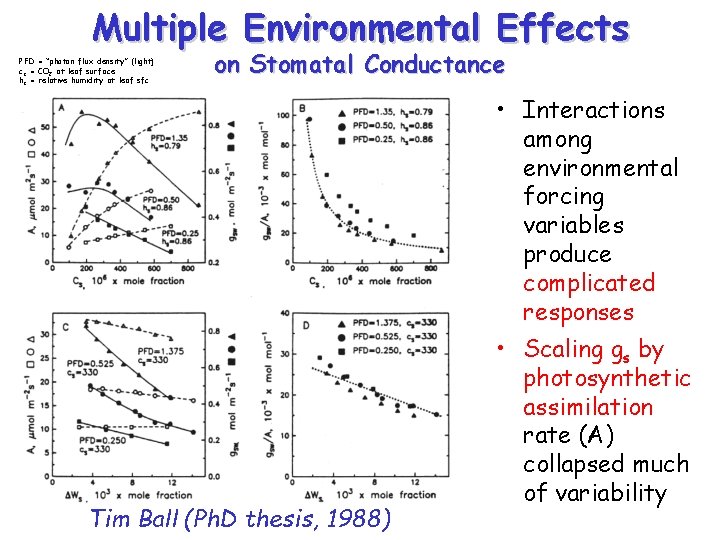
Multiple Environmental Effects PFD = “photon flux density” (light) cs = CO 2 at leaf surface hs = relative humidity at leaf sfc on Stomatal Conductance • Interactions among environmental forcing variables produce complicated responses Tim Ball (Ph. D thesis, 1988) • Scaling gs by photosynthetic assimilation rate (A) collapsed much of variability
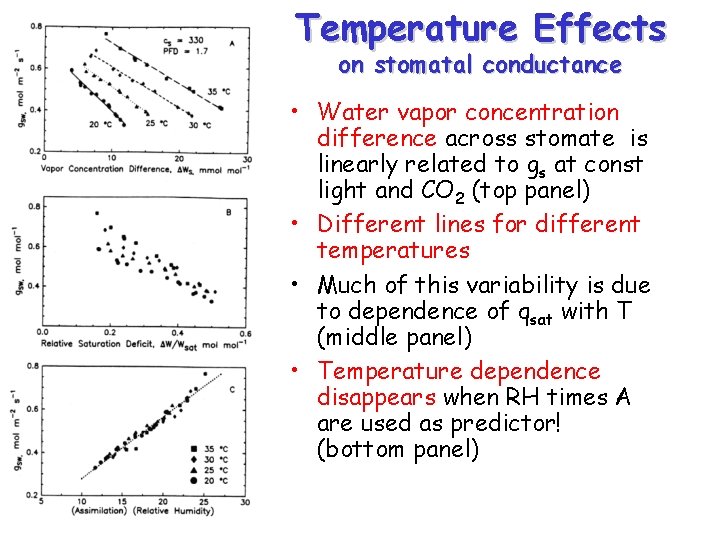
Temperature Effects on stomatal conductance • Water vapor concentration difference across stomate is linearly related to gs at const light and CO 2 (top panel) • Different lines for different temperatures • Much of this variability is due to dependence of qsat with T (middle panel) • Temperature dependence disappears when RH times A are used as predictor! (bottom panel)
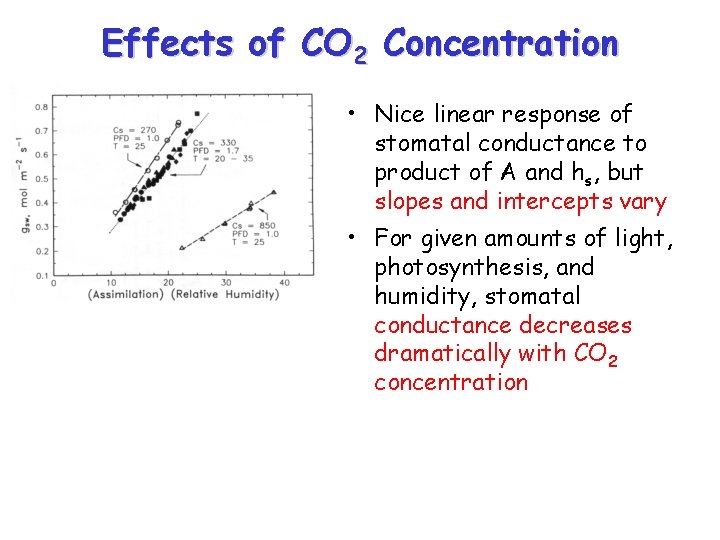
Effects of CO 2 Concentration • Nice linear response of stomatal conductance to product of A and hs, but slopes and intercepts vary • For given amounts of light, photosynthesis, and humidity, stomatal conductance decreases dramatically with CO 2 concentration
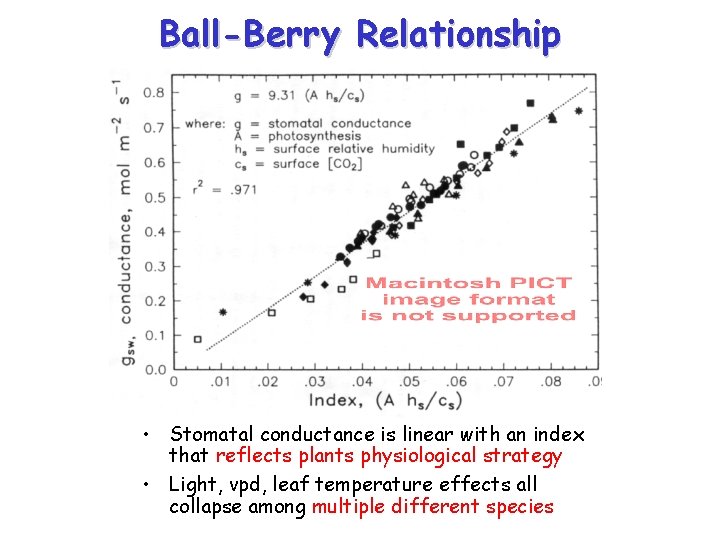
Ball-Berry Relationship • Stomatal conductance is linear with an index that reflects plants physiological strategy • Light, vpd, leaf temperature effects all collapse among multiple different species
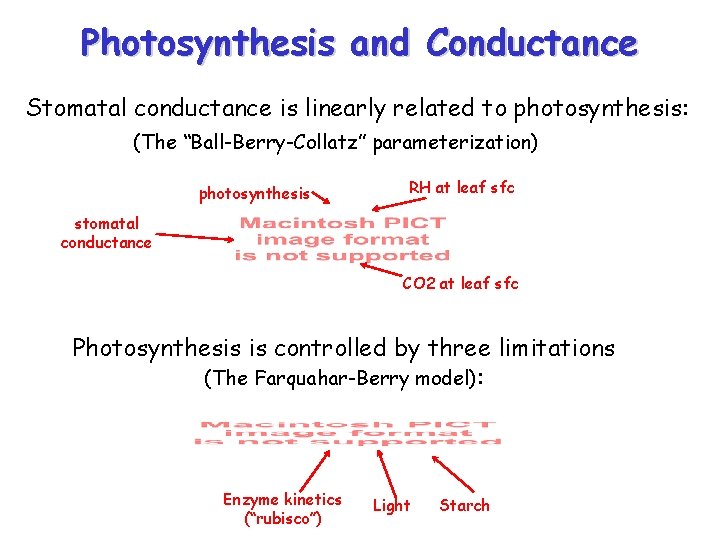
Photosynthesis and Conductance Stomatal conductance is linearly related to photosynthesis: (The “Ball-Berry-Collatz” parameterization) photosynthesis RH at leaf sfc stomatal conductance CO 2 at leaf sfc Photosynthesis is controlled by three limitations (The Farquahar-Berry model): Enzyme kinetics (“rubisco”) Light Starch
Two major sets of reactions • Light-harvesting reactions – Convert light into chemical energy (chlorophyll pigments inside the chloroplast) – Generate stored energy and “reductant” • Carbon fixation (“dark”) reactions – Uses chemical energy to convert CO 2 into sugars for later use by plant (or heterotrophs!) – Conversion of inorganic, oxidized carbon to organic, reduced carbon in an oxidizing environment requires energy and reductant – Primary fixation enzyme is called Rubisco
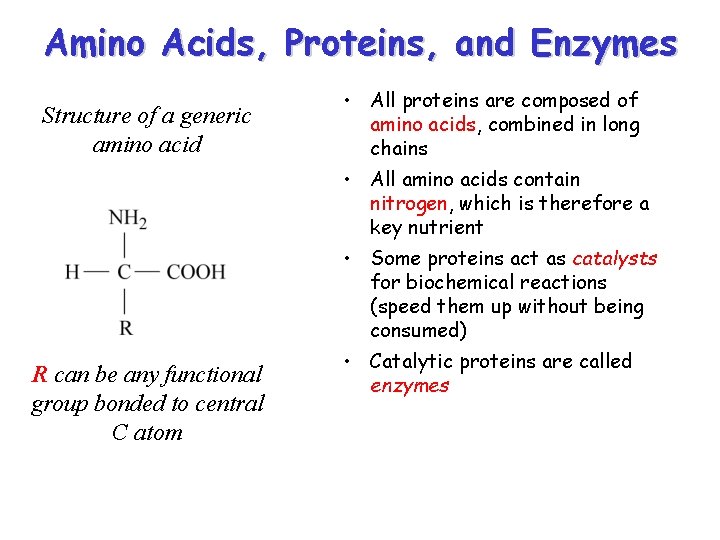
Amino Acids, Proteins, and Enzymes Structure of a generic amino acid • All proteins are composed of amino acids, combined in long chains • All amino acids contain nitrogen, which is therefore a key nutrient • Some proteins act as catalysts for biochemical reactions (speed them up without being consumed) R can be any functional group bonded to central C atom • Catalytic proteins are called enzymes
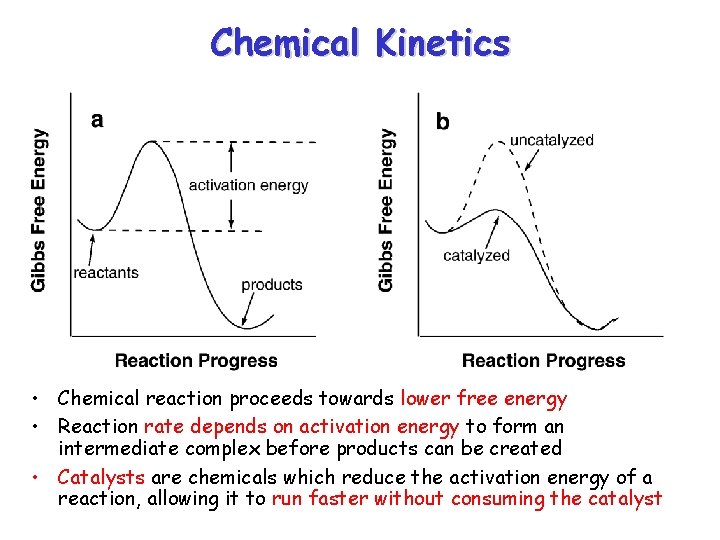
Chemical Kinetics • Chemical reaction proceeds towards lower free energy • Reaction rate depends on activation energy to form an intermediate complex before products can be created • Catalysts are chemicals which reduce the activation energy of a reaction, allowing it to run faster without consuming the catalyst
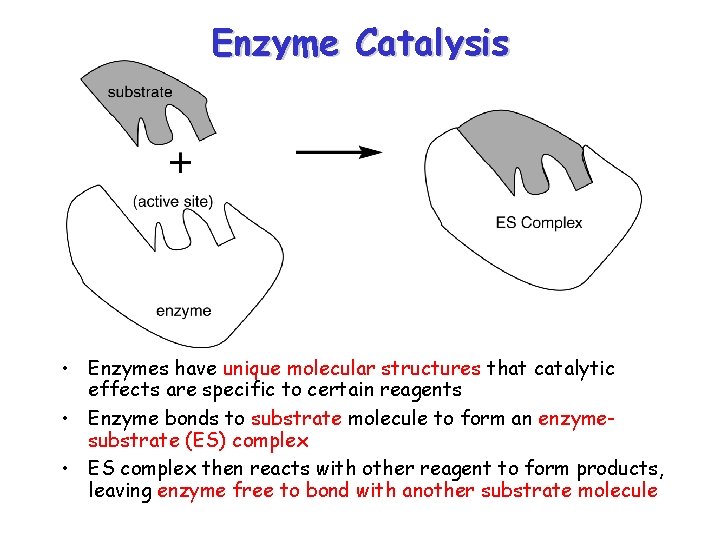
Enzyme Catalysis • Enzymes have unique molecular structures that catalytic effects are specific to certain reagents • Enzyme bonds to substrate molecule to form an enzymesubstrate (ES) complex • ES complex then reacts with other reagent to form products, leaving enzyme free to bond with another substrate molecule
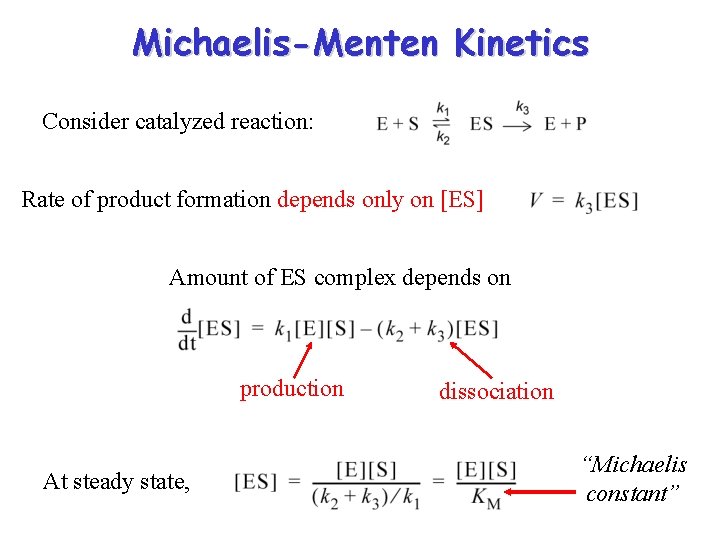
Michaelis-Menten Kinetics Consider catalyzed reaction: Rate of product formation depends only on [ES] Amount of ES complex depends on production At steady state, dissociation “Michaelis constant”
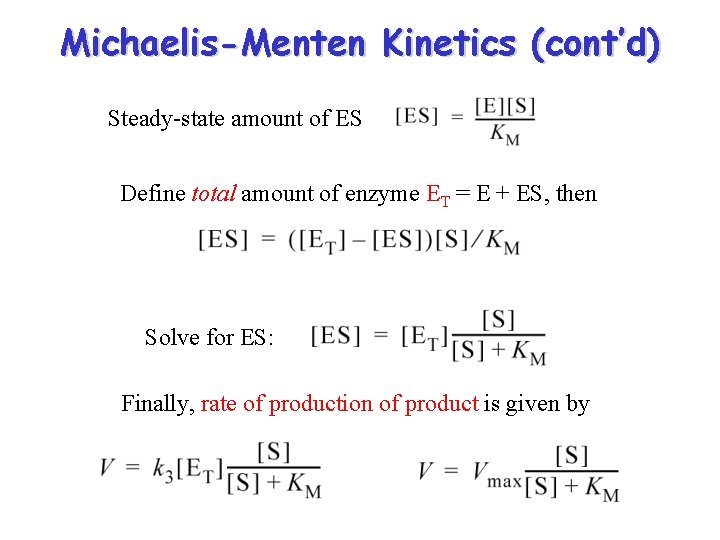
Michaelis-Menten Kinetics (cont’d) Steady-state amount of ES Define total amount of enzyme ET = E + ES, then Solve for ES: Finally, rate of production of product is given by
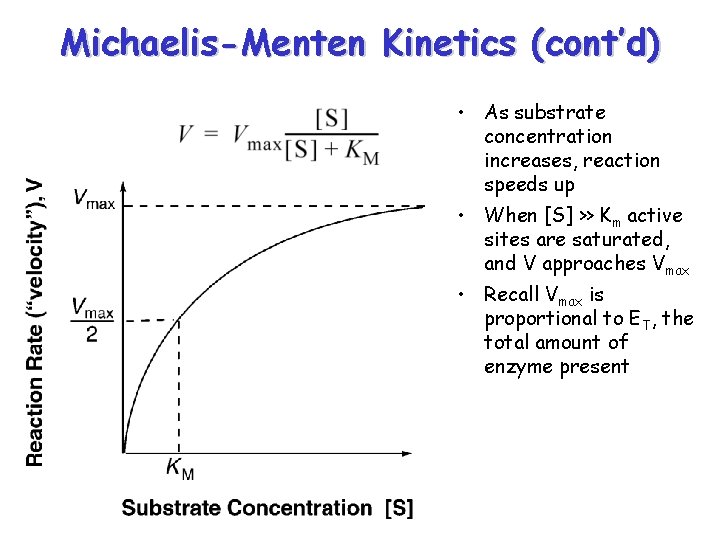
Michaelis-Menten Kinetics (cont’d) • As substrate concentration increases, reaction speeds up • When [S] >> Km active sites are saturated, and V approaches Vmax • Recall Vmax is proportional to ET, the total amount of enzyme present
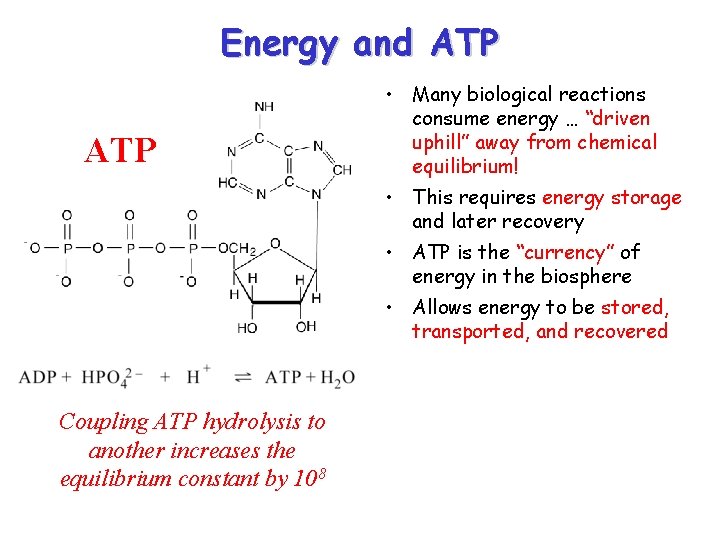
Energy and ATP • Many biological reactions consume energy … “driven uphill” away from chemical equilibrium! • This requires energy storage and later recovery • ATP is the “currency” of energy in the biosphere • Allows energy to be stored, transported, and recovered Coupling ATP hydrolysis to another increases the equilibrium constant by 108
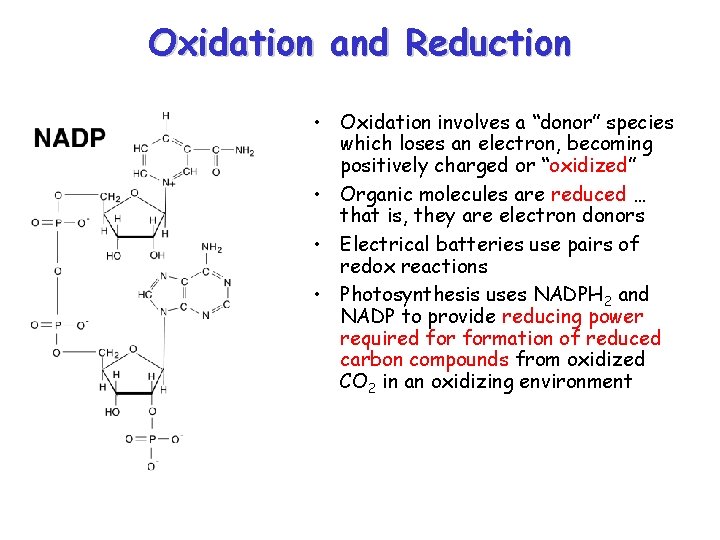
Oxidation and Reduction • Oxidation involves a “donor” species which loses an electron, becoming positively charged or “oxidized” • Organic molecules are reduced … that is, they are electron donors • Electrical batteries use pairs of redox reactions • Photosynthesis uses NADPH 2 and NADP to provide reducing power required formation of reduced carbon compounds from oxidized CO 2 in an oxidizing environment
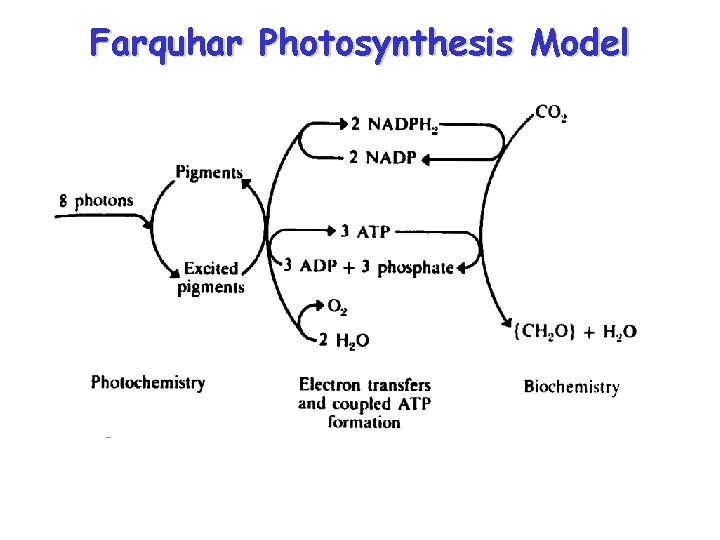
Farquhar Photosynthesis Model
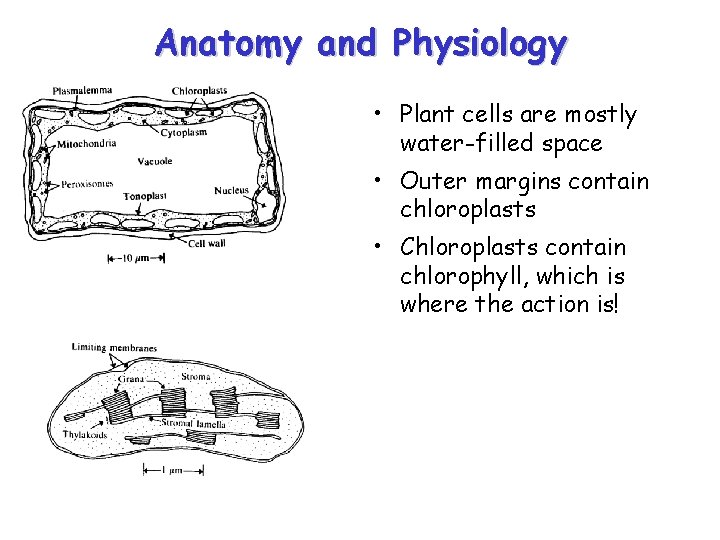
Anatomy and Physiology • Plant cells are mostly water-filled space • Outer margins contain chloroplasts • Chloroplasts contain chlorophyll, which is where the action is!
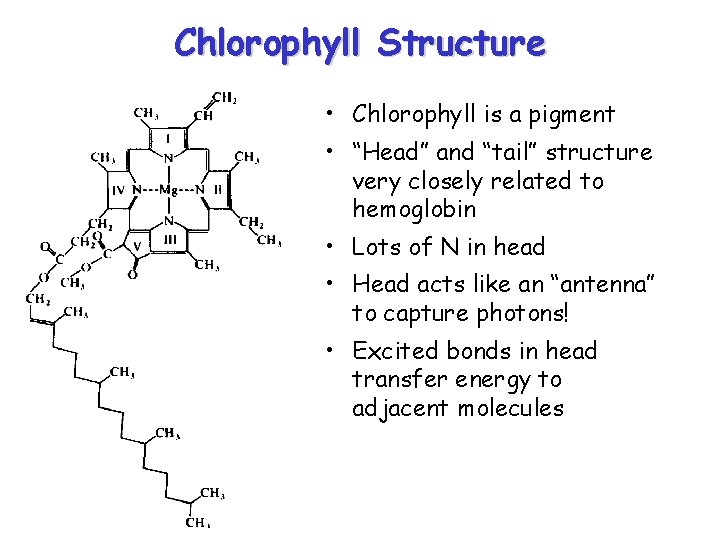
Chlorophyll Structure • Chlorophyll is a pigment • “Head” and “tail” structure very closely related to hemoglobin • Lots of N in head • Head acts like an “antenna” to capture photons! • Excited bonds in head transfer energy to adjacent molecules
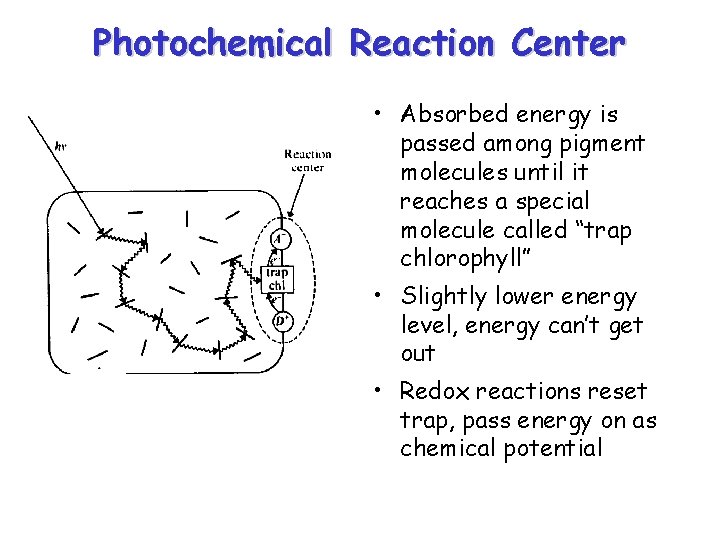
Photochemical Reaction Center • Absorbed energy is passed among pigment molecules until it reaches a special molecule called “trap chlorophyll” • Slightly lower energy level, energy can’t get out • Redox reactions reset trap, pass energy on as chemical potential
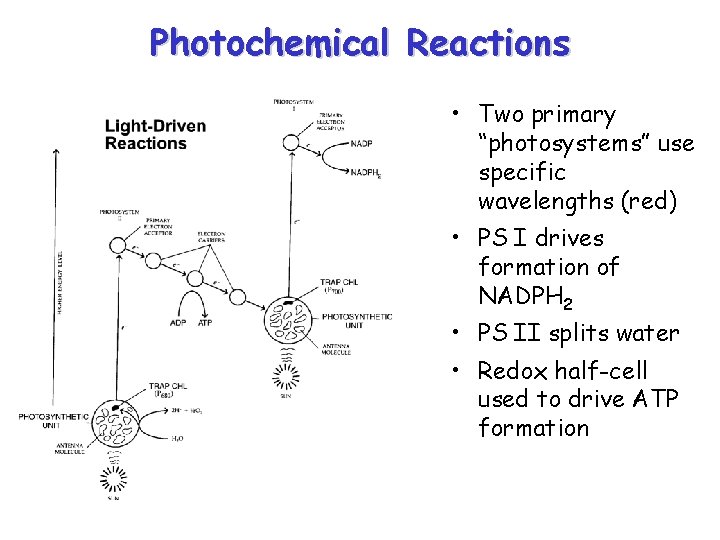
Photochemical Reactions • Two primary “photosystems” use specific wavelengths (red) • PS I drives formation of NADPH 2 • PS II splits water • Redox half-cell used to drive ATP formation
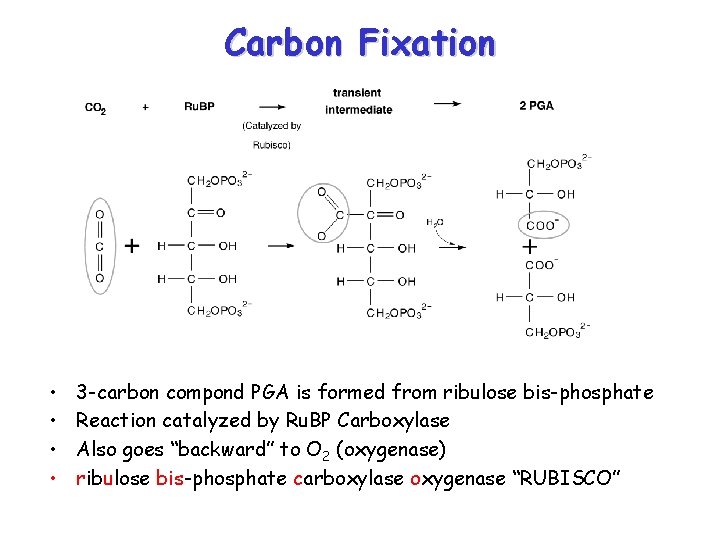
Carbon Fixation • • 3 -carbon compond PGA is formed from ribulose bis-phosphate Reaction catalyzed by Ru. BP Carboxylase Also goes “backward” to O 2 (oxygenase) ribulose bis-phosphate carboxylase oxygenase “RUBISCO”
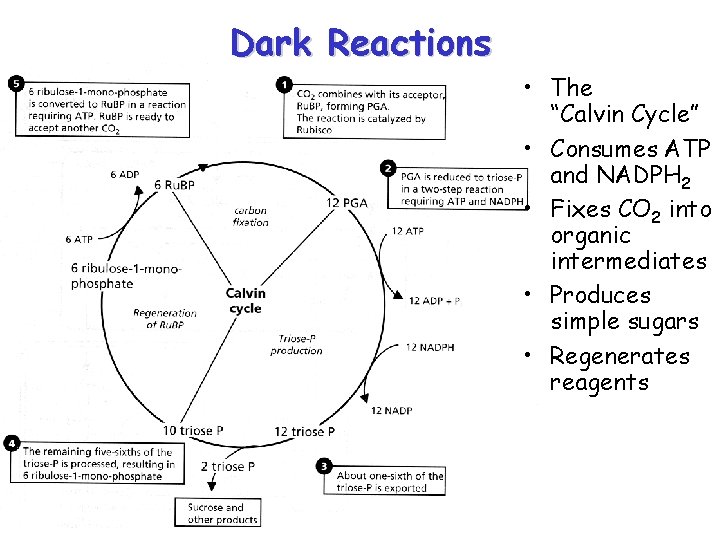
Dark Reactions • The “Calvin Cycle” • Consumes ATP and NADPH 2 • Fixes CO 2 into organic intermediates • Produces simple sugars • Regenerates reagents
Photorespiration • Rubisco molecule can work both ways (“carboxylase-oxygenase”) – Catalyses formation of {CH 2 O}n from CO 2 (assimilation) – Catalyses destruction of {CH 2 O}n to form CO 2 (photorespiration) • Unlike “dark” respiration, photorespiration provides no benefit at all to the plant … just a wasteful loss of energy • Relative rates of carboxylation vs. oxygenation determined by competition between CO 2 and O 2 molecules for active sites on Rubisco enzyme • Higher temperatures, increased O 2, and decreased CO 2 all favor photorespiration over assimilation
Rubisco can gain or lose carbon • Carboxylase – Reacts with CO 2 to produce sugars – Leads to carbon gain • Oxygenase – – Reacts with O 2 to convert sugars to CO 2 Respires 20 -40% of fixed carbon Process known as photorespiration Photoprotection mechanism
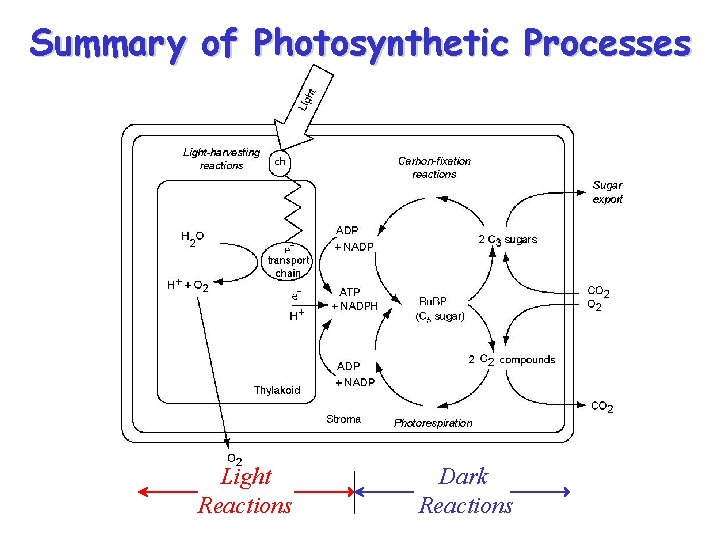
Summary of Photosynthetic Processes Light Reactions Dark Reactions
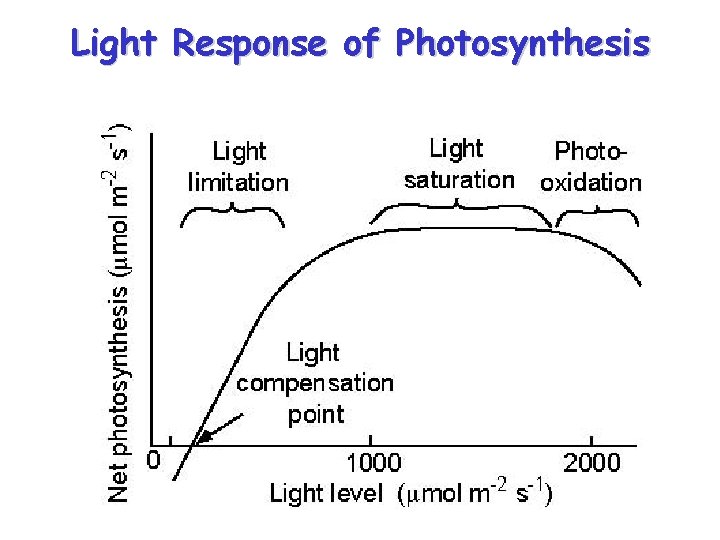
Light Response of Photosynthesis
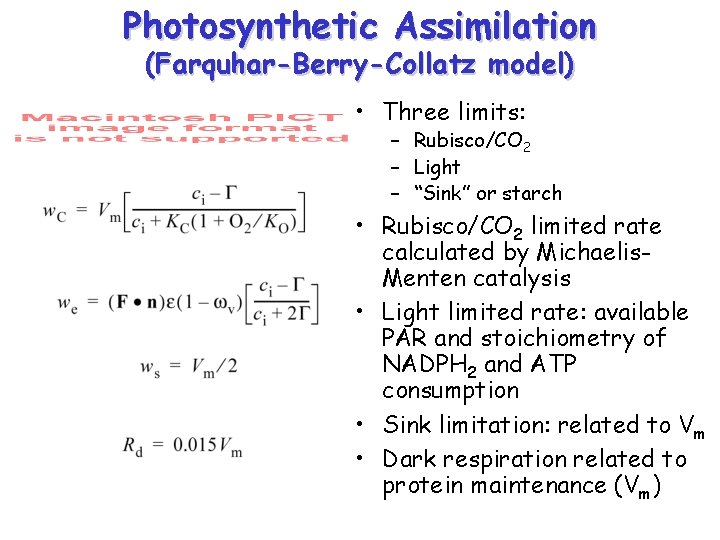
Photosynthetic Assimilation (Farquhar-Berry-Collatz model) • Three limits: – Rubisco/CO 2 – Light – “Sink” or starch • Rubisco/CO 2 limited rate calculated by Michaelis. Menten catalysis • Light limited rate: available PAR and stoichiometry of NADPH 2 and ATP consumption • Sink limitation: related to Vm • Dark respiration related to protein maintenance (Vm)
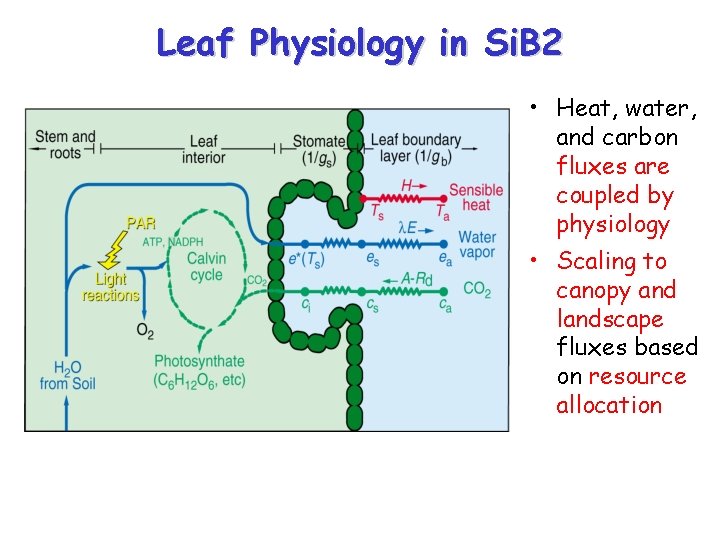
Leaf Physiology in Si. B 2 • Heat, water, and carbon fluxes are coupled by physiology • Scaling to canopy and landscape fluxes based on resource allocation
Canopy Integration • Farquhar photosynthesis model and Ball. Berry stomatal conductance calculation are derived for leaf-level fluxes • How to integrate to entire canopy? – Could multiply fluxes (mol m-2 s-1) at leaf level by total leaf-area index – That would assume all leaves have same properties and physical environment – What about shading inside canopy? – How does a plant respond to shading over time?
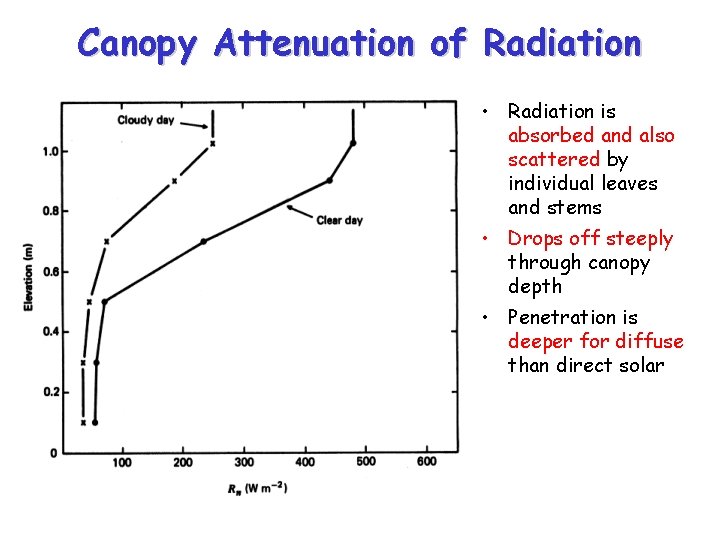
Canopy Attenuation of Radiation • Radiation is absorbed and also scattered by individual leaves and stems • Drops off steeply through canopy depth • Penetration is deeper for diffuse than direct solar
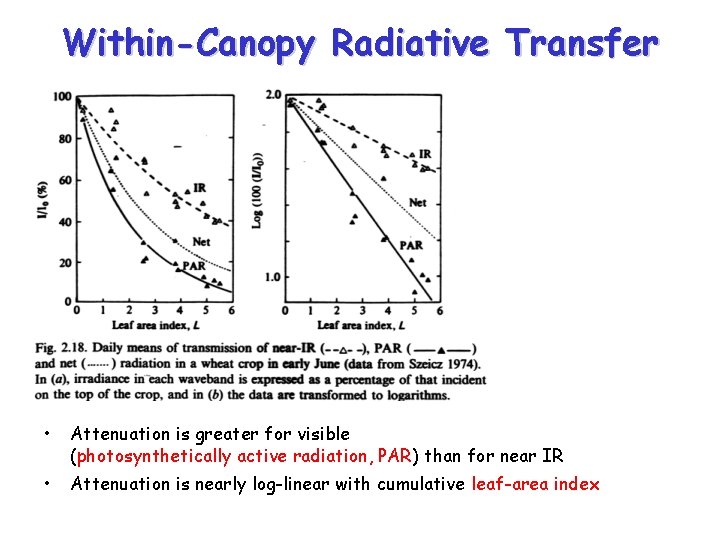
Within-Canopy Radiative Transfer • Attenuation is greater for visible (photosynthetically active radiation, PAR) than for near IR • Attenuation is nearly log-linear with cumulative leaf-area index
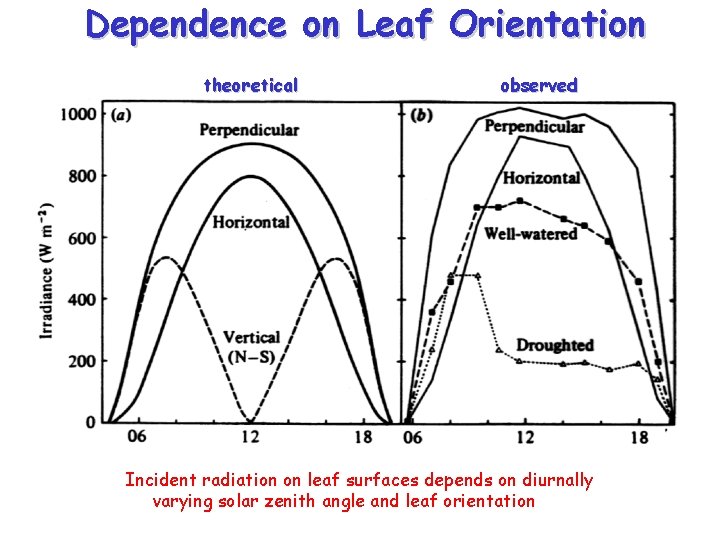
Dependence on Leaf Orientation theoretical observed Incident radiation on leaf surfaces depends on diurnally varying solar zenith angle and leaf orientation
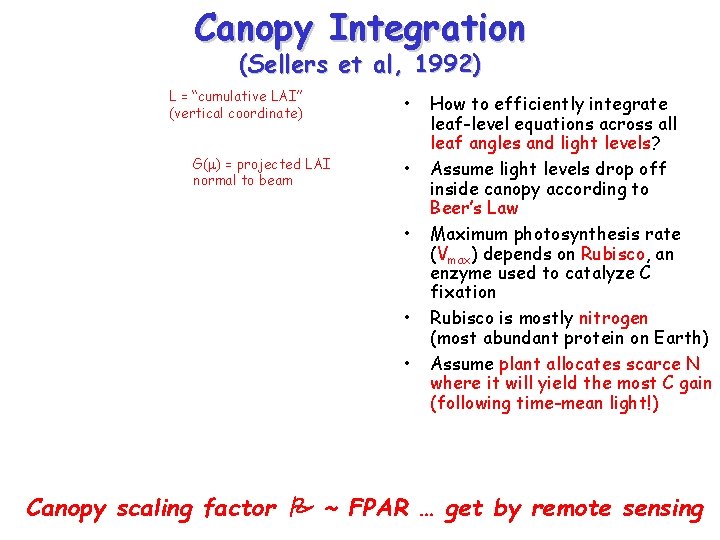
Canopy Integration (Sellers et al, 1992) L = “cumulative LAI” (vertical coordinate) G( ) = projected LAI normal to beam • • • How to efficiently integrate leaf-level equations across all leaf angles and light levels? Assume light levels drop off inside canopy according to Beer’s Law Maximum photosynthesis rate (Vmax) depends on Rubisco, an enzyme used to catalyze C fixation Rubisco is mostly nitrogen (most abundant protein on Earth) Assume plant allocates scarce N where it will yield the most C gain (following time-mean light!) Canopy scaling factor P ~ FPAR … get by remote sensing
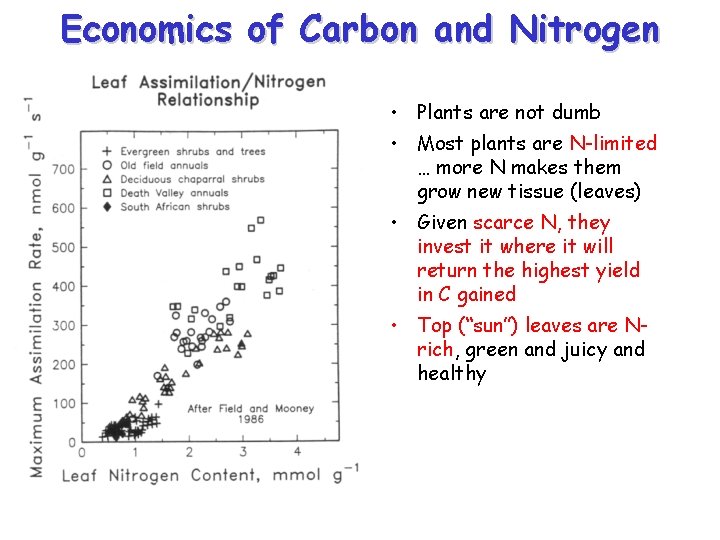
Economics of Carbon and Nitrogen • Plants are not dumb • Most plants are N-limited … more N makes them grow new tissue (leaves) • Given scarce N, they invest it where it will return the highest yield in C gained • Top (“sun”) leaves are Nrich, green and juicy and healthy
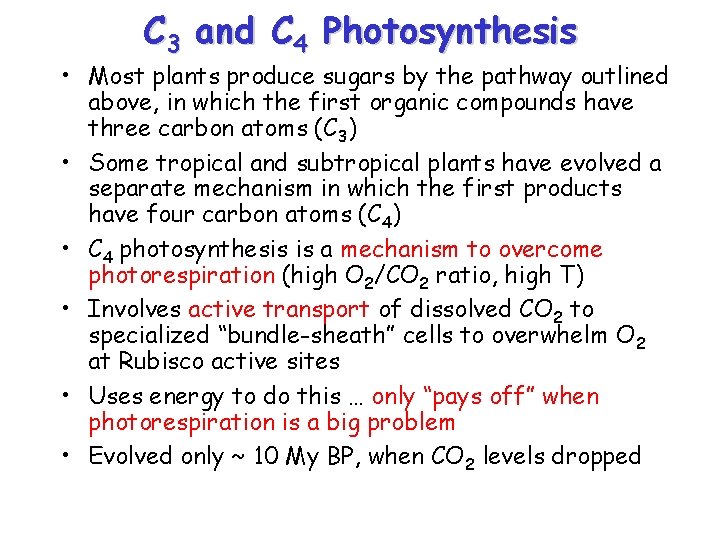
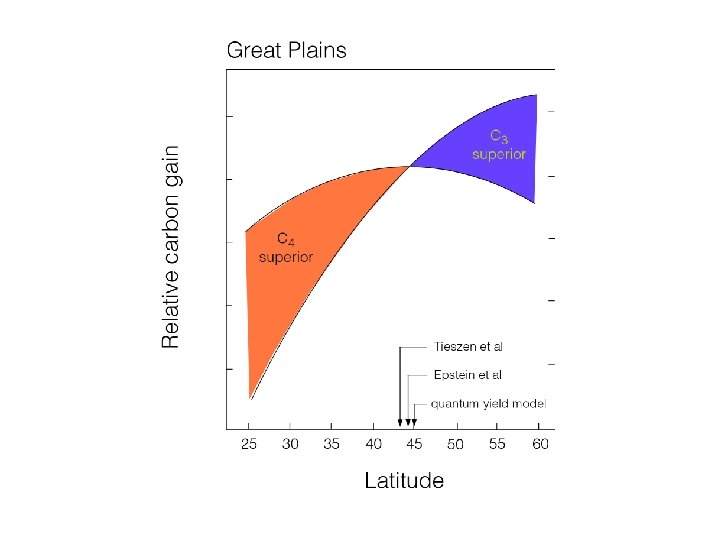
C 3 and C 4 Photosynthesis • Most plants produce sugars by the pathway outlined above, in which the first organic compounds have three carbon atoms (C 3) • Some tropical and subtropical plants have evolved a separate mechanism in which the first products have four carbon atoms (C 4) • C 4 photosynthesis is a mechanism to overcome photorespiration (high O 2/CO 2 ratio, high T) • Involves active transport of dissolved CO 2 to specialized “bundle-sheath” cells to overwhelm O 2 at Rubisco active sites • Uses energy to do this … only “pays off” when photorespiration is a big problem • Evolved only ~ 10 My BP, when CO 2 levels dropped
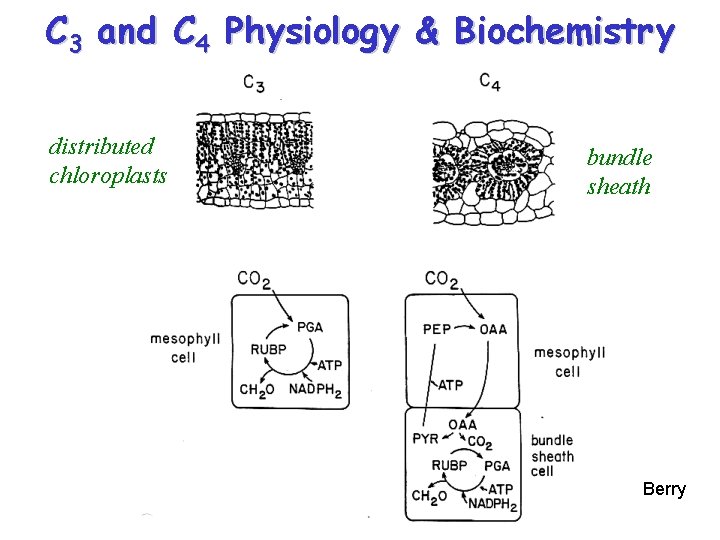
C 3 and C 4 Physiology & Biochemistry distributed chloroplasts bundle sheath Berry
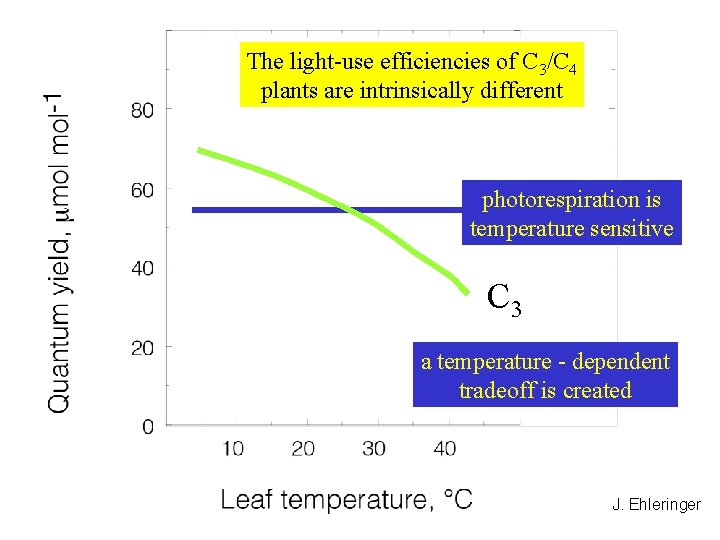
The light-use efficiencies of C 3/C 4 plants are intrinsically different photorespiration is C 4 temperature sensitive C 3 a temperature - dependent tradeoff is created J. Ehleringer
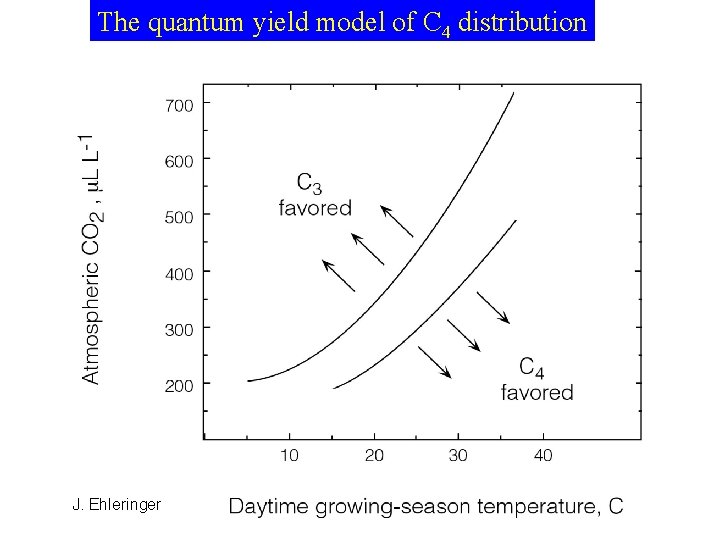
The quantum yield model of C 4 distribution J. Ehleringer
J. Ehleringer
- Slides: 46