4 Waves 2 4 3 Interference Part A
- Slides: 28
4 Waves (2. 4. 3 Interference - Part A) G 482 Electricity, Waves & Photons 2. 4. 1 Wave Motion 2. 4. 2. EM Waves 2. 4. 3 Interference Part A p 150 -151 Part B p 152 -157 2. 4. 4 Stationary Waves H 158/H 558 Mr Powell 2012 Index
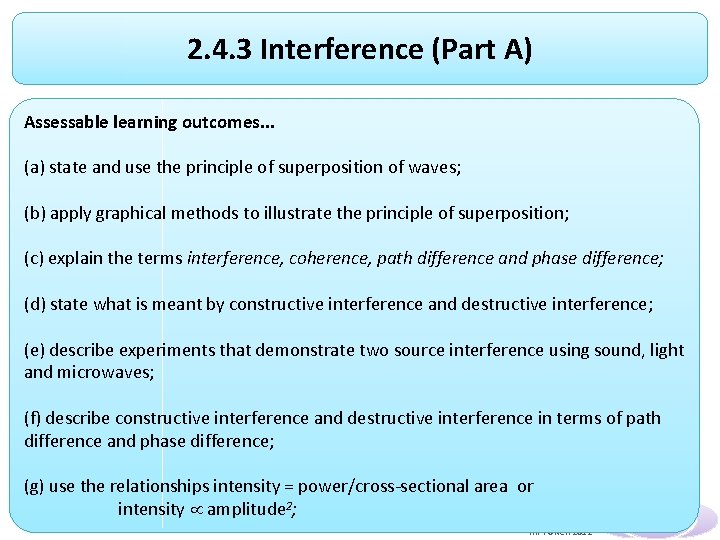
2. 4. 3 Interference (Part A) Assessable learning outcomes. . . (a) state and use the principle of superposition of waves; (b) apply graphical methods to illustrate the principle of superposition; (c) explain the terms interference, coherence, path difference and phase difference; (d) state what is meant by constructive interference and destructive interference; (e) describe experiments that demonstrate two source interference using sound, light and microwaves; (f) describe constructive interference and destructive interference in terms of path difference and phase difference; (g) use the relationships intensity = power/cross-sectional area or intensity amplitude 2; Mr Powell 2012 Index
(c) explain the terms interference, coherence, path difference and phase difference; Interference: Coherence: Phase Difference: Path Difference: Mr Powell 2012 Index
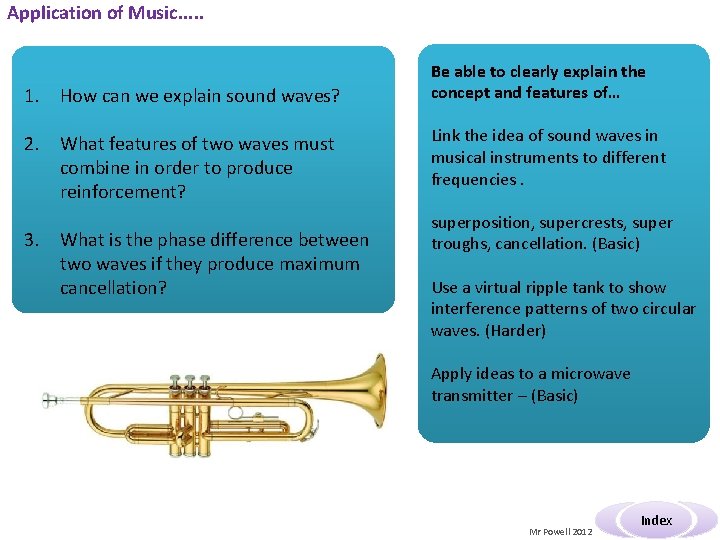
Application of Music. . . 1. How can we explain sound waves? 2. What features of two waves must combine in order to produce reinforcement? 3. What is the phase difference between two waves if they produce maximum cancellation? Be able to clearly explain the concept and features of… Link the idea of sound waves in musical instruments to different frequencies. superposition, supercrests, super troughs, cancellation. (Basic) Use a virtual ripple tank to show interference patterns of two circular waves. (Harder) Apply ideas to a microwave transmitter – (Basic) Mr Powell 2012 Index
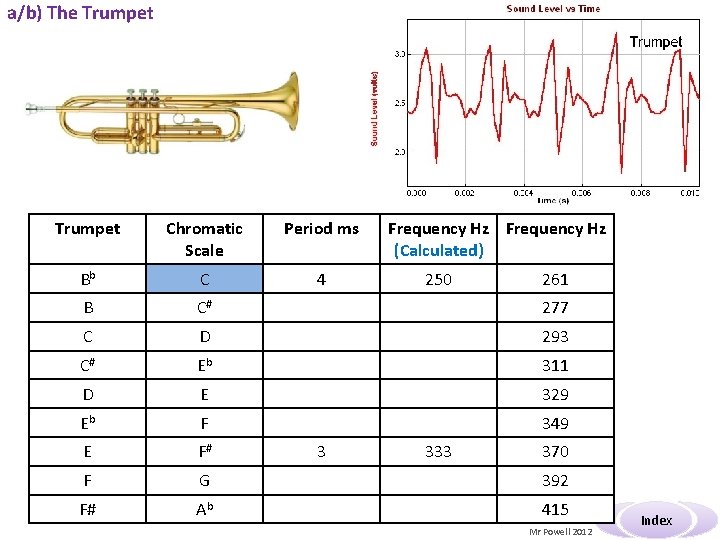
a/b) The Trumpet Chromatic Scale Period ms Bb C 4 B C# 277 C D 293 C# Eb 311 D E 329 Eb F 349 E F# F G 392 F# Ab 415 3 Frequency Hz (Calculated) 250 333 261 370 Mr Powell 2012 Index
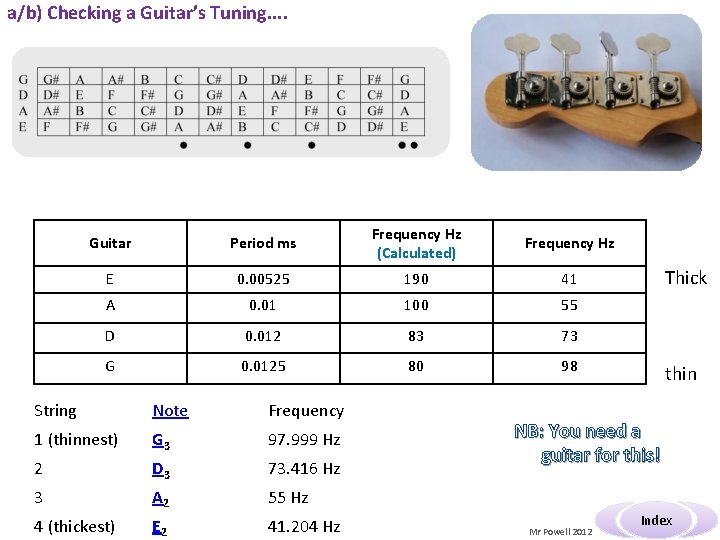
a/b) Checking a Guitar’s Tuning. . Guitar Period ms Frequency Hz (Calculated) Frequency Hz E 0. 00525 190 41 A 0. 01 100 55 D 0. 012 83 73 G 0. 0125 80 98 String Note Frequency 1 (thinnest) G 3 97. 999 Hz 2 D 3 73. 416 Hz 3 A 2 55 Hz 4 (thickest) E 2 41. 204 Hz Thick thin NB: You need a guitar for this! Mr Powell 2012 Index
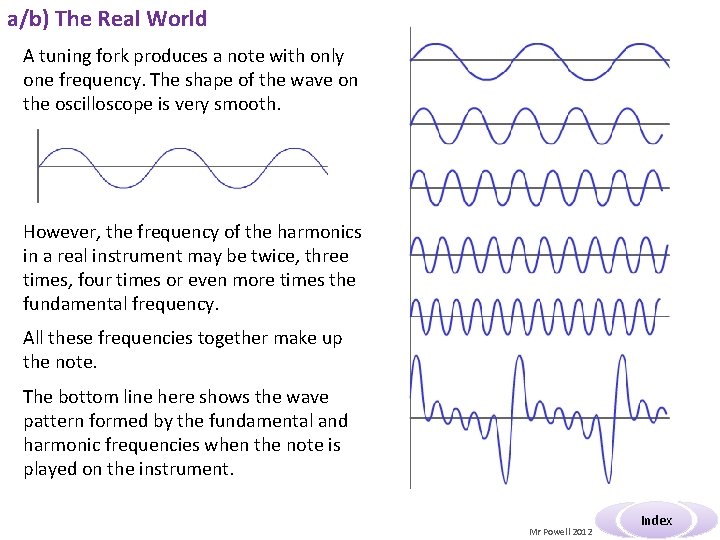
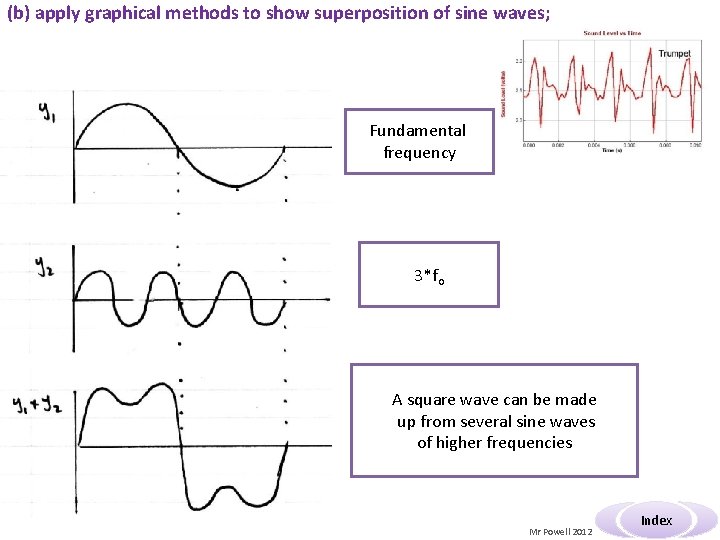
a/b) The Real World A tuning fork produces a note with only one frequency. The shape of the wave on the oscilloscope is very smooth. However, the frequency of the harmonics in a real instrument may be twice, three times, four times or even more times the fundamental frequency. All these frequencies together make up the note. The bottom line here shows the wave pattern formed by the fundamental and harmonic frequencies when the note is played on the instrument. Mr Powell 2012 Index
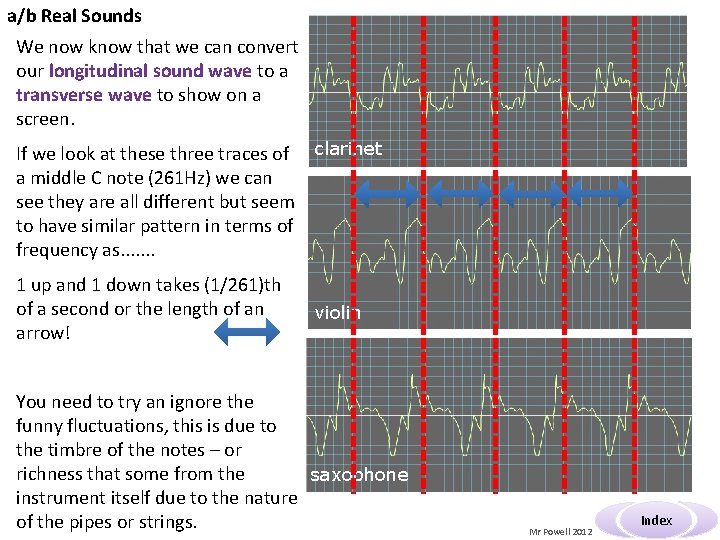
a/b Real Sounds We now know that we can convert our longitudinal sound wave to a transverse wave to show on a screen. If we look at these three traces of a middle C note (261 Hz) we can see they are all different but seem to have similar pattern in terms of frequency as. . . . 1 up and 1 down takes (1/261)th of a second or the length of an arrow! clarinet violin You need to try an ignore the funny fluctuations, this is due to the timbre of the notes – or richness that some from the saxophone instrument itself due to the nature of the pipes or strings. Mr Powell 2012 Index
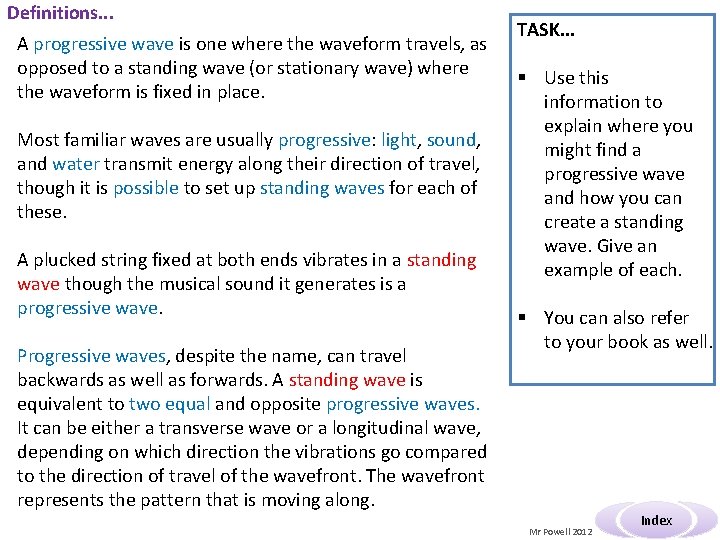
Definitions. . . A progressive wave is one where the waveform travels, as opposed to a standing wave (or stationary wave) where the waveform is fixed in place. Most familiar waves are usually progressive: light, sound, and water transmit energy along their direction of travel, though it is possible to set up standing waves for each of these. A plucked string fixed at both ends vibrates in a standing wave though the musical sound it generates is a progressive wave. Progressive waves, despite the name, can travel backwards as well as forwards. A standing wave is equivalent to two equal and opposite progressive waves. It can be either a transverse wave or a longitudinal wave, depending on which direction the vibrations go compared to the direction of travel of the wavefront. The wavefront represents the pattern that is moving along. TASK. . . § Use this information to explain where you might find a progressive wave and how you can create a standing wave. Give an example of each. § You can also refer to your book as well. Mr Powell 2012 Index
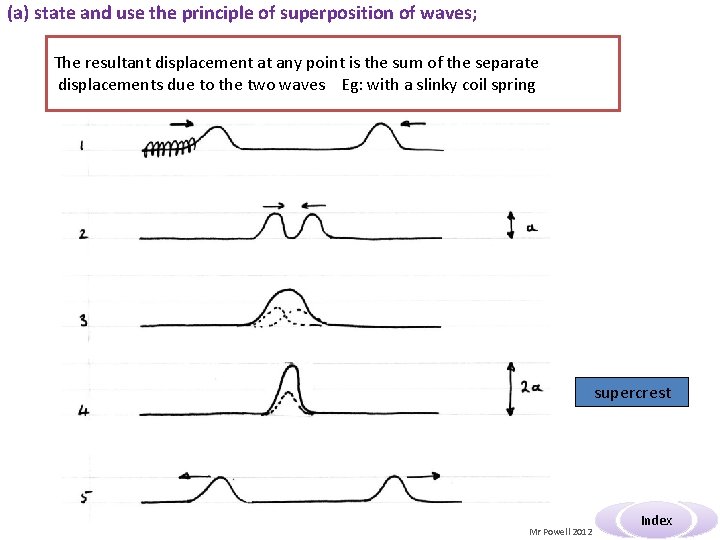
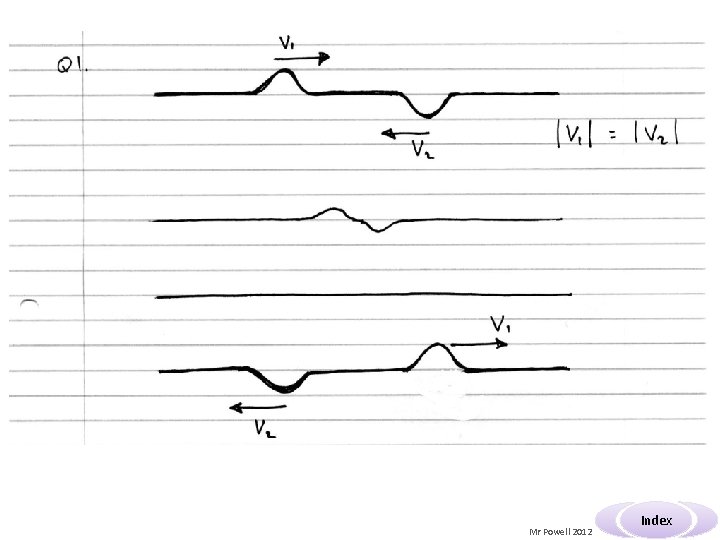
(a) state and use the principle of superposition of waves; The resultant displacement at any point is the sum of the separate displacements due to the two waves Eg: with a slinky coil spring supercrest Mr Powell 2012 Index
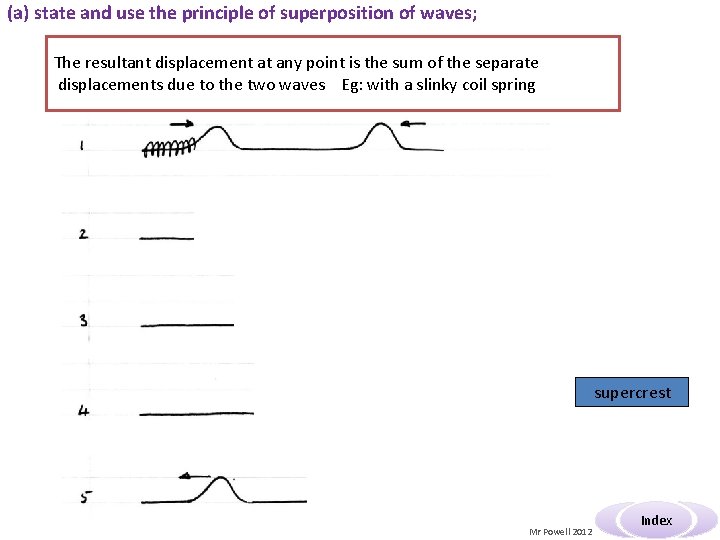
(a) state and use the principle of superposition of waves; The resultant displacement at any point is the sum of the separate displacements due to the two waves Eg: with a slinky coil spring supercrest Mr Powell 2012 Index
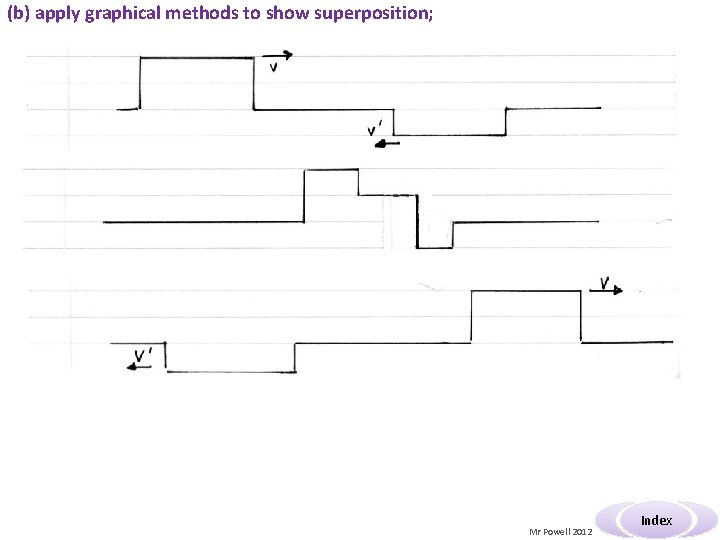
(b) apply graphical methods to show superposition; Mr Powell 2012 Index
(b) apply graphical methods to show superposition of sine waves; Fundamental frequency 3*fo A square wave can be made up from several sine waves of higher frequencies Mr Powell 2012 Index
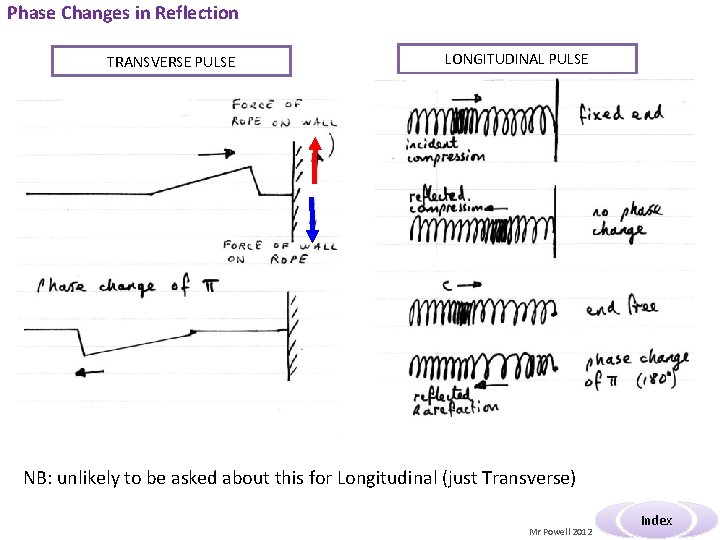
Phase Changes in Reflection TRANSVERSE PULSE LONGITUDINAL PULSE NB: unlikely to be asked about this for Longitudinal (just Transverse) Mr Powell 2012 Index
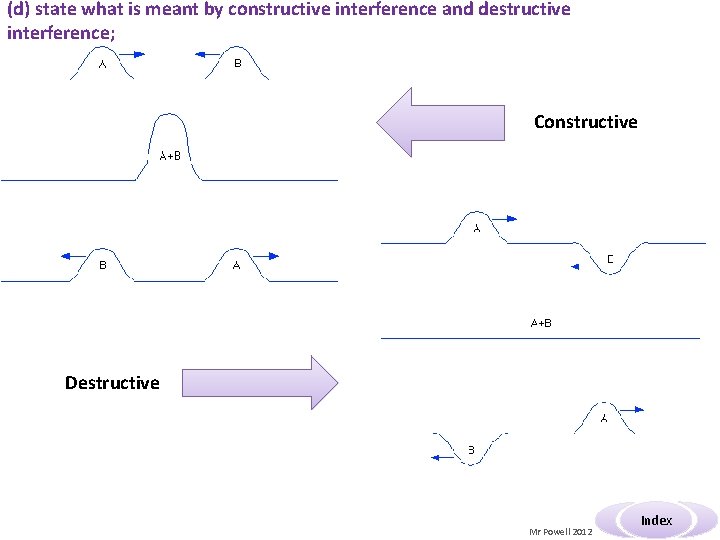
(d) state what is meant by constructive interference and destructive interference; Constructive Destructive Mr Powell 2012 Index
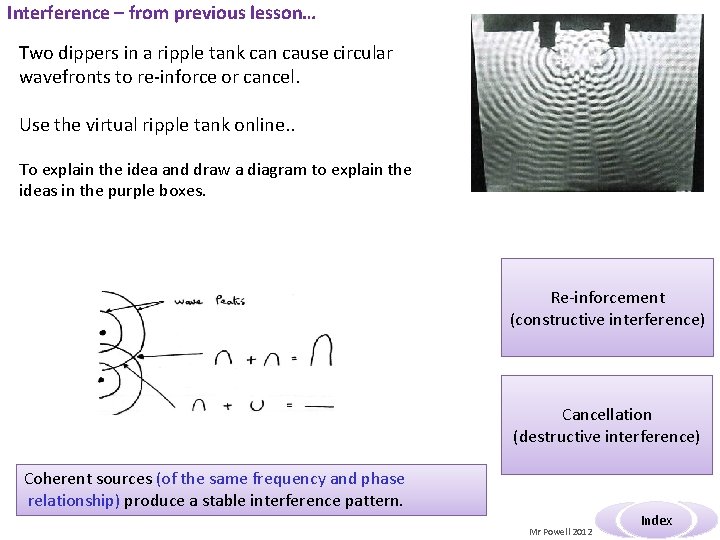
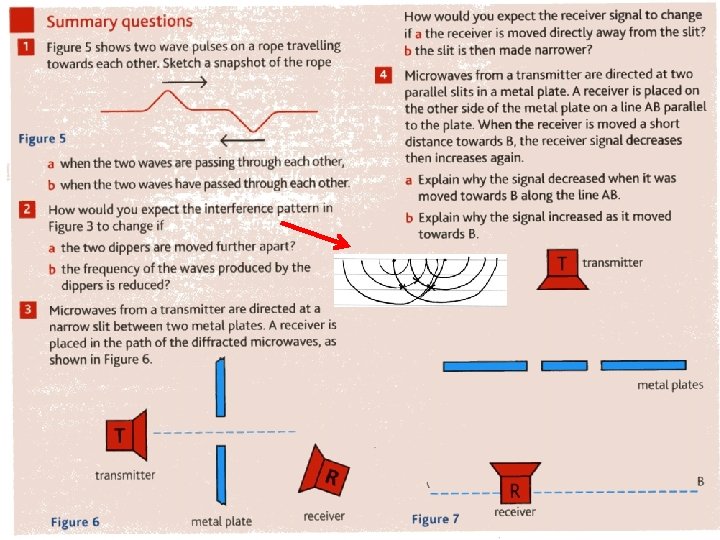
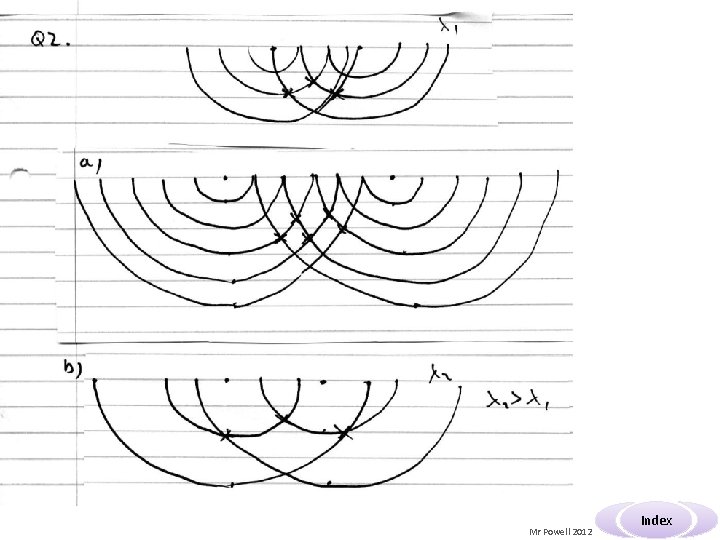
Interference – from previous lesson… Two dippers in a ripple tank can cause circular wavefronts to re-inforce or cancel. Use the virtual ripple tank online. . To explain the idea and draw a diagram to explain the ideas in the purple boxes. Re-inforcement (constructive interference) Cancellation (destructive interference) Coherent sources (of the same frequency and phase relationship) produce a stable interference pattern. Mr Powell 2012 Index
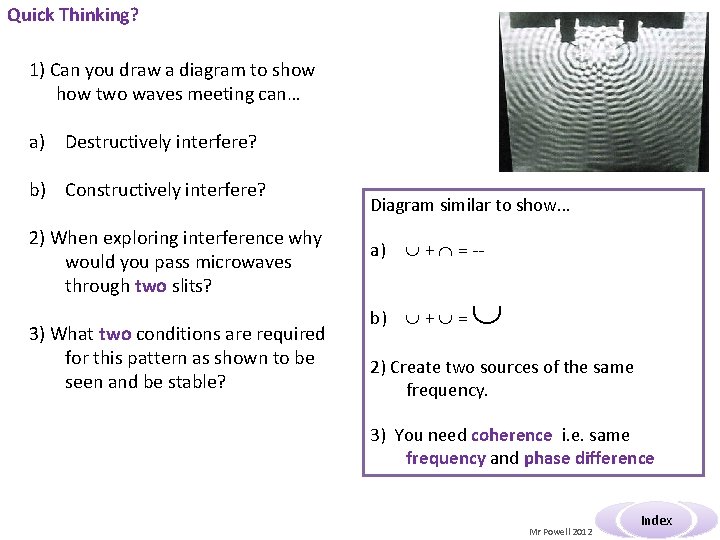
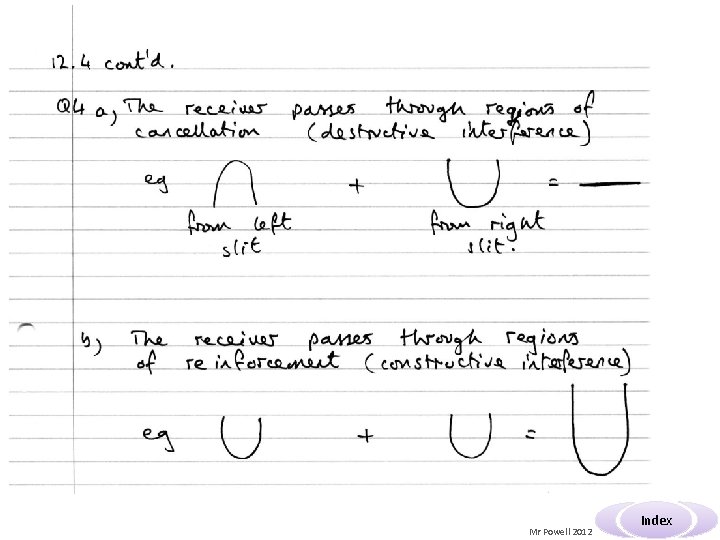
Quick Thinking? 1) Can you draw a diagram to show two waves meeting can… a) Destructively interfere? b) Constructively interfere? 2) When exploring interference why would you pass microwaves through two slits? 3) What two conditions are required for this pattern as shown to be seen and be stable? Diagram similar to show… a) + = -- b) + = 2) Create two sources of the same frequency. 3) You need coherence i. e. same frequency and phase difference Mr Powell 2012 Index
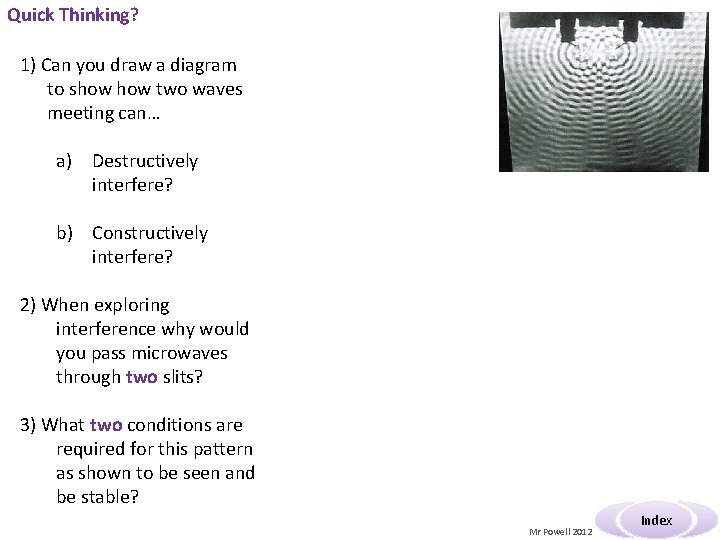
Quick Thinking? 1) Can you draw a diagram to show two waves meeting can… a) Destructively interfere? b) Constructively interfere? 2) When exploring interference why would you pass microwaves through two slits? 3) What two conditions are required for this pattern as shown to be seen and be stable? Mr Powell 2012 Index
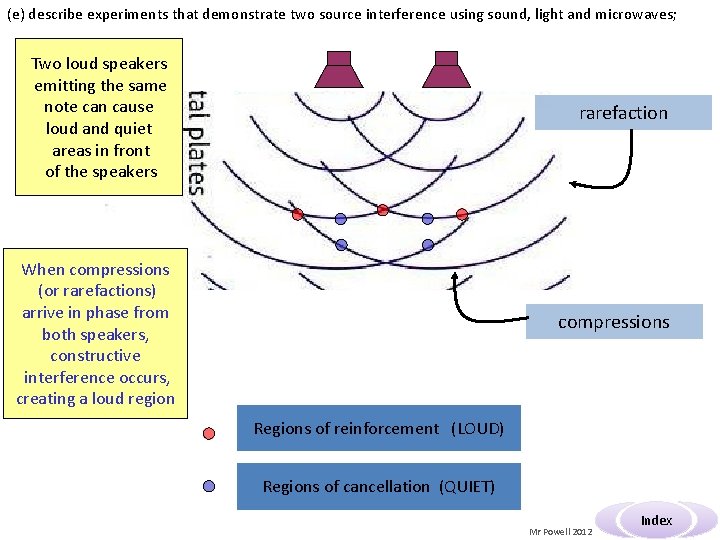
(e) describe experiments that demonstrate two source interference using sound, light and microwaves; Two loud speakers emitting the same note can cause loud and quiet areas in front of the speakers rarefaction When compressions (or rarefactions) arrive in phase from both speakers, constructive interference occurs, creating a loud region compressions Regions of reinforcement (LOUD) Regions of cancellation (QUIET) Mr Powell 2012 Index
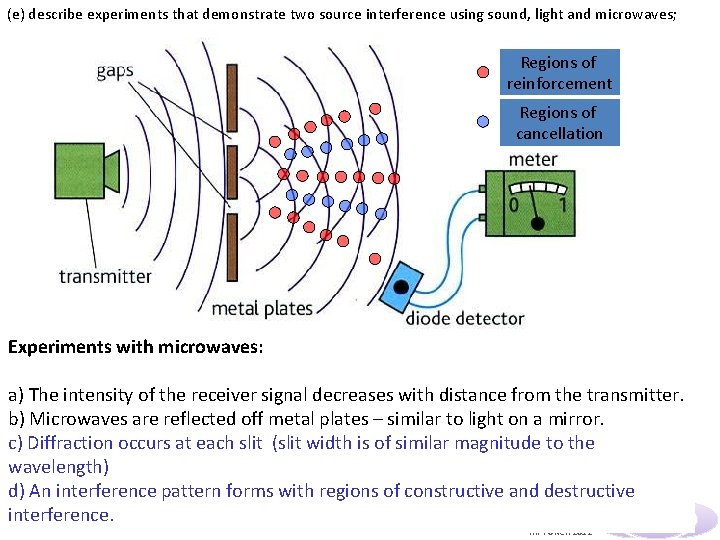
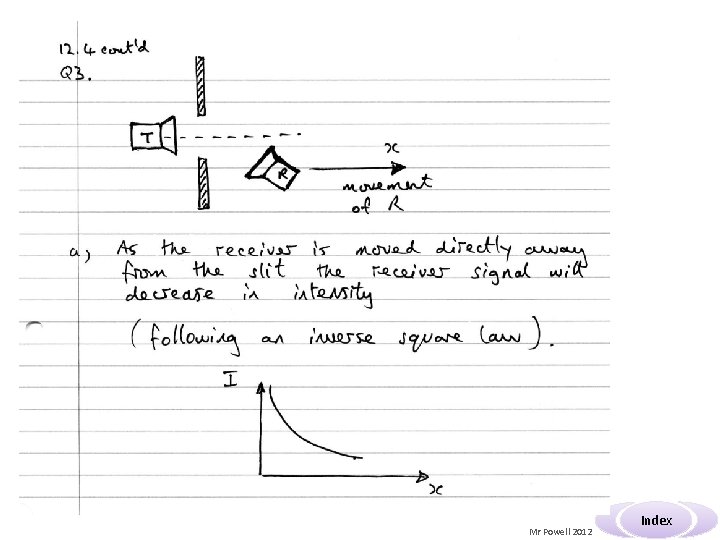
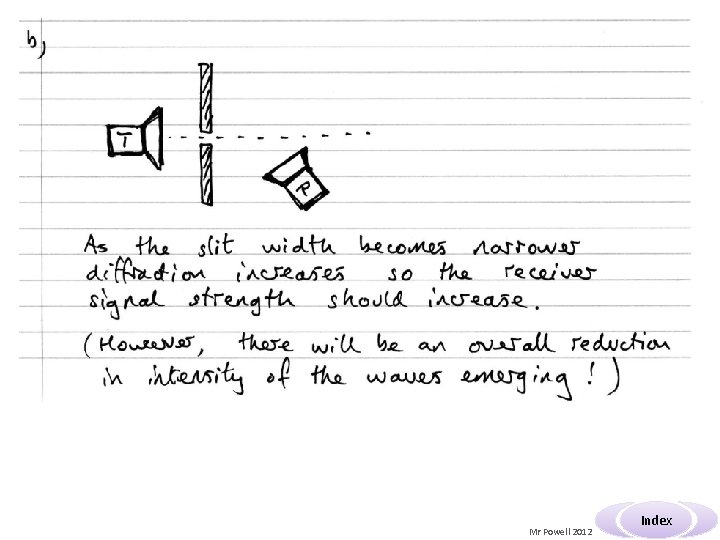
(e) describe experiments that demonstrate two source interference using sound, light and microwaves; Regions of reinforcement Regions of cancellation Experiments with microwaves: a) The intensity of the receiver signal decreases with distance from the transmitter. b) Microwaves are reflected off metal plates – similar to light on a mirror. c) Diffraction occurs at each slit (slit width is of similar magnitude to the wavelength) d) An interference pattern forms with regions of constructive and destructive interference. Index Mr Powell 2012
Mr Powell 2012 Index
Mr Powell 2012 Index
Mr Powell 2012 Index
Mr Powell 2012 Index
Mr Powell 2012 Index
Mr Powell 2012 Index
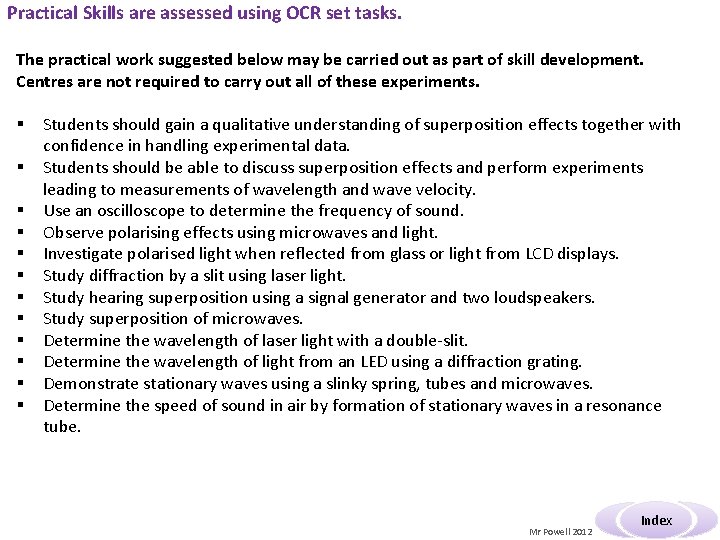
Practical Skills are assessed using OCR set tasks. The practical work suggested below may be carried out as part of skill development. Centres are not required to carry out all of these experiments. § § § Students should gain a qualitative understanding of superposition effects together with confidence in handling experimental data. Students should be able to discuss superposition effects and perform experiments leading to measurements of wavelength and wave velocity. Use an oscilloscope to determine the frequency of sound. Observe polarising effects using microwaves and light. Investigate polarised light when reflected from glass or light from LCD displays. Study diffraction by a slit using laser light. Study hearing superposition using a signal generator and two loudspeakers. Study superposition of microwaves. Determine the wavelength of laser light with a double-slit. Determine the wavelength of light from an LED using a diffraction grating. Demonstrate stationary waves using a slinky spring, tubes and microwaves. Determine the speed of sound in air by formation of stationary waves in a resonance tube. Mr Powell 2012 Index