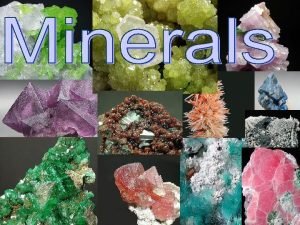
3 1 What is a mineral 3 2
- Slides: 23
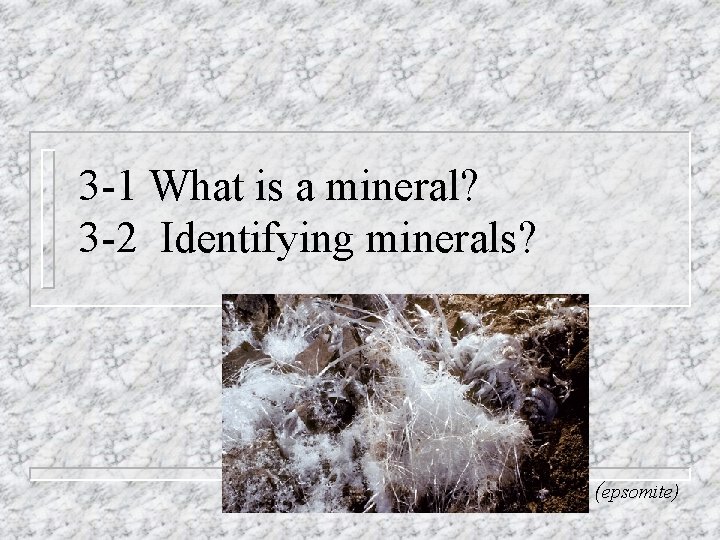
3 -1 What is a mineral? 3 -2 Identifying minerals? (epsomite)
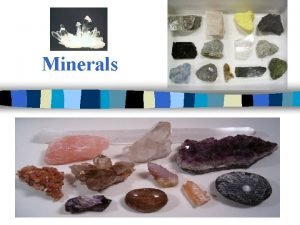
{enrich} n n What is a Mineral? More than 4, 000 minerals (40 -50 new minerals identified each year!) but only 100 common minerals about 20 minerals make up most of Earth’s crust native elements occur in nature in pure form (ex: gold, copper, diamond, sulfur, graphite, silver, and platinum)
n Most minerals are COMPOUNDS… (a chemical combination of two or more elements), while rocks are mixtures of minerals (and sometimes organic matter like shells) n Some minerals are elements (like copper, gold and diamonds)
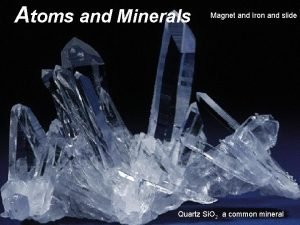
{enrich} n n n Classification of minerals 95% of the earth’s crust is made of silicates (minerals made of silicon and oxygen): ex: quartz Si. O 2) sulfide (+ sulfur) ex: cinnabar (Hg. S) sulfate (+sulfur & O) n n n carbonate (C & O) ex: calcite: Ca. CO 3 oxide (+oxygen) ex: corundum: Al 2 O 3 halide –ex: salt
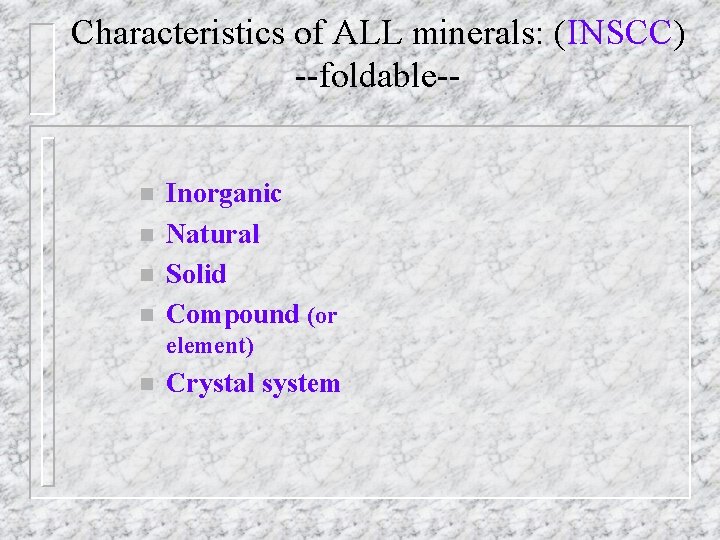
Characteristics of ALL minerals: (INSCC) --foldable-n n Inorganic Natural Solid Compound (or element) n Crystal system
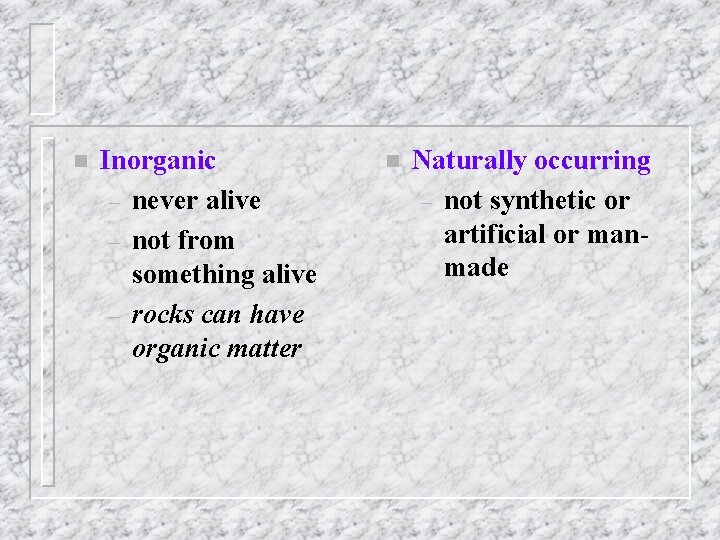
n Inorganic – never alive – not from something alive – rocks can have organic matter n Naturally occurring – not synthetic or artificial or manmade
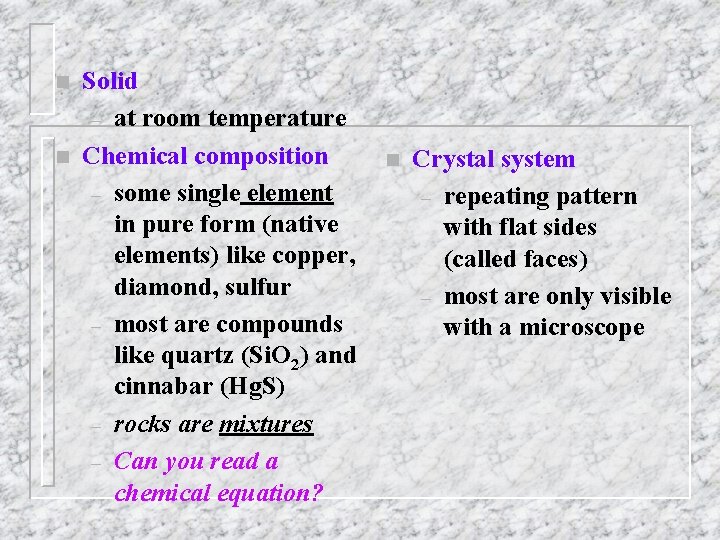
n n Solid – at room temperature Chemical composition – some single element in pure form (native elements) like copper, diamond, sulfur – most are compounds like quartz (Si. O 2) and cinnabar (Hg. S) – rocks are mixtures – Can you read a chemical equation? n Crystal system – repeating pattern with flat sides (called faces) – most are only visible with a microscope
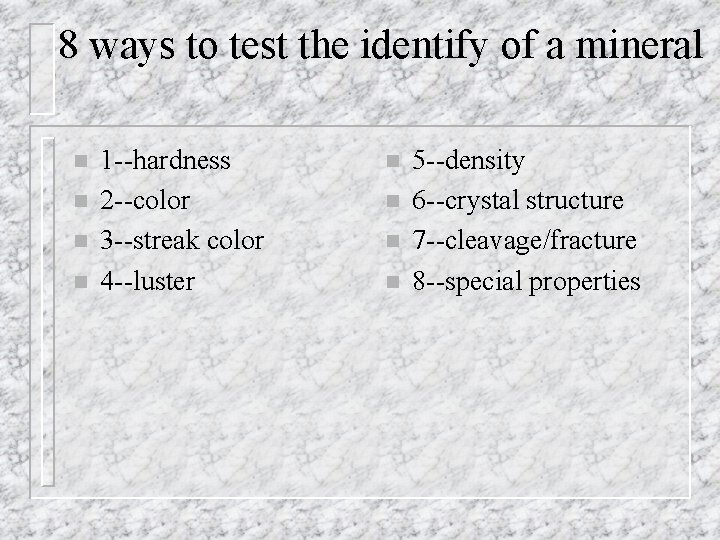
8 ways to test the identify of a mineral n n 1 --hardness 2 --color 3 --streak color 4 --luster n n 5 --density 6 --crystal structure 7 --cleavage/fracture 8 --special properties
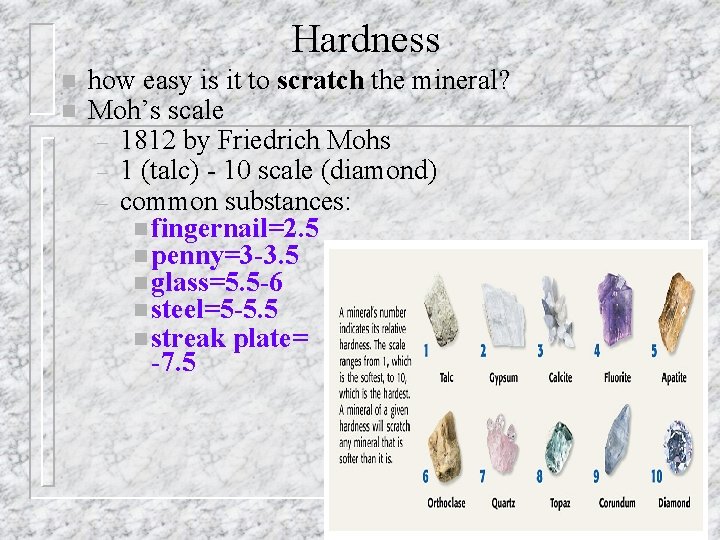
Hardness n n how easy is it to scratch the mineral? Moh’s scale – 1812 by Friedrich Mohs – 1 (talc) - 10 scale (diamond) – common substances: n fingernail=2. 5 n penny=3 -3. 5 n glass=5. 5 -6 n steel=5 -5. 5 n streak plate= -7. 5 6. 5
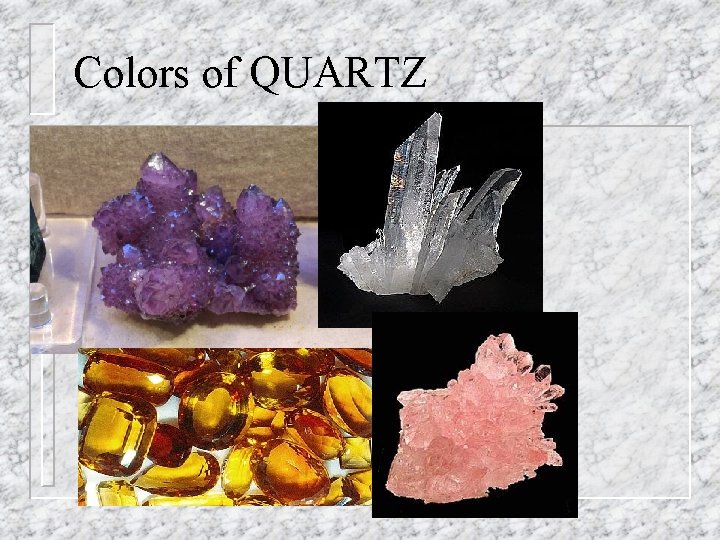
Colors of QUARTZ
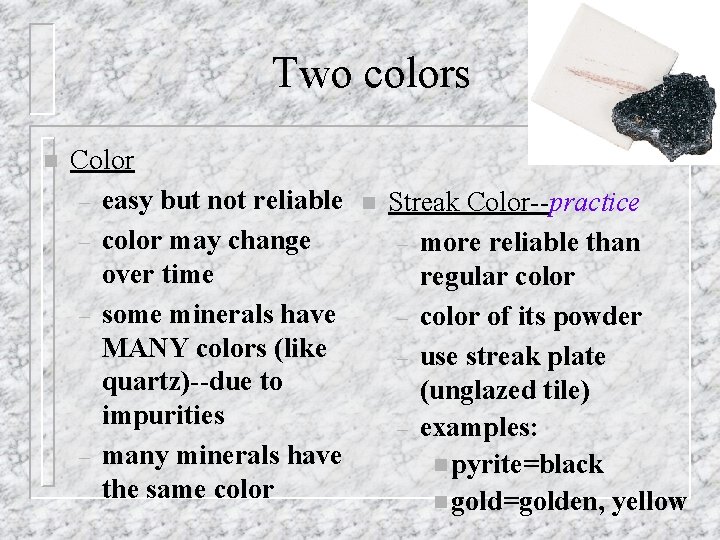
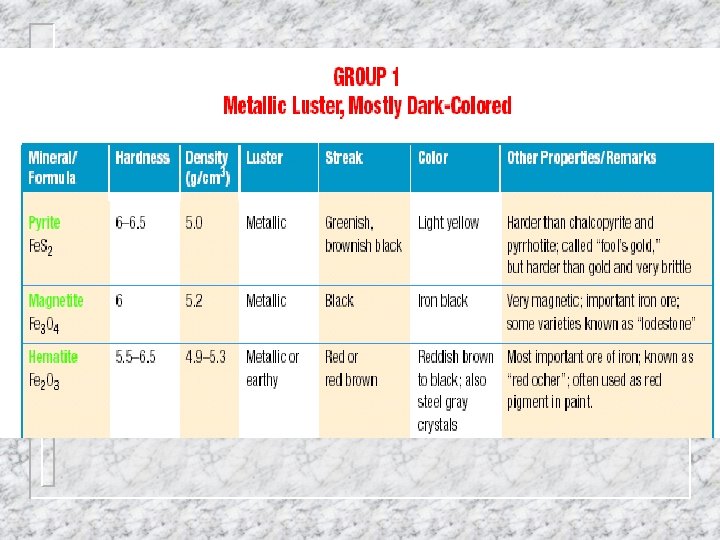
Two colors n Color – easy but not reliable – color may change over time – some minerals have MANY colors (like quartz)--due to impurities – many minerals have the same color n Streak Color--practice – more reliable than regular color – color of its powder – use streak plate (unglazed tile) – examples: n pyrite=black n gold=golden, yellow
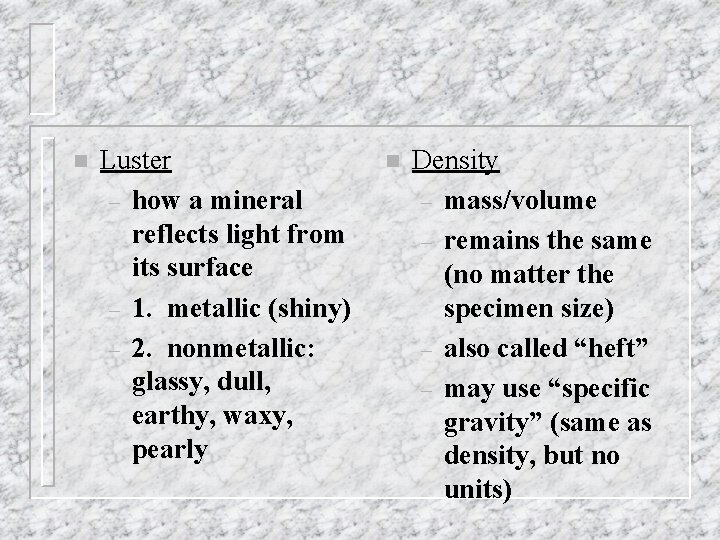
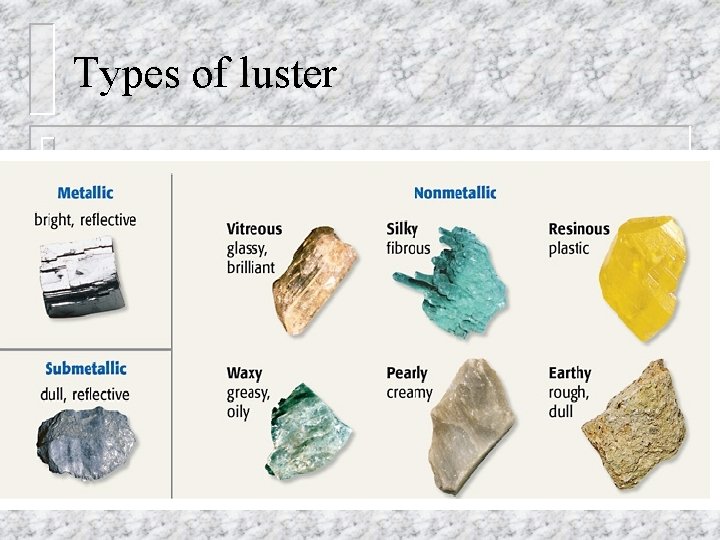
n Luster – how a mineral reflects light from its surface – 1. metallic (shiny) – 2. nonmetallic: glassy, dull, earthy, waxy, pearly n Density – mass/volume – remains the same (no matter the specimen size) – also called “heft” – may use “specific gravity” (same as density, but no units)
Types of luster
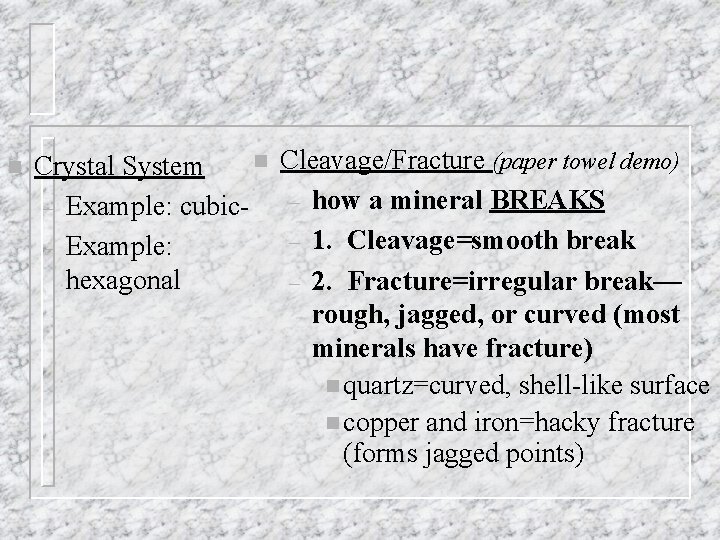
n n Cleavage/Fracture (paper towel demo) Crystal System – how a mineral BREAKS – Example: cubic– 1. Cleavage=smooth break – Example: hexagonal – 2. Fracture=irregular break— rough, jagged, or curved (most minerals have fracture) n quartz=curved, shell-like surface n copper and iron=hacky fracture (forms jagged points)
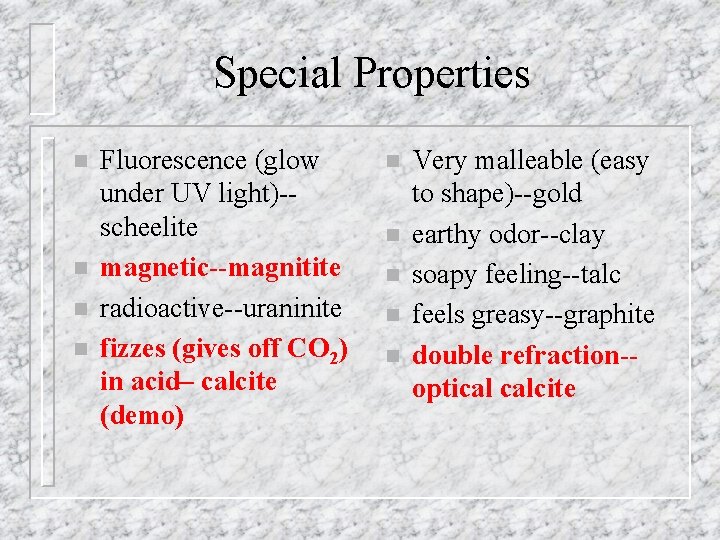
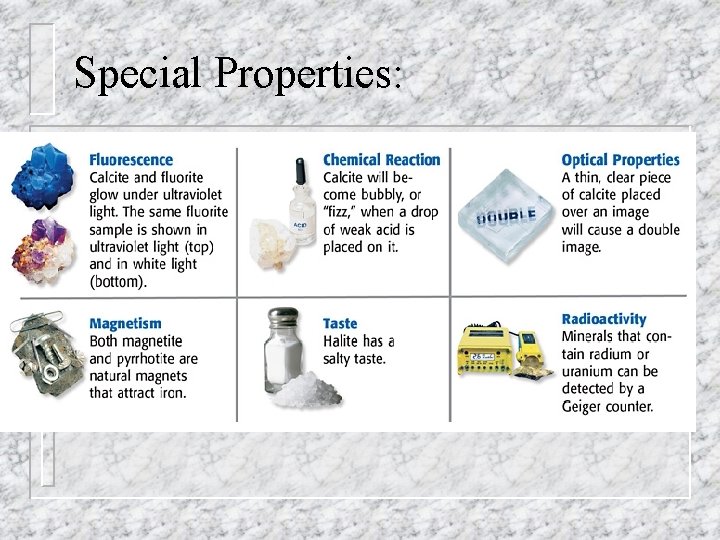
Special Properties n n Fluorescence (glow under UV light)-scheelite magnetic--magnitite radioactive--uraninite fizzes (gives off CO 2) in acid– calcite (demo) n n n Very malleable (easy to shape)--gold earthy odor--clay soapy feeling--talc feels greasy--graphite double refraction-optical calcite
Special Properties:
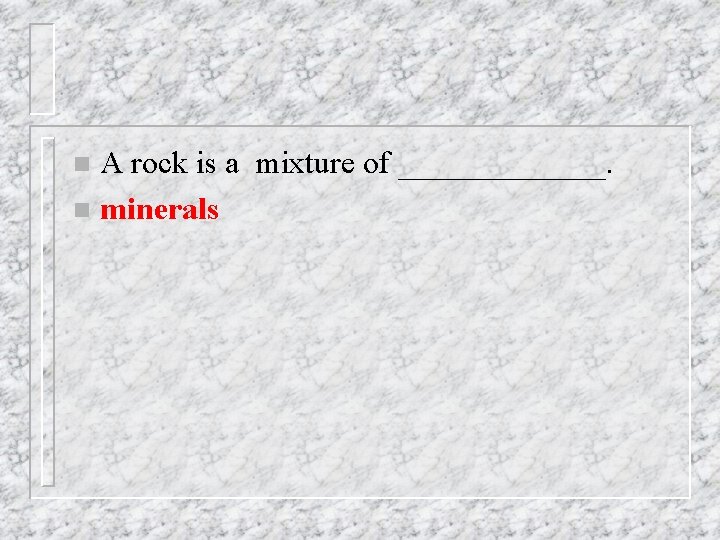
A rock is a mixture of _______. n minerals n
Mystery mineral game: Pick a mineral from pp. 800 -801 n other classmates must ask yes/no questions to determine the identity of the mystery mineral (like “ 20 Questions) n
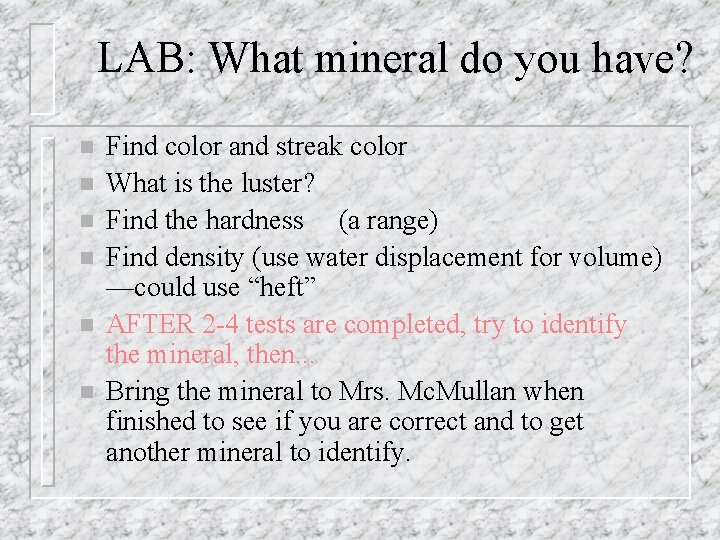
LAB: What mineral do you have? n n n Find color and streak color What is the luster? Find the hardness (a range) Find density (use water displacement for volume) —could use “heft” AFTER 2 -4 tests are completed, try to identify the mineral, then. . . Bring the mineral to Mrs. Mc. Mullan when finished to see if you are correct and to get another mineral to identify.
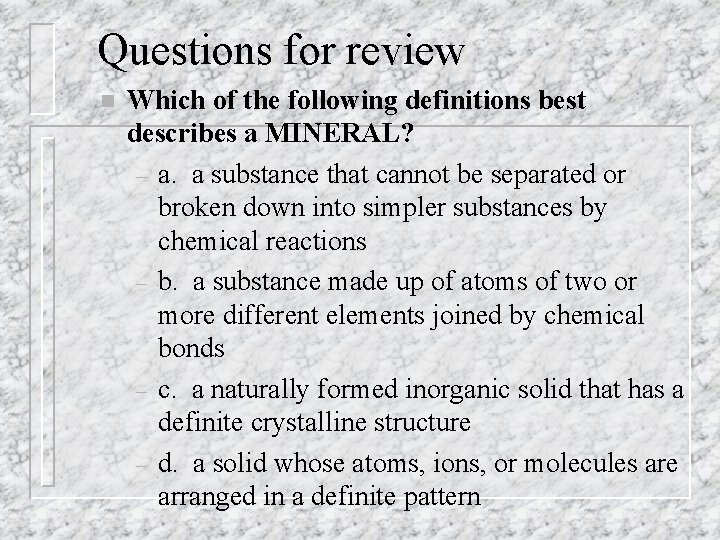
Questions for review n Which of the following definitions best describes a MINERAL? – a. a substance that cannot be separated or broken down into simpler substances by chemical reactions – b. a substance made up of atoms of two or more different elements joined by chemical bonds – c. a naturally formed inorganic solid that has a definite crystalline structure – d. a solid whose atoms, ions, or molecules are arranged in a definite pattern
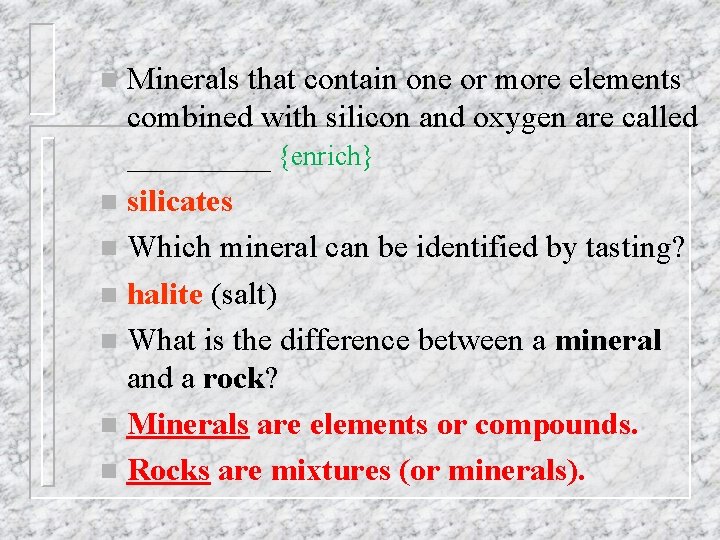
Minerals that contain one or more elements combined with silicon and oxygen are called _____ {enrich} n silicates n Which mineral can be identified by tasting? n halite (salt) n What is the difference between a mineral and a rock? n Minerals are elements or compounds. n Rocks are mixtures (or minerals). n