
SC State Standards Identify the characteristics of minerals
- Slides: 45
SC State Standards ü Identify the characteristics of minerals and explain how they are classified into groups. ü Describe a minerals crystal formation. ü Explain and experiment how to identify minerals based on their physical properties. Use of Mohs scale. ü Explain how minerals are formed and mined. ü Identify ways minerals are used in today’s world.
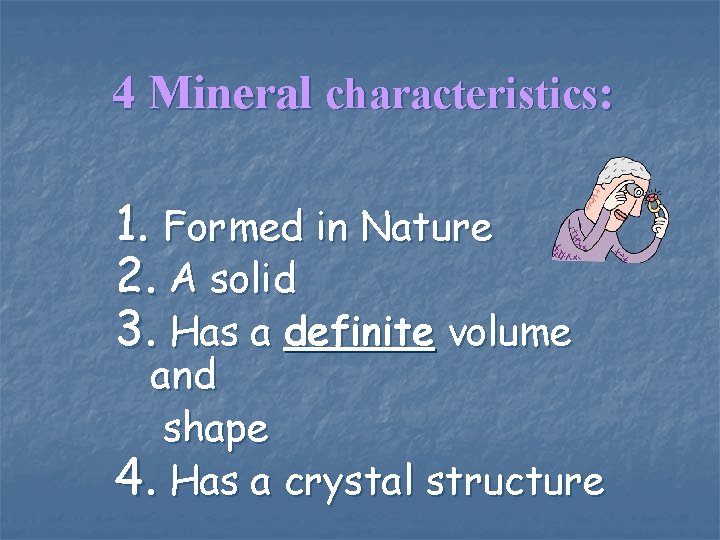
4 Mineral characteristics: 1. Formed in Nature 2. A solid 3. Has a definite volume and shape 4. Has a crystal structure
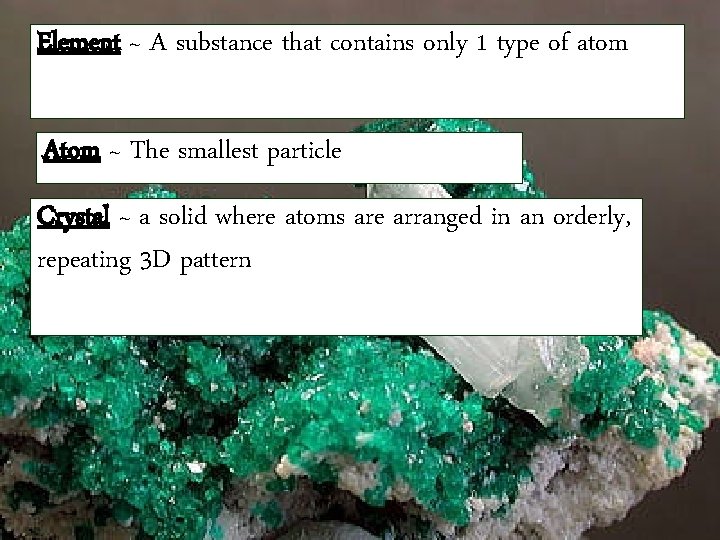
Element ~ A substance that contains only 1 type of atom Atom ~ The smallest particle Crystal ~ a solid where atoms are arranged in an orderly, repeating 3 D pattern
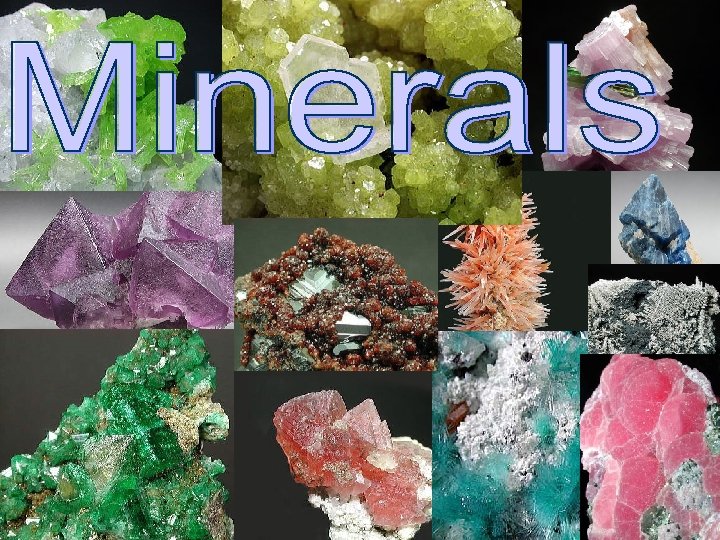
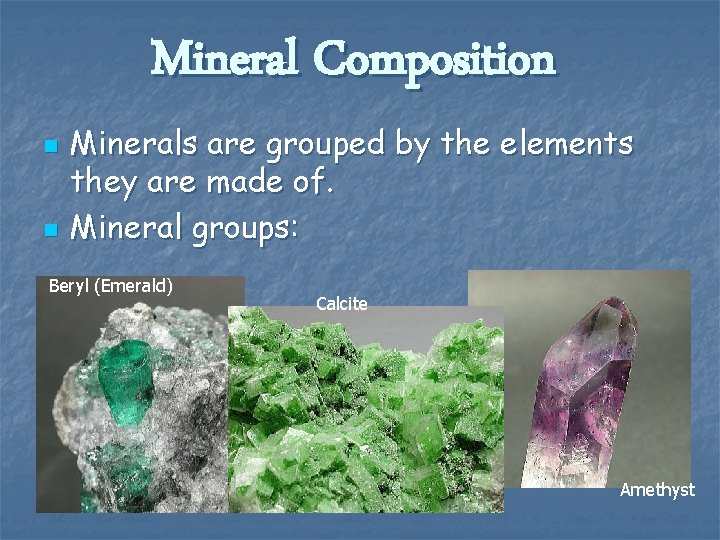
Mineral Composition n n Minerals are grouped by the elements they are made of. Mineral groups: Beryl (Emerald) Calcite Amethyst
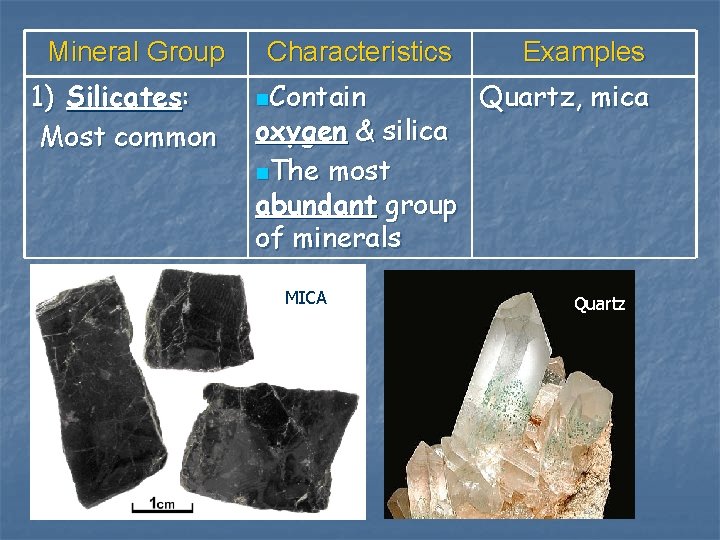
Mineral Group 1) Silicates: Most common Characteristics n. Contain oxygen & silica n. The most abundant group of minerals MICA Examples Quartz, mica Quartz
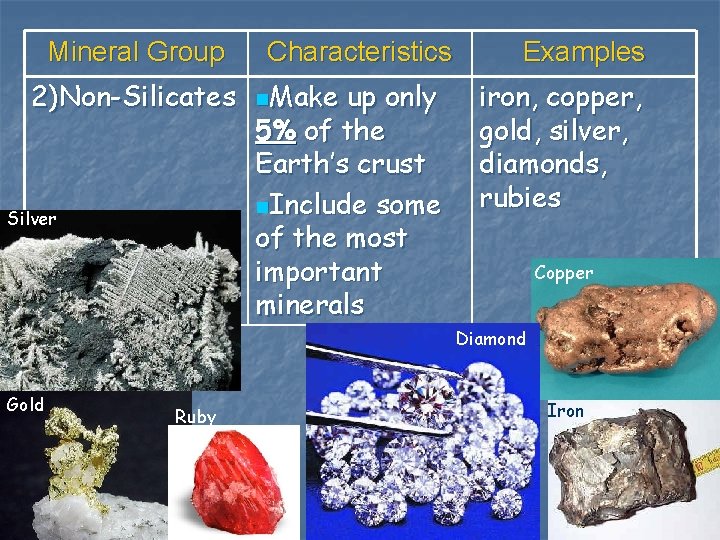
Mineral Group 2)Non-Silicates Silver Characteristics n. Make up only 5% of the Earth’s crust n. Include some of the most important minerals Examples iron, copper, gold, silver, diamonds, rubies Copper Diamond Gold Ruby Iron
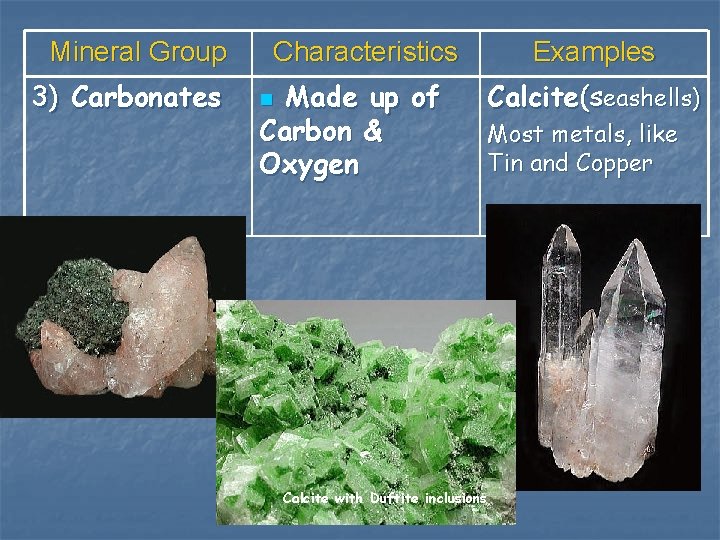
Mineral Group 3) Carbonates Characteristics Made up of Carbon & Oxygen n Calcite with Duftite inclusions Examples Calcite(seashells) Most metals, like Tin and Copper
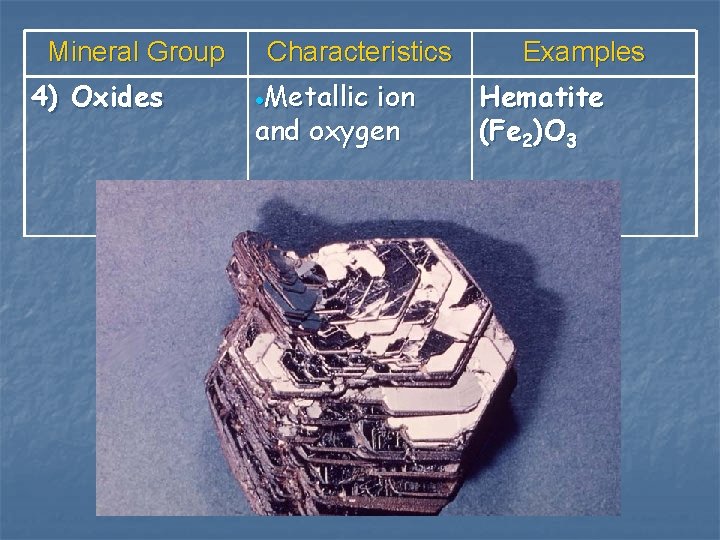
Mineral Group 4) Oxides Characteristics Metallic ion and oxygen Examples Hematite (Fe 2)O 3
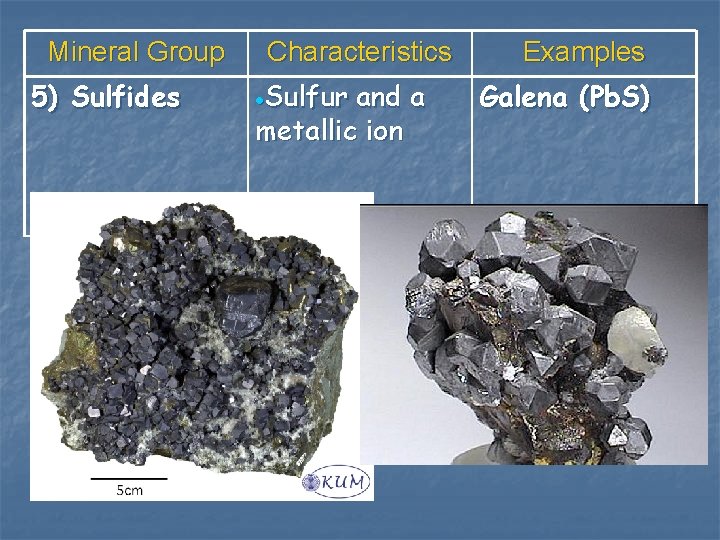
Mineral Group 5) Sulfides Characteristics Sulfur and a metallic ion Examples Galena (Pb. S)
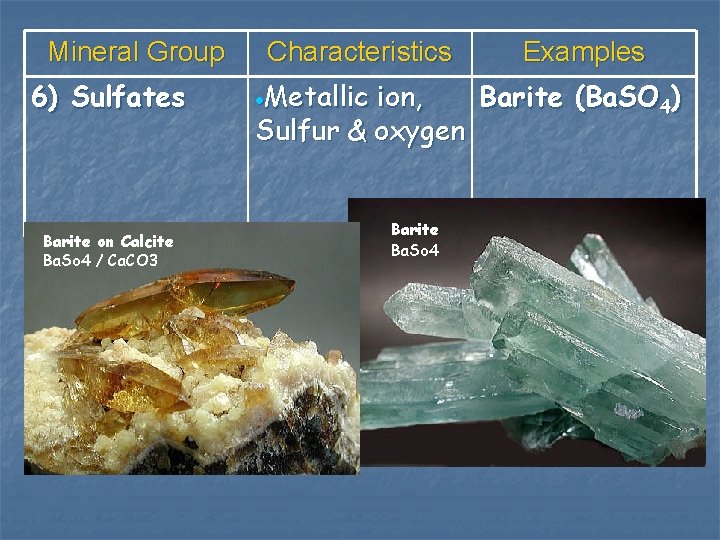
Mineral Group 6) Sulfates Barite on Calcite Ba. So 4 / Ca. CO 3 Characteristics Metallic Examples ion, Barite (Ba. SO 4) Sulfur & oxygen Barite Ba. So 4
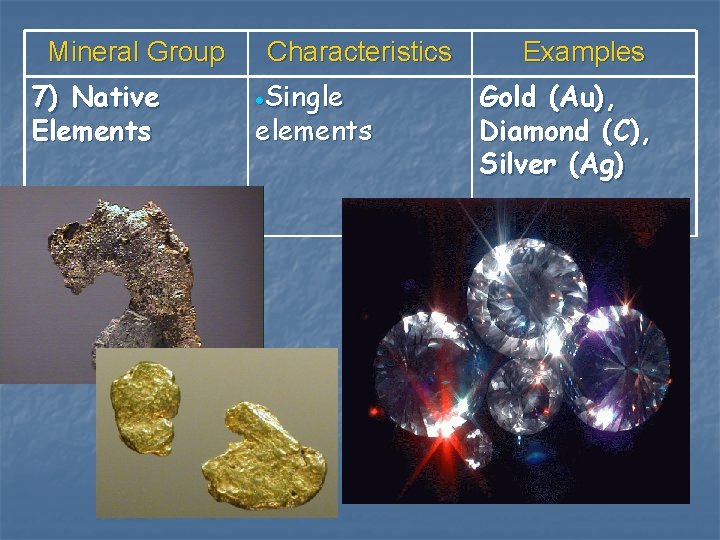
Mineral Group 7) Native Elements Characteristics Single elements Examples Gold (Au), Diamond (C), Silver (Ag)
Mineral Properties
Physical Properties of Minerals (can be used to identify the mineral) 1) Color § First & most easy observation § Some minerals are always the same color; some are not § Not good for mineral ID
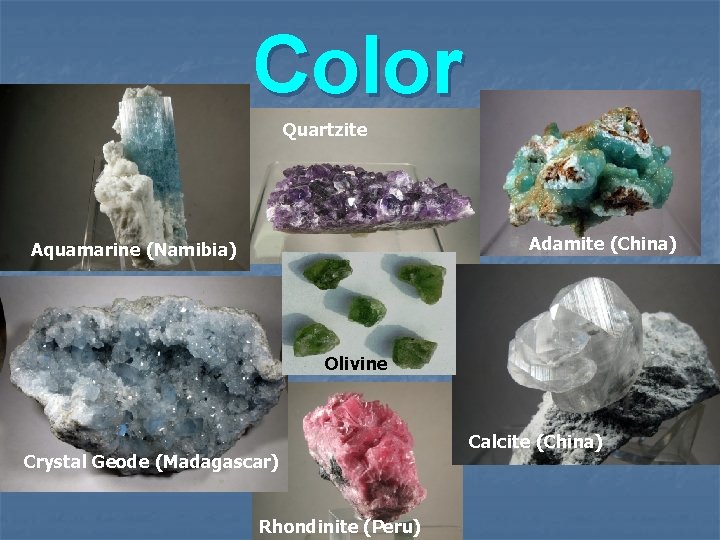
Color Quartzite Adamite (China) Aquamarine (Namibia) Olivine Crystal Geode (Madagascar) Rhondinite (Peru) Calcite (China)
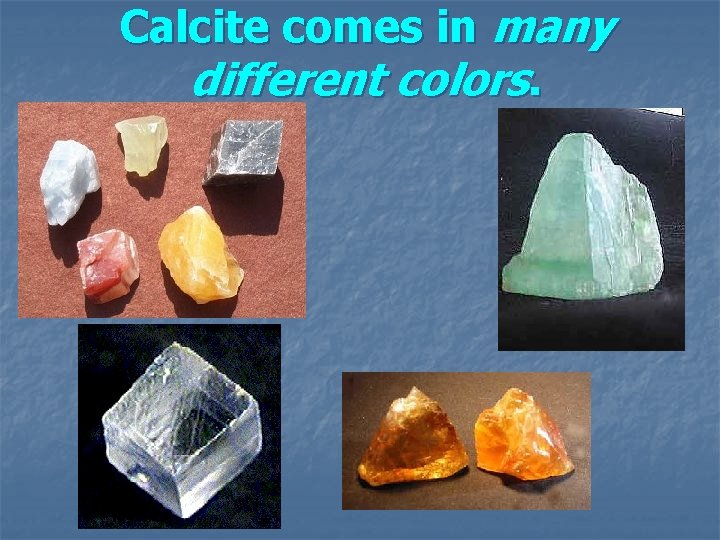
Calcite comes in many different colors.
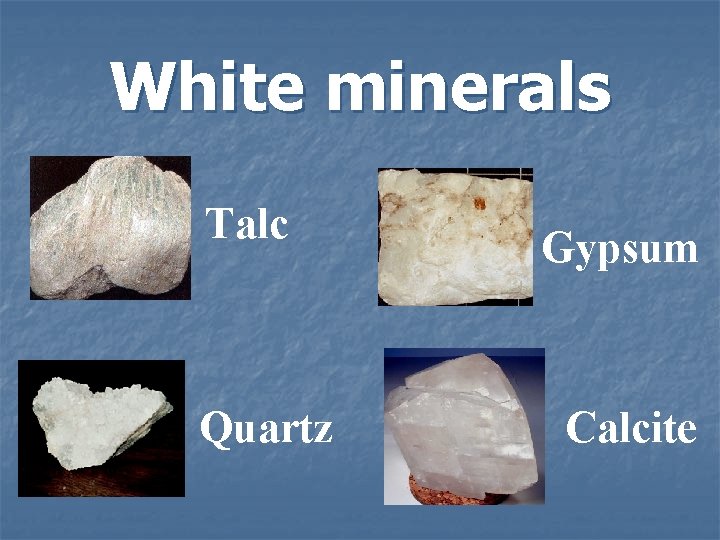
White minerals Talc Quartz Gypsum Calcite
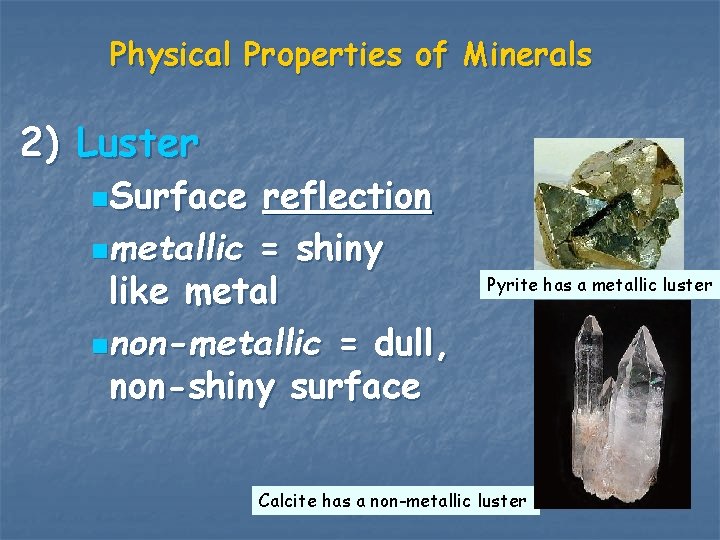
Physical Properties of Minerals 2) Luster n. Surface reflection nmetallic = shiny like metal nnon-metallic = dull, non-shiny surface Pyrite has a metallic luster Calcite has a non-metallic luster
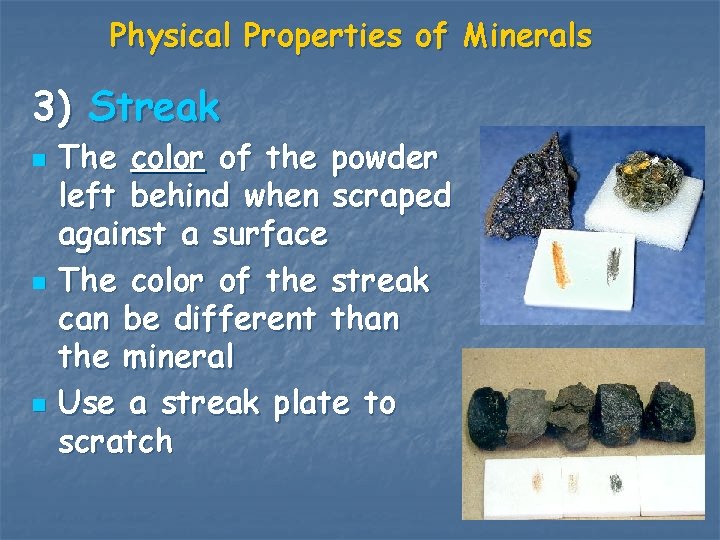
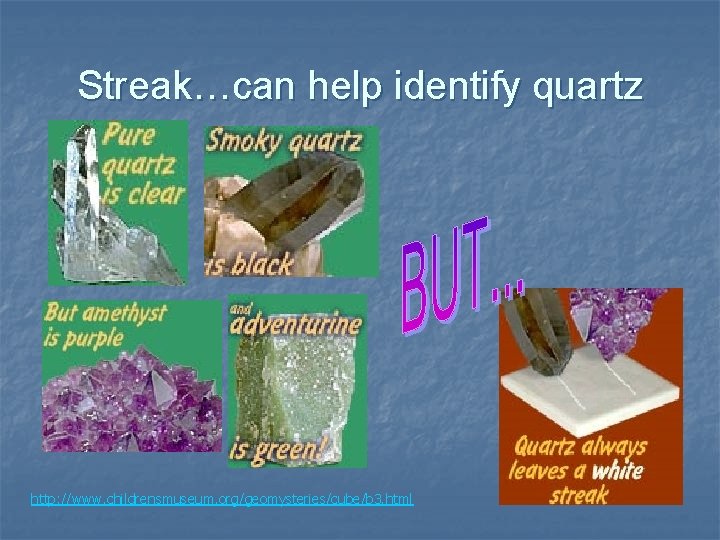
Physical Properties of Minerals 3) Streak n n n The color of the powder left behind when scraped against a surface The color of the streak can be different than the mineral Use a streak plate to scratch
Streak…can help identify quartz http: //www. childrensmuseum. org/geomysteries/cube/b 3. html
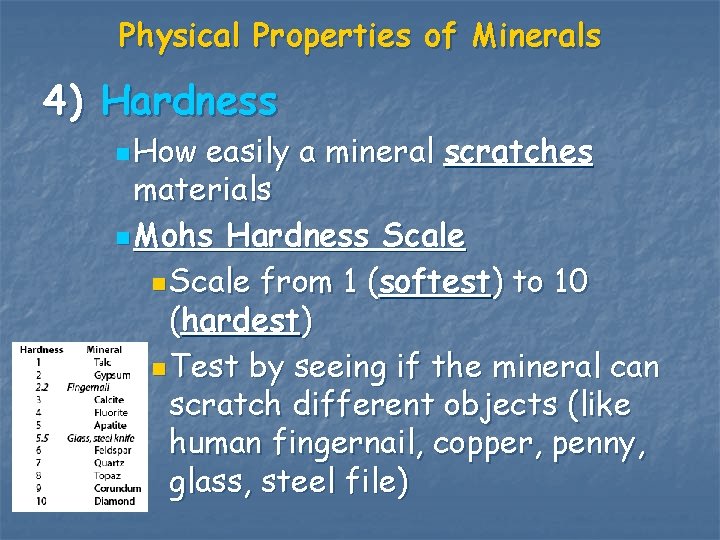
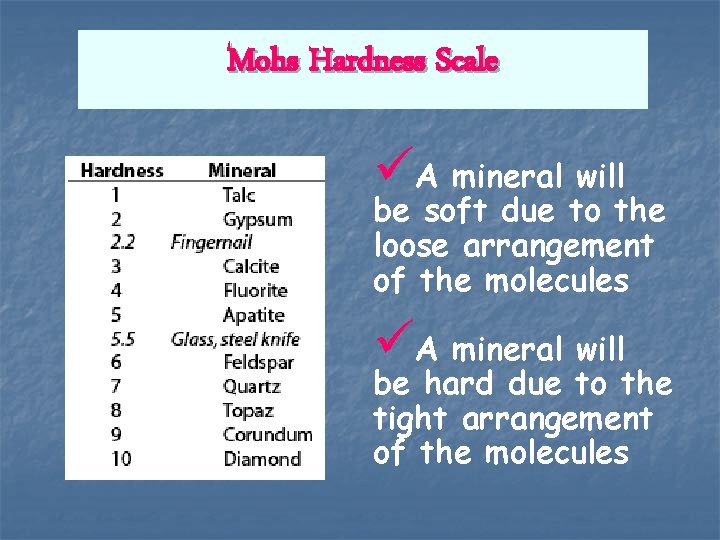
Physical Properties of Minerals 4) Hardness n How easily a mineral scratches materials n Mohs Hardness Scale n Scale from 1 (softest) to 10 (hardest) n Test by seeing if the mineral can scratch different objects (like human fingernail, copper, penny, glass, steel file)
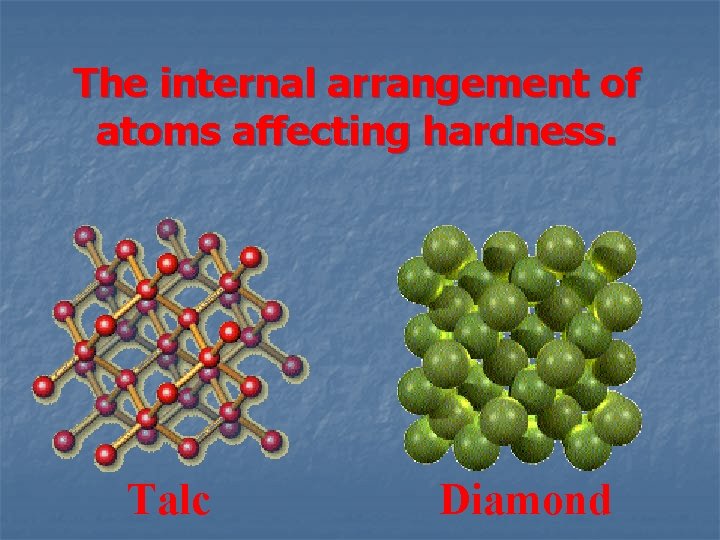
Mohs Hardness Scale üA mineral will be soft due to the loose arrangement of the molecules üA mineral will be hard due to the tight arrangement of the molecules
The internal arrangement of atoms affecting hardness. Talc Diamond
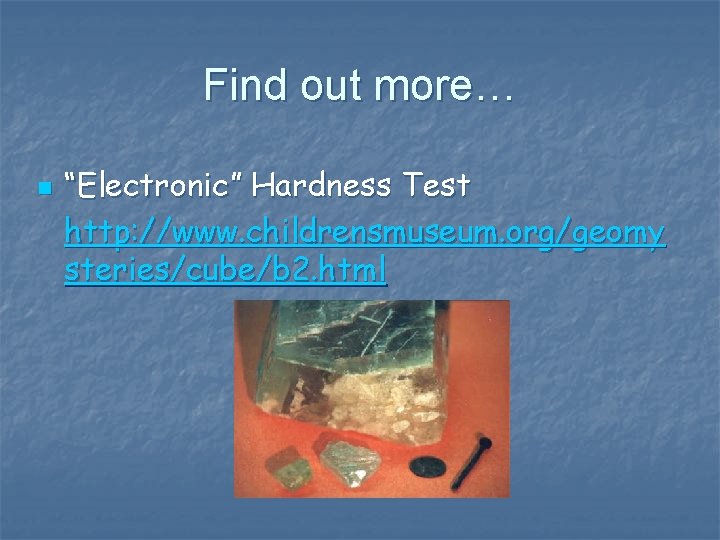
Find out more… n “Electronic” Hardness Test http: //www. childrensmuseum. org/geomy steries/cube/b 2. html
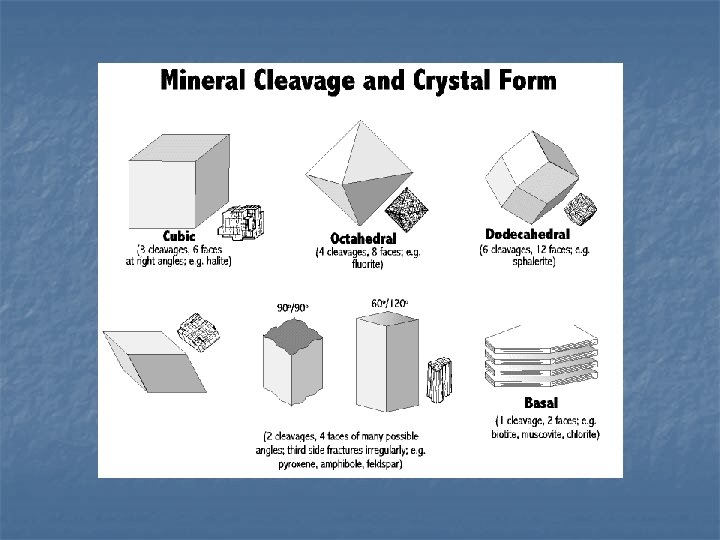
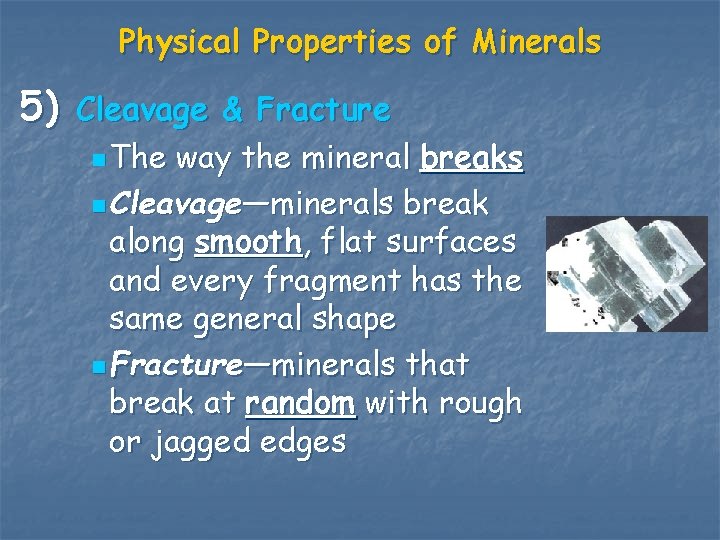
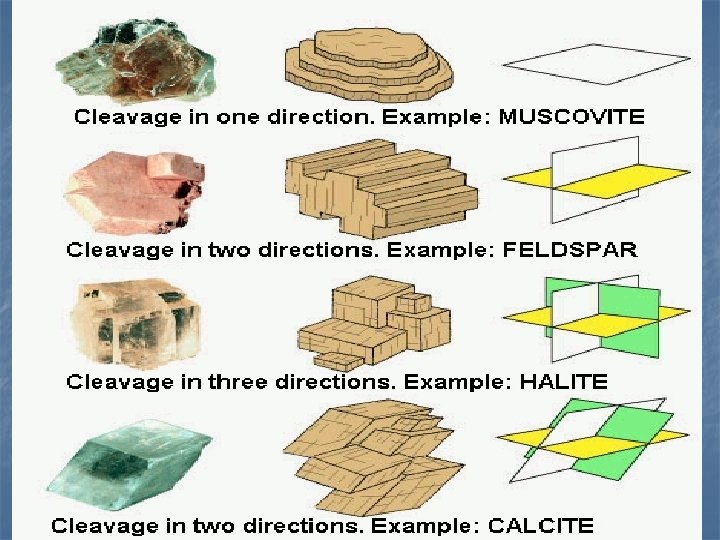
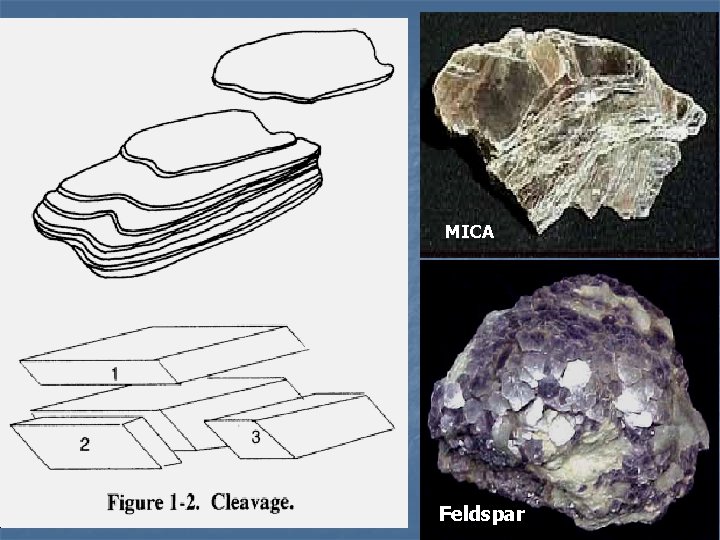
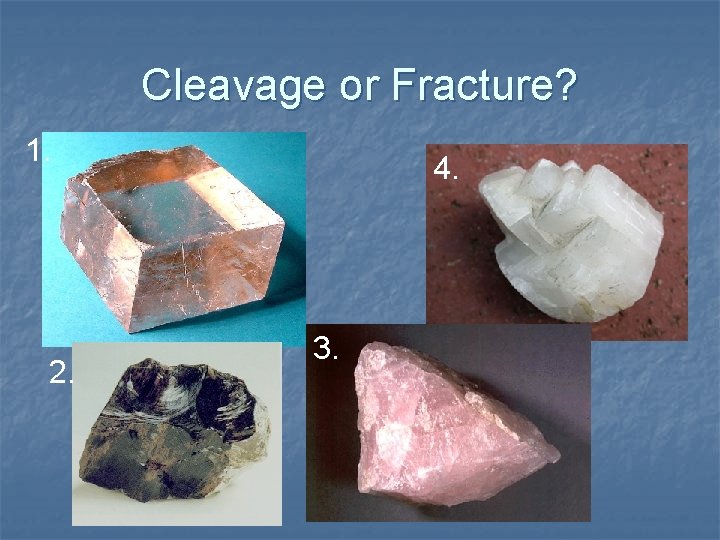
Physical Properties of Minerals 5) Cleavage & Fracture n The way the mineral breaks n Cleavage—minerals break along smooth, flat surfaces and every fragment has the same general shape n Fracture—minerals that break at random with rough or jagged edges
MICA Feldspar
Cleavage or Fracture? 1. 2. 4. 3.
6) Density ~ Amount of mass in a given volume of a substance - label units g/cm 3
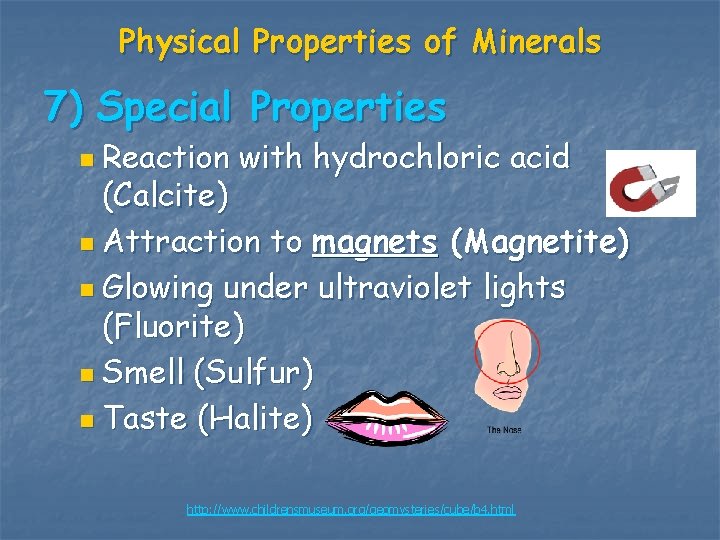
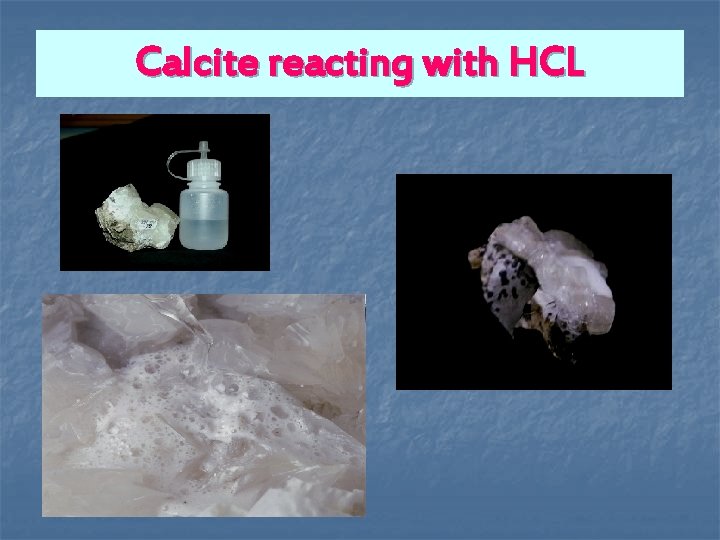
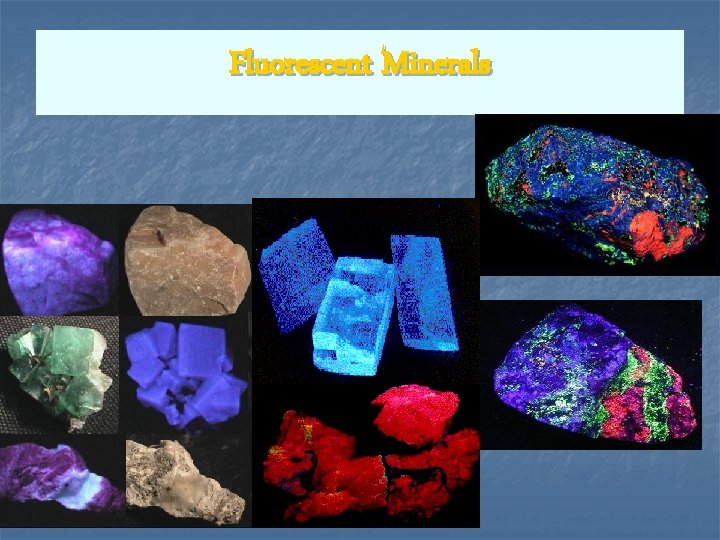
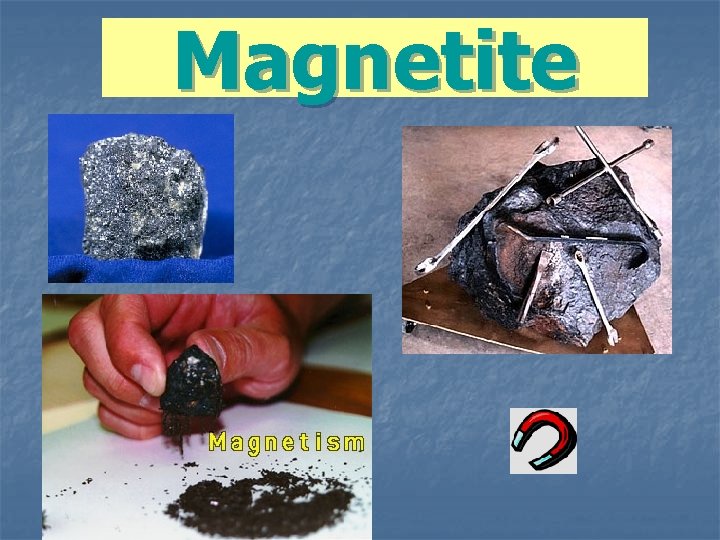
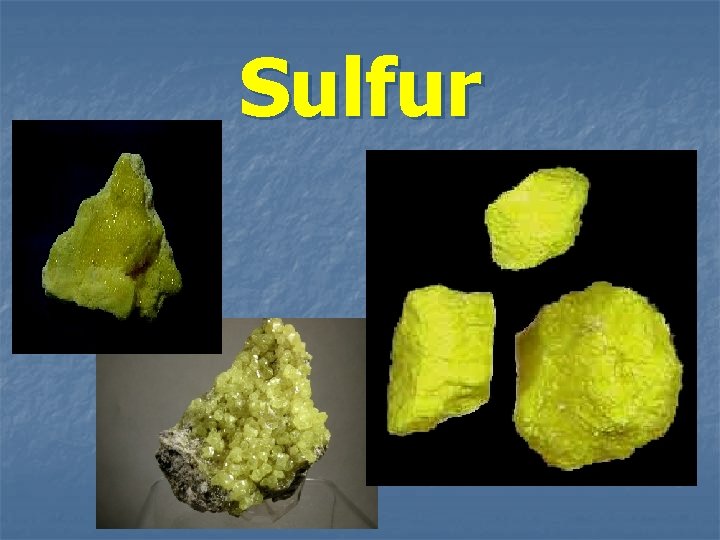
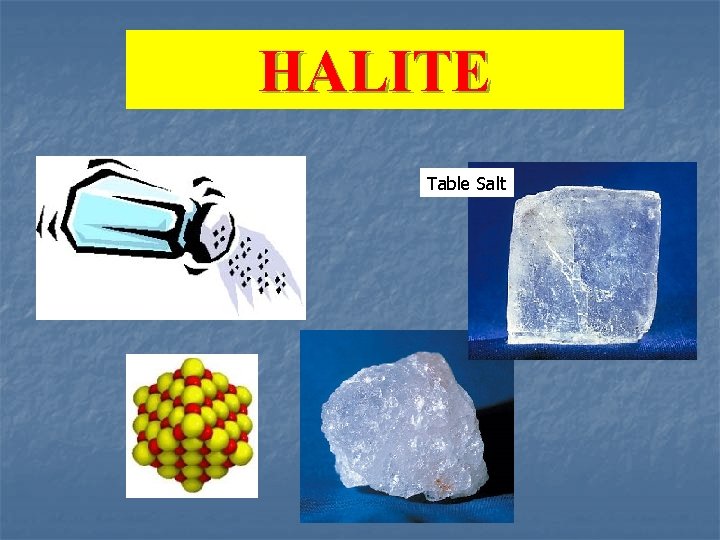
Physical Properties of Minerals 7) Special Properties n Reaction with hydrochloric acid (Calcite) n Attraction to magnets (Magnetite) n Glowing under ultraviolet lights (Fluorite) n Smell (Sulfur) n Taste (Halite) http: //www. childrensmuseum. org/geomysteries/cube/b 4. html
Calcite reacting with HCL
Fluorescent Minerals
Magnetite
Sulfur
HALITE Table Salt
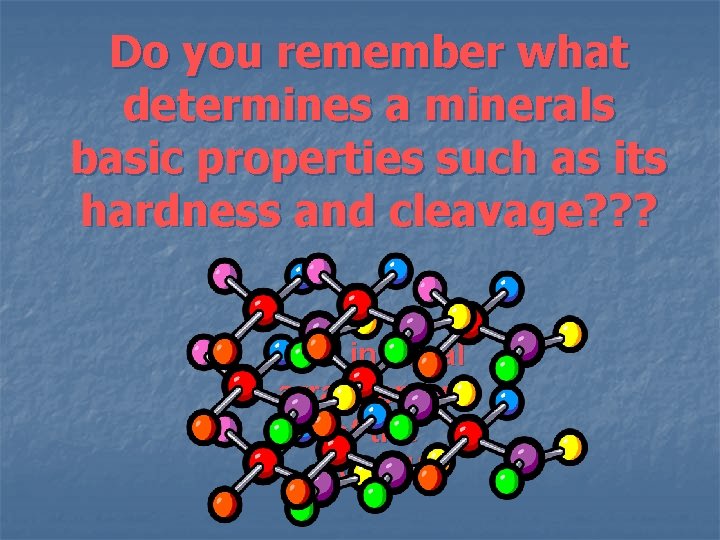
Do you remember what determines a minerals basic properties such as its hardness and cleavage? ? ? The internal arrangement of the atoms!!!
Mineral Formation & Mining
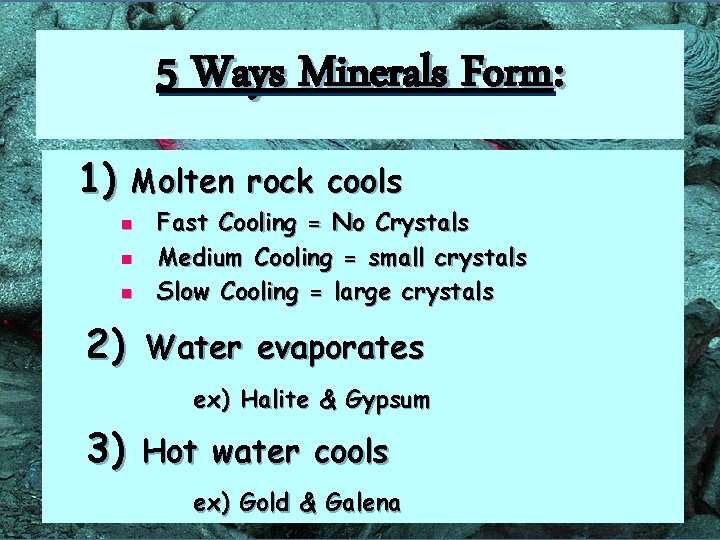
5 Ways Minerals Form: 1) Molten n 2) rock cools Fast Cooling = No Crystals Medium Cooling = small crystals Slow Cooling = large crystals Water evaporates ex) Halite & Gypsum 3) Hot water cools ex) Gold & Galena
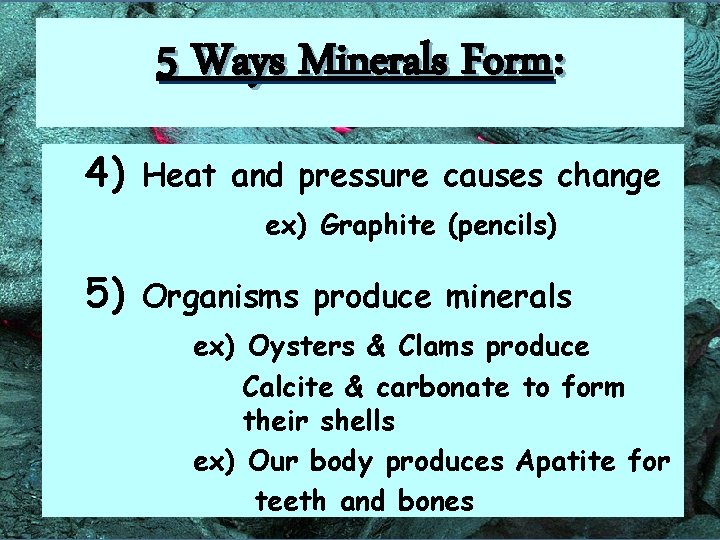
5 Ways Minerals Form: 4) Heat and pressure causes change ex) Graphite (pencils) 5) Organisms produce minerals ex) Oysters & Clams produce Calcite & carbonate to form their shells ex) Our body produces Apatite for teeth and bones
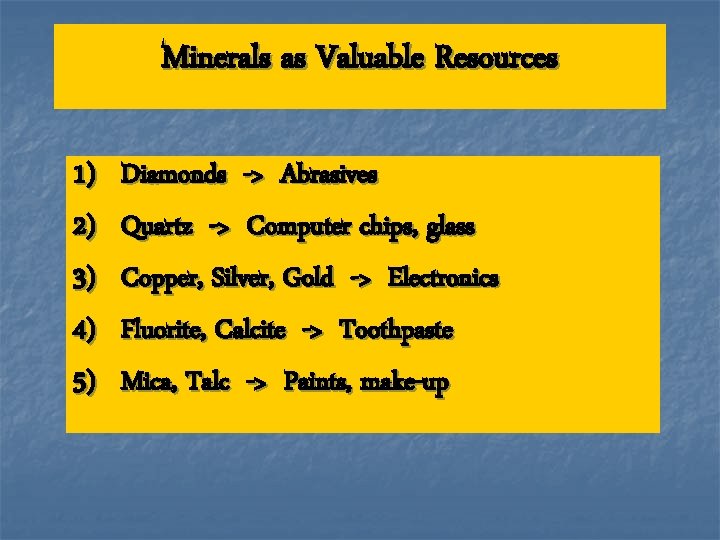
Minerals as Valuable Resources 1) 2) 3) 4) 5) Diamonds -> Abrasives Quartz -> Computer chips, glass Copper, Silver, Gold -> Electronics Fluorite, Calcite -> Toothpaste Mica, Talc -> Paints, make-up
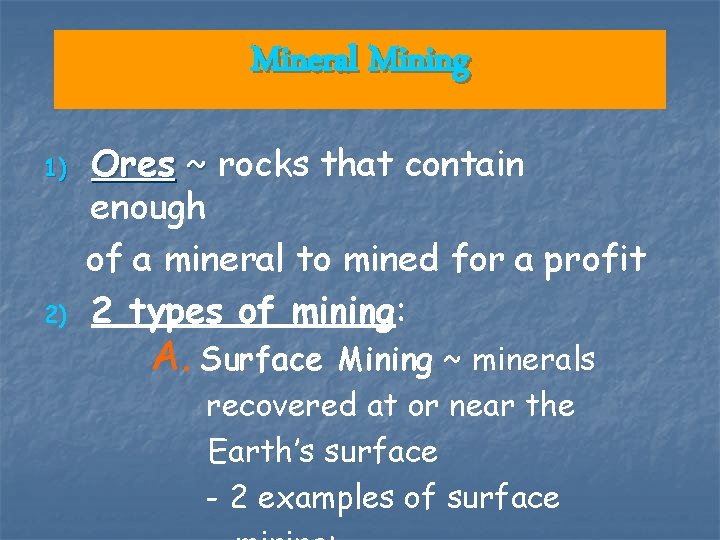
Mineral Mining 1) 2) Ores ~ rocks that contain enough of a mineral to mined for a profit 2 types of mining: A. Surface Mining ~ minerals recovered at or near the Earth’s surface - 2 examples of surface
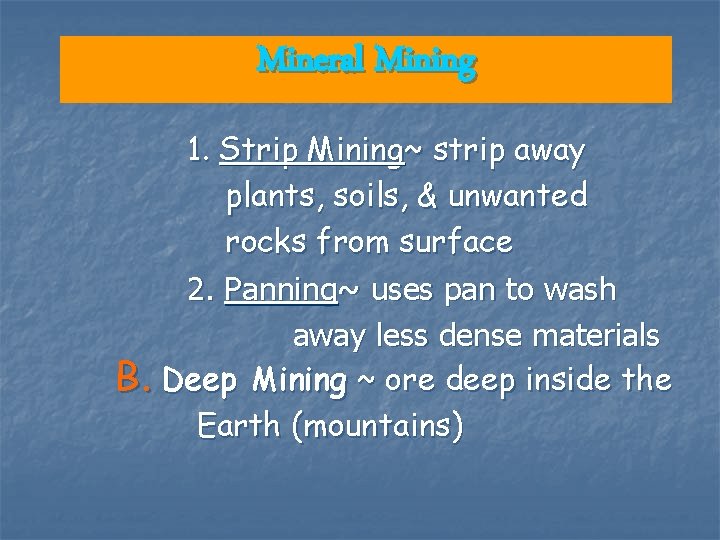
Mineral Mining 1. Strip Mining~ strip away plants, soils, & unwanted rocks from surface 2. Panning~ uses pan to wash away less dense materials B. Deep Mining ~ ore deep inside the Earth (mountains)
Watch Brainpop—“Mineral Identification” 1. If a mineral can scratch your fingernail, the mineral is ________ than your fingernail. 2. What is luster?
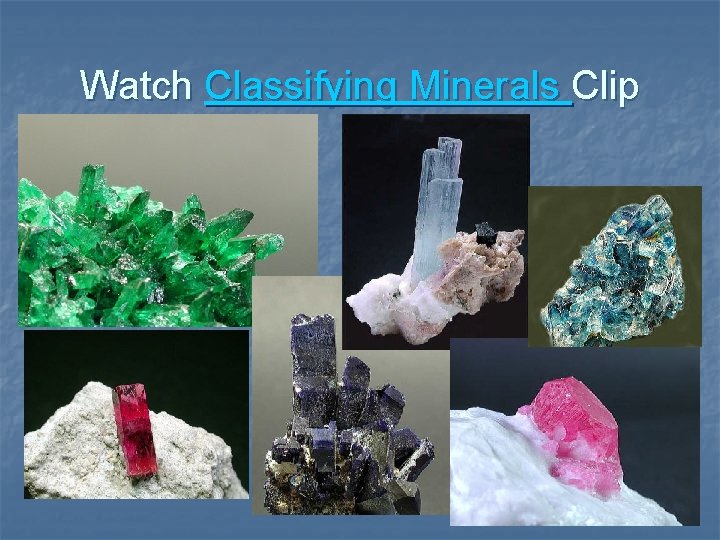
Watch Classifying Minerals Clip