1862 TRANSFORMING THE UNION KATHERINE M KIDD PHD




- Slides: 28
1862: TRANSFORMING THE UNION KATHERINE M. KIDD, PHD OLLI@BCC SUMMER SESSION 2020
OBJECTIVES FOR TODAY’S CLASS To consider history of agricultural research and societies To understand the importance of agriculture to the US economy at the time of the Civil War To review support for the creation of a Department of Agriculture To analyze the law itself and its initial implementation and challenges to that implementation To consider the expansion of the USDA’s mission To conclude with Lincoln’s words from his second inaugural address
INTEREST IN SCIENTIFIC AGRICULTURE 1840 s Scottish and Germans were promoting scientific agriculture. US students traveling to Europe to study their ideas and institutions 1860 – 900 agricultural societies existed in the US. Organized fairs, publications and other means to share new information about agriculture. 1850 s – Yale was promoting the idea of scientific agriculture. Only Michigan approved creation of an agricultural university before 1862. Northern state legislatures were reluctant to provide formal support for agricultural reform.
IMPORTANCE OF AGRICULTURE 1860 – 1869 75% of total US exports were agricultural products 1870 – 1879 – agricultural production nearly doubled to $435 million and still represented about 70% of exports Agricultural products remained 71% or more of exports until 1900 Increases in production came from increase in the number of acres under cultivation – extensive economic growth Few increases in productivity were due to greater use of mechanical devises until after 1900. Increased production due to chemistry and genetics was in the future.
IMPORTANCE OF AGRICULTURE Before Civil War, steel plows, threshers, reapers, corn planters, drills, cream separators, hay rakes, hay elevators had all been invented but had not been widely adopted Adoption of mechanical tools occurred during Civil War. Enabled northern farmers to increase production while work force declined on average about 25%. Significant regional differences in adoption of new agricultural methods Ratio of farmers to population 1862 – 1 farmer per 4. 53 people 1890 – 1 farmer per 5. 77 people 1960 - 1 farmer per 26 people 2020 – 1 farmer per 99 people
LINCOLN’S SUPPORT FOR DEPARTMENT OF AGRICULTURE "But farmers, being the most numerous class, it follows that their interest is the largest interest. It also follows that their interest is most worthy of all to be cherished and cultivated -- that if there be inevitable conflict between that interest and any other, that other should yield. ” December 1861 Address to Congress "Agriculture, confessedly the largest interest of the nation, has not a department nor a bureau, but a clerkship only, assigned to it in the Government. While it is fortunate that this great interest is so independent in its nature as to not have demanded and extorted more from the Government, I respectfully ask Congress to consider whether something more can not be given voluntarily with general advantage. . While I make no suggestions as to details, I venture the opinion that an agricultural and statistical bureau might profitably be organized. " Instead of a bureau, Congress established a Department to be headed by a Commissioner.
1856 ANTECEDENT LEGISLATION Patent Office strongly promoted creation of a Department of Agriculture Did not see promotion of scientific agriculture at the state level Argued that head of a Department of Agriculture had to be a scientist, not a politician Was debated in the House but did not get out of committee
US DEPARTMENT OF AGRICULTURE - 1862 Third element with Homestead Act and Land-grant College Act that created the structures to promote the economic and social welfare of family farms USDA had seven areas or responsibility • Collect and publish agricultural information and statistics • Establish an agricultural library • Collect and introduce valuable plants • Answer questions from farmers • Conduct chemical analysis of soils, plants and fertilizer • Hire botanists and entomologists
US DEPARTMENT OF AGRICULTURE - 1862 More support in the House than in the Senate favored making it a sub-unit of the Department of the Interior Called for collection and dissemination of information, not for scientific experimentation Senator Cowan of PA argued that support of agriculture is not in the constitution and questioned the constitutionality of the act but it passed over his objections – another example of the implied powers of Congress
INITIAL IMPLEMENTATION Issac Newton, a chemist, is appointed the first commissioner of agriculture in 1862 The National Agricultural Library is established in 1862 with books from the Patent Office Library 1863 Division of Statistics (now National Agricultural Statistics Service) created and data collected and shared results with farmers 1865 Issac Newton proposed first food safety measures requiring quarantine of imported animals USDA begins collecting meteorological reports to share with farmers
CHALLENGES FACING AGRICULTURE Problems facing Southern agriculture • 3. 5 million enslaved people no longer required to work on the land. Loss of enslaved workers represented the single largest source of wealth. Total population was about 9 million. • 60% of the world’s cotton was raised in the South in 1860 and required intense human labor. • Loss of other agricultural resources • • • 50% decline in land values 46% fewer farm implements 29% fewer horses 32% fewer cattle 32% fewer hogs
CHALLENGES FACING AGRICULTURE Changing work force in the north Immigrants unfamiliar with US farming systems Opening of new farmlands through homesteading New transportation systems, including railroad monopolies Continued need to adapt labor saving mechanical devices Extensive rather than intensive agricultural growth meant pressure on Native Americans and their lands and reenslavement of African Americans through share cropping and other exploitive systems
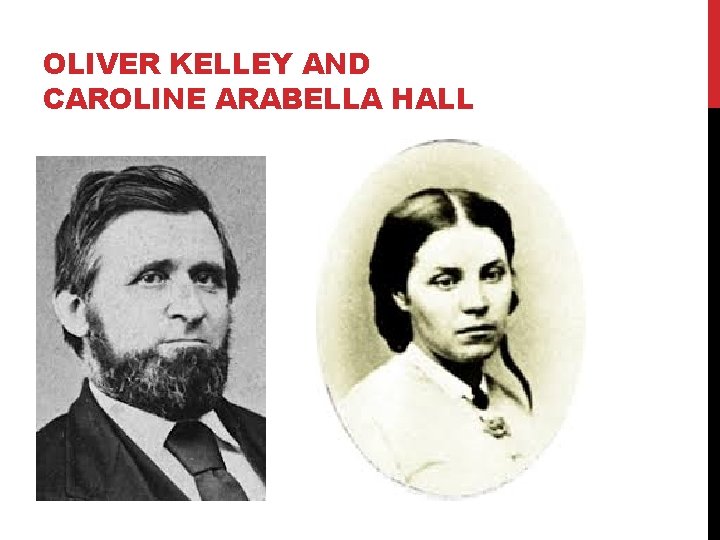
THE GRANGE MOVEMENT Farm movement in the Midwest – more than a million members Promoted self-help among farmers new to the region Fostered development of cooperatives – supplier, producer, marketing, mixed coops Included women – first agricultural society to do so Brought legal cases against the railroads, middlemen, and livestock processing firms Promoted greenbacks and opposed return to the gold standard
OLIVER KELLEY AND CAROLINE ARABELLA HALL
THE HATCH ACT 1887 Funded agricultural research stations associated with all land grant universities across the US Research was conducted on problems related to local, state, regional and national agriculture First research stations in Connecticut and California Integrated research fully into the educational mission of land grant colleges
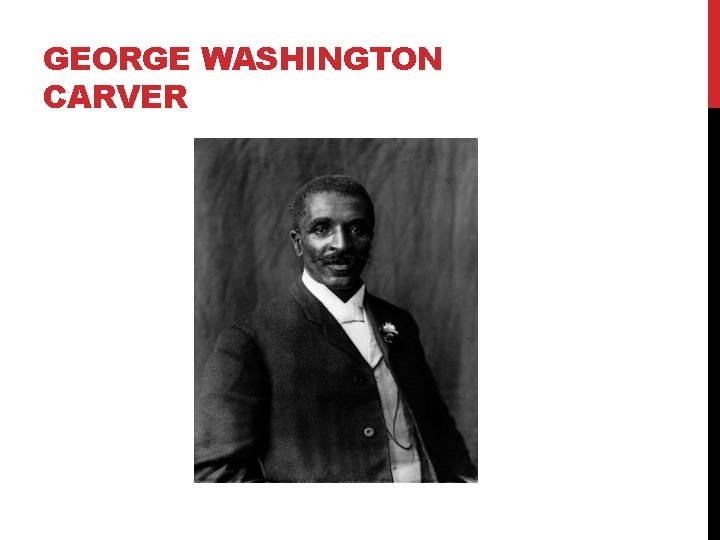
GEORGE WASHINGTON CARVER
GEORGE WASHINGTON CARVER Born a slave in Missouri Educated BS and MS at Iowa State 1894 and 1896 Taught and did research at Tuskegee Introduced peanuts, soybeans, and sweet potatoes to southern farmers. Led to renewal of southern agriculture especially after World War I Research linked agricultural products and industrial applications
HUMAN NUTRITION RESEARCH PROGRAMS 1894 – Dr. Wilbur Olin Atwater at University of Connecticut Agricultural Experiment Station advocated for more resources for human nutrition research 1894 – 1906 Atwater headed the nutrition program at the USDA • Types and amounts of foods consumed by different population groups • Chemical composition of foods • Effects of cooking and food processing of nutritional quality and • Types and nutrients needed for people to function at their best
1914 SMITH-LEVER ACT Extends agricultural extension services beyond campuses to support farmers in their work Smith-Lever education expanded to include home economics in 1920 4 -H began an official program of Smith-Lever in 1914 Supported agricultural coops Provided structure for farmers to organize and present needs at local, state and national level
EXPANSION OF USDA MISSION Foreign Agricultural Service 1882 – to promote US food exports Food Safety and Inspection Service – Wiley Pure Food and Drug Act 1906 Forest Service – founded in 1876 and shifted to USDA in 1905 by President Roosevelt with Gifford Pinchot as head forester Grain Inspection, Packers and Stockyard Administration – 1916 Economic Research Service – 1922
EXPANSION OF USDA MISSION New Deal Expansion at USDA • Farm Service Agency • Food and Nutrition Service • Natural Resources Conservation Service • Risk Management Agency – Crop insurance • Rural Development – formerly Resettlement Administration, Farmers, Home Administration, Farm Security Administration • Agricultural Marketing Service – houses farm support programs
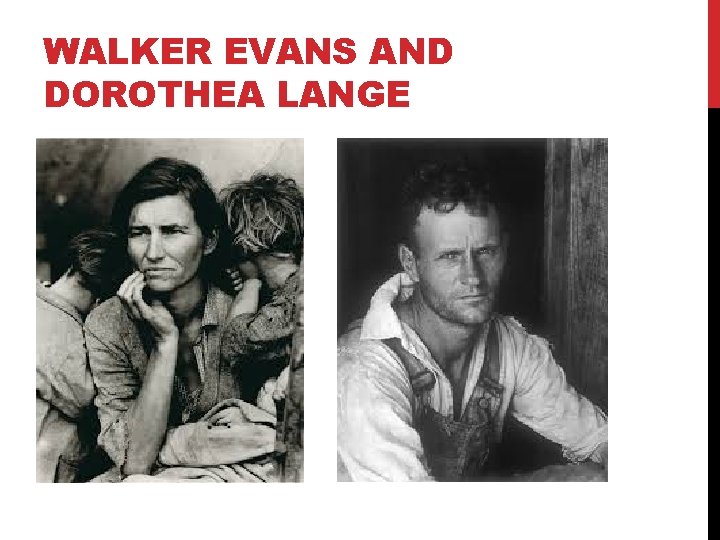
WALKER EVANS AND DOROTHEA LANGE
EXPANSION OF USDA MISSION Post World War II Expansion • Agricultural Research Service • Animal and Plant Health Inspection Service • Center for Nutrition Policy and Promotion
LESSONS FROM USDA HISTORY System that works at national, state and local level Importance of scientifically based work Value of cooperative work between USDA and land-grant universities Flexibility to take on new responsibilities Barriers to change at the local level Mission creep Potential for capture
GETTYSBURG ADDRESS – NOVEMBER 1863 It is rather for us to be here dedicated to the great task remaining before us – that from these honored dead we take increased devotion to that cause for which they gave the last full measure of devotion – that we here highly resolve that these dead shall not have died in vain – that this nation, under God, shall have a new birth of freedom – and that government of the people, by the people, for the people, shall not perish from the earth.
LINCOLN’S SECOND INAUGURAL ADDRESS One eighth of the whole population were colored slaves…These slaves constituted a peculiar and powerful interest. All knew that this interest was, somehow, the cause of the war. Yet if God wills that it continue, until all the wealth piled up by the bond-man’s 250 years of unrequited toil shall be sunk, and until every drop of blood drawn with the lash, shall be paid by another drawn with the sword…so still it must be said “the judgments of the Lord are true and righteous altogether. ”
LINCOLN’S SECOND INAUGURAL ADDRESS With malice toward none; with charity for all, with firmness in the right, as God gives us to see the right, let us strive on to finish the work we are in; to bind up the nation’s wounds; to care for him who shall have borne the battle, and for his widow and his orphan, to do all which may achieve and cherish a just, and a lasting peace, among ourselves, and with all nations.
DISCUSSION