Developing a Nurturing School Charlotte Kidd Gillian Dury




- Slides: 20
Developing a Nurturing School Charlotte Kidd Gillian Dury
Aims of Session For you to : l Consider local and national evidence for nurturing approaches l Be introduced to nurturing theories and principles and explore why these are important l Have the opportunity to reflect on what a nurturing school looks like and consider the implications for your practice
Why take a nurturing approach? l Evidence of effectiveness of nurture groups: – Nationally… – In East Dunbartonshire – In West Dunbartonshire – In Glasgow schools
Evidence for whole school nurturing approaches l Impact on Teachers l Impact on Head Teachers l Impact on Pupils
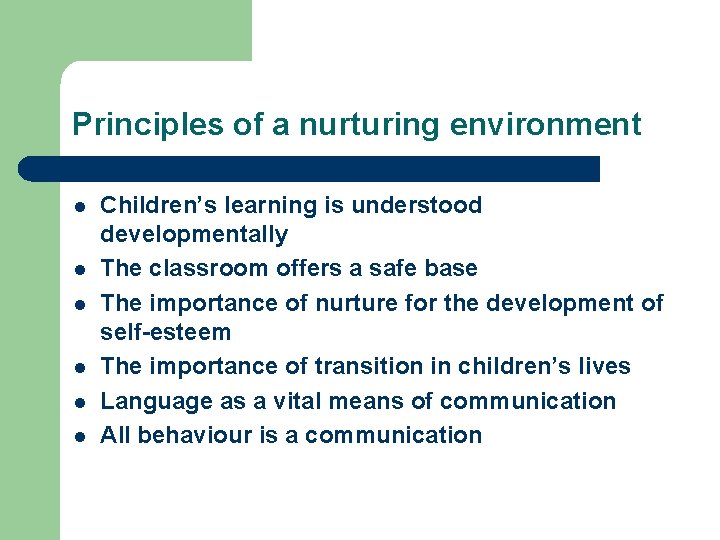
Principles of a nurturing environment l l l Children’s learning is understood developmentally The classroom offers a safe base The importance of nurture for the development of self-esteem The importance of transition in children’s lives Language as a vital means of communication All behaviour is a communication
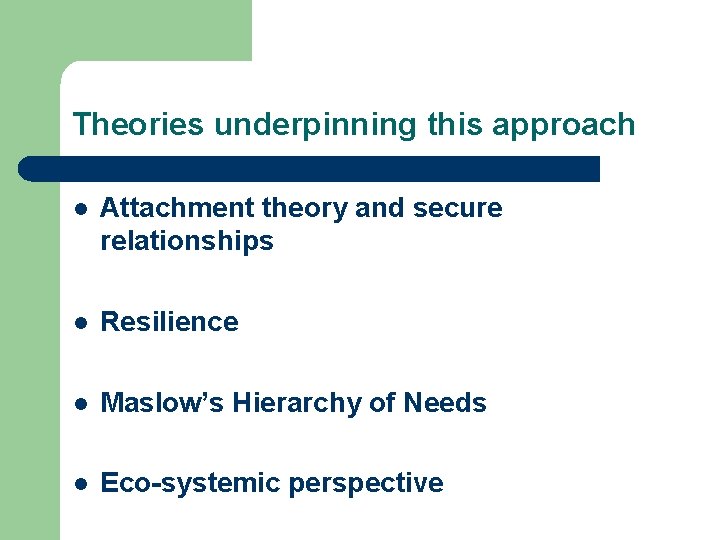
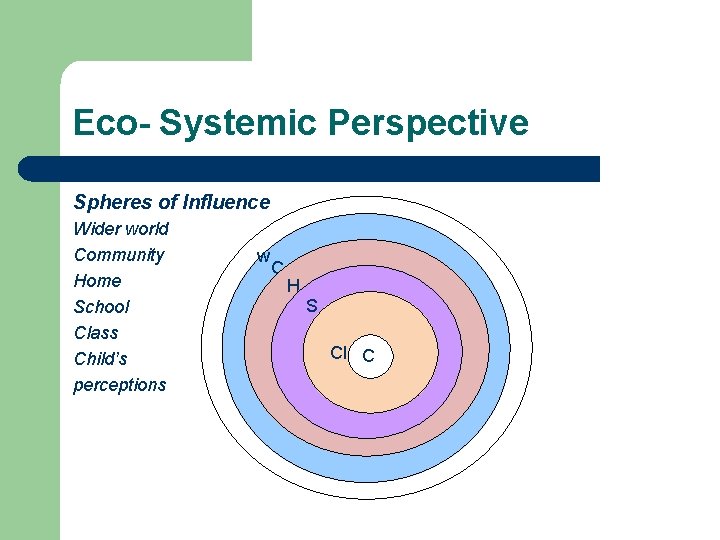
Theories underpinning this approach l Attachment theory and secure relationships l Resilience l Maslow’s Hierarchy of Needs l Eco-systemic perspective
Attachment Theory and Secure relationships l l The quality of early attachment is thought to impact on an individual’s self-concept and relationships with others. Through interactions with significant others, a young child begins to learn how to attain age appropriate behaviours, developing an increasing self-awareness of their environment
Erickson’s Psychological Stages l l Development is a life long process Emphasises the role of socialisation 8 psychosocial stages – described by opposing characteristics Erickson states that it is possible to make up for unsatisfactory early experiences at a later stage
The notion of resilience l l The capacity to do well despite adverse experience. To “bounce back” having endured adversity “A sensitively laid out and consistently managed … classroom and a warm relationship with a responsive teacher may do more for a child’s craving for a secure base than elaborate efforts around engaging in weekly one hour sessions of therapy”
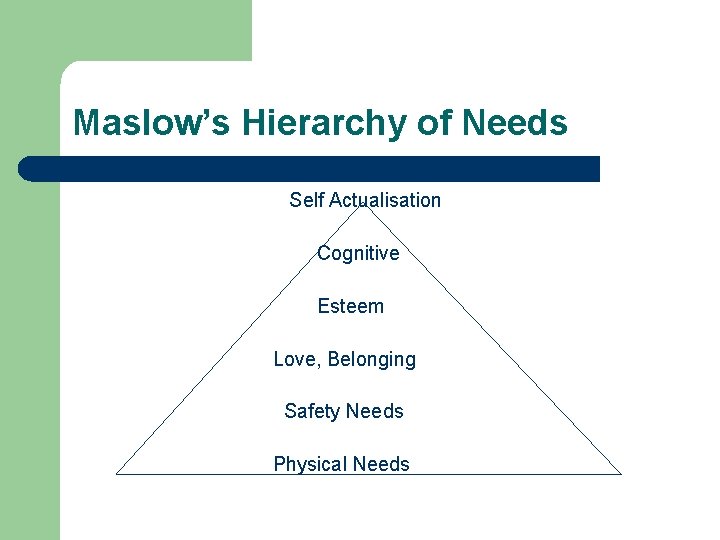
Maslow’s Hierarchy of Needs Self Actualisation Cognitive Esteem Love, Belonging Safety Needs Physical Needs
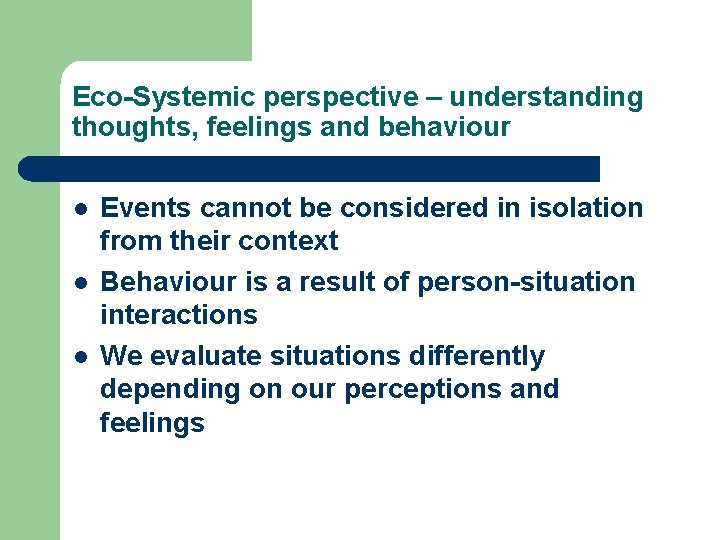
Eco-Systemic perspective – understanding thoughts, feelings and behaviour l l l Events cannot be considered in isolation from their context Behaviour is a result of person-situation interactions We evaluate situations differently depending on our perceptions and feelings
Eco- Systemic Perspective Spheres of Influence Wider world Community Home School Class Child’s perceptions w Co H S Cl C
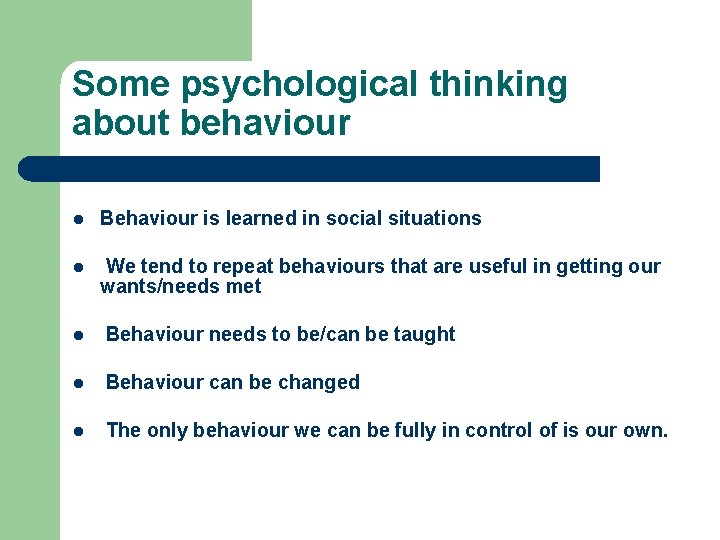
Some psychological thinking about behaviour l Behaviour is learned in social situations l We tend to repeat behaviours that are useful in getting our wants/needs met l Behaviour needs to be/can be taught l Behaviour can be changed l The only behaviour we can be fully in control of is our own.
Cycle of Emotions
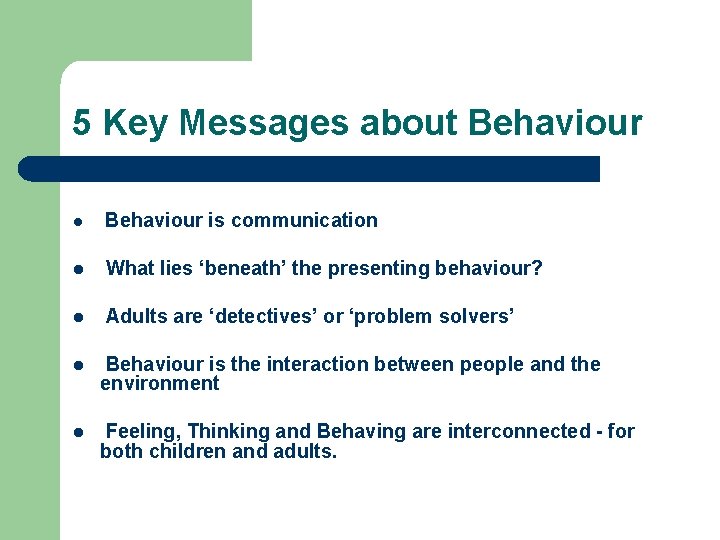
5 Key Messages about Behaviour l Behaviour is communication l What lies ‘beneath’ the presenting behaviour? l Adults are ‘detectives’ or ‘problem solvers’ l Behaviour is the interaction between people and the environment l Feeling, Thinking and Behaving are interconnected - for both children and adults.
Growing nurturing classrooms - part of the process of growing a nurturing school l l Takes an holistic approach to education Sees emotional well-being as central to the developmental and mental health needs of its pupils Sees emotional well-being as central to the effectiveness of teaching and learning Uses a common framework for thinking about the emotional development of its pupils Takes account of Maslow's theory 'Hierarchy of Needs'
Secondary Nurture Takes account of teenage life experiences Self-image and peer relationships Reported successes – bereavement, loss and trauma Low key introduction and build up of credibility Colley (2009)
Secondary Nurture Takes account of teenage life experiences Self-image and peer relationships Reported successes – bereavement, loss and trauma Low key introduction and build up of credibility Colley (2010)
So what does a nurturing school look like?
What does a nurturing school look like? l Relationships l Partnership working l Teaching & learning l Fostering resilience l Behaviour l Leadership l Physical environment l Staff Style/ approach l School organisation l Morale Discussion Activity: In small groups, pick one of these themes and discuss ways of making your own classroom more nurturing.