13 7 Polysaccharides The polysaccharide cellulose is composed

- Slides: 11
13. 7 Polysaccharides The polysaccharide cellulose is composed of glucose units connected by β-1, 4 -glycosidic bonds. Learning Goal Describe the structural features of amylose, amylopectin, glycogen, and cellulose. Chemistry: An Introduction to General, Organic, and Biological Chemistry, Twelfth Edition © 2015 Pearson Education, Inc.
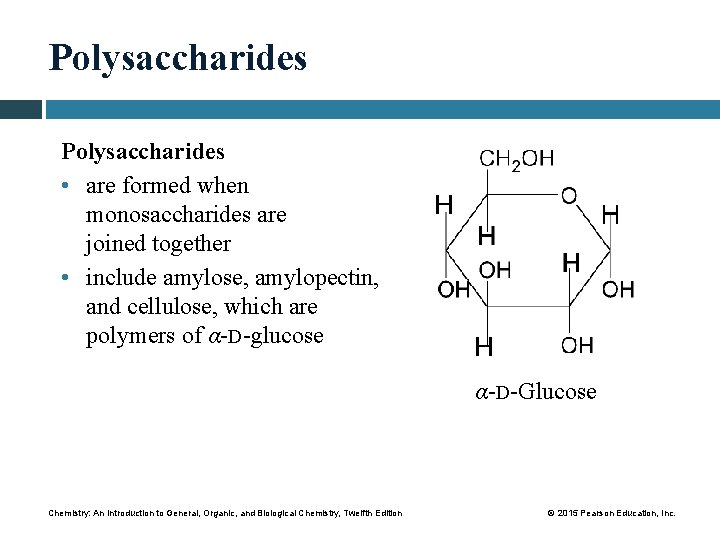
Polysaccharides • are formed when monosaccharides are joined together • include amylose, amylopectin, and cellulose, which are polymers of α-D-glucose α-D-Glucose Chemistry: An Introduction to General, Organic, and Biological Chemistry, Twelfth Edition © 2015 Pearson Education, Inc.
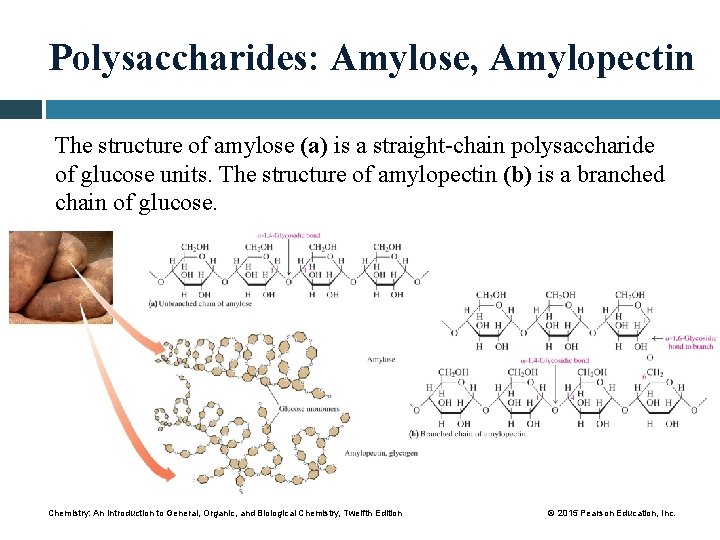
Polysaccharides: Amylose, Amylopectin The structure of amylose (a) is a straight-chain polysaccharide of glucose units. The structure of amylopectin (b) is a branched chain of glucose. Chemistry: An Introduction to General, Organic, and Biological Chemistry, Twelfth Edition © 2015 Pearson Education, Inc.
Amylose • makes up about 20% of starch • consists of 250 to 4000 α-D-glucose molecules connected by α-1, 4 -glycosidic bonds in a continuous chain • is called a straight-chain polymer even though the polymers of amylose are actually coiled in helical fashion Chemistry: An Introduction to General, Organic, and Biological Chemistry, Twelfth Edition © 2015 Pearson Education, Inc.
Amylopectin • makes up as much as 80% of starch • is a branched-chain polysaccharide • contains glucose molecules connected by α-1, 4 - and α-1, 6 - glycosidic bonds Starches hydrolyze easily in water and acid to give smaller saccharides, called dextrins, which then hydrolyze to maltose and finally glucose. Chemistry: An Introduction to General, Organic, and Biological Chemistry, Twelfth Edition © 2015 Pearson Education, Inc.
Glycogen is • a polymer of glucose that is stored in the liver and muscle of animals • hydrolyzed in our cells at a rate that maintains the blood level of glucose and provides energy between meals • similar to amylopectin, but it is more highly branched The glucose units in glycogen are joined by α-1, 4 -glycosidic bonds, with branches attached by α-1, 6 -glycosidic bonds that occur every 10– 15 glucose units. Chemistry: An Introduction to General, Organic, and Biological Chemistry, Twelfth Edition © 2015 Pearson Education, Inc.
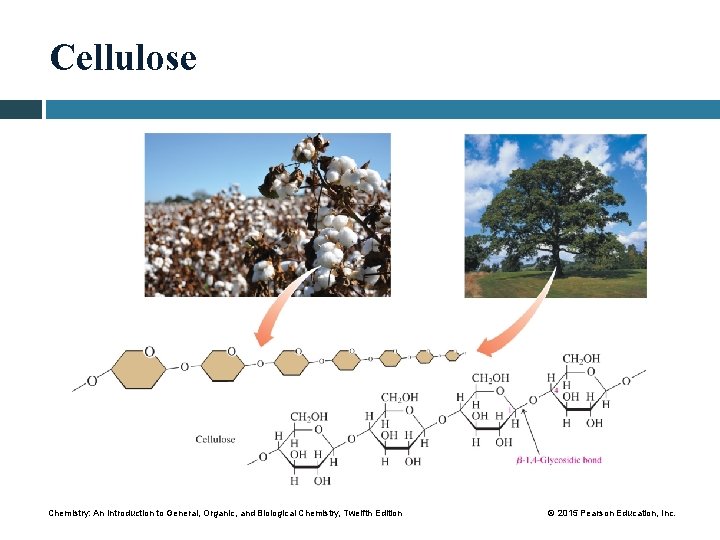
Cellulose, the major structural unit of wood, • is a polysaccharide of glucose units in unbranched chains with β -1, 4 -glycosidic bonds • cannot form hydrogen bonds with water; thus, it is insoluble in water • gives a rigid structure to the cell walls in wood and fiber • is more resistant to hydrolysis than are the starches • cannot be digested by humans because humans cannot break down β-1, 4 -glycosidic bonds Chemistry: An Introduction to General, Organic, and Biological Chemistry, Twelfth Edition © 2015 Pearson Education, Inc.
Cellulose Chemistry: An Introduction to General, Organic, and Biological Chemistry, Twelfth Edition © 2015 Pearson Education, Inc.
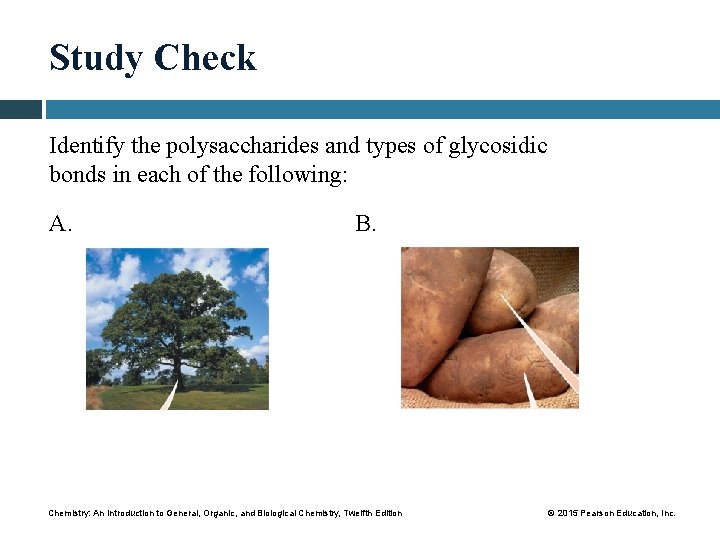
Study Check Identify the polysaccharides and types of glycosidic bonds in each of the following: A. B. Chemistry: An Introduction to General, Organic, and Biological Chemistry, Twelfth Edition © 2015 Pearson Education, Inc.
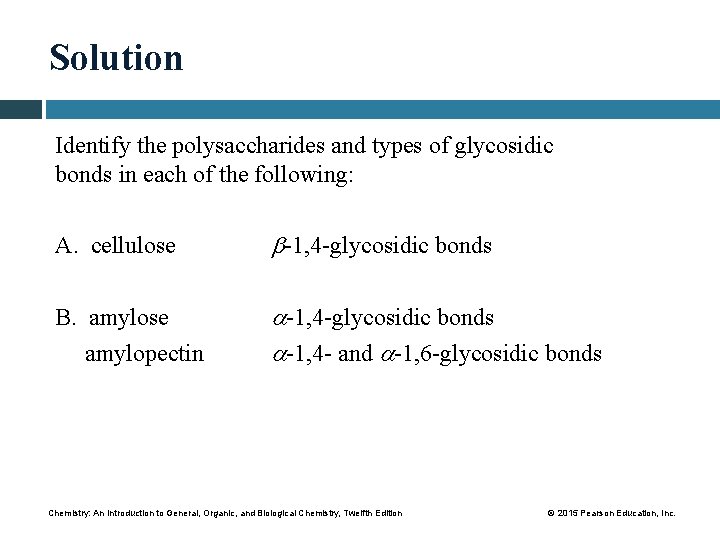
Solution Identify the polysaccharides and types of glycosidic bonds in each of the following: A. cellulose -1, 4 -glycosidic bonds B. amylose amylopectin -1, 4 -glycosidic bonds -1, 4 - and -1, 6 -glycosidic bonds Chemistry: An Introduction to General, Organic, and Biological Chemistry, Twelfth Edition © 2015 Pearson Education, Inc.
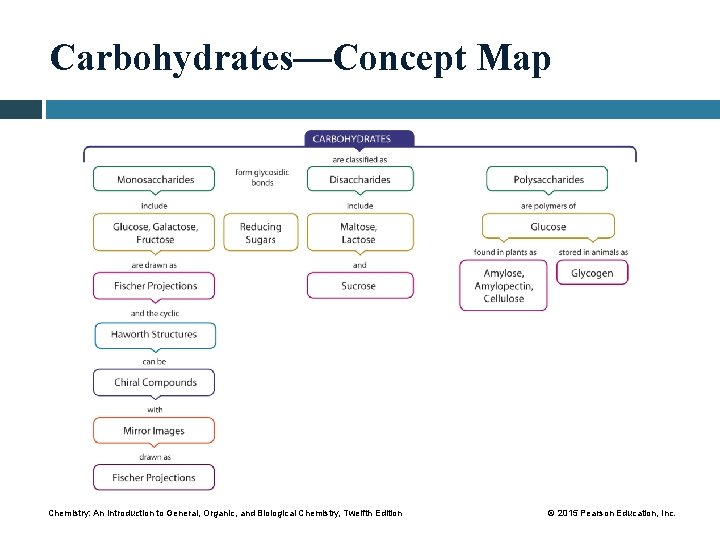
Carbohydrates—Concept Map Chemistry: An Introduction to General, Organic, and Biological Chemistry, Twelfth Edition © 2015 Pearson Education, Inc.