10162009 Telecom Regulatory Aspects of eHealth Dr Imad

- Slides: 19
10/16/2009 Telecom Regulatory Aspects of e-Health Dr. Imad Y. Hoballah Commissioner, Board Member Head of Telecommunications Technologies Unit Telecommunications Regulatory Authority (TRA), Lebanon 1/20 TRA Proprietary
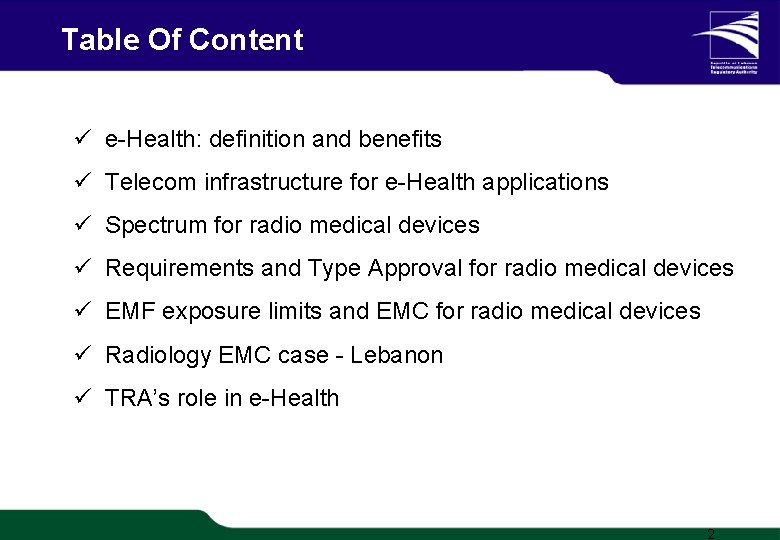
Table Of Content ü e-Health: definition and benefits ü Telecom infrastructure for e-Health applications ü Spectrum for radio medical devices ü Requirements and Type Approval for radio medical devices ü EMF exposure limits and EMC for radio medical devices ü Radiology EMC case - Lebanon ü TRA’s role in e-Health 1/20 TRA Proprietary 2
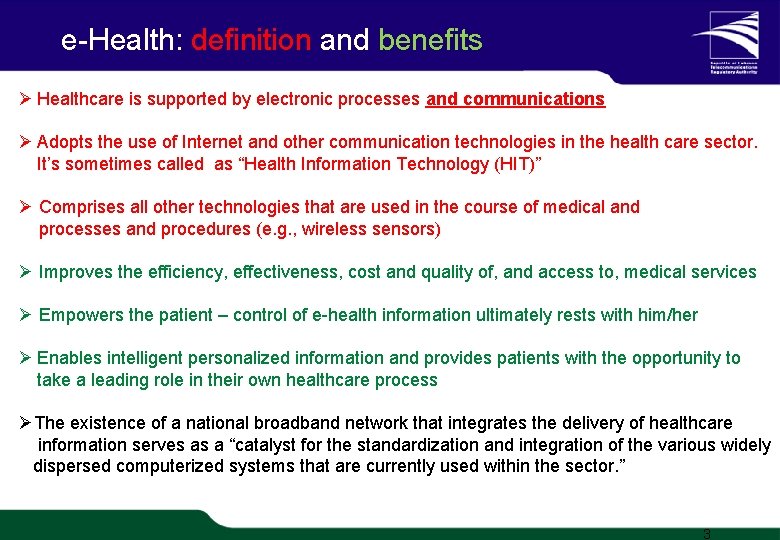
e-Health: definition and benefits Ø Healthcare is supported by electronic processes and communications Ø Adopts the use of Internet and other communication technologies in the health care sector. It’s sometimes called as “Health Information Technology (HIT)” Ø Comprises all other technologies that are used in the course of medical and processes and procedures (e. g. , wireless sensors) Ø Improves the efficiency, effectiveness, cost and quality of, and access to, medical services Ø Empowers the patient – control of e-health information ultimately rests with him/her Ø Enables intelligent personalized information and provides patients with the opportunity to take a leading role in their own healthcare process ØThe existence of a national broadband network that integrates the delivery of healthcare information serves as a “catalyst for the standardization and integration of the various widely dispersed computerized systems that are currently used within the sector. ” 1/20 TRA Proprietary 3
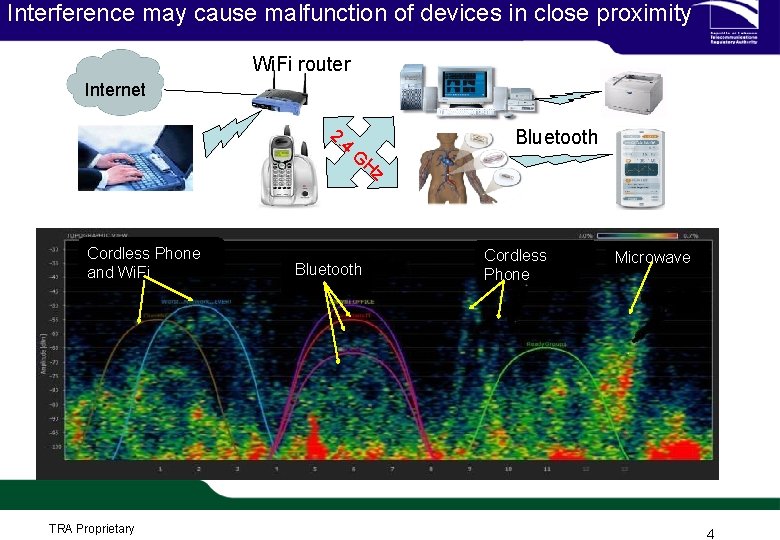
Interference may cause malfunction of devices in close proximity Wi. Fi router Internet 2. 4 Cordless Phone and Wi. Fi G Hz Bluetooth Cordless Phone Microwave 1/20 TRA Proprietary 4
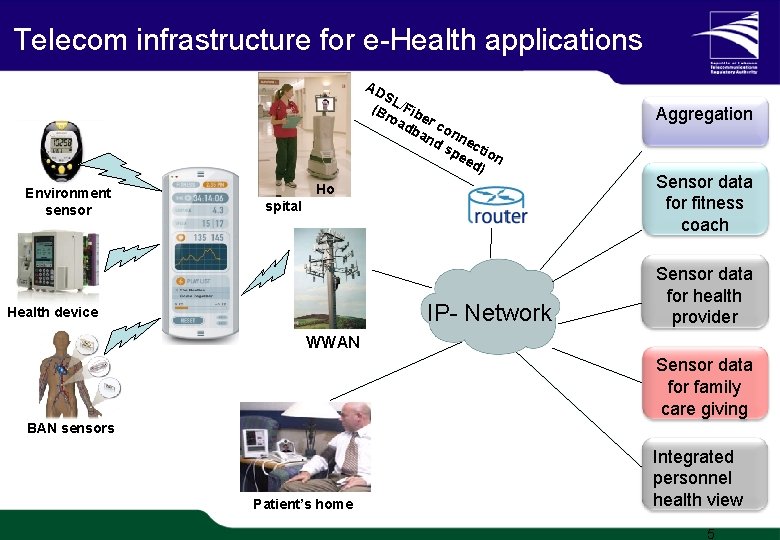
Telecom infrastructure for e-Health applications AD SL (B /Fib roa er db con an d s nect pe ion ed ) Ho Environment sensor spital IP- Network Health device Aggregation Sensor data for fitness coach Sensor data for health provider WWAN Sensor data for family care giving BAN sensors 1/20 TRA Proprietary Patient’s home Integrated personnel health view 5
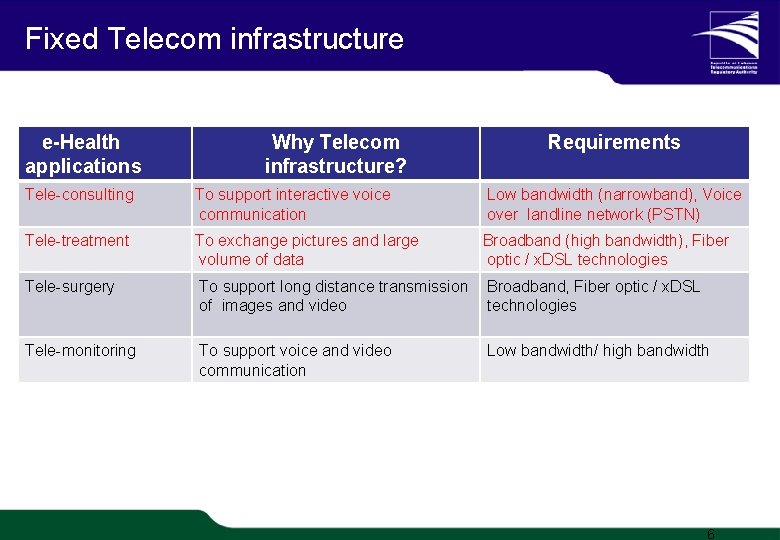
Fixed Telecom infrastructure e-Health applications Why Telecom infrastructure? Requirements Tele-consulting To support interactive voice communication Low bandwidth (narrowband), Voice over landline network (PSTN) Tele-treatment To exchange pictures and large volume of data Broadband (high bandwidth), Fiber optic / x. DSL technologies Tele-surgery To support long distance transmission of images and video Broadband, Fiber optic / x. DSL technologies Tele-monitoring To support voice and video communication Low bandwidth/ high bandwidth 1/20 TRA Proprietary 6
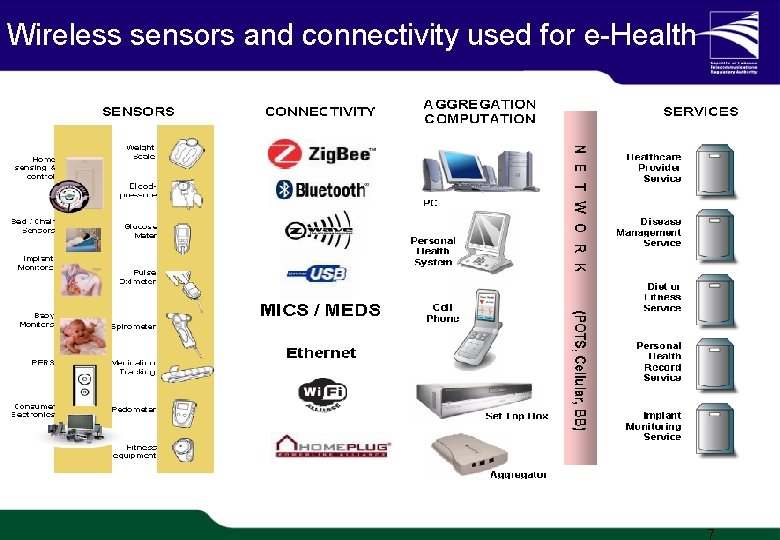
Wireless sensors and connectivity used for e-Health 1/20 TRA Proprietary 7
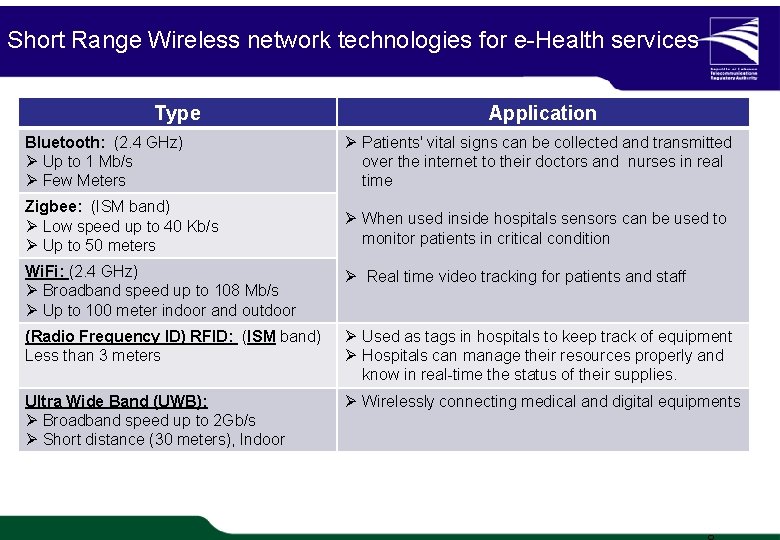
Short Range Wireless network technologies for e-Health services Type Application Bluetooth: (2. 4 GHz) Ø Up to 1 Mb/s Ø Few Meters Ø Patients' vital signs can be collected and transmitted over the internet to their doctors and nurses in real time Zigbee: (ISM band) Ø Low speed up to 40 Kb/s Ø Up to 50 meters Ø When used inside hospitals sensors can be used to monitor patients in critical condition Wi. Fi: (2. 4 GHz) Ø Broadband speed up to 108 Mb/s Ø Up to 100 meter indoor and outdoor Ø Real time video tracking for patients and staff (Radio Frequency ID) RFID: (ISM band) Less than 3 meters Ø Used as tags in hospitals to keep track of equipment Ø Hospitals can manage their resources properly and know in real-time the status of their supplies. Ultra Wide Band (UWB): Ø Broadband speed up to 2 Gb/s Ø Short distance (30 meters), Indoor Ø Wirelessly connecting medical and digital equipments 1/20 TRA Proprietary
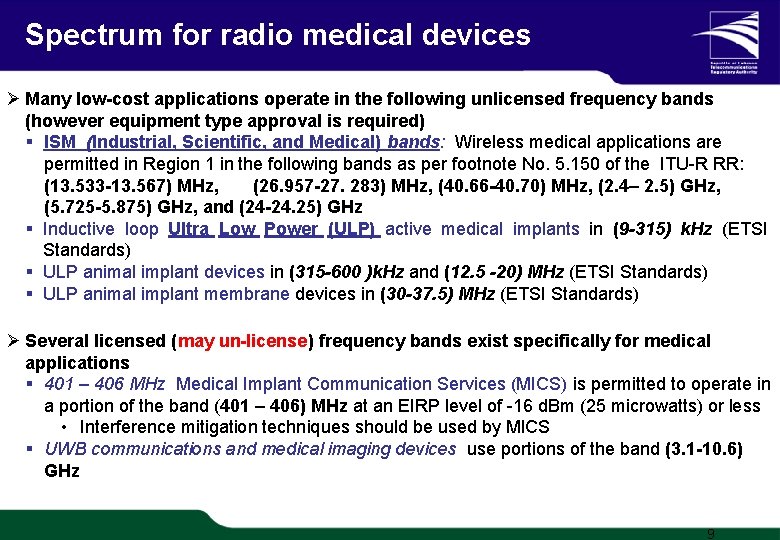
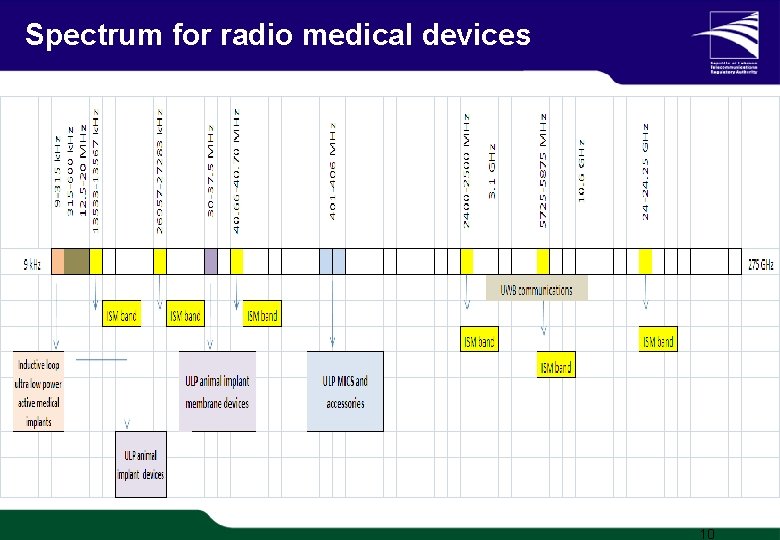
Spectrum for radio medical devices Ø Many low-cost applications operate in the following unlicensed frequency bands (however equipment type approval is required) § ISM (Industrial, Scientific, and Medical) bands: Wireless medical applications are permitted in Region 1 in the following bands as per footnote No. 5. 150 of the ITU-R RR: (13. 533 -13. 567) MHz, (26. 957 -27. 283) MHz, (40. 66 -40. 70) MHz, (2. 4– 2. 5) GHz, (5. 725 -5. 875) GHz, and (24 -24. 25) GHz § Inductive loop Ultra Low Power (ULP) active medical implants in (9 -315) k. Hz (ETSI Standards) § ULP animal implant devices in (315 -600 )k. Hz and (12. 5 -20) MHz (ETSI Standards) § ULP animal implant membrane devices in (30 -37. 5) MHz (ETSI Standards) Ø Several licensed (may un-license) frequency bands exist specifically for medical applications § 401 – 406 MHz Medical Implant Communication Services (MICS) is permitted to operate in a portion of the band (401 – 406) MHz at an EIRP level of -16 d. Bm (25 microwatts) or less • Interference mitigation techniques should be used by MICS § UWB communications and medical imaging devices use portions of the band (3. 1 -10. 6) GHz 1/20 TRA Proprietary 9
Spectrum for radio medical devices 1/20 TRA Proprietary 10
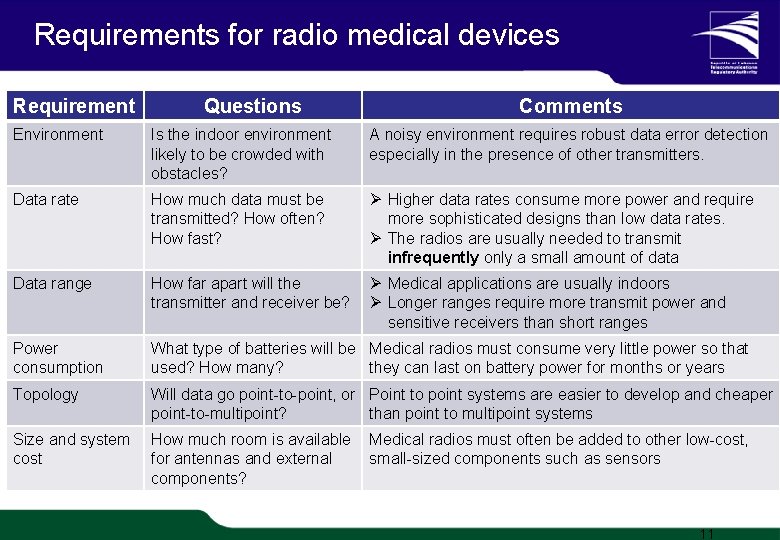
Requirements for radio medical devices Requirement Questions Comments Environment Is the indoor environment likely to be crowded with obstacles? A noisy environment requires robust data error detection especially in the presence of other transmitters. Data rate How much data must be transmitted? How often? How fast? Ø Higher data rates consume more power and require more sophisticated designs than low data rates. Ø The radios are usually needed to transmit infrequently only a small amount of data Data range How far apart will the transmitter and receiver be? Ø Medical applications are usually indoors Ø Longer ranges require more transmit power and sensitive receivers than short ranges Power consumption What type of batteries will be Medical radios must consume very little power so that used? How many? they can last on battery power for months or years Topology Will data go point-to-point, or Point to point systems are easier to develop and cheaper point-to-multipoint? than point to multipoint systems Size and system cost How much room is available for antennas and external components? Medical radios must often be added to other low-cost, small-sized components such as sensors 1/20 TRA Proprietary 11
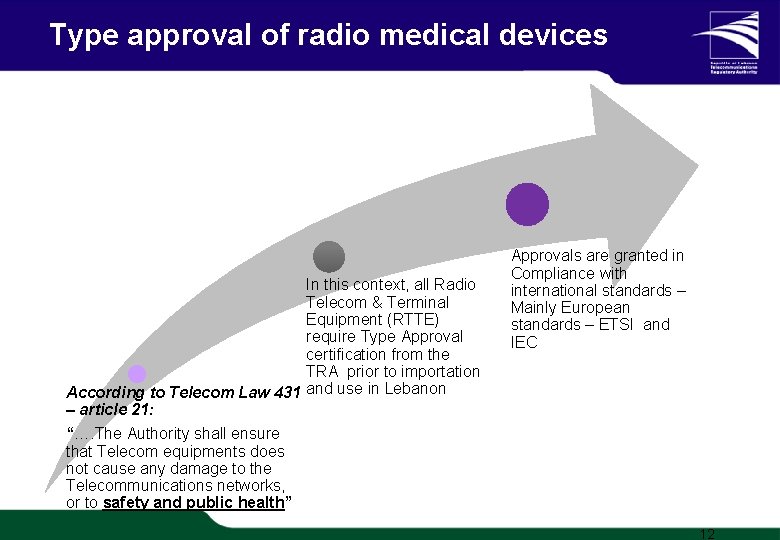
Type approval of radio medical devices In this context, all Radio Telecom & Terminal Equipment (RTTE) require Type Approval certification from the TRA prior to importation According to Telecom Law 431 and use in Lebanon – article 21: Approvals are granted in Compliance with international standards – Mainly European standards – ETSI and IEC “…. The Authority shall ensure that Telecom equipments does not cause any damage to the Telecommunications networks, 1/20 or to safety and public health” TRA Proprietary 12
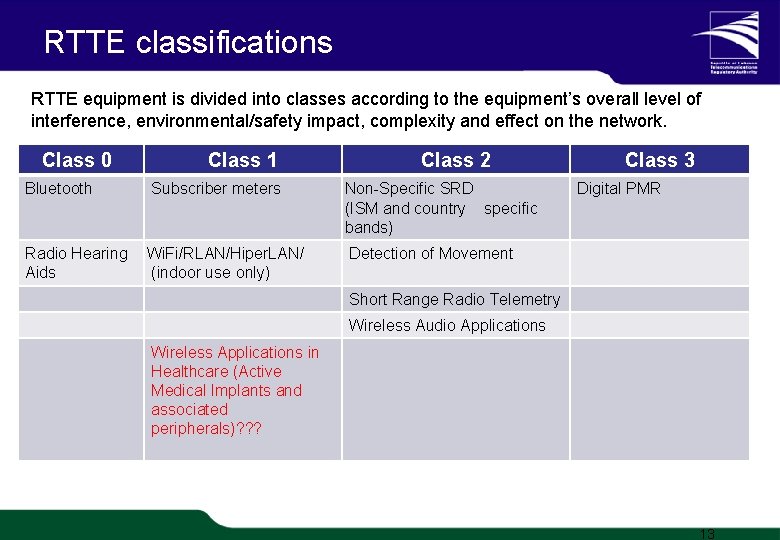
RTTE classifications RTTE equipment is divided into classes according to the equipment’s overall level of interference, environmental/safety impact, complexity and effect on the network. Class 0 Class 1 Class 2 Bluetooth Subscriber meters Non-Specific SRD (ISM and country specific bands) Radio Hearing Aids Wi. Fi/RLAN/Hiper. LAN/ (indoor use only) Detection of Movement Class 3 Digital PMR Short Range Radio Telemetry Wireless Audio Applications Wireless Applications in Healthcare (Active Medical Implants and associated peripherals)? ? ? 1/20 TRA Proprietary 13
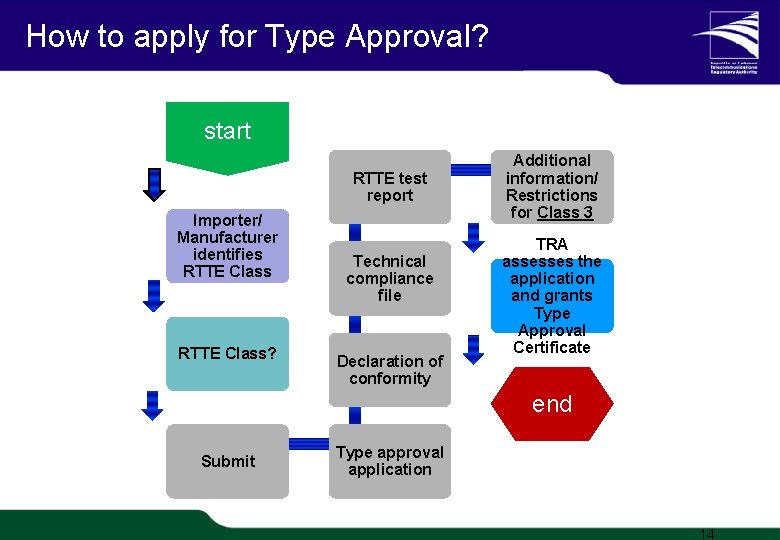
How to apply for Type Approval? start RTTE test report Importer/ Manufacturer identifies RTTE Class? Technical compliance file Declaration of conformity Additional information/ Restrictions for Class 3 TRA assesses the application and grants Type Approval Certificate end Submit Type approval application 1/20 TRA Proprietary 14
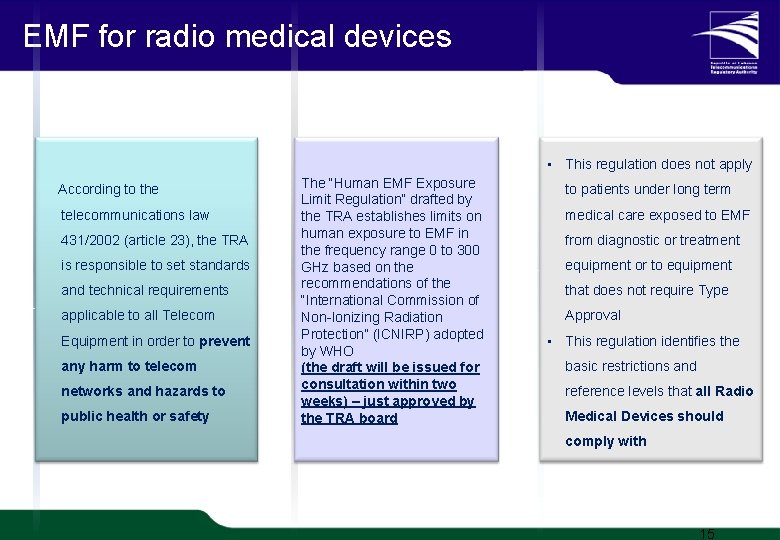
EMF for radio medical devices • This regulation does not apply According to the telecommunications law 431/2002 (article 23), the TRA is responsible to set standards and technical requirements applicable to all Telecom Equipment in order to prevent any harm to telecom networks and hazards to public health or safety The “Human EMF Exposure Limit Regulation” drafted by the TRA establishes limits on human exposure to EMF in the frequency range 0 to 300 GHz based on the recommendations of the “International Commission of Non-Ionizing Radiation Protection” (ICNIRP) adopted by WHO (the draft will be issued for consultation within two weeks) – just approved by the TRA board to patients under long term medical care exposed to EMF from diagnostic or treatment equipment or to equipment that does not require Type Approval • This regulation identifies the basic restrictions and reference levels that all Radio Medical Devices should comply with 1/20 TRA Proprietary 15
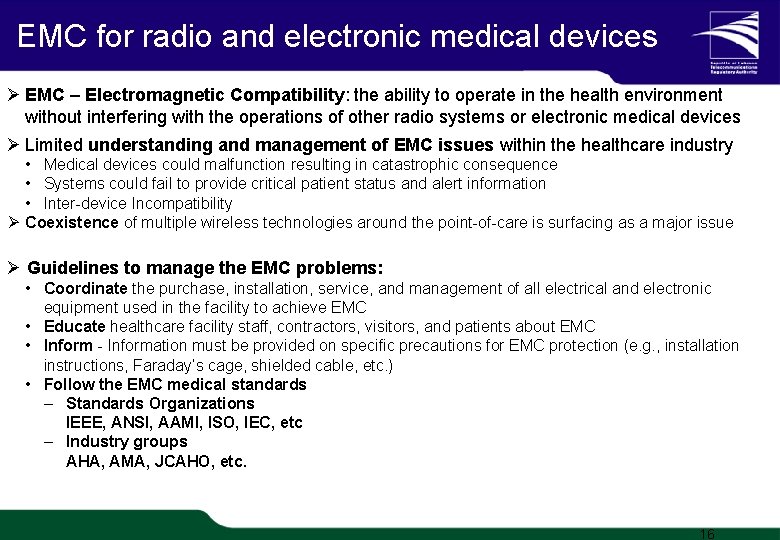
EMC for radio and electronic medical devices Ø EMC – Electromagnetic Compatibility: the ability to operate in the health environment without interfering with the operations of other radio systems or electronic medical devices Ø Limited understanding and management of EMC issues within the healthcare industry • Medical devices could malfunction resulting in catastrophic consequence • Systems could fail to provide critical patient status and alert information • Inter-device Incompatibility Ø Coexistence of multiple wireless technologies around the point-of-care is surfacing as a major issue Ø Guidelines to manage the EMC problems: • Coordinate the purchase, installation, service, and management of all electrical and electronic equipment used in the facility to achieve EMC • Educate healthcare facility staff, contractors, visitors, and patients about EMC • Inform - Information must be provided on specific precautions for EMC protection (e. g. , installation instructions, Faraday’s cage, shielded cable, etc. ) • Follow the EMC medical standards – Standards Organizations IEEE, ANSI, AAMI, ISO, IEC, etc – Industry groups AHA, AMA, JCAHO, etc. 1/20 TRA Proprietary 16
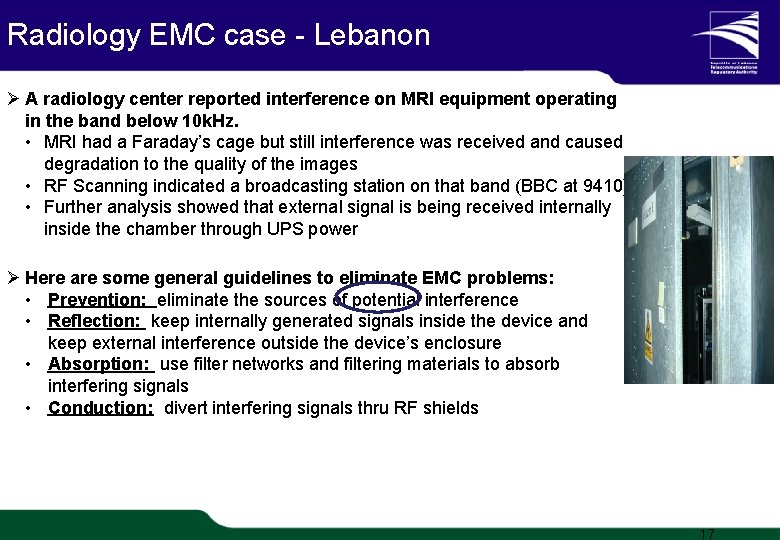
Radiology EMC case - Lebanon Ø A radiology center reported interference on MRI equipment operating in the band below 10 k. Hz. • MRI had a Faraday’s cage but still interference was received and caused degradation to the quality of the images • RF Scanning indicated a broadcasting station on that band (BBC at 9410) • Further analysis showed that external signal is being received internally inside the chamber through UPS power Ø Here are some general guidelines to eliminate EMC problems: • Prevention: eliminate the sources of potential interference • Reflection: keep internally generated signals inside the device and keep external interference outside the device’s enclosure • Absorption: use filter networks and filtering materials to absorb interfering signals • Conduction: divert interfering signals thru RF shields 1/20 TRA Proprietary 17
TRA’s role in e-Health Define spectrum requirements for wireless medical applications and reflect them in the Lebanese National Frequency-Allocation Table (LNFT) Issue Service Provider licenses including spectrum licenses that could be used as the telecom infrastructure required for medical applications Receive and resolve user complaints (including interference complaints) filed through the TRA or the Consumer Protection Directorate (CPD) at 1739 at the Ministry of Economy and Trade. The TRA and the Mo. ET have joined their efforts by signing an MOU to share this hotline as a first step to better serve telecom consumers Issue Import and Type Approval certificates for “Radio Telecom & Terminal Equipment (RTTE)” Ø“TRA -Approved” label ensures Electro-Magnetic Compatibility 1/20 TRA Proprietary Ø All RTTE should comply with the guidelines and limits set in TRA’s “Human EMF exposure limit regulation” 18
THANK YOU 1/20 TRA Proprietary 19