
e Health basic principles achievements frank robbenehealth fgov
e. Health: basic principles & achievements frank. robben@ehealth. fgov. be @Fr. Robben https: //www. ehealth. fgov. be https: //www. frankrobben. be 07/05/2019 1
Roadmaps on e. Health • 2012: round table was organized on the further digitization of the health care sector – about 300 people in the sector participated – a concrete e. Health action plan was drawn up for 5 years: roadmap 2013 -2018 • 2015 > update: roadmap 2. 0 (2015 -2018) – 20 action areas with concrete objectives • 2019 > roadmap 3. 0 (2019 -2021) has been elaborated with a focus on, amongst others – operational excellence: availability, performance, quality, chain supervision, usability, training… – applications for citizens – support for innovation – international standards & terminology – … 07/05/2019 - 2 -
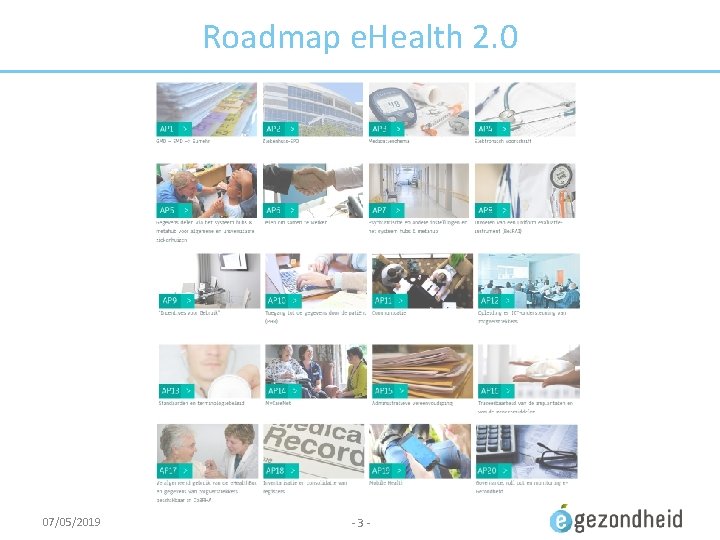
Roadmap e. Health 2. 0 07/05/2019 - 3 -
Roadmap e. Health 2. 0 • Systems & information flows between health care actors – – – – 07/05/2019 AP 1: GMF = EMF => Sum. EHR AP 3: medication schedule AP 4: electronic prescribing AP 5: data sharing via the system hubs & metahub by general and university hospitals AP 6: sharing data for improved cooperation AP 7: psychiatric and other institutions and the system hubs & metahub AP 8: implementation of a uniform assessment instrument (Bel. RAI) AP 14: My. Carenet - 4 -
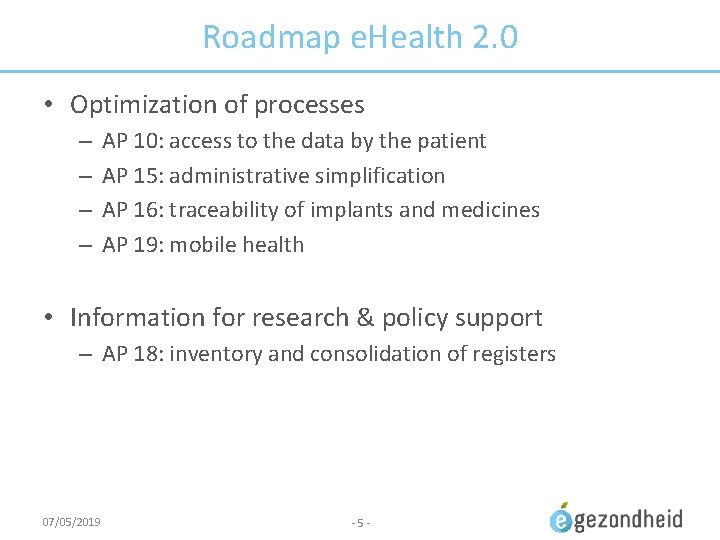
Roadmap e. Health 2. 0 • Optimization of processes – – AP 10: access to the data by the patient AP 15: administrative simplification AP 16: traceability of implants and medicines AP 19: mobile health • Information for research & policy support – AP 18: inventory and consolidation of registers 07/05/2019 - 5 -
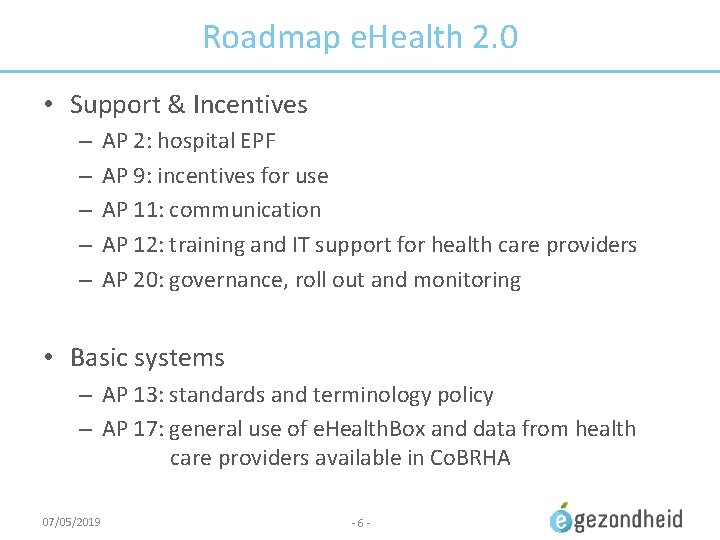
Roadmap e. Health 2. 0 • Support & Incentives – – – AP 2: hospital EPF AP 9: incentives for use AP 11: communication AP 12: training and IT support for health care providers AP 20: governance, roll out and monitoring • Basic systems – AP 13: standards and terminology policy – AP 17: general use of e. Health. Box and data from health care providers available in Co. BRHA 07/05/2019 - 6 -
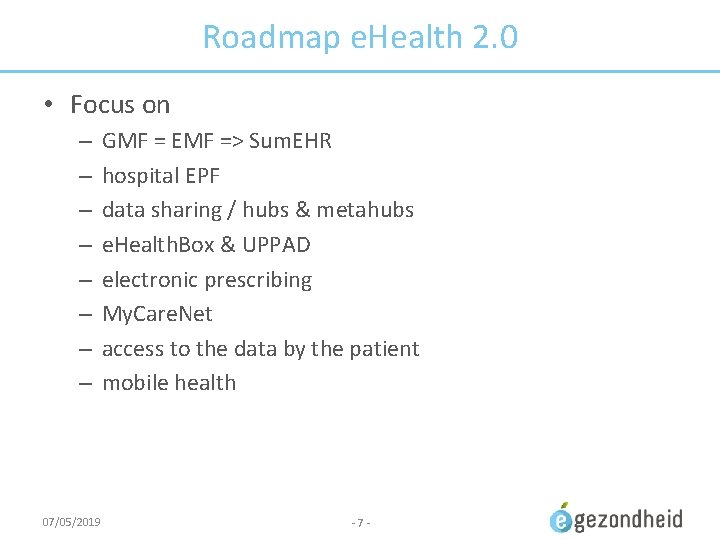
Roadmap e. Health 2. 0 • Focus on – – – – 07/05/2019 GMF = EMF => Sum. EHR hospital EPF data sharing / hubs & metahubs e. Health. Box & UPPAD electronic prescribing My. Care. Net access to the data by the patient mobile health - 7 -
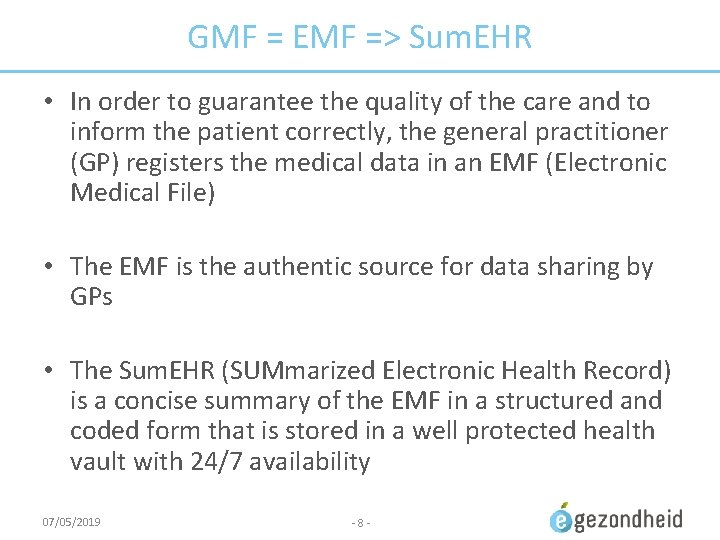
GMF = EMF => Sum. EHR • In order to guarantee the quality of the care and to inform the patient correctly, the general practitioner (GP) registers the medical data in an EMF (Electronic Medical File) • The EMF is the authentic source for data sharing by GPs • The Sum. EHR (SUMmarized Electronic Health Record) is a concise summary of the EMF in a structured and coded form that is stored in a well protected health vault with 24/7 availability 07/05/2019 - 8 -
GMF = EMF => Sum. EHR • Each patient is entitled to having a Sum. EHR, if desired • The information in the Sum. EHR is, with the patient’s consent, accessible to any physician having a therapeutic relation with the patient, and to the patient himself • Use of the Sum. EHR for out-of-hours GPs and emergency departments is being prioritized 07/05/2019 -
GMF = EMF => Sum. EHR • Objectives 01/01/2020 – GP’s: approval of the legal basis by The National Commission of Representatives of Physicians and Sickness Funds • every general practitioner has to use a recognized software package with the possibility to register an EMF for each patient – other health care providers • definition of the EMF • publication and update of certain information in the secure ‘health vaults’ 07/05/2019 - 10 -
Hospital EPF • EMF = electronic medical file > general practitioners • EPF = electronic patient file > health care providers in general • Integrated EPF is a tool that is necessary for – – 07/05/2019 better quality / continuity in the health care sector administrative simplification (paperless) cost reduction (avoiding unnecessary examinations) policy support for authorities and hospitals - 11 -
Hospital EPF • Integrated EPF has to contain (para)medically relevant data on a patient (consultation, hospitalization, emergency admission), that is accessible everywhere (intramural and extramural) and at any time • Integrated EPF = interoperable system with clinical data on patients health care data on patients (medical, nursing) data on invoicing, pricing, reimbursement administrative data management of the planning of consultations, the operation theatre, … – hotel service – etc – – – 07/05/2019 - 12 -
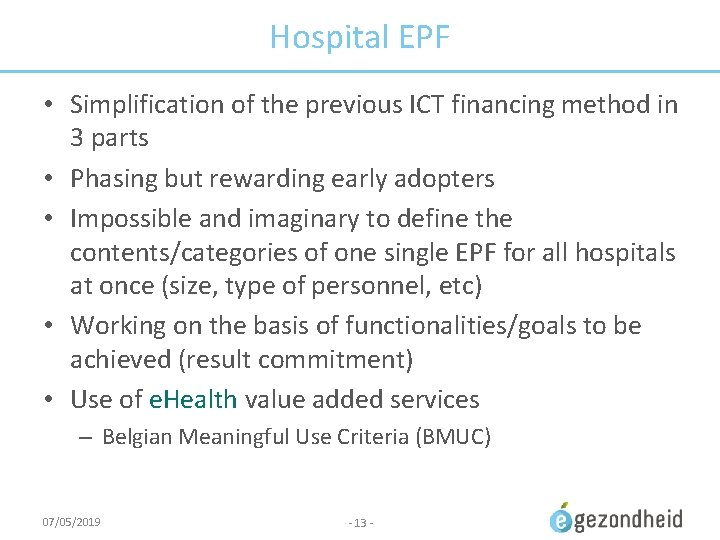
Hospital EPF • Simplification of the previous ICT financing method in 3 parts • Phasing but rewarding early adopters • Impossible and imaginary to define the contents/categories of one single EPF for all hospitals at once (size, type of personnel, etc) • Working on the basis of functionalities/goals to be achieved (result commitment) • Use of e. Health value added services – Belgian Meaningful Use Criteria (BMUC) 07/05/2019 - 13 -
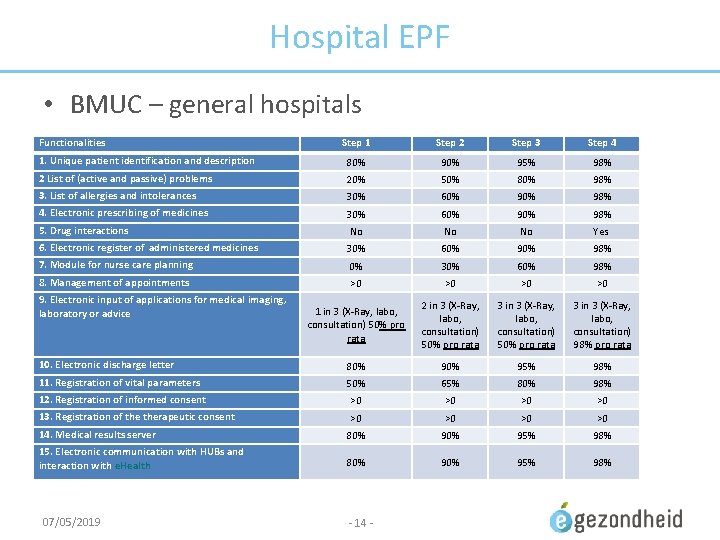
Hospital EPF • BMUC – general hospitals Functionalities Step 1 Step 2 Step 3 Step 4 1. Unique patient identification and description 80% 95% 98% 2 List of (active and passive) problems 20% 50% 80% 98% 3. List of allergies and intolerances 30% 60% 98% 4. Electronic prescribing of medicines 30% 60% 98% 5. Drug interactions No No No Yes 6. Electronic register of administered medicines 30% 60% 98% 7. Module for nurse care planning 0% 30% 60% 98% 8. Management of appointments >0 >0 1 in 3 (X-Ray, labo, consultation) 50% pro rata 2 in 3 (X-Ray, labo, consultation) 50% pro rata 3 in 3 (X-Ray, labo, consultation) 98% pro rata 10. Electronic discharge letter 80% 95% 98% 11. Registration of vital parameters 50% 65% 80% 98% 12. Registration of informed consent >0 >0 13. Registration of therapeutic consent >0 >0 14. Medical results server 80% 95% 98% 15. Electronic communication with HUBs and interaction with e. Health 80% 95% 98% 9. Electronic input of applications for medical imaging, laboratory or advice 07/05/2019 - 14 -
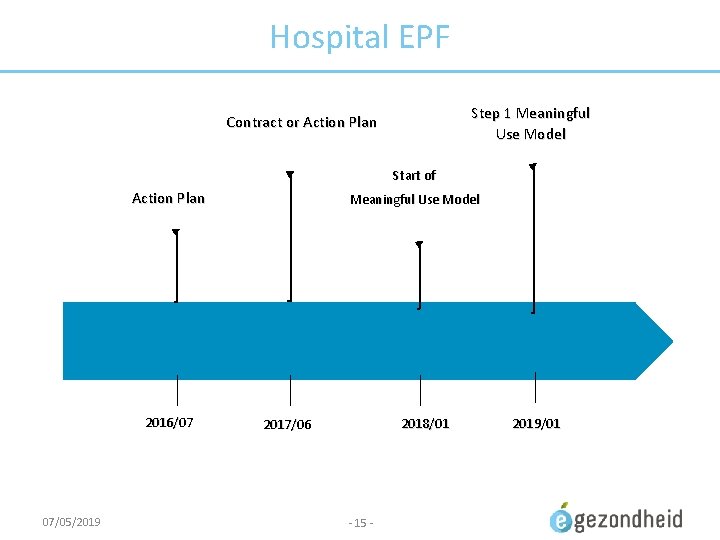
Hospital EPF Step 1 Meaningful Use Model Contract or Action Plan Start of Action Plan 2016/07 07/05/2019 Meaningful Use Model 2018/01 2017/06 - 15 - 2019/01
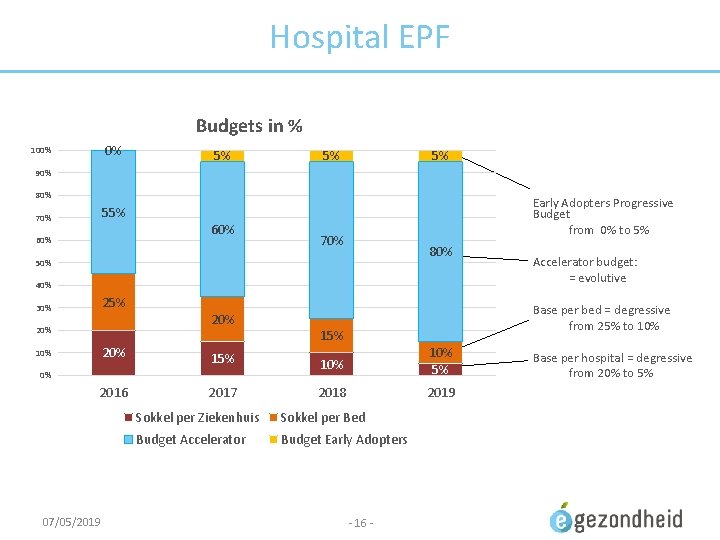
Hospital EPF Budgets in % 0% 100% 5% 5% 5% 90% 80% 55% 70% 60% Early Adopters Progressive Budget from 0% to 5% 70% 80% 50% 40% 25% 30% 20% Base per bed = degressive from 25% to 10% 15% 20% 15% 10% 5% 2016 2017 2018 2019 10% 0% 07/05/2019 Accelerator budget: = evolutive Sokkel per Ziekenhuis Sokkel per Bed Budget Accelerator Budget Early Adopters - 16 - Base per hospital = degressive from 20% to 5%
Hospital EPF • Situation 2018 – 77 % strategic ICT plan – 75% multiannual budget – 85% governance structure • Objectives 2019 – most hospitals have an integrated EPF in production and are already using it, other hospitals are implementing an integrated EPF that meets the BMUC criteria – a multiannual strategic ICT plan and budget, and an appropriate governance structure exists in each hospital – immediate publication of important electronic documents via hubs 07/05/2019 - 17 -
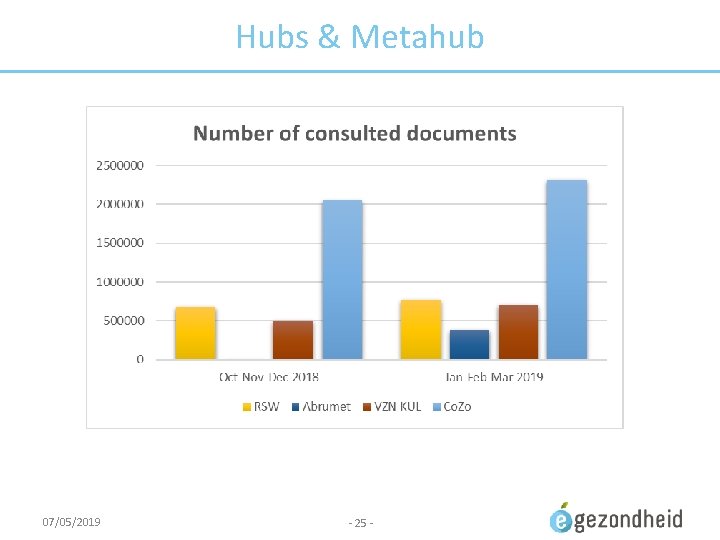
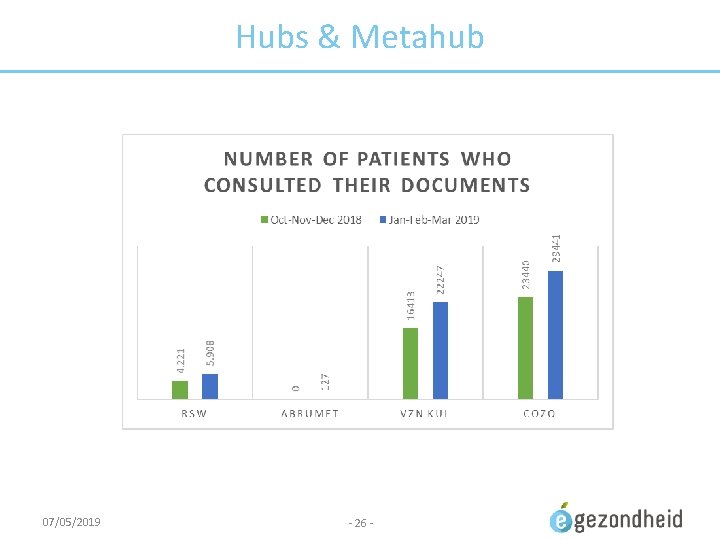
Hubs & Metahub • System to make medical data available between health care providers – – – consultation and operation reports discharge letters protocols of medical imaging and results of lab tests Sum. EHRs, medication schedules, … in health vaults. . . • Objective – linking regional and local exchange systems of medical data (hubs) – possibility for health care providers to retrieve and consult the available electronic medical files regarding a specific patient, irrespective of • the location where these documents are stored • the location where the health care provider logs into the system 07/05/2019 - 18 -
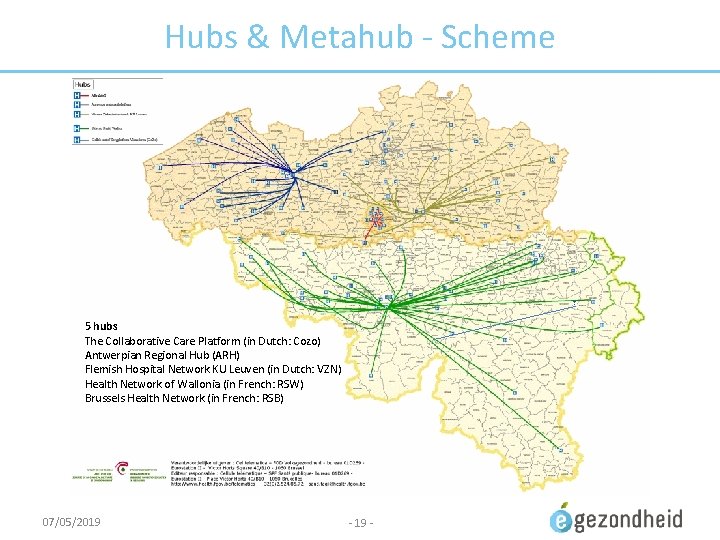
Hubs & Metahub - Scheme 5 hubs The Collaborative Care Platform (in Dutch: Cozo) Antwerpian Regional Hub (ARH) Flemish Hospital Network KU Leuven (in Dutch: VZN) Health Network of Wallonia (in French: RSW) Brussels Health Network (in French: RSB) 07/05/2019 -
Hubs & Metahub • Situation 2019 – system for sharing data and documents by general and psychiatric hospitals via the following 5 hubs • • • the Collaborative Care Platform (in Dutch: Cozo) Antwerpian Regional Hub (ARH) Flemish Hospital Network KU Leuven (in Dutch: VZN) Health Network of Wallonia (in French: RSW) Brussels Health Network (in French: RSB) – reference to first-line documents (Sum. EHR, medication schedules. . . ) via the 3 health vaults/metahub • Vitalink • Inter. Med • Bru. Safe 07/05/2019 - 20 -
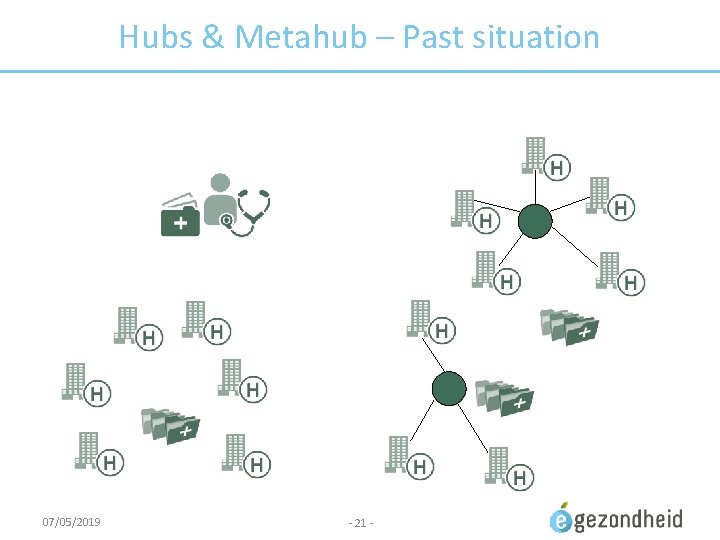
Hubs & Metahub – Past situation 07/05/2019 - 21 -
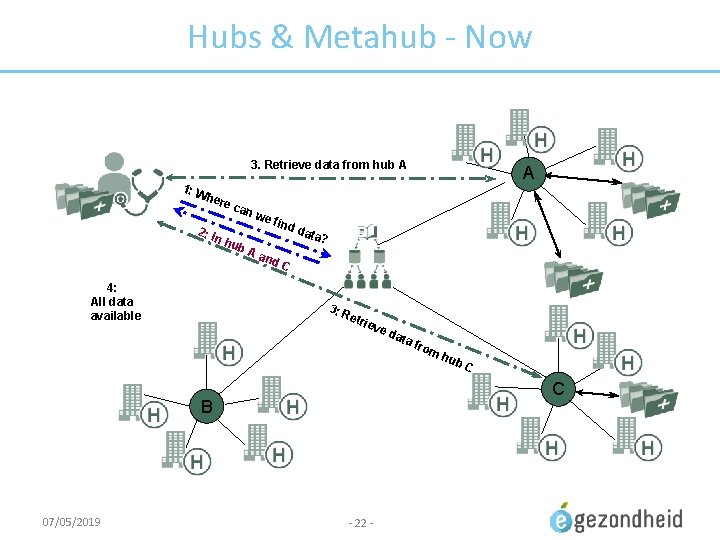
Hubs & Metahub - Now 3. Retrieve data from hub A 1: W her 2: I e ca nw nh 4: All data available ub e fin dd Aa ata? nd C 3: R etr ie ve dat a fr om hub C C B 07/05/2019 A - 22 -
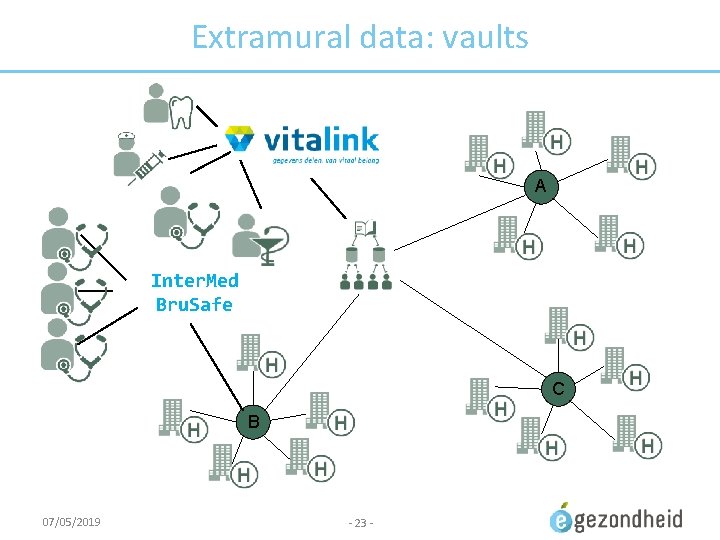
Extramural data: vaults A Inter. Med Bru. Safe C B 07/05/2019 - 23 -
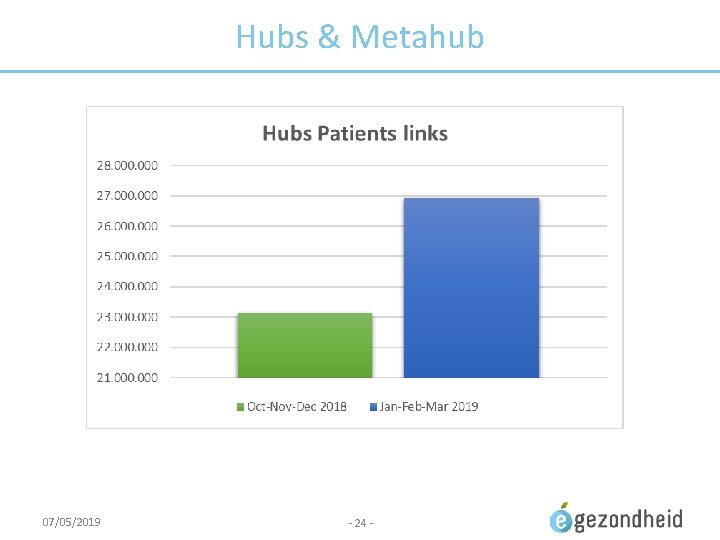
Hubs & Metahub 07/05/2019 - 24 -
Hubs & Metahub 07/05/2019 - 25 -
Hubs & Metahub 07/05/2019 - 26 -
Data sharing consent • Required condition for the exchange of health data: patient has given his informed consent to share his health data electronically – regulation has been approved by the various management and advisory bodies of the e. Health platform (Consultation Committee with the users, Board of Directors and Information Security Committee) – only exchange between health care providers/institutions having a therapeutic/care relationship with the patient – registration of the consent by the patient himself or through his doctor, pharmacist, health fund or hospital 07/05/2019 - 27 -
Data sharing consent • Possibility to exclude a health care provider • Possibility to withdraw the consent • Possibility to modify his permission profile at any time, without any restrictions concerning the modifications • Possibility to see who has entered or modified the informed consent • Permanent support to encourage the registration of consents • 8. 345. 830 consents on 29/04/2019 07/05/2019 - 28 -
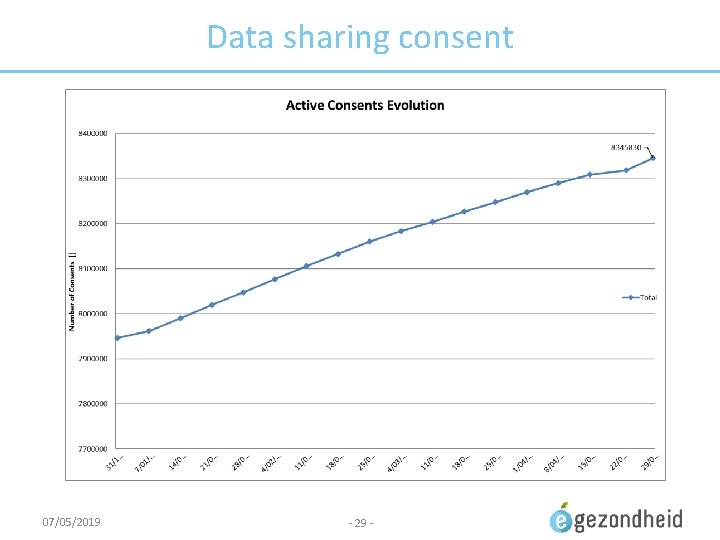
Data sharing consent 07/05/2019 - 29 -
Therapeutic/care relationships • Definition: the relationship between a specific patient and one or more health care professionals involved in activities concerning diagnosis, prevention or care for the patient • Examples of evidence of a therapeutic/care relationship – – – 07/05/2019 establishment of a GMF with a GP consultation with an individual health care provider hospitalization supply of a medicinal product in a pharmacy … - 30 -
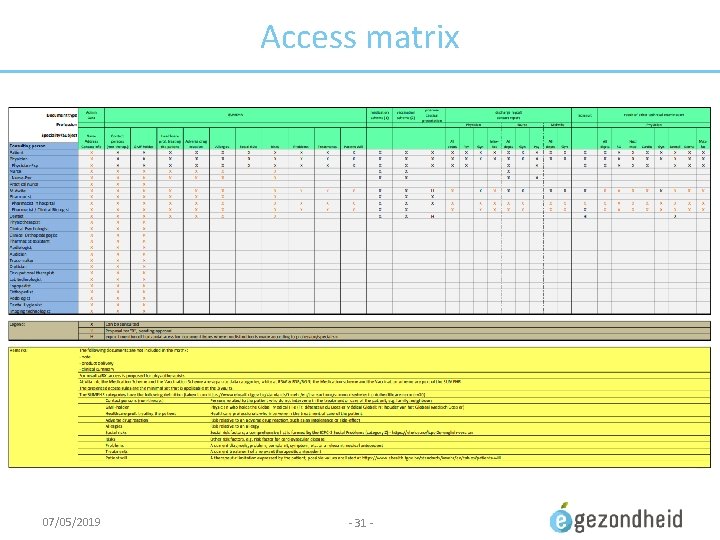
Access matrix 07/05/2019 - 31 -
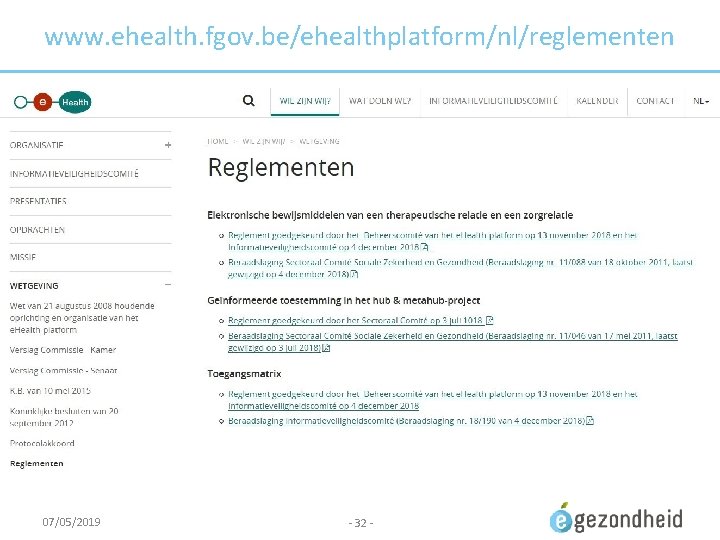
www. ehealth. fgov. be/ehealthplatform/nl/reglementen 07/05/2019 - 32 -
e. Health. Box, Co. BRHA and UPPAD • e. Health. Box – enables secure asynchronic electronic communication of medical and confidential information between health care actors – generally used by health care actors registered in Co. BRHA • Co. BHRA – common database with information about health care providers and care institutions • UPPAD – enables health care actors to consult / modify / complete specific information themselves • unique electronic counter (UPPAD) • address book (Co. BRHA database) 07/05/2019 - 33 -
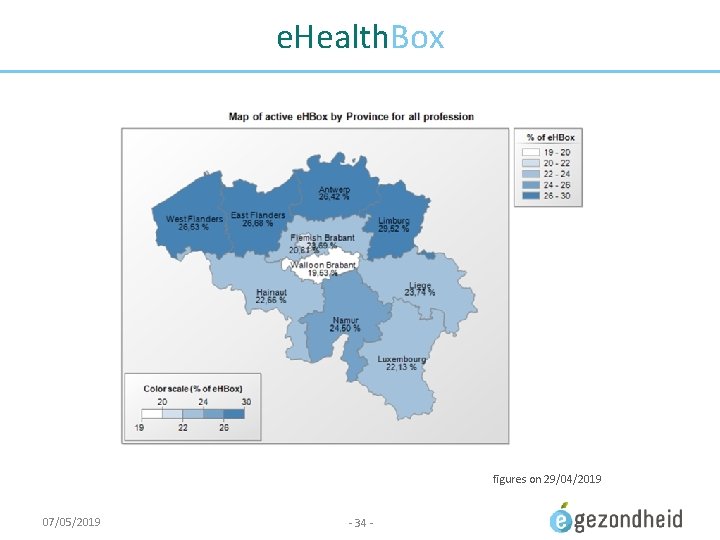
e. Health. Box figures on 29/04/2019 07/05/2019 - 34 -
e. Health. Box • Address book – allows senders of messages to health care providers to decide which channel type and which information are the most appropriate • for communicating medical data > mandatory use of e. Health. Box • for communicating administrative data (internship, recognition…) > using a regular e-mail address allowed and if no data available > shipment by mail (paper) • available address book data comes from Co. BRHA 07/05/2019 - 35 -
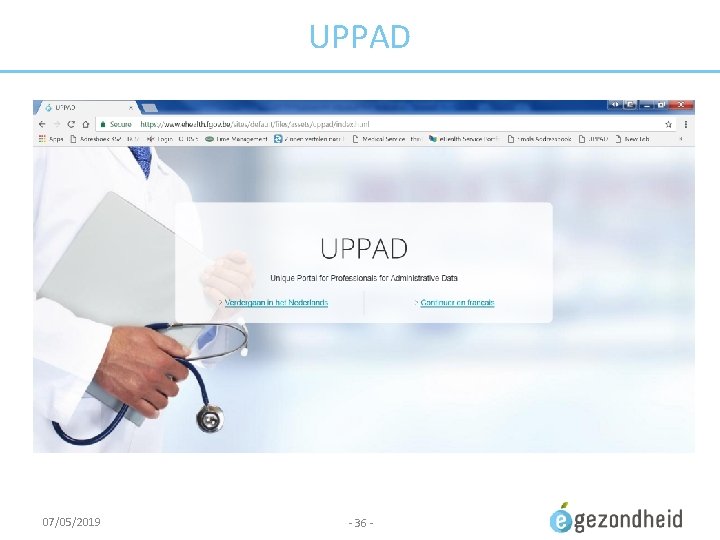
UPPAD 07/05/2019 - 36 -
UPPAD • UPPAD → Unique Portal for Professionals for Administrative Data • Central hub (website) where individual health care providers can consult their administrative data (e. g. visa, recognition…) that are known to government bodies (authentic sources) • Information coming from Co. BRHA 07/05/2019 - 37 -
UPPAD • Possibility to modify specific Authentic Source data yourself (being a health care provider) using underlying applications • Possibility to start up administrative processes electronically (e. g. recognition request) or consult information pages (e. g. procedures on the FPS Public Health website) • UPPAD will not replace applications/procedures that currently exist in various ‘authentic sources’ • Health care providers cannot update information directly in UPPAD – UPPAD merely forwards health care providers to the right application / information available in the authentic sources (= gateway only) 07/05/2019 - 38 -
Electronic prescribing (Recip-e) • Current situation – physician, dentist or midwife who prescribes medication electronically (via software package and the Recip-e service) gives his patient a ‘proof of e-prescribing’ containing a barcode – by scanning the barcode the pharmacist can download the electronic prescription only the electronic prescription has legal value • Future situation – no ‘proof of e-prescribing’ anymore – authentication of the patient at the pharmacy – pharmacist and patient have electronic access to all pending electronic descriptions of the patient 07/05/2019 - 39 -
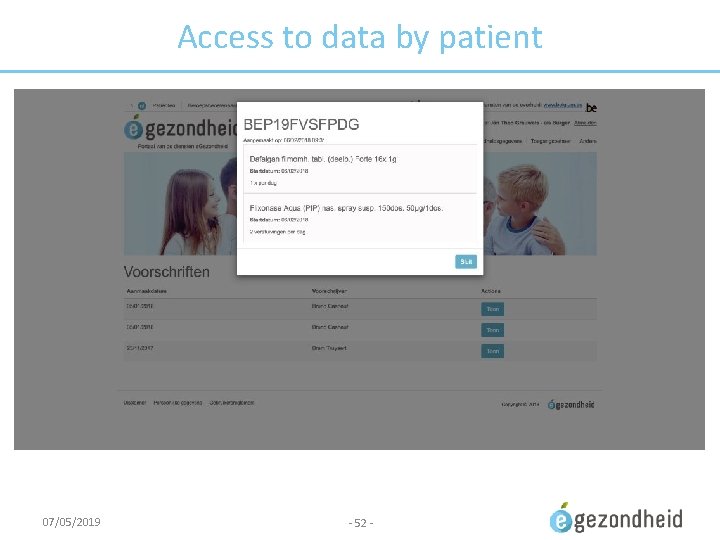
Electronic prescribing (Recip-e) • Advantages for pharmacists – easily download the prescription – know the reimbursement level of the prescribed medicine – send feedback to the prescriber • Advantages for prescribers/health care providers – draw up, consult, send and if needed modify prescriptions that haven’t been provided yet – delete a prescription that hasn’t been provided yet (if he justifies his decision) – receive feedback from the health care provider (pharmacist, physiotherapist, nurse) • Advantages for patients – consult his prescriptions via secure internet access – delete prescriptions which he finds to be useless 07/05/2019 - 40 -
Electronic prescribing • A ‘protocol for the electronic prescription of drugs to ambulatory patients’ describes the conditions and situations allowing the use of paper prescriptions due to force majeure, e. g. – the urgent need of medical assistance is indisputable – the prescriber is a foreign citizen without a NISS (or bis) number – the patient is a newborn waiting for a NISS number – etc 07/05/2019 - 41 -
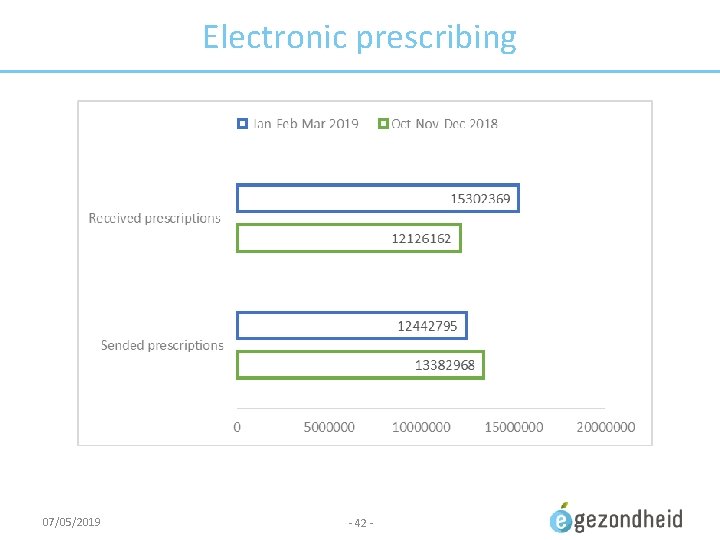
Electronic prescribing 07/05/2019 - 42 -
PARIS Prescription & Autorisation Requesting Information System • Free web application made available by software providers at INAMI’s request – offering minimal service to prescribers for delivering electronic prescriptions outside the Electronic Medical File – as an online service on the e. Health portal, with strong authentication – no interaction with the electronic medical file or other data sharing systems 07/05/2019 - 43 -
PARIS Prescription & Autorisation Requesting Information System • Target groups – prescribers (temporarily) not having access to the software for managing patient records, or to the hospital’s ICT systems – prescribers not having any software (yet) for managing electronic medical files • some specialist categories • occasional prescribers (limited practice only, or no longer medical practitioner in the classic sense – working for insurance companies, administrations, educational organizations, clinical biologists, anatomist-pathologists…) • older prescribers at the end of their career 07/05/2019 - 44 -
My. Care. Net • My. Care. Net > several applications 1. electronic consultation of insurance status by health care providers and institutions 2. electronic transfer of third-party invoicing by health care providers and institutions 3. medical-administrative flows for the home care sector 4. electronic transfer of medical certificates given by health care providers to insurance companies 07/05/2019 - 45 -
My. Care. Net • My. Care. Net ‘Insurance status’ – goal • enable individual providers and institutions to check insurance information about their patients – features • request insurance information on a patient • My. Care. Net ‘third-party invoicing’ – goal • enable individual providers and institutions to transfer third-party invoices to health insurance funds – features • upload and transfer third-party invoicing files to a specific health insurance fund • consult the refund decision for an invoice by a specific sickness fund 07/05/2019 - 46 -
My. Care. Net • My. Care. Net ‘medical-administrative’ flows – goal • transfer of medical-administrative documents between health care providers of the home care sector (or their representatives) and insurance companies (medical advisors) to replace or supplement paper documents – features • flows concerning – flat rate requests – specific requests for palliative care patients – requests for specific technical acts 07/05/2019 - 47 -
My. Care. Net • My. Care. Net ‘e. Attest’ – goal • to enable care providers to electronically send their medical certificates to insurance companies for patients not making part of the third-party payment system – features • service directly linked with the service to check the insurance status • concerning patients for whom the health care provider is not allowed / not willing to apply the third-party payment process • service available via web services only > not available on a portal, health care providers need to use their own software 07/05/2019 - 48 -
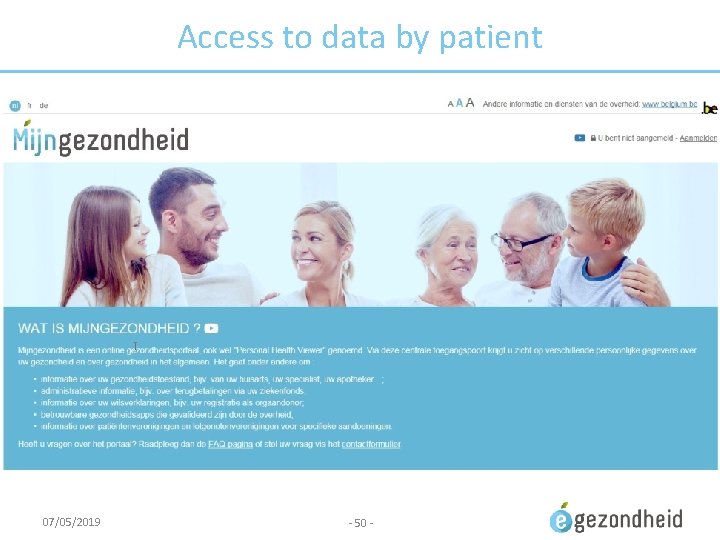
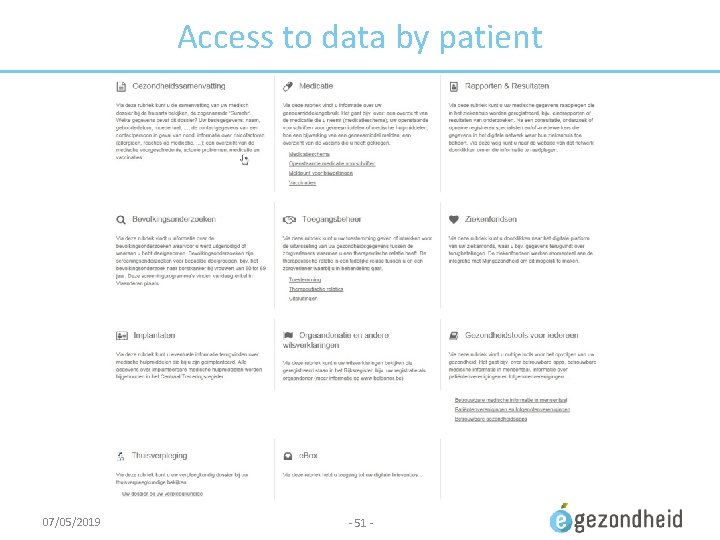
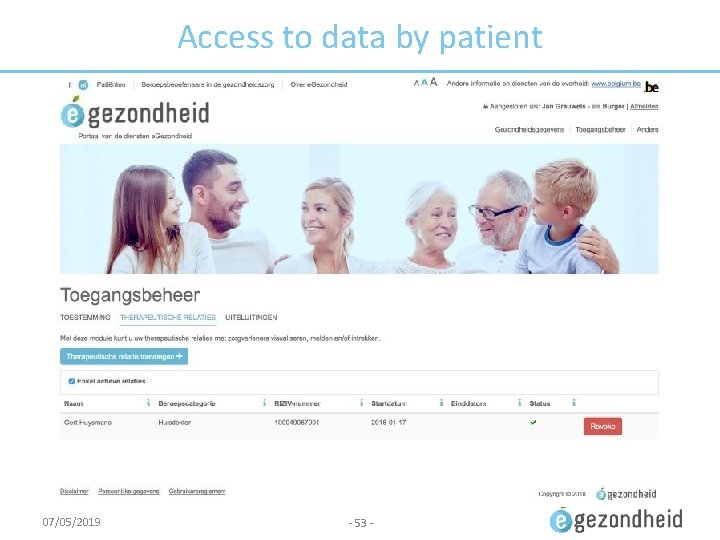
Access to data by patient • Objectives – creating a framework for access management, consulting and/or adding health data by the patient – creating a governance structure watching over the execution of the framework – developing a communication strategy to inform citizens/patients about online health information access and other functions for patients regarding data sharing 07/05/2019 - 49 -
Access to data by patient 07/05/2019 - 50 -
Access to data by patient 07/05/2019 - 51 -
Access to data by patient 07/05/2019 - 52 -
Access to data by patient 07/05/2019 - 53 -
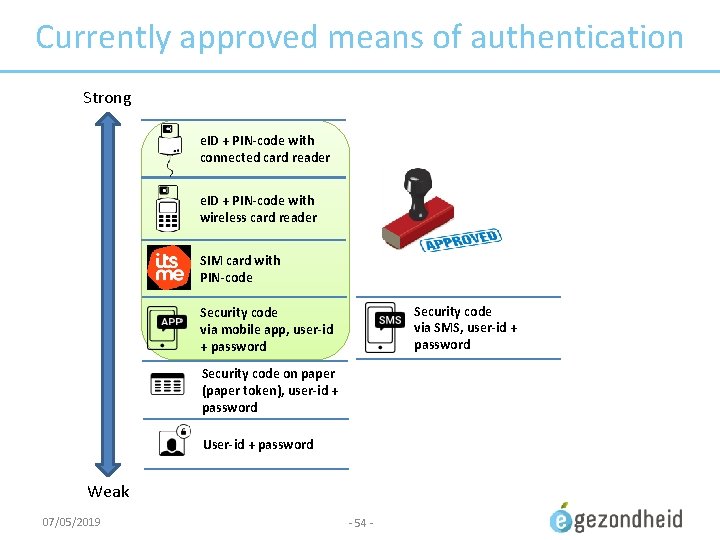
Currently approved means of authentication Strong e. ID + PIN-code with connected card reader e. ID + PIN-code with wireless card reader SIM card with PIN-code Security code via SMS, user-id + password Security code via mobile app, user-id + password Security code on paper (paper token), user-id + password User-id + password Weak 07/05/2019 - 54 -
Mobile Health • Objectives – framework for m. Health actions > efficient implementation – support when using m. Health applications – integration of a legal, financial and organizational framework in new and existing care agreements – integration of the e. Health services in m. Health – support quality and accessibility of m. Health – approach based on use cases (diabetes, cardiovascular. . . ) 07/05/2019 - 55 -
Mobile Health • 5 priority use cases, selected based on their impact (number of patients x severity) and the availability of m. Health technical tools • • • 07/05/2019 stroke diabetes chronic pain mental health cardiovascular disease - 56 -
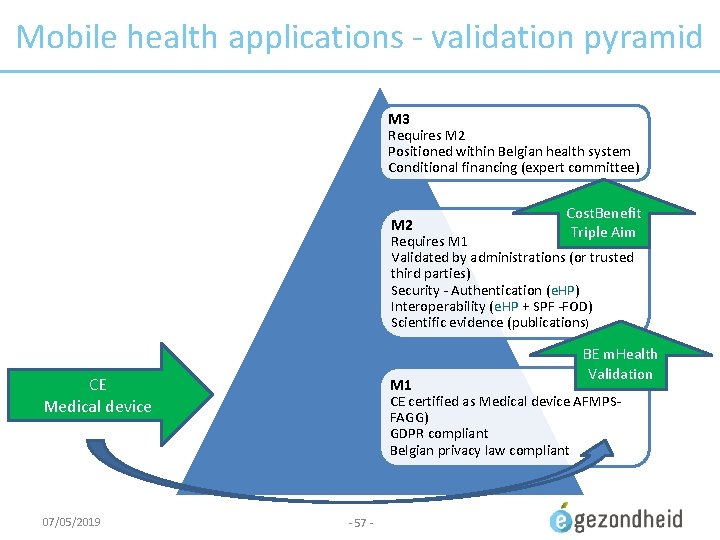
Mobile health applications - validation pyramid M 3 Requires M 2 Positioned within Belgian health system Conditional financing (expert committee) M 2 Cost. Benefit Triple Aim Requires M 1 Validated by administrations (or trusted third parties) Security - Authentication (e. HP) Interoperability (e. HP + SPF -FOD) Scientific evidence (publications) CE Medical device 07/05/2019 M 1 BE m. Health Validation CE certified as Medical device AFMPSFAGG) GDPR compliant Belgian privacy law compliant - 57 -
Mobile health 07/05/2019 - 58 -
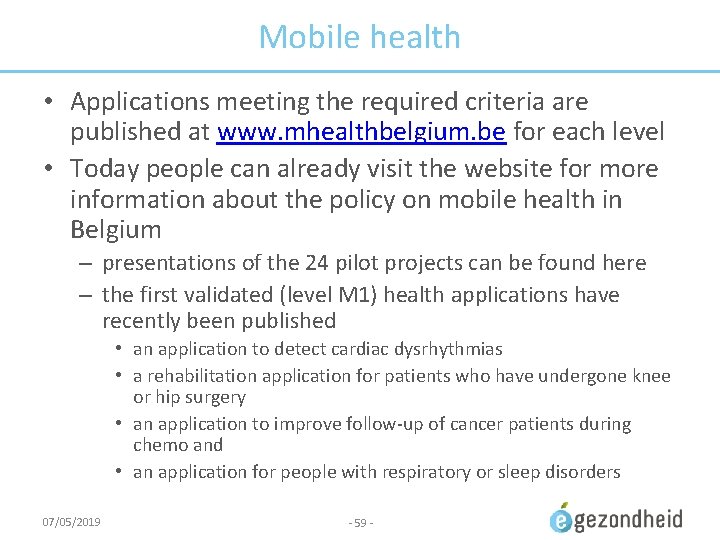
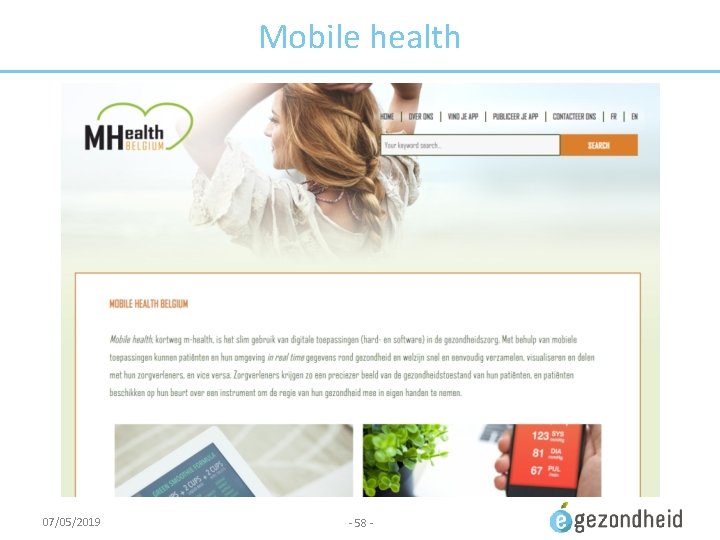
Mobile health • Applications meeting the required criteria are published at www. mhealthbelgium. be for each level • Today people can already visit the website for more information about the policy on mobile health in Belgium – presentations of the 24 pilot projects can be found here – the first validated (level M 1) health applications have recently been published • an application to detect cardiac dysrhythmias • a rehabilitation application for patients who have undergone knee or hip surgery • an application to improve follow-up of cancer patients during chemo and • an application for people with respiratory or sleep disorders 07/05/2019 - 59 -
Role of the e. Health platform 07/05/2019 - 60 -
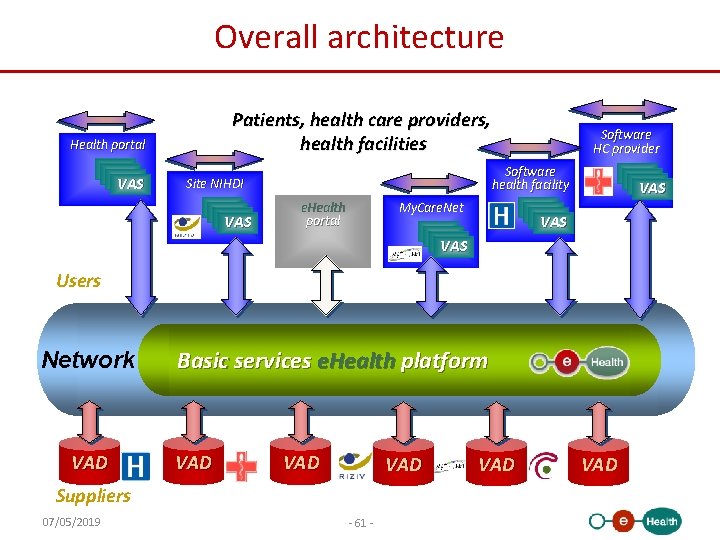
Overall architecture Patients, health care providers, health facilities Health portal VAS Software health facility Site NIHDI VAS Software HC provider e. Health portal My. Care. Net VAS VAS Users Network VAD Basic services e. Health platform VAD VAD Suppliers 07/05/2019 - 61 - VAD
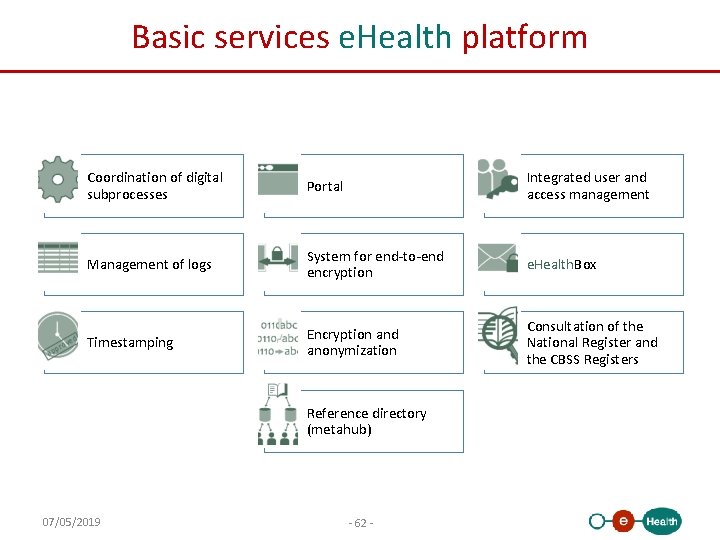
Basic services e. Health platform Coordination of digital subprocesses Portal Integrated user and access management Management of logs System for end-to-end encryption e. Health. Box Timestamping Encryption and anonymization Consultation of the National Register and the CBSS Registers Reference directory (metahub) 07/05/2019 - 62 -
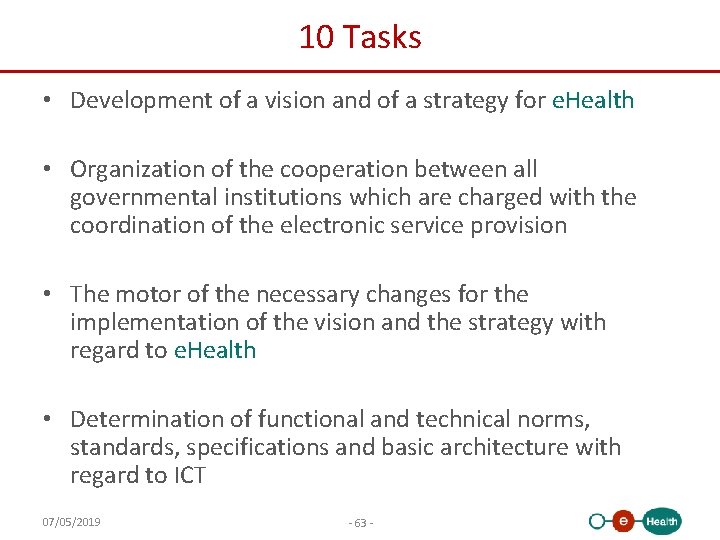
10 Tasks • Development of a vision and of a strategy for e. Health • Organization of the cooperation between all governmental institutions which are charged with the coordination of the electronic service provision • The motor of the necessary changes for the implementation of the vision and the strategy with regard to e. Health • Determination of functional and technical norms, standards, specifications and basic architecture with regard to ICT 07/05/2019 - 63 -
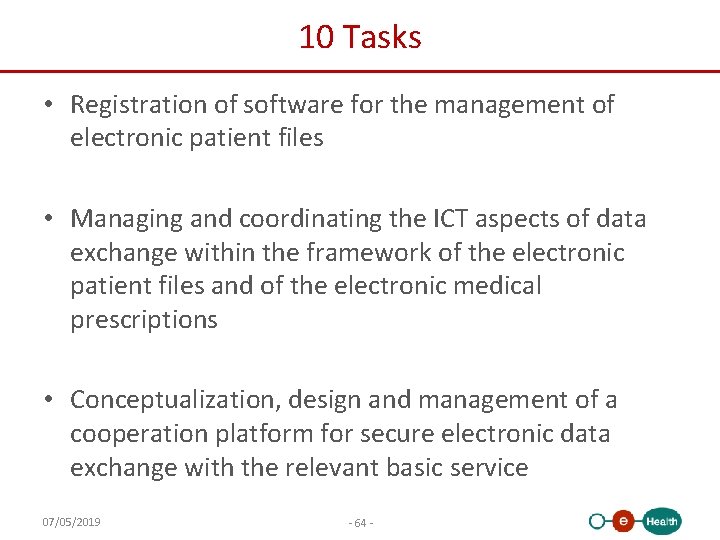
10 Tasks • Registration of software for the management of electronic patient files • Managing and coordinating the ICT aspects of data exchange within the framework of the electronic patient files and of the electronic medical prescriptions • Conceptualization, design and management of a cooperation platform for secure electronic data exchange with the relevant basic service 07/05/2019 - 64 -
10 Tasks • Reaching an agreement about division of tasks and about the quality standards and checking that the quality standards are being fulfilled • Acting as an independent trusted third party (TTP) for the encoding and anonymisation of personal information regarding health for certain institutions summarized in the law for the support of scientific research and the policymaking • Promoting and coordinating programmes and projects 07/05/2019 - 65 -
Conclusion • The sharing of data between healthcare providers / institutions via the hub-meta-hub system, the health safes and the e. Health. Box reaches cruising speed • > 75% of the Belgian population has now given their data sharing consent • The opening up of health data for the patient starts => attention for integrated access • Experience is gained with mobile e. Health applications 07/05/2019 - 66 -
THANK YOU ANY QUESTIONS? frank. robben@ehealth. fgov. be @Fr. Robben https: //www. ehealth. fgov. be https: //www. frankrobben. be 07/05/2019 - 67 -
- Slides: 67