1 Chapter 7 Pointers Outline 7 1 7
- Slides: 83
1 Chapter 7 – Pointers (指標) Outline 7. 1 7. 2 7. 3 7. 4 7. 5 7. 6 7. 7 7. 8 7. 9 7. 10 7. 11 Introduction Pointer Variable Definitions and Initialization Pointer Operators Calling Functions by Reference Using the const Qualifier with Pointers Bubble Sort Using Call by Reference Pointer Expressions and Pointer Arithmetic The Relationship between Pointers and Arrays of Pointers Case Study: A Card Shuffling and Dealing Simulation Pointers to Functions © Copyright by Deitel
2 Objectives • In this chapter, you will learn: – To be able to use pointers to pass arguments to functions using call by reference. – To understand the close relationships among pointers, arrays and strings. – To understand the use of pointers to functions. – To be able to define and use arrays of strings. © Copyright by Deitel
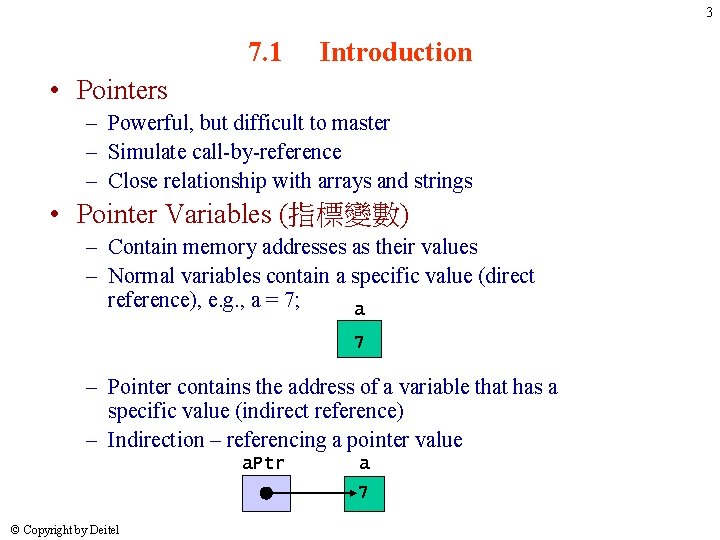
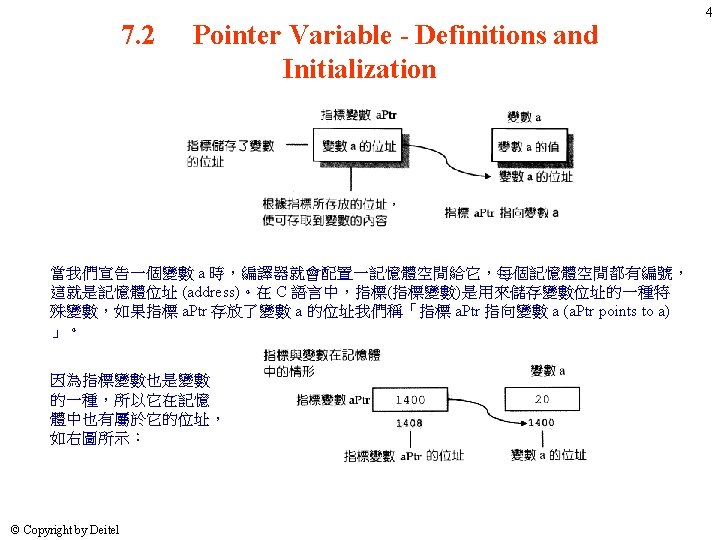
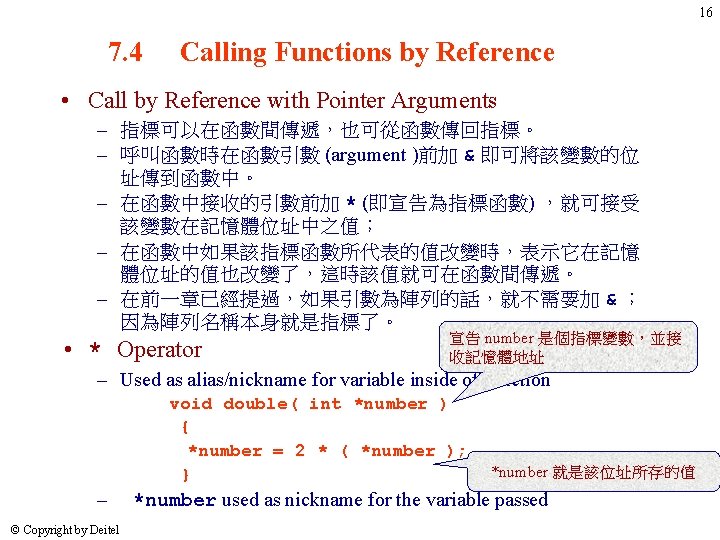
3 7. 1 Introduction • Pointers – Powerful, but difficult to master – Simulate call-by-reference – Close relationship with arrays and strings • Pointer Variables (指標變數) – Contain memory addresses as their values – Normal variables contain a specific value (direct reference), e. g. , a = 7; a 7 – Pointer contains the address of a variable that has a specific value (indirect reference) – Indirection – referencing a pointer value a. Ptr a 7 © Copyright by Deitel
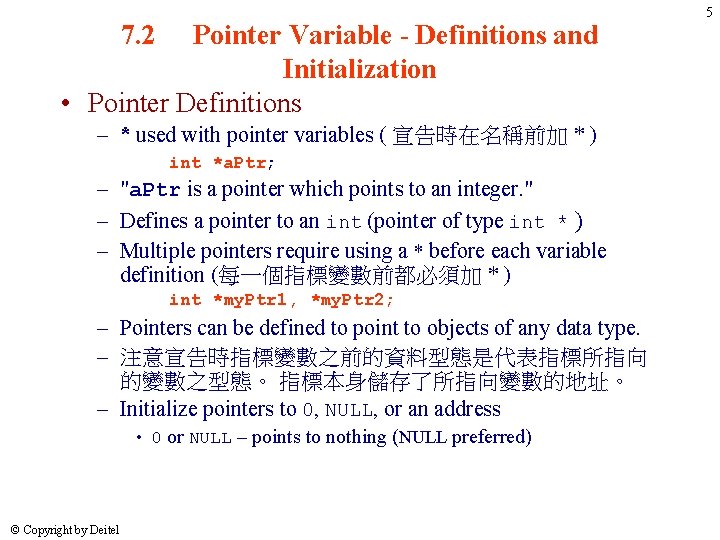
7. 2 Pointer Variable - Definitions and Initialization • Pointer Definitions – * used with pointer variables ( 宣告時在名稱前加 * ) int *a. Ptr; – "a. Ptr is a pointer which points to an integer. " – Defines a pointer to an int (pointer of type int * ) – Multiple pointers require using a * before each variable definition (每一個指標變數前都必須加 * ) int *my. Ptr 1, *my. Ptr 2; – Pointers can be defined to point to objects of any data type. – 注意宣告時指標變數之前的資料型態是代表指標所指向 的變數之型態。 指標本身儲存了所指向變數的地址。 – Initialize pointers to 0, NULL, or an address • 0 or NULL – points to nothing (NULL preferred) © Copyright by Deitel 5
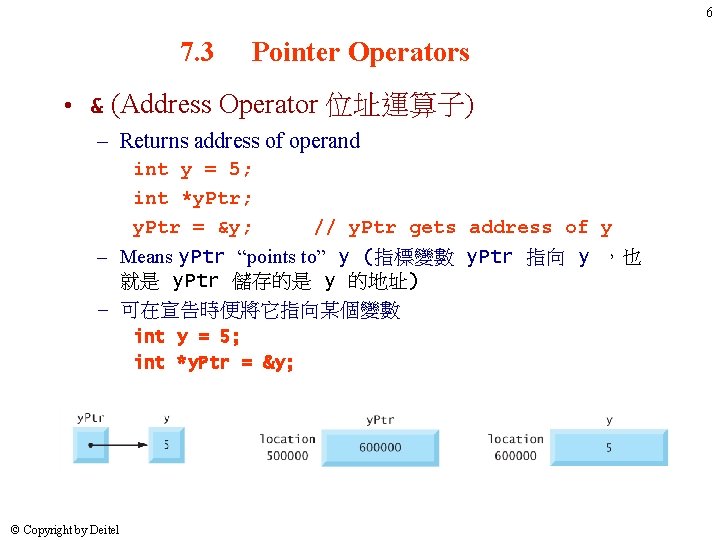
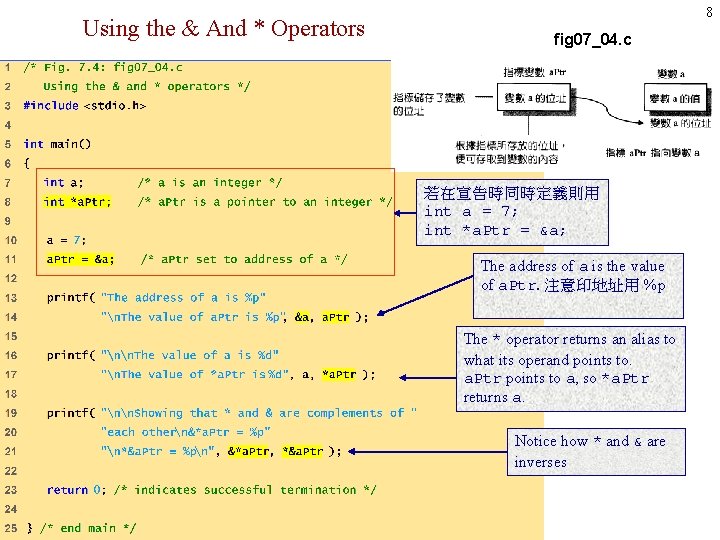
6 7. 3 Pointer Operators • & (Address Operator 位址運算子) – Returns address of operand int y = 5; int *y. Ptr; y. Ptr = &y; // y. Ptr gets address of y – Means y. Ptr “points to” y (指標變數 y. Ptr 指向 y ,也 就是 y. Ptr 儲存的是 y 的地址) – 可在宣告時便將它指向某個變數 int y = 5; int *y. Ptr = &y; © Copyright by Deitel
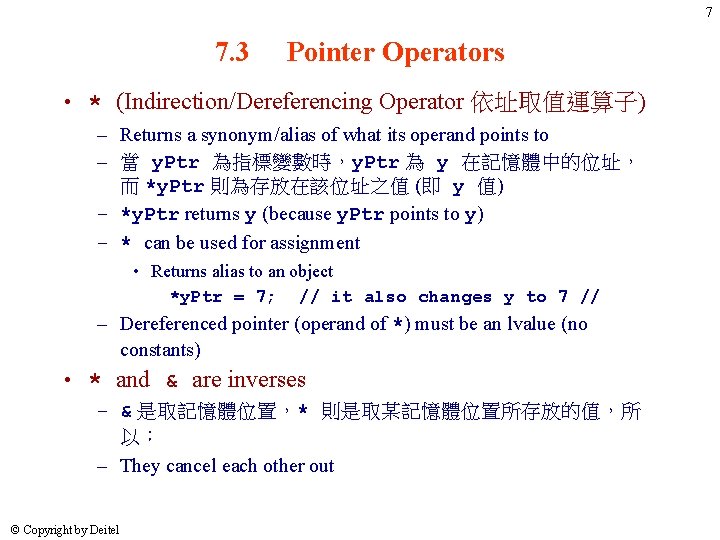
7 7. 3 Pointer Operators • * (Indirection/Dereferencing Operator 依址取值運算子) – Returns a synonym/alias of what its operand points to – 當 y. Ptr 為指標變數時,y. Ptr 為 y 在記憶體中的位址, 而 *y. Ptr 則為存放在該位址之值 (即 y 值) – *y. Ptr returns y (because y. Ptr points to y) – * can be used for assignment • Returns alias to an object *y. Ptr = 7; // it also changes y to 7 // – Dereferenced pointer (operand of *) must be an lvalue (no constants) • * and & are inverses – & 是取記憶體位置,* 則是取某記憶體位置所存放的值,所 以: – They cancel each other out © Copyright by Deitel
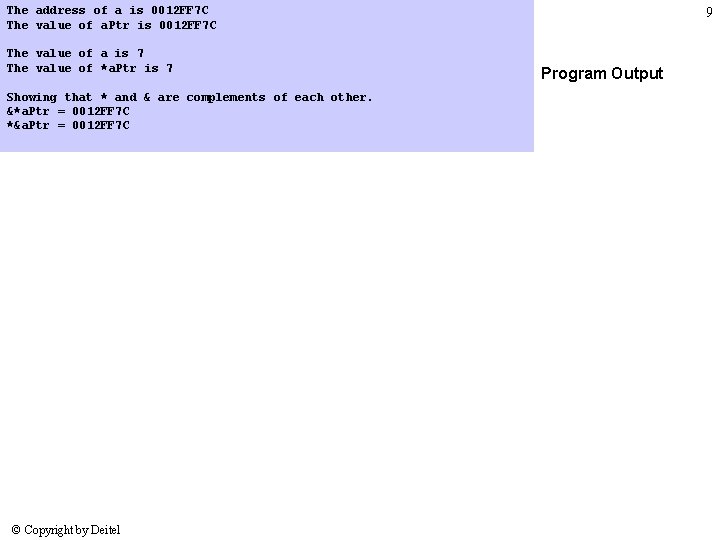
Using the & And * Operators 8 fig 07_04. c 若在宣告時同時定義則用 int a = 7; int *a. Ptr = &a; The address of a is the value of a. Ptr. 注意印地址用 %p The * operator returns an alias to what its operand points to. a. Ptr points to a, so *a. Ptr returns a. Notice how * and & are inverses © Copyright by Deitel
The address of a is 0012 FF 7 C The value of a. Ptr is 0012 FF 7 C The value of a is 7 The value of *a. Ptr is 7 Showing that * and & are complements of each other. &*a. Ptr = 0012 FF 7 C *&a. Ptr = 0012 FF 7 C © Copyright by Deitel 9 Program Output
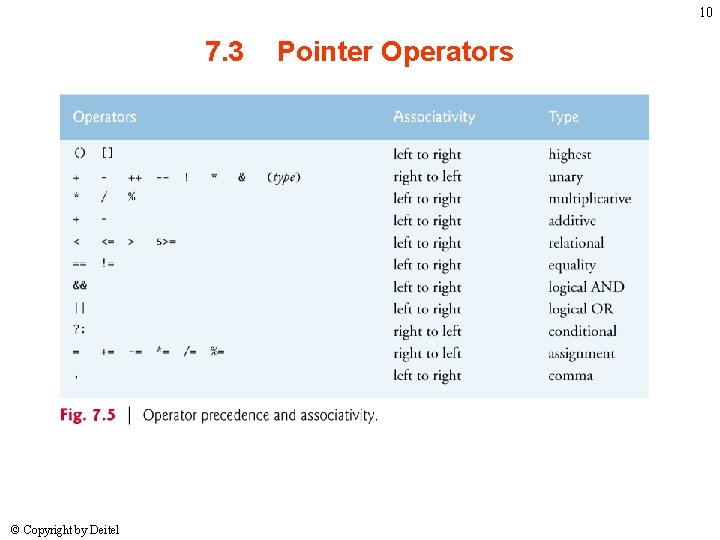
10 7. 3 © Copyright by Deitel Pointer Operators
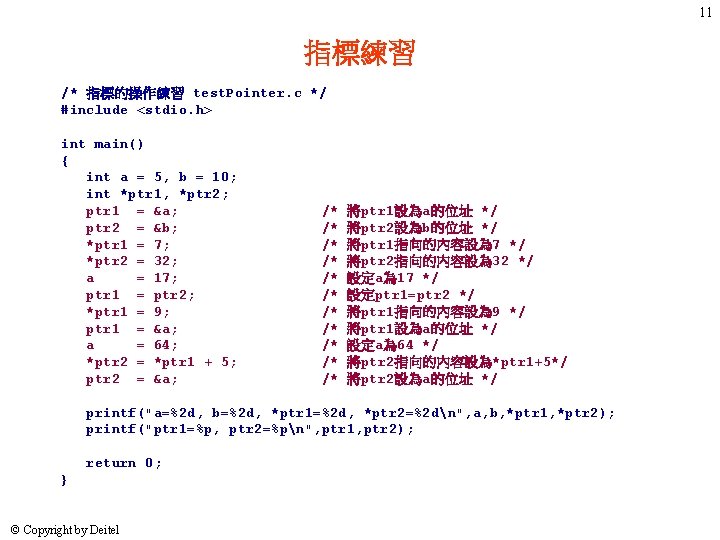
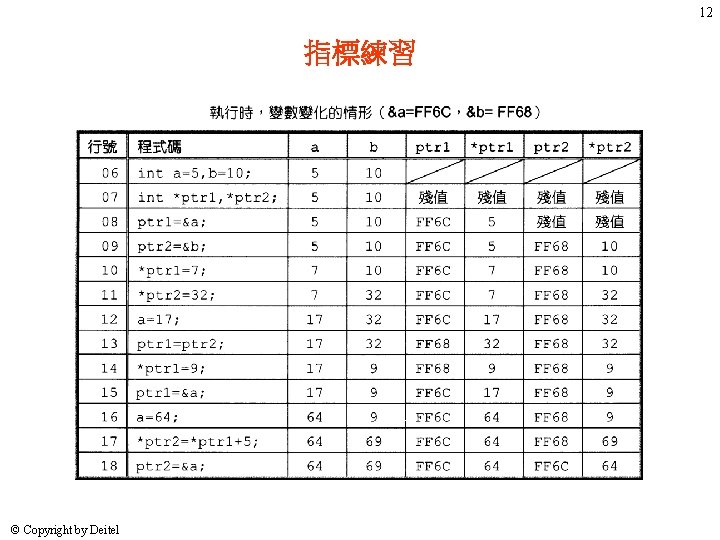
11 指標練習 /* 指標的操作練習 test. Pointer. c */ #include <stdio. h> int main() { int a = 5, b = 10; int *ptr 1, *ptr 2; ptr 1 = &a; /* 將ptr 1設為a的位址 */ ptr 2 = &b; /* 將ptr 2設為b的位址 */ *ptr 1 = 7; /* 將ptr 1指向的內容設為 7 */ *ptr 2 = 32; /* 將ptr 2指向的內容設為 32 */ a = 17; /* 設定a為 17 */ ptr 1 = ptr 2; /* 設定ptr 1=ptr 2 */ *ptr 1 = 9; /* 將ptr 1指向的內容設為 9 */ ptr 1 = &a; /* 將ptr 1設為a的位址 */ a = 64; /* 設定a為 64 */ *ptr 2 = *ptr 1 + 5; /* 將ptr 2指向的內容設為*ptr 1+5*/ ptr 2 = &a; /* 將ptr 2設為a的位址 */ printf("a=%2 d, b=%2 d, *ptr 1=%2 d, *ptr 2=%2 dn", a, b, *ptr 1, *ptr 2); printf("ptr 1=%p, ptr 2=%pn", ptr 1, ptr 2); return 0; } © Copyright by Deitel
12 指標練習 © Copyright by Deitel
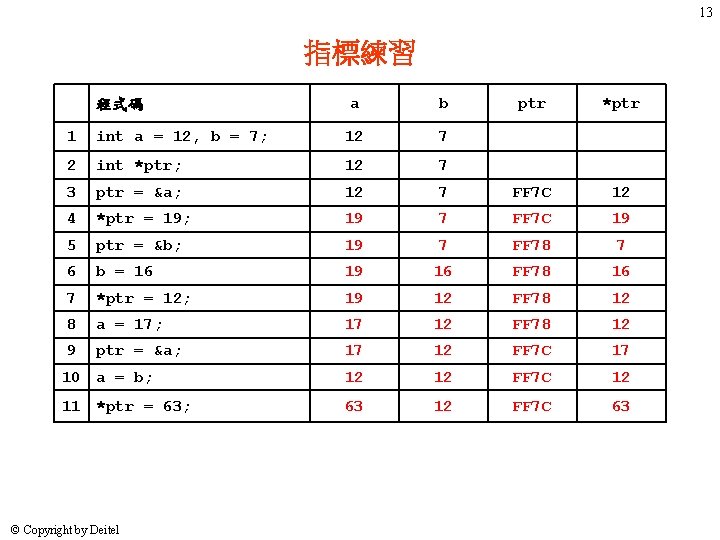
13 指標練習 程式碼 a b ptr *ptr 1 int a = 12, b = 7; 12 7 2 int *ptr; 12 7 3 ptr = &a; 12 7 FF 7 C 12 4 *ptr = 19; 19 7 FF 7 C 19 5 ptr = &b; 19 7 FF 78 7 6 b = 16 19 16 FF 78 16 7 *ptr = 12; 19 12 FF 78 12 8 a = 17; 17 12 FF 78 12 9 ptr = &a; 17 12 FF 7 C 17 10 a = b; 12 12 FF 7 C 12 11 *ptr = 63; 63 12 FF 7 C 63 © Copyright by Deitel
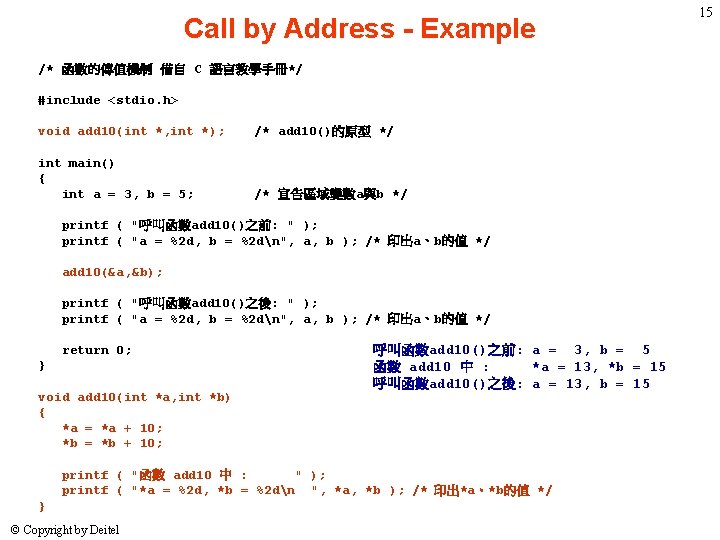
Call by Address - Example /* 函數的傳值機制 借自 C 語言教學手冊*/ #include <stdio. h> void add 10(int *, int *); /* add 10()的原型 */ int main() { int a = 3, b = 5; /* 宣告區域變數a與b */ printf ( "呼叫函數add 10()之前: " ); printf ( "a = %2 d, b = %2 dn", a, b ); /* 印出a、b的值 */ add 10(&a, &b); printf ( "呼叫函數add 10()之後: " ); printf ( "a = %2 d, b = %2 dn", a, b ); /* 印出a、b的值 */ return 0; } void add 10(int *a, int *b) { *a = *a + 10; *b = *b + 10; 呼叫函數add 10()之前: a = 3, b = 5 函數 add 10 中 : *a = 13, *b = 15 呼叫函數add 10()之後: a = 13, b = 15 printf ( "函數 add 10 中 : " ); printf ( "*a = %2 d, *b = %2 dn ", *a, *b ); /* 印出*a、*b的值 */ } © Copyright by Deitel 15
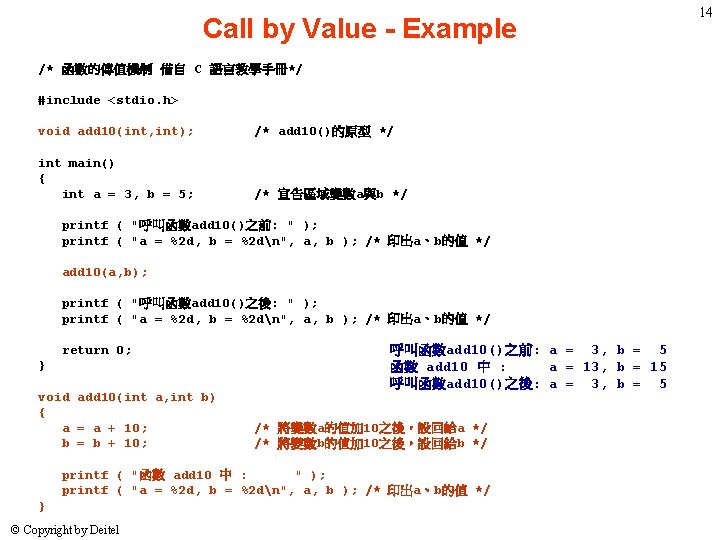
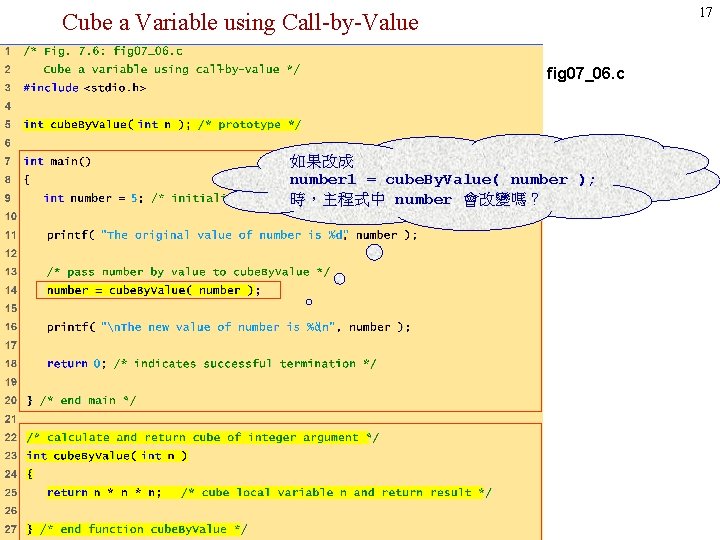
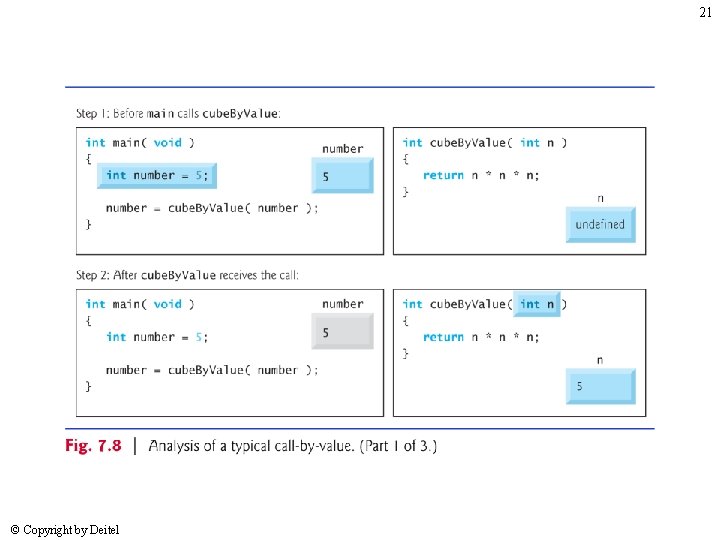
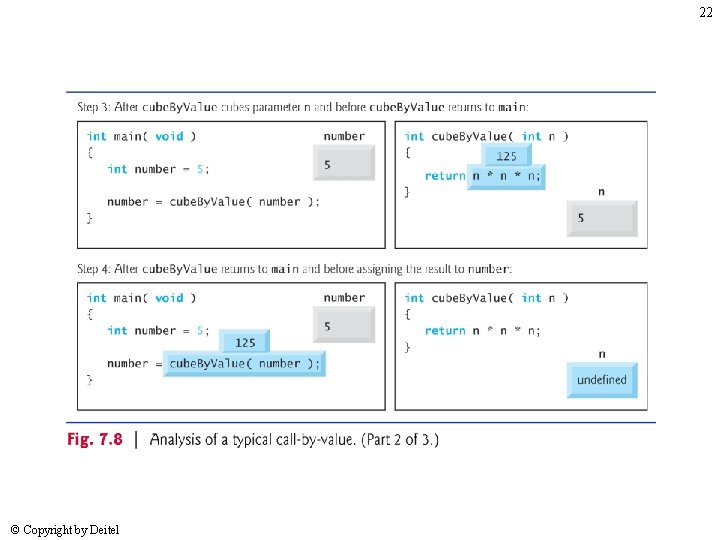
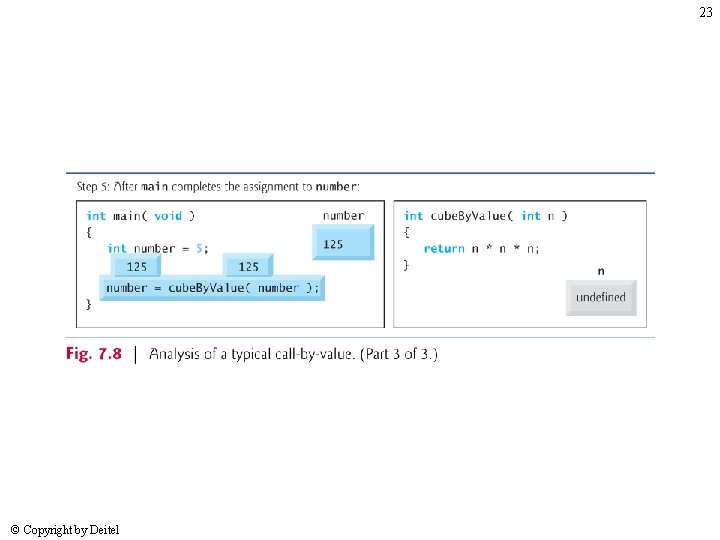
17 Cube a Variable using Call-by-Value fig 07_06. c 如果改成 number 1 = cube. By. Value( number ); 時,主程式中 number 會改變嗎? © Copyright by Deitel
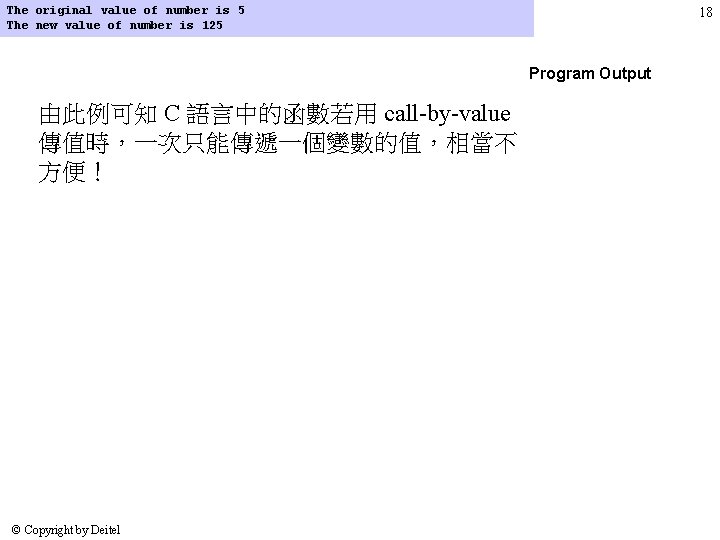
The original value of number is 5 The new value of number is 125 18 Program Output 由此例可知 C 語言中的函數若用 call-by-value 傳值時,一次只能傳遞一個變數的值,相當不 方便! © Copyright by Deitel
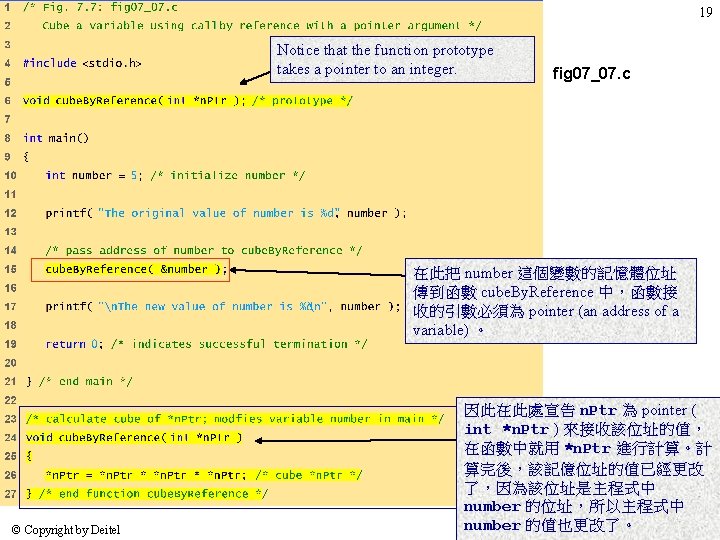
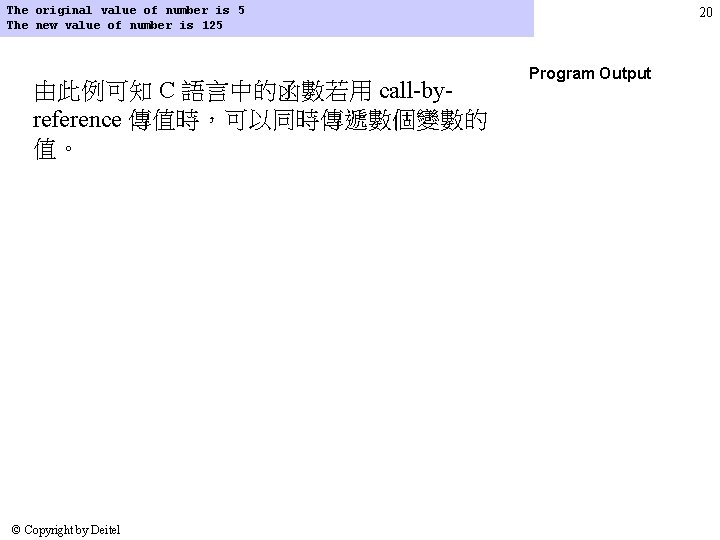
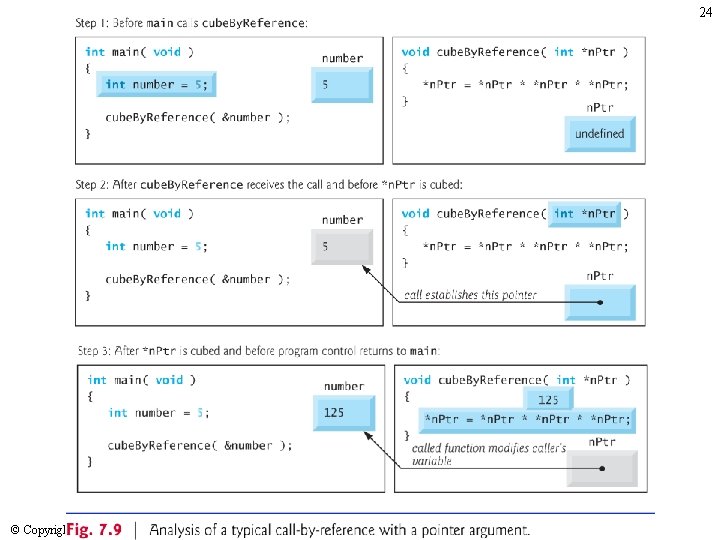
The original value of number is 5 The new value of number is 125 由此例可知 C 語言中的函數若用 call-byreference 傳值時,可以同時傳遞數個變數的 值。 © Copyright by Deitel 20 Program Output
21 © Copyright by Deitel
22 © Copyright by Deitel
23 © Copyright by Deitel
24 © Copyright by Deitel
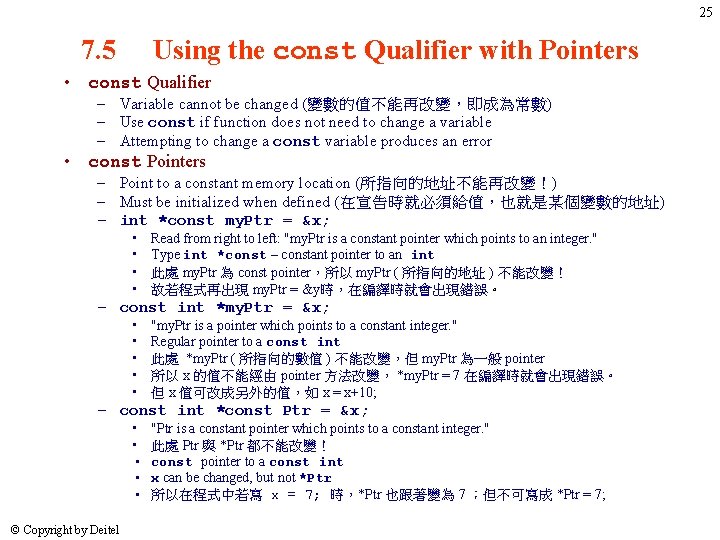
25 7. 5 Using the const Qualifier with Pointers • const Qualifier – Variable cannot be changed (變數的值不能再改變,即成為常數) – Use const if function does not need to change a variable – Attempting to change a const variable produces an error • const Pointers – Point to a constant memory location (所指向的地址不能再改變!) – Must be initialized when defined (在宣告時就必須給值,也就是某個變數的地址) – int *const my. Ptr = &x; • • Read from right to left: "my. Ptr is a constant pointer which points to an integer. " Type int *const – constant pointer to an int 此處 my. Ptr 為 const pointer,所以 my. Ptr ( 所指向的地址 ) 不能改變! 故若程式再出現 my. Ptr = &y時,在編譯時就會出現錯誤。 – const int *my. Ptr = &x; • • • "my. Ptr is a pointer which points to a constant integer. " Regular pointer to a const int 此處 *my. Ptr ( 所指向的數值 ) 不能改變,但 my. Ptr 為一般 pointer 所以 x 的值不能經由 pointer 方法改變, *my. Ptr = 7 在編譯時就會出現錯誤。 但 x 值可改成另外的值,如 x = x+10; – const int *const Ptr = &x; • • • © Copyright by Deitel "Ptr is a constant pointer which points to a constant integer. " 此處 Ptr 與 *Ptr 都不能改變! const pointer to a const int x can be changed, but not *Ptr 所以在程式中若寫 x = 7; 時,*Ptr 也跟著變為 7 ;但不可寫成 *Ptr = 7;
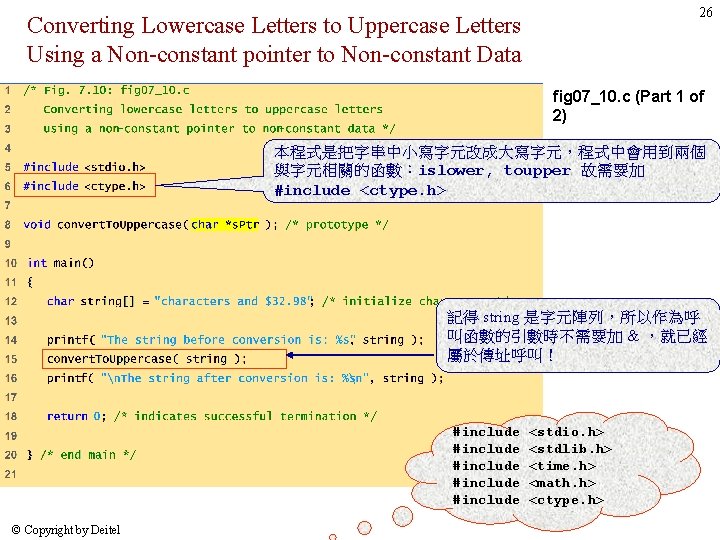
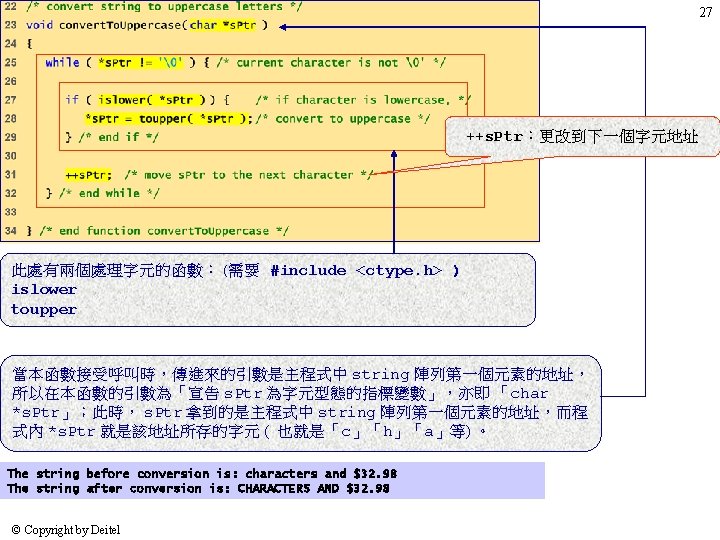
26 Converting Lowercase Letters to Uppercase Letters Using a Non-constant pointer to Non-constant Data fig 07_10. c (Part 1 of 2) 本程式是把字串中小寫字元改成大寫字元,程式中會用到兩個 與字元相關的函數:islower, toupper 故需要加 #include <ctype. h> 記得 string 是字元陣列,所以作為呼 叫函數的引數時不需要加 & ,就已經 屬於傳址呼叫! #include <stdio. h> #include <stdlib. h> #include <time. h> #include <math. h> #include <ctype. h> © Copyright by Deitel
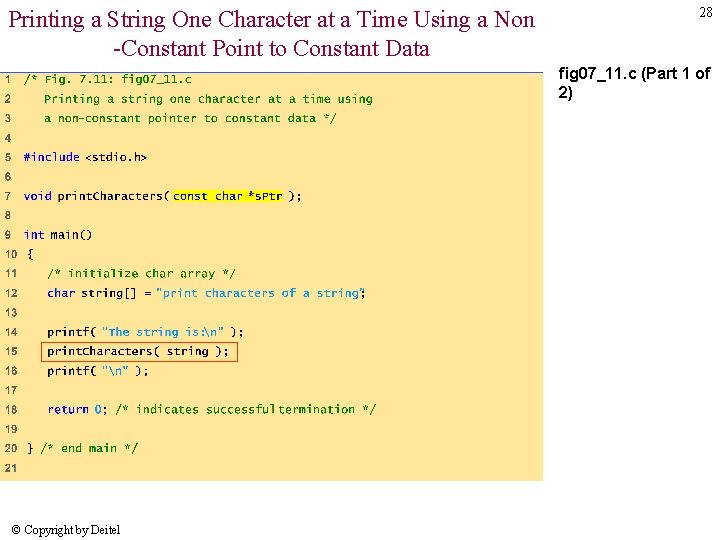
Printing a String One Character at a Time Using a Non -Constant Point to Constant Data 28 fig 07_11. c (Part 1 of 2) © Copyright by Deitel
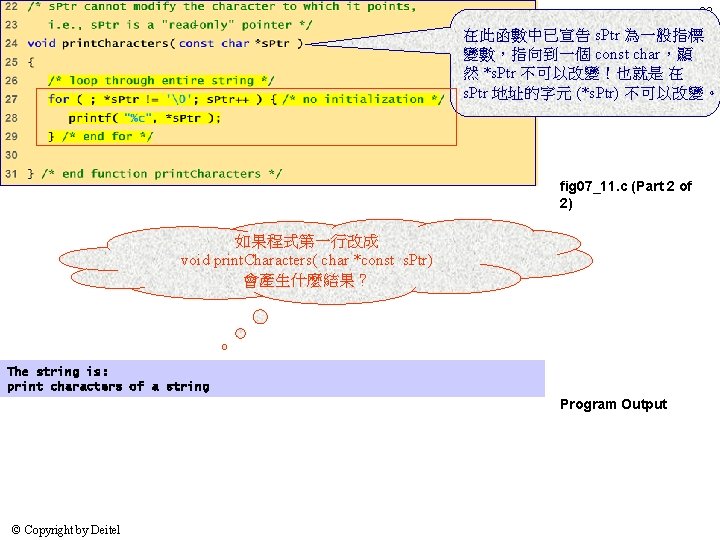
29 在此函數中已宣告 s. Ptr 為一般指標 變數,指向到一個 const char,顯 然 *s. Ptr 不可以改變!也就是 在 s. Ptr 地址的字元 (*s. Ptr) 不可以改變。 fig 07_11. c (Part 2 of 2) 如果程式第一行改成 void print. Characters( char *const s. Ptr) 會產生什麼結果? The string is: print characters of a string Program Output © Copyright by Deitel
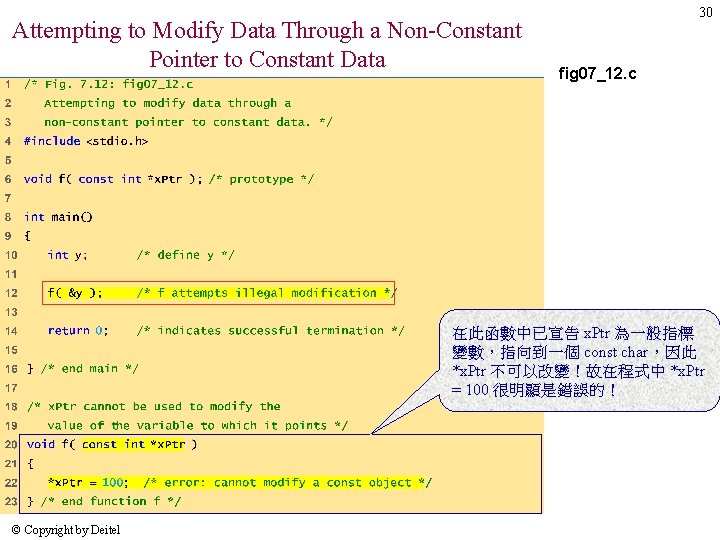
Attempting to Modify Data Through a Non-Constant Pointer to Constant Data 30 fig 07_12. c 在此函數中已宣告 x. Ptr 為一般指標 變數,指向到一個 const char,因此 *x. Ptr 不可以改變!故在程式中 *x. Ptr = 100 很明顯是錯誤的! © Copyright by Deitel
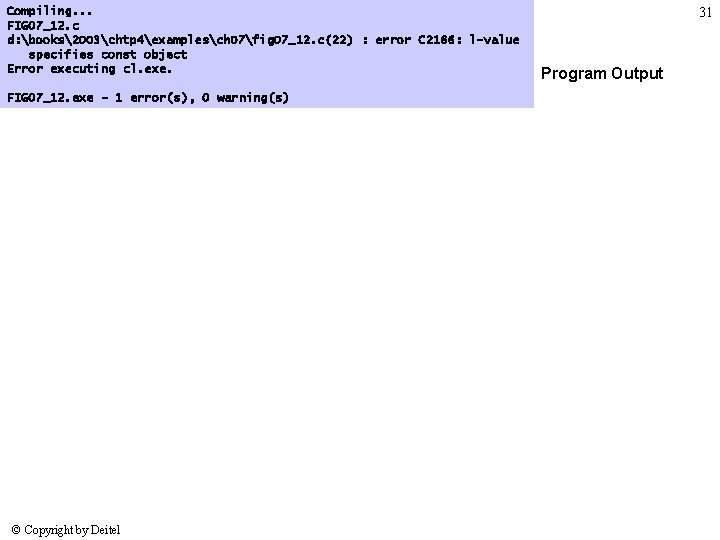
Compiling. . . FIG 07_12. c d: books2003chtp 4examplesch 07fig 07_12. c(22) : error C 2166: l-value specifies const object Error executing cl. exe. FIG 07_12. exe - 1 error(s), 0 warning(s) © Copyright by Deitel 31 Program Output
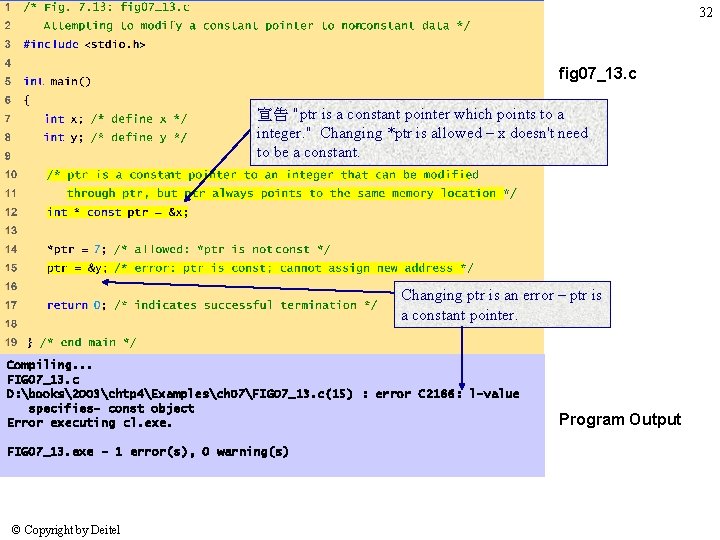
32 fig 07_13. c 宣告 "ptr is a constant pointer which points to a integer. " Changing *ptr is allowed – x doesn't need to be a constant. Changing ptr is an error – ptr is a constant pointer. Compiling. . . FIG 07_13. c D: books2003chtp 4Examplesch 07FIG 07_13. c(15) : error C 2166: l-value specifies const object Error executing cl. exe. FIG 07_13. exe - 1 error(s), 0 warning(s) © Copyright by Deitel Program Output
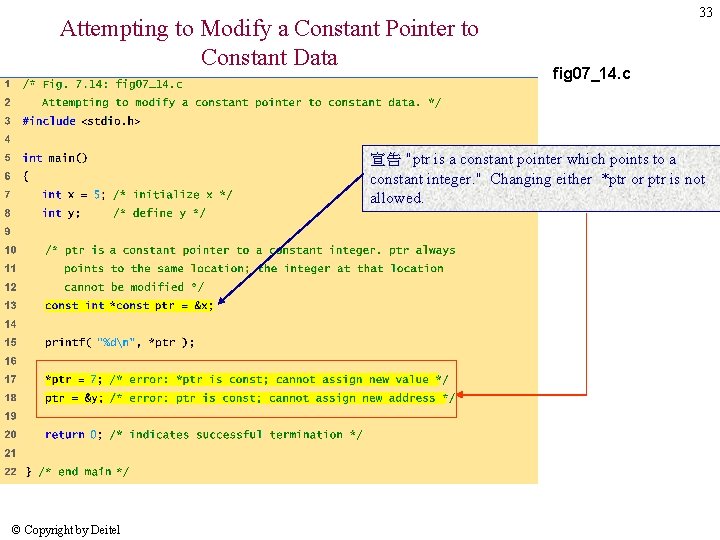
Attempting to Modify a Constant Pointer to Constant Data 33 fig 07_14. c 宣告 "ptr is a constant pointer which points to a constant integer. " Changing either *ptr or ptr is not allowed. © Copyright by Deitel
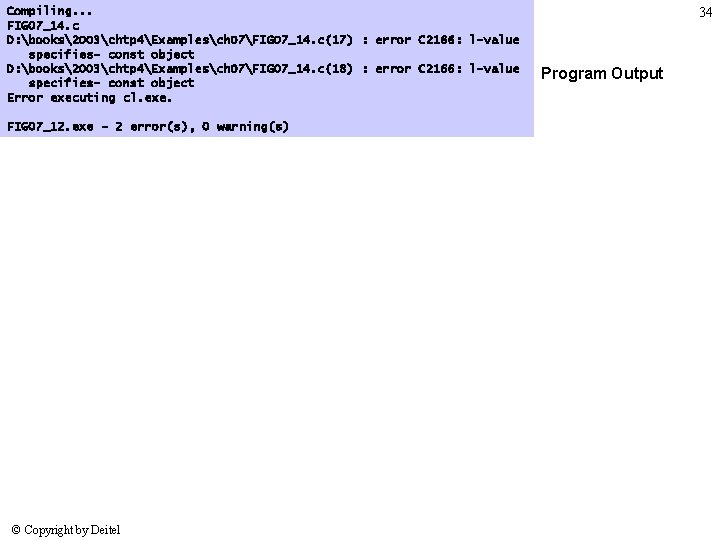
Compiling. . . FIG 07_14. c D: books2003chtp 4Examplesch 07FIG 07_14. c(17) : error C 2166: l-value specifies const object D: books2003chtp 4Examplesch 07FIG 07_14. c(18) : error C 2166: l-value specifies const object Error executing cl. exe. FIG 07_12. exe - 2 error(s), 0 warning(s) © Copyright by Deitel 34 Program Output
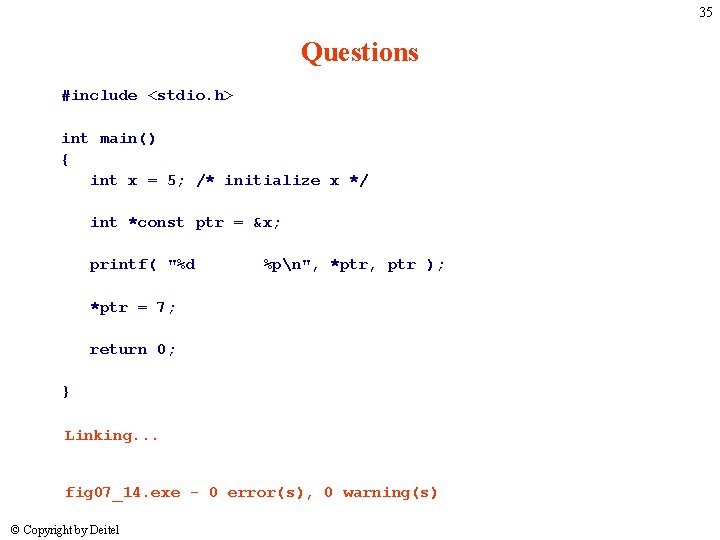
35 Questions #include <stdio. h> int main() { int x = 5; /* initialize x */ int *const ptr = &x; printf( "%d %pn", *ptr, ptr ); *ptr = 7; return 0; } Linking. . . fig 07_14. exe - 0 error(s), 0 warning(s) © Copyright by Deitel
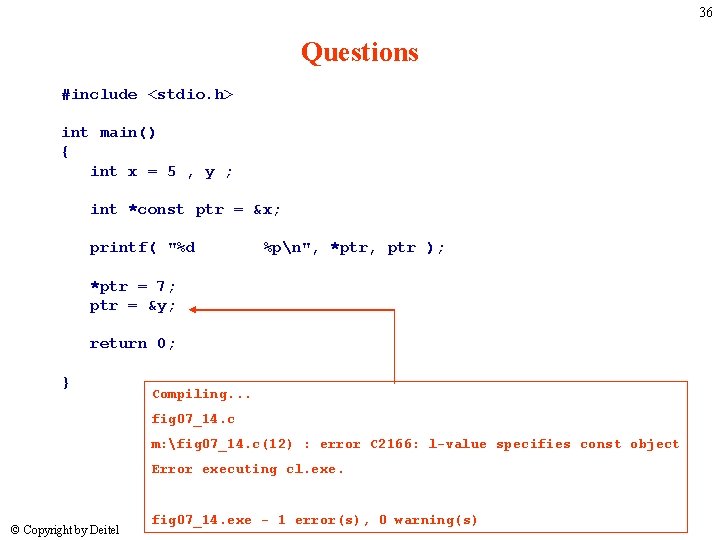
36 Questions #include <stdio. h> int main() { int x = 5 , y ; int *const ptr = &x; printf( "%d %pn", *ptr, ptr ); *ptr = 7; ptr = &y; return 0; } Compiling. . . fig 07_14. c m: fig 07_14. c(12) : error C 2166: l-value specifies const object Error executing cl. exe. © Copyright by Deitel fig 07_14. exe - 1 error(s), 0 warning(s)
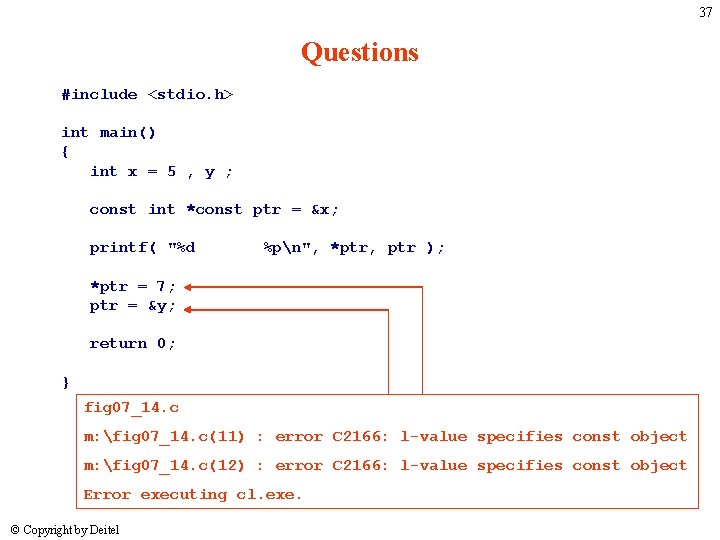
37 Questions #include <stdio. h> int main() { int x = 5 , y ; const int *const ptr = &x; printf( "%d %pn", *ptr, ptr ); *ptr = 7; ptr = &y; return 0; } fig 07_14. c m: fig 07_14. c(11) : error C 2166: l-value specifies const object m: fig 07_14. c(12) : error C 2166: l-value specifies const object Error executing cl. exe. © Copyright by Deitel
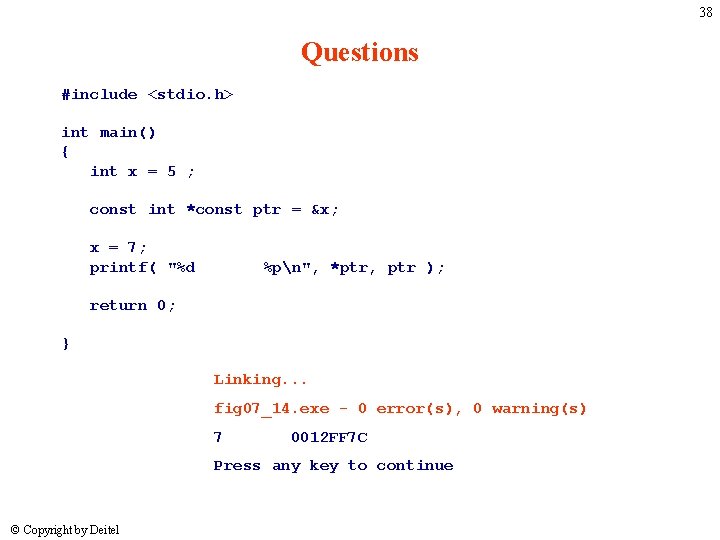
38 Questions #include <stdio. h> int main() { int x = 5 ; const int *const ptr = &x; x = 7; printf( "%d %pn", *ptr, ptr ); return 0; } Linking. . . fig 07_14. exe - 0 error(s), 0 warning(s) 7 0012 FF 7 C Press any key to continue © Copyright by Deitel
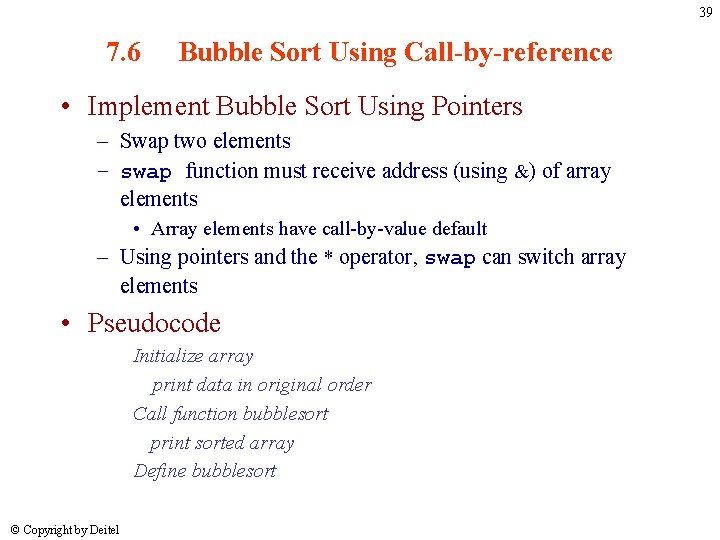
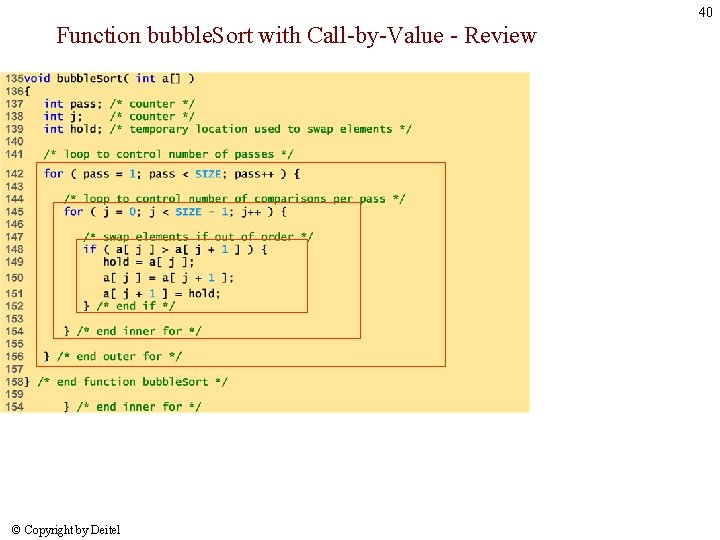
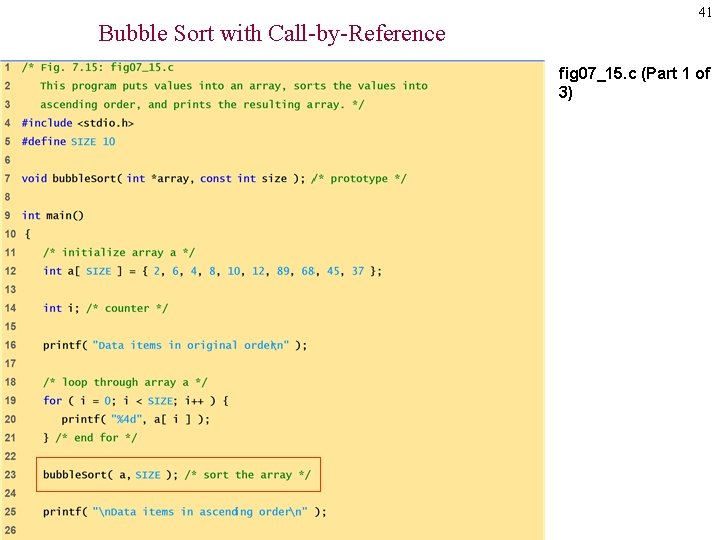
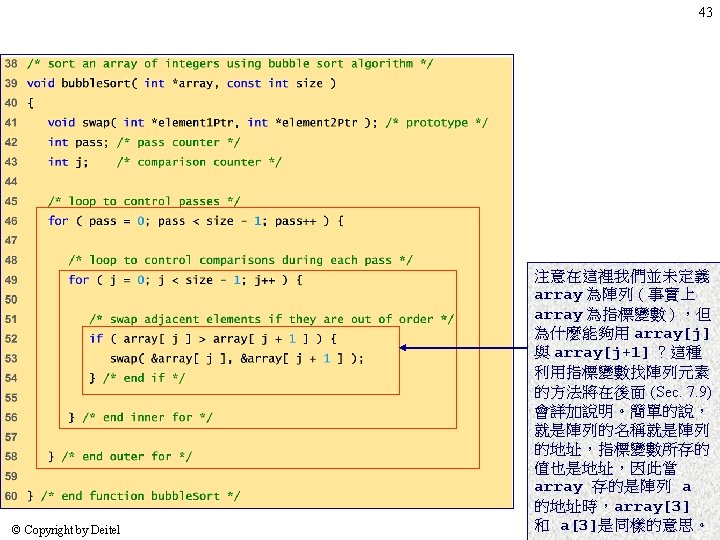
39 7. 6 Bubble Sort Using Call-by-reference • Implement Bubble Sort Using Pointers – Swap two elements – swap function must receive address (using &) of array elements • Array elements have call-by-value default – Using pointers and the * operator, swap can switch array elements • Pseudocode Initialize array print data in original order Call function bubblesort print sorted array Define bubblesort © Copyright by Deitel
40 Function bubble. Sort with Call-by-Value - Review © Copyright by Deitel
Bubble Sort with Call-by-Reference 41 fig 07_15. c (Part 1 of 3) Bubblesort gets passed the address of array elements (pointers). The name of an array is a pointer. © Copyright by Deitel
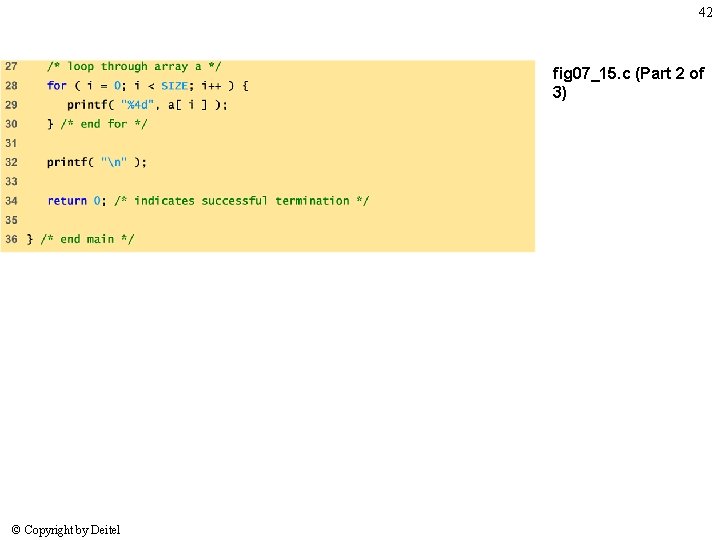
42 fig 07_15. c (Part 2 of 3) © Copyright by Deitel
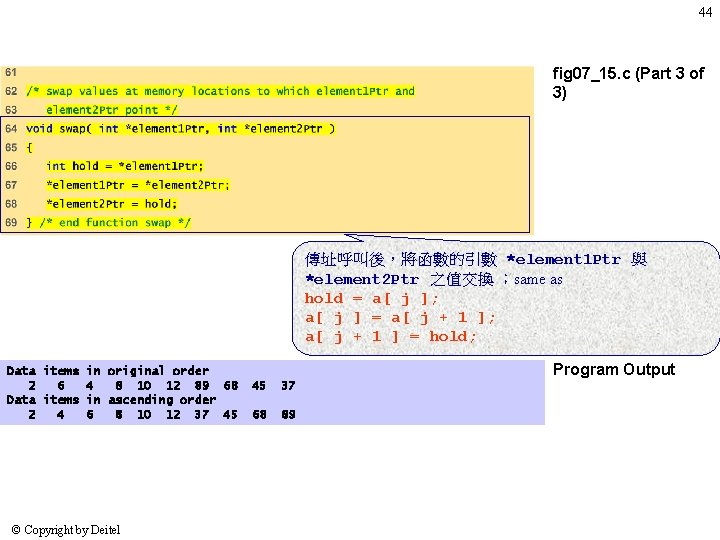
44 fig 07_15. c (Part 3 of 3) 傳址呼叫後,將函數的引數 *element 1 Ptr 與 *element 2 Ptr 之值交換 ;same as hold = a[ j ]; a[ j ] = a[ j + 1 ]; a[ j + 1 ] = hold; Data items in original order 2 6 4 8 10 12 89 68 Data items in ascending order 2 4 6 8 10 12 37 45 © Copyright by Deitel Program Output 45 37 68 89
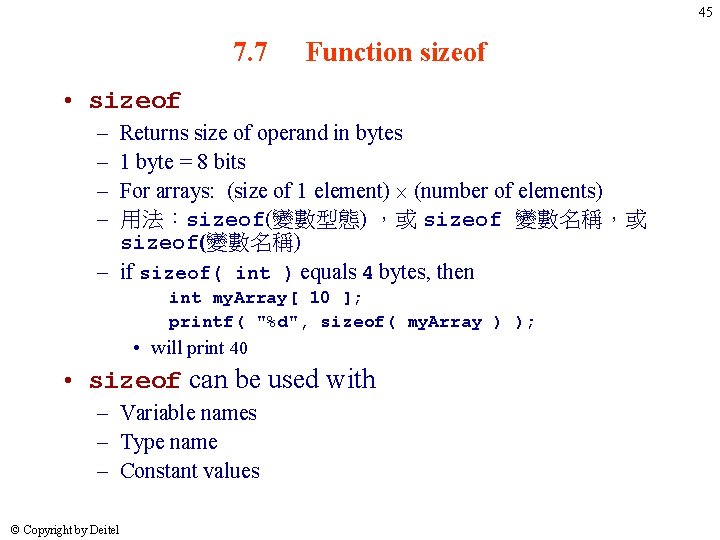
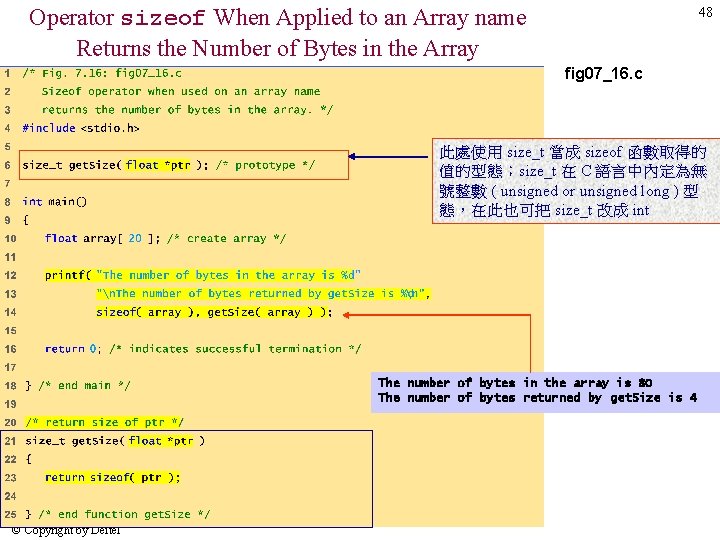
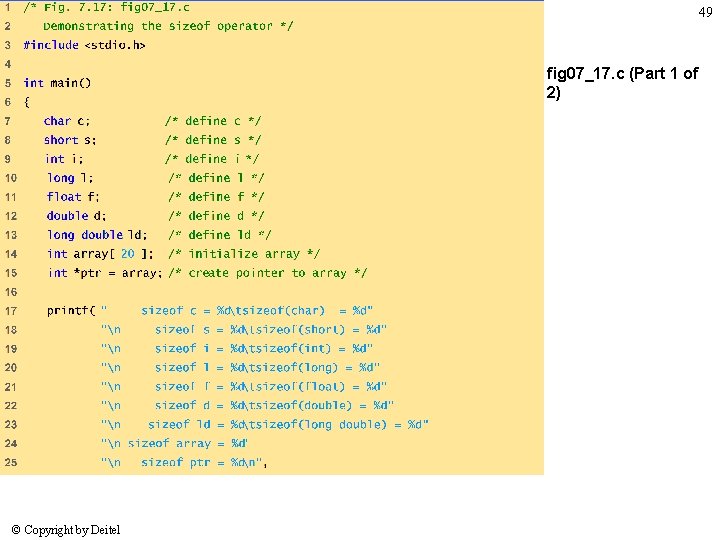
45 7. 7 Function sizeof • sizeof – – Returns size of operand in bytes 1 byte = 8 bits For arrays: (size of 1 element) (number of elements) 用法:sizeof(變數型態) ,或 sizeof 變數名稱,或 sizeof(變數名稱) – if sizeof( int ) equals 4 bytes, then int my. Array[ 10 ]; printf( "%d", sizeof( my. Array ) ); • will print 40 • sizeof can be used with – Variable names – Type name – Constant values © Copyright by Deitel
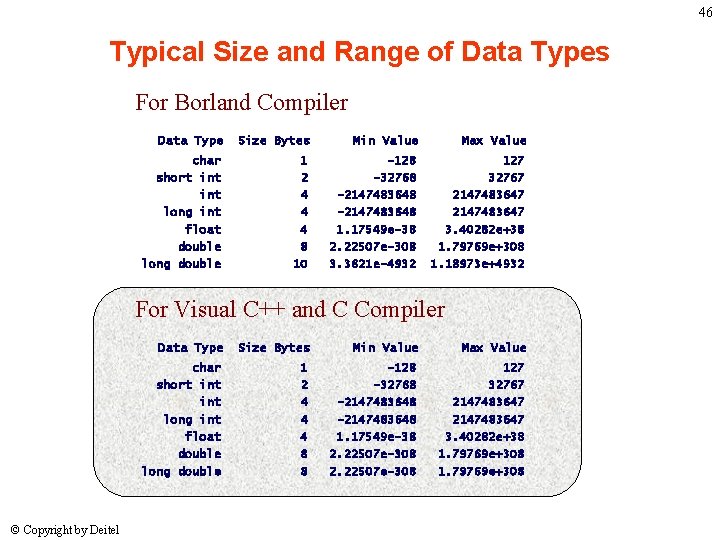
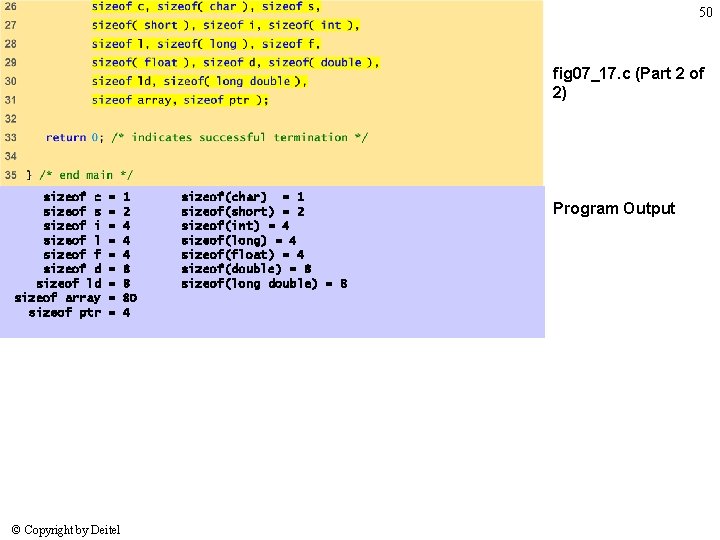
46 Typical Size and Range of Data Types For Borland Compiler Data Type Size Bytes Min Value Max Value char short int long int float double long double 1 2 4 4 4 8 10 -128 -32768 -2147483648 1. 17549 e-38 2. 22507 e-308 3. 3621 e-4932 127 32767 2147483647 3. 40282 e+38 1. 79769 e+308 1. 18973 e+4932 For Visual C++ and C Compiler © Copyright by Deitel Data Type Size Bytes Min Value Max Value char short int long int float double long double 1 2 4 4 4 8 8 -128 -32768 -2147483648 1. 17549 e-38 2. 22507 e-308 127 32767 2147483647 3. 40282 e+38 1. 79769 e+308
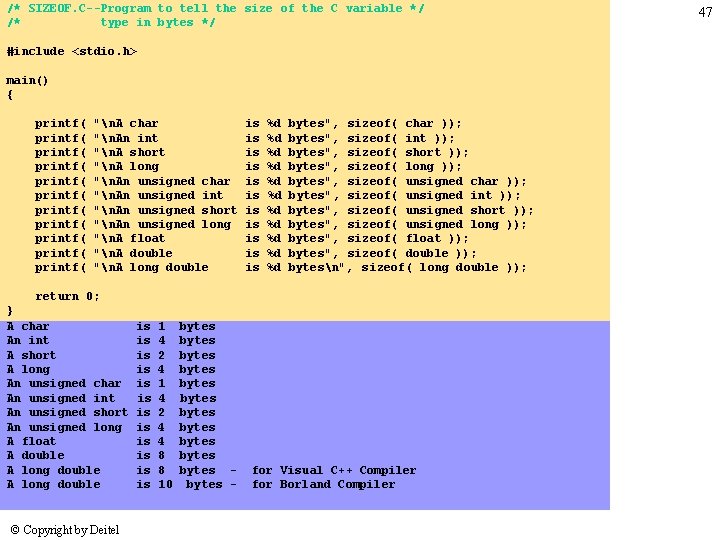
/* SIZEOF. C--Program to tell the size of the C variable */ /* type in bytes */ #include <stdio. h> main() { printf( "n. A char is %d bytes", sizeof( char )); printf( "n. An int is %d bytes", sizeof( int )); printf( "n. A short is %d bytes", sizeof( short )); printf( "n. A long is %d bytes", sizeof( long )); printf( "n. An unsigned char is %d bytes", sizeof( unsigned char )); printf( "n. An unsigned int is %d bytes", sizeof( unsigned int )); printf( "n. An unsigned short is %d bytes", sizeof( unsigned short )); printf( "n. An unsigned long is %d bytes", sizeof( unsigned long )); printf( "n. A float is %d bytes", sizeof( float )); printf( "n. A double is %d bytes", sizeof( double )); printf( "n. A long double is %d bytesn", sizeof( long double )); return 0; } A char is 1 bytes An int is 4 bytes A short is 2 bytes A long is 4 bytes An unsigned char is 1 bytes An unsigned int is 4 bytes An unsigned short is 2 bytes An unsigned long is 4 bytes A float is 4 bytes A double is 8 bytes A long double is 8 bytes - for Visual C++ Compiler A long double is 10 bytes - for Borland Compiler © Copyright by Deitel 47
Operator sizeof When Applied to an Array name Returns the Number of Bytes in the Array 48 fig 07_16. c 此處使用 size_t 當成 sizeof 函數取得的 值的型態;size_t 在 C 語言中內定為無 號整數 ( unsigned or unsigned long ) 型 態,在此也可把 size_t 改成 int The number of bytes in the array is 80 The number of bytes returned by get. Size is 4 © Copyright by Deitel
49 fig 07_17. c (Part 1 of 2) © Copyright by Deitel
50 fig 07_17. c (Part 2 of 2) sizeof c sizeof s sizeof i sizeof l sizeof f sizeof d sizeof ld sizeof array sizeof ptr = = = = = © Copyright by Deitel 1 2 4 4 4 8 8 80 4 sizeof(char) = 1 sizeof(short) = 2 sizeof(int) = 4 sizeof(long) = 4 sizeof(float) = 4 sizeof(double) = 8 sizeof(long double) = 8 Program Output
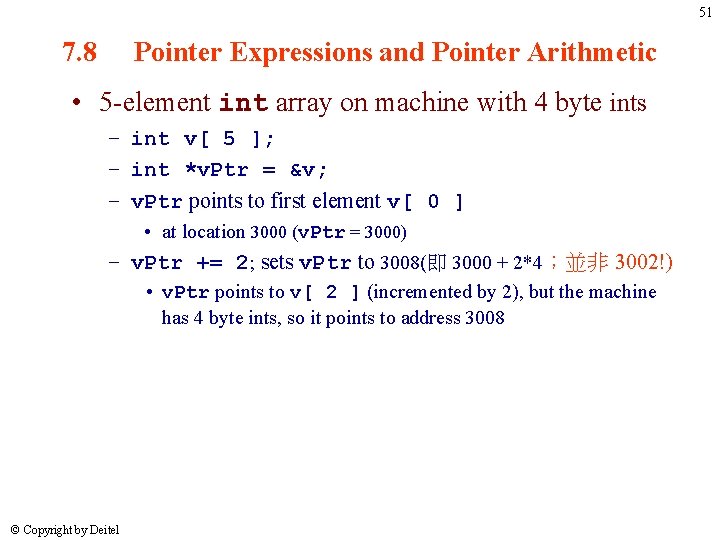
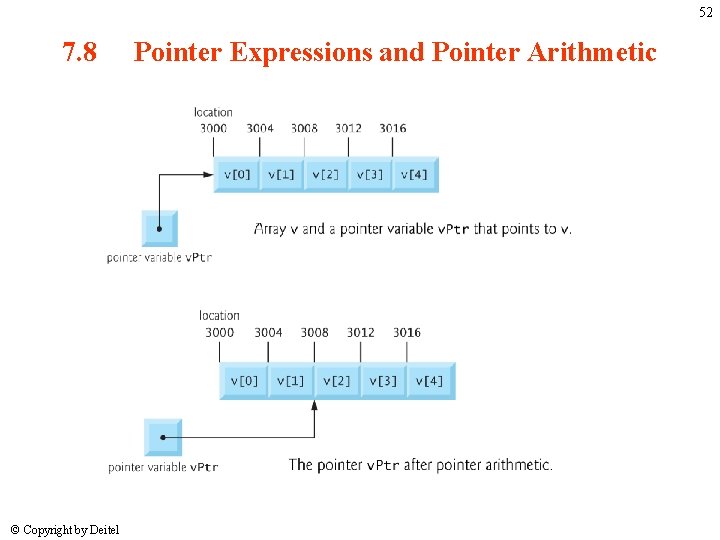
51 7. 8 Pointer Expressions and Pointer Arithmetic • 5 -element int array on machine with 4 byte ints – int v[ 5 ]; – int *v. Ptr = &v; – v. Ptr points to first element v[ 0 ] • at location 3000 (v. Ptr = 3000) – v. Ptr += 2; sets v. Ptr to 3008(即 3000 + 2*4;並非 3002!) • v. Ptr points to v[ 2 ] (incremented by 2), but the machine has 4 byte ints, so it points to address 3008 © Copyright by Deitel
52 7. 8 © Copyright by Deitel Pointer Expressions and Pointer Arithmetic
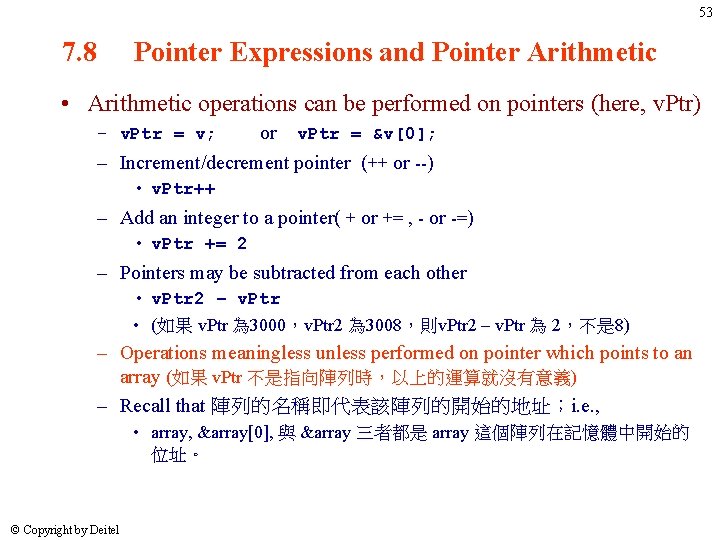
53 7. 8 Pointer Expressions and Pointer Arithmetic • Arithmetic operations can be performed on pointers (here, v. Ptr) – v. Ptr = v; or v. Ptr = &v[0]; – Increment/decrement pointer (++ or --) • v. Ptr++ – Add an integer to a pointer( + or += , - or -=) • v. Ptr += 2 – Pointers may be subtracted from each other • v. Ptr 2 – v. Ptr • (如果 v. Ptr 為 3000,v. Ptr 2 為 3008,則v. Ptr 2 – v. Ptr 為 2,不是 8) – Operations meaningless unless performed on pointer which points to an array (如果 v. Ptr 不是指向陣列時,以上的運算就沒有意義) – Recall that 陣列的名稱即代表該陣列的開始的地址;i. e. , • array, &array[0], 與 &array 三者都是 array 這個陣列在記憶體中開始的 位址。 © Copyright by Deitel
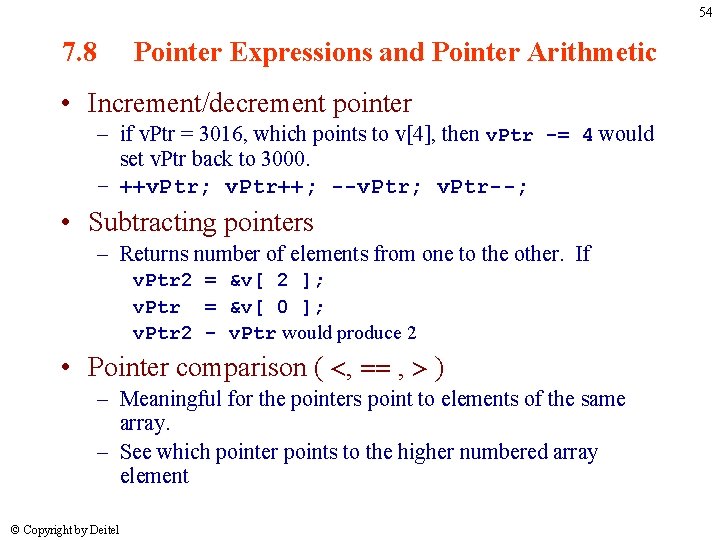
54 7. 8 Pointer Expressions and Pointer Arithmetic • Increment/decrement pointer – if v. Ptr = 3016, which points to v[4], then v. Ptr -= 4 would set v. Ptr back to 3000. – ++v. Ptr; v. Ptr++; --v. Ptr; v. Ptr--; • Subtracting pointers – Returns number of elements from one to the other. If v. Ptr 2 = &v[ 2 ]; v. Ptr = &v[ 0 ]; v. Ptr 2 - v. Ptr would produce 2 • Pointer comparison ( <, == , > ) – Meaningful for the pointers point to elements of the same array. – See which pointer points to the higher numbered array element © Copyright by Deitel
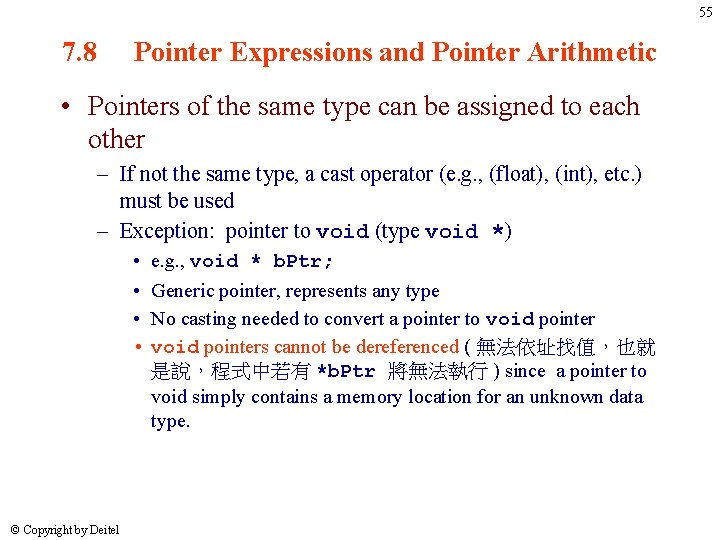
55 7. 8 Pointer Expressions and Pointer Arithmetic • Pointers of the same type can be assigned to each other – If not the same type, a cast operator (e. g. , (float), (int), etc. ) must be used – Exception: pointer to void (type void *) • e. g. , void * b. Ptr; • Generic pointer, represents any type • No casting needed to convert a pointer to void pointer • void pointers cannot be dereferenced ( 無法依址找值,也就 是說,程式中若有 *b. Ptr 將無法執行 ) since a pointer to void simply contains a memory location for an unknown data type. © Copyright by Deitel
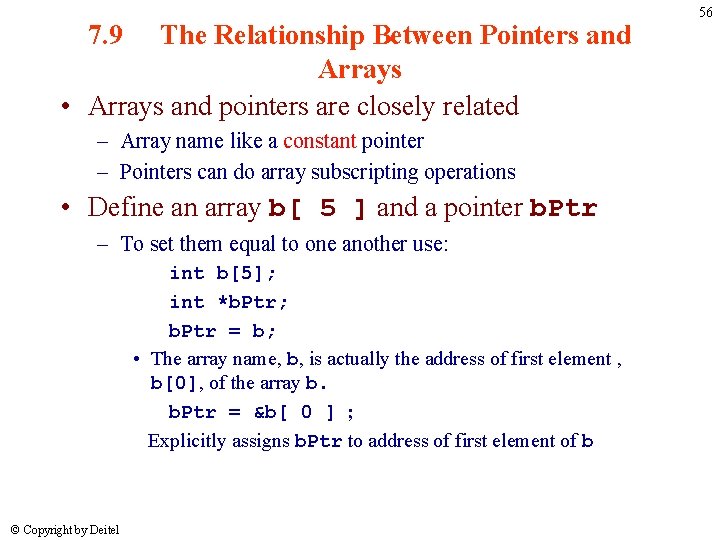
7. 9 The Relationship Between Pointers and Arrays • Arrays and pointers are closely related – Array name like a constant pointer – Pointers can do array subscripting operations • Define an array b[ 5 ] and a pointer b. Ptr – To set them equal to one another use: int b[5]; int *b. Ptr; b. Ptr = b; • The array name, b, is actually the address of first element , b[0], of the array b. b. Ptr = &b[ 0 ] ; Explicitly assigns b. Ptr to address of first element of b © Copyright by Deitel 56
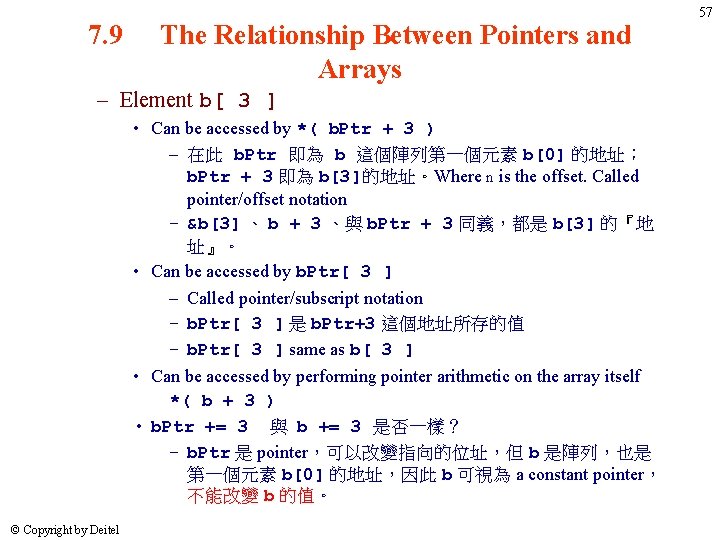
7. 9 The Relationship Between Pointers and Arrays – Element b[ 3 ] • Can be accessed by *( b. Ptr + 3 ) – 在此 b. Ptr 即為 b 這個陣列第一個元素 b[0] 的地址; b. Ptr + 3 即為 b[3]的地址。Where n is the offset. Called pointer/offset notation – &b[3] 、 b + 3 、與 b. Ptr + 3 同義,都是 b[3] 的『地 址』。 • Can be accessed by b. Ptr[ 3 ] – Called pointer/subscript notation – b. Ptr[ 3 ] 是 b. Ptr+3 這個地址所存的值 – b. Ptr[ 3 ] same as b[ 3 ] • Can be accessed by performing pointer arithmetic on the array itself *( b + 3 ) • b. Ptr += 3 與 b += 3 是否一樣? – b. Ptr 是 pointer,可以改變指向的位址,但 b 是陣列,也是 第一個元素 b[0] 的地址,因此 b 可視為 a constant pointer, 不能改變 b 的值。 © Copyright by Deitel 57
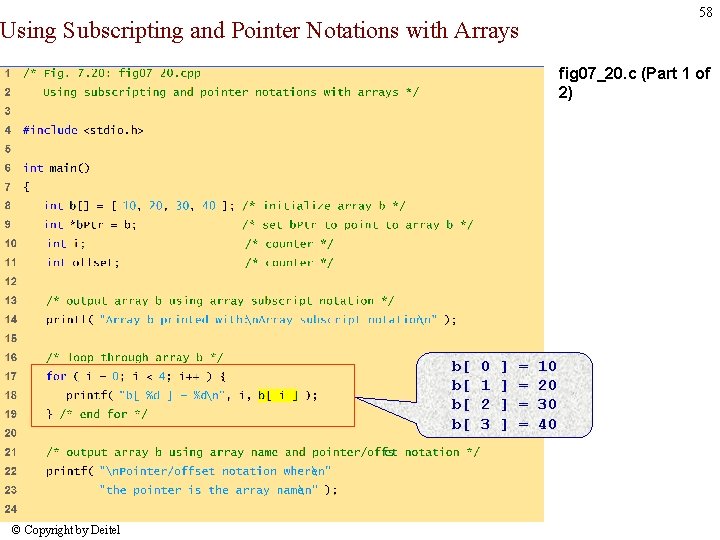
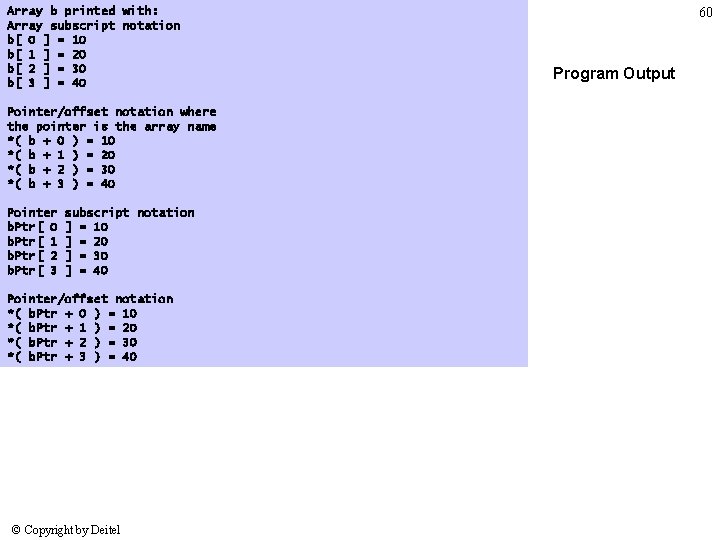
Using Subscripting and Pointer Notations with Arrays 58 fig 07_20. c (Part 1 of 2) b[ 0 ] = 10 b[ 1 ] = 20 b[ 2 ] = 30 b[ 3 ] = 40 © Copyright by Deitel
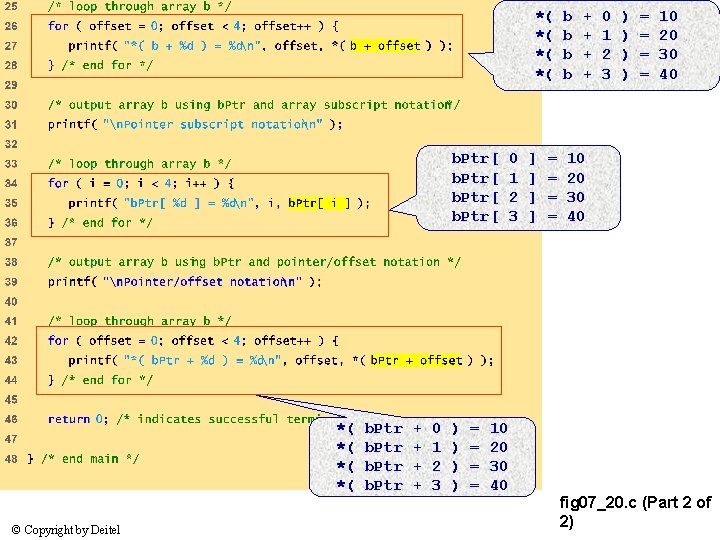
*( b + 0 ) = 10 *( b + 1 ) = 20 *( b + 2 ) = 30 *( b + 3 ) = 40 59 b. Ptr[ 0 ] = 10 b. Ptr[ 1 ] = 20 b. Ptr[ 2 ] = 30 b. Ptr[ 3 ] = 40 *( b. Ptr + 0 ) = 10 *( b. Ptr + 1 ) = 20 *( b. Ptr + 2 ) = 30 *( b. Ptr + 3 ) = 40 © Copyright by Deitel fig 07_20. c (Part 2 of 2)
Array b printed with: Array subscript notation b[ 0 ] = 10 b[ 1 ] = 20 b[ 2 ] = 30 b[ 3 ] = 40 Pointer/offset notation where the pointer is the array name *( b + 0 ) = 10 *( b + 1 ) = 20 *( b + 2 ) = 30 *( b + 3 ) = 40 Pointer subscript notation b. Ptr[ 0 ] = 10 b. Ptr[ 1 ] = 20 b. Ptr[ 2 ] = 30 b. Ptr[ 3 ] = 40 Pointer/offset notation *( b. Ptr + 0 ) = 10 *( b. Ptr + 1 ) = 20 *( b. Ptr + 2 ) = 30 *( b. Ptr + 3 ) = 40 © Copyright by Deitel 60 Program Output
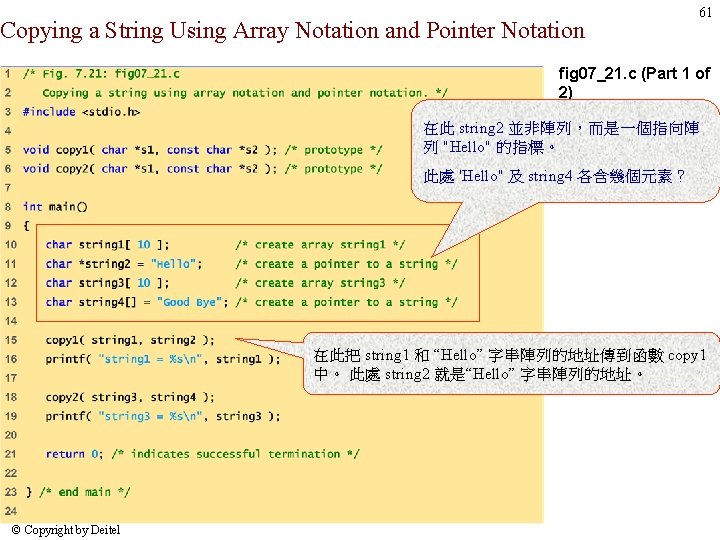
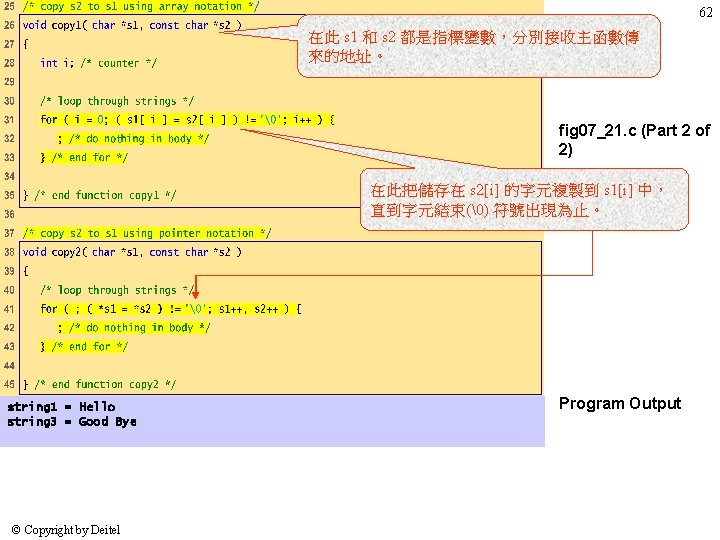
Copying a String Using Array Notation and Pointer Notation 61 fig 07_21. c (Part 1 of 2) 在此 string 2 並非陣列,而是一個指向陣 列 "Hello" 的指標。 此處 'Hello" 及 string 4 各含幾個元素? 在此把 string 1 和 “Hello” 字串陣列的地址傳到函數 copy 1 中。 此處 string 2 就是“Hello” 字串陣列的地址。 © Copyright by Deitel
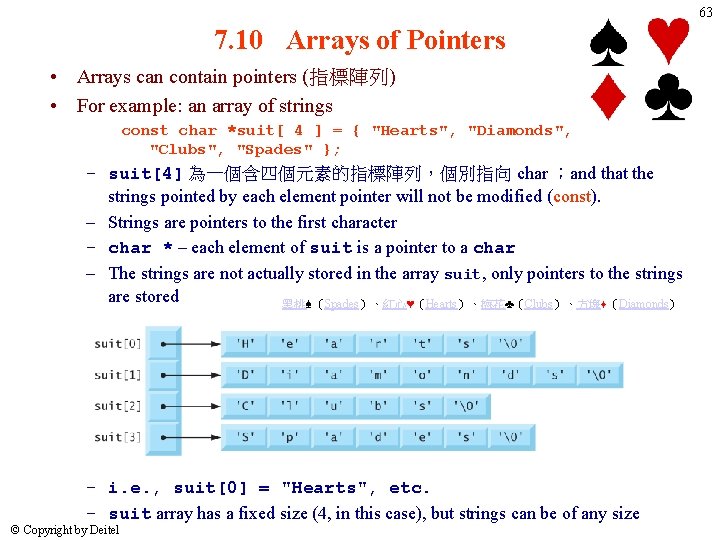
63 7. 10 Arrays of Pointers • Arrays can contain pointers (指標陣列) • For example: an array of strings const char *suit[ 4 ] = { "Hearts", "Diamonds", "Clubs", "Spades" }; – suit[4] 為一個含四個元素的指標陣列,個別指向 char ;and that the strings pointed by each element pointer will not be modified (const). – Strings are pointers to the first character – char * – each element of suit is a pointer to a char – The strings are not actually stored in the array suit, only pointers to the strings are stored 黑桃♠(Spades)、紅心♥(Hearts)、梅花♣(Clubs)、方塊♦(Diamonds) – i. e. , suit[0] = "Hearts", etc. – suit array has a fixed size (4, in this case), but strings can be of any size © Copyright by Deitel
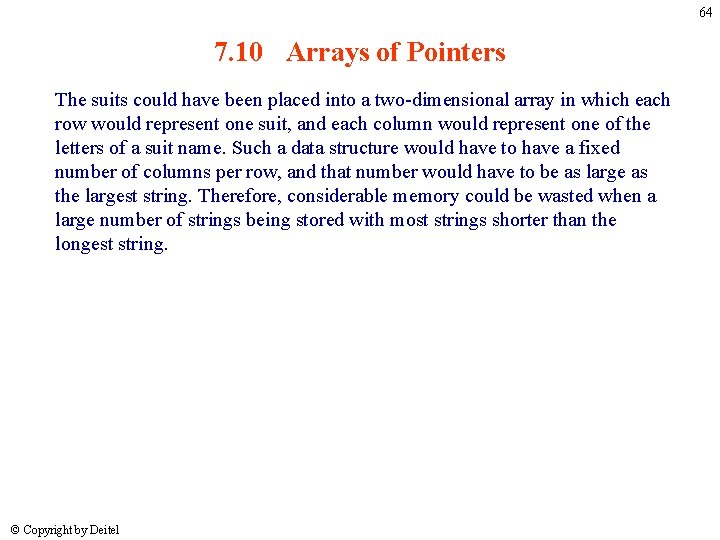
64 7. 10 Arrays of Pointers The suits could have been placed into a two-dimensional array in which each row would represent one suit, and each column would represent one of the letters of a suit name. Such a data structure would have to have a fixed number of columns per row, and that number would have to be as large as the largest string. Therefore, considerable memory could be wasted when a large number of strings being stored with most strings shorter than the longest string. © Copyright by Deitel
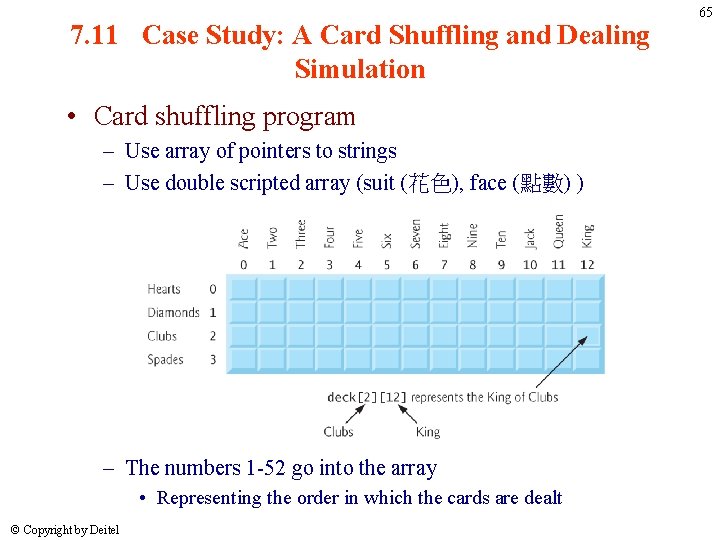
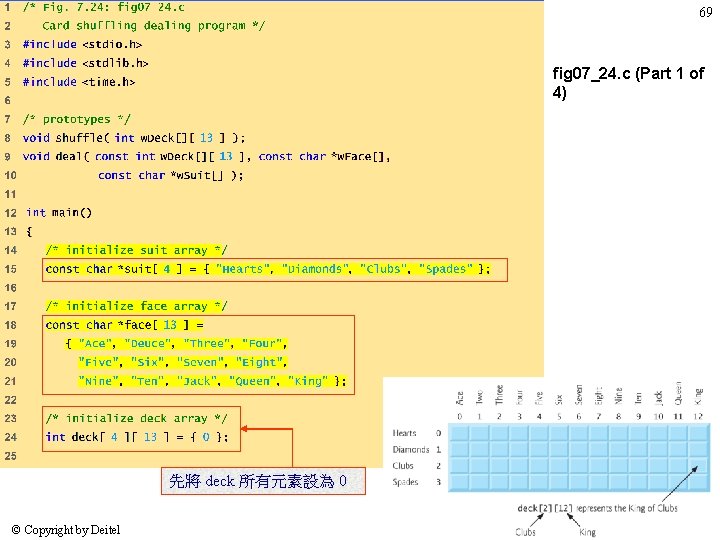
7. 11 Case Study: A Card Shuffling and Dealing Simulation • Card shuffling program – Use array of pointers to strings – Use double scripted array (suit (花色), face (點數) ) – The numbers 1 -52 go into the array • Representing the order in which the cards are dealt © Copyright by Deitel 65
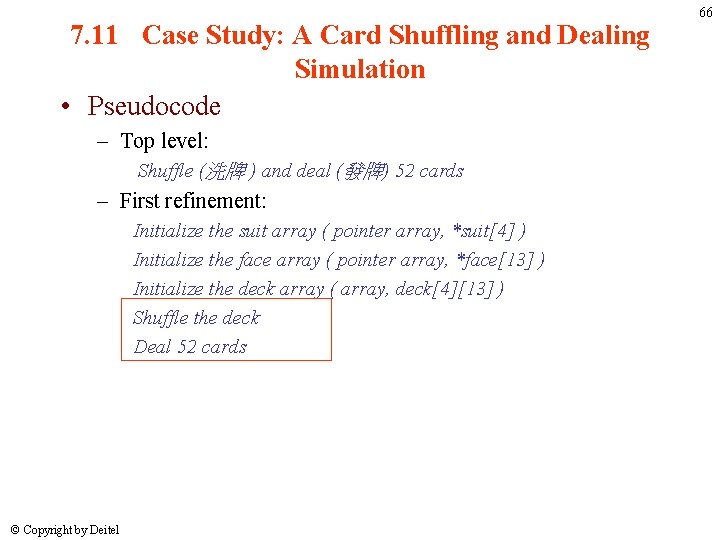
7. 11 Case Study: A Card Shuffling and Dealing Simulation • Pseudocode – Top level: Shuffle (洗牌 ) and deal (發牌) 52 cards – First refinement: Initialize the suit array ( pointer array, *suit[4] ) Initialize the face array ( pointer array, *face[13] ) Initialize the deck array ( array, deck[4][13] ) Shuffle the deck Deal 52 cards © Copyright by Deitel 66
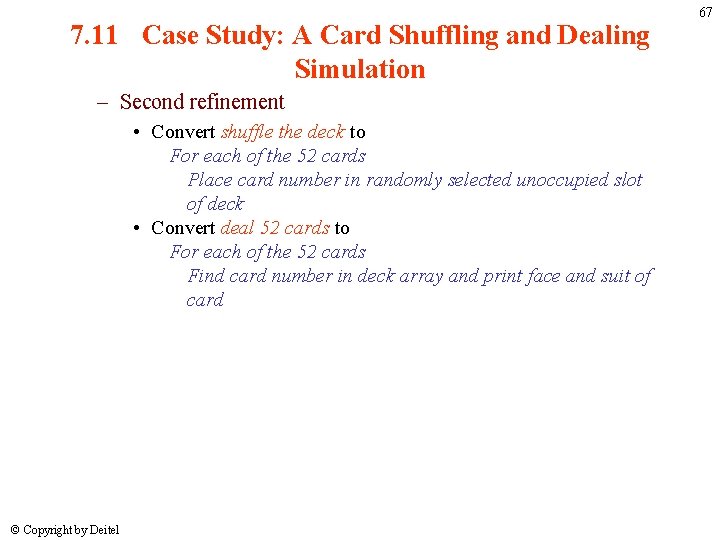
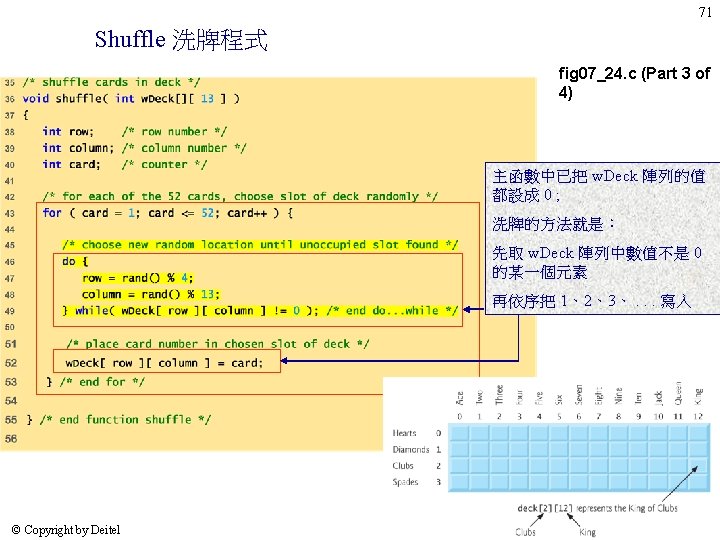
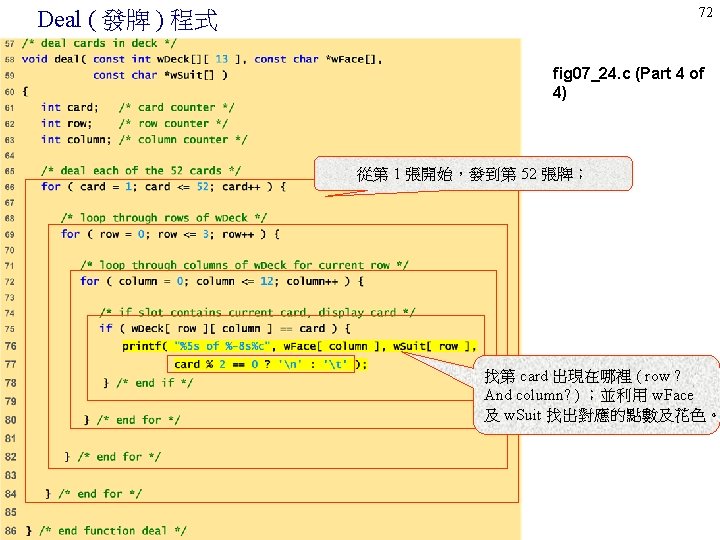
7. 11 Case Study: A Card Shuffling and Dealing Simulation – Second refinement • Convert shuffle the deck to For each of the 52 cards Place card number in randomly selected unoccupied slot of deck • Convert deal 52 cards to For each of the 52 cards Find card number in deck array and print face and suit of card © Copyright by Deitel 67
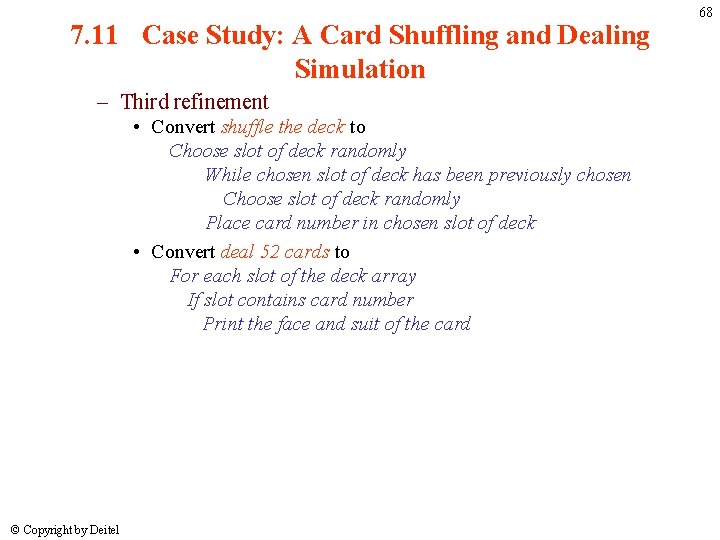
7. 11 Case Study: A Card Shuffling and Dealing Simulation – Third refinement • Convert shuffle the deck to Choose slot of deck randomly While chosen slot of deck has been previously chosen Choose slot of deck randomly Place card number in chosen slot of deck • Convert deal 52 cards to For each slot of the deck array If slot contains card number Print the face and suit of the card © Copyright by Deitel 68
69 fig 07_24. c (Part 1 of 4) 先將 deck 所有元素設為 0 © Copyright by Deitel
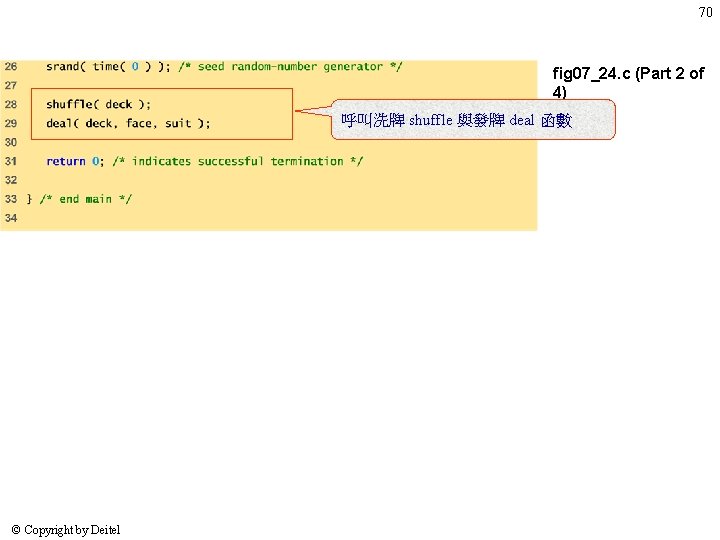
70 fig 07_24. c (Part 2 of 4) 呼叫洗牌 shuffle 與發牌 deal 函數 © Copyright by Deitel
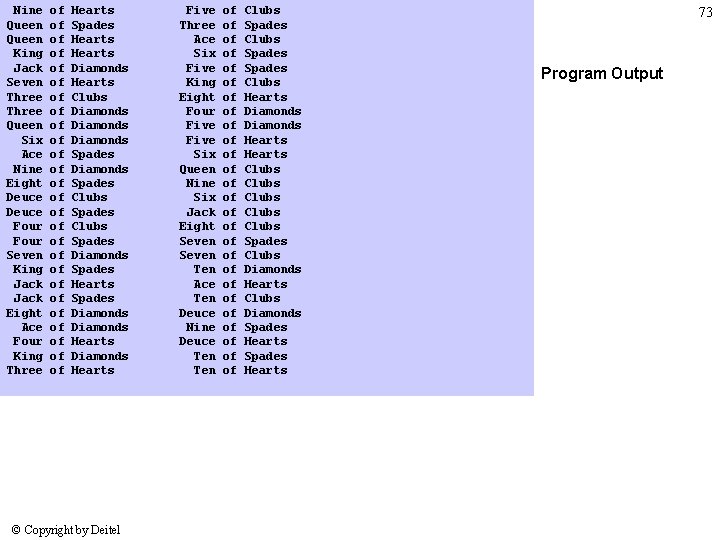
Nine of Hearts Five of Clubs Queen of Spades Three of Spades Queen of Hearts Ace of Clubs King of Hearts Six of Spades Jack of Diamonds Five of Spades Seven of Hearts King of Clubs Three of Clubs Eight of Hearts Three of Diamonds Four of Diamonds Queen of Diamonds Five of Diamonds Six of Diamonds Five of Hearts Ace of Spades Six of Hearts Nine of Diamonds Queen of Clubs Eight of Spades Nine of Clubs Deuce of Clubs Six of Clubs Deuce of Spades Jack of Clubs Four of Clubs Eight of Clubs Four of Spades Seven of Spades Seven of Diamonds Seven of Clubs King of Spades Ten of Diamonds Jack of Hearts Ace of Hearts Jack of Spades Ten of Clubs Eight of Diamonds Deuce of Diamonds Ace of Diamonds Nine of Spades Four of Hearts Deuce of Hearts King of Diamonds Ten of Spades Three of Hearts Ten of Hearts © Copyright by Deitel 73 Program Output
74 7. 12 Pointers to Functions • Pointer to function – 前面已談到,陣列的名稱是陣列中第一個(編號為 0) 的元素在 記憶體中的位置,相同的,函數的名稱是記憶體中函數儲存 的開始位置。Similar to how array name is address of first element, function name is starting address of code that defines function – 指標也可以指向函數 (function) ;指向函數時,就是指向函數 在記憶體中開始的位址。 – Contains address of function • Pointers to function can be – – – © Copyright by Deitel 就像一般的指標變數;可以: Passed to functions Returned from functions Stored in arrays Assigned to other function pointers
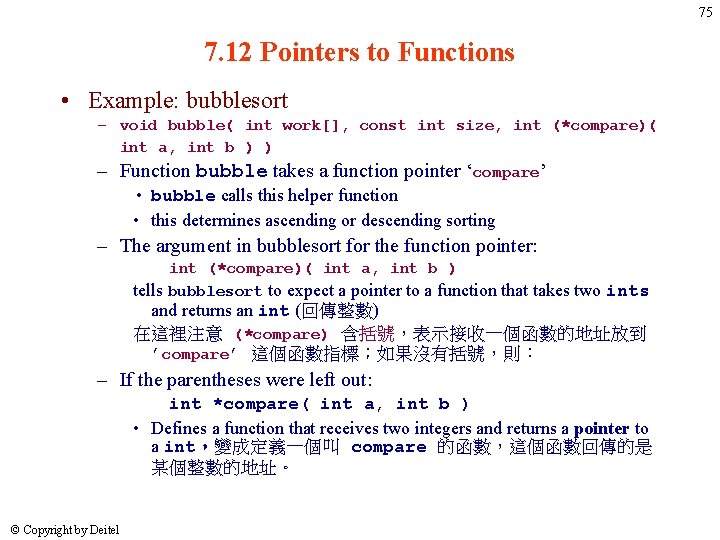
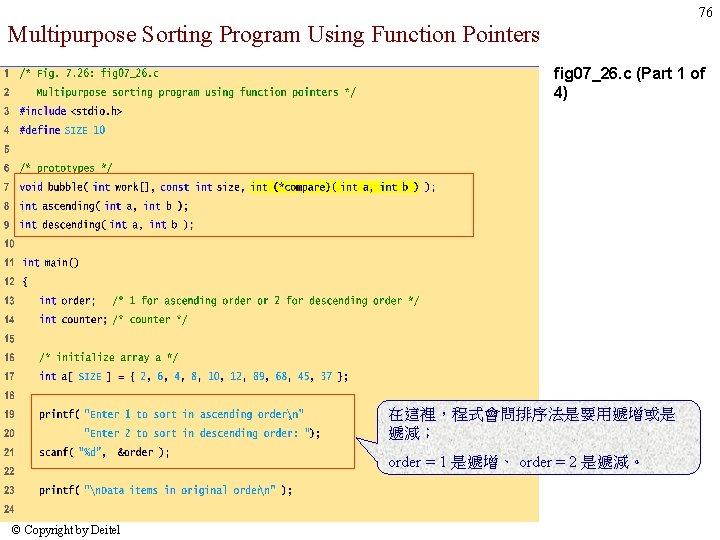
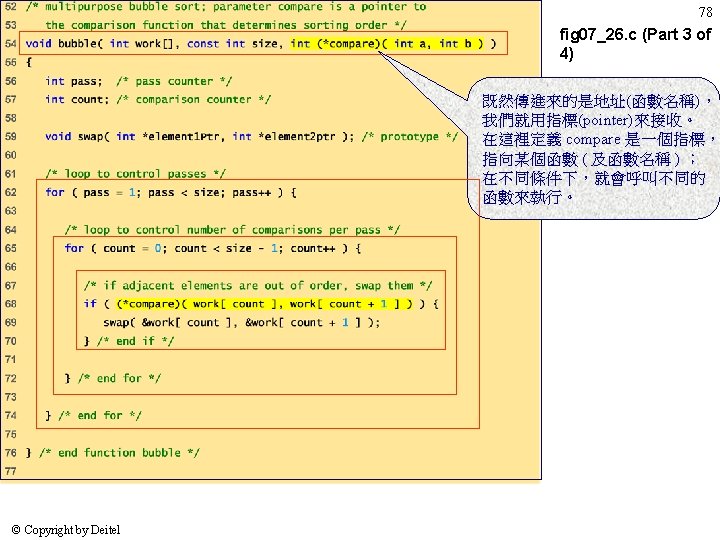
75 7. 12 Pointers to Functions • Example: bubblesort – void bubble( int work[], const int size, int (*compare)( int a, int b ) ) – Function bubble takes a function pointer ‘compare’ • bubble calls this helper function • this determines ascending or descending sorting – The argument in bubblesort for the function pointer: int (*compare)( int a, int b ) tells bubblesort to expect a pointer to a function that takes two ints and returns an int (回傳整數) 在這裡注意 (*compare) 含括號,表示接收一個函數的地址放到 ’compare’ 這個函數指標;如果沒有括號,則: – If the parentheses were left out: int *compare( int a, int b ) • Defines a function that receives two integers and returns a pointer to a int,變成定義一個叫 compare 的函數,這個函數回傳的是 某個整數的地址。 © Copyright by Deitel
76 Multipurpose Sorting Program Using Function Pointers fig 07_26. c (Part 1 of 4) 在這裡,程式會問排序法是要用遞增或是 遞減; order = 1 是遞增、 order = 2 是遞減。 © Copyright by Deitel
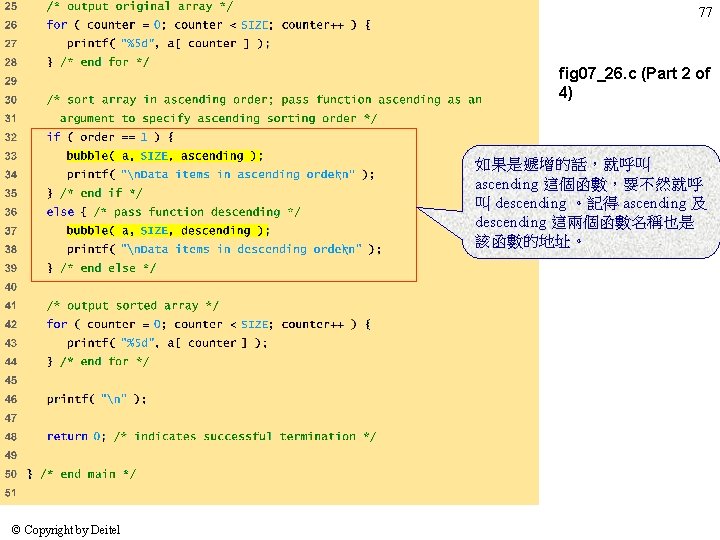
77 fig 07_26. c (Part 2 of 4) 如果是遞增的話,就呼叫 ascending 這個函數,要不然就呼 叫 descending 。記得 ascending 及 descending 這兩個函數名稱也是 該函數的地址。 © Copyright by Deitel
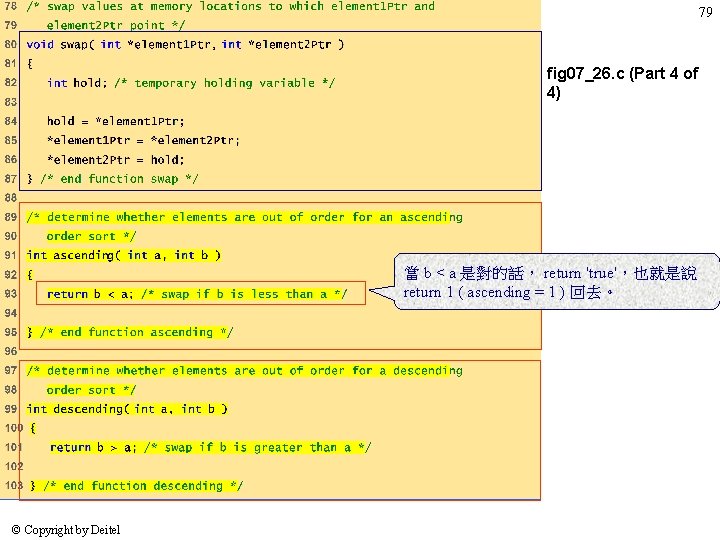
79 fig 07_26. c (Part 4 of 4) 當 b < a 是對的話, return 'true',也就是說 return 1 ( ascending = 1 ) 回去。 © Copyright by Deitel
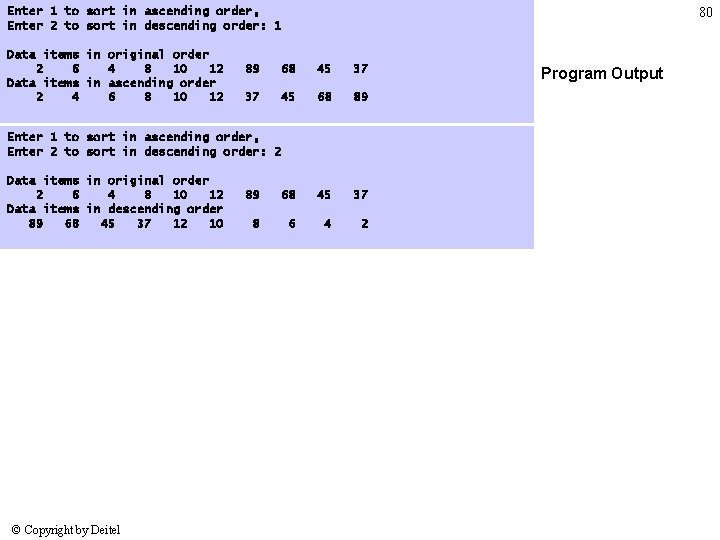
sort in ascending order, sort in descending order: 1 Enter 1 to Enter 2 to Data items 2 6 Data items 89 68 sort in ascending order, sort in descending order: 2 80 Enter 1 to Enter 2 to Data items 2 6 Data items 2 4 in original order 4 8 10 12 in ascending order 6 8 10 12 in original order 4 8 10 12 in descending order 45 37 12 10 © Copyright by Deitel 89 68 45 37 37 45 68 89 68 45 37 8 6 4 2 Program Output
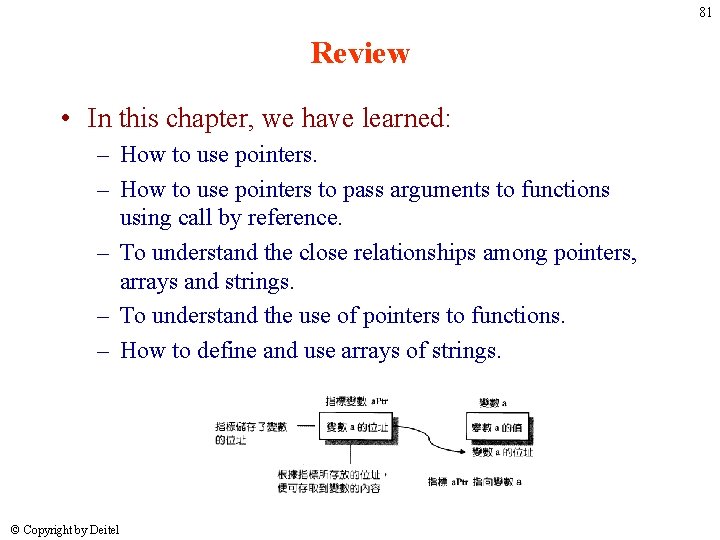
81 Review • In this chapter, we have learned: – How to use pointers to pass arguments to functions using call by reference. – To understand the close relationships among pointers, arrays and strings. – To understand the use of pointers to functions. – How to define and use arrays of strings. © Copyright by Deitel
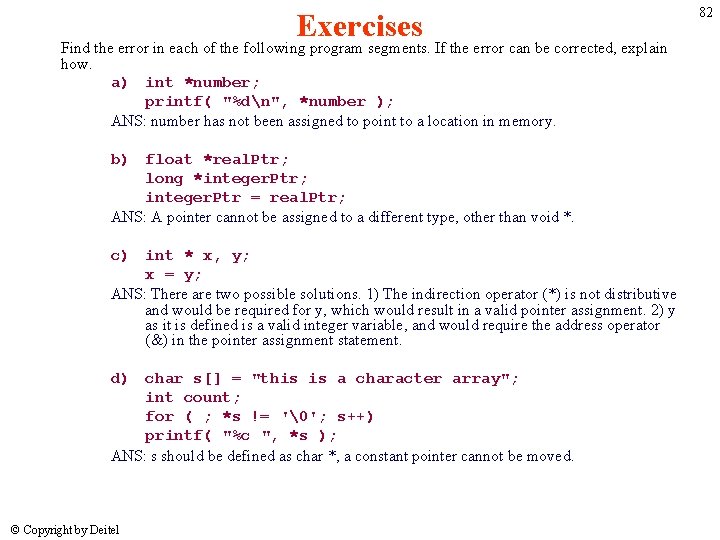
Exercises Find the error in each of the following program segments. If the error can be corrected, explain how. a) int *number; printf( "%dn", *number ); ANS: number has not been assigned to point to a location in memory. b) float *real. Ptr; long *integer. Ptr; integer. Ptr = real. Ptr; ANS: A pointer cannot be assigned to a different type, other than void *. c) int * x, y; x = y; ANS: There are two possible solutions. 1) The indirection operator (*) is not distributive and would be required for y, which would result in a valid pointer assignment. 2) y as it is defined is a valid integer variable, and would require the address operator (&) in the pointer assignment statement. d) char s[] = "this is a character array"; int count; for ( ; *s != ''; s++) printf( "%c ", *s ); ANS: s should be defined as char *, a constant pointer cannot be moved. © Copyright by Deitel 82
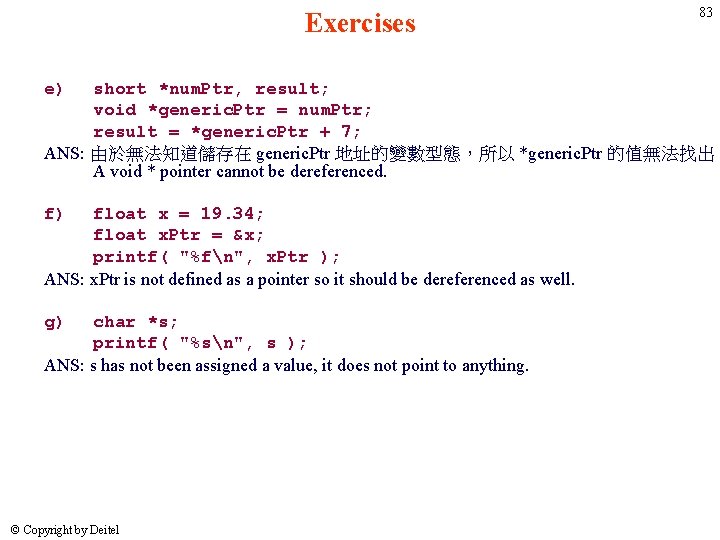
Exercises 83 e) short *num. Ptr, result; void *generic. Ptr = num. Ptr; result = *generic. Ptr + 7; ANS: 由於無法知道儲存在 generic. Ptr 地址的變數型態,所以 *generic. Ptr 的值無法找出。 A void * pointer cannot be dereferenced. f) float x = 19. 34; float x. Ptr = &x; printf( "%fn", x. Ptr ); ANS: x. Ptr is not defined as a pointer so it should be dereferenced as well. g) char *s; printf( "%sn", s ); ANS: s has not been assigned a value, it does not point to anything. © Copyright by Deitel