Yvonne Fulmore The Coexistence of Work and Play
- Slides: 19
Yvonne Fulmore The Coexistence of Work and Play in Academia Educational/Serious Gaming and the Educational System
Yvonne Fulmore What Makes a Game “Educational” or “Serious”? • The clearly established goal of the gamer to learn new academic (educational games) or training-based (serious games) content. • Have academic or training-based content as the focus of gameplay. • Educational games make use of “immersive entertainment” to disperse new content in an approachable way (Zyda 27. )
Yvonne Fulmore The Necessary Ingredients for Building Educational/Serious Games “Interest is the key to learning” (Lewin 273. ) Elements that are needed when building serious games (Kelly et al. 46): • Collaboration. Many experts must work together to produce the game. • Game Design. Games must be entertaining/engaging. • Integration. Students must have a way to ask questions and have them answered. • Multiple Scales. There must be different angles from which to view the learned material.
Yvonne Fulmore Video Games and Learning • “Video games stimulate chemical changes in the brain that promote learning. ” ~Merrilea J. Mayo, as quoted by Michael Zyda, p. 28. • “A child rehearses what he or she has learned through play” (Sutton-Smith 37. ) • If children enjoy the experience, it will foster an interest in learning: a focus on creating a game that “children [will] demand to play even in their spare time” (Zyda 28. )
Yvonne Fulmore Some Skepticism About Impacts of Gaming on Learning • Sutton-Smith: the tutorial stimulation effect and experimenter effects (Sutton-Smith 40 -41. ) • Arguable example: Middle school girls and the game Supercharged (Mayo 34. ) – Control group and game group received instruction and handouts. • Game group given Supercharged to play during class time. • Game group’s test scores went up by 23% as opposed to control group’s 5%. • Another angle: it has shown growth in terms of understanding, regardless of the control group’s lack of access to a third source.
Yvonne Fulmore Topics to Consider • Should video games be used as a substitute for the current educational system? • Could video games be a hostile introduction to the classroom? • Who should be the target audience for educational/serious video games?
Yvonne Fulmore Should Video Game Education Replace Academic Settings? • Zyda’s argument: “My crazy dream is that someday we'll replace the education system everywhere with emotion-cognizant video games that children demand to play even in their spare time” (Zyda 28. ) • Zyda advocates (Zyda 28): – Games that are aware of human cognition processes/states of learning – Games that adapt to different levels of student learning – The reduction of the current educational system to “a tutoring service for questions and answers not yet incorporated into the online edusphere [educational atmosphere]. ”
Yvonne Fulmore What Would Video Games Lend to a Classroom Setting? • Introduction to new material. • Reinforcement of learned material. • Encouraging necessary academic practices and skills. • If immersive entertainment: could encourage outside research on topic and foster greater interest within students. – – – Alice 2. 0 increases academic success and retention rate of at-risk college freshmen who either enter college with no programming experience or are not prepared to enroll in a calculus course (Kelleher & Pausch 61. ) By using a video game as “homework” for a course: “students [were] spending roughly twice the time working on the course outside of class compared to other mechanical engineering courses” (Mayo 34. ) Reading of introductory text: “Players who fail to read the information have difficulty winning action games and is itself another important lesson” (Kelly et al. 48. ) Video games “give teachers and parents the ability to reach students where they live, bypassing many of the challenges of restructuring the educational system from the inside out” (Mayo 33. ) In the case of Storytelling Alice: “they [the students] were three times more likely to sneak extra time after we had called ‘time up’ to continue working on their programs” (Kelleher & Pausch 63. )
Yvonne Fulmore When Should Video Games Remain Outside of the Classroom? • When they are clearly a source of agitation for students: – “Competition increases anxiety in pupils who are performing a motor-steadiness test” (Johnson, Bryant 173) – “It is also proven that subjects [students] in a competitively-structured discussion are more anxious. They lose self-assurance, show more self-oriented needs, are less able in recitation and more dissatisfied with discussion” (173. )
Yvonne Fulmore The Necessity of Keeping the Playground (Not Play) Outside of the Classroom • Cooperative learning has been proven to enhance learning by 50% when compared to individualized or competitive learning (Mayo 33. ) – Example: Massive multiplayer online games (33. ) • Turning the classroom into the playground with the introduction of playground hierarchies (Sutton-Smith 44. ) – Can boost self-esteem of winning students, but can negatively impact selfesteem of less successful ones. • Sutton-Smith on playground play: “patterns of negative attachment correlate with dysfunctional playground relationships” (44. ) • Solution: keep video games individualized or cooperative—either let one student play at a time or encourage cooperative group play.
Yvonne Fulmore Educational/Serious Games: The Concept of All-inclusive Gaming • Educational games: serve as direct microcosms of society – Have different standards than games that exist within fantasy worlds. • Purpose of informing about unknown content rather than creating something entirely fictional. – Examples: Immune Attack (teaches immunology to college students), Squire’s Quest (teaches healthy eating habits to 4 th grade children), Virtual Cell (teaches biology to college students) ~Mayo 34 -35. – Having an audience looking to be educated = the opportunity to promote awareness. • What inclusive games are expected to consider: – Society’s demographics: age, gender, race, class, etc. – Cost and system compatibility. • “Certain games (such as The Sims) and styles of games (free, downloadable, casual) have attracted a female demographic in the 60%– 80% range” (Mayo 33. )
Yvonne Fulmore What Happens When Exclusion Occurs? • Intel Flash “advergame” developed in the UK, 2004: – Intel IT Manager Game: The simulation of an IT department – Frasca on omission of female employees in this game: a “cultural bug—one that only affects serious games” (Frasca 5. ) • Some argue that inclusion prevents creativity and promotes censorship – • Blogger commenting on IT Manager game being pulled for fixing, as quoted in Frasca article: “examples like this [game] keep companies and products from being developed over fear of being ‘politically incorrect’” ~Frasca quoting D. Dooler, ¶ 6 In order to most successfully teach everyone, it is necessary for these games to appeal to all members of society within the level of education (3 rd grader, 10 th grader, undergraduate college student, etc. ) – Frasca on games that educate as a “cultural product”: “As such, it can reflect ideas and values. Hopefully, those should be the ideas and values that designers actually want to convey” (13. )
Yvonne Fulmore The Benefits of Inclusive Games in Education • Educational/serious games as different from entertainment games: Fable versus IT Manager. – Frasca: “Unlike what happens in the fantasy world of Fable, gender inequality is a very real problem for IT workers” (Frasca 10. ) • Creating all-inclusive educational games helps some members of groups who are often left out of the world of games to better identify with games.
Yvonne Fulmore Using Education to Attract Potential Gamers • Adding diversity to the field (for sake of field member and/or profit growth. ) • Using a game-creating program to increase the interest of middle-school girls in computer programming: Storytelling Alice (a program used to teach object-oriented programming to middle-school girls. ) – “Creating an animated movie and learning to program a computer can be fundamentally the same activity” (Kelleher & Pausch 60. ) – Incorporates “high-level” 3 -D animations and characters, storybased tutorials, and support for the creation of complex scenes (61 -2. )
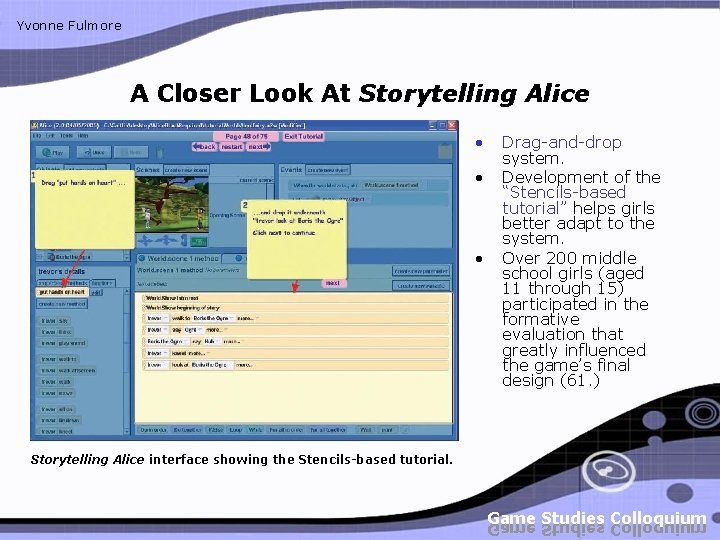
Yvonne Fulmore A Closer Look At Storytelling Alice • • • Storytelling Alice interface showing the Stencils-based tutorial. Drag-and-drop system. Development of the “Stencils-based tutorial” helps girls better adapt to the system. Over 200 middle school girls (aged 11 through 15) participated in the formative evaluation that greatly influenced the game’s final design (61. )
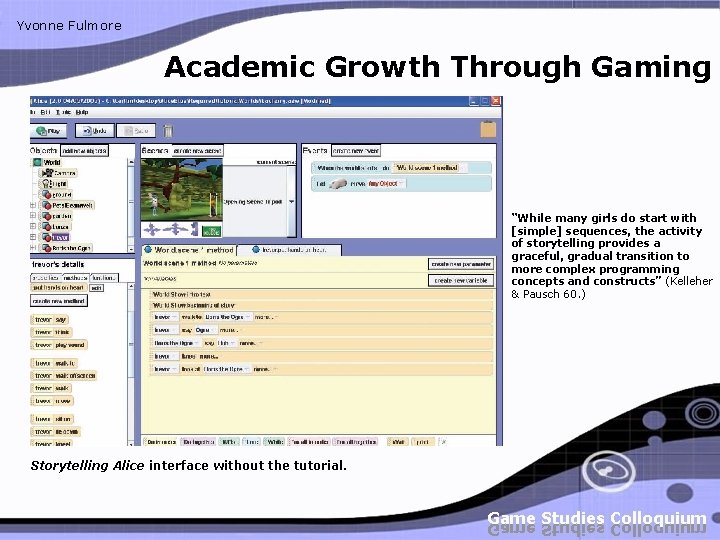
Yvonne Fulmore Academic Growth Through Gaming “While many girls do start with [simple] sequences, the activity of storytelling provides a graceful, gradual transition to more complex programming concepts and constructs” (Kelleher & Pausch 60. ) Storytelling Alice interface without the tutorial.
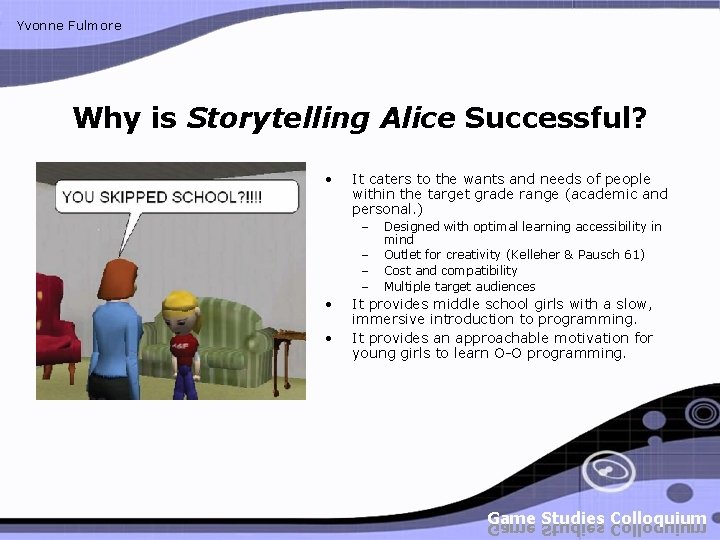
Yvonne Fulmore Why is Storytelling Alice Successful? • It caters to the wants and needs of people within the target grade range (academic and personal. ) – – • • Designed with optimal learning accessibility in mind Outlet for creativity (Kelleher & Pausch 61) Cost and compatibility Multiple target audiences It provides middle school girls with a slow, immersive introduction to programming. It provides an approachable motivation for young girls to learn O-O programming.
Yvonne Fulmore Educational Games: How They Can Best Benefit Academia • Video games should be a supplement—not a substitute—for classroom learning. • Play—not the playground—can benefit the academic learning environment. • Educational and serious games need to be culturally all-inclusive to be most successful.
Yvonne Fulmore Works Cited • • • • Frasca, Gonzalo. “Playing with Fire: When Advergaming Backfires. ” www. ludology. org Johnson, Roger & Johnson, David & Bryant, Brenda. “Cooperation and Competition in the Classroom. ” The Elementary School Journal, Vol. 74, No. 3. (Dec. 1973), pp. 172 -181. Kelleher, Caitlin & Pausch, Randy. “Using Storytelling to Motivate Programming. ” Communications of the ACM, Volume 50, Number 7 (2007), pp. 58 -64. Kelly, Henry & Howell, Kay & Glinert, Eitan & Holding, Loring & Swain, Chris & Burrowbridge, Adam & Roper, Michelle. “How to Build Serious Games, ” Communications of the ACM, Volume 50, Number 7 (2007), pp. 44 -49. Kilgore, Susan. “Bridges from Content Experts to Novice Learners in 21 st-Century Classrooms. ” Rocky Mountain Review of Language and Literature, Vol. 58, No. 2. (2004), pp. 63 -70. Lewin, Ann White. “Down with Green Lambs: Creating Quality Software for Children. ” Theory into Practice, Vol. 22, No. 4, Microcomputers: A Revolution in Learning. (Autumn 1983), pp. 272 -280. Mayo, Merrilea J. “Games For Science and Engineering Education, ” Communications of the ACM, Volume 50, Number 7 (2007), pp. 30 -35. Sutton-Smith, Brian. The Ambiguity of Play. Harvard University Press, Cambridge: 2001. pp. 37, 41, 44. Wardrip-Fruin & Harrigan, Pat, ed. “Videogames of the Oppressed, ” Gonzalo Frasca. First Person: New Media as Story, Performance, and Game. Massachusetts Institute of Technology, Cambridge: 2004. p. 93. Wardrip-Fruin & Harrigan, Pat, ed. “Representation, Enaction, and the Ethics of Simulation, ” Simon Penny. First Person: New Media as Story, Performance, and Game. Massachusetts Institute of Technology, Cambridge: 2004. p. 80. Zyda, Michael. “Creating a Science of Games. ” Communications of the ACM, Volume 50, Number 7 (2007), pp. 26 -29. Storytelling Alice and Alice 2. 0 can be downloaded from www. alice. org Virtual Cell can be downloaded/registered for at http: //vcell. ndsu. edu/public. html