WRC Adjudication and Mediation Service James Kelly Adjudication

- Slides: 21
WRC – Adjudication and Mediation Service James Kelly Adjudication Officer & Mediator Sligo Regional Services of the Workplace Relations Commission
My presentation will focus on…. • • • Adjudication and Mediation Service Pre hearing arrangements Adjudication/Mediation conduct of hearings Post hearing arrangements General information - achievements and challenges
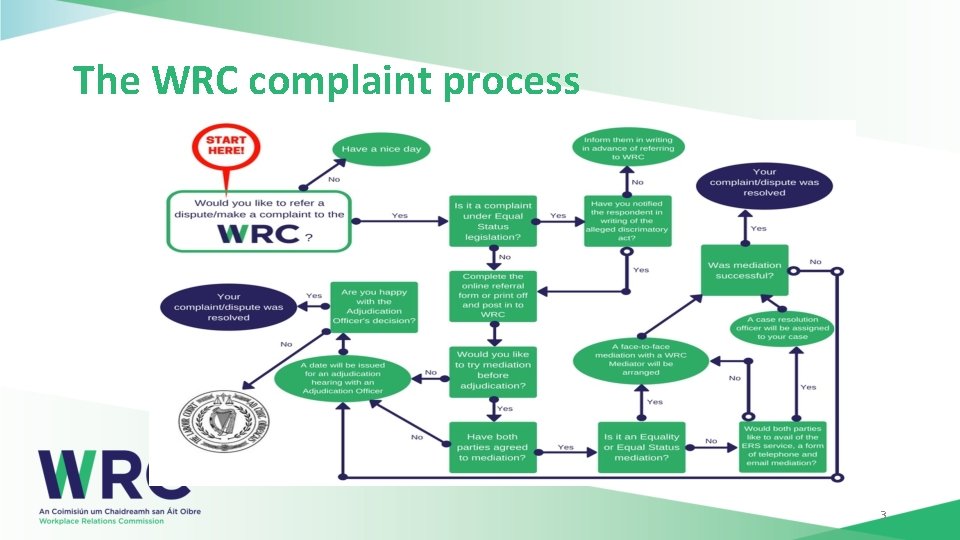
The WRC complaint process 3
Our Role • The Adjudication Service investigates disputes, grievances and claims that individuals or small groups of workers make under employment and equality legislation. Examples of the most common type of complaints include pay issues under the Payment of Wages Act; working time, annual leave and breaks issues under the Organisation of Working Time Act; dismissals or constructive dismissal under the Unfair Dismissal Acts and Discrimination/Equality issues under the Employment Equality Acts and the Equal Status Acts and industrial relation issues under the Industrial Relations Acts. 4
MEDIATIONS 5
‘Pre-Adjudication’ Mediation • Telephone (1, 241 in 2018) or face-to-face (603 in 2018) • Early intervention -v- just prior to adjudication • By agreement of both parties • Confidential • Voluntary • High resolution success (64% in 2018) 6
PRE-HEARING – Mediation • Complaint comes in and the Respondent notified by the WRC • Complainant ticks Mediation or case may be selected for Mediation • Less formal requirements than adjudication. • Arrangements are made and parties informed. • Flexibility in the arrangements to suit the parties. 7
Mediation – The key cornerstones • Opportunity for the parties to participate in the resolution • Clear focus on removing the complaint from adjudication system by agreement • Voluntary process and confidential process • Agreements reached are legally enforceable • It’s less costly, less stressful and parties own and influence agreements reached 8
Mediation • Agreement • If an agreement is reached at mediation the parties will set out the terms of the agreement and sign up to them. • That agreement is legally enforceable in the courts, thereafter. • The WRC complaint file is closed. Success. • No Agreement • If agreement is not reached the case will revert back for Adjudication and nothing discussed at the mediation will be allowed to be disclosed. • Neither party will be penalised for failure (in attempting to reach a settlement). 9
Adjudication 10
PRE-HEARING - Adjudication • Complaint comes in and the Respondent is notified by the WRC • Mediation – Complaint remains unresolved • Adjudication • Formal arrangement - Submissions are often required in advance. • Hearing scheduled. • Postponements are only granted in exceptional circumstances. 11
Adjudication Hearing • The Adjudication Officer’s role is to hold a hearing and manage that hearing, where both parties are given a fair opportunity to present their case and any evidence relevant to the complaint, including any witnesses or documentation. • Hearings are held in private. No recording of the proceedings are permitted. • Parties may be accompanied and represented -a trade union official, a practicing barrister or practicing solicitor or any other person, if the Adjudication Officer so permits. • Although its not a Court of law, it will follow the normal Court procedures gathering evidence, it will allow for cross examination of witnesses and the making of legal statements. 12
Adjudication – Hearing Day • It is a formal hearing of the Complaint. • The Adjudication Officer will consider any preliminary issues (legal points) and then the substantive claim(s). • Both parties will, in turn, be asked to give a concise outline of their position in relation to the claim(s) made (the type of case will determine which side starts first). • The Adjudicator will take direct evidence from both parties and all other witnesses. 13
Adjudication • The party, or their representative, will be given the opportunity to question the Comp. / Resp. and other witnesses regarding the evidence they have given. • Both parties are given the opportunity to present a summing up of the case, including submission of legal points and introduction of relevant case law. • The Adjudicator may allow further information to be submitted after the hearing. • Final Decision/Recommendation will issue. (6+ weeks) 14
Post Hearing – Decisions • The Adjudication Officer will then decide the matter and give a written decision in relation to the complaint. The decision will be communicated to both parties and published on the WRC website. • It will declare whether the complaint was or was not well-founded. • If well founded, it may require the employer/service provider to comply with the relevant provision(s) of the legislation. • Require the employer/service provider to make such redress as is just and equitable in the circumstances including an award of compensation. • A party to a complaint may appeal a decision/recommendation to the Labour Court or Circuit Court for decision under the Equal Status Acts. • The redress that may be granted by an Adjudication Officer in a case is set down in the individual Statute. 15
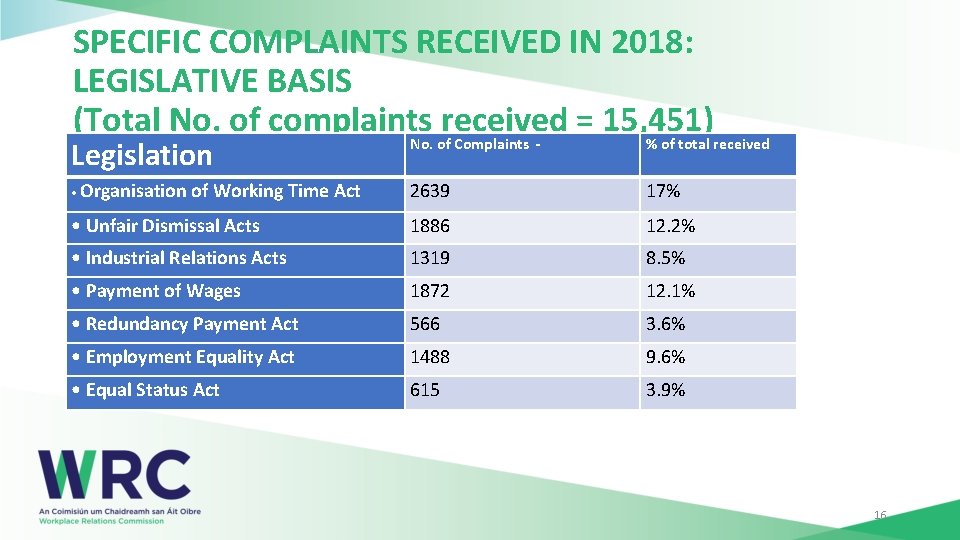
SPECIFIC COMPLAINTS RECEIVED IN 2018: LEGISLATIVE BASIS (Total No. of complaints received = 15, 451) No. of Complaints - % of total received 2639 17% • Unfair Dismissal Acts 1886 12. 2% • Industrial Relations Acts 1319 8. 5% • Payment of Wages 1872 12. 1% • Redundancy Payment Act 566 3. 6% • Employment Equality Act 1488 9. 6% • Equal Status Act 615 3. 9% Legislation • Organisation of Working Time Act 16
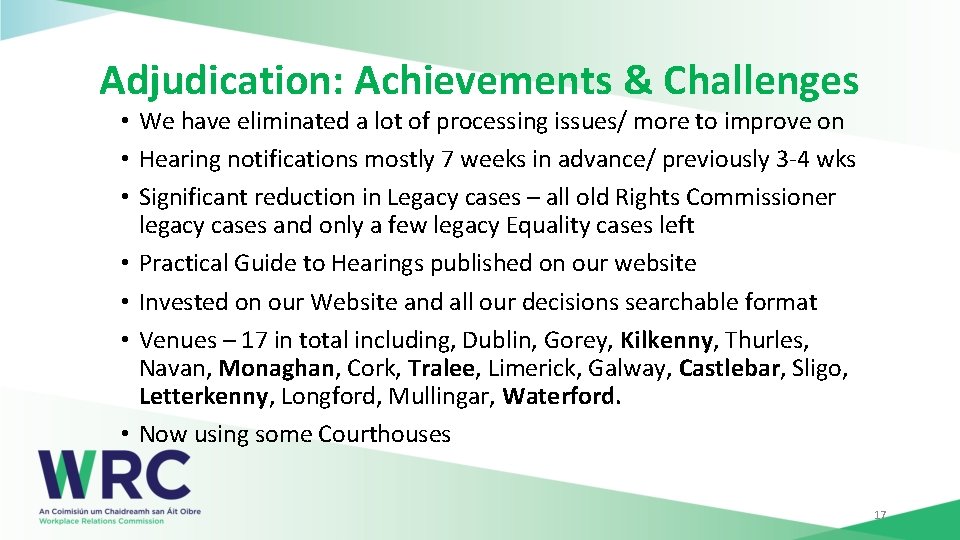
Adjudication: Achievements & Challenges • We have eliminated a lot of processing issues/ more to improve on • Hearing notifications mostly 7 weeks in advance/ previously 3 -4 wks • Significant reduction in Legacy cases – all old Rights Commissioner legacy cases and only a few legacy Equality cases left • Practical Guide to Hearings published on our website • Invested on our Website and all our decisions searchable format • Venues – 17 in total including, Dublin, Gorey, Kilkenny, Thurles, Navan, Monaghan, Cork, Tralee, Limerick, Galway, Castlebar, Sligo, Letterkenny, Longford, Mullingar, Waterford. • Now using some Courthouses 17
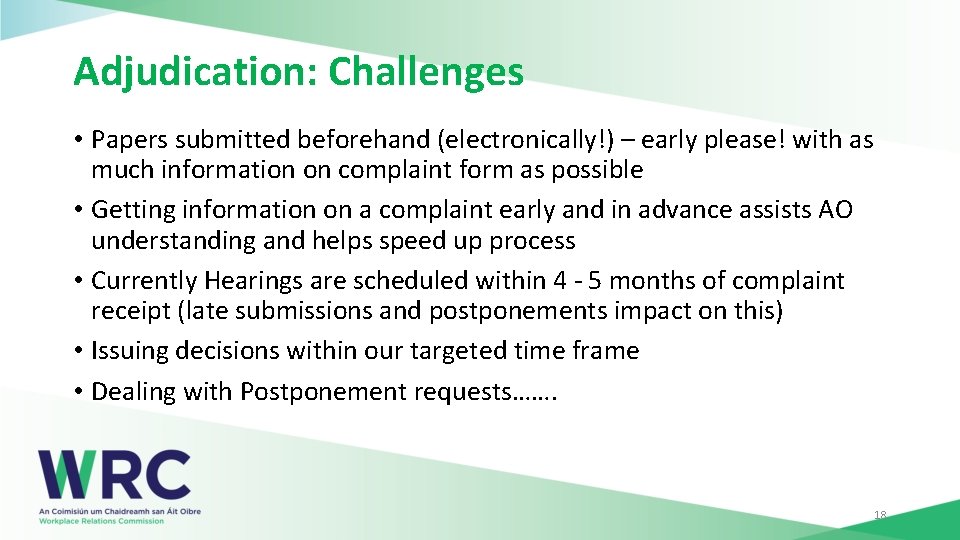
Adjudication: Challenges • Papers submitted beforehand (electronically!) – early please! with as much information on complaint form as possible • Getting information on a complaint early and in advance assists AO understanding and helps speed up process • Currently Hearings are scheduled within 4 - 5 months of complaint receipt (late submissions and postponements impact on this) • Issuing decisions within our targeted time frame • Dealing with Postponement requests……. 18
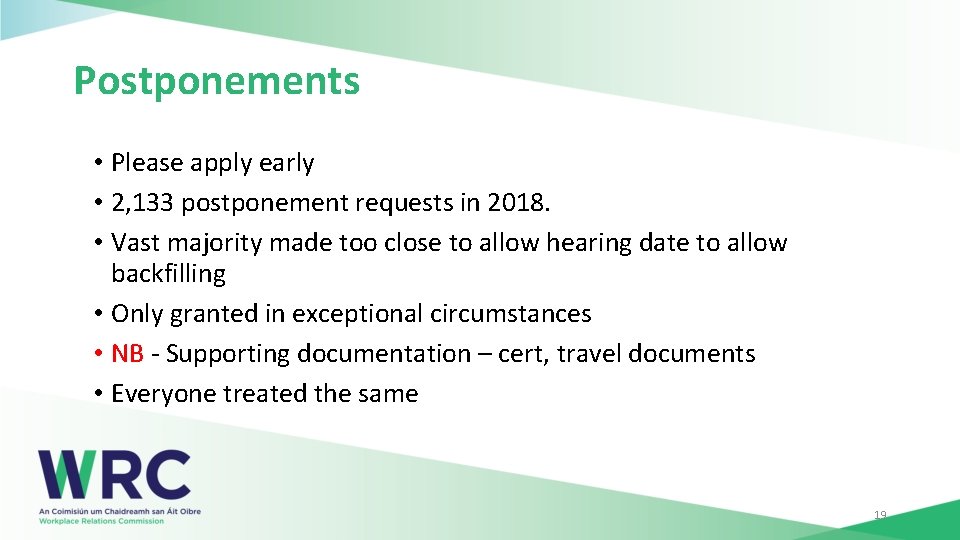
Postponements • Please apply early • 2, 133 postponement requests in 2018. • Vast majority made too close to allow hearing date to allow backfilling • Only granted in exceptional circumstances • NB - Supporting documentation – cert, travel documents • Everyone treated the same 19
Improving our service, the challenge goes on! • 15, 451 Specific Complaints (7, 724 Complaint Applications) (2018) • (16, 469 – Jan to Sept 2019 already) • 5, 312 Hearings held in 2018 - 22% increase in the number of Hearings held in 2017 • 75% of hearings have been scheduled within 5 months of complaint receipt. (2018) • Hearing notifications now are mostly sent to the parties 7 weeks in advance of the hearing. • 17 hearings locations across the country (Accessibility) • 2, 964 decisions/recommendations issued in 2018 (+32% on 2017) 20
Thank You 1890 80 80 90 Sligo Regional Services of the Workplace Relations Commission